Light Red Wines: Which to Pick If You Usually Drink White

By the Sommy Team — AI-assisted, human-edited.
Updated Nov 3, 2026
Contents (11)
- Which Light Red Wine Should You Pick, in One Paragraph?
- The Light Red Wine List, Grape by Grape
- What Makes a Red Wine Light?
- Is Pinot Noir a Light Red Wine?
- Why Is Beaujolais So Easy to Drink?
- Which Italian, Austrian and French Light Reds Should You Know?
- Are Merlot, Zinfandel and Grenache Light Reds?
- Are Light Red Wines Sweet?
- How Cold Should You Serve a Light Red?
- What Food Goes With Light Red Wine?
- Your First Light Red Tonight
TL;DR
Light red wines are reds with little tannin and modest weight: Poulsard, Lambrusco, Schiava, Gamay, Zweigelt, Frappato, Pinot Noir and Cinsault. Thin skins and gentle winemaking keep the drying grip low. Serve them cool, from about 9 °C for Lambrusco to 18 °C for Pinot Noir, and start with Gamay from Beaujolais.
A light red wine is a red with little tannin and modest weight, and tannin, more than colour, decides whether someone who drinks white enjoys the glass. The grapes on this list all have thin skins or are made gently, so they taste fresh and juicy and can be served cool from the fridge.
Which Light Red Wine Should You Pick, in One Paragraph?
Start with Gamay from Beaujolais or a Pinot Noir, served cool. Both are low in tannin (the drying grip on your gums), the part of red wine most white wine drinkers react to first. Poulsard, Schiava and dry Lambrusco are lighter still, and Frappato, Zweigelt and Cinsault sit between them and Pinot. Every light red goes into the fridge before you pour. If you want one bottle that suits most first-time red drinkers, buy a Beaujolais-Villages. If the shop has none, buy a Pinot Noir labelled Bourgogne.
The Light Red Wine List, Grape by Grape
The table runs from the gentlest wine to the firmest. Tannin levels are Sommy's reading of Wine Folly's tasting notes; serving ranges are Wine Folly's, converted to Celsius.
| Grape | Label words to look for | Tannin | Serve at | Pick it if |
|---|---|---|---|---|
| Poulsard | Jura, Arbois, Ploussard | Little to none | 9–12 °C | You want the palest, most delicate red |
| Lambrusco | Lambrusco secco, Sorbara | Low, slight bitter edge | 9–12 °C | You like fizz and serve salami or pizza |
| Schiava | Vernatsch, Trollinger, Santa Maddalena | Low, clean | 13–16 °C | You drink crisp Pinot Grigio |
| Gamay | Beaujolais, Beaujolais-Villages, cru names | Low | 12–15 °C | You want one safe first red |
| Zweigelt | Austria, Zweigelt | Low, crunchy | 12–15 °C | You like tart cherry and a purple colour |
| Frappato | Sicily, Vittoria | Light, easy | 15–18 °C | You like strawberry and a peppery lift |
| Pinot Noir | Burgundy, Bourgogne, Pinot Noir | Low | 15–18 °C | You drink oaked Chardonnay |
| Cinsault | Languedoc, Cinsault | Soft | 17–19 °C | You want a light red that stays at cool room temperature |
If you drink crisp, unoaked whites such as Sauvignon Blanc or Pinot Grigio, start with Schiava or Gamay at the cold end of their range. If you drink oaked Chardonnay, start with Pinot Noir: it has more weight and often sees barrels too. If the bottle will go to a picnic, pick Lambrusco or Poulsard, the two that take the deepest chill.

Quick check
One question on what you just read
What matters most for whether a red feels light to someone who usually drinks white?
Tap an answer to see how you did.
What Makes a Red Wine Light?
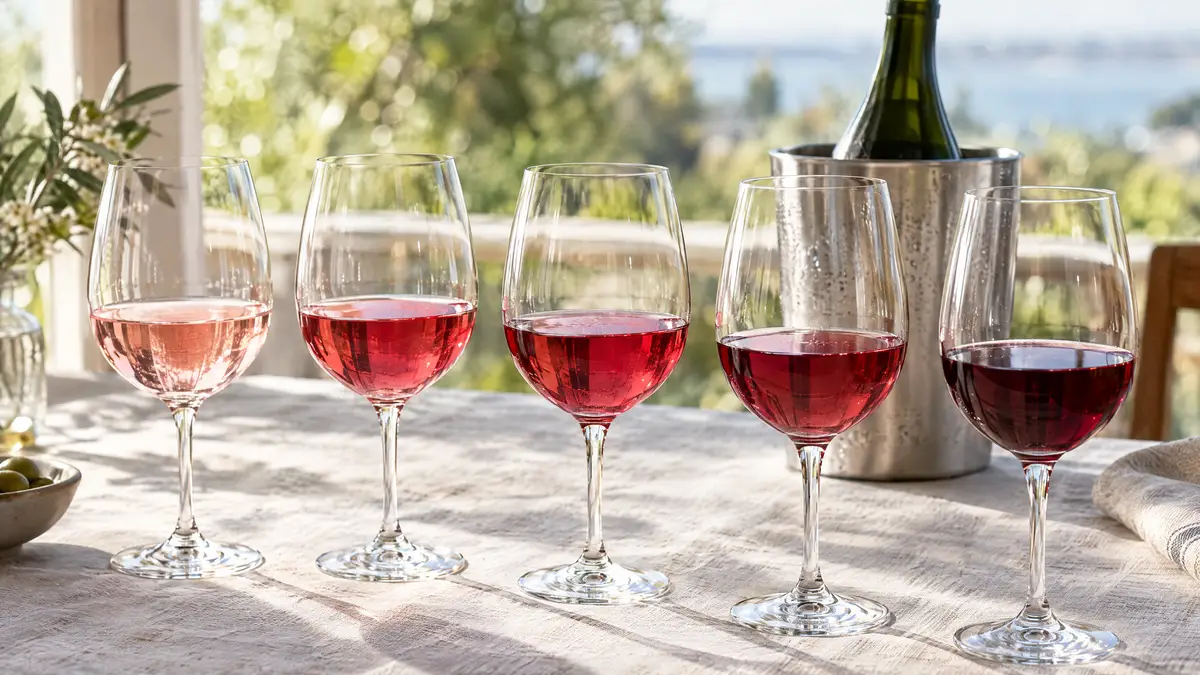
Thin skins and gentle winemaking, which leave little tannin behind. Red grape juice is clear. Colour and tannin both come from the skins, so a grape with thin skins gives a paler wine with less grip. Wine Folly's list of light reds shares one trait: they "tend to have lower tannins."
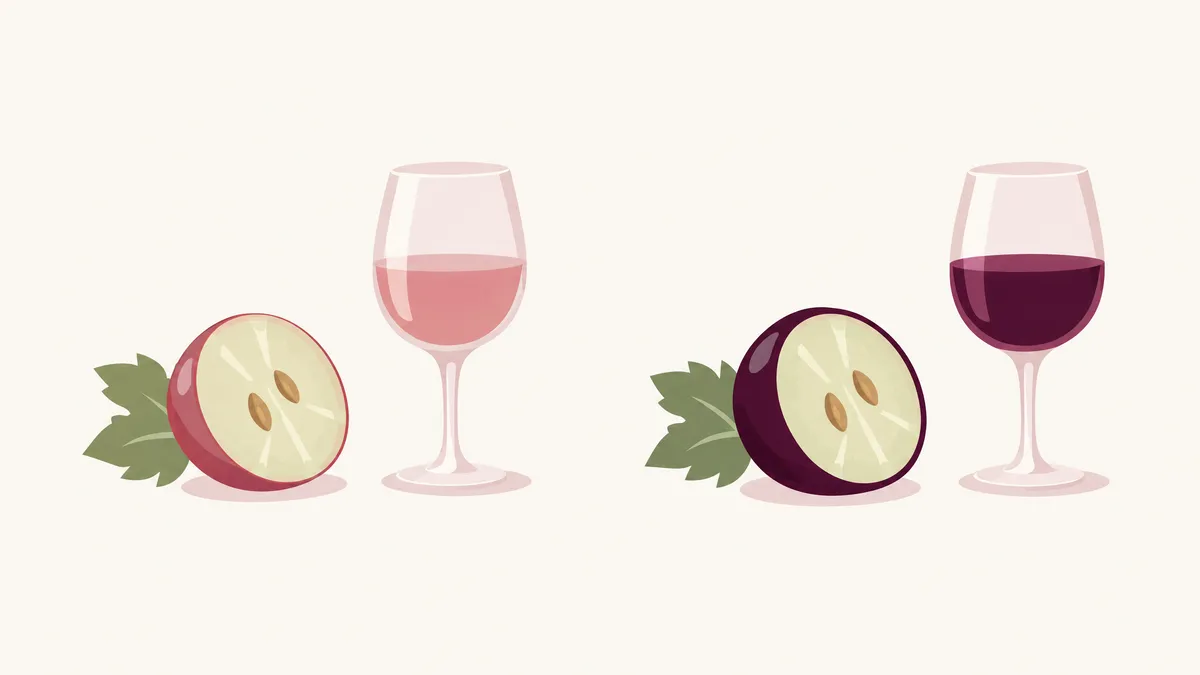
Body (how heavy the wine feels in your mouth) is the second dial, and it is set mostly by alcohol and ripeness. Sommy's guide to what wine body is covers it in full, and understanding tannins, acidity and body shows how the three work together.
Colour is a third dial, and it can mislead. Nebbiolo, the grape of Barolo, is pale in the glass, but it is not light: Wine Folly calls it "among the most tannic red wines in the world." A pale red can still dry your mouth like strong tea. Judge a red by its grape and its label, then by the feel on your gums.
Winemaking moves the dials too. Short skin contact, cool fermentation and no new oak all keep a red lighter. Some light reds are made from whole grapes that ferment inside their own skins, which keeps tannin even lower; Beaujolais, below, is the best known. How red wine is made shows each step where extra tannin gets in.
Is Pinot Noir a Light Red Wine?
Mostly yes. Wikipedia describes Pinot Noir as "producing mostly lightly colored, medium-bodied and low-tannin wines." It is one of the fuller grapes on this list and the one most white wine drinkers already know, which makes it a good second red after Gamay.
The reason is the skin. Pinot Noir has a thin one, so it gives little colour and tannin to the wine. The same thin skin makes the grape fussy to grow: "Its thin skin makes it susceptible to bunch rot and similar fungal diseases."
Its home is Burgundy, above all the Côte-d'Or, where labels name the village rather than the grape. A bottle that says Bourgogne Rouge is made mainly from Pinot Noir. Warmer places make riper, slightly fuller versions, and the Pinot Noir guide maps them. Cabernet Sauvignon vs Pinot Noir puts the lightest and one of the firmest classic reds side by side.
If you find Pinot Noir too light, move to a cru Beaujolais or Zweigelt. If you find it too heavy, go back up the table to Schiava.
Why Is Beaujolais So Easy to Drink?
Because it is nearly all Gamay, and much of it is made in a way that keeps tannin very low. Gamay accounts for "nearly 98% of all plantings" in Beaujolais, so the region name on a label is, in practice, the grape name. Gamay also grows in the Loire Valley around Tours.
The method is carbonic maceration (fermenting whole, uncrushed grapes in a tank filled with carbon dioxide). Fermentation starts inside each berry before the grapes are pressed, so little tannin leaves the skins. Wikipedia describes the result as "fruity with very low tannins." The method also softens acidity and keeps the fresh fruit of a young wine.
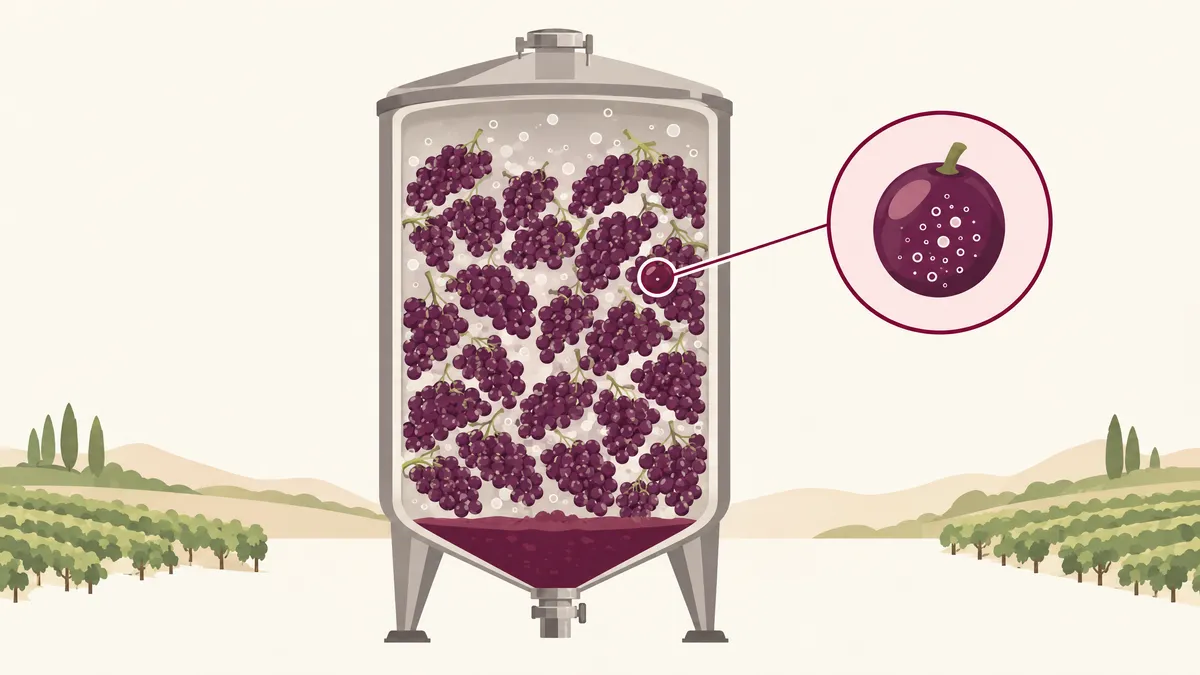
Gamay smells of cherry, herbs and, in Wine Folly's words, "sometimes banana," a note that comes from this whole-grape fermentation. Sommy's page on carbonic maceration walks through the method step by step.
Beaujolais comes in three levels of weight:
- Beaujolais Nouveau is the lightest, released on the third Thursday of November, weeks after harvest. See Beaujolais Nouveau explained.
- Beaujolais and Beaujolais-Villages are the everyday bottles, still light and juicy.
- The 10 crus are villages whose names, such as Fleurie or Morgon, appear on the label instead of "Beaujolais." They differ in character, and the firmer ones taste closer to Pinot Noir. The cru Beaujolais guide ranks them.
If the label says Nouveau, drink it within months. If it names a cru, it is the fuller step up. The Gamay guide and the Beaujolais wine guide cover the grape and the region in depth.
Which Italian, Austrian and French Light Reds Should You Know?
Six names cover most shelves beyond Beaujolais and Burgundy: Frappato and Lambrusco from Italy, Schiava from the Alps, Zweigelt from Austria, and Poulsard and Cinsault from France. Each is made mostly as a young, low-tannin red, and each hides behind a place name or a local synonym on the label.
Italy and the Alps
- Frappato is planted primarily in Sicily. Wine Folly notes "dried strawberries and red pepper flake with light, easy tannins." It is also blended with Nero d'Avola in Cerasuolo di Vittoria, Sicily's only DOCG (Italy's top tier of protected wine names). The Sicily wine guide places it.
- Schiava has grown in Trentino-Alto Adige since at least the 13th century. It is called Vernatsch in South Tyrol and Trollinger in Germany, so look for all three names. Santa Maddalena, from the hills east of Bolzano, is its best-known wine. See the Schiava guide and the Alto Adige guide.
- Lambrusco is "typically a little bubbly," with strawberry to blueberry fruit and a slight bitterness. The Lambrusco guide explains its grape family.
Austria and France
- Zweigelt is widely planted in Austria. It is purple in the glass, with fresh berry flavours and what Wine Folly calls "crunchy tannins." Read the Zweigelt guide.
- Poulsard from the Jura is "very delicate, with a very pale color" and little to no tannin. The Jura wine guide shows where it grows.
- Cinsault from southern France has soft tannins and smells of cherries and pink peppercorn. The Cinsault guide follows it to Lebanon and South Africa.
If a shop stocks only one of these, buy Schiava or Zweigelt: they are the easiest to find and the least likely to surprise you.
Are Merlot, Zinfandel and Grenache Light Reds?
Usually not. They are easy reds, which is a different thing. Ripe fruit and soft tannin make Merlot and Zinfandel feel gentle, but they carry more weight and alcohol than anything in the table. Sommy's serving temperature chart files Merlot with the medium reds, and Wine Folly serves Grenache at room temperature, 16 to 18 °C.
The difference shows up in a warm room: a ripe Zinfandel feels heavy and hot, while a Gamay stays fresh. Pinot Noir vs Merlot shows the gap in one side-by-side.
If you liked Merlot as your first red, try Pinot Noir next. If Merlot felt heavy, go straight to Gamay.
Are Light Red Wines Sweet?
Most are dry. Gamay, Pinot Noir, Schiava, Frappato, Zweigelt, Poulsard and Cinsault are almost always made dry (no sugar you can taste), even when they smell of ripe cherry. Fruity and sweet are not the same, as what dry wine means explains.
The exceptions are labelled. Lambrusco comes from secco (dry) to dolce (sweet), with amabile (semi-sweet) between them. Brachetto d'Acqui, a red from Piedmont that is usually sweet and often fizzy, is the other common one. If a Lambrusco label says secco, it is dry. If it says amabile or dolce, it is sweet. Sweet vs dry wine covers every sweetness level.
How Cold Should You Serve a Light Red?
Cooler than room temperature: about 9 to 12 °C for Lambrusco and Poulsard, 12 to 15 °C for Gamay and Zweigelt, and 15 to 18 °C for Pinot Noir and Frappato. The lower the tannin, the colder the wine can go.
Cold makes tannin feel firmer and more bitter, so a light red takes a chill that would make a Cabernet taste harsh.
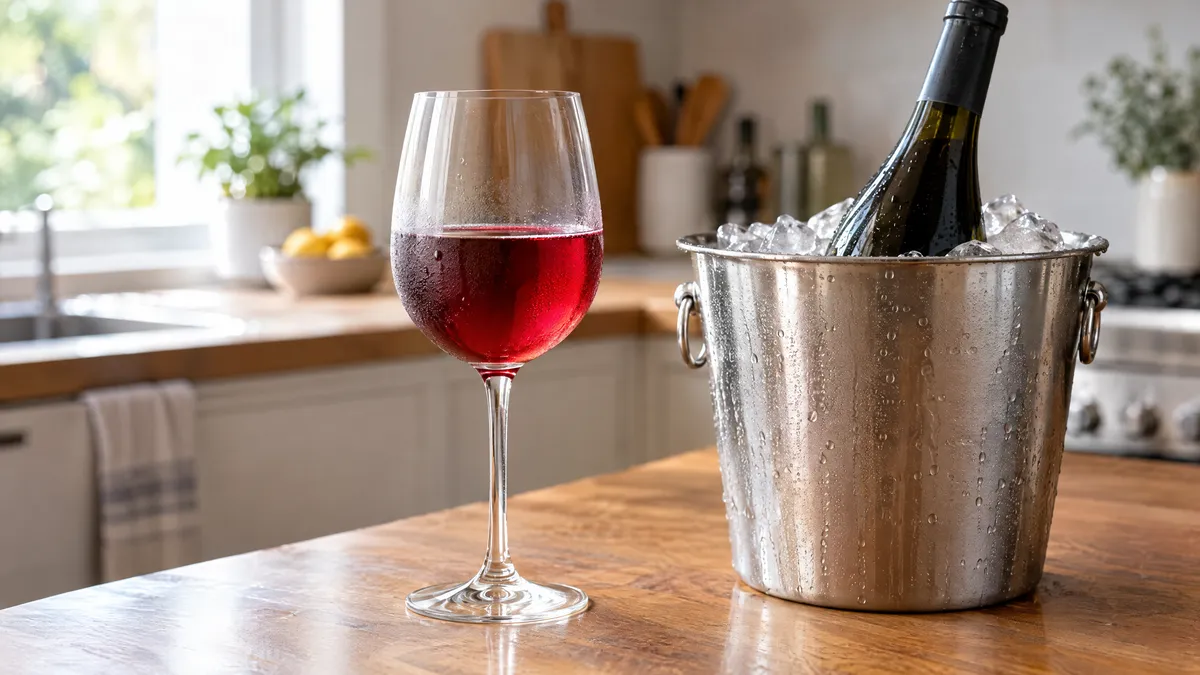
If the bottle has been sitting in a warm room, give it about 30 minutes in the fridge before you pour. If it comes out too cold and tastes of little, hold the glass in your hands for a few minutes. In a hurry, how to chill wine fast has an ice bucket method that takes 15 minutes. The wider rules for every style sit in how temperature affects wine taste.
What Food Goes With Light Red Wine?
Light reds go where a fuller white would: roast chicken, salmon, cured meats, mushrooms and pizza. Low tannin means the wine does not grip against delicate meat or fish. Fresh acidity cuts through fat and salt, the same job a crisp white does at the table.
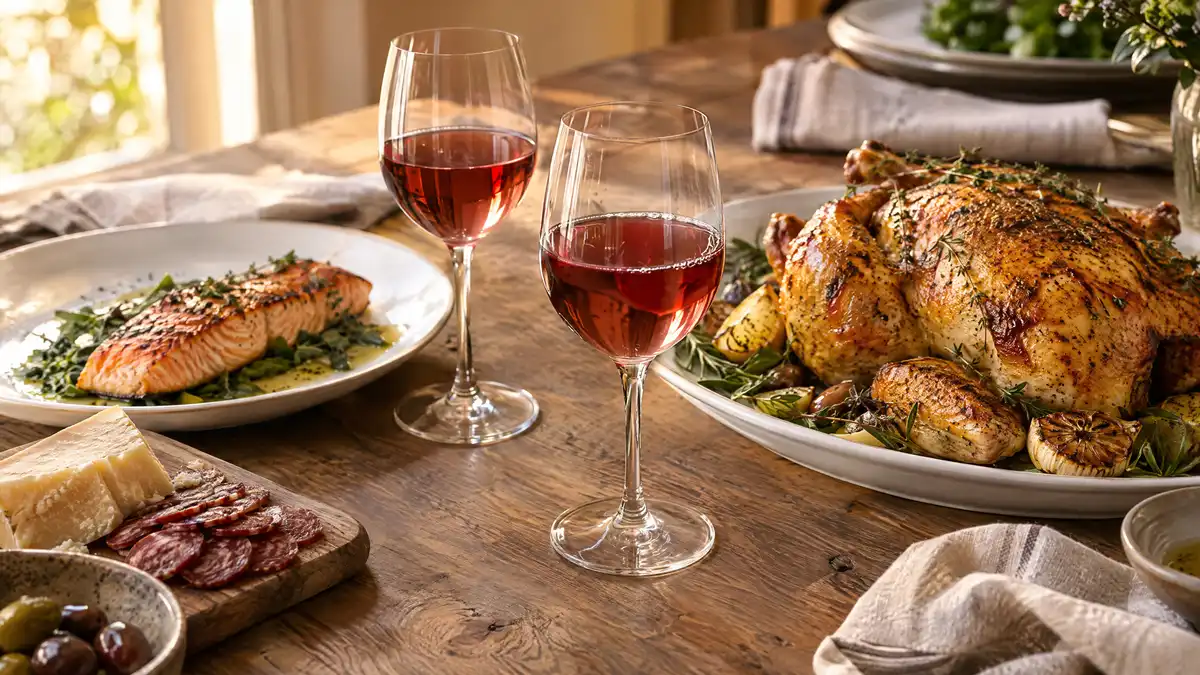
- Roast chicken and pork: Gamay. Crisp, salty skin and soft white meat need acidity more than tannin. More options are in wine with chicken.
- Salmon and tuna: Pinot Noir. Oily, firm fish has the weight to meet Pinot's extra body. Wine with salmon shows when a white still wins.
- Salami, ham and aged cheese: dry Lambrusco. The bubbles and acidity clean fat from your mouth between bites.
- Mushroom dishes: Pinot Noir or a cru Beaujolais, whose earthy notes echo the mushrooms.
- Pizza and tomato pasta: Frappato or Schiava, whose acidity keeps up with the tomato.
If the dish is light and white, pick the lightest red on the table. If it has char from a grill, pick Pinot Noir or a cru Beaujolais.
Your First Light Red Tonight
Tasting reds side by side is the fastest way to learn where each sits on the tannin dial. Sommy, a wine-education app at sommy.wine, has bite-sized courses including Wine 101 and a France course. Its AI-guided tasting mode walks through look, smell and taste and saves the notes to a tasting journal. More light and fizzy styles sit in the wine styles hub.
Tonight, buy a Beaujolais-Villages, give it 30 minutes in the fridge, and pour it next to the white you usually drink. Taste the white first, then the red, and feel your gums after each.
Sources
Frequently Asked Questions
What is the lightest red wine?
Poulsard from the Jura in eastern France is among the palest and gentlest reds you can buy. Wine Folly describes it as very pale with little to no tannin. Lambrusco and Schiava sit close to it. All three taste best served cool, and Poulsard and Lambrusco can go as cold as 9 to 12 °C.
What red wine tastes closest to white wine?
Low-tannin reds served cool come closest: Schiava from Alto Adige, Poulsard from the Jura, Gamay from Beaujolais and dry Lambrusco. Each has little of the drying grip that most red wine has, so the glass feels fresh rather than rough. Chill the bottle for about 30 minutes, and the gap between it and a white narrows further.
Is Merlot a light red wine?
No. Merlot is a medium-bodied red with more tannin and weight than Pinot Noir or Gamay. It is often recommended to white wine drinkers because it tastes soft and ripe, but soft is not the same as light. If you want a truly light red, buy Gamay, Pinot Noir, Schiava or Frappato instead.
Should you chill light red wine?
Yes. Light reds taste fresher below room temperature. Wine Folly suggests 9 to 12 °C for Lambrusco and Poulsard, 12 to 15 °C for Gamay and Zweigelt, and 15 to 18 °C for Pinot Noir and Frappato. A bottle from a warm room needs about 30 minutes in the fridge. Low tannin is what lets these reds take the chill.
Is Beaujolais a light or heavy red?
Light. Beaujolais is almost all Gamay, and much of it is made by carbonic maceration, which ferments whole grapes and gives fruity wine with very low tannin. Beaujolais Nouveau is the lightest version. The ten cru villages make fuller Gamay, but even the firmest of them is lighter than most Merlot or Cabernet.
Are light red wines sweet?
Most are dry. Gamay, Pinot Noir, Schiava, Frappato, Zweigelt and Cinsault are almost always made dry, even when they smell of ripe cherry. The sweet exceptions are Lambrusco labelled amabile or dolce and Brachetto d'Acqui. If a Lambrusco label says secco, it is dry.
What food goes with light red wine?
Light reds go where a fuller white would: roast chicken, salmon, tuna, mushroom dishes, cured meats and pizza. Their low tannin lets them sit beside fish and poultry without overpowering them. Choose Pinot Noir for oily fish, Gamay for chicken and pork, and dry Lambrusco for salami, ham and aged cheese.
Sommy Team
LinkedInFounder & Wine Educator
The Sommy Team is building the world's most approachable wine education app, helping beginners develop real tasting skills through structured courses and AI-guided practice.