Carbonic Maceration Wine Explained: Fruity, Low-Tannin Reds

By the Sommy Team — AI-assisted, human-edited.
Updated Sep 25, 2026
Contents (9)
- What Is Carbonic Maceration Wine, in One Paragraph?
- How Does a Grape Ferment Inside Its Own Skin?
- Carbonic vs Semi-Carbonic Maceration: What Is the Difference?
- What Does Carbonic Maceration Wine Taste Like?
- How Should You Serve and Pair a Carbonic Red?
- Which Grapes and Regions Use Carbonic Maceration?
- Can Carbonic Maceration Wines Age?
- Why Is Beaujolais Nouveau Released on One Day?
- How Can You Taste Carbonic Maceration Tonight?
TL;DR
Carbonic maceration seals whole, uncrushed grapes in carbon dioxide so fermentation starts inside each berry. The wines are fruity, soft in acidity and very low in tannin. Most Beaujolais uses the semi-carbonic version. Serve these reds cool, around 13°C, drink Nouveau young, and expect more structure from a cru.
A red made by carbonic maceration tastes juicy and soft because the grapes start fermenting whole, inside their own skins, before anything crushes them. That single change in the cellar explains the low grip, the crushed-strawberry smell and the banana note people notice in young Beaujolais. Carbonic maceration wine is almost always red, and Beaujolais is where most of it comes from.
What Is Carbonic Maceration Wine, in One Paragraph?
Carbonic maceration wine is red wine made by sealing whole, uncrushed grape clusters in a tank full of carbon dioxide so fermentation starts inside each berry. Carbonic maceration (from the carbon dioxide and the soaking of skins in juice) keeps the skins intact at first, so they give up little tannin. After days rather than weeks, the grapes are pressed and yeast finishes turning sugar into alcohol. The result is fruity, soft and very low in tannin, ready to drink within weeks. Gamay in Beaujolais is the classic example, and Beaujolais Nouveau can travel from vine to bottle in under six weeks.
How Does a Grape Ferment Inside Its Own Skin?
With no oxygen around it, a whole grape switches to fermenting its own sugar, using its own enzymes rather than yeast. Winemakers call this intracellular fermentation: the carbon dioxide seeps through the skin and sets off the change inside each intact berry. A small amount of sugar becomes alcohol before any yeast gets involved.
In ordinary red winemaking, the grapes are crushed first. Yeast then ferments the juice while it soaks with the broken skins, and the skins release colour and tannin (the drying grip you feel on your gums). Carbonic maceration reverses the order. The berries stay whole, so the skins release far less tannin during the first days.
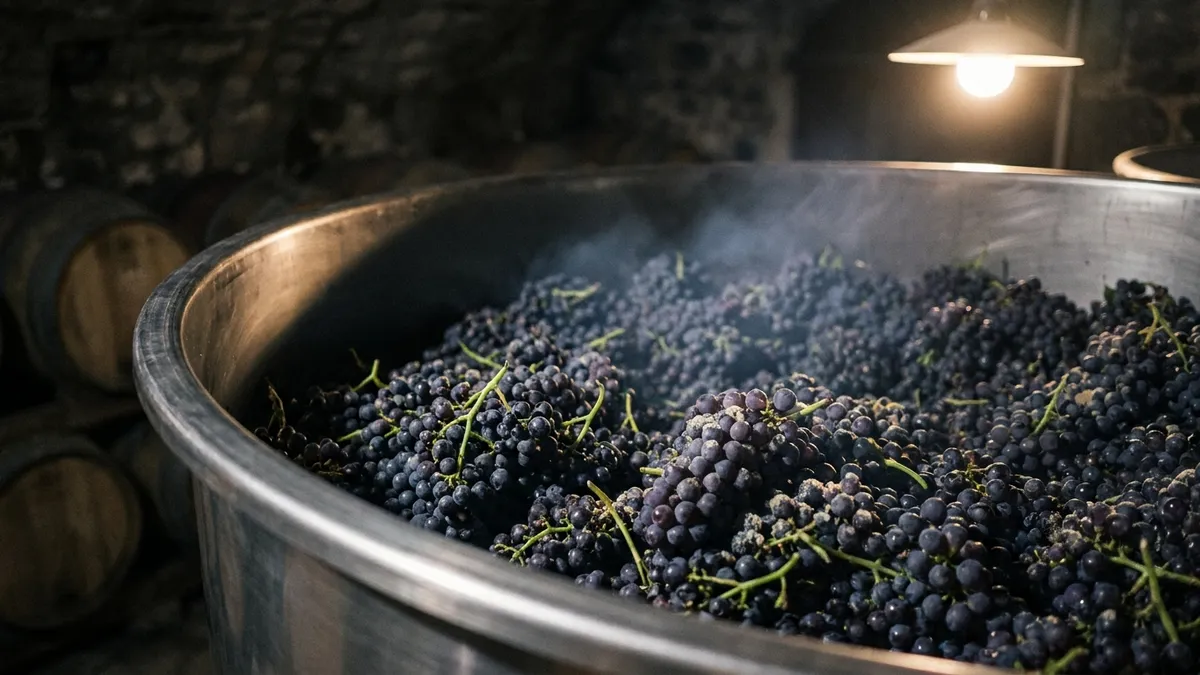
Gravity makes the process messier than the textbook picture. Grapes at the bottom of the vessel are crushed by the weight of the bunches above them, and that juice ferments in the conventional way, with yeast. So even a carbonic tank holds two fermentations at once: one inside the intact berries on top, one in the pool of juice below.
When the winemaker judges the fruit character is right, the grapes are pressed. The berries burst, the sweet juice mixes with the fermenting liquid, and yeast carries on until the wine is dry.
The link between air and flavour was spotted early. Louis Pasteur found that grapes held in oxygen before crushing gave wines with different flavours from grapes held in carbon dioxide.
Carbonic vs Semi-Carbonic Maceration: What Is the Difference?
Full carbonic fills the tank with carbon dioxide before it is sealed; semi-carbonic lets the crushed bottom layer make that gas itself. Most Beaujolais is semi-carbonic, not full carbonic, though the two names often get swapped. Semi-carbonic maceration is a short carbonic period followed by a conventional yeast fermentation, and it is the method behind Beaujolais Nouveau.
In Beaujolais, whole clusters go into cement or stainless-steel tanks holding between 4,000 and 30,000 litres. The juice from the crushed bottom layer starts fermenting with yeast, gives off carbon dioxide, and that gas settles over the intact bunches above. The winemaker then decides how long the grapes stay in the vat before pressing, and that choice moves the wine from featherweight to firm.
Labels almost never say which method was used. The wine's weight gives it away: a pale, purple-edged red with almost no grip leans carbonic, while a darker Beaujolais with a firm finish spent longer on its skins.
| Method | What happens in the tank | Tannin and colour | Where you meet it | Look for on the shelf |
|---|---|---|---|---|
| Full carbonic | Tank filled with carbon dioxide and sealed; whole berries ferment inside their skins | Lowest tannin, bright purple-ruby | Some Carignan for blending in southern France, some Valdiguié sold as Nouveau in California | Very light red, often labelled carbonic or Nouveau; chill it |
| Semi-carbonic | Crushed bottom layer ferments with yeast and makes the gas for the whole bunches above | Low to medium tannin, ruby | Most Beaujolais, from Nouveau to the ten crus | Beaujolais, Beaujolais-Villages or a cru village name |
| Conventional red | Grapes crushed first; yeast ferments juice with broken skins | Medium to high tannin, deeper colour | Most red wine made anywhere | A grape or region known for grip, such as Cabernet or Syrah |
The two methods feed straight into how yeast drives fermentation, since the yeast stage is what finishes both wines.
What Does Carbonic Maceration Wine Taste Like?
Carbonic reds taste low in tannin, soft in acidity and loud with fresh fruit. Start with structure. Rub your tongue along your gums after a sip: a carbonic red leaves them almost wet, where a young Cabernet leaves them dry. The resulting wine is fruity with very low tannins, which is why it feels juicy rather than gripping.
The method also rounds off acidity (the tartness that makes your mouth water). In Gamay, carbonic maceration softens that acidity and brings out the smell of bright crushed strawberries and raspberries. The fruit should smell freshly squashed, like a strawberry pressed with a fork, and never stewed or jammy.
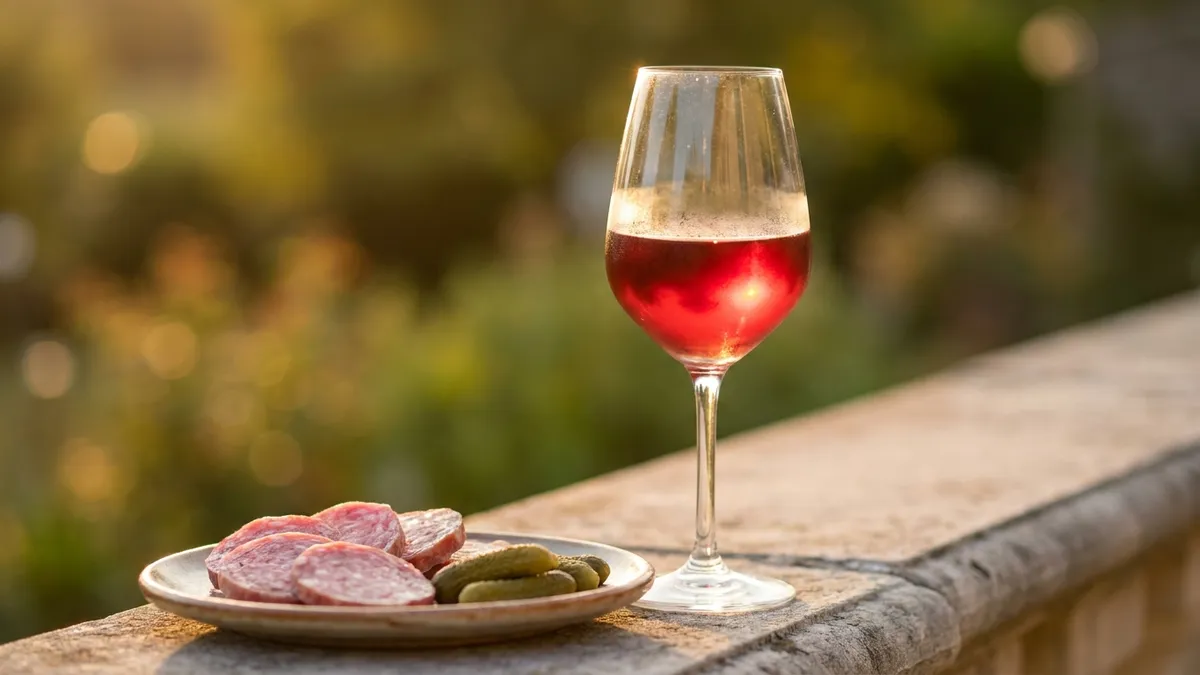
Then comes the banana. Young carbonic wines are rich in esters (fruity-smelling compounds made during fermentation). In Beaujolais Nouveau they are described as banana, grape, fig and pear drop. The effect is loudest in a wine bottled within weeks of harvest, before those aromas have time to fade.
A strong banana smell is a style marker in these wines. If a red smells of pear drops and fresh strawberry and barely grips your gums, carbonic or semi-carbonic maceration is the likely reason. Our guide to primary, secondary and tertiary aromas shows where these fermentation smells sit among the rest, and what tannins are explains the grip that carbonic wines lack.
How Should You Serve and Pair a Carbonic Red?
Serve a carbonic red cool, around 13°C, and pair it with food that a tannic red would fight. That temperature is what Beaujolais Nouveau is usually served at: colder than most reds, warmer than a white. The chill sharpens the fresh fruit and stops the alcohol from feeling warm.
If the bottle is Nouveau or a light Gamay at room temperature, give it 20 to 30 minutes in the fridge. If it is a cru with more grip, 10 to 15 minutes is enough. A white-wine glass works well here, because smaller pours stay cool while the rest waits in the fridge. For a faster fix, how to chill wine fast has the ice-bucket method, and the wine serving temperature chart places these reds next to every other style.
Low tannin is what makes these wines easy with food. Tannic reds often clash with oily fish and can taste metallic, so a salmon fillet or grilled sardines go better with a carbonic red than with a firm Cabernet. With chilli heat, choose a carbonic red around 12 to 13% alcohol, because heat makes alcohol burn and tannin feel harsher. With salty charcuterie, the fresh acidity cuts the fat. If the dish is heavy with char and fat, such as a ribeye, a cru with more grip holds up better than a Nouveau.
Which Grapes and Regions Use Carbonic Maceration?
Gamay in Beaujolais is the classic, but the method also turns up in Spain, the south of France and California. Gamay accounts for nearly 98% of all plantings in Beaujolais. Its ten crus (named villages with their own appellation) are Saint-Amour, Juliénas, Chénas, Moulin-à-Vent, Fleurie, Chiroubles, Morgon, Régnié, Brouilly and Côte de Brouilly.
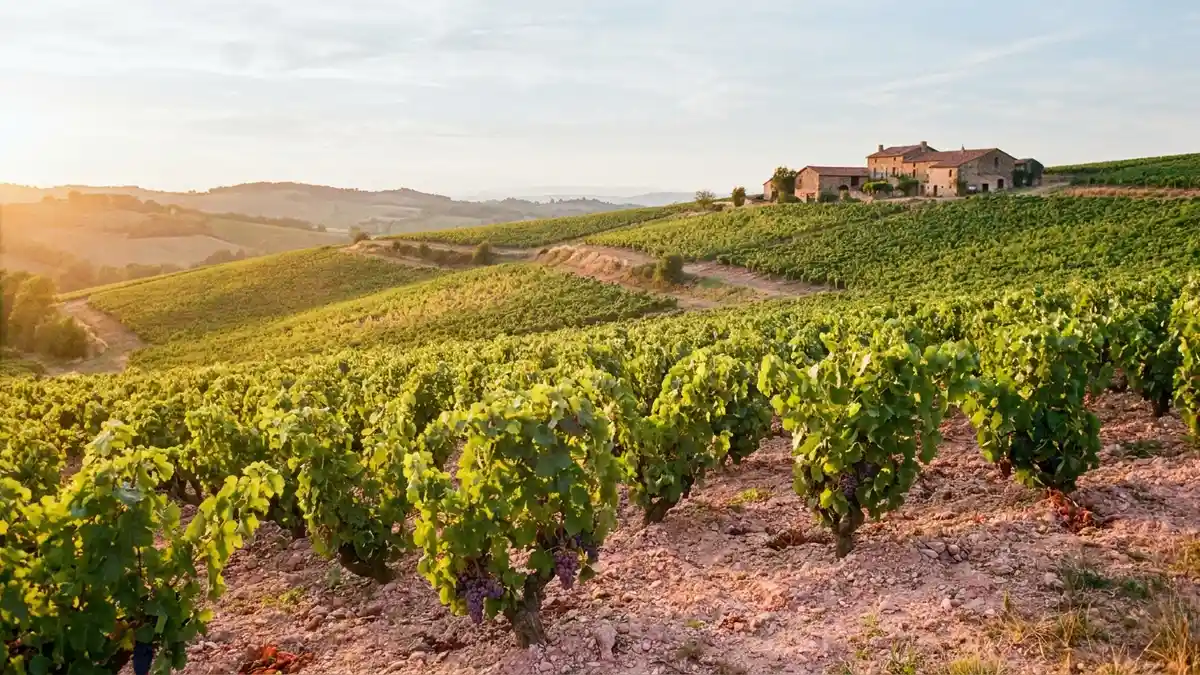
The grape needed the softening. In July 1395, Philip II, Duke of Burgundy, outlawed Gamay and called it full of "very great and horrible harshness". Carbonic maceration tames that sharp edge by softening the acidity and pushing the strawberry fruit forward.
Outside Beaujolais, producers use the method where they want fruit without grip:
- Rioja Alavesa and Jumilla, Spain: young reds made to drink early. See the Rioja guide and Jumilla guide.
- Languedoc and the Rhône: coarse, tannic grapes like Carignan, especially when they are to be blended. The Carignan guide covers the juicy modern style.
- California: Valdiguié, sometimes sold with the word Nouveau on the label.
- Gamay beyond Beaujolais: the grape also grows in the Loire around Tours, around Lake Geneva in Switzerland, in Canada and in Oregon's Willamette Valley, though not every producer there uses the method.
White grapes almost never get the treatment, because some flavour compounds it produces, from volatile phenols, taste unpleasant in white varieties. When buying, if a red label says Nouveau or carbonic, expect the lightest style; if it names a Beaujolais cru village, expect more structure.
Can Carbonic Maceration Wines Age?
Most should be drunk young, because the method extracts little tannin, and tannin is what carries a red through years in bottle. A wine made by carbonic maceration is ready to drink quickly but lacks the structure for long-term ageing. If it says Nouveau, drink it within months of release.
The drink-young rule belongs to Nouveau, not to the technique as a whole. The deciding factor is cuvaison (the time the grapes spend in the vat before pressing). For Beaujolais Nouveau, the rules cap cuvaison at 10 days. A cru producer can leave the grapes longer, so the skins give up more tannin and colour, and the wine gains firmer grip and a deeper ruby. Those cru wines handle a few years in bottle far better than a Nouveau does.
The cru wine explainer covers why village names signal a step up, and tasting young vs aged wine shows what changes in the glass as a red gets older.
Why Is Beaujolais Nouveau Released on One Day?
Because French law says so: Beaujolais Nouveau goes on sale at 00:01 on the third Thursday of November. The official Beaujolais wine board gives the same date. The speed is only possible because of carbonic methods: in extreme cases, the time between picking and bottling is under six weeks.
The date moved twice before it settled. The first release date was 15 December. In 1951 the rules relaxed and set 15 November. In 1985 the French appellation authority, the INAO, fixed the third Thursday so the release always lands on the same weekday.
The wine is no small side project. In 2024, 14.3 million bottles of Beaujolais Nouveau were sold worldwide, 9 million of them in France. That was 22% of the Beaujolais vineyards' total production. On the shelf in late November, the words Nouveau or Primeur tell you the wine is from this year's harvest and meant for drinking now.
How Can You Taste Carbonic Maceration Tonight?
Pour a carbonic red next to a conventional red of similar weight and compare the grip. A Beaujolais beside a young Pinot Noir works well, since both are light. Taste the Beaujolais first, then the Pinot, and rub your tongue on your gums after each.
For more on the grape itself, read the Gamay wine guide and the Beaujolais wine guide, or browse the other wine styles the same way. The Sommy app at sommy.wine has bite-sized courses, including Wine 101 and a French regional course, plus an AI-guided tasting mode. Pour a chilled Beaujolais and a chilled Pinot Noir side by side tonight, and check which one leaves your gums wet.
Sources
Frequently Asked Questions
What is carbonic maceration in wine?
Carbonic maceration is a red winemaking method in which whole, uncrushed grape clusters are sealed in a tank rich in carbon dioxide. Starved of oxygen, each berry begins fermenting its own sugar inside its skin. The grapes are pressed afterwards and yeast finishes the job. The result is a fruity red with very low tannin that is ready to drink quickly.
What is the difference between carbonic and semi-carbonic maceration?
In full carbonic maceration the tank is filled with carbon dioxide before it is sealed, so the whole bunches ferment mostly inside their berries. In semi-carbonic maceration the bottom layer is crushed by the weight above, its juice ferments with yeast, and that fermentation makes the carbon dioxide for the berries on top. Most Beaujolais is made the semi-carbonic way.
Why does Beaujolais Nouveau taste like banana?
Young carbonic and semi-carbonic reds are rich in esters, the fruity-smelling compounds made during fermentation. In Beaujolais Nouveau they are usually described as banana, grape, fig and pear drop. The effect is strongest in a wine bottled within weeks of harvest, before those aromas fade. Cru Beaujolais made with longer vat time usually smells more of cherry and raspberry than of banana.
Can carbonic maceration be used for white wine?
Almost never. The method is used for red grapes because some flavour compounds it produces, from volatile phenols, taste unpleasant in white varieties. That is why carbonic maceration is a red-wine technique. If you want a light, fruity white, a cool, stainless-steel fermentation is the usual route instead.
Should you chill carbonic maceration wines?
Yes, lightly. Beaujolais Nouveau is usually served at around 13°C, which is cooler than most reds and warmer than a white. Twenty to thirty minutes in the fridge brings a room-temperature bottle close. The chill sharpens the fresh fruit and keeps the alcohol from feeling warm. A cru from one of Beaujolais's ten named villages can be served a few degrees warmer.
How long does carbonic maceration take?
The carbonic phase itself is short, usually days rather than weeks. For Beaujolais Nouveau, the rules cap cuvaison, the time the grapes spend in the vat, at 10 days. In extreme cases the wine goes from picking to bottling in less than six weeks, which is why Nouveau can reach shops in November of the same year.
Sommy Team
LinkedInFounder & Wine Educator
The Sommy Team is building the world's most approachable wine education app, helping beginners develop real tasting skills through structured courses and AI-guided practice.