Primary, Secondary, and Tertiary Aromas in Wine Explained

By the Sommy Team — AI-assisted, human-edited.
Updated Apr 17, 2026
Contents (12)
TL;DR
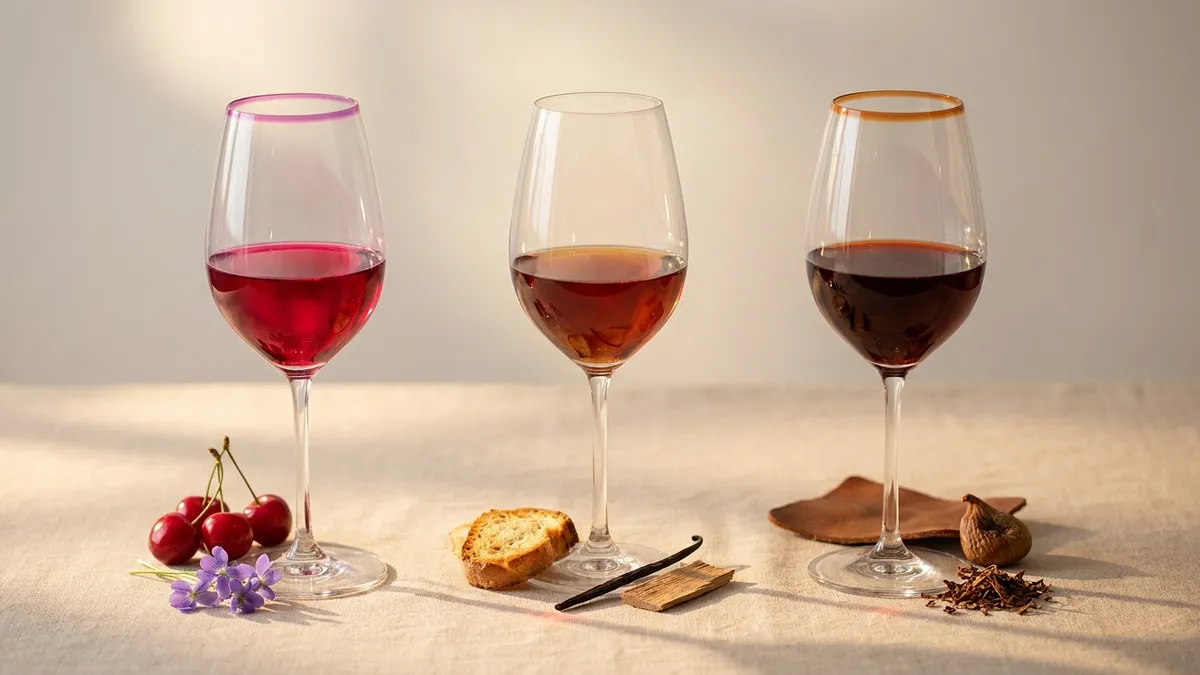
Every wine aroma comes from one of three stages. Primary aromas come from the grape — fruit, herbs, florals. Secondary aromas come from winemaking — yeast, oak, malolactic fermentation. Tertiary aromas come from aging — leather, tobacco, dried fruit, honey. Separating the three turns vague descriptors into a readable history of the bottle.
TLDR
Every aroma in a glass of wine comes from one of three stages. Primary aromas come from the grape itself — fruit, herbs, florals. Secondary aromas come from winemaking — yeast, oak, malolactic fermentation. Tertiary aromas come from aging — leather, tobacco, dried fruit, honey. Separating the three is the single most useful vocabulary shift a taster can make.
Why the Three-Part Framework Exists
A complex wine can produce thirty distinct aromas in a single glass. Without structure, naming them becomes guesswork. With structure, each aroma tells you something about the wine's history.
The framework of primary secondary tertiary aromas comes from academic enology and is now standard across WSET, the Court of Master Sommeliers, and most professional tasting curricula. The idea is simple: every smell in the glass traces back to one of three origin points — the grape, the fermentation, or the aging. If you can tag each aroma to its source, the wine starts to reveal its story.
A young New Zealand Sauvignon Blanc that smells loudly of gooseberry and passion fruit and freshly cut grass is almost pure primary. A Champagne with brioche and toasted nut notes is primary fruit plus prominent secondary yeast autolysis. A 20-year-old Bordeaux with leather, dried fig, and forest floor is primary fruit that has transformed into heavy tertiary character through long aging.
Learning to taste these three categories separately is how a collection of disconnected descriptors becomes a readable wine.
Primary Aromas: From the Grape
Primary aromas are the ones the grape itself contributes. They are present at harvest and survive fermentation in some form. If you imagine smelling a bowl of the raw grapes, the aromas that come through clearly are the grape's primary contribution.
Every grape variety has a signature primary aroma profile. Riesling smells of lime and green apple. Gewürztraminer smells of lychee and rose. Cabernet Sauvignon smells of blackcurrant and green bell pepper. These are not accidents — specific aromatic compounds in the grape DNA produce them reliably, within the range a climate allows.
Primary aromas fall into loose sensory groups:
- Fruit — red fruit (cherry, raspberry, strawberry), black fruit (blackberry, blueberry, plum), citrus (lemon, lime, grapefruit), tropical (pineapple, mango, passion fruit), stone fruit (peach, apricot), orchard (apple, pear)
- Floral — violet, rose, orange blossom, honeysuckle, elderflower, jasmine
- Herbal — grass, mint, eucalyptus, dill, bell pepper, tomato leaf
- Spice — black pepper (notably Syrah), white pepper, anise (in some Grenache)
- Vegetal — asparagus, green bean, olive, jalapeño
Our wine aroma wheel guide groups these categories into a visual map that many tasters find easier than lists.
How to recognize primary aromas in a young wine
Young wines — within 1 to 3 years of harvest — are dominated by primary notes. A 2024 Marlborough Sauvignon Blanc you taste today is roughly 85 to 90 percent primary. The fruit is crisp, the florals are fresh, the herbals are sharp.
A good test: imagine the aroma in a farmers' market. If you can picture a pile of that exact fresh ingredient — fresh raspberries, fresh mint, fresh grapefruit — you are probably tasting a primary aroma.
Secondary Aromas: From Winemaking
Secondary aromas arise during fermentation and the immediate post-fermentation period. They are the fingerprint of the winemaker's choices, not the grape's.
The biggest producers of secondary aroma are:
- Yeast and lees aging — bread, brioche, pastry, toasted nuts (prominent in Champagne, Muscadet sur lie, many whites aged on lees)
- Malolactic fermentation — butter, cream, yogurt, hazelnut (very prominent in oaked Chardonnay and many reds)
- Oak — vanilla, coconut (American oak), clove, cedar (French oak), toast, smoke, bacon fat, coffee bean
- Carbonic maceration — banana, bubblegum, Juicy Fruit, kirsch (prominent in young Beaujolais Nouveau)
- Stem inclusion — green tea, forest undergrowth, pine, savory herbs
Secondary aromas are how the same grape from the same vineyard can produce drastically different bottles depending on how it was made. An unoaked Chardonnay smells of citrus and apple — primary. A heavily oaked Chardonnay with full malolactic conversion smells of vanilla, butter, and toast — secondary dominance riding on top of the primary fruit.
How to recognize secondary aromas
The test is whether the aroma existed in the grape before fermentation. Butter did not. Vanilla did not. Toast did not. Brioche absolutely did not. If the note sounds like something that came out of a bakery or a kitchen, it is almost always secondary.
A good exercise: taste two Chardonnays side by side — one unoaked Chablis, one oaked California. The differences are almost all secondary. The grape and the acidity are roughly the same. The wrapping is the winemaker's choice.
Tertiary Aromas: From Aging
Tertiary aromas develop slowly over years as the wine rests in bottle or barrel. They emerge when primary fruit softens, secondary wrapping integrates, and new compounds form through slow chemical reactions.
The classic tertiary notes include:
- Dried fruit — raisin, prune, fig, dried apricot, dried cranberry
- Cooked fruit — stewed plum, cherry compote, fruit leather
- Savory — leather, tobacco, dried herbs, forest floor, mushroom, truffle, game
- Nutty and oxidative — almond, walnut, caramel, nutty sherry notes (not always a fault in the right wine)
- Earthy — wet leaves, damp earth, petrichor, stony mineral
- Petrol in Riesling — from a specific molecule called TDN that develops with age
- Honey — ranges from clover honey to darker buckwheat depending on wine and age
Tertiary aromas are the mark of a wine that has matured. They tend to accompany softer tannin, resolved acidity, and a color shift toward garnet (reds) or gold (whites). Our what is wine vintage guide discusses how specific vintages develop these tertiary notes at different rates.
How to recognize tertiary aromas
The test is time. A 2023 wine tasted in 2026 is mostly primary and secondary. A 2003 wine tasted in 2026 is heavy tertiary. The aromas shift toward dried, cooked, and savory character. Fresh raspberry becomes stewed cranberry. Fresh green pepper becomes dried tobacco. Fresh oak vanilla becomes integrated sweet spice.
If you smell something that does not exist in a fresh fruit aisle — dried, leathery, earthy, mushroomy — you are almost certainly in tertiary territory.
Why Separating the Three Matters
A taster who cannot tell primary from tertiary can describe a wine's smell without understanding anything about it. A taster who can separate the three is doing something much more powerful: reading the wine's history from the glass.
Identifying age
A glass of Nebbiolo dominated by fresh cherry and rose is young. A glass of Nebbiolo dominated by dried cherry, leather, and tar is old. Same grape, same region — different ages. The aromatic profile is the diagnostic.
Identifying style
Two Chardonnays with the same primary fruit but very different secondary profiles (one oaky and buttery, one steely and taut) will never be confused for the same wine. The secondary signature is almost entirely winemaking choice.
Identifying quality
Top-tier wines tend to show all three layers simultaneously, in balance. Young fruit, well-integrated winemaking notes, early hints of tertiary. Lesser wines often show only one layer, or have one element overwhelming the others. A Sauternes that tastes only of oak and sugar is failing. One that shows honey, dried apricot, orange zest, vanilla, and waxy oxidation simultaneously is succeeding.
How Aromas Evolve in the Glass and the Bottle
An aroma is not static. Three timescales shift the balance between primary, secondary, and tertiary:
- Within an hour of opening — primary fruit softens slightly, secondary wrapping unwinds, tertiary notes become more prominent. Classic reason to decant.
- Within a day or two of opening — oxidation accelerates. Primary fades fastest. Secondary and tertiary hang on longer. Reds often taste better on day two; some whites do not.
- Over years of storage — slow chemical reactions convert primary compounds into tertiary compounds. This is the whole point of cellaring.
A taster who recognizes the shifts can decide when to drink a wine, when to decant, and when to wait. Our develop your wine palate guide has short exercises that practice these temporal shifts directly.
Common Confusion Points
Beginners frequently mix up the categories. Three recurring traps:
Mistaking oak-driven vanilla for primary sweetness
Heavily oaked wine can taste slightly sweet even when bone dry. The sweetness is from vanilla and toast — secondary, not primary fruit. A quick check: sniff. If the "sweetness" is nose-driven rather than tongue-driven, it is oak, and the wine is actually dry.
Calling dried fruit "primary because it is fruit"
Dried fruit is almost always tertiary. Fresh fruit is primary. The word "fruit" is not enough — the freshness matters. A raisin-dominated wine is an aged wine, not a fruit-dominated young wine.
Confusing petrol in Riesling with a fault
TDN petrol is tertiary. It develops over 5 to 15 years and is a hallmark of fine aged Riesling, not a defect. A young Mosel Riesling does not have it. A 10-year-old German Riesling should.
Treating reductive aromas as tertiary
Aromas of struck match, flint, or sulfur are neither primary nor tertiary — they are reductive, a winemaking choice that sits in the secondary category. Common in modern Burgundy whites and some natural wines.
A Tasting Exercise
If you want to train your ability to separate the three layers, do this across three sessions in a week:
- Session 1 — pure primary. Taste a young unoaked white (a Sancerre or a Chablis). Every aroma you find should be grape-driven. If you find oak, you chose the wrong bottle.
- Session 2 — primary plus secondary. Taste a young oaked Chardonnay or a young Champagne. Identify the fruit first, then the oak or brioche wrapping.
- Session 3 — full triptych. Taste an aged red — a 10 to 15-year-old Bordeaux, Chianti, or Rioja. Identify the primary fruit (likely dried), the secondary oak (likely integrated), and the tertiary character (leather, forest floor, earth).
Three short sessions and the framework starts to feel instinctive.
Sommelier note: Start your tasting from the oldest, most tertiary wine in the lineup, not the youngest. Tertiary notes are more delicate and get drowned out after fresh primary fruit.
The Sommy Approach
The Sommy app's tasting flow tags aromas by category as you select them, so every wine you log produces a breakdown of primary-secondary-tertiary percentages. Over time, the breakdown reveals patterns — the styles you reach for, the aromas your palate notices first, and the gaps in your library.
You can build the same system by hand with a color-coded notebook. The act of tagging is what matters; the tool is secondary.
FAQ
What is the easiest aroma category to identify?
Primary fruit, in a young wine. Fresh cherry, fresh lemon, fresh grass — these are the aromas most people can name immediately because they smell exactly like the real-world ingredient. Starting here builds confidence before tackling the harder categories.
Do all wines have tertiary aromas?
No. Wines drunk within 1 to 3 years of harvest are almost entirely primary and secondary. Tertiary aromas develop slowly over 5-plus years in the bottle, and some wines — light fresh whites and many everyday reds — are designed to be drunk young and never develop them.
How long does it take a wine to develop tertiary aromas?
It depends on the wine. A tannic age-worthy red like Barolo or Bordeaux can show first tertiary hints at 5 years and hit full tertiary character at 15 to 20. A light, fresh rosé will never develop them. The grape, structure, and storage conditions all matter.
Why does Riesling smell like petrol?
Aged Riesling develops a molecule called TDN (trimethyl-dihydronaphthalene) that smells unmistakably of petrol or kerosene. It is a tertiary note — a hallmark of mature Riesling, not a fault — and takes 5 to 15 years of bottle age to develop fully.
Can a wine have only secondary aromas?
No wine is purely secondary. Every wine starts with grape-derived primary compounds, even if they are subtle. A heavily oaked Chardonnay can be secondary-dominant in perception, but the primary apple and citrus are still there beneath the oak wrapping.
Are earth or mineral aromas primary or tertiary?
Mineral and earth notes are complicated. Some come from the grape and growing conditions (primary). Some develop during aging (tertiary). A young Chablis can smell of wet stone — that is primary. An aged Nebbiolo can smell of forest floor — that is tertiary. Context and age decide.
How do I remember which is which?
Use a three-word shortcut: grape, fermentation, age. Primary = grape. Secondary = fermentation (which includes oak, yeast, and malolactic). Tertiary = age. Every aroma traces back to one of the three verbs.
The Bottom Line
Every aroma in a glass of wine comes from the grape, from winemaking, or from aging. Primary, secondary, and tertiary are the three categories, and separating them turns vague descriptors into a readable history of the bottle. A month of tagging aromas by category — through a notebook, an app, or a structured class — locks the framework in.
Want a tasting flow that tags each aroma for you? Sommy's guided journal groups every aroma selection into primary, secondary, and tertiary buckets in real time, so the framework is built in instead of something you have to remember.
Frequently Asked Questions
What are primary, secondary, and tertiary aromas in wine?
They are the three origin categories for every smell in a wine glass. Primary aromas come directly from the grape and include fresh fruit, florals, and herbs. Secondary aromas come from fermentation choices like oak, yeast contact, and malolactic conversion. Tertiary aromas develop slowly over years of aging and include leather, dried fruit, tobacco, and forest floor.
How do I tell primary aromas from tertiary aromas?
Primary aromas smell like fresh ingredients you could pick up at a farmers' market — fresh cherry, fresh mint, fresh grapefruit. Tertiary aromas smell dried, cooked, or savory — raisin, leather, mushroom, tobacco. If you can picture the fresh version of the ingredient, it is primary. If it only exists as dried or aged, it is tertiary.
Do all wines develop tertiary aromas?
No. Wines drunk within one to three years of harvest are almost entirely primary and secondary. Tertiary aromas develop slowly over five-plus years of bottle aging, and many styles — light fresh whites, everyday reds, fresh rosés — are designed to be drunk young and never develop them at all.
Why does aged Riesling smell like petrol?
Aged Riesling develops a molecule called TDN, short for trimethyl-dihydronaphthalene, which smells unmistakably of petrol or kerosene. It is a tertiary note, a hallmark of mature Riesling rather than a fault, and it takes roughly five to fifteen years of bottle age to develop fully in the right conditions.
Are oak flavors primary or secondary?
Oak flavors like vanilla, coconut, clove, toast, smoke, and cedar are secondary. They come from the wood the wine contacts during fermentation or aging, not from the grape itself. American oak pushes vanilla and coconut; French oak leans toward clove and cedar. Toasted barrel levels add the smoky and coffee-bean notes.
Are mineral and earth aromas primary or tertiary?
Both, depending on the wine. Some mineral notes come from grape and growing conditions and show up in young wines as primary character — think the wet-stone note in young Chablis. Other earth notes like forest floor or truffle develop during long aging and are tertiary. Age and context decide which category applies.
What is the easiest way to remember the three categories?
Use a three-word shortcut: grape, fermentation, age. Primary equals grape. Secondary equals fermentation, which covers oak, yeast, and malolactic. Tertiary equals age. Every aroma in the glass traces back to one of those three verbs, and tagging each smell you notice by its source quickly becomes instinctive.
Sommy Team
LinkedInFounder & Wine Educator
The Sommy Team is building the world's most approachable wine education app, helping beginners develop real tasting skills through structured courses and AI-guided practice.