Beaujolais Wine Guide: Far More Than Nouveau

By the Sommy Team — AI-assisted, human-edited.
Updated Jun 17, 2026
Contents (10)
- What Is Beaujolais Wine?
- The One Grape That Defines Beaujolais
- Where Beaujolais Is: Granite, Hills, and Burgundy's Southern Edge
- Carbonic Maceration: The Method Behind the Juice
- The Beaujolais Wine Guide to the Quality Ladder
- The 10 Crus of Beaujolais
- Beaujolais Nouveau in Context
- What Makes Beaujolais Distinctive
- How a Beginner Should Start with Beaujolais
- Beaujolais Beyond Gamay's Reputation
TL;DR
Beaujolais sits just south of Burgundy and makes bright, low-tannin red wine from Gamay grown on granite. A signature method called carbonic maceration gives it juicy fruit. The quality ladder runs Beaujolais to Beaujolais-Villages to ten named Crus, and serious cru wines deserve a serious look.
What Is Beaujolais Wine?
This beaujolais wine guide begins by clearing up the region's biggest misunderstanding: Beaujolais is far more than the cheerful young wine released every November. Beaujolais is a French region just south of Burgundy that makes bright, low-tannin red wine almost entirely from one grape, Gamay, grown on pink granite soils. Its calling card is a winemaking trick called carbonic maceration, which fills the wine with juicy red fruit and keeps tannins soft. The quality climbs through three rungs — basic Beaujolais, Beaujolais-Villages, and ten named Crus like Morgon and Fleurie. Learn the grape, the granite, and the ladder, and you will find one of France's best-value and most food-friendly regions.
The One Grape That Defines Beaujolais
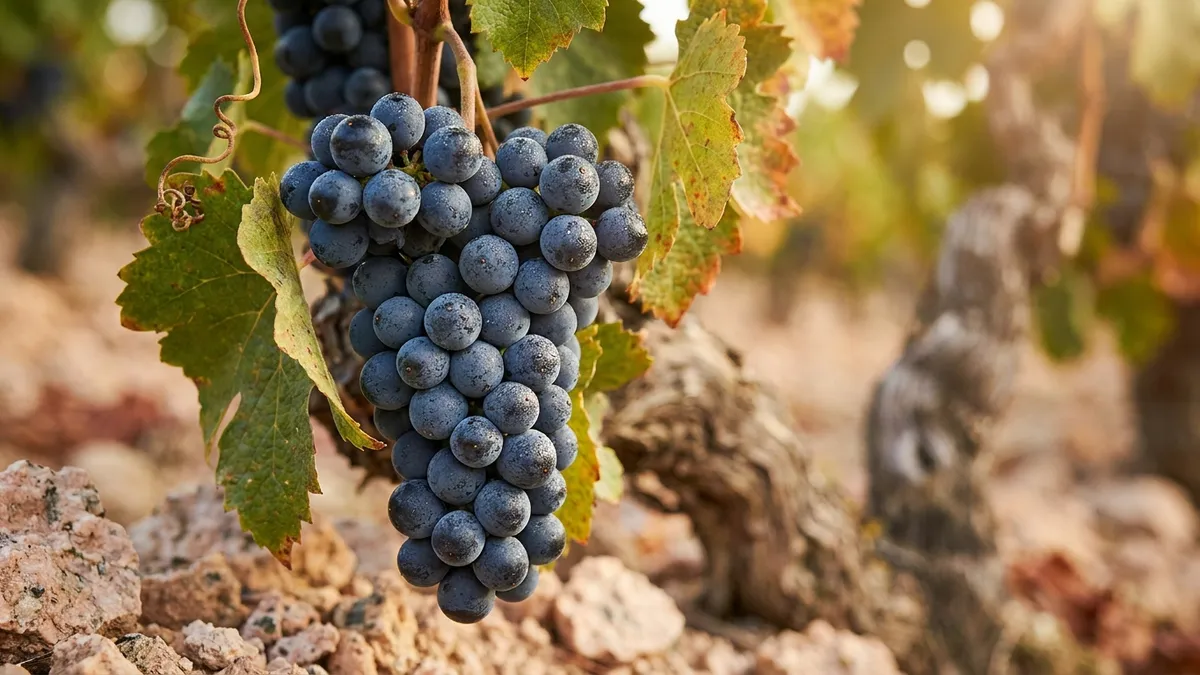
Beaujolais is a single-grape region. Nearly every bottle is Gamay — fully, Gamay Noir à Jus Blanc, meaning black-skinned grape with clear juice. It is a thin-skinned variety, and that thin skin matters: skins are where red wine gets its color and its tannins (the drying, gripping sensation you feel on your gums and the back of your teeth). Less skin means lighter color and gentler grip.
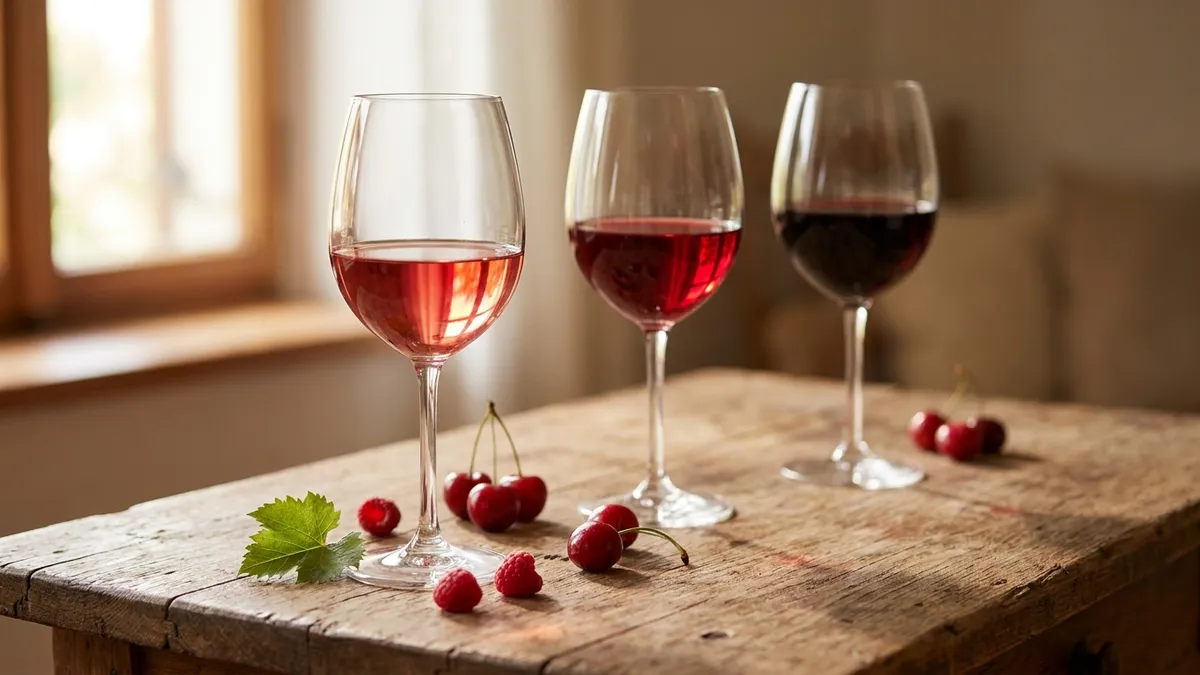
The result is a red wine that drinks easily. Gamay is light-to-medium bodied with vivid red-fruit flavor, high acidity, and soft tannins that almost never get in the way. Typical aromas: red cherry, raspberry, strawberry, violet, and a faint peppery or banana note from the winemaking. Body: light-to-medium (2-3/5) · Acidity: high (4/5) · Tannins: low (1-2/5). For the full picture of this grape beyond Beaujolais, our Gamay wine guide covers how it behaves and why it earns its juicy reputation.
A tiny amount of white Beaujolais exists, made from Chardonnay, but it is a rounding error. Red Gamay is the region. Because the skin is so thin, Gamay sits near the pale, gentle end of the red spectrum — the opposite of a thick-skinned grape like Cabernet Sauvignon. Our piece on thick versus thin-skinned grapes explains exactly why that skin difference shapes everything in the glass.
Where Beaujolais Is: Granite, Hills, and Burgundy's Southern Edge
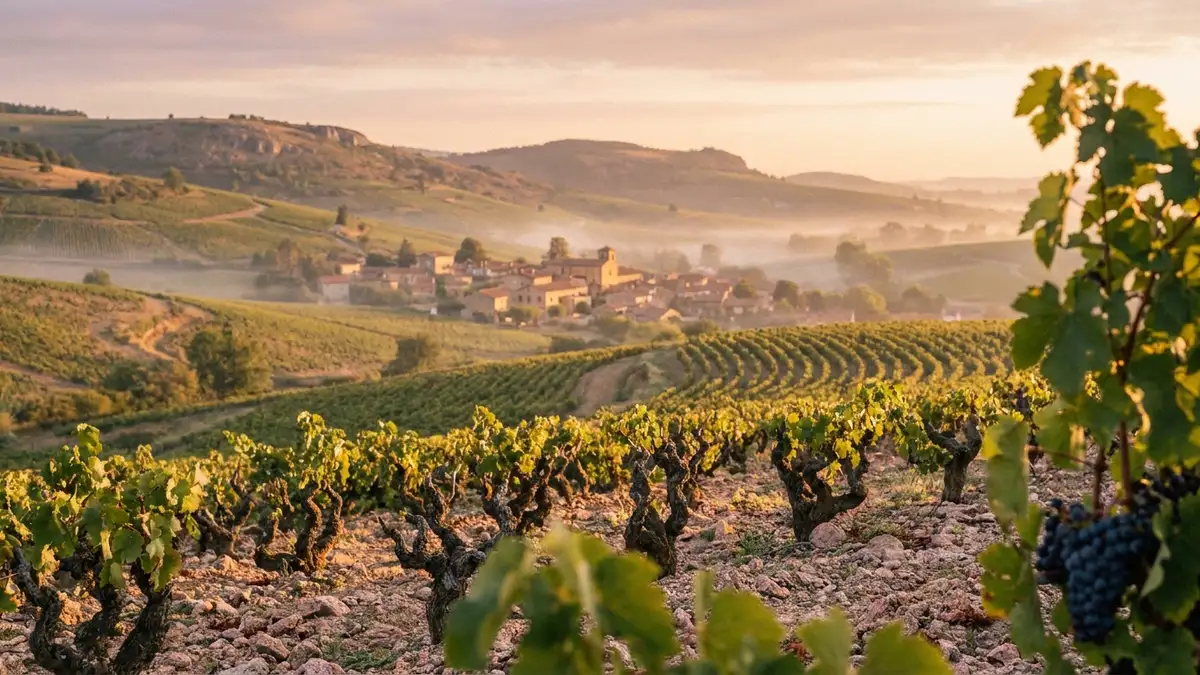
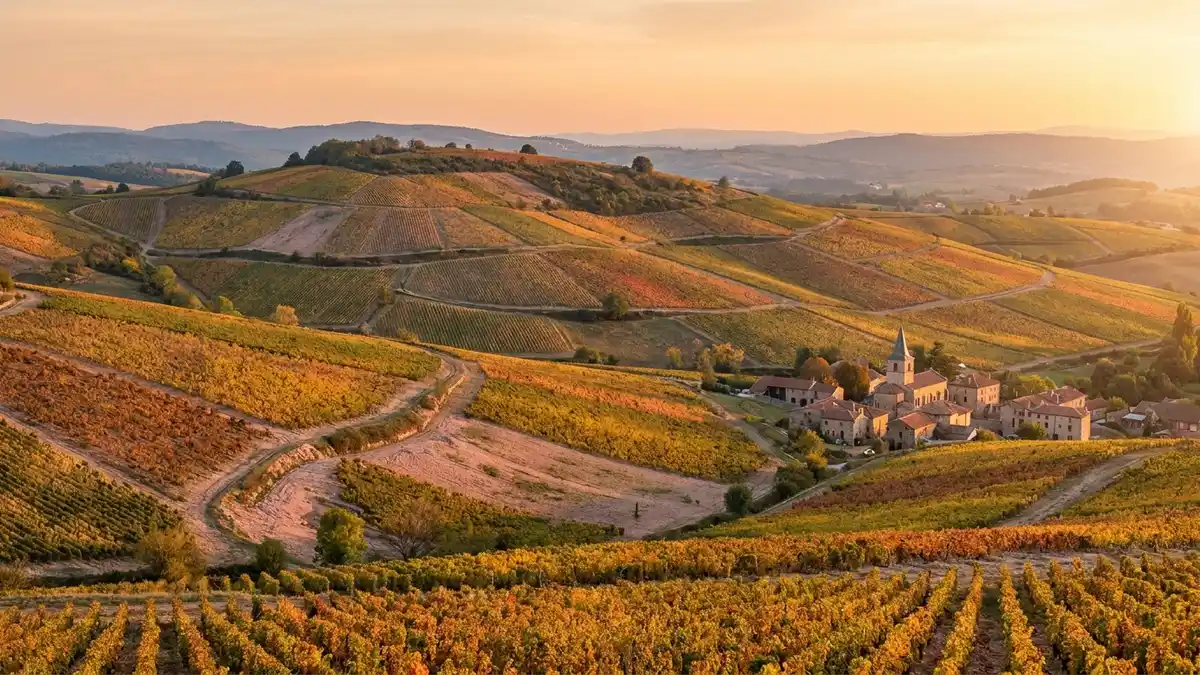
Beaujolais runs as a band of rolling hills in eastern France, just south of Burgundy and stretching down toward the city of Lyon. Administratively it is often tucked under the Burgundy umbrella, which is why the two get confused. In the glass they could hardly be more different.
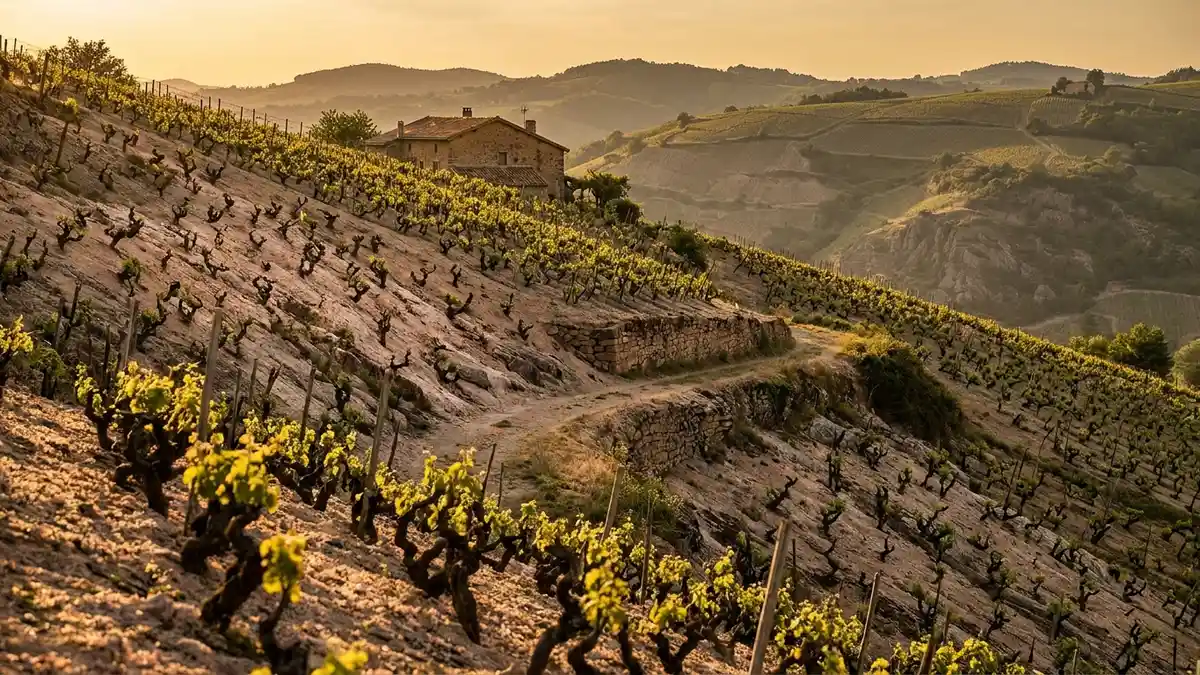
The split comes down to soil. Burgundy's prized slopes are limestone, ideal for Pinot Noir. The best of Beaujolais, especially in the north, is granite — ancient, weathered, mineral-rich rock that crumbles into sandy, free-draining soils. Gamay planted on these granite hills gains lift, freshness, and a fine, almost stony edge that flatland Gamay never reaches.
The climate is gently continental with a southern warmth: warm summers ripen the fruit, while cool nights and altitude on the slopes lock in the high acidity that makes the wines so refreshing. The northern half, home to the Crus, is hillier and rockier; the southern half is flatter, with more clay and sandstone, and makes the lighter everyday wines.
To see how Beaujolais fits among its neighbors — Burgundy above, the Rhône below — our overview of French wine regions places it on the wider map and shows why its southern, granite identity sets it apart.
Carbonic Maceration: The Method Behind the Juice
If one technique defines Beaujolais, it is carbonic maceration. Most red wine is made by crushing grapes and letting yeast ferment the juice. Carbonic maceration does the opposite: it seals whole, uncrushed grapes inside a tank flooded with carbon dioxide, so fermentation starts inside each intact berry before the skins are ever broken.
That intracellular fermentation is what gives Beaujolais its signature personality. It pulls bright, exuberant red-fruit flavor and soft, silky tannins out of the grape, and it can lend that telltale whiff of banana, bubblegum, or kirsch in the youngest, most fruit-forward styles.
In practice, most Beaujolais uses a partial version called semi-carbonic maceration. The grapes go into the tank whole, but the sheer weight of the bunches crushes the berries at the bottom, which begin a normal fermentation. The carbon dioxide that fermentation releases then fills the tank and triggers carbonic fermentation in the whole berries above. One tank, two processes, and a wine that is juicy yet still has real structure.
Carbonic maceration is why a young Beaujolais can taste like crushed fresh berries — the fruit ferments before it is ever bruised.
The serious Crus often lean less on full carbonic maceration and more toward conventional fermentation, which is precisely how they gain the grip and ageability that everyday Beaujolais lacks. Same grape, same region — the method is dialed up or down depending on the ambition of the wine.
The Beaujolais Wine Guide to the Quality Ladder
Every bottle of Beaujolais sits on a three-rung ladder, and knowing which rung you are on predicts both style and price. As with much of France, the more specific the place named on the label, the higher the quality. From broadest to most prized:
- Beaujolais: The base rung, covering the whole region but in practice drawn mostly from the flatter southern half. These are the lightest, fruitiest, most affordable wines — easy, gulpable reds for everyday drinking. The label simply reads "Beaujolais."
- Beaujolais-Villages: A step up, from a defined zone of around 38 villages in the hillier middle of the region with better soils. Fuller, more concentrated, and still excellent value, this is the smartest place for a beginner to meet the region's true character without spending much.
- The 10 Crus: The top rung — ten specific villages in the granite-rich north, each making structured, expressive wine sold under its own village name rather than the word "Beaujolais." These are the serious, sometimes ageworthy bottles that prove how good Gamay can be.
The pattern to remember: a label that says only "Beaujolais" is the base, "Beaujolais-Villages" is the middle, and a standalone village name — Morgon, Fleurie, and the rest — is a Cru at the top. The Sommy app's French wine course walks through real labels so you can place any bottle on this ladder at a glance.
The 10 Crus of Beaujolais
The Crus are where Beaujolais earns its place among France's fine wines. All ten cluster in the northern hills, sharing granite soils but each carrying its own personality. Here are the ten, grouped roughly from lighter to firmer in style:
- Brouilly: The largest Cru, ripe and rounded with juicy red and dark cherry fruit. Approachable and a friendly first Cru.
- Côte de Brouilly: Grown on the steep slopes of an extinct volcano above Brouilly. More mineral, concentrated, and structured than its larger neighbor.
- Régnié: The newest Cru, light and floral with red-berry charm — a gentle, early-drinking style.
- Chiroubles: The highest-altitude Cru, delicate, perfumed, and notably fresh thanks to its cool elevation. Often the most elegant and lightest.
- Fleurie: Aptly named, all floral lift and silky red fruit. Perfumed and graceful, frequently called the most charming Cru.
- Saint-Amour: The northernmost Cru, supple and aromatic, balancing soft fruit with a touch of spice.
- Régnié, Chiroubles, Fleurie, and Saint-Amour sit at the lighter, more aromatic end; the next four bring more weight.
- Juliénas: Firmer and spicier, with darker fruit and good structure that rewards a little patience.
- Chénas: The smallest and rarest Cru, sturdy and floral with an oak-woods character — its name comes from the oak forests it replaced.
- Morgon: Deep, dark, and structured, famous for an earthy, sometimes cherry-pit character locals call morgonné. Among the most ageworthy Crus, it can taste almost Burgundian with a few years.
- Moulin-à-Vent: The most powerful and longest-lived Cru, named for an old windmill. Iron-rich granite gives it firm tannins and real aging potential — the "king" of Beaujolais and the wine that most surprises Gamay skeptics.
For a beginner, three are the easiest gateways: Fleurie for floral charm, Morgon for depth, and Moulin-à-Vent for structure. Tasting those three side by side teaches the whole range of what Gamay on granite can do.
Beaujolais Nouveau in Context
No region carries a single product's reputation the way Beaujolais carries Beaujolais Nouveau. Nouveau is a young, fruity wine released on the third Thursday of November, just weeks after harvest, in a global marketing event built around the slogan that "the Nouveau has arrived." It is made for immediate drinking — primary, grapey, often with that banana-and-bubblegum lift from full carbonic maceration — and it is not meant to age a single day.
Nouveau is genuinely fun, and there is nothing wrong with it for what it is: a fresh, low-stakes celebration of the new vintage. The problem is reputation. For decades, oceans of cheap, dilute Nouveau taught the world to dismiss the entire region as thin and disposable.
That judgment is unfair to cru Beaujolais. A serious Morgon or Moulin-à-Vent shares almost nothing with a November Nouveau beyond the grape. Where Nouveau is fleeting, the Crus are structured, mineral, and built to develop over years. Judging Beaujolais by Nouveau is like judging an entire cuisine by its fast food.
What Makes Beaujolais Distinctive
Beyond the grape and the granite, a few traits set Beaujolais apart and make it one of the most useful regions for a learner to know.
Built for the Table
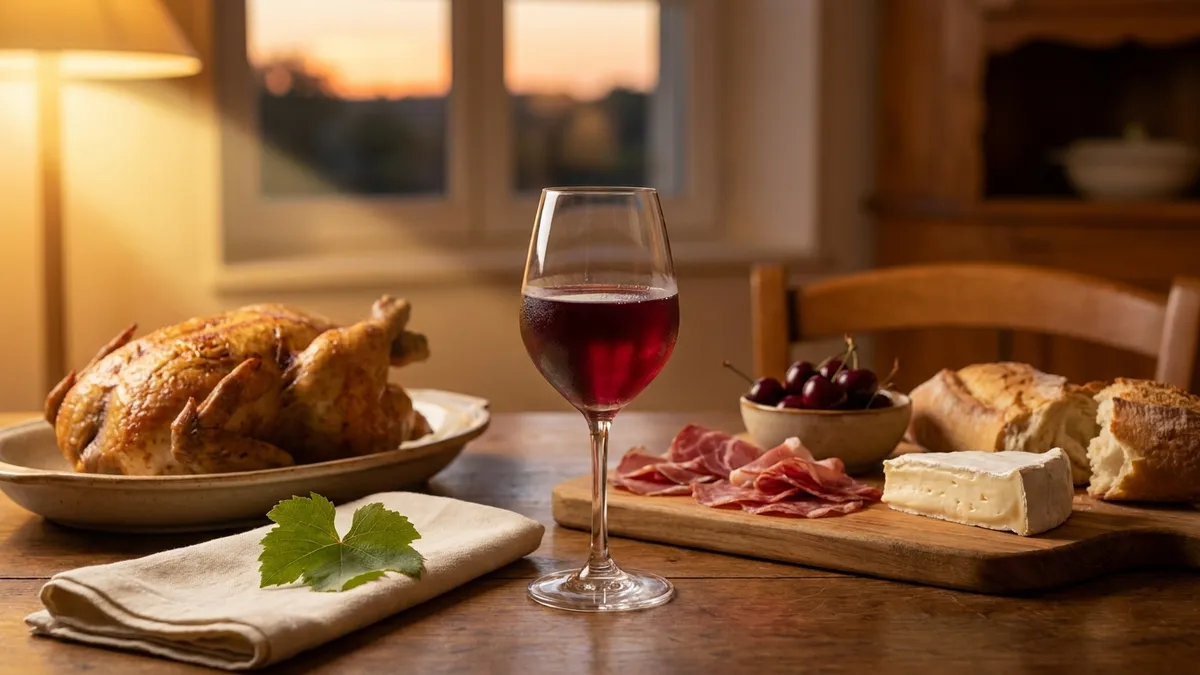
Beaujolais is arguably the most flexible food wine in France. Its high acidity, bright fruit, and low tannins mean it flatters almost anything: roast chicken, charcuterie, salmon, mushroom dishes, soft cheeses, even Thanksgiving turkey. Tannic reds fight rich, fatty, or delicate foods; Gamay's gentleness lets it slip alongside dishes that would bully a Cabernet. For a beginner building a single all-purpose red, few wines work harder.
Serve It Slightly Chilled
This is the practical tip that changes everything: serve Beaujolais slightly chilled, around 13 to 15 degrees Celsius — cooler than you would serve most reds. Twenty minutes in the fridge tightens the fruit, freshens the acidity, and makes a light Beaujolais astonishingly refreshing. The fuller Crus like Moulin-à-Vent want a touch less chill, but no Beaujolais should ever be served warm. A warm Gamay tastes flat; a cool one sings.
Value and a Sense of Place
Cru Beaujolais offers some of the best price-to-quality value in fine French wine. A structured Morgon costs a fraction of a comparable red Burgundy from just up the road, yet delivers real complexity and a genuine sense of place. As the granite-driven Crus earn more respect, they remain one of wine's great open secrets.
The deeper lesson Beaujolais teaches is how much a grape's character is shaped before it ever reaches the glass — by skin thickness, by soil, by method. If that idea interests you, our overview of the noble grapes every learner should know first gives useful context, and our guide to red Pinot Noir makes a perfect Burgundy-side comparison for the same cool-climate, low-tannin family of reds.
How a Beginner Should Start with Beaujolais
You do not need a Cru or a big budget to understand Beaujolais. The smartest path is to taste deliberately up the ladder and pay attention to what changes as you climb. Here is a practical order:
- Begin with a Beaujolais-Villages. This is the region's true everyday character — juicy, bright, food-friendly, and inexpensive. Serve it slightly chilled and notice the high acidity and soft, low tannins.
- Step up to a Cru. Pick one of the gateway Crus — Fleurie for floral charm or Morgon for depth — and feel how the same grape gains structure and length when grown on northern granite.
- Taste two side by side. Open a Beaujolais-Villages and a Cru together. The Villages wine will feel lighter and fruitier; the Cru firmer, deeper, more savory. Same grape, different rung — the ladder made obvious.
- Compare a Cru with a red Burgundy. Set a Morgon next to a Village-level Burgundy from just to the north. Both are light, high-acid, low-tannin reds, but the Gamay shows more upfront fruit and the Pinot more earth. Our Burgundy wine guide explains its neighbor in full.
- Build the tasting habit. Note the color, the red-fruit aromas, the bracing acidity, and the gentle grip. Our guide to how to taste wine gives you the step-by-step method to capture all of it.
Sommy turns these comparisons into guided exercises — naming the aromas, scoring the structure, and building the vocabulary to describe what you sense. You can start practicing free at sommy.wine, then bring the method to your next bottle of cru Beaujolais.
Beaujolais Beyond Gamay's Reputation
Beaujolais rewards the learner who looks past the November marketing. Once you taste a granite-grown Cru slightly chilled, the old "thin and disposable" reputation collapses. What replaces it is a region of genuine range: from breezy, gulpable village wines to structured Crus that age gracefully, all from one humble, thin-skinned grape.
If Gamay's lightness intrigues you, it is worth meeting its alpine cousin in style — the pale, juicy reds of northern Italy. Our Schiava wine guide explores another thin-skinned, low-tannin red built for easy drinking, and makes a fascinating contrast with Gamay's French expression.
Sources
Frequently Asked Questions
What grape is Beaujolais wine made from?
Almost all Beaujolais is made from a single red grape, Gamay, known fully as Gamay Noir à Jus Blanc. It is a thin-skinned variety that gives light-to-medium-bodied reds with bright red-fruit flavor, high acidity, and gentle tannins. A tiny amount of white Beaujolais is made from Chardonnay, but red Gamay defines the region almost entirely.
What is carbonic maceration in Beaujolais?
Carbonic maceration ferments whole, uncrushed grapes inside a sealed, carbon-dioxide-filled tank, so fermentation begins inside each berry before any crushing. The result is vivid red fruit, soft tannins, and a juicy, easy texture. Most Beaujolais uses a partial version called semi-carbonic maceration, where the weight of the grapes crushes the bottom layer and the rest ferments whole.
Is Beaujolais Nouveau the same as cru Beaujolais?
No. Beaujolais Nouveau is a young, fruity wine released only weeks after harvest, on the third Thursday of November, meant to be drunk straight away. Cru Beaujolais comes from ten specific villages, is more structured and ageworthy, and is treated as serious wine. Judging the whole region by Nouveau alone misses its best bottles entirely.
What are the 10 Beaujolais Crus?
The ten Crus are Brouilly, Côte de Brouilly, Régnié, Morgon, Chiroubles, Fleurie, Moulin-à-Vent, Chénas, Juliénas, and Saint-Amour. Each is a named village in the granite-rich north of the region with its own style, from the floral lift of Fleurie to the firm, ageworthy structure of Moulin-à-Vent. Cru labels name the village rather than the word Beaujolais.
Should you serve Beaujolais chilled?
Yes, lightly. Most Beaujolais tastes best slightly chilled, around 13 to 15 degrees Celsius, cooler than a typical red. A short twenty minutes in the fridge tightens the fruit and freshens the high acidity. Fuller Crus like Moulin-à-Vent can take a touch less chill, while a light Beaujolais-Villages is delightful almost cellar-cold.
How is Beaujolais different from Burgundy?
Beaujolais sits just south of Burgundy and is often grouped with it administratively, but the two differ sharply. Burgundy's red grape is Pinot Noir grown on limestone; Beaujolais is Gamay grown on granite. Beaujolais reds are lighter, fruitier, and far cheaper, while red Burgundy is more structured, earthy, and expensive. Both prize freshness and a strong sense of place.
Where should a beginner start with Beaujolais?
Start with a Beaujolais-Villages to meet the region's juicy, friendly style, then move up to a Cru such as Fleurie or Morgon to feel the step in depth. Serve both slightly chilled and taste them side by side. This shows how the same grape gains structure as you climb the quality ladder from village to Cru.
Sommy Team
LinkedInFounder & Wine Educator
The Sommy Team is building the world's most approachable wine education app, helping beginners develop real tasting skills through structured courses and AI-guided practice.