Schiava (Vernatsch): The Light Alpine Red of Northern Italy

By the Sommy Team — AI-assisted, human-edited.
Updated Jun 17, 2026
Contents (10)
- What Is Schiava (Vernatsch) Wine?
- Schiava in 100 Words
- Schiava Tasting Notes and Flavor Profile
- The Three Names: Schiava, Vernatsch, and Trollinger
- Why Schiava Is the Gateway Red
- Where Schiava Grows: Alto Adige and Beyond
- How to Serve Schiava
- How to Pair Schiava with Food
- Schiava vs Other Light Reds
- How a Beginner Should Approach Schiava
TL;DR
Schiava is a pale, feather-light red grape from Italy's Alpine Alto Adige, also called Vernatsch in German and Trollinger in Germany. It offers strawberry, cotton candy, violet, and almond on a low-tannin, high-acid, very light frame. Best served chilled, it is one of the friendliest gateway reds for beginners.
What Is Schiava (Vernatsch) Wine?
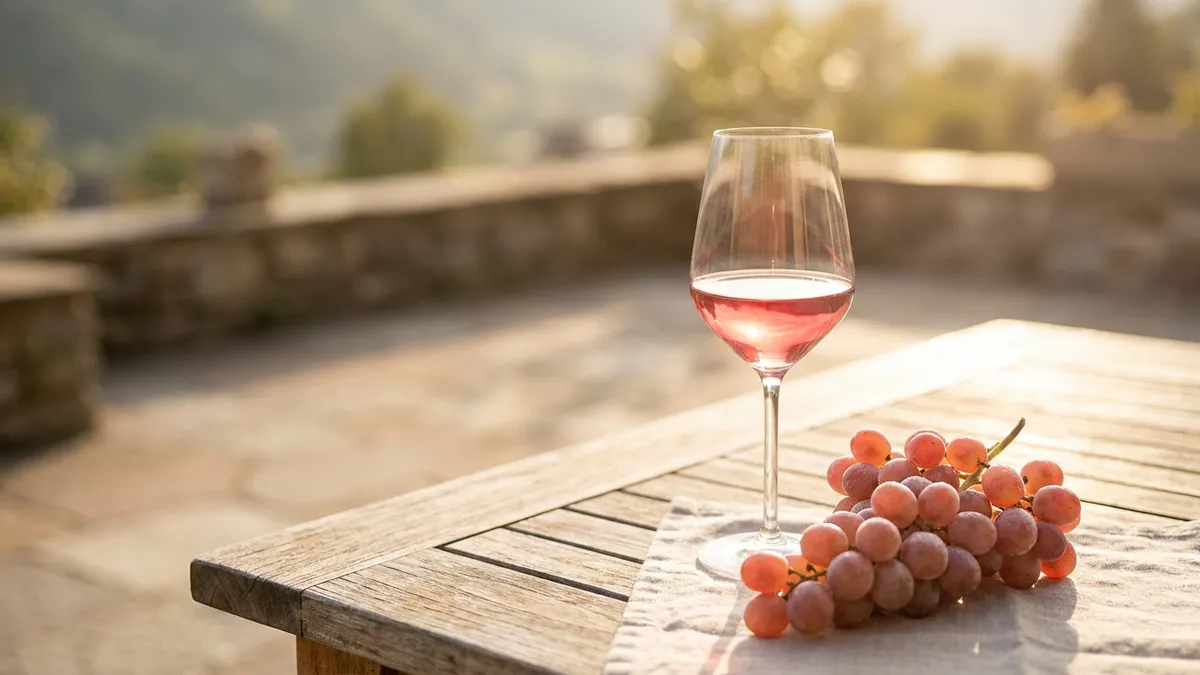
Schiava is a pale, feather-light red grape from the Alps of northern Italy, and the everyday red of the Alto Adige region. The same grape carries three names across borders: Schiava in Italian, Vernatsch in the German-speaking part of Alto Adige, and Trollinger in Germany's Württemberg. As a schiava vernatsch wine, it pours a translucent ruby so pale it can look like a dark rosé, and tastes of crushed strawberry, cotton candy, violet, and a whisper of bitter almond. It is very light-bodied, low in tannin, bright in acidity, and built to be served slightly chilled — one of the most beginner-friendly reds you can pour.
For centuries this was the workhorse grape of the South Tyrol, planted on steep terraces above Bolzano. It once made simple tavern wine by the jug. Today, careful growers treat it as a delicate Alpine specialty rather than bulk filler — and beginners are rediscovering it as the gentlest possible entry into red wine.
If you already enjoy a chilled, low-tannin red like Gamay or a transparent, cherry-driven Pinot Noir, Schiava belongs in the same easy-drinking family — only lighter still.
Schiava in 100 Words
Schiava vernatsch wine is a very light-bodied dry red built on crushed strawberry, fresh raspberry, cotton candy, violet, and a faint bitter-almond finish. Grown mainly across the Alto Adige in northern Italy and in Germany's Württemberg as Trollinger, it pours a pale, translucent ruby and runs low in alcohol, usually 11–12.5%. Tannins are very low and acidity is fresh, so the wine drinks more like a chilled rosé-red hybrid than a structured red. Best served at 12–14°C, it shines as a summer red and a gateway grape, often compared to a feather-light Gamay or Pinot Noir.
Schiava Tasting Notes and Flavor Profile
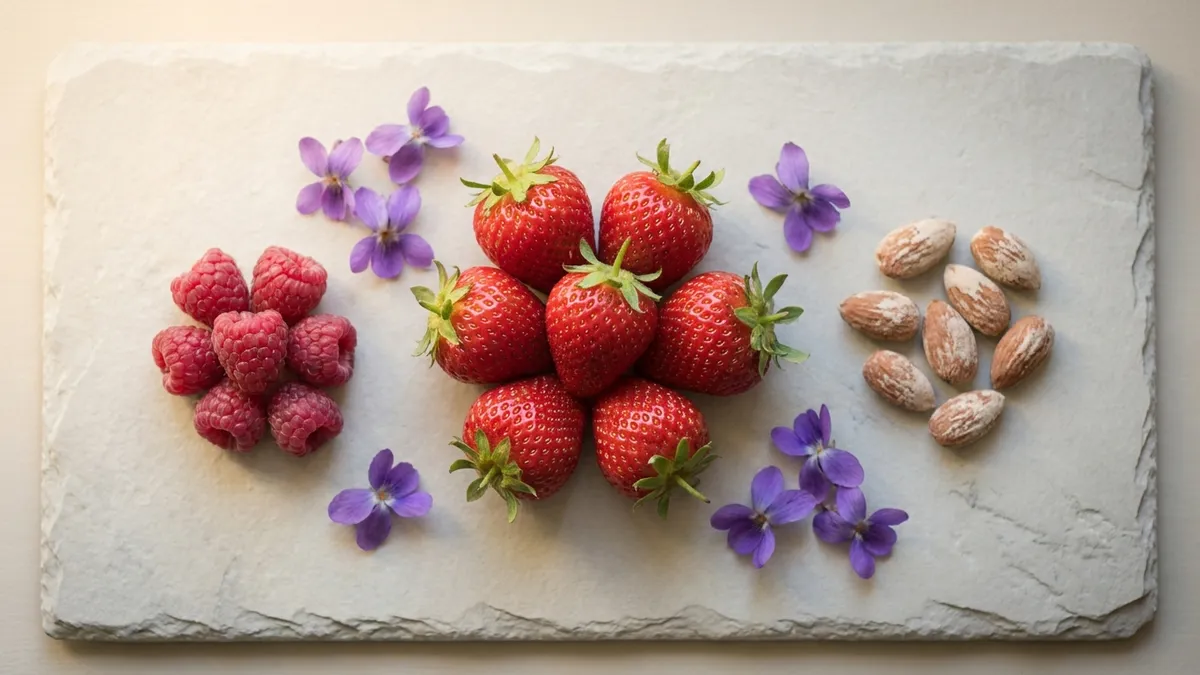
Schiava is the opposite of a fruit bomb. Where most reds reach for power, this grape leans into delicacy. The fruit is pale and pretty, the texture is light, and the whole glass feels more like a refreshment than a statement. Once you learn its strawberry-and-cotton-candy signature, it is one of the easiest reds to recognize.
The Core Flavors
- Red fruit — crushed strawberry and fresh raspberry sit at the center, joined by a little red cherry
- Confectionery — a distinctive cotton candy or pink-bubblegum note, soft and sweet-smelling even though the wine is dry
- Floral — a clear lift of violet and faded rose petal
- Nutty finish — a gentle bitter almond edge that closes the wine and keeps it from feeling simple
The aromatics promise sweetness, but the palate stays dry and crisp. That contrast — sweet-smelling fruit over a dry, fresh body — is part of what makes Schiava so charming and so easy to drink.
Structure at a Glance
Schiava is defined by what it lacks as much as what it has: barely any tannin, modest alcohol, and a light body, all held up by lively acidity. Reading these axes — body, acidity, and tannin — is the fastest way to understand any red. If the terms are new, the guide to tannins, acidity, and body breaks them down.
Body: very light (1/5) · Acidity: medium-high (4/5) · Tannin: very low (1/5)
This profile is why Schiava works chilled and pairs so widely. There is no firm tannic grip to soften and no heavy weight to balance — just bright fruit and refreshing acid. It behaves almost like a red with the manners of a white.
The Three Names: Schiava, Vernatsch, and Trollinger
One grape family, three labels, depending on where it grows. Knowing the trio helps you spot the wine on shelves and lists across Italy and Germany.
- Schiava — the Italian name, used on most Alto Adige bottlings and the one you will see most often internationally. The word means "slave," likely a reference to the way the vines were once tied, or trained, to supports.
- Vernatsch — the German name used by the German-speaking majority of Alto Adige, a bilingual region where labels often carry both languages. Vernatsch and Schiava are interchangeable.
- Trollinger — the name in Württemberg, Germany, where it is a beloved local red. German Trollinger tends to be a touch riper and rounder, but the pale color and light body carry across.
There are also several sub-varieties — Schiava Grossa, Schiava Gentile, and Schiava Grigia — that growers blend or bottle separately. The differences are subtle for most drinkers; the family signature of pale, light, strawberry-driven red holds across all of them.
Schiava is a red that drinks like a rosé's confident cousin — pale, chilled, and impossible to dislike.
If you want the wider picture of where this grape sits among Italy's varieties, the Italian wine guide maps the country's regions and styles, and the round-up of grapes that look the same but taste different explains why a pale grape like Schiava can still have a clear identity.
Why Schiava Is the Gateway Red
The grape parallel that helps most beginners is this: Schiava is to light reds what training wheels are to a bicycle. Three things make it the friendliest red on the shelf.
No Harsh Tannins
The drying, gripping sensation that beginners often dislike in big reds comes from tannins (compounds from grape skins and seeds that pull moisture from your mouth). Schiava has almost none. Its skins are thin and pale, the opposite of a thick-skinned grape like Cabernet Sauvignon, so there is nothing astringent to work past.
Low Alcohol, Light Body
Most Schiava lands around 11–12.5% alcohol, low for a red. Combined with the light body, that keeps the wine refreshing rather than heavy. You can drink it on a warm afternoon without the wine feeling like a weight.
Simple, Friendly Fruit
The strawberry-and-cotton-candy profile is immediately likeable and easy to name — a gift when you are still building a tasting vocabulary. There is no need to decode oak, leather, or earthy complexity; the fruit is right there on the surface.
The closest familiar reference points are two other low-tannin charmers. Gamay, the grape of Beaujolais, shares the chillable, juicy, low-tannin appeal. And light Pinot Noir shares the pale color and red-cherry transparency. Schiava sits one notch lighter than both — the most delicate of the three.
Where Schiava Grows: Alto Adige and Beyond
Few grapes are as tied to a single place as Schiava is to the Alto Adige. The region's Alpine geography shapes everything about the wine.
Alto Adige (South Tyrol)
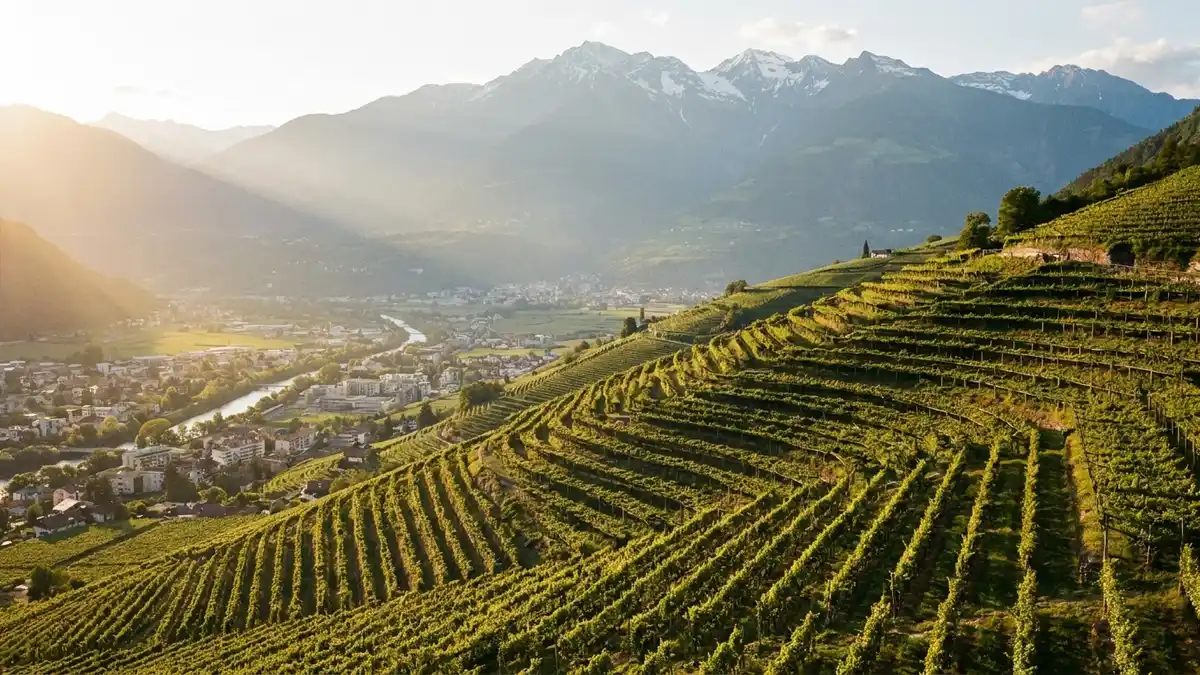
Alto Adige, also called Südtirol, sits in Italy's far north against the Austrian border, a bilingual Alpine region of steep valleys and dramatic mountain light. Vineyards climb terraces above the Adige river, often pergola-trained in the traditional South Tyrolean style. The high altitude and big day-to-night temperature swings preserve the bright acidity that defines Schiava, while the mountain sun ripens the delicate fruit.
Schiava was long the most-planted red here, though it has ceded ground to Pinot Noir and the darker local grape Lagrein in recent decades. What remains is increasingly farmed for quality rather than quantity.
St. Magdalener (Santa Maddalena)
St. Magdalener, or Santa Maddalena in Italian, comes from the warm, steep hills just northeast of Bolzano. It is built mostly from Schiava with a small permitted share of Lagrein (a dark, brooding local grape) added for color and grip. The result is a deeper, riper, more savory take on Schiava — still light, but with a little more flesh and a darker red-fruit core. It is widely considered the grape's most serious expression.
Lago di Caldaro (Kalterersee)
Lago di Caldaro, known in German as Kalterersee, surrounds a shallow lake south of Bolzano whose waters moderate the climate and help the grapes ripen. The wines here are typically the softest, roundest, and most easygoing Schiava — gentle, fruity, and made for early drinking. Look for the Classico designation for fruit from the heart of the zone.
Germany: Trollinger in Württemberg
In Württemberg, southwestern Germany, Schiava becomes Trollinger and ranks among the region's most popular reds — practically a regional drink. German Trollinger tends to be a little riper and rounder than its Italian cousin, but it keeps the pale color, low tannin, and easy charm. It is rarely exported, so it is mostly a treat to seek out when traveling.
How to Serve Schiava
Serving Schiava well is mostly about temperature, and this is where it breaks the usual red-wine rules.
Serve It Chilled
Schiava is one of the few reds that genuinely improves with a chill. Serve it at 12–14°C (54–57°F) — roughly 30 minutes in the fridge if the bottle is at room temperature. The cool temperature sharpens the acidity and freshens the strawberry fruit, while a warm Schiava tastes flat and loses its crisp lift. Treat it more like a robust white or a chilled rosé than a traditional red. For the full picture, the guide to how temperature affects wine taste explains why a chill flatters light, fruity reds.
Glassware and Decanting
- Glass — a standard, slightly smaller red or universal glass is perfect; no need for a giant bowl
- Decanting — not necessary, this is a fresh, simple wine meant to be poured and enjoyed
- Aging — drink Schiava young, within 1–3 years of the vintage, while the fruit is bright; it is not built for the cellar
How to Pair Schiava with Food
Schiava's low tannins and bright acidity make it one of the most flexible reds at the table. With no astringent grip to clash with food and a refreshing core, it slips alongside dishes that would overwhelm a heavier wine.
Reliable Pairings
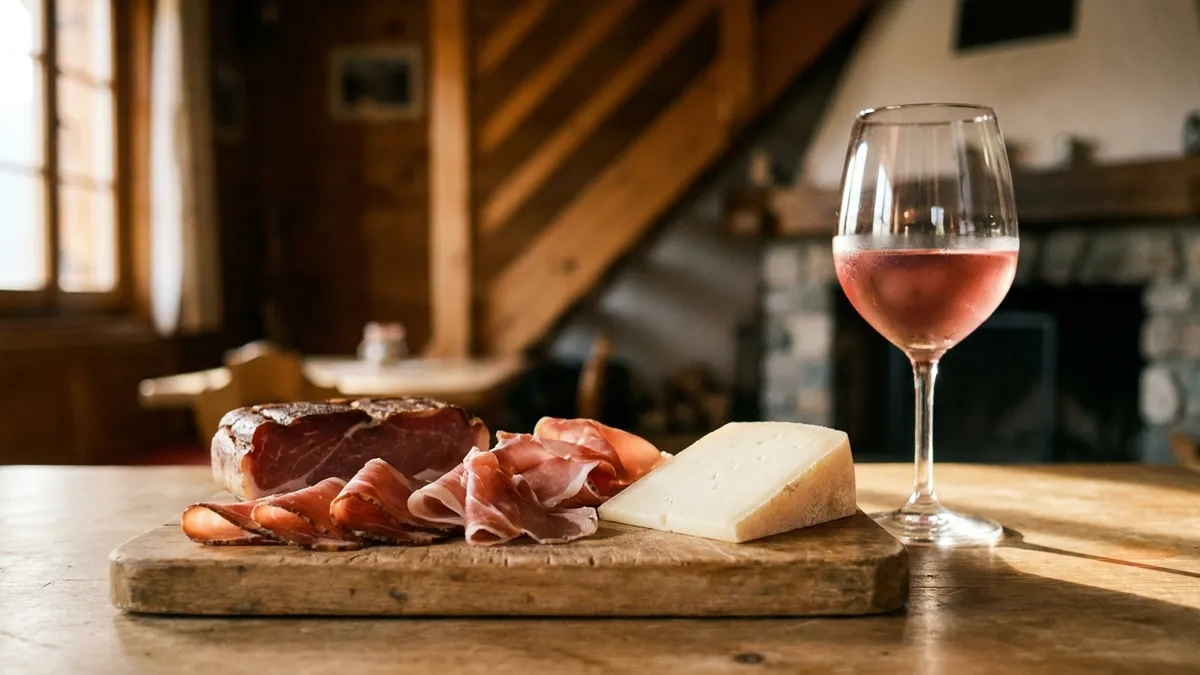
- Cured meats and speck — Alto Adige's smoky cured ham is the local, classic match; prosciutto and salami work too
- Pizza and charcuterie — the acidity cuts through fat and salt without piling on weight
- Roast chicken and pork — light enough not to bully white meat, fresh enough to lift it
- Salmon and richer fish — a chilled, low-tannin red is one of the rare reds that flatters oily fish
- Mild and soft cheeses — fresh mozzarella, young Alpine cheeses, and creamy styles
- Alpine and Germanic dishes — spätzle, sausages, and dumplings, the food of its home turf
What to Avoid
Skip very rich, heavily spiced, or deeply savory dishes — a slow-braised beef stew or a charred ribeye will steamroll Schiava's delicate fruit. Save those for a structured red and bring out Schiava for lighter fare, picnics, and warm-weather meals where a chilled, easy red is exactly right.
Schiava vs Other Light Reds
Placing the grape next to familiar light reds makes its delicate profile easier to remember.
How Schiava compares to two well-known light-bodied reds.
- Body: Schiava very light; Gamay light to medium; Pinot Noir light to medium
- Acidity: Schiava medium-high; Gamay high; Pinot Noir high
- Tannins: Schiava very low; Gamay low; Pinot Noir low to medium
- Key flavors: Schiava strawberry, cotton candy, violet, almond; Gamay red cherry, banana, peony; Pinot Noir cherry, earth, rose
- Alcohol: Schiava low (11–12.5%); Gamay moderate; Pinot Noir moderate
- Serve chilled: Schiava yes; Gamay yes; Pinot Noir lightly, optional
- Best with: Schiava speck, pizza, salmon; Gamay charcuterie, roast chicken; Pinot Noir duck, mushrooms
If Schiava's pale, gentle style appeals, you will likely enjoy the chillable charm of Gamay and the transparency of Pinot Noir. For the foundational varieties every taster should know first, the guide to the noble grapes is the place to start.
How a Beginner Should Approach Schiava
The smartest way to learn any grape is to taste it with intention, and Schiava makes that gentle and low-stakes. There is no harsh structure to fight through, so you can focus entirely on aroma and freshness.
- Chill it first. Pour Schiava at 12–14°C so the fruit and acidity show at their best. A warm bottle will mislead you about what the grape really offers.
- Hunt for the cotton candy. Before the strawberry, look for that sweet, confectionery lift sitting over a dry palate. It is the grape's fingerprint.
- Notice how little tannin there is. Feel how smooth and grip-free the wine is compared with a bigger red. That contrast teaches you exactly what tannin does — by its near-absence.
The point of paying attention is to give your senses something concrete to react to. A wine you can name is a wine you understand, and Schiava's clear, simple profile makes it an ideal grape to practice on. That habit of systematic tasting is the single fastest way to build a real palate.
The Sommy app walks you through exactly these structured tastings — guiding you to name the strawberry, catch the cotton candy, and feel how a chill changes the glass. With its low stakes and friendly fruit, Schiava is one of the best grapes a beginner can use to start building confidence, one pale, chilled glass at a time.
Sources
- Schiava (Vernatsch) — Wikipedia
- Alto Adige Wines — Schiava / Vernatsch — Consorzio Vini Alto Adige
- Schiava: Italy's Light Alpine Red — Wine Folly
Frequently Asked Questions
What does Schiava wine taste like?
Schiava tastes of crushed strawberry, fresh raspberry, a hint of cotton candy, violet, and a faint bitter-almond note on the finish. It is very light-bodied with low tannins and bright, refreshing acidity. The overall impression is delicate, juicy, and floral rather than rich or powerful, closer to a chilled red than a heavy one.
Is Schiava the same as Vernatsch and Trollinger?
Yes. Schiava is the Italian name, Vernatsch is the German name used in Alto Adige, and Trollinger is the name used in Germany's Württemberg region. All three refer to the same family of pale, light-bodied red grapes. The wine style varies a little by place, but the grape and its delicate, strawberry-driven character stay the same.
Should you serve Schiava chilled?
Yes. Schiava is one of the few reds that genuinely improves with a chill. Serve it at 12–14°C (54–57°F), about 30 minutes in the fridge from room temperature. The cooler temperature sharpens its acidity and freshens the strawberry fruit. A warm Schiava tastes flat and loses the crisp, refreshing quality that makes it special.
Is Schiava a good wine for beginners?
Yes. Schiava is one of the easiest reds to start with because it has very low tannins, low alcohol, gentle acidity by red standards, and simple, friendly fruit. There is no harsh grip or heavy structure to work past. If you find big reds overwhelming, Schiava is a low-stakes way to enjoy red wine and to practice naming aromas.
What is St. Magdalener wine?
St. Magdalener (Santa Maddalena in Italian) is a classic Schiava-based red from the hills around Bolzano in Alto Adige. It is built mostly from Schiava with a small share of Lagrein added for color and structure. The result is a slightly deeper, more savory version of Schiava, with riper red fruit and a touch more body and grip.
What food pairs with Schiava?
Schiava's low tannins and bright acidity make it flexible at the table. It suits cured meats, speck, prosciutto, mild cheeses, pizza, charcuterie, roast chicken, and salmon. It also handles lighter Alpine and Germanic dishes like spätzle and sausages. Because it can be chilled, it works as a summer red for picnics and warm-weather meals where heavier reds feel too much.
Is Schiava a sweet wine?
No. Most Schiava is a dry red wine with no significant residual sugar. The cotton-candy and ripe-strawberry aromas can create an impression of sweetness on the nose, but the wine itself finishes dry and crisp. A few off-dry or rosé-style versions exist, but the standard Alto Adige and Trollinger bottlings are dry, light reds.
Sommy Team
LinkedInFounder & Wine Educator
The Sommy Team is building the world's most approachable wine education app, helping beginners develop real tasting skills through structured courses and AI-guided practice.