Alto Adige Wine Guide: Italy's Alpine Wine Paradise

By the Sommy Team — AI-assisted, human-edited.
Updated Jun 17, 2026
Contents (10)
- What Is Alto Adige Wine?
- A German-Speaking Wine Region Inside Italy
- Altitude Is Everything: The Terroir of Alto Adige
- The Signature White Wines of Alto Adige
- The Local Reds: Schiava and Lagrein
- Sub-Regions and the Wine Road
- What Makes Alto Adige Distinctive
- How a Beginner Should Start with Alto Adige
- Alto Adige Beyond the Famous Grapes
- The Reward of Learning Alto Adige
TL;DR
Alto Adige is far-northern Italy's German-speaking alpine region, famous for crisp, precise white wines like Pinot Grigio, Gewürztraminer, Pinot Bianco, and Kerner, plus two local reds, Schiava and Lagrein. High-altitude valleys give the wines bright acidity and clarity. This alto adige wine guide shows beginners where to start.
What Is Alto Adige Wine?
This alto adige wine guide begins with a place that does not feel entirely Italian. Alto Adige — known to its German-speaking majority as Südtirol — is Italy's northernmost wine region, pressed against the Austrian border high in the Alps. The region is famous for crisp, aromatic white wines: Pinot Grigio, Gewürztraminer, Pinot Bianco, and the spicy Kerner, alongside two local reds, the light Schiava and the structured Lagrein. What ties them together is altitude. Vineyards climb from warm valley floors to steep mountain slopes, and that height gives Alto Adige wines a clarity and freshness that few warmer regions can match. Learn the grapes and the altitude story, and the whole region opens up.
A German-Speaking Wine Region Inside Italy
To understand Alto Adige, start with its split identity. The region was part of Austria-Hungary until the end of the First World War in 1919, when it was handed to Italy. More than a century later, most locals still speak German as a first language, and daily life — the food, the architecture, the village names — feels closer to Tyrol than to Tuscany.
This shows up directly on the wine label. Bottles often carry both an Italian and a German name, and the grapes follow suit. Schiava is also called Vernatsch, and you will see place names like Tramin written as both Termeno and Tramin. Reading an Alto Adige label means getting comfortable with this bilingual habit.
The cultural mix matters for taste, not just trivia. Alto Adige favors the cool-climate, varietally pure style you find across the border — clean, precise, single-grape whites — rather than the blended, sun-soaked reds of southern Italy. If you want the wider national picture first, our Italian wine guide places Alto Adige alongside the country's twenty regions.
Altitude Is Everything: The Terroir of Alto Adige
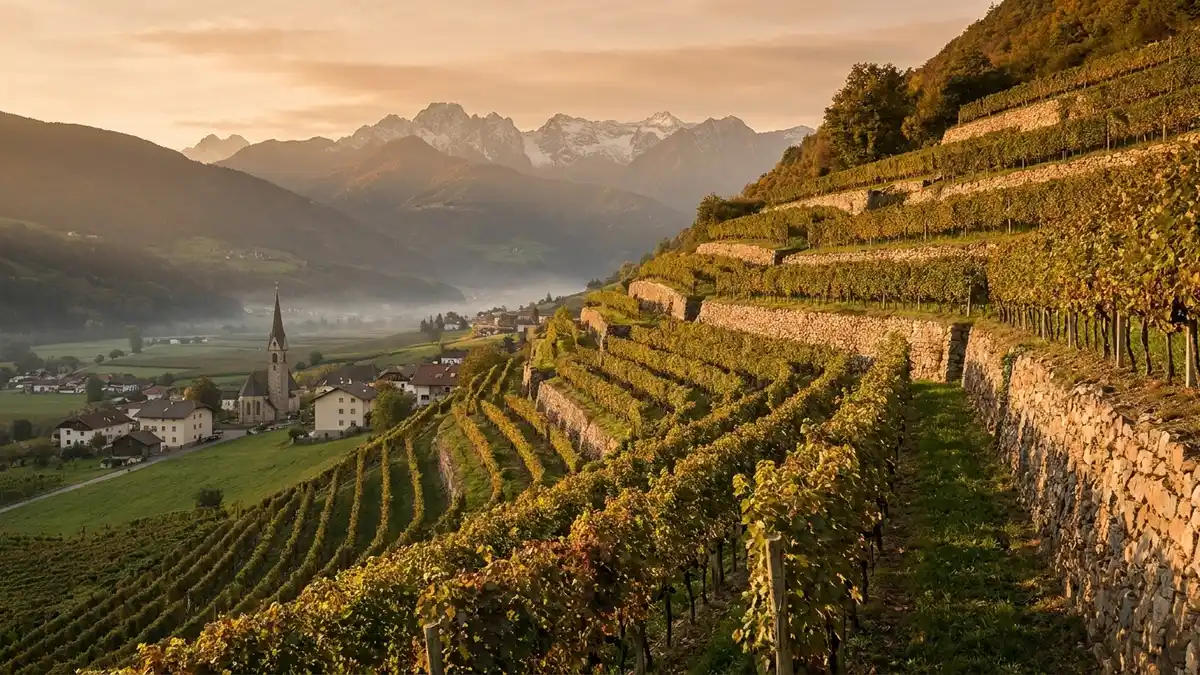
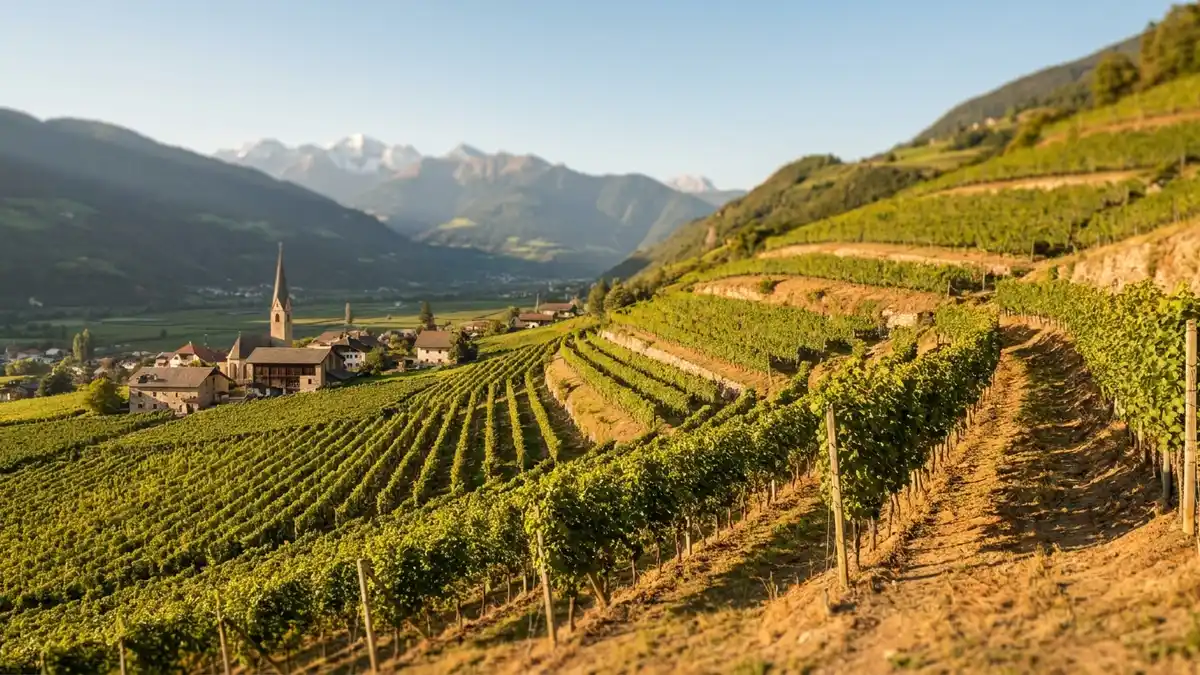
The single most important fact about Alto Adige is vertical. Vineyards here are not planted on a flat plain — they climb. The warmest sites sit on the valley floor around 200 meters, while the highest vines cling to mountain slopes above 1,000 meters. A grower can grow ripe red grapes low down and delicate aromatic whites a short, steep drive uphill.
This range creates the region's signature: a dramatic gap between hot days and cold alpine nights, known as diurnal variation (the swing between daytime and nighttime temperature). Long, sunny days ripen the fruit and build flavor, while cold nights lock in acidity and aroma. The result is wine that tastes both ripe and fresh at once — the alpine balancing act that defines the whole region.
The valleys also funnel sunshine and shelter the vines from the worst alpine weather. Three river valleys carry most of the vineyards: the broad Adige Valley (Etschtal) that gives the region its name, the side-branching Isarco Valley (Eisacktal) in the cooler northeast, and the smaller pockets around the city of Bolzano. Soils shift constantly with the terrain — limestone, gravel, volcanic porphyry, and glacial deposits — so a single grape can taste meaningfully different from one slope to the next.
In Alto Adige the same grape planted three hundred meters higher becomes a different wine. Altitude is the region's true grape variety.
This is why Alto Adige is such a good classroom for terroir — the idea that soil, climate, and altitude shape how a wine tastes. Because the wines are made cleanly from single grapes, every difference you sense traces back to where the vines grew.
The Signature White Wines of Alto Adige
Whites make up the majority of production and carry the region's fame. Most are bottled as single varieties under the Alto Adige DOC, which keeps the style clean and the grape easy to read on the label. These are the ones worth knowing first:
- Pinot Grigio: The region's most exported white, and a world apart from the thin, neutral mass-market version. Alto Adige Pinot Grigio is grown at altitude, so it is riper and more textured — think pear, apple, a touch of stone fruit, fuller body, and a crisp, mineral finish. This is Pinot Grigio with something to say.
- Pinot Bianco (Weissburgunder): Quietly one of the region's finest whites. Subtle and refreshing, with green apple, white peach, almond, and a clean, chalky line of acidity. Less showy than Pinot Grigio but often more elegant, and a benchmark for what cool-climate Italy can do.
- Gewürztraminer: The region's most perfumed white and its aromatic calling card. Heady with lychee, rose petal, and warm baking spice, yet kept lively by alpine acidity. More on its deep link to the village of Tramin below.
- Kerner: A local specialty grown high in the cool Isarco Valley. A crossing of Riesling and Schiava, it gives a bright, zippy white with peach, citrus, and a faint nutmeg lift — distinctive and food-friendly.
- Sauvignon Blanc: Increasingly excellent here, showing taut gooseberry, elderflower, and white-pepper notes sharpened by altitude. A reminder that Alto Adige excels at international grapes, not only its own.
The dividing line that runs through this list is whether a grape is aromatic or neutral. Gewürztraminer and Kerner shout their perfume; Pinot Bianco and Pinot Grigio whisper. If that distinction is new to you, our piece on aromatic versus neutral grapes explains exactly how to tell them apart in the glass. For the wider family of pale grapes, our white grapes overview maps where each one fits.
Gewürztraminer and the Town of Tramin
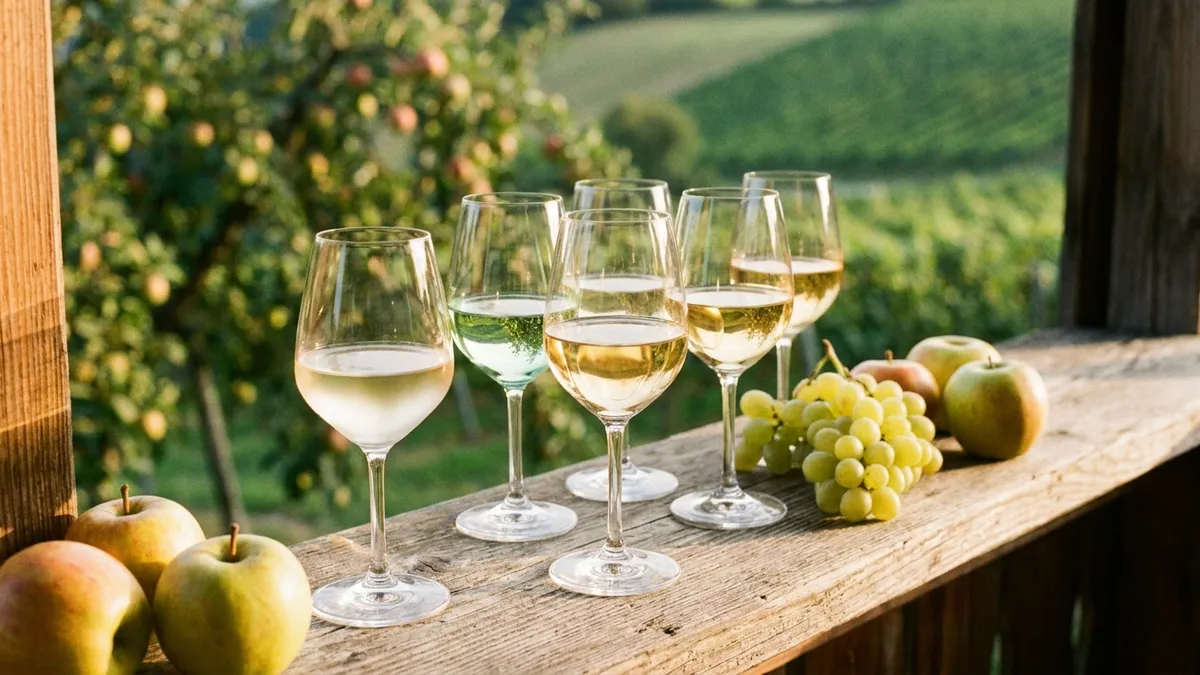
No grape is more tied to Alto Adige than Gewürztraminer. The name itself points home: the traminer family of grapes is associated with Tramin (Termeno in Italian), a village on the region's wine road. The prefix Gewürz is German for "spice," a nod to the grape's heady, perfumed character.
What makes the alpine version special is balance. Gewürztraminer is naturally rich, low in acid, and intensely floral — qualities that can turn flabby in warm climates. Alto Adige's high, cool sites keep the acidity fresh, so the lychee-and-rose perfume arrives with a crisp backbone instead of a heavy one. It is one of the most distinctive whites a beginner can taste, and a perfect demonstration of an aromatic grape. Our dedicated Gewürztraminer wine guide goes deeper into the grape and how to drink it.
The Local Reds: Schiava and Lagrein
Alto Adige is white-wine country, but its two indigenous reds are essential to the story. They sit at opposite ends of the weight scale, and tasting them together tells you a great deal about the region.
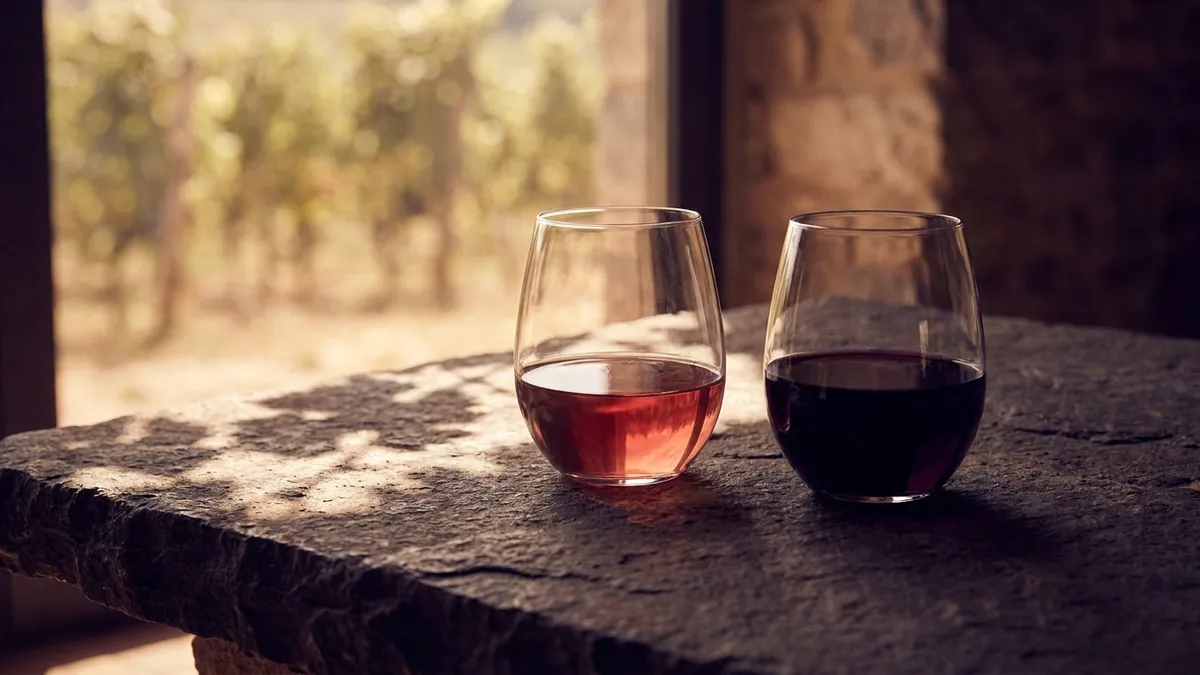
- Schiava (Vernatsch): The region's traditional everyday red and once its most-planted grape. Pale ruby, light-bodied, and low in tannin, it offers gentle red cherry, strawberry, and a faint almond note. It is soft enough to chill slightly and drink young — closer in spirit to a delicate rosé-toned red than a brooding one. For a full portrait, see our Schiava wine guide.
- Lagrein: The bold counterpart. Deeply colored, full-bodied, and structured, with dark berry and black cherry fruit, firm tannins, and a savory, faintly bitter twist on the finish. Grown mainly on the warm gravels around Bolzano, it is the region's most serious red and ages well. Our Lagrein wine guide covers its style and history in detail.
Here is the contrast at a glance, written as a simple comparison so you can hold both in mind:
- Schiava (Vernatsch): Color: pale ruby · Body: light · Tannin: low · Fruit: red cherry, strawberry · Drink: young, lightly chilled
- Lagrein: Color: deep purple-black · Body: full · Tannin: firm · Fruit: dark berry, black cherry · Drink: now or with age
These indigenous grapes are part of what makes Alto Adige worth exploring beyond the famous internationals. They sit outside the small club of noble grapes that dominate global wine, which is precisely why they reward the curious.
Sub-Regions and the Wine Road
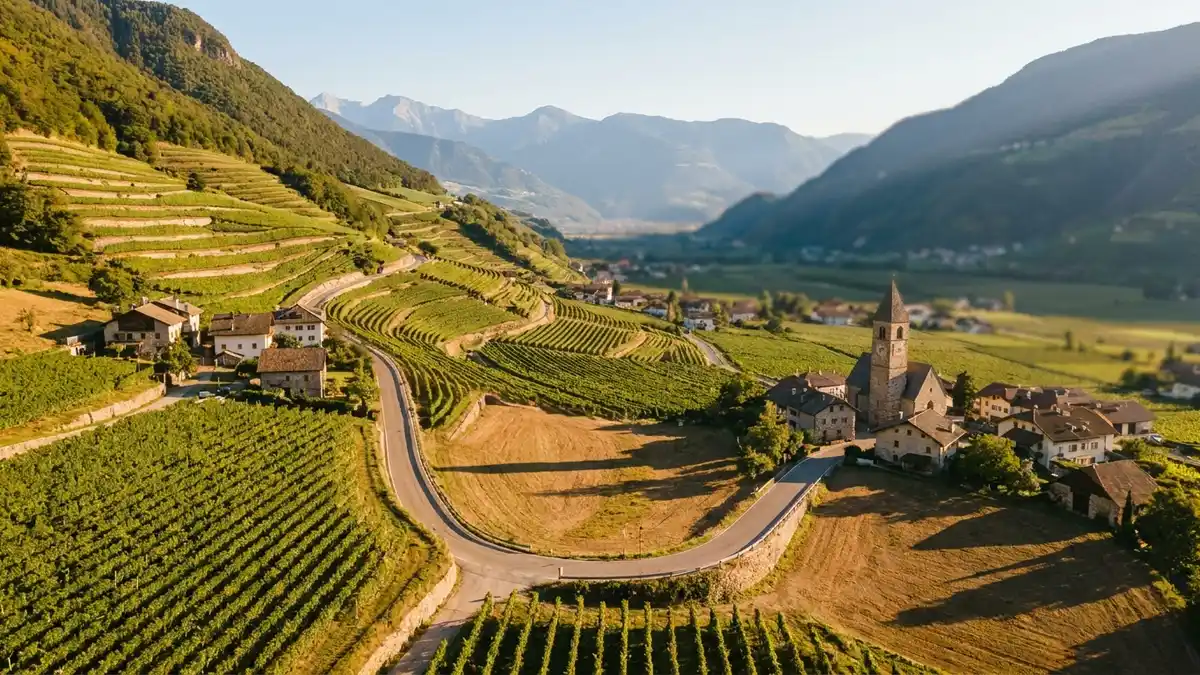
Alto Adige is compact, but it folds into distinct pockets that each lean toward different grapes. Knowing the main areas turns the map into a story you can follow from bottle to bottle.
- Adige Valley (Etschtal): The broad central valley that names the region and grows the bulk of the vineyards. Warm valley floors suit reds like Lagrein and Schiava, while the slopes above carry Pinot Grigio, Pinot Bianco, and Chardonnay.
- South Tyrolean Wine Road (Südtiroler Weinstraße): A famous strip of villages running south from Bolzano, including Tramin. This is the aromatic-white heartland, the home stretch of Gewürztraminer and many of the region's benchmark whites.
- Isarco Valley (Eisacktal): The cool, steep northeastern arm. Its high, narrow vineyards specialize in racy, high-altitude whites — Kerner, Sylvaner, Riesling, and Veltliner — all marked by piercing acidity and clarity.
- Bolzano basin: The warm bowl around the regional capital, with sun-soaked gravel and porphyry soils. This is the natural home of full-bodied Lagrein and the deepest of the local reds.
The single overarching appellation, Alto Adige DOC (Südtirol DOC), covers nearly all quality wine and usually names the grape clearly on the label. Some bottles add a more specific sub-zone or vineyard, but for a beginner the DOC plus the grape name is enough to know roughly what is in the glass.
What Makes Alto Adige Distinctive
A few qualities set Alto Adige apart from the rest of Italian wine, and they are worth naming plainly:
- Varietal clarity. Most wines are single grapes, labelled by variety, made to taste cleanly of that grape. This is unusual in Italy, where blends and place-names often dominate, and it makes the region a friendly place to learn what each grape actually tastes like.
- White-wine focus in red-wine Italy. Roughly two-thirds of production is white — a striking reversal of Italy's overall lean toward reds. Alto Adige is where Italy makes some of its most precise, age-worthy whites.
- Cooperative quality. A large share of wine comes from grower cooperatives, yet quality is consistently high. The model spreads good winemaking across many small alpine plots that would otherwise be too tiny to bottle alone.
- Altitude as identity. No other major Italian region builds its style so completely around height and the cool nights that come with it. The freshness in the glass is the mountain in liquid form.
Sommy's Italian wine course uses regions like this to show how climate shapes taste — why an alpine white feels so different from a southern one, even from the same grape.
How a Beginner Should Start with Alto Adige
You do not need a deep cellar or a big budget to understand Alto Adige. The smartest approach is to taste a small spread of its grapes and pay attention to what altitude does. Here is a practical order:
- Begin with a single-variety white. Pick an Alto Adige DOC Pinot Grigio or Pinot Bianco. Notice how much fresher, riper, and more textured it is than a cheap supermarket Pinot Grigio — that difference is altitude at work.
- Add an aromatic white. Open a Gewürztraminer next to the neutral white. The leap in perfume — lychee, rose, spice — makes the aromatic-versus-neutral distinction unforgettable in a single sip.
- Meet the local reds. Try a light, chillable Schiava, then a deeper Lagrein, side by side. The gap in color, body, and tannin shows the full range of the region's reds in one sitting.
- Climb the valley in your glass. If you can find one, taste a high-altitude Kerner from the Isarco Valley to feel just how taut and bright the coolest sites get.
- Build the tasting habit. Note the color, the bright acidity, and the clean fruit that runs through nearly every Alto Adige wine. Our guide to how to taste wine gives you the step-by-step method, so each bottle becomes a short lesson rather than a guess.
Sommy turns these comparisons into guided exercises — naming the aromas, scoring the structure, and building the vocabulary to describe what you sense. You can start practicing free at sommy.wine, then bring the method to your next alpine white.
Alto Adige Beyond the Famous Grapes
The region rewards going a little further than Pinot Grigio. Sylvaner and Veltliner turn up in the cool Isarco Valley as crisp, mineral whites. Müller-Thurgau thrives on the highest sites, giving light, floral wines that taste of mountain air. And classic internationals like Chardonnay and Pinot Noir are made with real precision here, the cool climate lending them tension and freshness.
These lesser-known bottles are a low-risk way to broaden your palate, because the region's clean, varietal style means each grape shows its true character. Once a few Alto Adige whites have clicked, the same alpine logic helps you read other cool-climate regions across Europe.
The Reward of Learning Alto Adige
Alto Adige is one of the most beginner-friendly regions in Italy precisely because it does not hide behind blends or baffling labels. The grape is usually right there on the bottle, the style is consistently fresh and clean, and the through-line — altitude — is easy to taste once you know to look for it.
Start with a crisp white, add an aromatic one, taste the two local reds, and let the mountains explain themselves one glass at a time. The Sommy app is built to make that habit stick, turning each bottle into a short, guided lesson so the next alpine white you open is a little clearer than the last.
Sources
Frequently Asked Questions
Where is Alto Adige and why is it bilingual?
Alto Adige sits in the far north of Italy, against the Austrian border, and is also called Südtirol. It was part of Austria-Hungary until 1919, so most locals speak German as a first language. Wine labels often appear in both Italian and German, with grapes like Schiava also named Vernatsch.
What wines is Alto Adige known for?
Alto Adige is best known for crisp, aromatic white wines: Pinot Grigio, Gewürztraminer, Pinot Bianco, Sauvignon Blanc, and Kerner. It also makes two distinctive local reds, the light Schiava and the deeper, structured Lagrein. The whites dominate production and define the region's reputation for clarity and freshness.
Is Alto Adige Pinot Grigio different from other Italian Pinot Grigio?
Yes. Alto Adige Pinot Grigio is grown at altitude in cool alpine conditions, so it tends to be more concentrated, textured, and aromatic than the light, neutral mass-market style. Expect ripe pear and apple, a touch of stone fruit, fuller body, and a crisp mineral finish rather than a simple, watery character.
What is Gewürztraminer and what is its connection to Alto Adige?
Gewürztraminer is a deeply aromatic white grape famous for lychee, rose, and spice notes. Its name links it to Tramin, a village in Alto Adige long associated with the grape's traminer family. The region's high-altitude sites give Gewürztraminer aromatic intensity while keeping the acidity fresh, balancing its naturally rich, perfumed style.
What are Schiava and Lagrein?
Schiava, also called Vernatsch, is Alto Adige's light, pale, gently fruity red, low in tannin and easy to chill slightly. Lagrein is the bolder local red, deeply colored with dark berry fruit, firm tannins, and a savory edge. Together they are the region's two signature indigenous red grapes, very different in weight and structure.
What does Alto Adige terroir mean for the wine?
Alto Adige vineyards climb from warm valley floors around 200 meters to steep mountain sites above 1,000 meters. Large day-to-night temperature swings preserve acidity and aroma while sunshine ripens the fruit. This combination gives the whites their hallmark precision, freshness, and clarity, and lets each grape express its variety cleanly.
How should a beginner start with Alto Adige wine?
Start with a single-variety white labelled Alto Adige DOC, such as Pinot Grigio or Pinot Bianco, to taste the region's clean, fresh style. Then try an aromatic Gewürztraminer and a light Schiava red. Tasting these side by side shows how altitude shapes both crisp neutral whites and perfumed ones.
Sommy Team
LinkedInFounder & Wine Educator
The Sommy Team is building the world's most approachable wine education app, helping beginners develop real tasting skills through structured courses and AI-guided practice.