Best Wine for Spicy Food — the Off-Dry Rule Sommeliers Use

By the Sommy Team — AI-assisted, human-edited.
Updated Sep 10, 2026
Contents (11)
- What Wine Goes with Spicy Food?
- Why Is It Tricky to Pair Wine with Spicy Food?
- The Three Rules of Pairing Wine with Spicy Food
- Wine for Spicy Food at a Glance: Grape, Alcohol, Sugar, and Heat Level
- The Best White Wine for Spicy Food, Grape by Grape
- Match the Heat, Not Just the Dish
- Cuisine-Specific Pairing Guide
- What About Red Wine?
- Is a "Spicy Red Wine" the Right Red for Spicy Food?
- Serving Temperature: The Cheapest Fix
- Building Your Spicy Food Wine Strategy
TL;DR
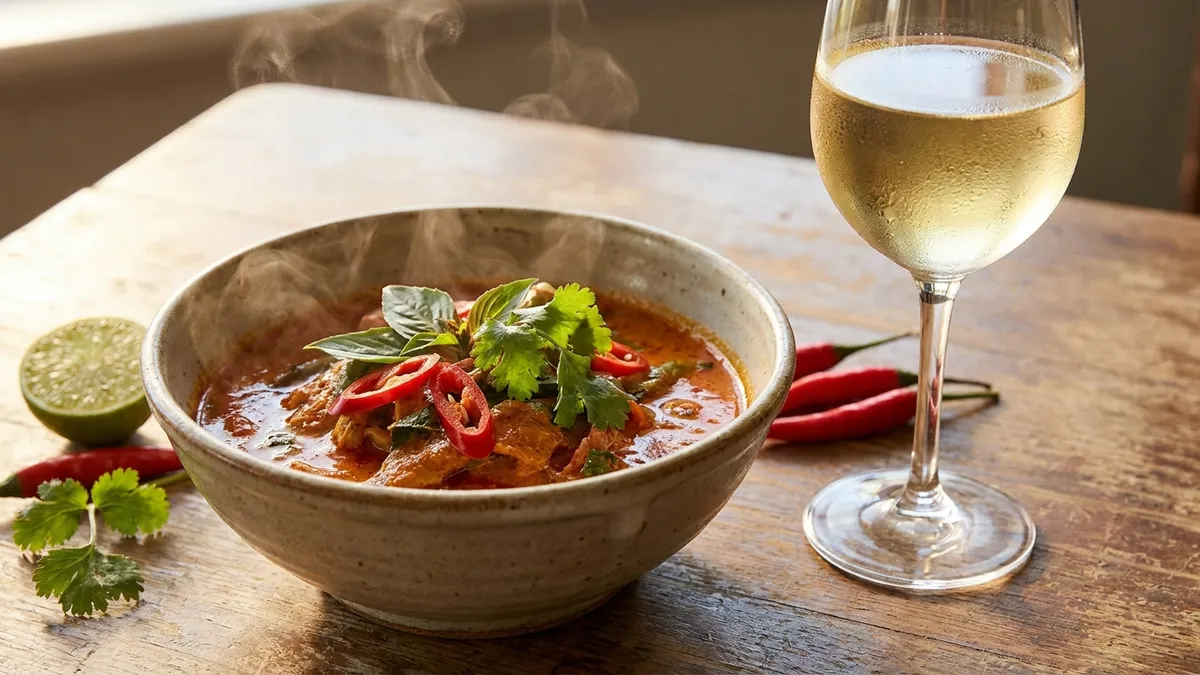
The best wine for spicy food is an off-dry white with low alcohol and no tannin: German Riesling Kabinett or Spätlese, off-dry Gewürztraminer, demi-sec Chenin Blanc, or Moscato d'Asti. Residual sugar cools capsaicin's burn, acidity refreshes the palate, and alcohol under 12% avoids feeding the fire. Tannic, high-alcohol reds make spicy food feel hotter and the wine taste bitter.
What Wine Goes with Spicy Food?
The best wine for spicy food is an off-dry white with low alcohol and no tannin: German Riesling Kabinett or Spätlese, off-dry Gewürztraminer, demi-sec Vouvray Chenin Blanc, or Moscato d'Asti. Residual sugar cools the burn, acidity refreshes the palate, and alcohol under about 12% avoids amplifying the heat. Tannic, high-alcohol reds do the opposite.
The one rule to remember: if the dish is hotter, choose a sweeter wine. It holds for a bowl of chili-oil noodles too, as the wine with ramen guide shows.
Why Is It Tricky to Pair Wine with Spicy Food?
Capsaicin, the compound that makes chili burn, fires the same warmth-sensing nerves as alcohol, so a strong wine makes the burn feel stronger. Spicy food also sharpens bitterness and astringency, which turns even a low-tannin red harsh. If a Cabernet tastes harsh and a green curry feels hotter after one bite, switch to a sweeter, lighter wine.
The Three Rules of Pairing Wine with Spicy Food
Rule 1: Choose Off-Dry Over Dry
Residual sugar (grape sugar left in the wine after fermentation) is the most effective tool against capsaicin's burn. It coats the palate and buffers your pain receptors, the way yogurt does.
EU wine-labelling law (Commission Delegated Regulation (EU) 2019/33, Annex III Part B) fixes what "dry" means. A still wine can be called dry (trocken, sec) only up to 4 grams per litre of residual sugar, or 9 grams per litre when acidity is high enough to balance it. Medium dry (halbtrocken, demi-sec) stops at 12 grams per litre, or 18 grams per litre when its total acidity is no more than 10 grams per litre below the sugar. Anything sweeter is medium or sweet.
An off-dry German Riesling at roughly 20 to 90 grams per litre handles spicy food far better than a bone-dry wine under 4. Its high acidity (the tartness that makes your mouth water) keeps it from tasting cloying. The wine sweetness scale runs from bone-dry to dessert-sweet, and tasting residual sugar in wine shows how to feel sugar apart from acidity.
Rule 2: Keep Alcohol Low
Alcohol above 13% starts to amplify capsaicin's burn, and above 14% the effect is significant. That rules out most full-bodied reds, typically 13.5 to 15.5%, such as a Napa Cabernet at 14.5% or an Australian Shiraz at 15%. If the label reads 7 to 12%, the wine is in the safe range. Our roundup of low-alcohol wines lists more styles at the low end.
Rule 3: Avoid Tannin
Tannins (the drying grip on your gums, found mainly in red wine) feel soft on their own and harsh after a bite of spicy food.
Bitterness also makes a burn harder to place. In a 2021 pilot study in the journal Biology (Liu and colleagues), 30 volunteers tried to locate a burn on the tongue caused by piperine, black pepper's heat compound and a relative of capsaicin. They got it right 87.8% of the time on its own, but only 67.8% of the time when a bitter taste was present (p = 0.002). A sweet taste caused no such drop. It is a small study on pepper rather than chili.
Wine for Spicy Food at a Glance: Grape, Alcohol, Sugar, and Heat Level
Only the EU dryness terms in Rule 1 are legal thresholds. If the label gives a figure, trust the label.
| Wine style | Typical alcohol | Typical residual sugar | Best heat level |
|---|---|---|---|
| German Riesling Kabinett (not trocken) | 7.5 to 10% | Off-dry, roughly 20 to 50 g/L | Medium heat; pad Thai, tacos, Korean BBQ |
| German Riesling Spätlese (not trocken) | 8 to 11% | Medium, roughly 40 to 90 g/L | Hot; green curry, madras, kimchi stew |
| German Riesling Auslese | 7 to 10% | Sweet, 80 g/L and up | Very hot; vindaloo, phaal |
| Moscato d'Asti | 5 to 6% | Sweet, roughly 100 to 130 g/L | Very hot and fruit-and-chili dishes |
| Vouvray demi-sec (Chenin Blanc) | 11 to 12.5% | Off-dry, roughly 9 to 18 g/L | Medium; korma, jerk, honey-sriracha glazes |
| Off-dry Gewürztraminer (Alsace) | 13 to 14% | Off-dry, roughly 5 to 30 g/L | Medium; aromatic Thai and Sichuan dishes |
| Grüner Veltliner (dry) | 11.5 to 13% | Dry, under 4 g/L | Mild; warm-spice dishes, wasabi, mezze |
| Vinho Verde | 9 to 11.5% | Dry to just off-dry, 0 to 15 g/L | Mild; ceviche, papaya salad, seafood with chili |
| Gamay (Beaujolais), chilled | 12 to 13% | Dry, under 4 g/L | Mild only; smoky tacos, mole |
| Brachetto d'Acqui | 5 to 7% | Sweet, roughly 80 to 120 g/L | Hot; the sweet red option for chili-heavy dishes |
The Best White Wine for Spicy Food, Grape by Grape
The best white wine for spicy food is off-dry Riesling. If the label shows a sweetness word and alcohol under 12%, the wine will cope with real heat.
Riesling: The Undisputed Champion
For spicy food, choose the off-dry German styles of Riesling:
- Kabinett: light, fresh, barely sweet, 7.5 to 10% alcohol; best for medium-spice dishes
- Spätlese: slightly richer and sweeter, 8 to 11% alcohol; handles serious heat
- Auslese: noticeably sweet, for the hottest dishes, where you need the most sugar
Alsatian Riesling tends to be drier than German. Australian Riesling from the Clare or Eden Valley is almost always bone-dry at around 12%, so it suits mild dishes such as som tam.
Sommelier Bert Blaize, co-author of Which Wine When, started with Riesling when Club Oenologique asked him about spicy food in 2021. He looks for sweetness, acidity, bubbles and aromatics, also named German and Austrian Sekt (sparkling wine), and warned against big tannins.
Reading a German Riesling Label
Kabinett and Spätlese name ripeness levels. Wines of Germany (the Deutsches Weininstitut) explains that the Prädikat system, codified in the 1971 wine law, ranks wines by grape sugar at harvest (must weight, in degrees Oechsle) and forbids adding sugar. The winemaker still decides whether to ferment that sugar out.
So a Kabinett labelled trocken is dry and will not cool a curry. Feinherb or halbtrocken means off-dry, and no dryness word usually means the fruity style. If a German Riesling does not say trocken and its alcohol reads under 10%, the sugar is almost certainly still there.
Gewürztraminer: Aromatic and Full-Bodied
Gewürztraminer (pronounced geh-VERTS-trah-mee-ner) is the second-best wine for spicy food. It smells of lychee, rose petal, ginger and warm spice.
Alsace Gewürztraminer is full-bodied and often 13 to 14% alcohol, so choose an off-dry version and let the sugar do the work. Its low acidity refreshes less between bites, but its aromas bridge to ginger, lemongrass, galangal and star anise.
Best for: Thai food, Vietnamese pho, Chinese Sichuan (more on wine with Chinese food), Moroccan tagine
Chenin Blanc: The Versatile Alternative
Off-dry Chenin Blanc, such as demi-sec Vouvray from the Loire Valley, sits between Riesling's high acidity and Gewürztraminer's aromatics. Its honey and quince flavours go with sweet-and-spicy dishes. South African Chenin Blanc tends to be dry, so keep it for mild spice.
Best for: Indian curries, Caribbean jerk, honey-sriracha glazes, Szechuan dishes with sweet elements
Moscato d'Asti: The Secret Weapon
At 5 to 6% alcohol with generous sweetness and light fizz, Moscato d'Asti from Piedmont works like a sweet mango lassi with very spicy food. Its peach and apricot flavours suit fruit-and-chili sauces.
Best for: Very hot dishes (vindaloo, Korean fire chicken, Thai bird's eye chili preparations), fruit-and-chili combinations
Grüner Veltliner: For Mild to Medium Spice
Austria's main white grape is a dry option for warm spices (cumin, coriander, turmeric) rather than chili heat. Its white pepper and lentil-like flavours bridge to South Asian spice blends.
Best for: Mild Indian dal, Middle Eastern mezze, vegetable curries, Japanese wasabi-based dishes
Match the Heat, Not Just the Dish
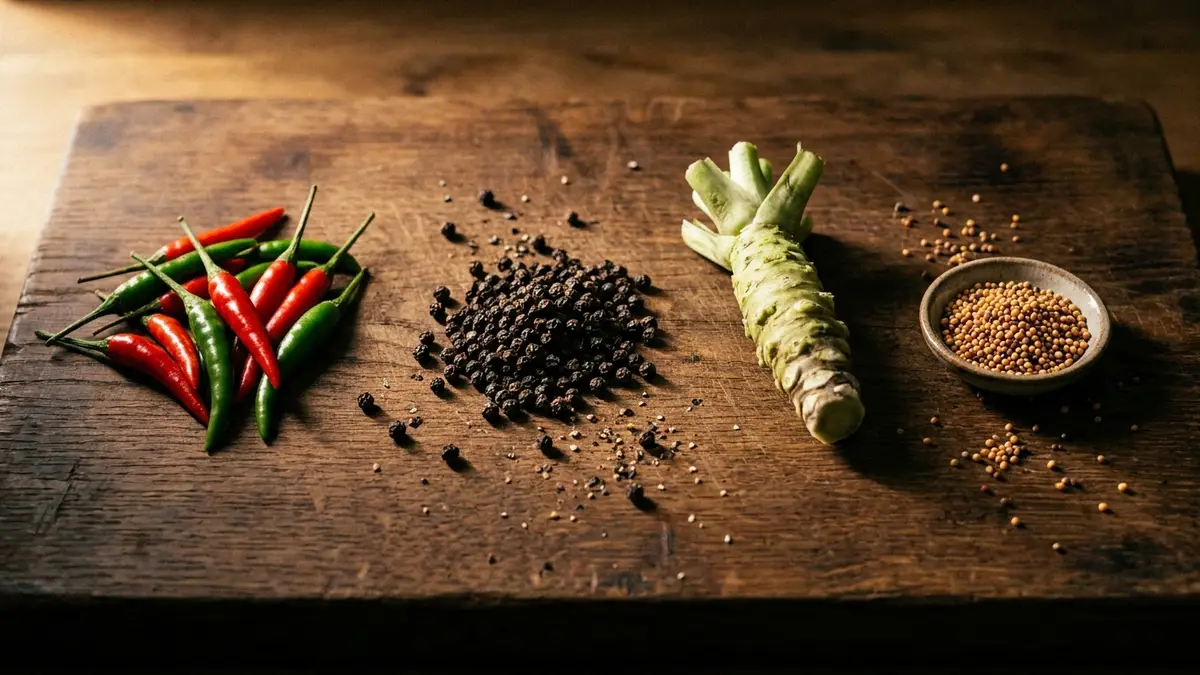
Chili heat comes from capsaicin, black pepper from piperine, and wasabi, mustard, and horseradish from allyl isothiocyanate. Capsaicin is oil-soluble and lingers for minutes, so it needs sugar and low alcohol. Isothiocyanate heat vents through the nose in seconds, so a dry wine copes fine.
Chili heat (capsaicin)
Capsaicin binds to the TRPV1 receptor and builds bite after bite. Sichuan peppercorn's numbing buzz comes from sanshool and reads as texture rather than burn. If the dish numbs more than it burns, an aromatic white bridges it better than extra sugar.
Black-pepper heat (piperine)
Piperine hits the same receptor family but is milder and shorter-lived, so peppercorn-crusted steak needs no off-dry wine. A low-tannin red served cool, or a dry Grüner Veltliner, works.
Wasabi, mustard, and horseradish heat (allyl isothiocyanate)
This heat acts on a different receptor (TRPA1) and never builds up. Choose acidity and bubbles: a dry Riesling, a brut sparkling wine, or a crisp Albariño. Avoid heavily oaked whites, whose toasty edge fights the condiment.
Cuisine-Specific Pairing Guide
Thai
If a Thai dish leads with aromatics, choose Gewürztraminer; if it leads with heat, choose Riesling. Massaman, larb and khao soi are in wine with Thai food.
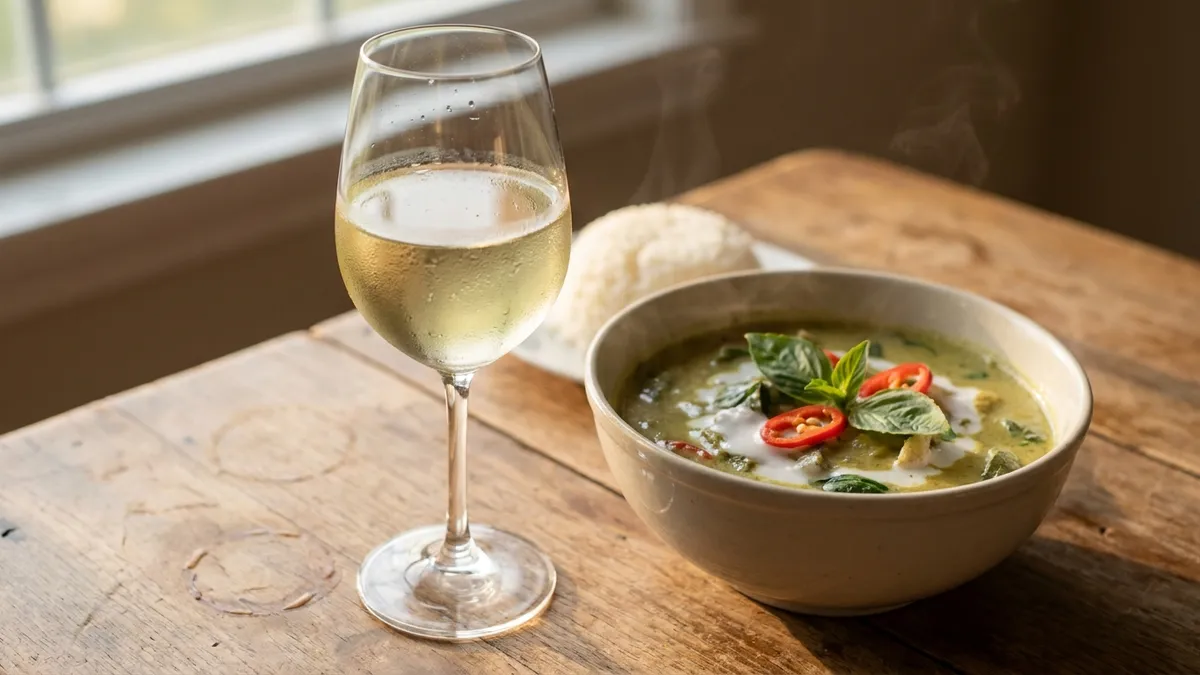
- Green curry: Riesling Spätlese (the coconut cream needs matching sweetness)
- Pad Thai: off-dry Riesling Kabinett or Grüner Veltliner
- Som tam (papaya salad): dry Riesling or Vinho Verde (the lime acidity in the dish bridges to the wine)
- Tom yum soup: off-dry Gewürztraminer (other bowls are covered in wine with soup)
Indian and Mexican
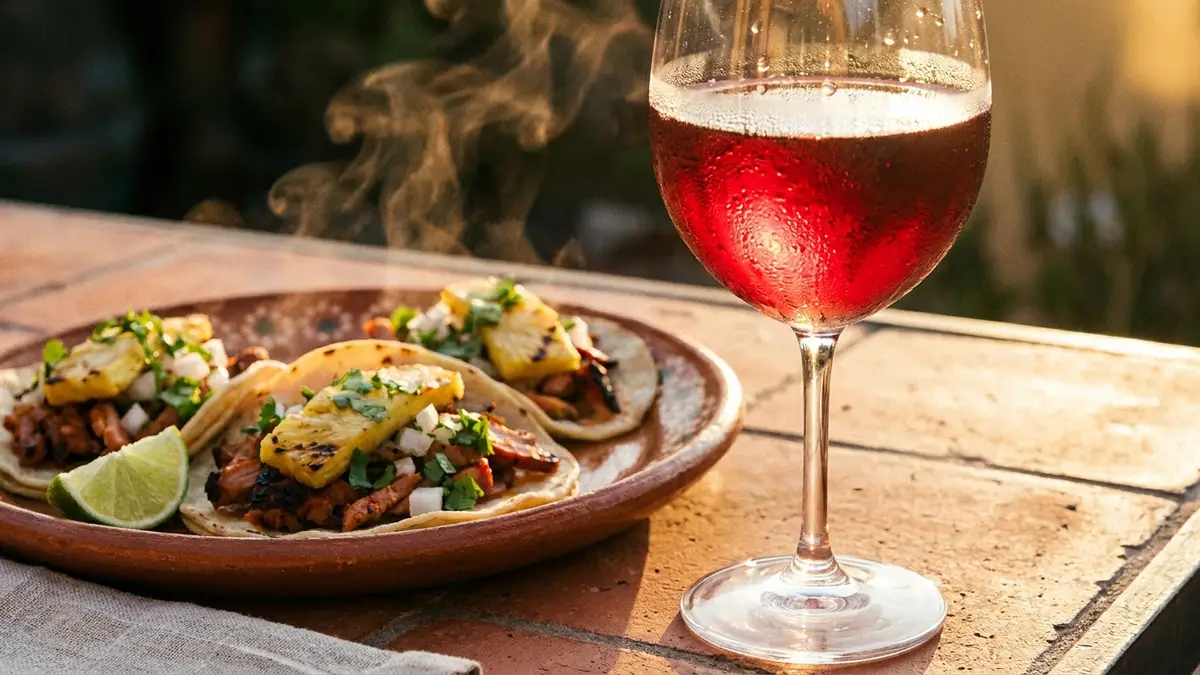
India's range runs from mild korma (off-dry Chenin Blanc or Viognier) through madras (Riesling Spätlese) to vindaloo (Moscato d'Asti or Riesling Auslese). In Mexican cooking, fruit-forward Grenache goes with smoky mole, while ceviche wants Albariño or Vinho Verde. Taco fillings, from carnitas to al pastor, get their own picks in wine with tacos. Dish-by-dish picks are in wine with Indian food and wine with Mexican food. Scotch bonnet heat in jollof, suya and pepper soup is covered in wine with West African food.
Korean
Choose off-dry Riesling or Gewürztraminer for Korean BBQ and Riesling Spätlese for kimchi jjigae, where its acidity mirrors the kimchi. Moscato d'Asti suits tteokbokki, and dry Riesling suits japchae. More dishes are in wine with Korean food, and berbere stews with sour injera in wine with Ethiopian food.
What About Red Wine?
If you want red with spicy food, choose the lightest, lowest-alcohol, lowest-tannin red you can find, keep the heat mild or medium, and chill it first. It will still work less well than an off-dry white. The three safest reds:
- Gamay (Beaujolais): low tannin and high acid; slightly chilled, it handles mild heat
- Lambrusco, sweet frizzante style: sparkling, sweet and low in alcohol
- Brachetto d'Acqui: a sweet, lightly sparkling red from Piedmont for hot dishes
Is a "Spicy Red Wine" the Right Red for Spicy Food?
Usually not. A spicy red wine smells of pepper, clove, cinnamon or similar spices; that says nothing about how it handles chili. The grapes most often called spicy, such as Syrah, Grenache, Zinfandel, and Mourvèdre, tend to be full-bodied, tannic, and 14% alcohol or higher, the profile that makes spicy food feel hotter.
Peppery spice comes from the grape: the black-pepper smell in Syrah is traced to rotundone, and our guide to spicy red wine lists the reds that carry it. Baking spice (clove, vanilla, cinnamon) usually comes from oak barrels. Our guide to spice notes in wine traces each aroma to its source, and the Syrah vs Shiraz comparison shows how one grape swings from peppery to jammy with climate.
If you love those wines, keep the dish mild and serve the bottle cooler: a cool-climate Syrah at 12.5 to 13% suits a gently spiced lamb tagine, while one at 15% fails with a vindaloo.
Serving Temperature: The Cheapest Fix
A cooler wine tastes less alcoholic, because less alcohol vapour rises off the glass, and cold also dulls the burn itself. For spicy food, pour whites at 7 to 10°C and any light red at 12 to 14°C, a few degrees below their usual serving range.
If it is a Gamay, give it twenty minutes in the fridge; if it is a white, give it forty. Below about 6°C, Gewürztraminer loses its smell of lychee and rose.
Building Your Spicy Food Wine Strategy
If you keep one bottle in the fridge for spicy nights, make it German Riesling Kabinett or Spätlese. The Sommy app trains the two skills underneath wine and food pairing, detecting sweetness and acidity, by having you rate each as a separate dial.
Pour a dry white and an off-dry white beside your next curry and taste each after a bite.
Sources
- Commission Delegated Regulation (EU) 2019/33 — Annex III, Part B: terms for sugar content of wine (dry, medium dry, medium, sweet) — EUR-Lex, Official Journal of the European Union, 2019
- Bitter Taste Disrupts Spatial Discrimination of Piperine-Evoked Burning Sensations: A Pilot Study — Liu DT, Besser G, Bayer K, Prem B, Mueller CA, Renner B, Biology (Basel), via PubMed Central, 2021
- Which wines pair best with spicy food? Ask the Sommelier — Bert Blaize — Club Oenologique, 2021
- Prädikat categories — quality standards — Wines of Germany (Deutsches Weininstitut)
Frequently Asked Questions
What is the best wine for spicy food?
Off-dry Riesling, particularly German Kabinett or Spätlese, is the most reliable wine for spicy food. Its residual sugar cools the heat, its high acidity refreshes the palate between bites, and its low alcohol (usually 7.5 to 11%) avoids amplifying the burn. Off-dry Gewürztraminer, demi-sec Chenin Blanc, and Moscato d'Asti are the strongest alternatives.
Why is it tricky to pair wine with spicy food?
Capsaicin, the heat compound in chili, fires the same warmth-sensing nerve endings in your mouth that alcohol stimulates, so a high-alcohol wine makes the burn feel stronger. Spicy food also makes your palate more sensitive to bitterness and astringency, which turns a smooth red wine harsh. The wine has to cool the burn without adding any irritant of its own.
What wine should you avoid with spicy food?
Avoid full-bodied, tannic reds above 13.5% alcohol, such as Cabernet Sauvignon, Shiraz, or Malbec, and heavily oaked whites above 14%. High alcohol amplifies the burn, tannin turns bitter against chili heat, and oak adds a drying, toasty edge that clashes with fresh spice.
Does Riesling really cool down spicy food?
Yes, as long as it is off-dry. The residual sugar in a Kabinett or Spätlese Riesling coats the palate and softens capsaicin's burn in the same way a spoonful of yogurt does, while the wine's high acidity keeps each sip refreshing rather than sugary. A bone-dry trocken Riesling helps far less, because it has no sugar to do the cooling.
What ABV of wine is best with spicy food?
Aim for 7 to 12% alcohol. Moscato d'Asti sits at 5 to 6%, German Riesling Kabinett at 7.5 to 10%, Spätlese at 8 to 11%, and Vinho Verde at 9 to 11%. Above about 13%, alcohol starts to noticeably amplify chili heat, and above 14% the effect is hard to ignore.
Is Kabinett or Spätlese better with spicy food?
Kabinett suits medium heat: it is lighter, lower in alcohol, and just off-dry. Spätlese is riper and usually sweeter, so it handles hotter dishes and richer, coconut-based curries. Both are ripeness levels rather than sweetness guarantees, so check the label: a Kabinett or Spätlese marked trocken has been fermented dry and will not cool the heat.
Is rosé good with spicy food?
Off-dry rosé works with mildly spicy dishes, but most dry rosé lacks the residual sugar to tame real heat. Above mild heat, choose an off-dry white. A fuller Tavel-style rosé can handle dishes where smoke and warm spices dominate over chili heat, such as tacos al pastor or jerk-seasoned vegetables.
Does wasabi heat need a different wine than chili heat?
Yes. Wasabi, mustard, and horseradish heat comes from volatile compounds that hit the nose and fade within seconds, so you do not need sugar to cool it. A dry, high-acid, unoaked white or a brut sparkling wine works well. Chili heat is oil-soluble and lingers on the tongue for minutes, which is why it needs residual sugar and low alcohol.
Sommy Team
LinkedInFounder & Wine Educator
The Sommy Team is building the world's most approachable wine education app, helping beginners develop real tasting skills through structured courses and AI-guided practice.