Wine with Chinese Food: Dim Sum, Stir-Fry, and Peking Duck

By the Sommy Team — AI-assisted, human-edited.
Updated Sep 24, 2026
Contents (9)
- What Wine Goes With Chinese Food, in One Paragraph?
- Why Is Chinese Food Hard to Pair With Wine?
- What Wine Goes With Dim Sum?
- What Wine Pairs With Stir-Fry?
- What Wine Goes With Peking Duck?
- What Wine Works With Spicy Sichuan Food?
- Is Riesling the Best All-Round Wine for Chinese Food?
- Does Red Wine Ever Work With Chinese Food?
- What Should You Pour for a Shared Banquet Table?
TL;DR
Pick wine with Chinese food by each dish's loudest flavour. Off-dry Riesling covers the most ground, because its sugar calms chili and its acidity cuts fat and soy salt. Sparkling suits fried dim sum, a chilled Pinot Noir suits Peking duck, and tannic, high-alcohol reds clash with anything hot.
Choose the wine for the loudest flavour on the plate, and pick off-dry Riesling when the table is mixed. Wine with Chinese food works when you match that one thing: duck fat, soy salt, chili burn, numbing pepper or a sweet glaze. Off-dry Riesling answers more of that list than any other style.
What Wine Goes With Chinese Food, in One Paragraph?
The most reliable wine with Chinese food is an off-dry Riesling (a wine with a little sugar you can taste), because its sugar calms chili heat and its high acidity cuts fat and soy salt. Dim sum suits a dry sparkling wine, since carbonation lifts oil from fried dumplings. Stir-fry follows its sauce: a crisp white for pale sauces, a chilled light red for dark ones. Peking duck wants acidity: Pinot Noir, off-dry Riesling or sparkling rosé. If a dish carries chili, stay off-dry and lower in alcohol, and never pour a tannic, high-alcohol red.
Why Is Chinese Food Hard to Pair With Wine?
Because "Chinese food" spans at least eight regional cuisines, and one shared table can put fat, salt, chili, numbing pepper and sweet sauce in front of you at once. The eight cuisines are usually listed as Anhui, Guangdong (Cantonese), Fujian, Hunan, Jiangsu, Shandong, Sichuan and Zhejiang, and their dominant flavours differ widely.
Cantonese dim sum is often steamed and delicate. Sichuan and Hunan cooking is famous for heat. A takeaway order mixes them, which is why a single "Chinese food wine" rule fails. The fix is to read each dish for one driver and pick the wine trait that answers it. If a table mixes three or more drivers, open an off-dry Riesling first.
Two traits do most of the work. Acidity (the tartness that makes your mouth water) cuts fat and stands up to salty sauces. Tannin (the drying grip on your gums, mostly from red grape skins) is the trait to keep low, because it clashes with heat.
| Loudest flavour | Where you meet it | Wine trait that answers it | Pour this |
|---|---|---|---|
| Fat and crisp skin | Peking duck, crispy pork belly, fried dumplings | High acidity or bubbles | Pinot Noir, dry sparkling rosé, dry sparkling wine |
| Soy salt and savoury depth | Stir-fries, black bean sauce, soy chicken | Acidity, low tannin | Dry Riesling, Grüner Veltliner, chilled Gamay |
| Chili burn | Kung pao, Hunan dishes, chili oil | A touch of sugar, lower alcohol, no tannin | German Riesling Kabinett, off-dry Gewürztraminer |
| Numbing Sichuan pepper | Mapo tofu, mala hot pot, dan dan noodles | Same as chili: off-dry, lower alcohol | Off-dry Riesling or Gewürztraminer |
| Sweet or sweet-sour sauce | Char siu, sweet-and-sour pork, hoisin | At least as much sweetness as the sauce | Off-dry Riesling, off-dry Chenin Blanc |
| Delicate steamed seafood | Har gow, steamed fish with ginger | Light body, crisp acidity | Dry Riesling, Grüner Veltliner, dry sparkling |
For the general principles behind this table, the wine and food pairing guide covers the full set of rules, and the food pairing hub collects every cuisine.
What Wine Goes With Dim Sum?
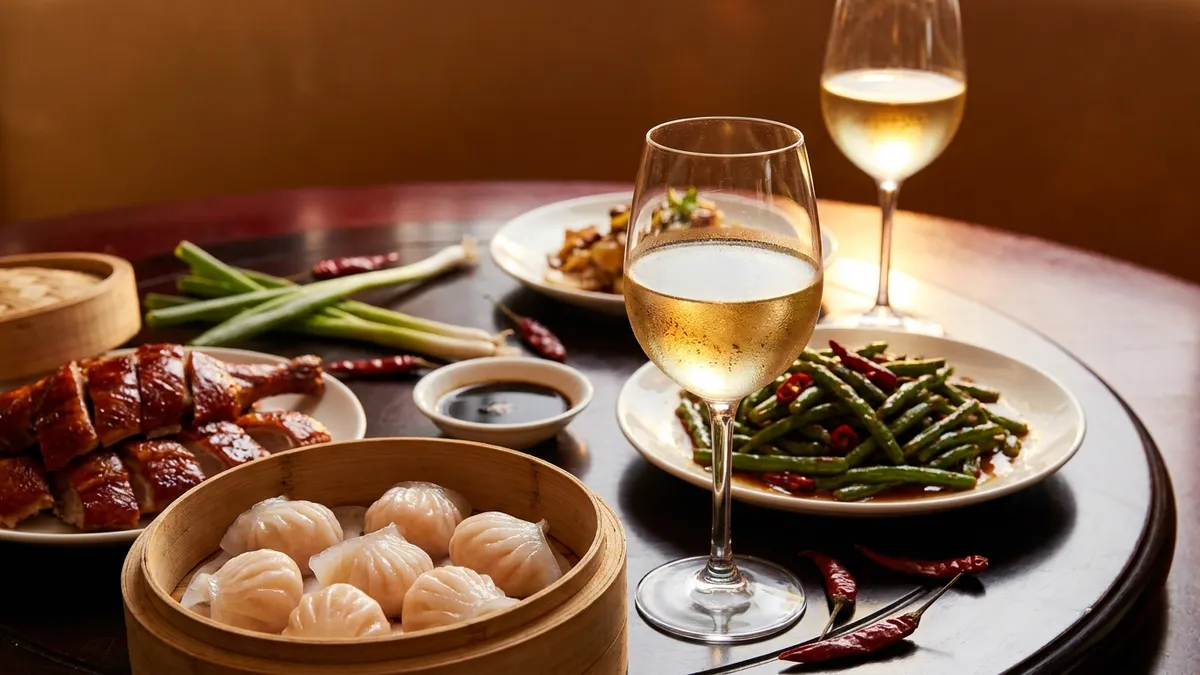
Sparkling wine or a crisp dry white is the safest pour for dim sum, because most of the basket is steamed, salty or fried. A dry sparkling wine handles all three. Dim sum grew out of the Cantonese teahouse tradition of yum cha (literally "drink tea") in Guangzhou, once called Canton, where small plates were served alongside tea.
That tea origin explains the variety. There are at least two thousand types of dim sum across China, and about forty to fifty are commonly sold outside it. A basket of steamed shrimp dumplings and a plate of fried taro puffs are different pairing problems, so no single "dim sum wine" covers them equally.
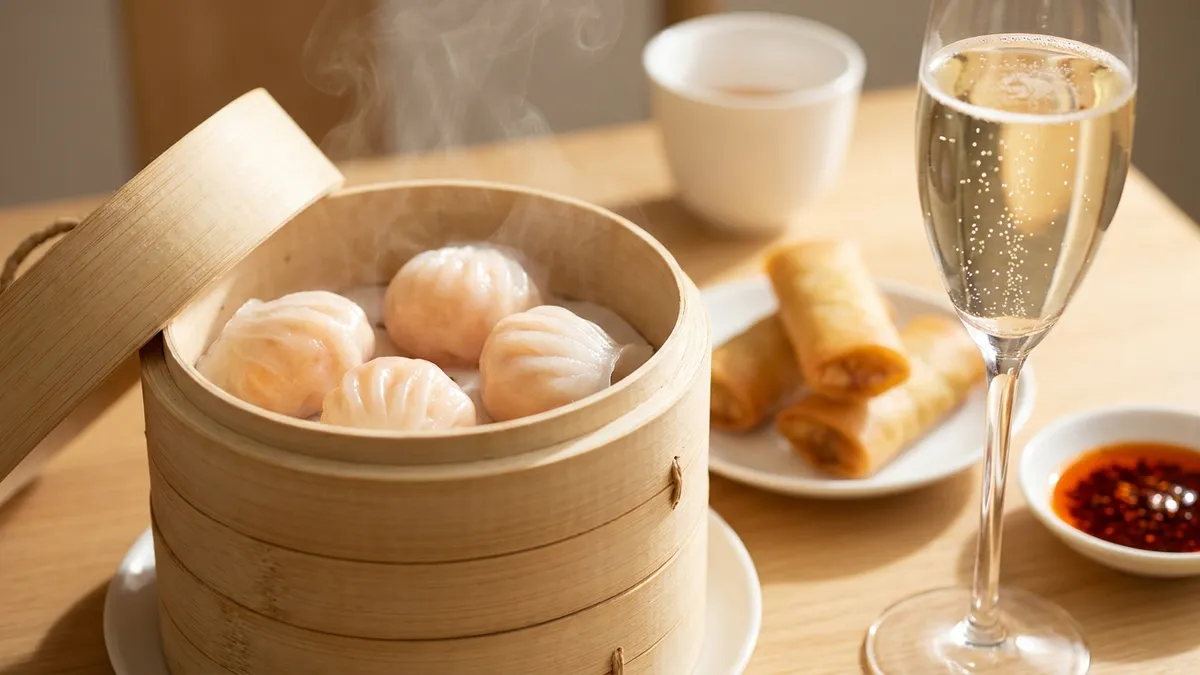
Bubbles earn their place with the fried items. The Wine & Spirit Education Trust (WSET) notes that carbonation cleanses the palate between bites, lifting away oils and spice compounds that cling to the mouth. That is what a spring roll or a fried sesame ball leaves behind. For the difference between the main styles, see sparkling wine types.
Steamed seafood dumplings such as har gow are lighter and saltier from the dipping soy. A crisp, light-bodied dry white suits them: dry Riesling or Grüner Veltliner. Barbecue pork buns and sticky glazed ribs bring sugar, and sugar in food makes a dry wine taste thin and sour, so those want a touch of sweetness in the glass.
If the basket is fried, pour the sparkling wine; if it is steamed seafood, pour the crisp dry white; if it is glazed and sweet, reach for off-dry Riesling.
What Wine Pairs With Stir-Fry?
Match a stir-fry to its sauce: crisp whites for pale garlic-and-ginger sauces, and a chilled light red for dark oyster or black bean sauces with beef or pork. The protein matters less than the sauce, because the sauce coats every single bite.
Most of those sauces start with soy. China is home to soy sauce, which is made from fermented soybeans and wheat, and it brings salt and deep savoury flavour to the wok. Salt and savoury depth favour wines with high acidity and low tannin. For why that savoury taste changes how wine feels, see the explainer on umami and savoury flavours in wine.
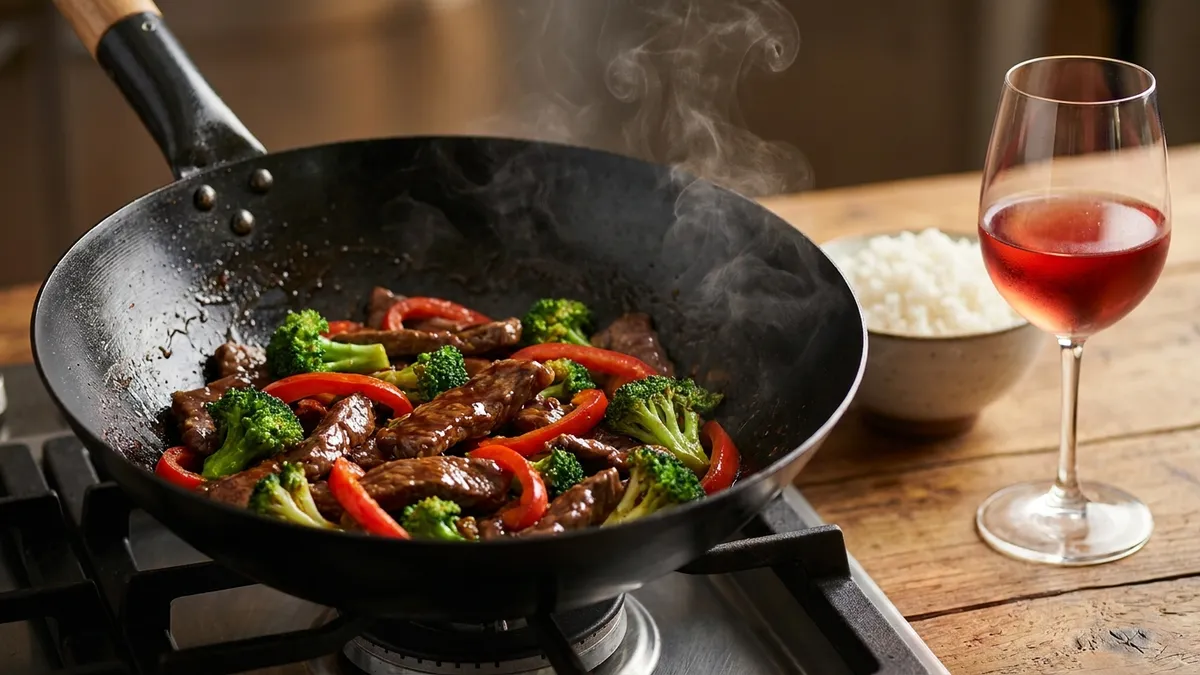
Pale sauces built on garlic, ginger and a splash of rice wine go with prawns, chicken and tofu. A dry Riesling or Grüner Veltliner brings the acidity those sauces need without covering the ginger.
Dark sauces are heavier. Oyster sauce, black bean sauce and dark soy with beef or pork can carry a red, as long as the red is light and low in tannin. Gamay, the grape of Beaujolais, is the easiest choice, served slightly cool; the Gamay wine guide explains why it has so little grip. If the stir-fry has dried chilies in it, treat it as a spicy dish and use the Sichuan rule below.
If the sauce is dark and the meat is beef or pork, pour a chilled light red; if the sauce is pale and the protein is prawn, chicken or tofu, pour a dry white.
What Wine Goes With Peking Duck?
Peking duck wants acidity or bubbles more than weight: Pinot Noir, off-dry Riesling or a dry sparkling rosé. The duck is served for its thin, crispy skin, and traditional versions put mostly skin and little meat on the plate. It is fat and glaze, and the wine has to cut both.
The cooking explains the skin. Air is pumped under the skin to separate it from the fat. Then the bird is glazed twice: first with honey syrup, then with soy sauce and five-spice powder (a blend of Sichuan peppercorn, cloves, cinnamon, fennel seeds and star anise). In the open-oven method it roasts at 270°C (518°F) for 30 to 40 minutes, which leaves the skin glassy and crisp.
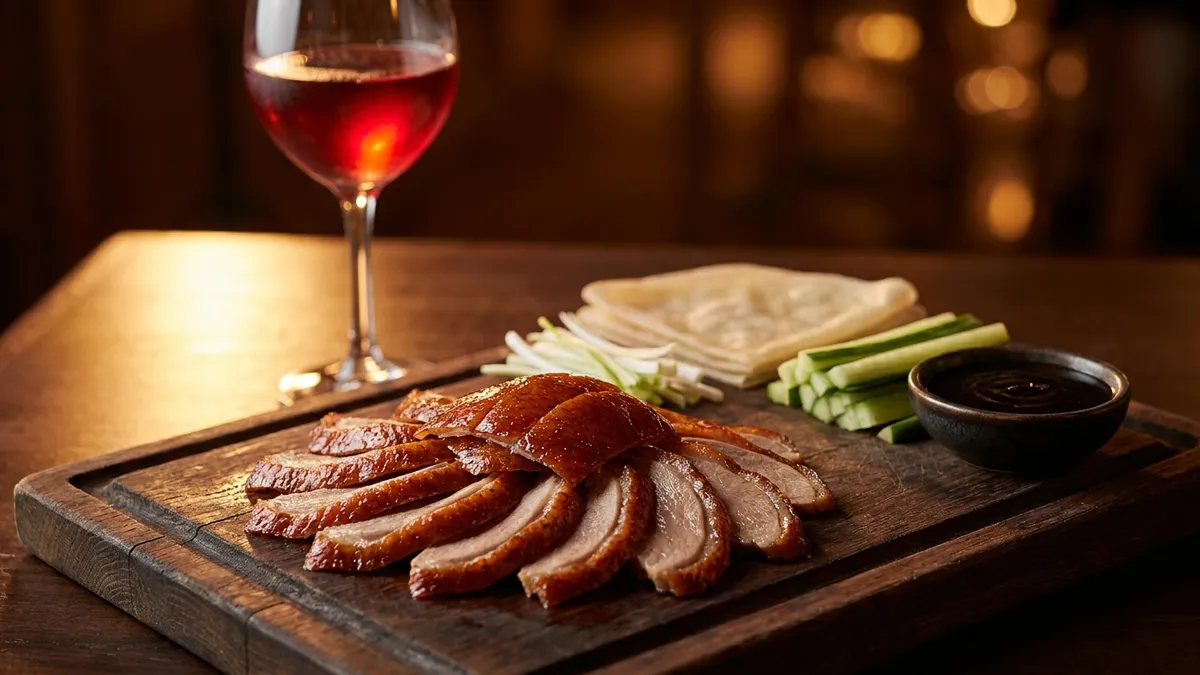
The duck comes with spring pancakes, sliced cucumber, spring onions and sweet bean sauce. The sauce adds sugar and the spring onion adds a sharp bite.
The usual reflex is "rich meat, big red." That reflex fails here, because the plate is driven by fat and sweet sauce rather than by red meat. A full-bodied, tannic red tastes bitter against the sugar. Body (a wine's weight in the mouth, like skimmed versus whole milk) matters less than acidity.
Pinot Noir has both high acidity and low tannin, and its cherry fruit sits well with the five-spice glaze; the Pinot Noir guide covers the styles. Sparkling rosé scrubs the fat between pancakes.
If the sweet bean sauce goes on thickly, pick the off-dry Riesling; if you eat the skin mostly plain, pour Pinot Noir or a sparkling rosé.
What Wine Works With Spicy Sichuan Food?
An off-dry, lower-alcohol white such as German Riesling Kabinett or off-dry Gewürztraminer handles Sichuan food best, because most numbing dishes also carry chili. The numbing and the burn are two separate sensations, caused by different compounds, and the chili is the one that decides the wine.
The numbing comes from Sichuan pepper, which is not closely related to black pepper or chili pepper. Its tingle comes from a compound called hydroxy-alpha-sanshool. So the famous Sichuan tingle is touch, not heat. Food scientist Harold McGee describes sanshools as making nerves sensitive to touch and cold that normally are not, "a kind of general neurological confusion."
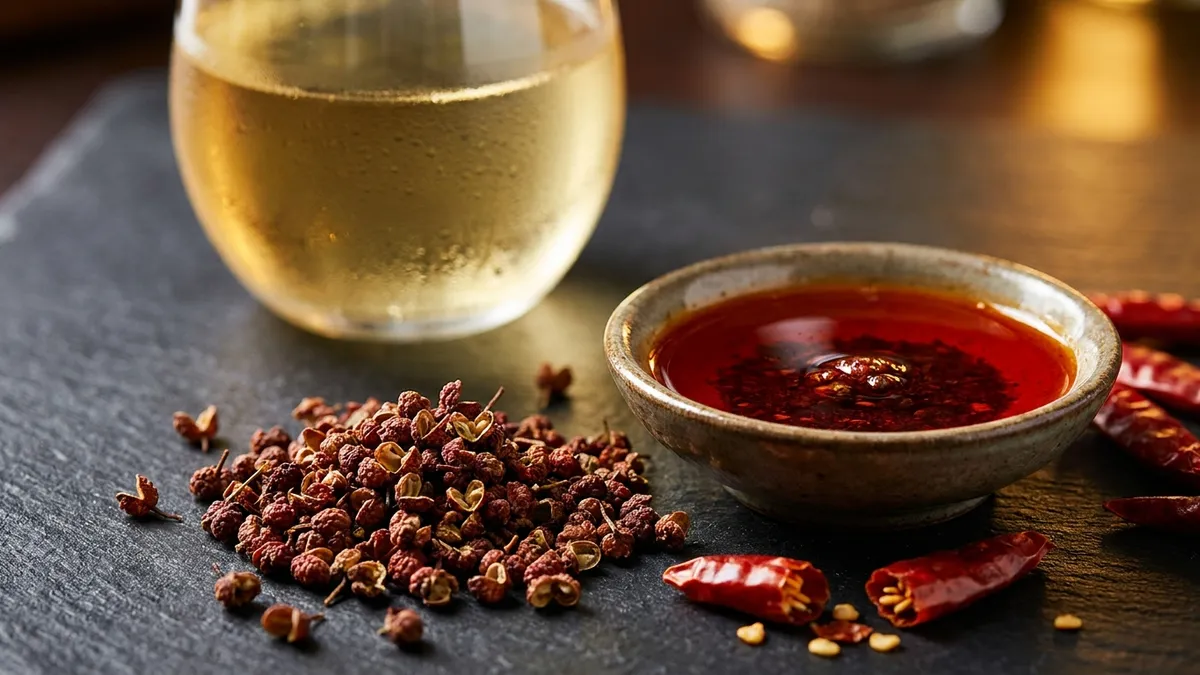
The burn comes from capsaicin, the heat compound in chili. It barely dissolves in water, at 0.0013 g per 100 mL, which is why a glass of water does little against it. It does dissolve in alcohol, yet a strong wine still makes the burn feel stronger. WSET notes that the perception of alcohol intensifies when it meets spice. The same source notes that a drink with some sweetness softens the perception of heat, so a touch of sugar calms the burn.
Put together, the rule is simple. Mapo tofu, dan dan noodles and mala hot pot all combine the tingle with chili oil, so treat them as chili dishes. German Riesling Kabinett has the sugar and modest alcohol they need.
Gewürztraminer is the second choice. It shares aroma compounds with lychee, so it smells of lychee and rose, and that perfume holds its own against the peppercorn's citrus-like scent. The Gewürztraminer wine guide explains how to find an off-dry one. For the chili rule in full, including alcohol levels by style, see the best wine for spicy food.
If chili oil is visible on the plate, choose a wine with a touch of sugar and lower alcohol, and leave the dry, tannic reds for another meal.
Is Riesling the Best All-Round Wine for Chinese Food?
Riesling is the best single bet, as long as the label promises a little sweetness and the dish has some heat. Its naturally high acidity cuts fat and salt, and it is made in every sweetness level, so one grape can match a steamed dumpling or a chili stir-fry.
The label is where to be careful. German Riesling uses ripeness words called Prädikat levels, from Kabinett and Spätlese up to Beerenauslese and Trockenbeerenauslese, the last two being dessert wines. Kabinett is the lightest and suits medium heat; Spätlese is riper, usually sweeter, and handles hotter or sweeter dishes. The word trocken means the wine was fermented dry, so a Kabinett trocken will not soften chili.
Other regions make Riesling drier and stronger. Alsace producers favour styles at around 12% alcohol, and Austrian Riesling normally reaches about 13%. Those drier, fuller wines suit steamed fish, salt-and-pepper squid and soy chicken more than chili dishes. The Riesling wine guide maps every style, and the sweet vs dry wine explainer shows how to read sweetness on a label.
Alsace is also Gewürztraminer's home: it is one of the region's most planted grapes and its most characteristic one. An Alsace shelf gives you both options for a Chinese meal in one place.
If the label says trocken, save the bottle for the mild dishes; if it says Kabinett or Spätlese with no trocken, bring it to the spicy ones.
Does Red Wine Ever Work With Chinese Food?
Yes, if the red is light, low in tannin and slightly chilled, and the dish is savoury rather than hot. Pinot Noir and Gamay fit that description. Heavy, high-alcohol Cabernet Sauvignon or Shiraz does not, and it clashes with anything carrying chili.
The problem is tannin. WSET notes that tannins create strong tactile sensations and, with hot spices, can feel harsh, exaggerating both dryness and intensity. Add the alcohol effect from the Sichuan section and a big red meets chili from two sides. For what tannin is and where it comes from, see what are tannins.
Savoury, non-spicy dishes are where a red works. Peking duck, char siu, soy-braised pork belly and black bean beef all have fat and deep savoury sauce but no chili. A light red with good acidity handles them. Serve it cool from the fridge, which makes the alcohol less noticeable and the fruit taste fresher.
If the dish is hot, keep the red for another night; if it is savoury and rich, pour a chilled Pinot Noir or Gamay.
What Should You Pour for a Shared Banquet Table?
Put one dry sparkling wine and one off-dry Riesling on the table, and chill both well. The sparkling wine covers the fried dim sum and the duck; the Riesling covers the salty stir-fries, the sweet glazes and the chili dishes.
If you only open one bottle, make it the off-dry Riesling, because it has the widest reach. Add a third, a chilled Pinot Noir, only when duck or dark-sauced meat is the centre of the meal. The same two-bottle logic works for other shared tables: see wine with Thai food for a cuisine that stacks sweet, sour, salty and hot in one dish.
Serve the whites and the sparkling well chilled, straight from the fridge. Cold wine tastes crisper and the alcohol is less noticeable next to chili.
Tonight, order a mixed takeaway with one steamed, one fried, one dark-sauced and one spicy dish, then taste one off-dry Riesling against each. Note which dish made the wine taste sweeter and which made it taste sour. The tasting mode in the Sommy app can guide it. Photograph the label and it walks you through look, smell and taste, then saves your notes to a tasting journal. Pour the Riesling with the spiciest dish first.
Sources
- How to pair drinks with spice — Aleesha Hansel, WSET Global, Knowledge Centre, 2026
- Sichuan pepper — Wikipedia
- Peking duck — Wikipedia
- Dim sum — Wikipedia
- Riesling — Wikipedia
Frequently Asked Questions
What is the best wine to go with Chinese food?
Off-dry Riesling is the most reliable single bottle. Its high acidity cuts through duck fat and salty soy sauces, and its touch of sugar softens chili heat, so it copes with most of a mixed table. Add a dry sparkling wine for fried dim sum and a chilled, low-tannin red such as Pinot Noir or Gamay for duck and dark-sauced beef.
What wine goes with Peking duck?
Pinot Noir is the classic choice, because its acidity cuts the fatty skin and its low tannin stays soft beside the sweet bean sauce. Off-dry Riesling works when the sauce goes on thickly, and a dry sparkling rosé scrubs the fat from your mouth between pancakes. Avoid heavy, tannic reds: the skin is mostly fat and sugar-glazed, and they taste bitter beside it.
What wine pairs with dim sum?
A dry sparkling wine is the safest match for a mixed dim sum spread, because its bubbles lift oil from fried items and its acidity suits salty dipping sauces. With steamed seafood dumplings, a crisp dry white such as Grüner Veltliner or dry Riesling works well. With barbecue pork buns and sticky sauces, move to an off-dry Riesling.
Does red wine go with Chinese food?
Yes, with the right dish and the right red. Choose a light, low-tannin red such as Pinot Noir or Gamay, serve it slightly chilled, and pour it with savoury, non-spicy dishes like Peking duck, char siu or black bean beef. Keep tannic, high-alcohol reds away from chili, because tannin feels harsh with hot spice and alcohol makes the burn stronger.
What wine goes with spicy Sichuan food?
An off-dry, lower-alcohol white is the best choice: German Riesling Kabinett or an off-dry Gewürztraminer. Most Sichuan dishes combine numbing Sichuan pepper with chili, and the chili sets the rule. A little sugar softens the burn, while high alcohol makes it feel hotter. Dry, tannic reds are the worst choice with mapo tofu or chili-oil dishes.
Is Gewürztraminer good with Chinese food?
Yes, especially with aromatic and spicy dishes. Gewürztraminer shares aroma compounds with lychee, so it smells of lychee and rose, and off-dry versions soften chili heat. It suits five-spice pork, sweet-and-sour dishes and Sichuan chili oil. Choose an off-dry bottle: dry, high-alcohol Gewürztraminer can taste bitter and hot beside real chili.
Sommy Team
LinkedInFounder & Wine Educator
The Sommy Team is building the world's most approachable wine education app, helping beginners develop real tasting skills through structured courses and AI-guided practice.