Wine with Thai Food: Balancing Sweet, Sour, Salty, and Spicy

By the Sommy Team — AI-assisted, human-edited.
Updated Sep 23, 2026
Contents (11)
- Why Wine with Thai Food Is a Four-Flavor Problem
- What Wine Goes with Thai Food? The Short Answer
- Why Is Wine with Thai Food Different from Wine with Spicy Food?
- What Wine Pairs with Pad Thai?
- What Wine Goes with Green and Red Curry?
- Is Massaman Curry a Different Pairing?
- What Wine Works with Som Tam and Larb?
- What Wine Pairs with Tom Yum and Khao Soi?
- Thai Dish, Wine Style, and Why: At a Glance
- Should You Drink Red Wine with Thai Food?
- How to Order Wine for a Whole Thai Table
TL;DR
Wine with Thai food works when you answer all four flavors, not just the chili. Off-dry, low-alcohol Riesling (Kabinett for pad thai, Spätlese for green curry) covers the sweet and spicy dishes, while dry, high-acid whites like Vinho Verde and Albariño suit sour, salty som tam and larb. Mellow massaman opens the door to Gewürztraminer or a chilled Gamay.
Why Wine with Thai Food Is a Four-Flavor Problem
Pairing wine with Thai food is harder than pairing wine with "spicy food", because chili heat is only one of four dials on the plate. A Thai cook balances sweet (palm sugar, coconut cream), sour (lime, tamarind), salty (fish sauce, shrimp paste), and spicy (bird's eye chili) in a single dish. A wine chosen only to cool the chili tastes sugary next to a lime-led salad and thin next to a coconut curry. This guide translates each flavor into a wine trait, then works dish by dish, so you can pick a style by asking which flavor is loudest in the bowl.
What Wine Goes with Thai Food? The Short Answer
The most reliable wine with Thai food is an off-dry, low-alcohol, high-acid white: German Riesling Kabinett for milder dishes such as pad thai, Spätlese for green curry and anything hotter. Its touch of residual sugar softens the chili, its acidity matches lime and tamarind, and alcohol around 8 to 11 percent stops the burn from spreading. Sour-led Isaan dishes like som tam and larb prefer a dry or barely off-dry white with sharp acidity: dry Riesling, Vinho Verde, Albariño, or Grüner Veltliner. Mellow, warm-spiced massaman curry is where Gewürztraminer, Viognier, and a chilled light red such as Gamay earn a place. Avoid tannic, oaky reds above 13.5 percent alcohol with anything hot, and serve every bottle well chilled.
Why Is Wine with Thai Food Different from Wine with Spicy Food?
Because Thai cooking balances four flavors at once, and each one pulls the wine a different way. Chili heat wants sugar and low alcohol, but sourness wants acidity, saltiness wants fruit and no tannin, and sweetness wants a wine at least as sweet as the dish. A wine chosen only for the heat gets three of the four wrong.
- Sour asks for acidity. Lime and tamarind are the two souring agents: lime sharp and bright, tamarind sweet-sour and rounder. Both make a low-acid wine taste flat, while a wine with high acidity (the tart, mouth-watering quality that makes you salivate) keeps pace. See what wine acidity is.
- Salty asks for fruit and low tannin. Fish sauce (nam pla, a clear, fermented fish seasoning) goes into nearly every Thai dish. It is intensely salty: common commercial fish sauces carry roughly 50 to 60 percent of the FDA's daily recommended sodium in one tablespoon. Salt on its own softens a wine, but fish sauce is also loaded with umami, which makes tannin (the drying, gripping texture in red wine) feel harsher and more bitter; see savory and umami flavors in wine.
- Sweet asks for equal or greater sweetness. Palm sugar and coconut cream run through curries, pad thai, and dipping sauces, and a wine drier than the dish tastes thin and sour after each bite. Off-dry wine carries a little unfermented grape sugar; under EU labelling law a wine may be called "medium dry" up to 12 grams of sugar per litre, or 18 with enough acidity to balance it. The wine sweetness scale shows where each style sits.
- Spicy asks for sugar and low alcohol. In WSET's 2026 guide to pairing drinks with spice, Aleesha Hansel writes that "when a drink with sweetness meets spice, it softens the perception of heat", while "the perception of alcohol intensifies when it meets spice", especially with capsaicin. Bird's eye chili, the small Thai chili behind most of the burn, is far hotter than a jalapeño, so both rules bite hard here. The chemistry and the grape-by-heat table live in our guide to wine with spicy food; the low-alcohol wines roundup lists styles under 12 percent.
What Wine Pairs with Pad Thai?
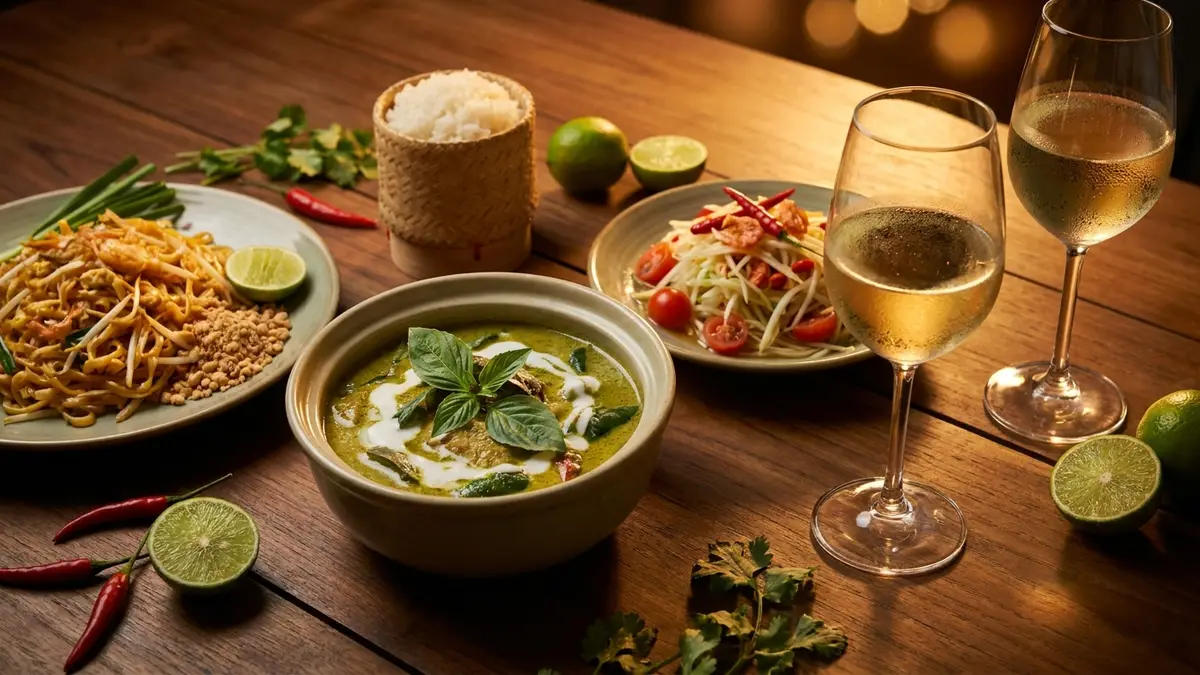
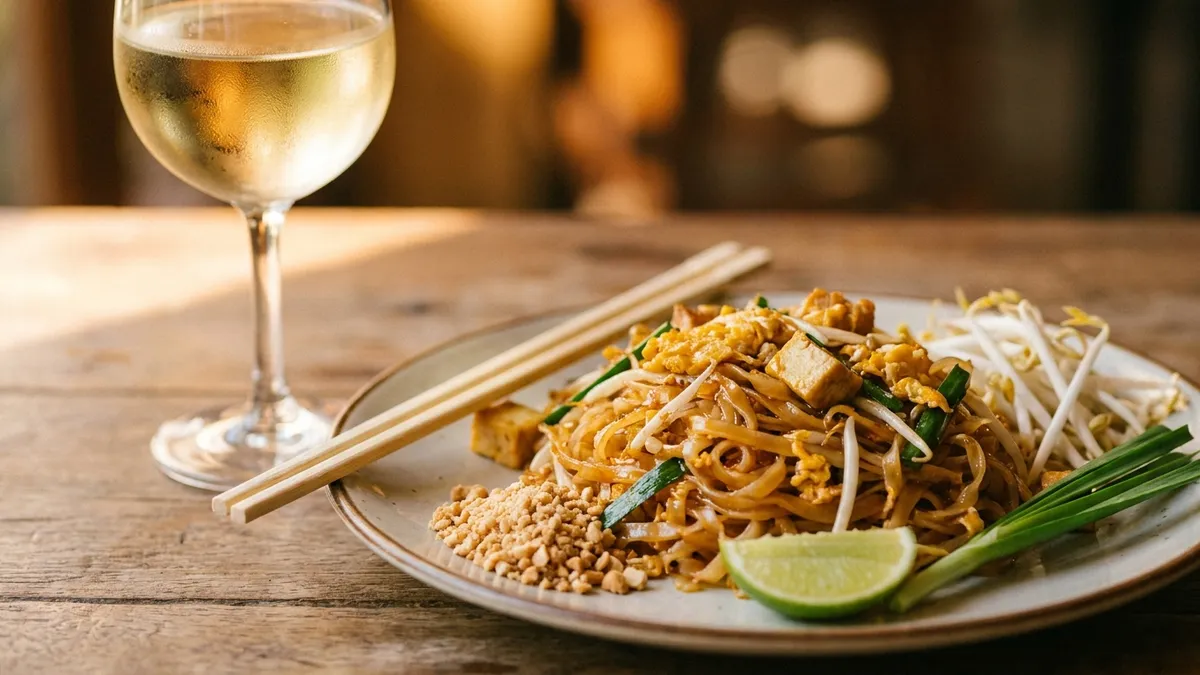
Off-dry Riesling Kabinett is a classic match for pad thai. The sauce is tamarind, fish sauce, and palm sugar, so the dish is sweet, sour, and salty with only mild heat: Kabinett's sugar meets the palm sugar, its acidity meets the tamarind and lime, and its low alcohol leaves the chili flakes alone.
Pad thai is stir-fried rice noodles with egg, firm tofu, dried shrimp, garlic, and shallots, finished with crushed peanuts, bean sprouts, and a squeeze of lime. Sweet and sour lead, salt supports, and heat is usually up to you. That balance is why a Kabinett, which Mosel winemaker Ernst Loosen describes as having "a low alcohol content, just 7.5-8.5%", tastes almost engineered for it. The Riesling wine guide explains the label, and the Prädikat classification guide decodes Kabinett, Spätlese, and Auslese.
To stay dry, Grüner Veltliner brings crisp acidity and a white-pepper note that suits the peanuts and lime; see the Grüner Veltliner guide. A demi-sec Vouvray, the off-dry face of Chenin Blanc, is the richer choice when egg and peanuts weigh the plate down.
What Wine Goes with Green and Red Curry?
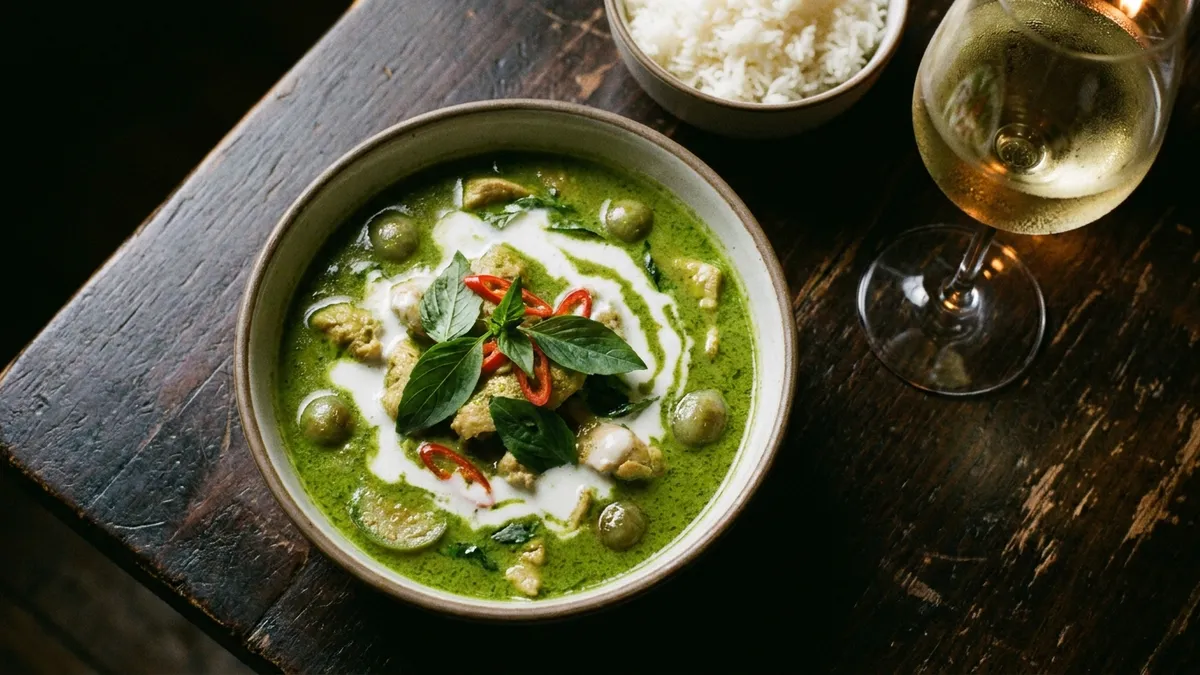
Riesling Spätlese is the safest wine for Thai green or red curry. Coconut milk makes the curry rich and gently sweet, the paste brings serious heat, and fish sauce salts it, so the wine needs more sugar than a Kabinett, the same bright acidity, and alcohol under about 11 percent. Off-dry Gewürztraminer is the aromatic alternative.
Green curry takes its color from green chilies, and despite the "sweet green" in its Thai name it is no sweeter than other curries; it tends to be more pungent than the milder red. Both are built on coconut milk, curry paste, palm sugar, and fish sauce, with Thai basil and kaffir lime leaf on top. Spätlese passes that test because its sugar matches the coconut, its acidity cuts the cream, and its alcohol adds nothing to the burn. For the spiciest curries Loosen goes one tier up, to an Auslese, because "that sweetness will tone down the spiciness well".
Gewürztraminer earns its reputation here: its lychee, rose, and ginger perfume echoes the galangal and lemongrass in the paste, and off-dry versions carry enough sugar for a medium-heat curry. Two cautions from the Gewürztraminer wine guide: its acidity is low, so it refreshes less between bites, and Alsace versions often reach 13 to 14 percent alcohol, so save it for medium heat rather than a fiery bowl.
Is Massaman Curry a Different Pairing?
Yes. Massaman is Thailand's mellow curry, built on dried warm spices, peanuts, potato, and tamarind rather than fresh chili heat, so it does not need much sugar in the glass. Pour a dry or just off-dry aromatic white such as Gewürztraminer or Viognier, or a chilled light red like Gamay or Pinot Noir.
Writing for National Geographic, Rebecca Seal notes that massaman "isn't like other Thai curries"; rather than chili-hot like a green or red curry, "it's positively mellow", with mace, nutmeg, cloves, cassia, bay leaves, cumin, coriander seed, and cardamom in the pot.
With the chili dial turned down, the loudest flavors are warm spice and coconut-peanut richness, so you are matching aromatics and weight, not fighting a burn. Viognier, with its apricot and baking-spice character, and a dry Alsace Gewürztraminer both mirror the paste; see the Viognier wine guide. This is also the one curry where a red belongs: a Gamay from Beaujolais or a light Pinot Noir, served cool, has the red fruit for the braised meat and so little tannin that the fish sauce cannot turn it bitter. The Gamay wine guide covers the chillable styles.
What Wine Works with Som Tam and Larb?
Som tam and larb want a dry, high-acid white, not a sweet one. Both Isaan dishes are led by lime and fish sauce with chili layered on top, so the wine's job is to match the sourness: dry Riesling, Vinho Verde, Albariño, or Grüner Veltliner. Step up to an off-dry Kabinett only when the chili count climbs.
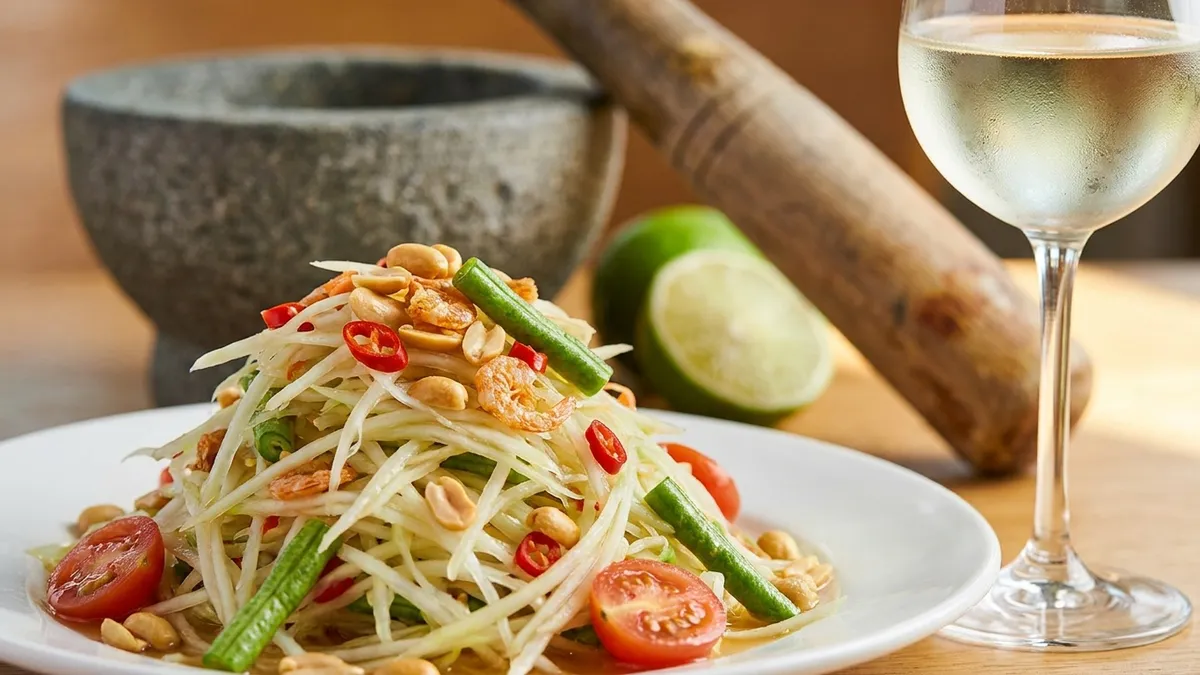
Som tam is shredded green papaya pounded in a mortar (tam means the pounding) with lime juice, chili, fish sauce, palm sugar, dried shrimp, garlic, and tomato. An Isaan staple with Lao roots, it puts sour, spicy, salty, and sweet into one bite, but lime leads. Larb applies the same dressing to a meat salad: minced pork, chicken, or beef with lime juice, fish sauce, chili, fresh mint, and khao khua (toasted, coarsely ground rice that adds a nutty crunch), served at room temperature with sticky rice.
Sweetness is the wrong answer because neither dish carries much sugar of its own; a Spätlese would taste like syrup beside them. Acidity is the right one, and the salt in the fish sauce makes a crisp wine taste rounder than it would alone. Loosen suggests a Kabinett for a mild to medium som tam and a Spätlese for very spicy versions or those made with crab or fermented fish. For the dry end, the Vinho Verde guide and the Albariño wine guide cover two coastal whites with the lime-like zip these salads want.
What Wine Pairs with Tom Yum and Khao Soi?
Tom yum, a hot-and-sour broth, pairs with off-dry Riesling or a dry sparkling wine; khao soi, the north's coconut curry noodle soup, pairs with off-dry Riesling or demi-sec Chenin Blanc. Both stack sour and spicy on top of aromatic herbs, so acidity and a little sugar do most of the work.
Tom yum simmers lemongrass, galangal, kaffir lime leaves, and chili in broth, then finishes with fish sauce and lime juice. The clear version, tom yum nam sai, is all citrus, herb, and heat: a dry sparkling wine or dry Riesling refreshes between spoonfuls. The creamy version, tom yum nam khon, which adds evaporated milk, wants an off-dry Riesling; Loosen goes as far as an Auslese for tom yum and tom kha. The sparkling wine types guide covers the dry styles.
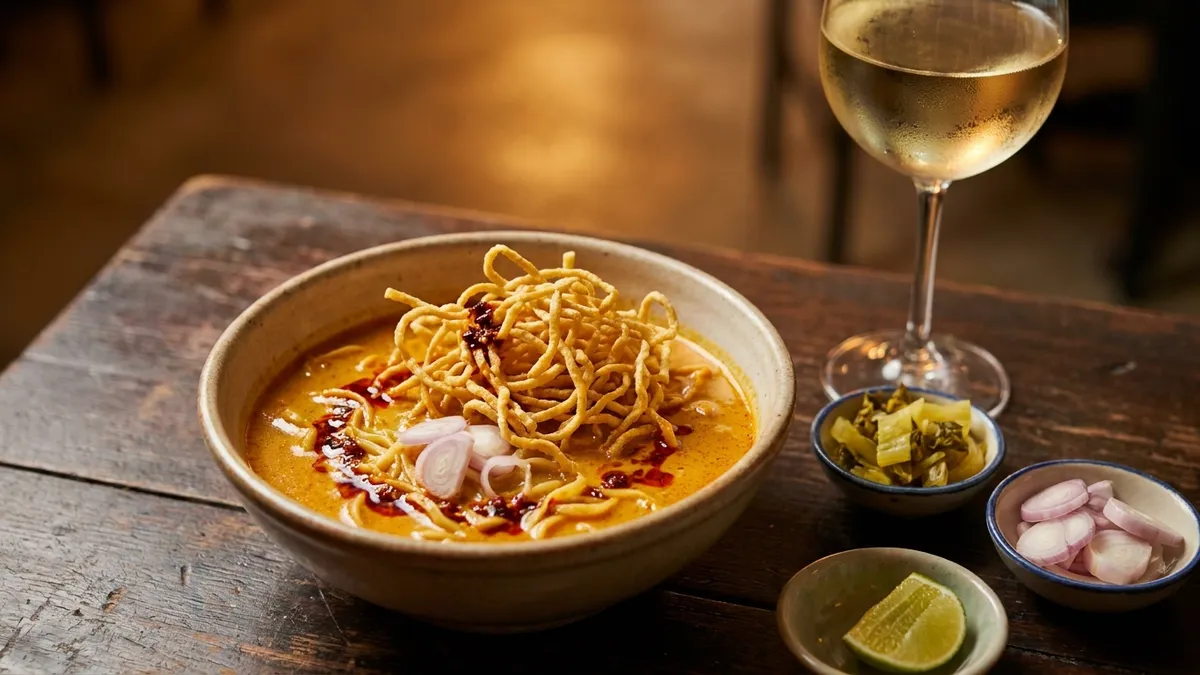
Khao soi is northern Thailand's signature dish: soft egg noodles in a coconut-milk curry, topped with crispy fried noodles and served with pickled mustard greens, shallots, lime, and chili fried in oil. Sweet coconut, sour pickles, salty broth, and chili oil arrive together, so the pairing is the curry answer with extra acidity: an off-dry Riesling, or a demi-sec Vouvray whose honeyed weight suits the coconut and crispy noodles.
Thai Dish, Wine Style, and Why: At a Glance
The table below puts the four-flavor logic on one page. Read the second column first: the leading flavors decide the wine, and the style follows.
| Dish | Leading flavors | Wine style | Why it works |
|---|---|---|---|
| Pad thai | Sweet, sour, salty; mild heat | Riesling Kabinett, demi-sec Chenin Blanc | Sugar meets palm sugar, acidity meets tamarind, low alcohol spares the chili |
| Green curry | Rich, sweet coconut; hot; salty | Riesling Spätlese, off-dry Gewürztraminer | More sugar for the heat and coconut, acidity to cut the cream |
| Red curry | Rich, sweet coconut; medium heat | Riesling Kabinett or Spätlese | Green curry's structure with less heat to cover |
| Massaman curry | Warm dried spice, peanut, mild | Gewürztraminer, Viognier, chilled Gamay | Low chili: match aromatics and weight, not a burn |
| Som tam | Sour lime, salty, spicy | Dry Riesling, Vinho Verde, Albariño | Acidity mirrors the lime; sweetness would cloy |
| Larb | Sour, salty, herbal, spicy | Dry Riesling, Grüner Veltliner | Crisp acidity for the lime, no tannin for the fish sauce |
| Tom yum (clear) | Hot and sour, aromatic | Dry sparkling, dry Riesling | Acidity and bubbles refresh between spoonfuls |
| Tom yum (creamy) / tom kha | Hot, sour, rich | Off-dry to Auslese Riesling | Sugar softens the heat and matches the cream |
| Khao soi | Sweet coconut, sour pickles, chili oil | Off-dry Riesling, demi-sec Vouvray | Off-dry weight for the curry, acidity for the pickles |
| Pad see ew | Sweet-salty soy, smoky wok char | Chilled Gamay, dry rosé, Grüner Veltliner | Low heat and savory soy suit a fruity, low-tannin wine |
| Drunken noodles (pad kee mao) | Hot, salty, basil-heavy | Riesling Spätlese, off-dry rosé | Real heat needs sugar; a chilled, fruity style suits the basil |
| Grilled pork skewers (moo ping) | Sweet-savory marinade, smoke | Chilled Gamay, Pinot Noir, dry rosé | No chili, so a light red's fruit meets the caramelised meat |
Should You Drink Red Wine with Thai Food?
Rarely, and only a light one. Tannin turns bitter against chili and fish sauce, and alcohol above about 13.5 percent fans the burn, so skip Cabernet Sauvignon, Shiraz, and Malbec. A chilled Gamay, Pinot Noir, or Schiava works with massaman, pad see ew, grilled pork skewers, and other low-heat, savory dishes.
Chili makes the palate more sensitive to bitterness, so tannins that felt velvety on their own turn coarse, and fish-sauce umami does the same. Our guide to what tannins are shows how to feel that texture. When you do pour a red, serve it at 12 to 14°C, a few degrees cooler than usual, so it reads as less alcoholic and its fruit tightens up; the wine serving temperature chart has the full range.
How to Order Wine for a Whole Thai Table
Two bottles cover a shared table: an off-dry Riesling, Kabinett or Spätlese, for the curries, noodles, and anything hot, and a dry, high-acid white such as Vinho Verde, Albariño, or dry Riesling for the salads, soups, and grilled dishes. Serve both at 7 to 10°C and let each guest switch glasses as the dishes change.
The pair works because it answers both ends of the balance: the off-dry bottle handles sweet and spicy, the dry one handles sour and salty. If the table leans toward massaman and grilled meats, swap the dry white for a chilled Gamay; if it leans north, toward khao soi, an off-dry Gewürztraminer makes a fine third glass. The same habit runs through our food-pairing hub, the companion guides to wine with Indian food and wine with Mexican food, and the general wine and food pairing guide.
The skill underneath every pairing here is telling sweetness from acidity in the glass, then noticing how the food moves each one. Sommy trains it: photograph a label in the AI-guided tasting mode and the app walks you through look, smell, and taste, then logs your notes so you can compare the same Riesling against a curry and a papaya salad. Start at sommy.wine.
Sources
- How to pair drinks with spice — Aleesha Hansel, WSET Global, Knowledge Centre, 2026
- Wine 101: How to pair Thai food with Riesling (with Ernst Loosen) — Michelin Guide Thailand
- Commission Delegated Regulation (EU) 2019/33 — Annex III, Part B: terms for sugar content of wine — EUR-Lex, Official Journal of the European Union, 2019
- Deconstructing massaman curry, Thailand's mellow classic — Rebecca Seal, National Geographic Travel, 2023
- Fish sauce — nutrition and use in Thai cuisine — Wikipedia
Frequently Asked Questions
What wine goes best with pad thai?
An off-dry German Riesling Kabinett is a classic match for pad thai. The sauce is tamarind, fish sauce, and palm sugar, so the dish is sweet, sour, and salty with only mild heat. Kabinett's light sweetness meets the palm sugar, its acidity matches the tamarind and lime, and its low alcohol keeps the chili quiet. A demi-sec Chenin Blanc is the closest alternative.
Is Riesling good with Thai food?
Riesling is the most useful grape for Thai food because it comes at every sweetness level. A dry Riesling suits lime-led salads and grilled seafood, an off-dry Kabinett handles pad thai, a Spätlese stands up to green curry, and an Auslese can meet the hottest tom yum. High acidity and low alcohol run through all of them, which is exactly what the cuisine needs.
Should you drink red or white wine with Thai food?
White, most of the time. Thai dishes are led by lime, fish sauce, and chili, and each of those makes a tannic red taste harsher while high alcohol fans the heat. Reds earn a place only with low-heat, savory dishes such as massaman curry, pad see ew, or grilled pork skewers, and even then choose a light, low-tannin Gamay or Pinot Noir served chilled.
What wine pairs with Thai green curry?
Riesling Spätlese is the safest choice for green curry. Coconut milk makes the curry rich and gently sweet, the green-chili paste brings real heat, and fish sauce salts it, so the wine needs more sugar than a Kabinett, bright acidity, and alcohol under about 11 percent. Off-dry Gewürztraminer is the aromatic alternative for a medium-heat version, since its lychee and ginger echo the galangal and lemongrass.
Does sweet wine go with spicy Thai food?
Yes, but the sweetness should scale with the heat and sugar in the dish, not be applied to everything. Residual sugar softens the perception of chili heat, so a hot green curry or tom yum benefits from a Spätlese or Auslese Riesling. A sour, salty dish with little sugar of its own, like som tam or larb, tastes cloying next to a sweet wine and prefers a dry, high-acid white.
What is the best wine for tom yum soup?
For clear tom yum, pour a dry sparkling wine or a dry Riesling: the broth is hot and sour, with lemongrass, galangal, lime leaf, and chili, so acidity and bubbles refresh the palate between spoonfuls. For the creamy version, or a very spicy bowl, move to an off-dry Riesling. Mosel winemaker Ernst Loosen goes as far as an Auslese for tom yum and tom kha.
Can you drink wine with som tam (papaya salad)?
Yes, and it is one of the easiest Thai pairings once you stop reaching for sugar. Som tam is pounded green papaya dressed with lime, fish sauce, chili, palm sugar, dried shrimp, and peanuts, so sourness and salt lead. A dry Riesling, Vinho Verde, Albariño, or Grüner Veltliner matches the lime. If the salad is fiercely hot, step up to an off-dry Kabinett.
Sommy Team
LinkedInFounder & Wine Educator
The Sommy Team is building the world's most approachable wine education app, helping beginners develop real tasting skills through structured courses and AI-guided practice.