Wine with Vietnamese Food: Pho, Banh Mi, and Spring Rolls

By the Sommy Team — AI-assisted, human-edited.
Updated Sep 24, 2026
Contents (10)
- What Wine Goes with Vietnamese Food? The Short Answer
- Why Is Vietnamese Food Different to Pair with Wine?
- What Wine Goes Best with Pho?
- Vietnamese Dishes and Wines at a Glance
- What Wine Pairs with Banh Mi?
- What Wine Goes with Fresh and Fried Spring Rolls?
- Is Off-Dry Riesling Always the Answer?
- Why Do Chili and Fish Sauce Clash with Some Wines?
- Does Red Wine Ever Work with Vietnamese Food?
- A Rule for Any Vietnamese Dish
TL;DR
Vietnamese food leads with fresh herbs, lime and fish sauce, and most chili is added at the table. So start with a dry, high-acid, unoaked white or a dry sparkling wine, keep tannin low around fish sauce, and switch to an off-dry Riesling only when you spoon in chili or hoisin.
Choosing wine with Vietnamese food is easier than it looks once you notice what leads the plate. Vietnamese cooking is built on fresh herbs, lime and fish sauce, and most of the chili arrives at the table in a dish or a bottle. That makes acidity the first thing to shop for and sugar the last. A crisp, dry glass covers most of the menu, and one off-dry bottle covers the rest.
What Wine Goes with Vietnamese Food? The Short Answer
A dry, high-acid white or a dry sparkling wine is the safest wine with Vietnamese food. Dry Riesling, Grüner Veltliner, Sauvignon Blanc, dry rosé and traditional-method sparkling such as Cava all match the herbs and lime and stay clear of trouble with fish sauce. For pho, pour dry sparkling or dry Riesling. For banh mi, pour dry rosé. For fresh summer rolls, pour dry Riesling, and for fried rolls or banh xeo, pour bubbles. If you load the bowl with sriracha or fresh chili, switch to a low-alcohol off-dry Riesling Kabinett. Reds belong with stewed or seared beef, and they should be low in tannin.
Why Is Vietnamese Food Different to Pair with Wine?
Vietnamese cooking leans on raw herbs, lime and fish sauce more than on chili cooked into the dish, so acidity does more work than sugar. A pairing guide built for curries points you toward sweet wines too early. Three things on the plate decide the glass.
- Herbs and lime. Mint, Thai basil, coriander and lime want high acidity (the tartness that makes your mouth water) and fresh citrus in the wine.
- Fish sauce. Nuoc mam, the fermented fish seasoning, salts almost everything, and it punishes tannin (the drying grip on your gums).
- Chili. Much of the heat is added at the table, from fresh slices, chili sauce or sriracha, so the diner controls it.
Fish sauce needs a closer look. Its savory depth, called umami, comes from its glutamate content. It is also very salty: common commercial brands carry about 50 to 60 percent of the FDA's daily recommended sodium in one tablespoon. Salt softens a crisp wine and makes it taste rounder, which helps. Umami does the opposite to tannin, which turns harsher and more bitter beside it. The savory and umami flavors guide covers that effect across other foods.
Where the chili sits changes the strategy. A wine chosen only for heat is a sweet one, and it tastes sugary against lime-dressed herbs. A wine chosen for acidity handles the herbs, the fish sauce and a mild bowl. If the chili stays in a side dish, keep the wine dry.
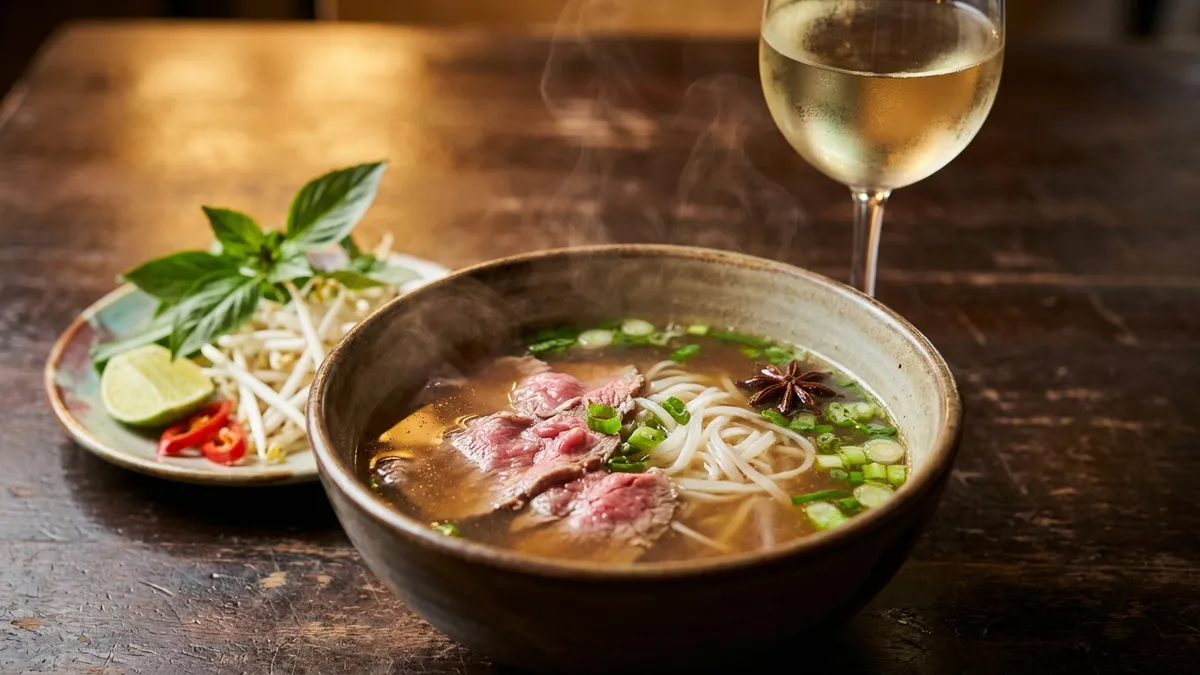
What Wine Goes Best with Pho?
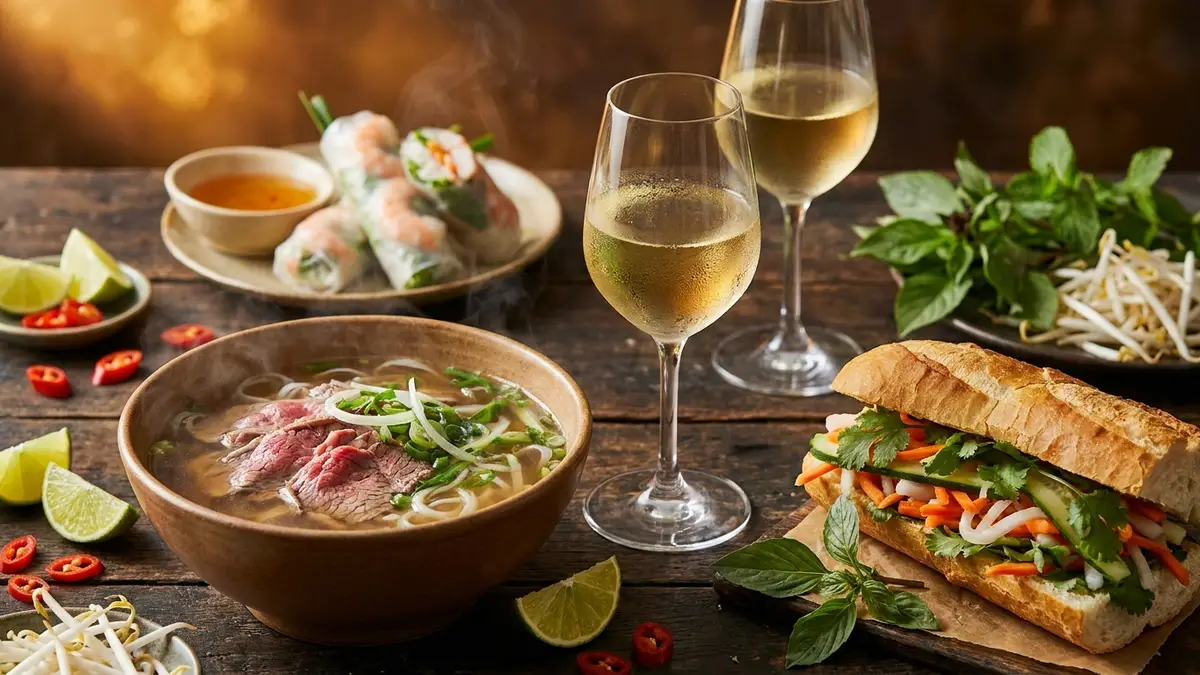
A light, dry sparkling wine such as Cava is the best all-round wine for pho. Its bubbles and high acidity refresh the palate after each salty spoonful of broth. Dry Riesling does the same job without bubbles, and a chilled, low-tannin red suits beef pho.
Yu Yamamoto is the WSET Diploma sommelier at Lửa in Ho Chi Minh City. He favours a dry traditional-method sparkling wine (fizz made by a second fermentation in the bottle) such as Cava for pho.
The broth explains why. Pho comes from Nam Định Province, southeast of Hanoi, and took shape in the early 1900s. Its beef-bone broth mirrors the French consommé technique, and it is scented with star anise, cinnamon and charred ginger. The result is clear, salty and savory, with little fat and no sugar of its own, so it needs no heavy wine.
Chicken pho, which appeared in 1939, is lighter still, so a dry Riesling or a Grüner Veltliner suits it as well as sparkling does. For beef pho with rare slices, a red can work. Yamamoto's advice is to avoid tannic wines, which clash with pho, and to choose a lighter-bodied, earthy Pinot Noir or Gamay. Serve it cool, around cellar temperature, so the alcohol stays quiet. The Gamay wine guide explains why that grape has so little grip.
The table caddy decides the rest. If you squeeze in hoisin and a lot of sriracha, the bowl becomes sweet and hot, and a dry wine will taste thin and hot beside it. Move to an off-dry Riesling for that bowl.
Vietnamese Dishes and Wines at a Glance
Use this table at the restaurant. Find the dish, pour the style in the third column, and read the last column before you reach for the chili sauce.
| Dish | What leads | Pour this | Why it works | If you add chili |
|---|---|---|---|---|
| Pho bo (beef) | Salty, spiced beef broth; herbs | Dry sparkling (Cava), dry Riesling | Bubbles and acid refresh after salt; no tannin to clash | Off-dry Riesling Kabinett |
| Pho ga (chicken) | Light broth, ginger, herbs | Dry Riesling, Grüner Veltliner | Light body for a light broth; citrus for the lime | Off-dry Riesling Kabinett |
| Banh mi | Pork fat, pâté, pickles, herbs | Dry rosé, Grüner Veltliner | Acid for the pickles, fruit for the pork | Off-dry Riesling |
| Summer rolls (goi cuon) | Raw herbs, prawn, peanut sauce | Dry Riesling, Sauvignon Blanc | High acid and herbal flavour match the mint and lettuce | Off-dry Riesling |
| Fried rolls, banh xeo | Crisp, oily, dipped in nuoc cham | Dry sparkling (Prosecco, Cava) | Bubbles cut the oil; acid meets the lime | Off-dry sparkling or Riesling |
| Bo kho (beef stew) | Braised beef, lemongrass, star anise | Medium-bodied Merlot | Soft tannin for the beef; enough fruit for the spice | Chilled Gamay |
What Wine Pairs with Banh Mi?
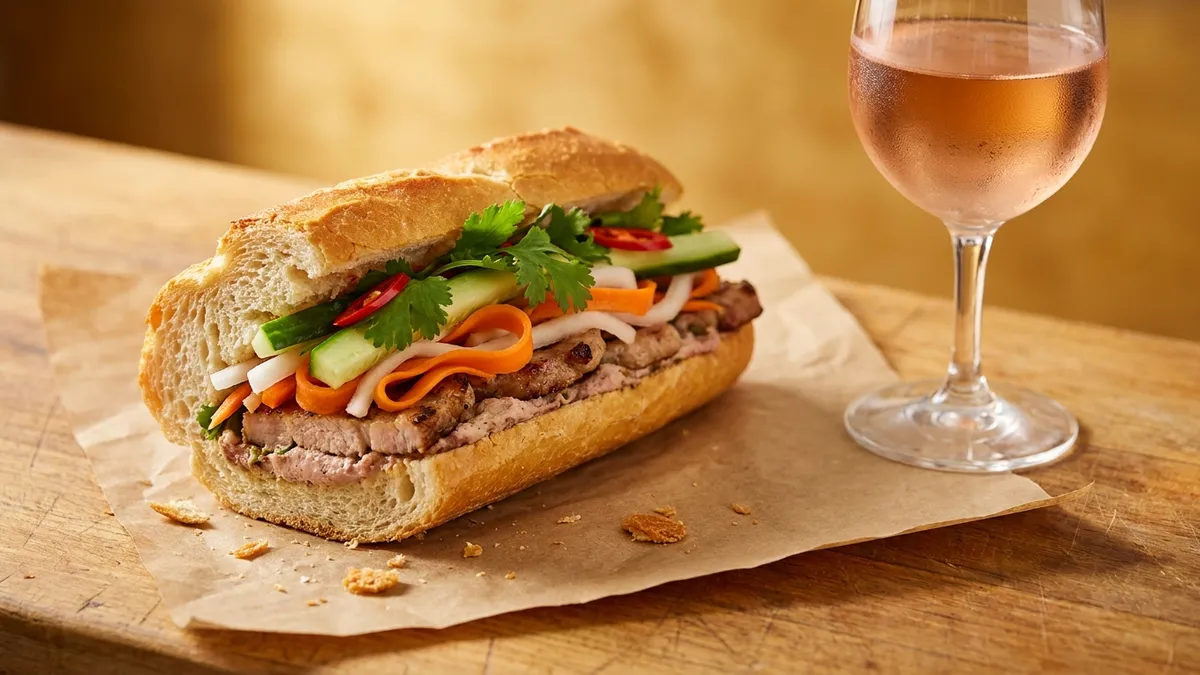
A dry rosé is the easiest wine for banh mi, because it has the acid for the pickles and enough fruit for the pork and pâté. The sandwich stacks five things in one bite: a crisp baguette, fatty grilled pork or cold cuts, rich pâté and mayonnaise, pickled carrot and daikon, and raw coriander, cucumber and chili.
The pickles set the acidity floor. Vinegar makes a soft, low-acid wine taste flat and flabby, so the glass needs at least as much tartness as the carrot. Dry rosé from Provence or Spain brings that acidity along with strawberry and watermelon fruit, which stays fresh because it is usually picked early and made without oak. The fruit meets the salty pork, and the lack of tannin leaves nothing for the rich pâté to turn bitter. The rosé wine guide explains how the short skin contact keeps tannin out of the glass.
Two whites do the same job with more herb. Grüner Veltliner (Austria's main white grape) brings white pepper and green apple that echo the coriander, covered in the Grüner Veltliner guide. Sauvignon Blanc brings grapefruit and cut grass and very high acidity, which suits a pickle-heavy sandwich; see the Sauvignon Blanc wine guide.
If the sandwich carries a lot of fresh chili or chili mayonnaise, pick an off-dry Riesling over the rosé. Its touch of sugar softens the heat that a dry rosé would amplify.
What Wine Goes with Fresh and Fried Spring Rolls?
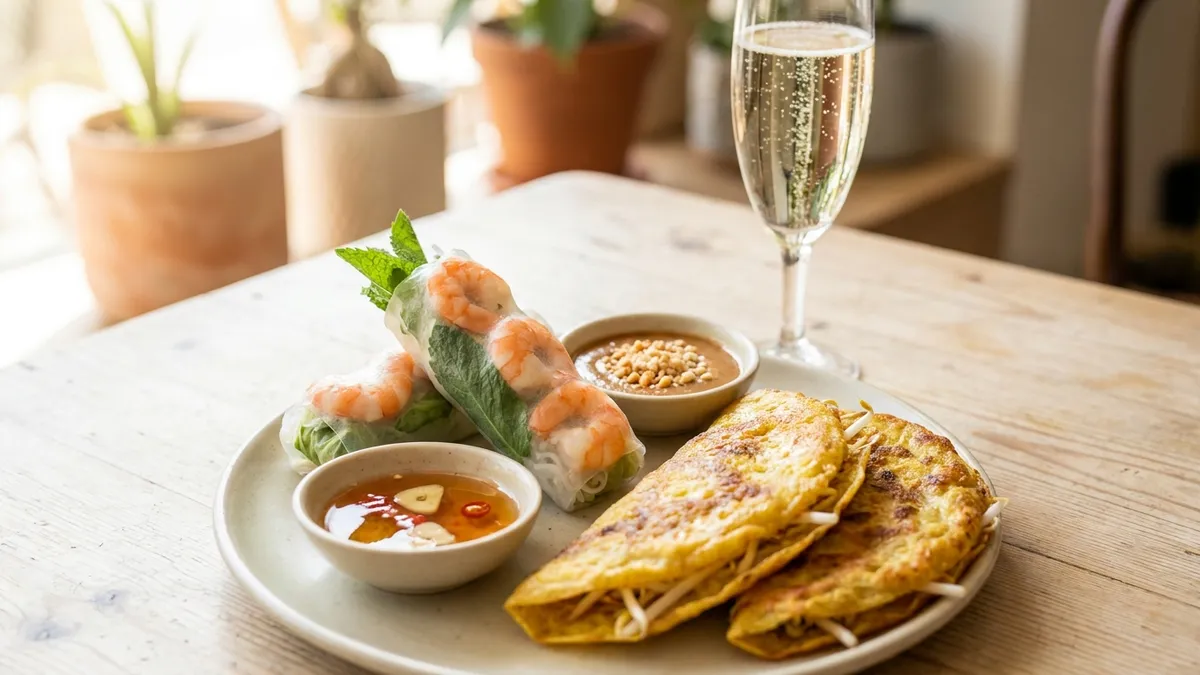
Fresh summer rolls want a dry Riesling, and fried rolls and banh xeo want a dry sparkling wine. The two dishes share a name in English but almost nothing on the plate. One is raw herbs and prawn in soft rice paper; the other is deep-fried, oily and crisp, and it asks the wine to cut through fat.
Goi cuon, the fresh summer roll, is rice paper wrapped around lettuce, mint, rice noodles and poached prawn or pork, served with peanut or hoisin sauce. Nothing is fried and nothing is heavy. Yamamoto calls dry German Riesling with summer rolls "a lovely combination", for its high acidity, citrus and herbal flavours. Lime and lemon flavours in the wine meet the lime in the dip, and the light body matches raw vegetables. If the peanut sauce is thick and sweet, an off-dry Riesling handles it better than a bone-dry one.
Fried rolls, called cha gio, and banh xeo, the crisp turmeric rice-flour crepe folded over prawn, pork and bean sprouts, add oil and crunch.
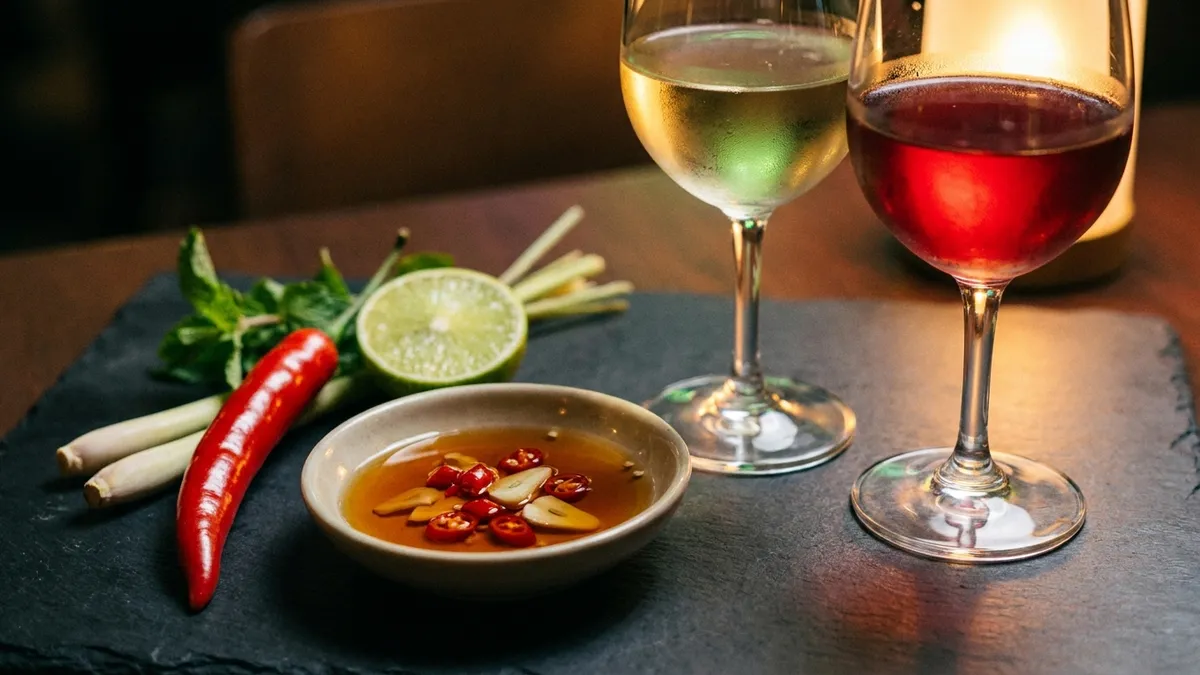
Both get wrapped in lettuce and herbs and dipped in nuoc cham, the dipping sauce of fish sauce, lime, sugar, garlic and chili. For banh xeo, Yamamoto recommends a dry, casual sparkling wine such as Prosecco, whose fine bubbles complement the crunch. Bubbles and acid clear the oil from your palate. For how Prosecco differs from Cava, see Champagne vs Prosecco vs Cava.
If the roll is fried, pour bubbles. If it is fresh, pour dry Riesling.
Is Off-Dry Riesling Always the Answer?
No. Off-dry Riesling is the answer only when the chili goes in. For a clear bowl of pho or a plate of summer rolls, a dry Riesling fits better, because nothing on the plate is sweet or hot enough to need sugar.
How to Read Kabinett on a Riesling Label
In Germany, Kabinett is a ripeness level, set by the sugar in the grapes at harvest: between 67 and 82 degrees Oechsle (a measure of grape-juice density), depending on region and grape. German law does not fix how much sugar stays in the finished wine, so Kabinett can be dry or off-dry.
The alcohol tells you which. A semi-sweet Mosel Riesling Kabinett averages around 7 to 8% alcohol, because fermentation stopped early and left residual sugar (grape sugar left unfermented). A dry version usually reaches 10 to 11%. Austria uses the same word differently: an Austrian Kabinett is always dry, with no more than 9 grams per litre of residual sugar and at most 13% alcohol.
If the label says German Kabinett and around 8% alcohol, it is off-dry and suits a chili-heavy bowl. If it says 11% or more, or comes from Austria, treat it as dry.
The sweetness itself is no compromise. Sugar in a wine softens the perception of chili heat, a mechanism the next section explains. Using it for a hot dish is a technique that works on the tongue, and no sign of a timid palate. The sweet vs dry wine guide shows how to read sweetness on other labels, and the Riesling wine guide covers the full ladder from dry to sweet.
Why Do Chili and Fish Sauce Clash with Some Wines?
Spice is a sensation of pain, not a taste, and alcohol and tannin both make it feel stronger. The Wine & Spirit Education Trust (WSET) puts spiciness outside the basic tastes of sweet, sour, salty, bitter and umami, because it is felt rather than tasted.
That sensation reacts to three parts of a wine:
- Alcohol. WSET notes that the perception of alcohol intensifies when it meets spice, so a 14.5% wine burns harder beside chili.
- Tannin. Tannins create strong tactile sensations, and with hot spices they can feel quite harsh.
- Sugar. A drink with some sweetness softens the perception of heat, so a touch of residual sugar calms it.
Fish sauce adds a second problem for tannin. Wine educators have long observed that umami-rich foods make tannic wines taste more bitter and sometimes metallic, while salt does the reverse and softens them. A dipping bowl of nuoc cham brings umami, salt, lime and chili at once. That combination rules out a firm, high-alcohol red and favours a crisp, light white. The wine with spicy food guide runs the same mechanism for curries and other hot dishes, and what are tannins explains where that grip comes from.
Does Red Wine Ever Work with Vietnamese Food?
Yes, with stewed or seared beef, as long as the tannin is soft. The clash is tannin against fish sauce and chili, not red wine against Vietnamese food as a whole. A braised beef dish has less salt and more fat than a broth or a dipping sauce, so it gives a soft red room to work.
Bo kho is the clearest case. It is a braised beef stew scented with lemongrass, star anise and cinnamon, and it is richer and less salty than a noodle broth. Yamamoto pairs it with a medium-bodied Merlot from Bordeaux, whose soft, velvety tannins suit the beef and its warm spices. Body (the weight of the wine: skimmed versus whole milk) matters here: the stew is heavy enough to carry a medium red, and a light one would taste watery. The Merlot wine guide explains why the grape has softer tannin than Cabernet Sauvignon.
Seared beef dishes such as shaking beef, cubes of steak tossed with garlic and pepper, follow the same logic. For pho and anything dipped in nuoc cham, keep the red light, low in tannin and cool.
If the dish is a broth or dipped in fish sauce, pour a chilled Pinot Noir or Gamay. If it is stewed or seared beef with little chili, a medium-bodied Merlot works.
A Rule for Any Vietnamese Dish
Read the plate for three things: herbs and lime, fish sauce, and chili. The same checklist works for bun cha, broken rice and any other dish on the menu.
- Herbs and lime lead: pour a dry, high-acid white such as Riesling, Grüner Veltliner or Sauvignon Blanc.
- Fish sauce leads: keep tannin low; dry sparkling, dry rosé or a crisp white.
- Fried or crisp: pour dry sparkling wine.
- Chili leads: pour off-dry Riesling around 8% alcohol.
- Stewed or seared beef: pour a soft, medium-bodied red such as Merlot.
For a shared table with several dishes, open one dry white and one off-dry Riesling, and let each diner switch as they add chili. The food pairing hub and the wine with Thai food guide apply the same approach to neighbouring cuisines.
Tonight, pour one dry Riesling with your order. Taste it once with a plain bite and once with a bite dipped in chili sauce, and notice how the acidity, fruit and burn change. Photograph the label in Sommy's AI-guided tasting mode at sommy.wine, which walks through look, smell and taste and logs both notes in a tasting journal.
Sources
- Michelin Guide: 101 guide to Vietnamese food and wine pairing (Yu Yamamoto, Lửa)
- WSET: How to pair drinks with spice
- Kabinett — Wikipedia
- Fish sauce — Wikipedia
- Pho — Wikipedia
Frequently Asked Questions
What wine goes best with pho?
A light, dry sparkling wine such as Cava is the best all-round choice for pho. Its acidity and bubbles refresh the palate after the salty, spiced beef broth. Dry Riesling works the same way without bubbles. For a red, choose a light, low-tannin Pinot Noir or Gamay served cool. Move to an off-dry Riesling if you add a lot of sriracha, chili or hoisin to the bowl.
Does red wine go with Vietnamese food?
Sometimes. Tannic reds clash with fish sauce and chili, which covers most broths, dipping sauces and fresh rolls. Reds work with stewed or seared beef: a medium-bodied Merlot suits bo kho, the lemongrass and star anise beef stew, and a chilled Pinot Noir or Gamay suits pho. Keep the red low in tannin and serve it slightly cool.
Is Riesling good with Vietnamese food?
Yes, and it covers the most dishes. Dry Riesling has the high acidity and citrus flavour that fresh herbs and lime call for, which makes it a strong match for summer rolls and clear pho. Off-dry Riesling suits dishes where you add chili, because a little sugar softens the heat. A low-alcohol German Kabinett around 7 to 8 percent is usually the off-dry style.
What wine pairs with banh mi?
A dry rosé is the easiest wine for banh mi. Its acidity keeps up with the pickled carrot and daikon, and its strawberry fruit and light body suit grilled pork and pâté without tannin. Grüner Veltliner and Sauvignon Blanc are the white alternatives, both crisp and herbal. If the sandwich is loaded with fresh chili, an off-dry Riesling is the safer glass.
What wine goes with fresh spring rolls?
Dry Riesling is the classic wine for fresh Vietnamese summer rolls. The rolls are raw herbs, lettuce, prawn and rice noodles, so the wine needs high acidity and fresh citrus rather than weight or sugar. Sauvignon Blanc and Grüner Veltliner work for the same reason. Fried spring rolls and crisp banh xeo pancakes are different: pour a dry sparkling wine to cut the oil.
What wine goes with fish sauce?
Fish sauce wants a wine with high acidity and little or no tannin. It is very salty and rich in glutamate, the source of its savory umami taste. Salt makes a crisp wine taste rounder, which helps, but umami makes tannin taste harsher and more bitter. Dry Riesling, dry sparkling wine, dry rosé and Grüner Veltliner all handle nuoc cham dipping sauce well.
Does sweet wine go with spicy Vietnamese food?
A slightly sweet wine does, as long as it is light. Sugar softens the perception of chili heat, while high alcohol makes the burn feel stronger. An off-dry German Riesling Kabinett, often around 7 to 8 percent alcohol, is the standard choice. A fully sweet dessert wine is too heavy for herb-led Vietnamese dishes and will taste syrupy beside the lime.
Sommy Team
LinkedInFounder & Wine Educator
The Sommy Team is building the world's most approachable wine education app, helping beginners develop real tasting skills through structured courses and AI-guided practice.