Wine in the Freezer: What Happens, and When It Helps

By the Sommy Team — AI-assisted, human-edited.
Updated Sep 24, 2026
Contents (10)
- Can You Put Wine in the Freezer to Chill It?
- How Should You Use the Freezer for Each Style of Wine?
- What Temperature Does Wine Freeze At?
- What Happens if a Bottle Freezes Solid?
- Is Wine That Froze and Thawed Safe to Drink?
- Is Sparkling Wine Riskier in the Freezer?
- What Is the Fastest Way to Chill Wine Without Freezing It?
- Can You Freeze Leftover Wine on Purpose?
- When Do Winemakers Freeze Wine on Purpose?
- Test Your Freezer Chill Tonight
TL;DR
You can put wine in the freezer to chill it, as long as you set a timer. Table wine starts to freeze at roughly -5°C, far warmer than a -18°C home freezer. Frozen wine is safe to drink, but expanding ice can push out the cork or crack the glass. Never freeze sparkling wine.
Your freezer is the fastest way to chill a bottle of wine, and the only risk is forgetting it. A home freezer runs far colder than the point where wine turns to ice, so a still white can go in for a short spell and come out ready to pour. The trouble starts only when the bottle stays in past that window.
Can You Put Wine in the Freezer to Chill It?
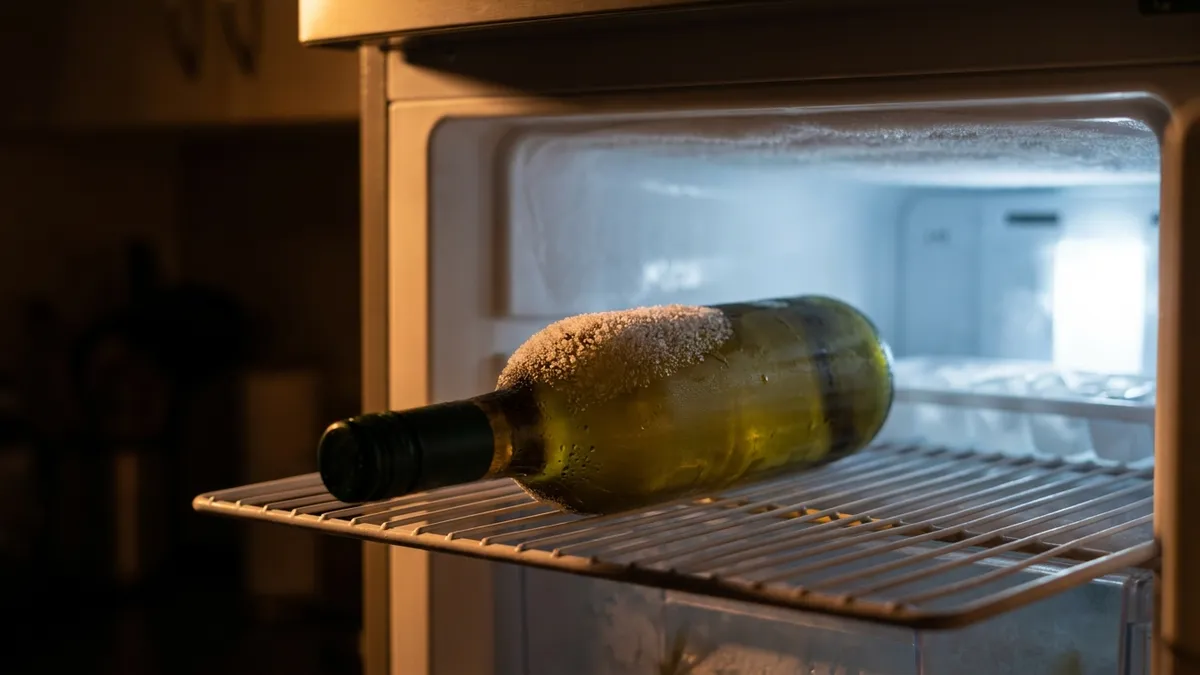
Yes. Putting wine in the freezer is a safe, quick way to cool a still white, rosé or light red, as long as you set a timer. A standard home freezer sits at about -18°C, while table wine starts to freeze at around -5°C. Check the bottle after about 15 minutes and take it out once the glass feels cold.
Left too long, the bottle keeps cooling past serving temperature and freezes. If it does freeze, the wine is still safe to drink. The damage is mechanical: expanding ice can push the cork up the neck or crack the glass, and any air that gets in dulls the fruit. Sparkling wine is the exception. It is already under high pressure, so it belongs in an ice bath, never the freezer.
How Should You Use the Freezer for Each Style of Wine?
Match the freezer time to the serving window. The colder a style is served, the more a freezer spell helps, and tannic reds rarely need one at all. A fridge sits at or below 4°C, which is already colder than any wine's ideal serving range, so the freezer only earns its place when time is short.
Serving ranges come in four bands. Sweet wines, sparkling wines and light whites and rosés are served at 6 to 10°C. Soft, lighter reds sit at 10 to 12°C. Fuller dry whites, such as oaked Chardonnay, show best at 12 to 16°C. Tannic reds sit at 15 to 18°C, where tannin (the drying grip on your gums) tastes softer than it does when cold.
| Style | Serve at | Freezer rule | Faster or safer option |
|---|---|---|---|
| Light whites and rosé | 6–10°C | Yes: check after about 15 minutes | Ice-water bath |
| Sweet whites | 6–10°C | Yes: check after about 15 minutes | Ice-water bath |
| Sparkling wine | 6–10°C | Never | Ice-water bath, always |
| Fuller dry whites | 12–16°C | Only a short spell, about 10 minutes | Fridge for 30 minutes |
| Light reds (Gamay, Pinot Noir) | 10–12°C | A short spell if the room is hot | Fridge for 20 minutes |
| Tannic reds | 15–18°C | Skip it | Fridge for 20 minutes |
If the style is served at 6 to 10°C, the freezer helps; if it is served at 15°C or warmer, give it 20 minutes in the fridge instead. A tannic red chilled too far tastes harsher and loses its fruit, as our guide to how temperature affects wine taste explains. The full list of grapes and styles sits in the wine serving temperature chart.
What Temperature Does Wine Freeze At?
Table wine starts to freeze a few degrees below zero, at roughly -5°C for a 13% bottle. That is well above the -18°C of a standard home freezer, and most household freezers run between -23 and -18°C. Given enough time, any still wine in there will freeze.
Pure water freezes at 0°C. Alcohol lowers the freezing point; it does not stop wine from freezing. Dissolve something in water, such as alcohol or sugar, and the freezing point drops. Chemists call this freezing-point depression: the more dissolved material, the colder the mix must get before ice forms.
The numbers track ABV (alcohol by volume, the percentage on the label). A water and alcohol mix at 10% ABV freezes at about -4°C, and at 20% at about -9°C. Most table wine sits at 12.5 to 14.5%, so it starts to freeze at around -5°C. Sugar lowers the point a little further, which is why a sweet wine holds out longer than a dry one. The ranges by style are in our guide to alcohol in wine by type.
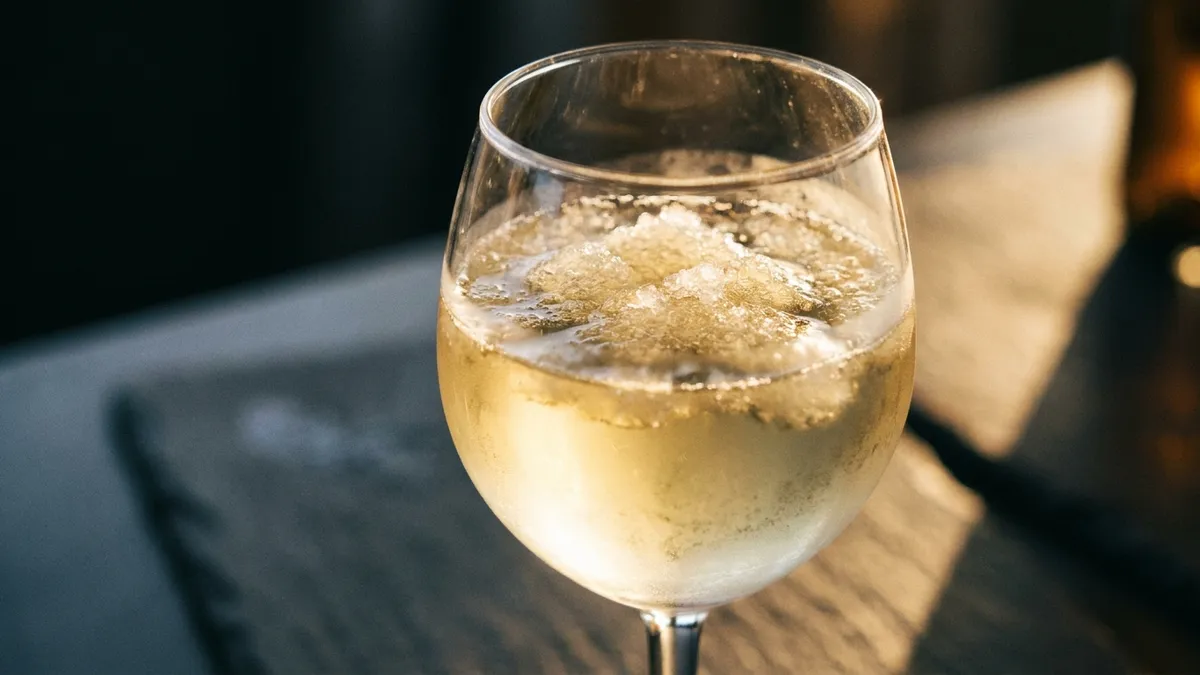
Wine also freezes in stages rather than all at once. Water leaves the mix first as ice crystals. The liquid left behind holds more alcohol and sugar, so its freezing point drops again. That is why a half-forgotten bottle turns to slush before it becomes a solid block. If you find slush and the cork has not moved, thaw the bottle upright in the fridge and drink it as planned.
What Happens if a Bottle Freezes Solid?
The water in wine expands by about 9% as it turns to ice, and that extra volume has to go somewhere. A bottle is filled almost to the closure, so there is no spare room. The ice either pushes the cork up the neck or presses on the glass until it cracks.
A natural cork usually gives first. It slides upward on a column of frozen wine, sometimes far enough to pop out. Screw caps, glass stoppers and tightly driven synthetic corks do not slide, so the pressure goes into the glass instead.
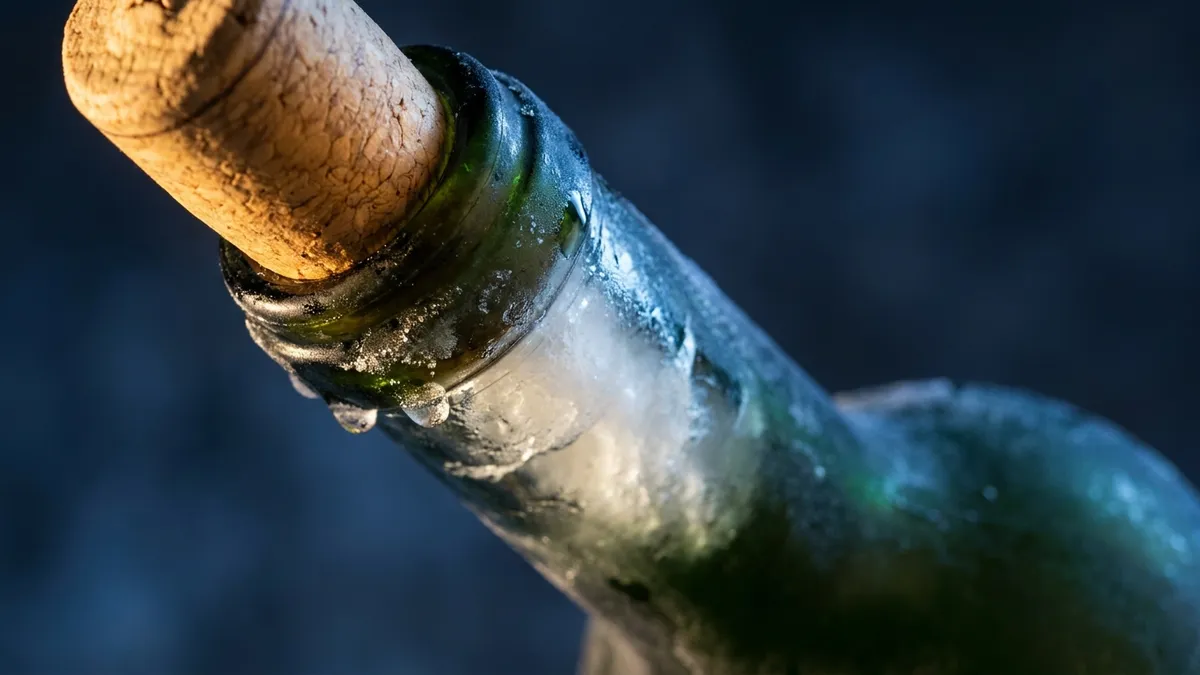
A moved cork breaks the seal, and a broken seal lets air reach the wine. That exposure starts oxidation (air flattening fresh fruit into bruised apple and nuts), the same process that ages an open bottle on the counter. A cracked bottle is simpler: pour nothing from it, because glass fragments can sit in the wine. Wrap it in a towel, let it thaw in the sink, and throw it away.
Is Wine That Froze and Thawed Safe to Drink?
Yes. Freezing is a quality problem, not a safety one. Thawed wine carries no new food-safety risk; what changes is the seal, the air that got in, and the crystals that cold leaves behind. Thaw it slowly in the fridge, standing upright, then taste it before you serve it.
Two things may look or taste different. The first is a scatter of clear, glassy shards on the cork or in the bottom of the bottle. These are tartrate crystals, also called potassium bitartrate or "wine diamonds", a natural salt of the grape's tartaric acid. They form in wine kept below 10°C, and once they form they seldom dissolve back into the wine. They are harmless, and our guide to tartrate crystals in wine shows how to pour around them.
The second is flatter fruit if the cork moved. The air that slipped past it behaves like the air in a half-finished bottle, which is covered in more detail in how long wine lasts after opening. If the cork stayed put and the glass is whole, drink the wine as normal. If the cork moved, drink it within a day or two, or cook with it. The signs of wine that has gone past saving are in oxidized wine explained.
Is Sparkling Wine Riskier in the Freezer?
Yes, by a wide margin. Sparkling wine is already under 5 to 6 atmospheres of pressure (the push of the dissolved gas, measured against the air around you) before any ice forms. That is more than double the pressure in a car tyre. Freezing adds a second push from inside a bottle that is already working hard.
Sparkling wine bottles use thick glass for this reason. Ice expanding inside can still force the cork out with real speed, or split the bottle along a weak point. A popping cork in a closed freezer drawer is a mess; one that flies when you open the door is a danger to your eyes.
A bottle that has turned to slush is also hard to open and pour cleanly. If it has bubbles, chill it in an ice bath, never the freezer. The sparkling wine types guide covers which styles are served coldest, and how to taste sparkling wine covers what to look for once it is in the glass.
What Is the Fastest Way to Chill Wine Without Freezing It?
A bucket of half ice and half water beats the freezer on speed and cannot freeze the wine. Water touches every part of the glass, so it pulls heat away much faster than cold air does. A bucket of ice cubes alone leaves air gaps and works far more slowly.
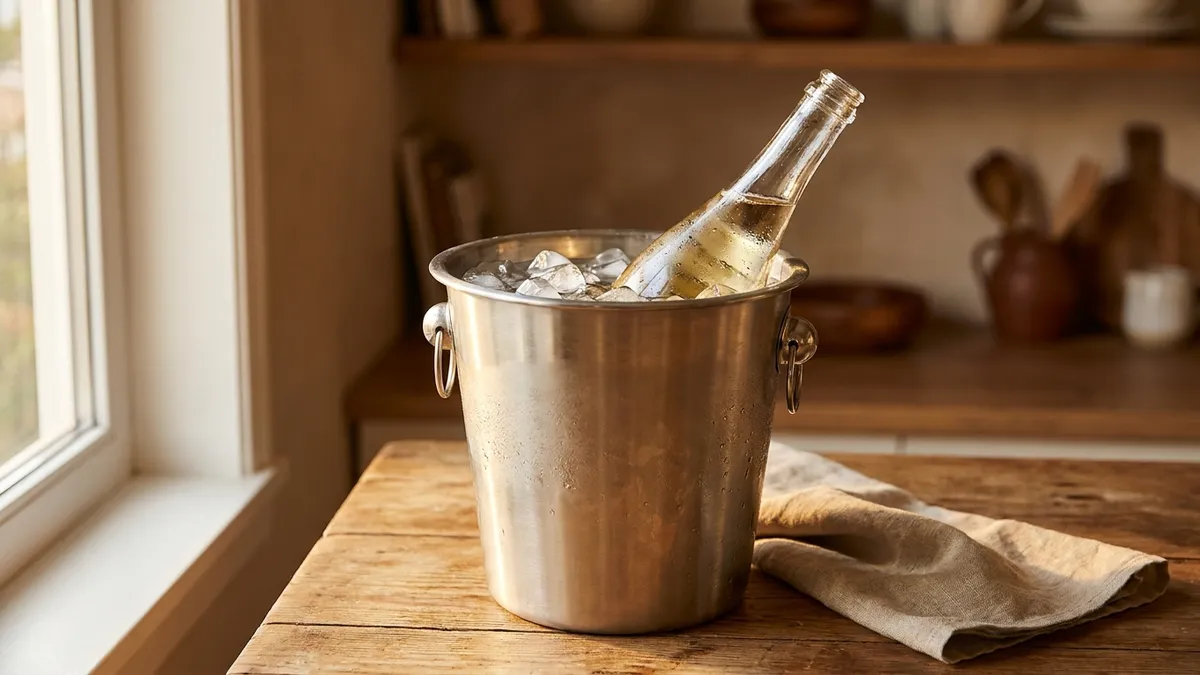
If you need a bottle cold in under half an hour, use the ice bath. Push the bottle down so the water reaches its neck, and give it a turn now and then so the wine inside moves past the cold glass. A handful of salt in the water lowers the bath below 0°C and speeds things up.
The freezer still wins when there is no bucket or ice to spare. Lay the bottle on its side so more of the glass touches the cold shelf. Set a phone timer at the moment you close the door. The wine serving temperature chart has more on hitting each window without a thermometer.
Can You Freeze Leftover Wine on Purpose?
Yes, for cooking. Pour leftover wine into an ice cube tray, freeze it, then tip the cubes into a freezer bag. Drop one or two into a pan sauce, risotto or stew, where the heat and the other flavours cover any change that freezing and thawing caused.
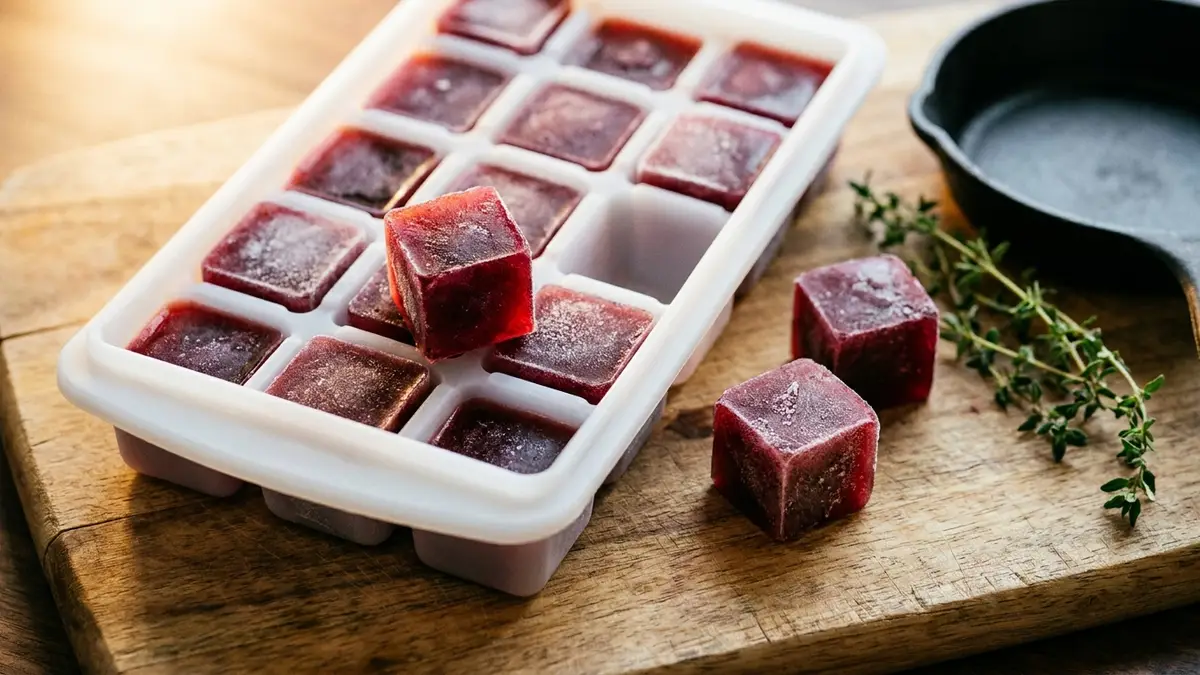
For drinking, freezing is a poor way to save wine. The thawed wine often tastes flatter than the bottle did, and the wine is exposed to air as you pour it into the tray. If less than a glass is left, freeze it for cooking. If half a bottle or more is left, reseal it and keep it in the fridge, as covered in how to store wine at home. The stoppers and pumps compared in wine preservation tools buy a few more days.
When Do Winemakers Freeze Wine on Purpose?
Two ways, and neither resembles a bottle forgotten behind the frozen peas. Cold stabilization chills finished wine in the tank so tartrate crystals drop out before bottling, and ice wine freezes the grapes on the vine before there is any wine at all.
| Where it happens | What gets cold | How cold | What it changes in the glass |
|---|---|---|---|
| Your freezer, by accident | The finished, bottled wine | About -18°C | Risk of popped cork, cracked glass, flatter fruit |
| Cold stabilization at the winery | Finished wine in the tank | Near its freezing point, without freezing it | Fewer crystals in the bottle later |
| Ice wine harvest | Grapes on the vine, before fermentation | -8°C in Canada, -7°C in Germany | Sweet, concentrated wine from frozen juice |
Cold stabilization works fast, with most of the crystals forming in the first few days of cooling. Producers do it so the crystals land in the tank, where they can be filtered out, rather than in your bottle. The ice wine rules and how the frozen grapes give that syrupy sweetness are in our ice wine and Eiswein guide.
Test Your Freezer Chill Tonight
Put a still white or rosé in the freezer tonight and set a 15-minute timer as you close the door. Pour two glasses, one straight away and one after ten minutes on the table, and taste them in turn. More storage and serving guides live in our serving and storage hub.
Sommy's Wine 101 course covers serving temperature with the rest of the basics. Pour the two glasses tonight, photograph the label in the AI-guided tasting mode at sommy.wine, and taste the cold glass against the warmer one.
Sources
- Engineering ToolBox: Ethanol-water mixtures, freezing points
- Wikipedia: Water (density and expansion on freezing)
- Wikipedia: Refrigerator (FDA freezer and fridge temperatures)
- Wikipedia: Sparkling wine (bottle pressure)
- Wikipedia: Potassium bitartrate (tartrate crystals and cold stabilization)
- Wikipedia: Clarification and stabilization of wine (cold stabilization)
- Wikipedia: Icewine (harvest temperature rules)
Frequently Asked Questions
How long can you leave wine in the freezer?
Treat the freezer as a short, supervised chill. Check a still white or rosé after about 15 minutes and take it out once the glass feels properly cold. A home freezer runs at about -18°C, far colder than the roughly -5°C where table wine starts to freeze, so a forgotten bottle will keep cooling until it turns to slush and then ice.
What temperature does wine freeze at?
Table wine begins to freeze a few degrees below zero. A mix of water and alcohol at 10% alcohol freezes at about -4°C, and at 20% at about -9°C, so a typical wine of 12.5 to 14.5% starts to freeze at around -5°C. Sugar and extra alcohol push the point lower, which is why sweet and fortified wines hold out longer.
Is it safe to drink wine that froze?
Yes. Freezing and thawing does not make wine unsafe. The risks are to quality: if the ice pushed the cork out, air may have reached the wine and started to flatten its fruit, and cold often leaves harmless tartrate crystals in the bottom. Thaw it slowly in the fridge, taste it, and cook with it if it tastes dull.
Why did my wine bottle crack in the freezer?
Water expands by about 9% when it turns to ice. A wine bottle is filled almost to the cork, so the growing ice has nowhere to go. It either shoves the cork up the neck or, when the closure holds, presses on the glass until it cracks. Screw caps and tight closures make cracking more likely because nothing gives way.
Can you put Champagne or Prosecco in the freezer?
It is the one wine to keep out. Sparkling wine is sold at 5 to 6 atmospheres of pressure, more than double a car tyre, before any ice forms. Freezing adds a second push from inside, so a forgotten bottle can lose its cork violently or split. Chill sparkling wine in a bucket of half ice and half water instead.
Can you freeze leftover wine to use later?
Yes, for cooking. Pour leftover wine into an ice cube tray, freeze it, then bag the cubes. Drop one or two into a pan sauce, risotto or stew, where the heat drives off the difference that freezing makes. Frozen wine cubes are not a good way to save wine for drinking, because the thawed wine tastes flatter than the bottle did.
Sommy Team
LinkedInFounder & Wine Educator
The Sommy Team is building the world's most approachable wine education app, helping beginners develop real tasting skills through structured courses and AI-guided practice.