Ice Wine and Eiswein: A Guide to Frozen Grape Dessert Wine

By the Sommy Team — AI-assisted, human-edited.
Updated Apr 29, 2026
Contents (13)
- Ice Wine and Eiswein, in 90 Seconds
- How Ice Wine Is Actually Made
- Two Names, Two Countries, One Style
- The Grapes That Freeze Best
- Taste Profile: What to Expect
- Why It Costs What It Costs
- Ice Wine Versus Other Dessert Wines
- Serving Ice Wine the Right Way
- Food Pairings That Work
- Buying and Aging
- Tasting Strategy: Getting the Most From One Small Bottle
- Building the Skill to Taste It Well
- The Honest Reality
TL;DR
Ice wine and Eiswein are dessert wines made from grapes that freeze on the vine, then are pressed while still solid. The frozen water stays behind as ice, leaving syrupy juice with concentrated sugar, acid, and flavor. Germany pioneered the style in 1794. Canada now leads global production using Vidal Blanc and Riesling, mostly from Niagara.
Ice wine and Eiswein sit at the strange edge of the wine world. The grapes freeze on the vine, get picked in the middle of a winter night, and are pressed while still rock-hard. What drips out is not really juice — it is a syrupy concentrate of sugar, acid, and aroma so intense that one small bottle can flavor an entire dinner.
This guide explains how the style works, why Germany and Canada dominate it, and what to expect when you open a bottle.
Ice Wine and Eiswein, in 90 Seconds
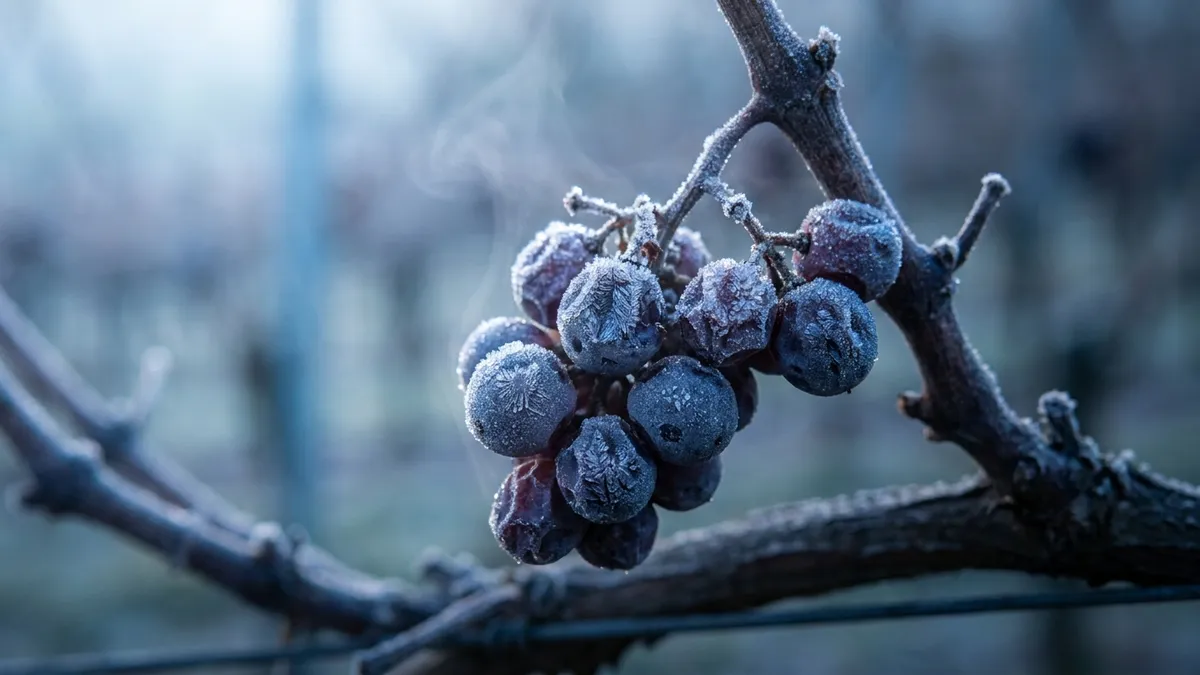
Ice wine and Eiswein are dessert wines made from grapes that freeze naturally on the vine, then are picked and pressed while still frozen solid. The frozen water stays behind as ice in the press, while the unfrozen sugar-acid solution oozes out at one tenth or less of a normal yield. Germany invented the style in 1794 in the Franconia region. Canada became the world's largest producer in the 1990s, with most production in Ontario's Niagara Peninsula and British Columbia's Okanagan Valley. German rules require harvest at minus 7 degrees Celsius, Canadian VQA rules at minus 8. Both forbid artificial freezing. Expect 180 to 250 grams of residual sugar per liter, high acidity, and aromas of peach, apricot, lychee, and honey at 9 to 12 percent alcohol.
How Ice Wine Is Actually Made
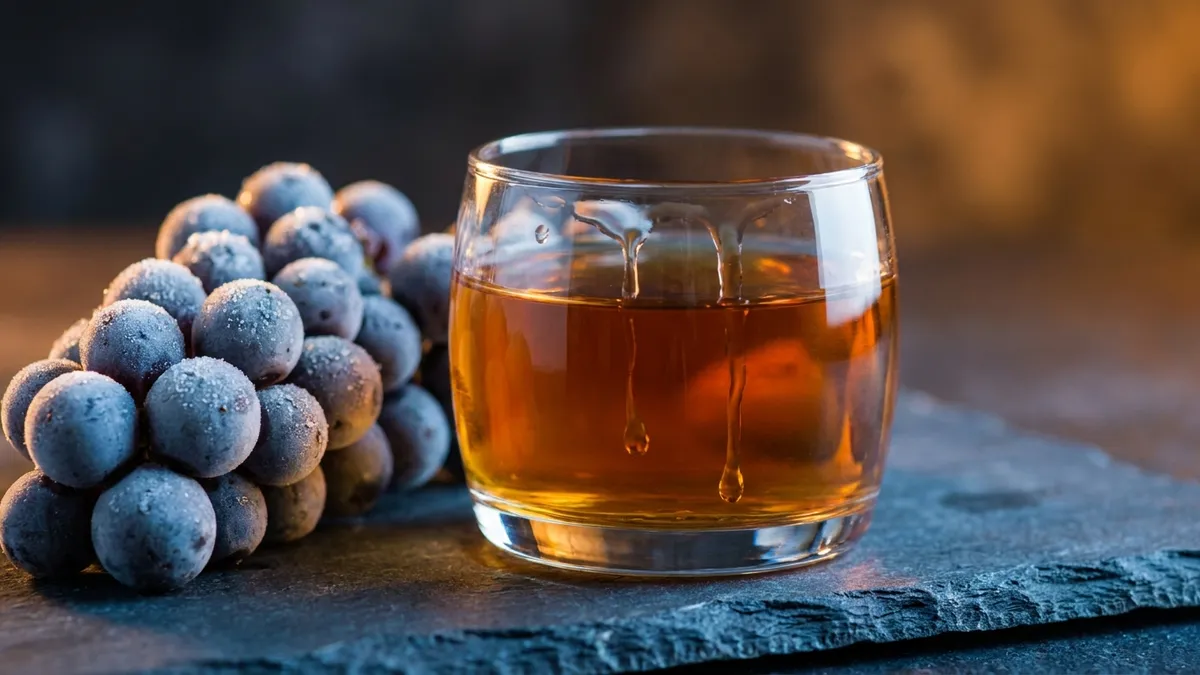
The basic principle is physics. Water freezes at zero degrees Celsius, but a sugar solution freezes at a lower temperature. When grapes hang through a hard frost, the water inside each berry turns to ice while the concentrated sugar-acid juice stays liquid.
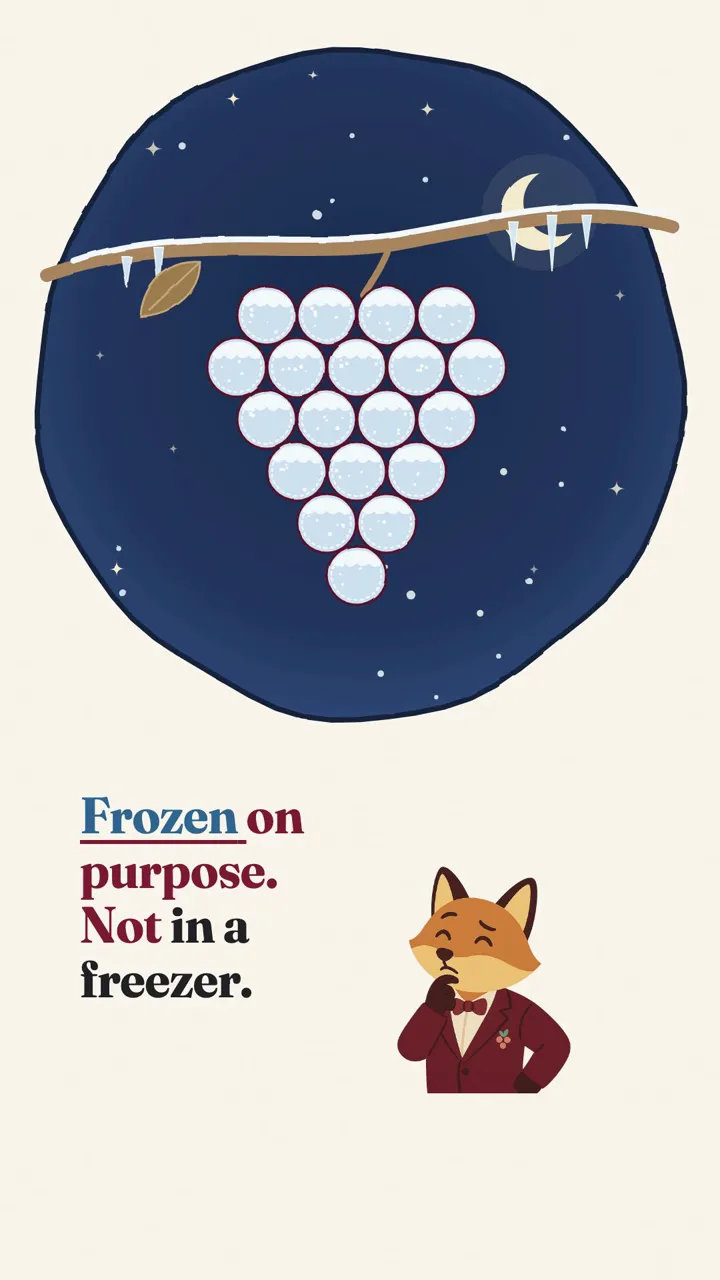
Frozen on purpose. Not in a freezer.
Sommy's voice is made with AI.
Read the script
Frozen on purpose. Not in a freezer. Press them frozen, and the water stays behind as ice. Only the sweet juice runs out. Use a freezer, and it can't be called ice wine. Send this to the friend who would use the freezer. Try it: half-thaw frozen apple juice and taste the first drips. So... would you wait for the frost?
Pressing those frozen grapes squeezes out the liquid concentrate first while the ice stays behind in the press. The result is a tiny amount of intensely concentrated juice — typically 10 to 20 percent of what the same grapes would produce at normal harvest.
That juice then ferments slowly. Because the sugar level is so high, yeast usually stop before all the sugar converts to alcohol. The finished wine ends up sweet, low in alcohol, and structurally unlike anything else in wine.
The harvest itself
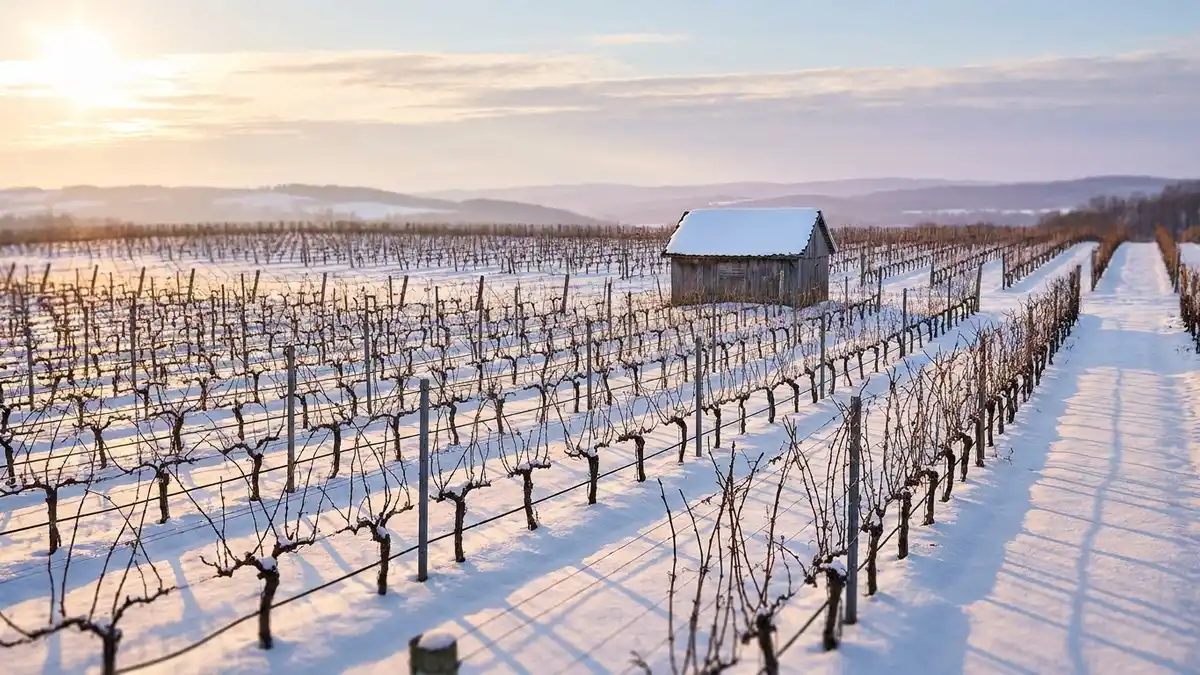
Grapes intended for ice wine stay on the vine well past normal picking — usually into December, often into January, sometimes February. They survive rain, wind, hungry birds, and rot during that wait. Many vineyards lose part or all of their crop before the freeze ever arrives.
When the right cold finally comes, picking happens by hand, at night, often between 3 and 5 AM, while temperatures sit at or below the legal minimum. The grapes go straight into the press without thawing.
The legal rules
The two leading regions both protect their style with strict rules.
- Germany — Grapes must be harvested at minus 7 degrees Celsius (19 degrees Fahrenheit) or colder. The wine must be labeled Eiswein only if pressed from naturally frozen grapes. No chaptalization (sugar addition) is allowed.
- Canada (VQA) — Grapes must be harvested at minus 8 degrees Celsius (17.6 degrees Fahrenheit) or colder. The wine must come from grapes frozen on the vine. Artificial freezing in a chamber is banned.
The technique of freezing already-picked grapes in an industrial freezer is called cryoextraction, and it is illegal under both labeling regimes. Wines made that way exist, but they cannot legally be called Eiswein or VQA Ice Wine.
Two Names, Two Countries, One Style
The split between Eiswein and ice wine is mostly a labeling story. The wines themselves are remarkably similar, with regional accents driven by grape choice and climate.
Germany and Austria — the originals
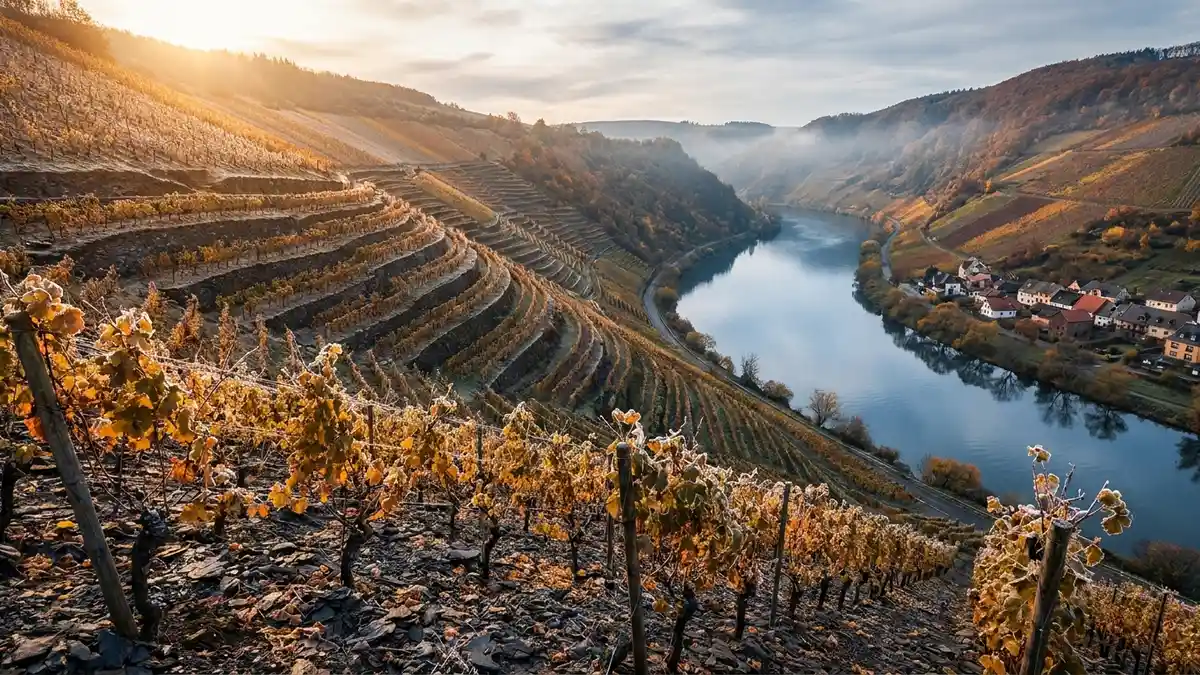
Germany invented the style by accident in 1794, when a Franconian winemaker pressed his frozen-over crop and discovered the result was extraordinary. The style remained obscure for over a century before becoming a recognized Prädikat level in 1971.
Riesling is the dominant grape, especially in the Mosel and Rhine. The wines tend toward laser-sharp acidity, mineral undertones, and aromas leaning more toward lime, white peach, and honey than tropical fruit. Austrian Eiswein, often from Grüner Veltliner or Welschriesling, follows a similar lean profile.
Recent vintages have been hard. Several winters in the late 2010s and early 2020s were simply too warm for the legal freeze across most German regions, and some growers reported the first vintages with zero Eiswein in living memory.
Canada — the modern volume leader
Canada took over the global volume crown in the 1990s and has held it since. The cold reliability of Ontario's Niagara Peninsula and British Columbia's Okanagan Valley turned out to be a structural advantage as European winters warmed.
The Canadian style leans more tropical and lush than the German one. Most Canadian ice wine comes from Vidal Blanc — a hardy white hybrid bred to survive harsh winters — which produces wines heavy on apricot, mango, and pineapple. Riesling-based Canadian ice wines exist and taste more austere and Germanic.
Cabernet Franc ice wine is also made in Niagara, producing a rare red ice wine with strawberry, raspberry, and rhubarb notes.
The Grapes That Freeze Best
Not every grape works for this style. The variety needs thick skin to survive a long autumn hang, naturally high acidity to balance extreme sugar, and aromatic compounds that hold up at concentration.
- Riesling — the classic, used in Mosel, Rhine, Niagara, and Okanagan. Produces the most age-worthy ice wines, with a citrus and stone fruit profile.
- Vidal Blanc — the most-planted ice wine grape in Canada, prized for thick skin and tropical character.
- Gewürztraminer — used in Alsace and a handful of Canadian sites. Very aromatic, with lychee and rose petal notes that intensify dramatically.
- Chardonnay — less common but produces richer, fuller-bodied ice wine with apple and tropical fruit.
- Cabernet Franc — rare, but the standout red ice wine grape in Niagara.
For more on these grapes outside the ice wine context, the Riesling wine guide covers the base variety in depth.
Taste Profile: What to Expect
A well-made ice wine is a study in extremes balanced against each other. The numbers tell most of the story.
- Color — pale gold in young examples, deepening to amber and copper with age
- Sweetness — 180 to 250 grams per liter of residual sugar (compared to under 4 g/L in dry wine)
- Acidity — high, often above 9 g/L total acidity, which is what stops the sweetness from feeling cloying
- Alcohol — 9 to 12 percent, lower than table wine because the yeast cannot finish fermenting
- Body — rich, viscous, syrupy in texture
- Finish — long and persistent, ideally clean rather than sticky
Aromas and flavors
Young ice wine usually leads with bright tropical and stone fruit: peach, apricot, mango, pineapple, lychee, papaya. Honey and floral notes sit underneath. With age, those primary aromas evolve toward dried apricot, marmalade, dried fig, caramel, and toasted nuts.
Riesling-based ice wines tend to keep more citrus and mineral character. Vidal-based ones lean tropical and floral. Gewürztraminer ice wines smell like a perfume shop in a good way.
Sommelier tip: The best ice wines feel weightless on the finish despite the sweetness. If your tongue feels coated and tired after the first sip, the acid is not doing its job — the wine is unbalanced.
If you struggle to identify these specific notes, aroma training is the underlying skill. Sweet wines reward a developed nose because the flavor density is so high.
Why It Costs What It Costs
Ice wine is expensive for structural reasons, not because producers are gouging.
- Yields are tiny — one tenth of normal harvest at best.
- Risk is real — entire vineyards lose their crop to rot, birds, or warm winters.
- Labor is brutal — hand-picking at minus 8 degrees in the dark is slow.
- Equipment is specialized — ice wine presses run for many hours at high pressure.
- Bottles are small — most ice wine sells in 200ml or 375ml format.
A single producer might make a few hundred cases in a successful year. Those economics put entry-level Vidal ice wine around $30 to $60 for a 375ml bottle, serious Riesling Eiswein and top Niagara examples at $60 to $150, and rare older vintages past $200.
Ice Wine Versus Other Dessert Wines
Ice wine is one of several intense sweet wine styles, and the differences come down to how the sugar gets concentrated. The dessert wine guide covers all of them in detail; here is the short comparison.
- Sauternes — sweetened by noble rot, the fungus Botrytis cinerea, which shrivels grapes on the vine. No freezing involved.
- Tokaji Aszú — also from noble rot, then pressed with regular wine in old Hungarian style. The Furmint guide covers the base grape.
- Vin Santo and Passito — grapes are dried on mats or in lofts after picking, concentrating sugar by evaporation.
- Late harvest — grapes simply ripen longer than usual, accumulating extra sugar but not affected by rot or freezing.
- Port and Sherry — fortified wines, where neutral spirit is added to stop fermentation and lock in sweetness.
- Madeira — heated and oxidized fortified wine, made for hot climates and long shelf life.
Ice wine is the only style that freezes the grapes on the vine. No rot, no drying, no fortification — just cold.
Serving Ice Wine the Right Way
Get the temperature wrong and the wine collapses. Get it right and it sings.
- Temperature — 8 to 10 degrees Celsius (46 to 50 degrees Fahrenheit). Too warm and the sweetness feels cloying. Too cold (straight from the freezer) and the aromatics shut down completely.
- Glass — a small dessert wine glass or a regular white wine glass. Avoid flutes or oversized glasses.
- Pour — 2 to 3 ounces per person. Ice wine is intense, and a 200ml bottle should comfortably serve four to six people at the end of a meal.
- Order — serve last in any tasting, after other dessert wines, or you will overpower everything that follows.
Food Pairings That Work
The cardinal rule for any sweet wine is that the wine must be at least as sweet as the food, otherwise the wine tastes thin and bitter. With ice wine, that is rarely a problem — the sugar level is so high that almost no dessert outsweetens it. The harder problem is matching intensity.
Classic pairings:
- Foie gras — the textbook match. Sugar and acid cut through the rich, fatty liver.
- Strong blue cheese — Roquefort, Stilton, Gorgonzola Piccante. The salt and funk play against the sweetness beautifully.
- Fruit tarts — tarte tatin, apricot tart, peach galette. Match stone fruit to stone fruit.
- Crème brûlée and panna cotta — creamy desserts with caramelized sugar tops mirror the wine's honey notes.
- Dark chocolate — high-cacao chocolate (70 percent and up) works, but stay away from heavy chocolate cake.
- Solo as a digestif — many people prefer ice wine after the meal, on its own, with no food at all.
Buying and Aging
A few practical buying tips.
- Look for the legal label — "VQA Ice Wine" in Canada or "Eiswein" in Germany guarantees authentic production. Anything labeled "iced wine" or made with cryoextraction is a different and usually inferior product.
- Check the vintage — climate-difficult years can produce thin Eiswein. Canadian winters are more reliable.
- Pick the right grape — Vidal for tropical lushness, Riesling for sharp elegance, Gewürztraminer for aromatic intensity.
Top ice wines age remarkably well. Cellaring 5 to 15 years is normal for serious bottlings, and the best Riesling Eiswein can develop for 30 years or more. The combination of high sugar and high acid acts as a natural preservative, and the wine slowly trades primary fruit for tertiary honey, marmalade, and dried fruit complexity. To explore that evolution, the tasting young versus aged wine guide is a good starting point.
Tasting Strategy: Getting the Most From One Small Bottle
A 375ml bottle of ice wine offers maybe 8 to 10 small pours. Treat each one carefully.
- Pour cold — straight from the fridge, or even briefly into an ice bucket.
- Take a tiny sip — much smaller than for a normal wine. This is concentrate.
- Hold it on the tongue — five to ten seconds, letting it warm and spread.
- Pay attention to the balance — focus on whether the acid is keeping pace with the sugar.
- Note the finish — long and clean is what you want, not sticky and short.
A practical first flight: start with a Canadian Vidal Blanc, follow with a German Riesling Eiswein, finish with a top Niagara Riesling ice wine. Three pours, one hour, the full range of the style.
Building the Skill to Taste It Well
Ice wine is one of the most rewarding wines to taste deliberately, because the flavor density gives you so much to detect. The structured approach in the sommelier-style tasting guide works for sweet wines, and the tasting vocabulary cheat sheet covers the specific terms — viscous, honeyed, racy, persistent.
The Sommy app builds the underlying sensory skills — recognizing sugar levels, judging acid balance, naming the specific fruit and floral compounds in a glass — through interactive practice. Ice wine sits inside the broader wine styles learning hub, alongside dry table wine, sparkling, and fortified styles.
Because ice wine sits at one extreme of the dessert spectrum, tasting it carefully helps calibrate your palate for everything else.
The Honest Reality
Ice wine is a special-occasion wine. The price-per-pour is high, the bottles are small, and the intensity means you do not drink it often or in volume. One bottle realistically lasts an evening among four to six people.
The experience is genuinely unlike anything else in wine. A glass of well-made ice wine — sharp, sweet, perfumed, and weightless on the finish — is one of the more memorable sensory moments wine has to offer. For broader guidance on building a thoughtful collection that includes a few sweet wines, see Sommy.
Sommelier tip: Buy one good 375ml bottle of Riesling Eiswein for an occasion you actually care about. Sharing it with three or four careful tasters is the best way to understand why this style has survived 230 years of warm winters and skeptical drinkers.
Frequently Asked Questions
What is the difference between ice wine and Eiswein?
They are the same style with different country labeling rules. Eiswein is the German term, used in Germany and Austria, where grapes must be picked at minus 7 degrees Celsius or colder. Ice wine is the Canadian term, governed by VQA rules requiring harvest at minus 8 degrees Celsius or colder. Both must come from grapes frozen naturally on the vine.
Why is ice wine so expensive?
Yields are tiny — often one tenth of a normal harvest — because most of the water leaves as ice during pressing. Grapes hang into December or January under constant risk of rot, birds, and storms. Picking happens by hand at night in freezing temperatures. Add specialized presses, climate gambling, and 200ml or 375ml bottles, and a single producer's annual output is often a few hundred cases.
What does ice wine taste like?
Expect intense sweetness — typically 180 to 250 grams of residual sugar per liter — balanced by high acidity that keeps the wine from feeling heavy. Common aromas include peach, apricot, lychee, mango, honey, and dried fig. The texture is rich and viscous, the finish long, and the alcohol low at around 9 to 12 percent because the frozen grapes never ferment fully.
Can ice wine be made artificially in a freezer?
Not legally in Germany or Canada. The technique of freezing harvested grapes in a freezer is called cryoextraction, and it is banned for any wine labeled Eiswein or VQA Ice Wine. The grapes must freeze on the vine in nature. Some other regions allow cryoextraction, but those wines cannot use the protected ice wine names.
How long does ice wine age?
Top examples easily age 5 to 15 years, and the best Riesling-based bottlings can develop for 30 years or more. The high sugar and high acid act as natural preservatives. Younger ice wine shows bright tropical and stone fruit. Older bottles develop honeyed, dried fruit, and caramelized notes while keeping their acid spine intact.
What food pairs best with ice wine?
The classic pairing is foie gras, where the wine's sugar and acid cut the liver's richness. Strong blue cheeses like Roquefort and Stilton also work beautifully. Fruit tarts, tarte tatin, crème brûlée, and dark chocolate all pair well. Avoid heavy chocolate cake — the dessert overwhelms the wine. Many people drink ice wine on its own as a digestif.
Is climate change affecting ice wine production?
Yes, especially in Germany. Several recent winters were too warm for grapes to freeze at the legal minimum temperature, and some traditional regions reported their first vintages without any Eiswein in centuries. Canadian production has stayed more reliable thanks to harsher winters in Niagara and the Okanagan, which is one reason Canada has become the global volume leader.
How should ice wine be served?
Serve ice wine well chilled at 8 to 10 degrees Celsius, or 46 to 50 degrees Fahrenheit. Cold preserves the aromatics and keeps the sweetness from feeling cloying, but avoid ice-cold from the freezer because that mutes the bouquet. Use a small dessert wine glass or a regular white wine glass and pour 2 to 3 ounces — the wine is intense and a little goes a long way.
Sommy Team
LinkedInFounder & Wine Educator
The Sommy Team is building the world's most approachable wine education app, helping beginners develop real tasting skills through structured courses and AI-guided practice.