Tartrate Crystals in Wine: Harmless Wine Diamonds Explained

By the Sommy Team — AI-assisted, human-edited.
Updated Jul 23, 2026
Contents (10)
- What Are Tartrate Crystals in Wine, in One Paragraph
- What Tartrate Crystals Actually Are
- Why Tartrate Crystals Form: Cold and Time
- Tartrate Crystals vs. Sugar, Glass, and Sediment
- Why White Wines and Rosé Show Tartrate Crystals Most
- Cold Stabilization: Why Some Wines Never Show Crystals
- Are Tartrate Crystals a Fault? (And the One Exception)
- How to Serve a Wine with Tartrate Crystals
- A Quick Word on Sulfites and Other "Scary" Words
- How Sommy Helps You Read a Bottle
TL;DR
Tartrate crystals in wine are harmless — natural salts of tartaric acid, the same food-grade compound sold as cream of tartar. They form when a wine gets cold, so whites and rosés show them most. The clear crystals on a cork are not broken glass, sugar, or a fault. Stand the bottle up and pour slowly.
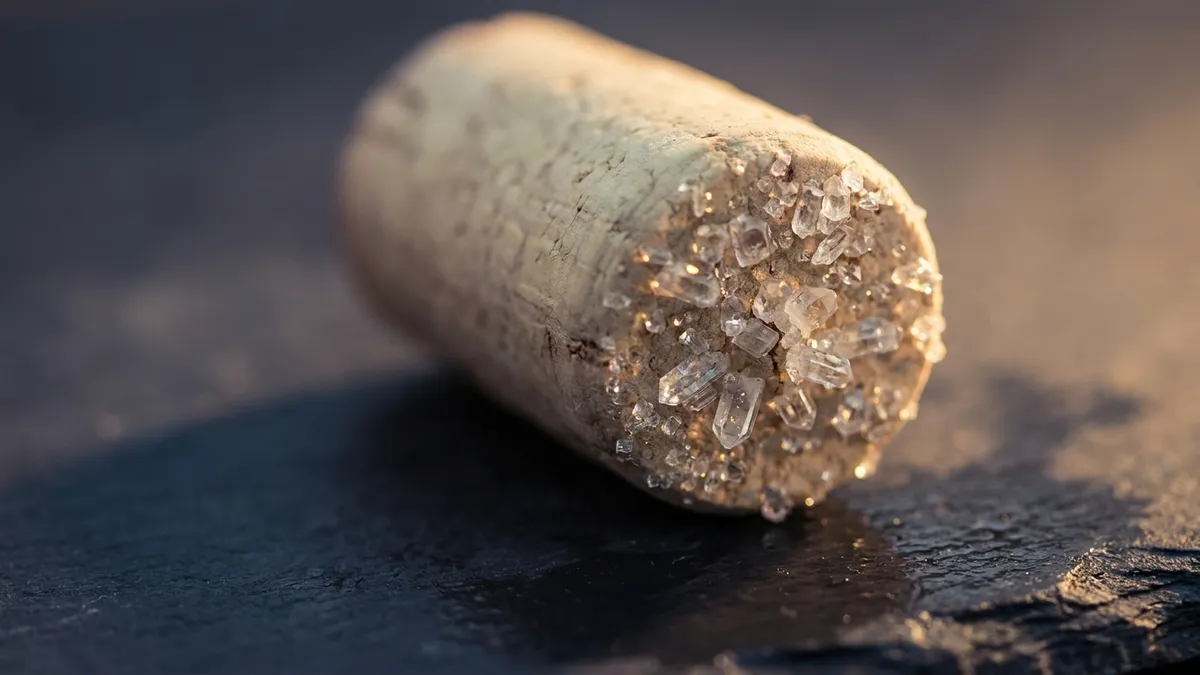
You pull the cork on a chilled white and find a scatter of clear, glassy specks clinging to the underside of the cork or settled at the bottom of the bottle. Those specks are tartrate crystals, and the instinct is alarm. Did the bottle sit next to something that shattered? Is the wine crystallizing sugar? Has it gone off?
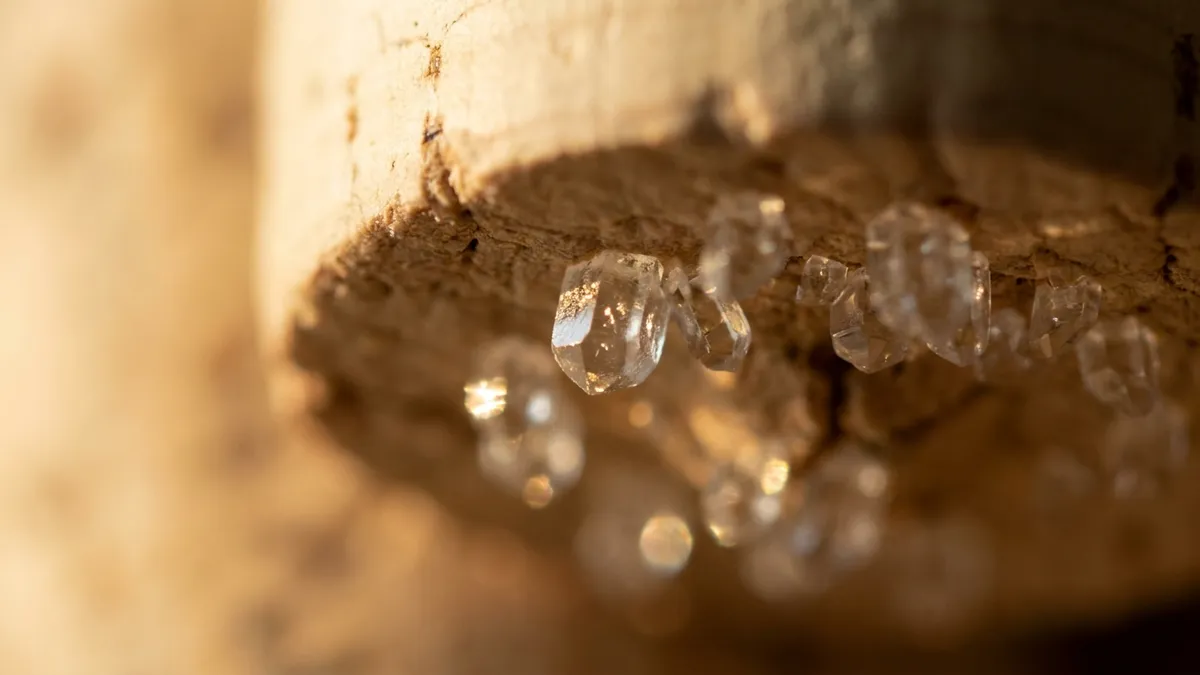
None of the above. Tartrate crystals are small crystals of potassium bitartrate, a natural salt of the tartaric acid found in every grape, and they are one of the most misread sights in wine. Winemakers nickname them "wine diamonds" because they catch the light, and they are as harmless as the name suggests — the same compound sold in the baking aisle as cream of tartar.
This guide explains exactly what tartrate crystals in wine are, why cold weather and certain styles produce them, how to tell them apart from broken glass or sediment in two seconds, and how to serve a bottle so the crystals stay where they belong.
What Are Tartrate Crystals in Wine, in One Paragraph
Tartrate crystals in wine are crystals of potassium bitartrate that form when tartaric acid — the dominant acid in grapes — bonds with potassium and drops out of the liquid in the cold. They are the same compound as cream of tartar, they are food-safe, and they are tasteless. Because cold drives the reaction, roughly the coldest corner of your fridge is where they appear, and low-tannin whites, rosés, and sparkling wines show them most. They are not sugar, not glass, and not a spoilage sign. A wine that throws crystals was simply bottled without the aggressive cold-filtering that strips them out of cheaper wine. Stand the bottle up, pour slowly, and the crystals stay behind.
What Tartrate Crystals Actually Are
Every wine grape is loaded with tartaric acid (the principal acid that gives wine its fresh, mouth-watering tartness). In the juice, some of that acid pairs up with naturally present potassium to form potassium bitartrate — a salt. While the wine is at room temperature, that salt stays dissolved and invisible.
The salt has a stubborn quirk: it becomes less soluble as the liquid cools. Chill the wine and the dissolved potassium bitartrate has nowhere to go, so it comes out of solution and crystallizes onto any available surface — the cork, the punt at the bottom of the bottle, or the inside of the glass.
If the name potassium bitartrate sounds oddly domestic, that is because you already own some. Purified, it is cream of tartar — the food-grade white powder in the baking aisle that stabilizes egg whites and keeps meringue from weeping. The crystals on your cork are the un-purified, wine-stained version of the exact same thing.
Why Tartrate Crystals Form: Cold and Time
Two conditions produce visible crystals: a cold enough temperature and enough time for the salt to gather into crystals big enough to see.
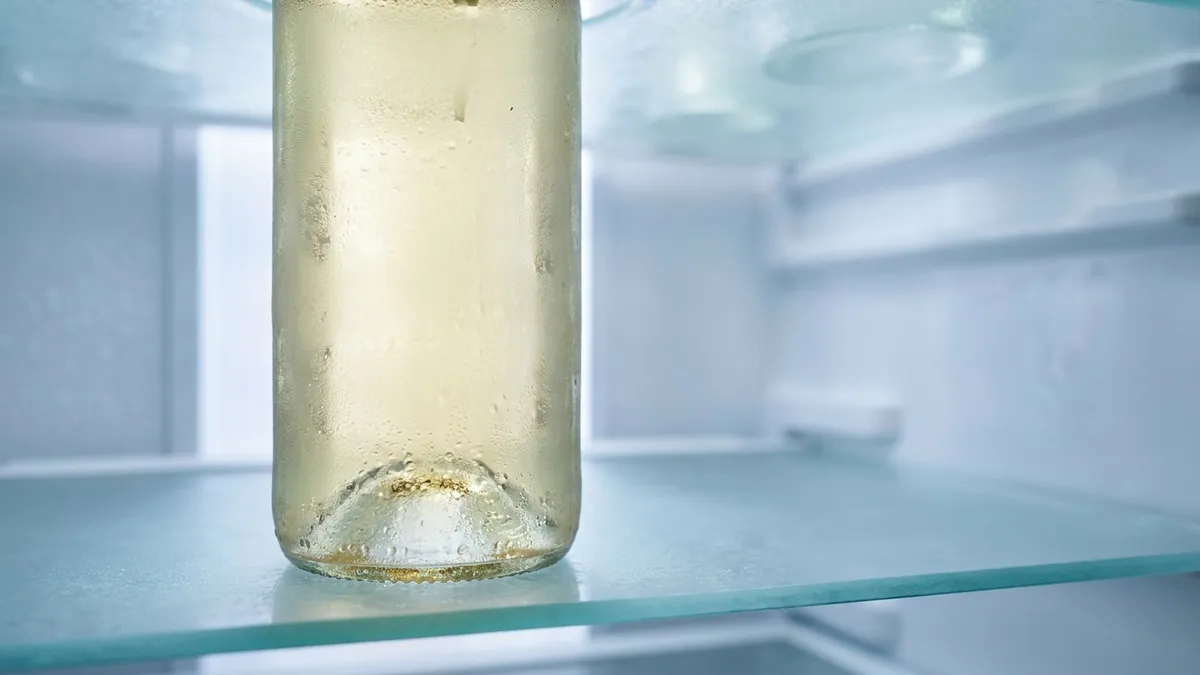
The colder the wine, the more of the dissolved salt is forced out. A bottle stored at a steady cellar temperature around 12–14°C (54–57°F) rarely shows crystals. Move that same bottle into a domestic fridge at 4°C (39°F) for a few weeks and the tartaric acid salts have both the cold and the time they need to crystallize. Freeze a bottle by accident and you can produce a heavy dusting of crystals overnight.
This temperature link is also why winemakers can prevent crystals on purpose, and why they sometimes choose not to — a decision we come back to below. For the storage side of the same equation, our guide to how to store wine at home covers the temperatures that keep a bottle stable, and the wine serving temperature chart shows where each style tastes best once it is out of the cold.
Tartrate Crystals vs. Sugar, Glass, and Sediment
The panic around tartrate crystals almost always comes from mistaking them for something else. Here is how they compare with the three things people usually fear instead.
| What you see | What it really is | Tell-tale sign | Safe? |
|---|---|---|---|
| Clear glassy crystals on a cork | Tartrate crystals (potassium bitartrate) | Crush to fine powder between two spoons | Yes — harmless |
| White specks you think are sugar | Still tartrate crystals | Sugar never crystallizes out of wine; it stays dissolved | Yes — harmless |
| Sharp shiny fragments | Actual broken glass (very rare) | Irregular, reflective edges that do not crush to powder | No — discard the bottle |
| Dark, fine grit at the bottom | Sediment: polymerized tannin and pigment | Only in aged reds; brown-red and dusty, not clear | Yes — harmless |
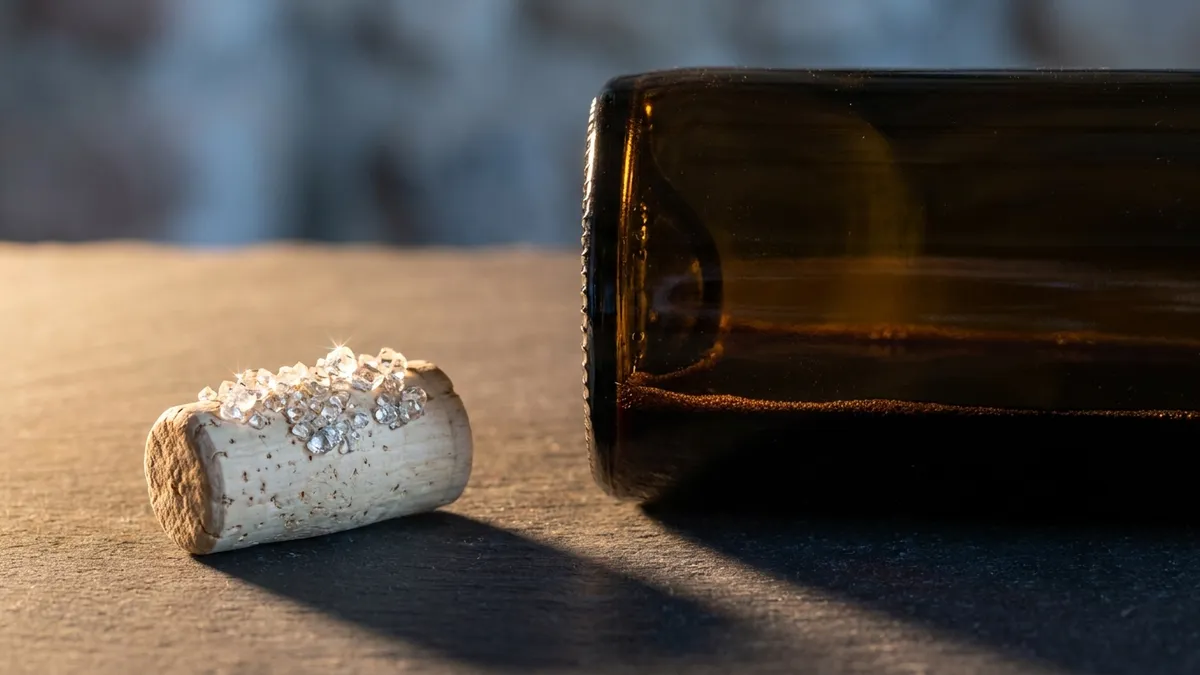
The most useful distinction is between crystals and sediment. Tartrate crystals are clear, hard, and crystalline. Sediment in an aged red is soft, dark, and dusty — polymerized tannin and color pigment rather than acid salt. Both are harmless, but they come from completely different processes. If you want the full picture of the darker deposit, our companion guide on wine sediment walks through the tannin-and-pigment grit that shows up in older reds.
The sugar myth deserves a direct answer, because it is the single most common misreading. Sugar does not crystallize out of wine — even a lusciously sweet dessert wine holds its sugar in solution indefinitely. What looks like "sugar crystals" on a sweet wine cork is, essentially without exception, tartrate crystals. Sweet wines often show them clearly because their high acidity gives the salts plenty of raw material.
Why White Wines and Rosé Show Tartrate Crystals Most
If you have only ever noticed crystals on white or sparkling wines, that is not a coincidence. Red wines throw them too, but they hide them better.
In a red wine, tannins (the drying, gripping compounds from grape skins and seeds) and color pigments act like a crowded room — they physically get in the way of the potassium bitartrate salts trying to line up into crystals, and they can keep the salts loosely suspended. A white wine has almost none of that clutter. With nothing to interfere, the salts crystallize freely and settle as clean, visible shards.
That is why the classic places to spot tartrate crystals are a cold-stored Riesling, a Champagne cork, or a chilled rosé. Our riesling wine guide covers a grape whose naturally high acidity makes it one of the most reliable crystal-formers of all, and the crisp acidity that drives crystal formation is the same trait explored in our explainer on what wine acidity is.
Cold Stabilization: Why Some Wines Never Show Crystals
Here is the part that reframes the whole subject. Winemakers have known about tartrate crystals for centuries, and most large producers deliberately remove them before bottling through a process called cold stabilization (chilling the finished wine to near-freezing so the tartrates crystallize in the tank, where they can be filtered out, instead of in the bottle).
The wine is held at roughly −4°C (25°F) for one to two weeks. Every crystal that would have formed in your fridge forms in the tank instead, gets filtered away, and the bottled wine looks flawless for years. It is a purely cosmetic step — it changes nothing about flavor except to remove a tiny amount of acid.
So why doesn't every producer do it? Two reasons. Cold stabilization costs energy and time, so smaller and lower-intervention producers often skip it. And a growing number of winemakers argue that aggressive chilling and filtering strips a sliver of texture and aromatic detail along with the crystals. Many natural and minimum-intervention wines are left un-stabilized on purpose — the crystals are the visible price of a gentler process. Our guide to natural wine covers this hands-off philosophy in depth.
Are Tartrate Crystals a Fault? (And the One Exception)
For nearly every bottle, the answer is a flat no. Tartrate crystals are a natural, harmless, and often positive sign. A wine that shows them was usually bottled without the harshest processing, which is a mark of care, not carelessness.
The one thing worth checking is whether you are actually looking at crystals or at something else. Clean crystals that have settled to the bottom of the bottle are never the problem. All-over cloudiness — a haze that hangs suspended through the whole glass rather than sitting at the base — is a different conversation and can point to a real fault. The simple test: crystals and sediment settle; a genuine fault haze does not. If a wine also smells of vinegar, wet cardboard, or nail polish, the crystals are a red herring and the smell is the real story. Our guide to telling if a wine has gone bad covers those warning signs, and the faults learning hub lays out every common fault with side-by-side cues.
How to Serve a Wine with Tartrate Crystals
Serving a crystal-bearing bottle is easy, and the technique is the same one used for any wine with a deposit.
Stand the bottle upright
If you know the bottle has crystals, stand it straight up for a few hours — a full day for a bottle with a heavy dusting. This lets the crystals slide to the very bottom of the punt so they are not swirling around when you pour.
Open without shaking
Cut the foil and draw the cork with the bottle steady and vertical. Every tilt and jostle stirs the crystals back into the wine, undoing the settling you just waited for.
Pour slowly and stop early
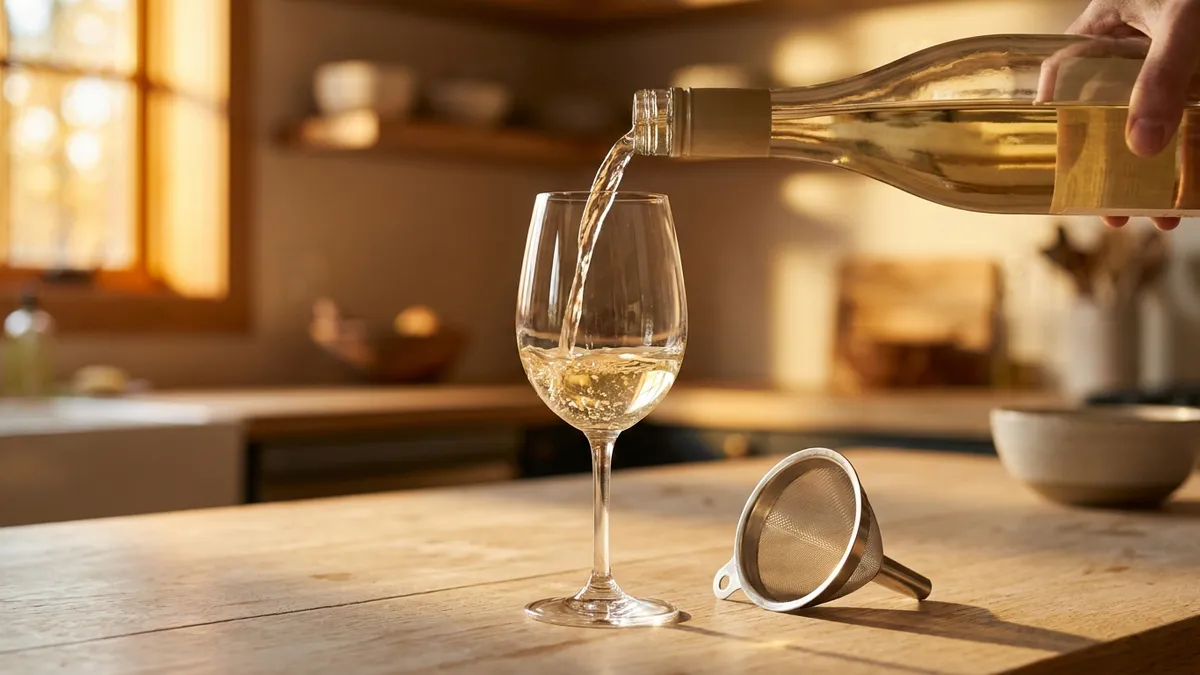
Pour in one smooth, unhurried motion and stop before the final splash. The crystals ride the last inch of wine, so leaving it in the bottle keeps every glass bright and grit-free.
Decant if there are many
For a bottle with lots of crystals, pour it through a small funnel with a fine mesh into a decanter. The mesh catches the crystals and the wine flows through clear.
If crystals do reach your glass, nothing bad happens — they are inert and tasteless. You will feel a faint grit, and that is the whole story. For the mechanics of separating a wine from any deposit, our guide on how to decant wine covers the pour-and-watch technique in detail.
A Quick Word on Sulfites and Other "Scary" Words
Tartrate crystals sit in the same category as a handful of other wine words that sound alarming and turn out to be routine. Sulfites are the best-known example — a naturally occurring and added preservative that gets far more blame than it deserves. Both crystals and sulfites are cases where a normal, well-understood part of winemaking gets mistaken for a defect. Our explainer on sulfites in wine unpacks that one the same way this guide unpacks crystals: with the actual chemistry, minus the fear.
The through-line is simple. A calibrated eye reads a bottle the way a mechanic reads an engine — most of what looks alarming to a newcomer is normal, and the genuinely bad signs are specific and learnable.
How Sommy Helps You Read a Bottle
Recognizing tartrate crystals, naming what they mean, and serving around them are exactly the kind of small, confidence-building skills that separate a hesitant drinker from a relaxed one. The Sommy app teaches fault-and-feature recognition with real-time feedback, starting with the visual cues you can read before you have even swirled the glass — crystals, sediment, color, and clarity.
The same nose-first method Sommy uses to diagnose oxidation, cork taint, or reduction also covers the visible side of the bottle, so you learn to separate a harmless deposit from a genuine warning sign in a couple of seconds. To build the broader framework, the lessons walk through appearance, aroma, palate, and finish as one connected system.
Visit sommy.wine to start training your eye for every clue a bottle gives you. Tartrate crystals are one of the easiest to read once you have seen them twice — after that, a glassy scatter on a cork reads as "wine diamonds," not "broken glass," every single time.
Sources
- Understanding Wine Chemistry — Waterhouse, Sacks & Jeffery, Wiley, 2016
- Tartrate stability — winemaking resources — The Australian Wine Research Institute, 2023
- What's in Wine: Fixed Acidity and Tartrates — Waterhouse Lab, UC Davis Viticulture & Enology, 2021
Frequently Asked Questions
Are tartrate crystals in wine safe to drink?
Yes. Tartrate crystals are potassium bitartrate — the same food-grade salt sold in the baking aisle as cream of tartar. They are tasteless, odorless, and completely harmless. If a few end up in your glass, they feel like fine grit but do nothing to the flavor or your health. Most drinkers simply leave the last splash in the bottle to keep the glass clean.
What are the crystals at the bottom of my wine bottle?
They are almost certainly tartrate crystals, often called wine diamonds. Tartaric acid is the main acid in grapes, and when it bonds with potassium it forms a salt that becomes less soluble in the cold. The salt drops out of the wine as clear, glassy crystals that collect on the cork or at the base of the bottle. They are a natural byproduct, not a contaminant.
Why does my white wine have crystals?
White wines and rosés show tartrate crystals more than reds because they have little tannin or pigment to keep the crystals suspended. Cold storage is the trigger — a bottle that sits in a cold fridge for weeks gives the tartaric acid salts time to crystallize and settle. Riesling, Chardonnay, and Champagne kept cold are the most common places to spot them.
Are tartrate crystals a sign of a bad or spoiled wine?
No. Tartrate crystals are the opposite of a fault. They often signal a wine that was bottled gently, without the harsh cold-filtering many mass-market wines get. A spoiled wine announces itself through smell and a cloudy haze throughout the glass, not through clean crystals settled at the bottom. Crystals that have dropped to the base are a quality clue, not a warning.
How do I get rid of tartrate crystals in wine?
You do not need to remove them, and you cannot dissolve them back into the wine. The simplest approach is to stand the bottle upright for a day so the crystals settle, then pour slowly and stop before the last splash. For a bottle with many crystals, decant it through a fine mesh. The crystals stay behind and the wine pours bright.
Are tartrate crystals the same as sugar or broken glass?
No. Sugar stays dissolved in wine and does not crystallize, even in very sweet styles, so white specks are never sugar. Broken glass would be sharp, irregular, and reflective, while tartrate crystals are small, blunt-edged, and prismatic. If you crush one between two spoons it turns to fine powder — glass would not. The powder is pure cream of tartar.
Sommy Team
LinkedInFounder & Wine Educator
The Sommy Team is building the world's most approachable wine education app, helping beginners develop real tasting skills through structured courses and AI-guided practice.