Does Vibration Affect Wine Storage? Appliances and Moves

By the Sommy Team — AI-assisted, human-edited.
Updated Sep 25, 2026
Contents (9)
- Does Vibration Affect Wine Storage, in One Paragraph
- What Does Vibration Actually Do to Wine?
- Which Household Vibrations Are Worth Worrying About?
- Is It Safe to Store Wine on Top of the Fridge?
- Can You Keep Wine Near a Washing Machine or Dryer?
- Why Do Winemakers Shake Sparkling Wine on Purpose?
- Does Shipping or a House Move Damage Wine?
- Which Matters More: Vibration, Temperature Swings or Light?
- Where Should You Keep Wine at Home Instead?
TL;DR
Vibration does affect wine storage, but slowly and mainly for bottles aged for years, where steady shaking keeps sediment stirred and one study found it mostly hurt quality. Appliances do more harm through heat than hum. A house move or delivery is a minor event: keep bottles cool, then let older reds rest before opening.
Vibration does affect wine storage, but slowly, and mostly for bottles you plan to keep for years. The appliance next to your wine does far more harm through the heat it throws off than through its hum.
Does Vibration Affect Wine Storage, in One Paragraph
Yes, a little, and slowly. Steady vibration over months and years can speed up chemical change in wine. The study usually cited, a 2008 trial on a commercial red wine, found that change was mostly for the worse. At home the effect shows in sediment (the solid deposit older reds drop in the bottle): constant shaking keeps it from settling.
A washing machine's spin cycle shakes harder than a fridge compressor. Even so, the fridge top is the worse spot, because warm air collects there and reactions in wine roughly double with every 10°C rise. A house move or a courier van is a one-off event. If a bottle will be opened within a year, ignore vibration and keep it cool and dark.
What Does Vibration Actually Do to Wine?
Over long periods, steady shaking can speed up chemical change in wine, and the evidence says that change is usually negative. Wine in a bottle keeps reacting slowly: tannins and colour pigments bind together, aromas shift, and older reds drop sediment.
The research is thinner than most storage advice suggests. The study that nearly every source leans on was published in the Journal of Food Composition and Analysis in 2008. It tested a commercial red wine and found that vibrations at different frequencies each changed its chemistry in their own way. Its conclusion was that vibration could be used to age wine faster, "but in most cases, this may lead to negative effects on wine quality." Wikipedia's storage entry adds that this remains a research area with relatively little data.
No source gives a safe vibration threshold, so be wary of any number you see quoted. What can be said is where the effect shows. The clearest, most visible one is on sediment. A bottle that is shaken daily never lets its deposit settle into a neat line along the lower side, so the wine pours cloudy and tastes gritty at the end. Our wine sediment explainer covers what that deposit is and why it forms.
Young wines, whites and rosés meant for drinking within a year or two carry little or no sediment and change slowly anyway. For them, the effect is too small to notice.
Which Household Vibrations Are Worth Worrying About?
Only steady, long-lasting vibration next to a bottle you plan to age for years is worth acting on. A washing machine shakes hard, but only for minutes at a time. A fridge compressor hums gently all day. A house move is one rough day in a bottle's life. Heat often comes along with all three.
If a bottle will be opened within a year, you can ignore vibration and fix heat and light instead. The table ranks the common sources by what they actually do to a resting bottle.
| Source | Vibration pattern | Other problem nearby | Risk to a resting bottle | What to do |
|---|---|---|---|---|
| Top of the kitchen fridge | Low hum, cycling all day | Warm air from the motor collects there | High for anything kept over a week | Move bottles to a shelf away from the fridge |
| Cupboard beside the fridge | Faint hum through the wall | Mild warmth | Low for wine opened within months | Fine short term; age wine elsewhere |
| Laundry room shelf | Hard shaking during spin cycles | Dryer heat and damp | Moderate for wine kept over a year | Far wall, separate shelf, drink within months |
| Cabinet above the dishwasher | Rumble during washes | Hot steam at the end of each cycle | High | Never store wine here |
| House move or courier van | One day of bumps | Heat in a closed van or car | Low if kept cool | Rest older reds upright a day or two |
| Riddling rack at a winery | Shake, turn and tap every day or two | None, it is deliberate | None, it is a production step | Nothing, the sediment is removed |
For the full ranking of storage errors beyond vibration, see our guide to wine storage mistakes.
Is It Safe to Store Wine on Top of the Fridge?
No, but mainly because of heat rather than the hum. A refrigerator pumps heat out of its cabinet through coils and a motor, and warm air rises and pools on its top. A bottle up there sits in the warmest spot in the kitchen and gets a small shudder every time the compressor starts.
The heat is what does the damage. On average, the rate of chemical reactions in wine doubles with each 10°C (18°F) rise. A bottle kept at 25°C therefore ages about twice as fast as one at 15°C. Held above 25°C (77°F) for long periods, wine can spoil and taste stewed and flat, as described in our guide to cooked wine and heat damage. Most experts also warn against moving wine back and forth between a warm room and a cold fridge, because those repeated swings harm it.
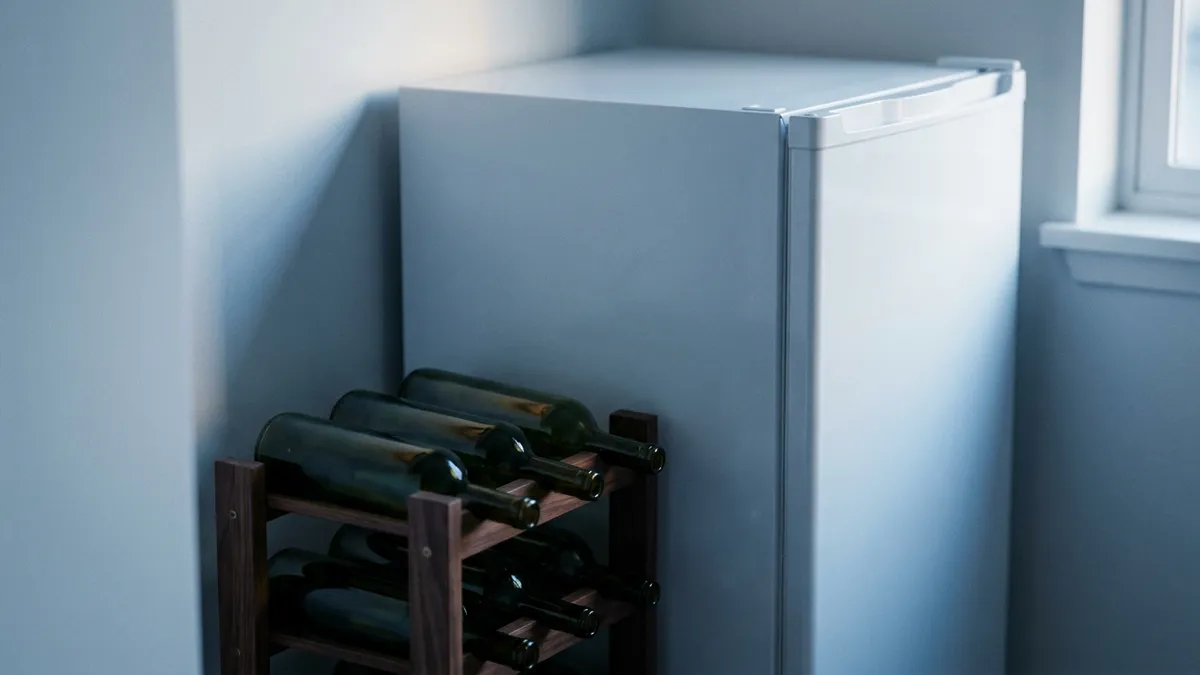
If the top of your fridge feels warm to your palm, nothing goes up there for longer than a week. A cupboard next to the fridge is a smaller problem, since it is cooler and the vibration reaching it is faint. Treat it as a short-term shelf for wine you will drink within a few months.
Inside the fridge is a separate question. A kitchen fridge is too cold and too dry for months of storage but fine for a bottle you will chill and open this week. Our wine fridge guide explains how a dedicated wine cooler handles temperature and vibration differently.
Can You Keep Wine Near a Washing Machine or Dryer?
For a few months, yes; for years of aging, no, because the spin cycle shakes hard and the dryer adds heat and damp. A washing machine's vibration is a different pattern from a fridge's hum. It comes in short, strong bursts a few times a week rather than a faint, constant buzz.
Those bursts are enough to stir the sediment in an older red on a shelf that touches the machine. The bigger threats in a laundry room are the others that come with it. A tumble dryer vents warm air, and a room full of wet washing swings in humidity, which is hard on labels and natural corks over time.
If a bottle must sit in the laundry room, keep it on the far wall, on a shelf that does not touch any machine, and drink it within months. Never rest wine directly on top of a washer or dryer. The same logic rules out the cabinet above a dishwasher, which gets a blast of hot steam at the end of every cycle.
Why Do Winemakers Shake Sparkling Wine on Purpose?
Because they want the sediment to move. Traditional-method sparkling wines such as Champagne get their bubbles from a second fermentation inside the bottle, which leaves behind lees (spent yeast that gives these wines their bready smell). Before the wine is sold, that yeast has to be collected in the neck and removed.
The step that collects it is called riddling. Bottles go into wooden racks called pupitres, held neck-down at a 35° angle. Once a day (every two days for Champagne) they are given a slight shake and turn, alternately right then left, and dropped back into the rack, with the angle gradually increased. The drop causes a slight tap, which pushes the sediment toward the neck. In 10 to 14 days, or 8 to 10 weeks for Champagne, each bottle points straight down with the lees settled in the neck. Many producers now hand the job to a machine called a gyropalette, which does the same shake and turn mechanically.
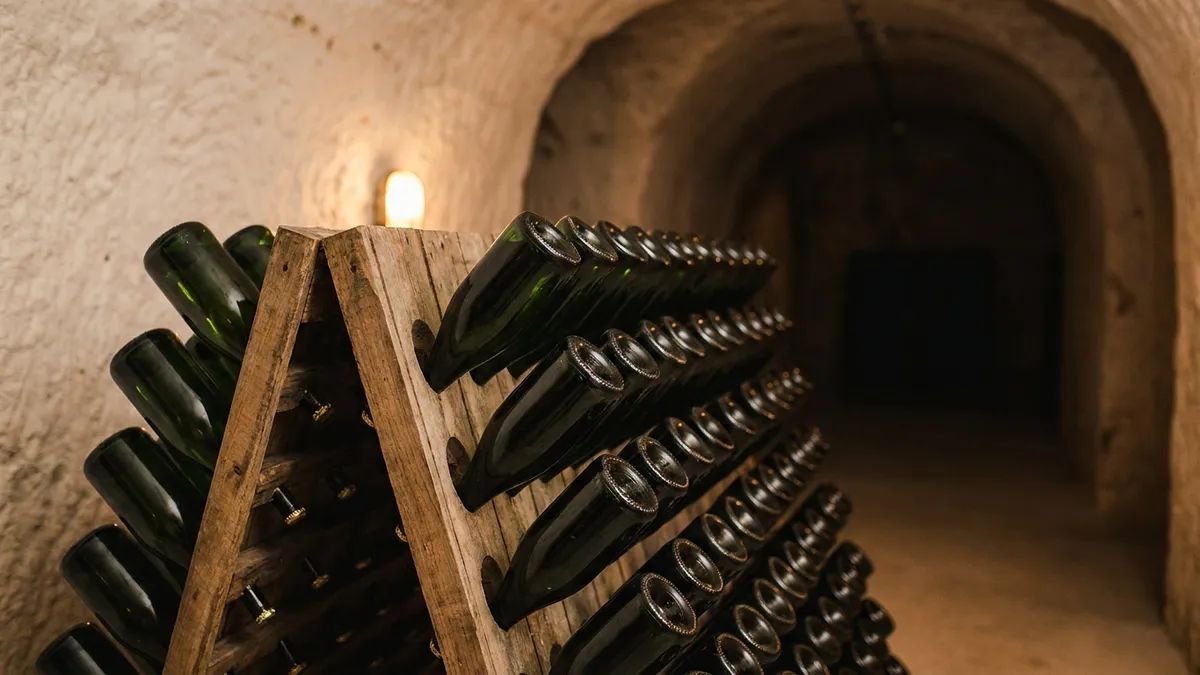
This looks like a contradiction, but the goals are opposite. Riddling is a short, controlled shake on a wine whose sediment is about to be thrown away; a bottle you are aging needs its sediment to settle and stay put. After riddling the neck is frozen and opened, and the plug of yeast shoots out. That step, disgorgement, is why a finished bottle of Champagne carries no yeast deposit at all. Our guide to sparkling wine types explains how this method differs from tank-made bubbles.
Does Shipping or a House Move Damage Wine?
Rarely, as long as the bottles stay cool. A move or a delivery is one day of bumps in a bottle's life, far short of the years of steady vibration the storage research describes. The real risk in transit is heat, especially a bottle left in a closed car or on a sunny doorstep.
Even heat has some margin. Professor Cornelius Ough of the University of California, Davis, held that wine could be exposed to temperatures as high as 49°C (120°F) for a few hours without damage. Days of heat are another matter, so bring deliveries inside the moment they arrive.
You may hear that wine suffers bottle shock after travel. Bottle shock (also called bottle sickness) is a real, temporary condition in which the fruit tastes muted or disjointed. The documented cause, though, is bottling itself or an extra dose of sulfur, and after a few weeks the condition usually disappears. The link to transport is widely repeated but not established in the sources that define it.
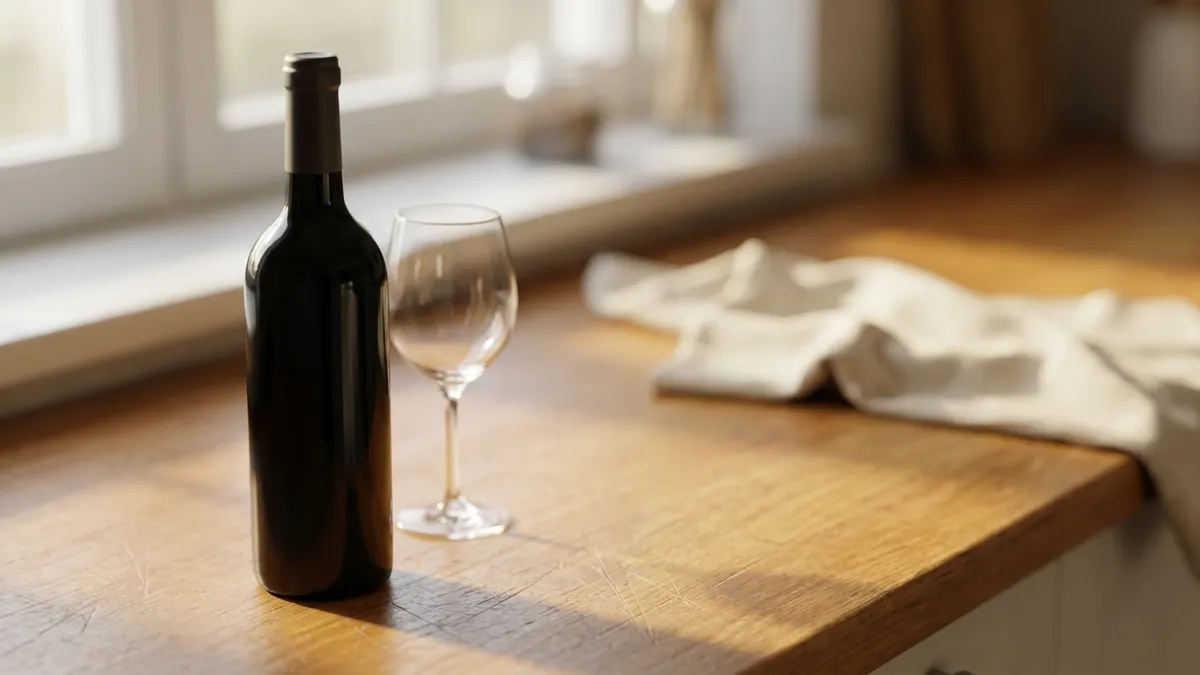
What a move does do is stir the sediment in older reds. If an older red has just arrived or been moved, stand it upright for a day or two before opening so the deposit drops to the base of the bottle. Young wine can be opened as soon as it is at serving temperature. For an older bottle, pour slowly or use the method in our guide to how to decant wine.
Which Matters More: Vibration, Temperature Swings or Light?
Temperature matters most, light comes second and vibration comes last. The three are often lumped together as one warning, and Wikipedia's aging entry does group vibration with heat swings as things that can hasten deterioration. Each works through its own mechanism, and heat acts fastest.
Temperature swings damage wine through the cork. All corks let a little air through, and every warm-cool cycle changes the pressure difference between the inside and outside of the bottle. Each swing pushes air in or out, which leads to oxidation, the flat, brownish decline covered in oxidized wine explained. Vibration does not move air at all; its visible effect is on sediment.
Light is the second threat. Wines are lightstruck when they take too much ultraviolet light, particularly in the range of 325 to 450 nanometres, which produces a smell of cabbage or wet cardboard. Light-bodied whites run the greatest risk, and clear bottles protect them least. Our guide to lightstruck wine shows how to spot it.
Put in order of speed, sunlight and heat can damage a bottle in days or weeks, while temperature swings work over months. Vibration needs years before it shows. If a storage spot gets sun or swings with the heating, fix that before worrying about any appliance hum.
Where Should You Keep Wine at Home Instead?
In the coolest, darkest, steadiest spot away from any appliance, usually an interior closet or a low cupboard on an inside wall. Wine keeps best at a constant 10 to 15°C (50 to 59°F), though anything from 7 to 18°C (45 to 64°F) works if changes are gradual.
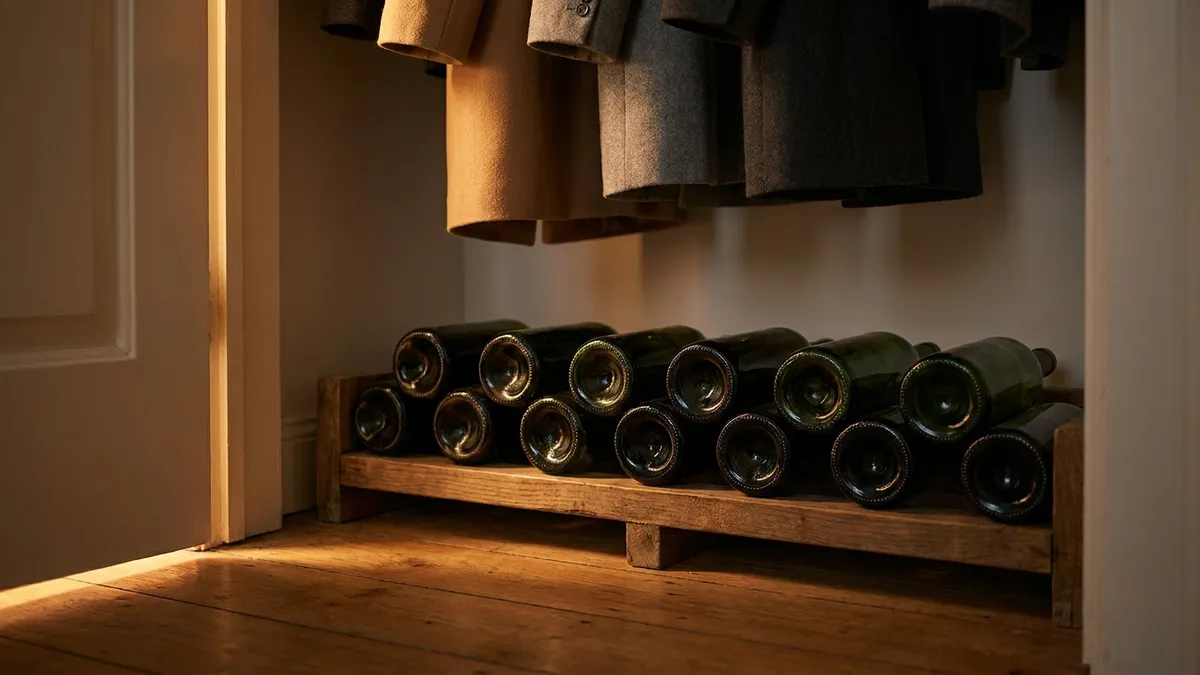
Humidity matters less than most advice claims. Moderate levels of 55 to 75% are the practical working range; very dry air can shrink a natural cork over years. Lay cork-sealed bottles on their side or at a slight angle so the cork stays in contact with the wine; horizontal vs vertical storage covers when standing them up is fine.
If a spot feels warm, bright or buzzing, move the bottles you plan to keep for more than a year and leave the weeknight bottles where they are. A basement floor, an understairs cupboard or the back of a bedroom wardrobe usually beats any kitchen shelf. For the full numbers and a way to test a spot, see wine cellar temperature and humidity and our broader guide to storing wine at home. The serving and storage hub collects the rest.
The Sommy app at sommy.wine has short courses, including Wine 101, for learning what a well-kept bottle should taste like. Tonight, walk to wherever your wine lives and lay a hand on the shelf and on the top of the fridge. Move any bottle meant for next year or later into the coolest inside cupboard in the house. Then pour one of the weeknight bottles left in the kitchen, since a few weeks there never hurt it.
Sources
Frequently Asked Questions
Does vibration really ruin wine?
Not quickly, and not for everyday bottles. The main study on the subject, from 2008, found vibration changed a red wine's chemistry and in most cases made it worse, but research on it is thin. The practical risk is steady vibration over years, which keeps sediment in older wines from settling. For wine you plan to open within a year, vibration is close to irrelevant.
Is it bad to store wine on top of the refrigerator?
Yes, for anything longer than a few days. The bigger problem is heat, not hum: warm air from the fridge collects on its top, and chemical reactions in wine roughly double in speed with every 10°C rise. The compressor also cycles on and off all day, adding low-level vibration. Move bottles to a shelf away from the fridge, or to an interior closet.
Can I store wine near a washing machine?
For a few months, yes. For years of aging, no. A spin cycle shakes much harder than a fridge compressor, a dryer adds heat, and laundry rooms swing in humidity. If the laundry room is your only option, use a separate shelf on the far wall, keep bottles off the machine itself, and drink them within months rather than holding them for years.
Does shaking a bottle of wine ruin it?
A single shake does not damage still wine. It only stirs any sediment into the liquid, which makes the pour cloudy and gritty until it settles again. Stand the bottle upright for a day or two and the sediment sinks back to the bottom. Sparkling wine is different: shake it and it can foam out when opened, so let it rest in the fridge first.
How long should wine rest after being shipped or moved?
Young wine without sediment can be opened as soon as it is at the right temperature. An older red that throws sediment should stand upright for a day or two so the deposit drops to the bottom before you pour. Bottle shock, the muted, disjointed taste people blame on travel, is documented mainly after bottling and usually clears within a few weeks.
Why do winemakers shake Champagne if vibration is bad for wine?
Because they want the sediment to move. In riddling, bottles sit neck-down in angled racks and are given a small shake and turn, tapping the dead yeast down into the neck over 8 to 10 weeks for Champagne. The deposit is then removed. A bottle you are aging needs the opposite: its sediment should settle and stay put.
Sommy Team
LinkedInFounder & Wine Educator
The Sommy Team is building the world's most approachable wine education app, helping beginners develop real tasting skills through structured courses and AI-guided practice.