Lightstruck Wine Fault: How Light Turns Wine to Cabbage

By the Sommy Team — AI-assisted, human-edited.
Updated Sep 24, 2026
Contents (10)
- What Is a Lightstruck Wine Fault, in One Paragraph?
- What Does Lightstruck Wine Smell and Taste Like?
- Which Bottle Colours Protect Wine From Light?
- Which Wines Get Lightstruck Most?
- How Fast Does Light Damage Wine?
- How Should You Buy and Store Wine to Avoid Light Strike?
- Can You Fix a Lightstruck Wine?
- Why Does Light Make Wine Smell of Cabbage?
- How Do Winemakers Stop Light Strike Before Bottling?
- Why Is Some Champagne Sold in Clear Glass?
TL;DR
Lightstruck wine is a pale wine damaged by UV and blue light. Vitamin B2 in the wine breaks down a sulfur amino acid into gases that smell of cabbage and wet cardboard. Clear glass blocks about 10% of that light, amber or dark green about 90%. The damage is permanent.
A lightstruck wine fault happens when light hits a pale wine in its bottle. The wine's own vitamin B2 then turns a sulfur amino acid into gases that smell of cooked cabbage. It can start within an hour on a bright shelf, and no amount of air undoes it. Sparkling wine, rosé and crisp whites in clear glass are the usual victims.
What Is a Lightstruck Wine Fault, in One Paragraph?
A lightstruck wine fault, or light strike (the French call it goût de lumière, "taste of light"), is a cabbage or wet-cardboard smell created when UV and blue light reach a wine in the bottle. Riboflavin, vitamin B2, absorbs light below about 510 nanometres and breaks down methionine into methanethiol and dimethyl disulfide. Clear glass blocks about 10% of the harmful light, light green about 50%, and dark green or amber about 90%. Five minutes of direct sun can do detectable damage.
In a supermarket test, some clear-bottle wines turned faulty in one to two days and all of them within 20 to 40. The fault is permanent. It mostly strikes sparkling wine, rosé and pale whites, because red wine's tannin soaks up much of the light.
What Does Lightstruck Wine Smell and Taste Like?
Lightstruck wine smells of cooked cabbage, onion, wet cardboard or a damp wool sweater, and in bad cases of drains. Two sulfur compounds cause it, and both work at tiny doses. Underneath them, the fresh fruit the wine should show has faded.
Methanethiol (a gas that smells of rotting cabbage) shows in white wine at just 2 to 10 micrograms per litre. Dimethyl disulfide, or DMDS, reads more as cooked onion and shows at 20 to 45 micrograms per litre. Both amounts are far smaller than a single drop spread through a bottle.
A rosé that should smell of fresh strawberry smells of cardboard instead, because the light breaks down the fruit aromas at the same time as it makes the sulfur ones. On the palate the wine tastes flat and a little dull, with the sulfur smell coming back up the nose after you swallow. Drinkers often borrow the beer word "skunky" for it, though in wine the smell usually reads as vegetables rather than animal.
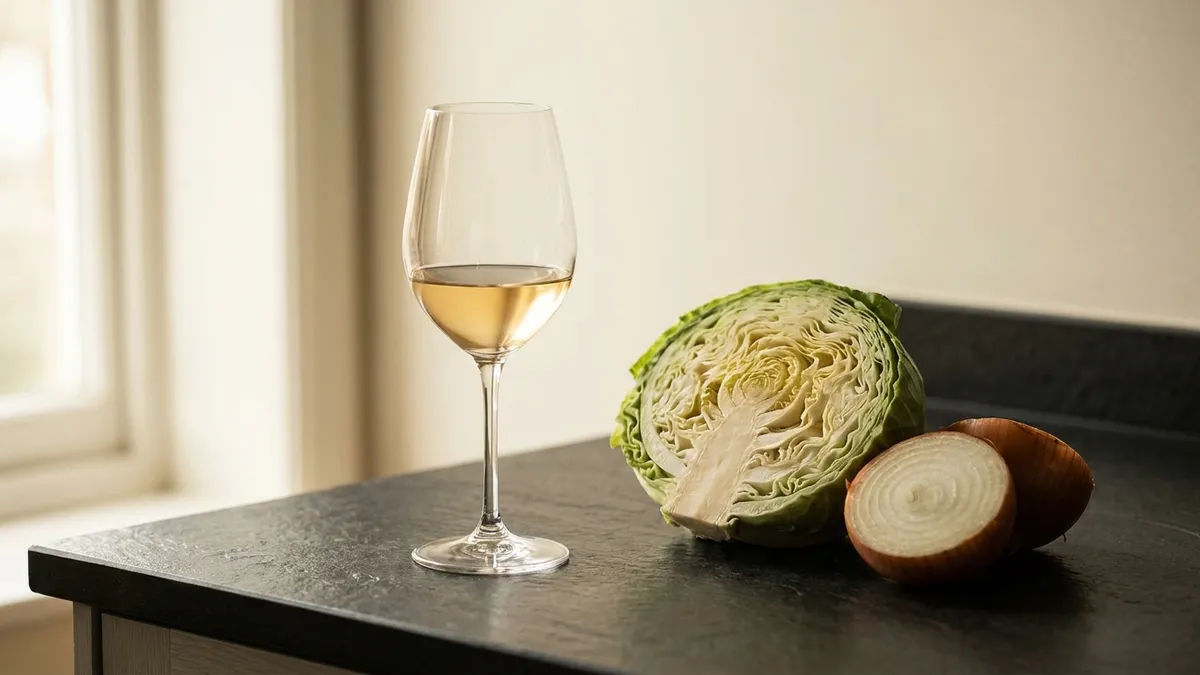
A mild case is easy to mistake for other sulfur smells. A struck-match smell that fades after ten minutes in the glass is usually sulfur dioxide or a reduced wine (one that spent too little time with air). A cabbage smell that stays, in a pale wine from a clear bottle, points to light. The sulfur smell guide and how to smell reduction in wine cover those look-alikes.
Which Bottle Colours Protect Wine From Light?
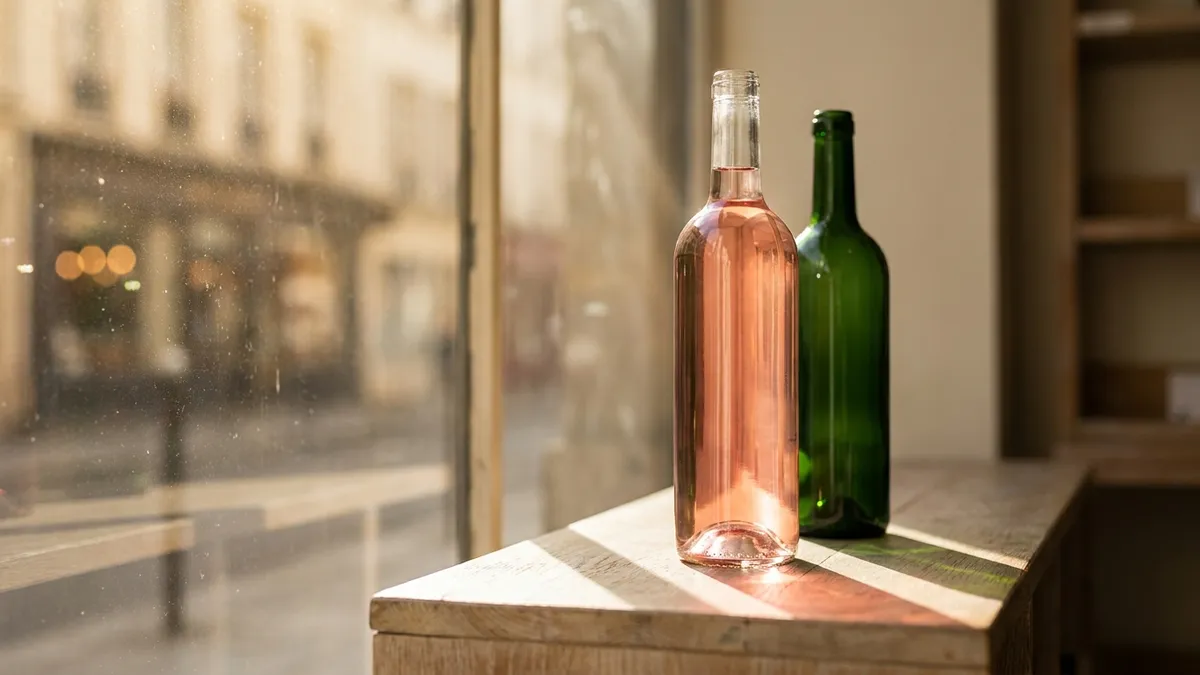
Darker glass protects more. Clear glass blocks only about 10% of the harmful light, and dark green or amber glass blocks about 90%. The catch is that "green glass" is not one thing. Light green bottles block about 50%, while dark antique green bottles reach about 90%, the same level reported for amber.
The two sources that give figures rank the colours the same way. One puts amber at 90% and green at 50%. The other, from an English sparkling wine estate, splits green into two shades and gives the darker one 90%. Read together, the ranking is settled: clear is worst, pale green halves the damage, and brown or very dark green protects best.
| Bottle glass | Harmful light blocked | How it behaves on a lit shelf | What to do in the shop |
|---|---|---|---|
| Clear (flint) | About 10% | Some wines faulty in 1 to 2 days, all within 20 to 40 days | Take a bottle from a closed box or the back of the row |
| Light green | About 50% | Green glass protected for up to about 50 days in the same test | Fine for a quick purchase, but skip window displays |
| Dark antique green | About 90% | Strong protection, still harmed by direct sun | A safe default for whites and sparkling wine |
| Amber (brown) | About 90% | Strong protection, still harmed by direct sun | The safest choice for delicate whites |
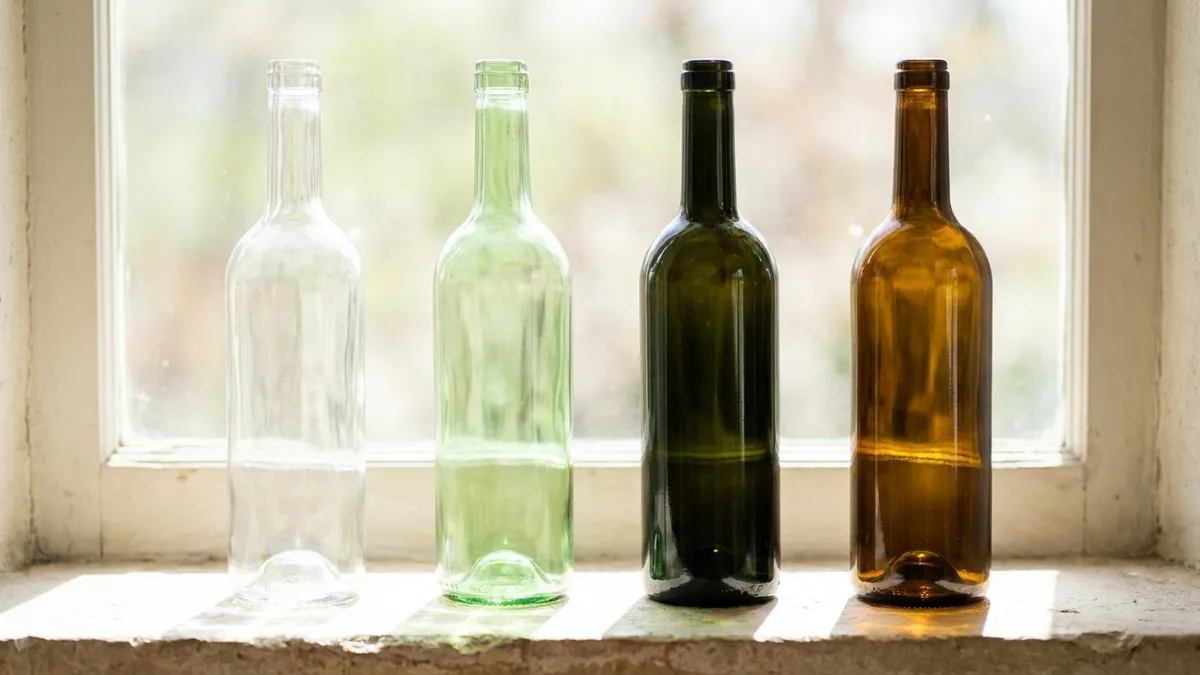
If a rosé or sparkling wine in clear glass stands under bright shop lights, take one from a closed box or the back of the shelf. Less light has reached those bottles.
Which Wines Get Lightstruck Most?
Sparkling wine, rosé and pale white wines get lightstruck most, above all in clear glass. Producers often choose clear or pale glass on purpose, so the colour shows on the shelf. These styles also lack tannin (the drying grip on your gums from grape skins).
In red wine, tannin absorbs light and binds the reactive compounds before they can do harm.
Sparkling wines aged on their lees (spent yeast, which gives bread notes) are a special worry. Yeast can release riboflavin and amino acids into the wine, so a long lees-aged fizz can carry more of the raw material the fault needs. Bubbly rosé in clear glass sits at the top of the risk list for that reason: pale colour, no tannin, lees contact and see-through glass.
Red wines are far less exposed. Their tannin and deep pigment take most of the hit, which is also why reds are nearly always sold in dark glass without anyone losing sleep over it. The rosé wine guide and the types of sparkling wine explain which of these styles you are most likely to meet in clear bottles.
How Fast Does Light Damage Wine?
Fast. Five minutes in direct sunlight can do enough damage to be detected, and an hour under the wrong light is more than enough to form the sulfur smell. Blue-rich light is the worst, so strong daylight and cool fluorescent tubes both count. An English producer warns that even half an hour of exposure can affect a wine.
Shop lighting works more slowly but never stops. In a retail test reported by SommWine, some wines in clear bottles showed the fault after just one to two days on a lit supermarket shelf. All of them had it after 20 to 40 days. Green glass held off the damage for up to about 50 days.
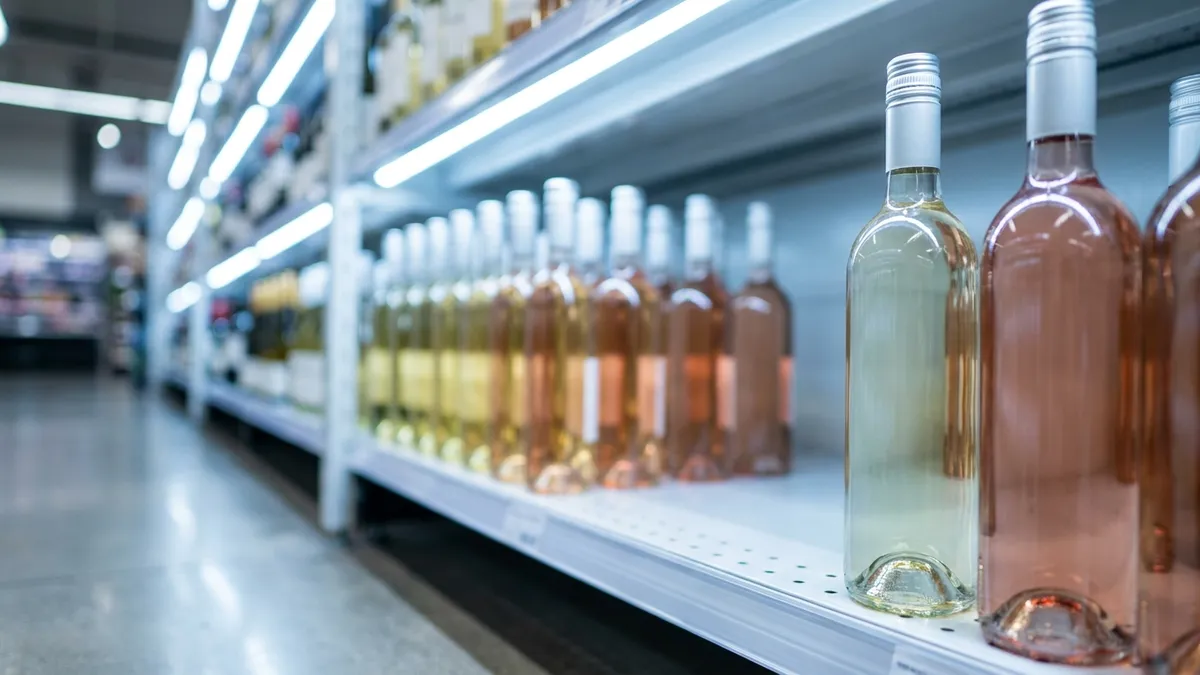
The damage adds up across the bottle's life: the winery, the lorry, the shop floor and your kitchen. If a clear bottle has sat in a sunny window display, skip it, because that is the most light it could have had short of standing in a garden.
How Should You Buy and Store Wine to Avoid Light Strike?
Buy delicate wines from a box or the back of the shelf, and keep them in the dark once they are home. Shop lights, sunny windows and open kitchen racks all add to the same running total of light. Three habits cover almost every case:
- Choose darker glass for pale whites you plan to keep more than a few days.
- Keep wraps and boxes on. Sparkling wine sold in a gift box, tube or coloured cellophane is protected until the moment you remove it.
- Store in a closed cupboard. A cupboard or wine fridge with a solid door blocks light completely.
If a bottle came in a box, tube or wrap, leave it there until you chill the wine. A clear bottle of rosé on an open kitchen rack under spotlights or daylight can lose its fruit within days.
Light is only one of three enemies at home, alongside heat and big temperature swings. The guide to storing wine at home sets out the full setup, and the piece on cooked wine and heat damage explains what warm storage does on its own.
Can You Fix a Lightstruck Wine?
No. The effect is irreversible. The sulfur compounds are dissolved in the wine, and the fruit aromas under them have already been broken down. Decanting, swirling and chilling cannot rebuild fruit that light has destroyed, so there is nothing for air to bring back.
That is where light strike parts company with the common struck-match smell. Decanting helps a reduced wine, because its sulfur smell comes from trapped gases that air lifts away. Light strike leaves lost fruit plus new sulfur dissolved in the wine, so a jug or decanter only spreads the cabbage smell around. Chilling hides it slightly at best. The decanting guide explains when air does help.
A lightstruck wine counts as a true fault rather than a matter of style. The difference between wine flaws and faults sets out why. If a freshly bought bottle smells of cabbage or wet cardboard, return it to the shop with the receipt, as you would a corked wine.
Why Does Light Make Wine Smell of Cabbage?
Riboflavin (vitamin B2, which grapes and yeast both supply) acts like a solar panel. It absorbs light below about 510 nanometres, the ultraviolet and blue end of the spectrum, most strongly around 370 and 440 nanometres. Warm yellow and red light sit above that range and do little harm.
The energy it picks up goes to methionine (a sulfur-containing amino acid found in wine at about 3 to 5 milligrams per litre), which breaks apart into methanethiol. Two methanethiol molecules then join into dimethyl disulfide, the cooked-onion half of the smell.
The amount of riboflavin sets the risk. Grape juice carries about 3 to 60 micrograms per litre, and fermentation can push a finished wine close to 150 micrograms or higher. Above 100 micrograms per litre a wine is considered high risk. A 2021 study in the journal Molecules, citing earlier research, notes that the risk drops once riboflavin sits below 50 to 80 micrograms per litre.
The same chemistry explains why the fault is a white, rosé and sparkling problem. Without tannin to absorb the light first, the riboflavin gets all of it.
How Do Winemakers Stop Light Strike Before Bottling?
Winemakers stop light strike with low riboflavin, protective additions and light-blocking packaging. In the cellar they keep riboflavin down and can add tannin or glutathione before bottling. Then they block light with dark glass, wraps, cartons or "second-skin" covers, which matter most for pale wines in clear bottles.
The 2021 Molecules study tested three additions in a real white wine. The wine was lit for two hours under 6500K fluorescent light, then stored in the dark for 24 months before tasting:
- Chestnut tannin at 50 milligrams per litre worked best. Neither methanethiol nor DMDS was detected in the wine that contained it.
- Glutathione (a compound grapes make naturally, which mops up reactive molecules) at 50 milligrams per litre came close behind.
- Sulfur dioxide, added at 20 to 25 milligrams per litre, helped least of the three.
The glutathione result comes with a limit. The dose tested was 50 milligrams per litre, but the OIV, the international wine body, allows winemakers to add only 20. So the glutathione dose that worked in the study is higher than the OIV limit. Tannin, the best performer, is the same thing that shields red wine in the bottle.
For your own bottles, the practical sign of all this is packaging. A pale wine in clear glass that arrives in a box, tube or full wrap has been protected on purpose. The sulfites guide explains what sulfur dioxide does in wine beyond this one job.
Why Is Some Champagne Sold in Clear Glass?
Tradition. One famous prestige Champagne has been bottled in clear glass since 1876, when it was first made for Tsar Alexander II of Russia. Its solution to light is an orange cellophane wrap that filters 98% of the harmful rays.
That wrap is the label clue worth remembering. If a clear-bottle sparkling wine comes in coloured cellophane, a tube or a box, the producer knows the glass cannot protect it, so keep the wrap on until the bottle goes into the fridge.
Light strike sits alongside cork taint, oxidation and volatile acidity in the family of faults you can learn by nose. The guide to identifying wine faults by smell and the wine faults hub put all of them side by side.
The Wine 101 course in the Sommy app teaches you to look, smell and taste step by step. Tonight, move every clear-glass white, rosé and sparkling wine you own into a dark cupboard or back into its box, then pour a glass from one and smell it for cabbage before you taste.
Sources
Frequently Asked Questions
What does lightstruck wine smell like?
Lightstruck wine smells of cooked cabbage, onion, wet cardboard or a damp wool sweater, and in bad cases of drains. The fresh fruit you expect from a white, rosé or sparkling wine fades underneath. On the palate it tastes flat and slightly sulfurous. The smell comes from methanethiol and dimethyl disulfide, two sulfur compounds that light creates inside the bottle.
Can you fix a lightstruck wine?
No. Light strike is irreversible. The sulfur compounds are already dissolved in the wine and the fruit aromas they cover have been broken down, so decanting, swirling or chilling will not bring the wine back. If a freshly opened bottle smells of cabbage or wet cardboard, take it back to the shop or recork it for cooking and open another.
Does green glass protect wine from light?
Partly. Light green glass blocks only about half of the harmful light, while dark antique green blocks about 90%, the same level reported for amber glass. Clear glass blocks about 10%. So a pale green bottle helps for a short time on a shelf, but only dark green or brown glass gives strong protection.
Why is sparkling wine and rosé more likely to be lightstruck?
They are often sold in clear or pale glass so the colour shows, and they have little tannin to absorb light. Sparkling wines aged on their spent yeast can also carry more of the vitamin B2 and amino acids that drive the reaction. Red wine is far less exposed because its tannin and pigment take most of the hit.
How long does it take for light to damage wine?
Very little time. Five minutes of direct sunlight can do damage a taster can detect, and under an hour of the wrong light is enough to form the sulfur smell. On a lit supermarket shelf, some wines in clear bottles showed the fault after one to two days, and all of them within 20 to 40 days.
Is lightstruck wine the same as skunky beer?
They are cousins. Both are light faults that create sulfur smells in the bottle, which is why drinkers borrow the word skunky for wine. In wine the smell usually reads as cabbage, onion or wet cardboard. The same buying rule works for both drinks: favour brown or dark bottles and keep them out of the light.
Sommy Team
LinkedInFounder & Wine Educator
The Sommy Team is building the world's most approachable wine education app, helping beginners develop real tasting skills through structured courses and AI-guided practice.