Wine Bottle Shapes: What the Bottle Shape Tells You

By the Sommy Team — AI-assisted, human-edited.
Updated Oct 1, 2026
Contents (11)
- Wine Bottle Shapes Meaning, in One Paragraph
- What Are the Main Wine Bottle Shapes?
- What Does a Bordeaux Bottle Tell You?
- What Does a Burgundy Bottle Tell You?
- Why Are Riesling and Alsace Bottles Tall and Slim?
- Why Are Champagne Bottles So Thick?
- What Is a Bocksbeutel?
- Can You Guess the Grape From the Bottle Shape?
- What Is the Punt For?
- Why Are Wine Bottles 750 ml?
- Try the Shoulder Test Tonight
TL;DR
A wine bottle's shape shows which regional tradition the wine follows. High shoulders point to Bordeaux grapes, sloping shoulders to Burgundy and the Rhône, a tall slim flute to Riesling and Alsace, thick glass to sparkling wine. Only a few shapes are fixed by law, such as the Alsace flute and the Bocksbeutel.
Wine bottle shapes follow regional habits that are centuries old, so the shoulders of a bottle tell you which tradition the wine follows before you read a word of the label. High, square shoulders say Bordeaux. Sloping ones say Burgundy. A tall, slim flute says Riesling country. Only a handful of shapes are protected by law.
Wine Bottle Shapes Meaning, in One Paragraph
The meaning of wine bottle shapes is mostly regional custom. The Bordeaux bottle has straight sides and high shoulders and holds Bordeaux grapes, port and sherry. The Burgundy bottle has sloping shoulders and holds Burgundy and Rhône grapes. The tall, narrow Rhine flute holds Riesling and other whites from Germany and Alsace, where French law requires it. Sparkling bottles are wide and thick-walled with a deep dimple, because the wine inside sits at about six bar of pressure. EU rules reserve four shapes for named wines: the flute inside France, the flat Bocksbeutel, the Jura clavelin and the Tokaj bottle. Everywhere else a winery can use any shape.
What Are the Main Wine Bottle Shapes?
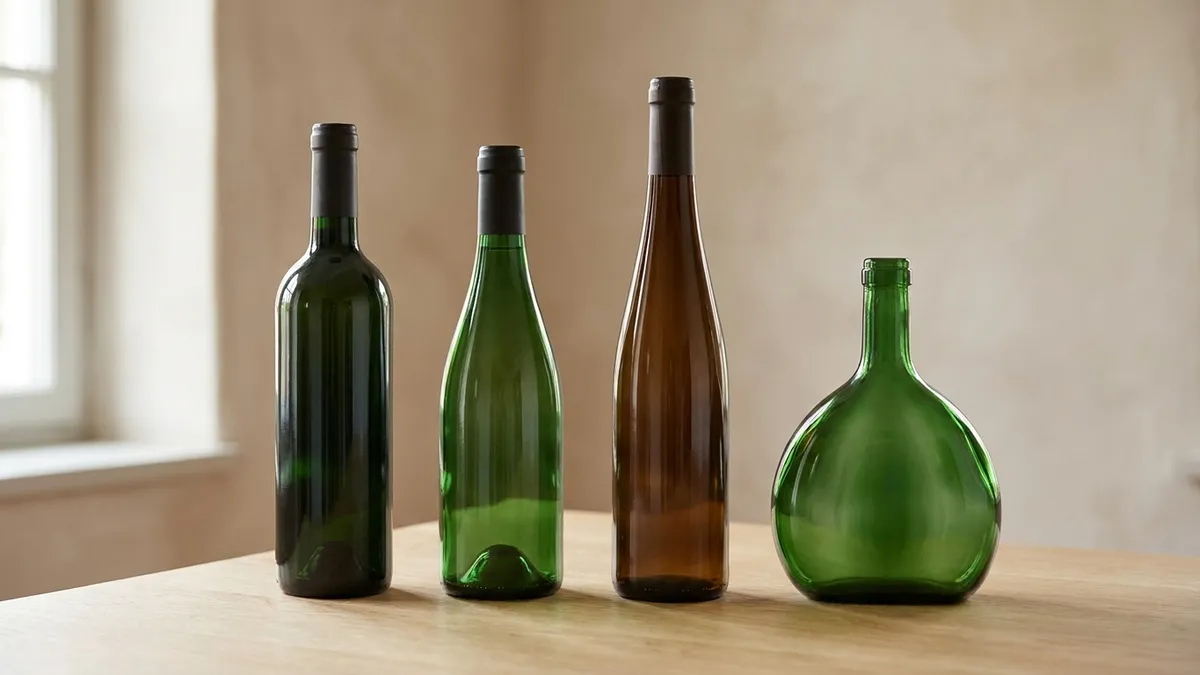
Four shapes cover most of a wine shop: Bordeaux, Burgundy, the Rhine flute and the sparkling bottle. Learn to read the shoulders (the part where the body narrows into the neck) and the base, and you can sort a shelf at a glance.
| Shape | Shoulders and base | Classic wines | Law or custom | What to expect in the glass |
|---|---|---|---|---|
| Bordeaux | Straight sides, high square shoulders, pronounced punt | Cabernet Sauvignon, Merlot, Sauvignon Blanc, Sémillon; also port and sherry | Custom | Reds with firm tannin; crisp or oaked whites |
| Burgundy | Tall, wider body, gently sloping shoulders, smaller punt | Pinot Noir, Chardonnay, Syrah, Grenache | Custom | Lighter, silkier reds or rounder whites |
| Rhine flute (hock, Mosel, Alsace) | Tall and narrow, long neck, little or no punt | Riesling, Gewürztraminer, Pinot Gris, Sylvaner | Law in Alsace; custom in Germany | Aromatic whites, from dry to sweet |
| Sparkling | Sloping shoulders, wide, thick walls, deep punt | Champagne, Crémant, Cava and other bubbles | Custom, driven by pressure | Bubbles; chill well and open with care |
| Bocksbeutel | Short neck, flattened round belly | Franconian Silvaner, some Baden, Italian, Greek and Portuguese wines | Reserved by EU rules | Usually dry, firm whites from Franconia |
What Does a Bordeaux Bottle Tell You?
High, square shoulders and straight sides mean the winery is following Bordeaux. The shape is straight-sided with a pronounced punt (the dimple pushed up into the base). Inside you will usually find the region's grapes: Cabernet Sauvignon and Merlot for reds, Sauvignon Blanc and Sémillon for whites.
The Bordeaux bottle is one of the most copied shapes in wine. Cabernet and Merlot from California, Chile or Australia usually arrive in it, because winemakers there borrowed the Bordeaux model along with the grapes. The Bordeaux blend grapes explainer covers what each one adds to the glass.
Port and sherry use a version of the same high-shouldered shape. Some have a bulbous neck to collect residue, which fits wines that can throw a crust. If a bottle has that bulge, stand it upright for a day and pour slowly; wine sediment explained covers why the deposit forms.
What Does a Burgundy Bottle Tell You?
Gently sloping shoulders mean Burgundy or the Rhône. The bottle is tall, a little wider than a Bordeaux, and has a smaller punt. Expect Pinot Noir or Chardonnay from Burgundy's tradition, or Syrah and Grenache from the Rhône's, whichever country the bottle comes from.
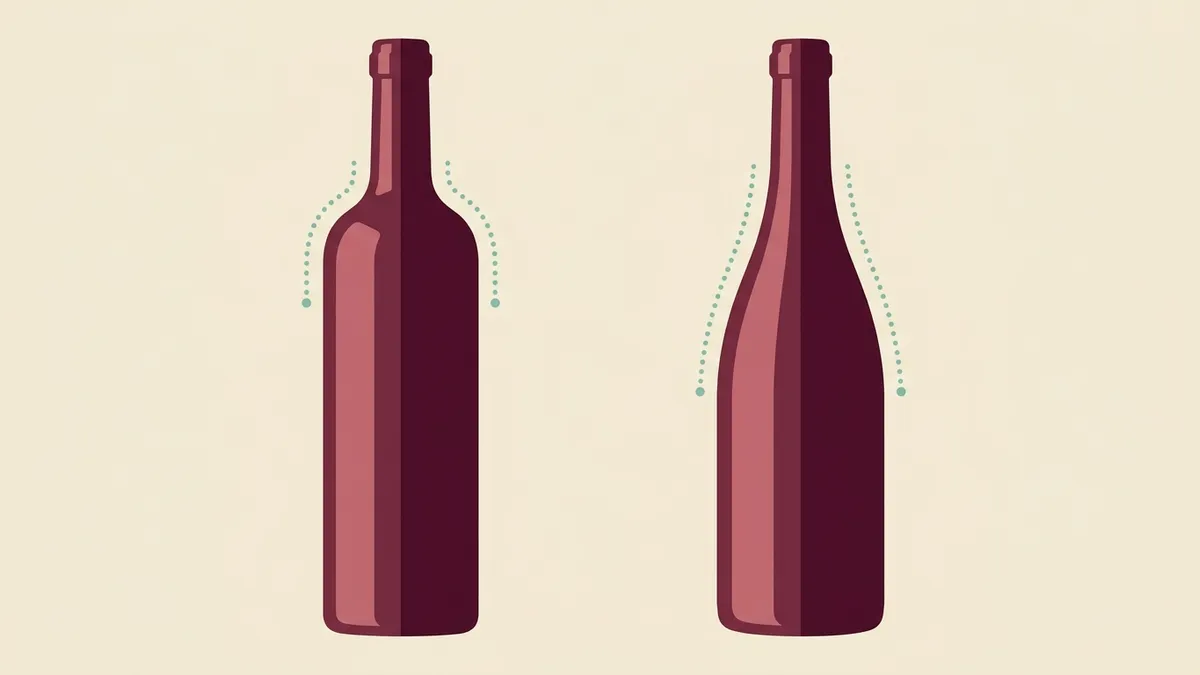
That split lines up with a real difference in the glass. Pinot Noir has thinner skins and less tannin (the drying grip on your gums) than Cabernet Sauvignon, so a sloping-shouldered red is more often lighter and silkier than its square-shouldered neighbour. Syrah breaks that pattern, since Rhône reds can be dense and dark. If the shoulders slope, check whether the label names Burgundy or the Rhône before you guess the weight. The Burgundy wine guide shows how the region's labels name places instead of grapes.
Why Are Riesling and Alsace Bottles Tall and Slim?
Because the Rhine tradition uses a tall, narrow bottle with little or no punt, and in Alsace that bottle is the law. English speakers sometimes call it a hock bottle; the Mosel uses the same form. It mostly holds aromatic whites such as Riesling, Gewürztraminer and Pinot Gris.
In Alsace the appellation (a protected place name with its own rules) requires the tall bottle, which locals call the flûte d'Alsace. The official rules call it vin du Rhin, "Rhine wine bottle". Across the river in Germany nobody requires it. The flute is simply the traditional bottle for Riesling and the other classic white grapes.
EU rules go one step further. Inside France, the flute is reserved for a short list of wines: Alsace and Alsace Grand Cru, Crépy, Château-Grillet, Jurançon, Tavel rosé, some Béarn rosé, red and rosé Côtes de Provence, and a few others. Some Provence rosé still comes in a flute.
If a tall flute holds a German wine, the label decides dry or sweet, so look for trocken. The Riesling wine guide explains the sweetness words, and the Alsace wine guide covers the region's grapes.
Why Are Champagne Bottles So Thick?
Because the gas inside pushes at about six bar (a unit of pressure; one bar is roughly the air pressure around you), around 90 psi. The sparkling bottle looks like a Burgundy bottle with sloping shoulders, but it is wider, has thick walls and a deeper punt. Every one of those features helps the glass hold the pressure.
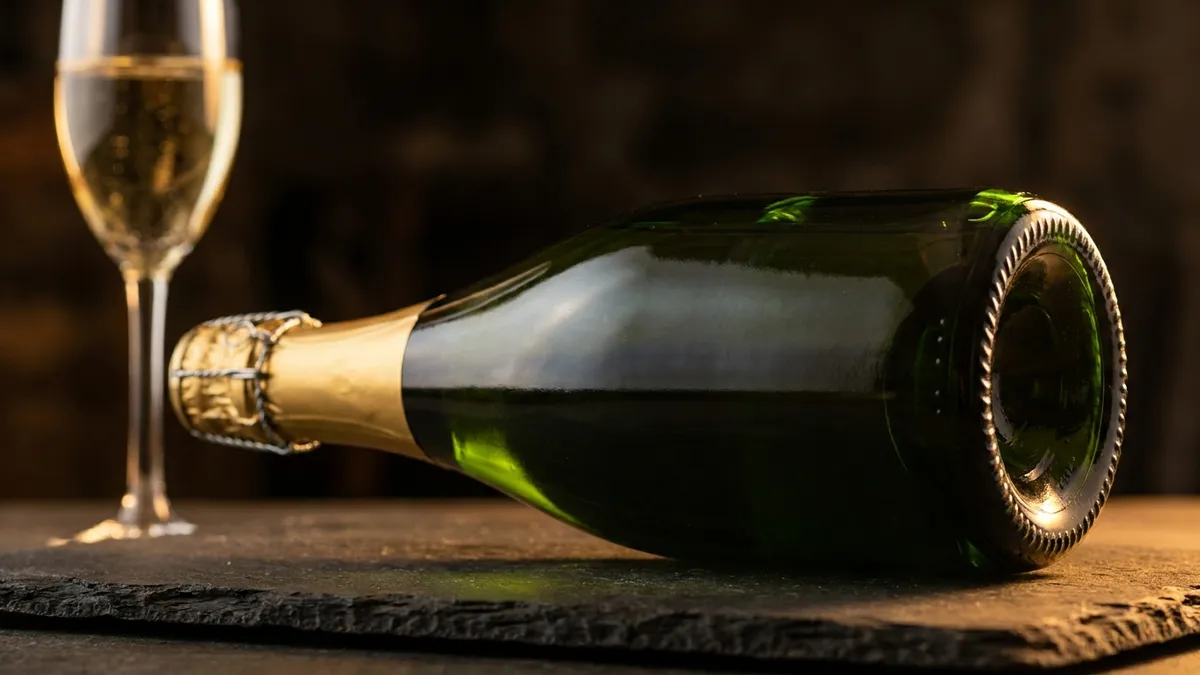
Glass made the style possible. English glassmakers developed bottles that could survive a second fermentation inside them. French glassworks of the time could not make bottles of that strength. The second fermentation that builds the pressure is set out step by step in méthode champenoise explained.
If you see that heavy shape with a wire cage, chill the bottle well before opening and keep a hand over the cork, because warm sparkling wine pushes harder.
What Is a Bocksbeutel?
A Bocksbeutel is a short-necked bottle with a flattened, round belly, roughly twice as wide as it is deep. It is the traditional bottle of Franconia in northern Bavaria. In 1728 the Würzburg city council decided that the best wines from the city's own Bürgerspital estate should be filled into Bocksbeutel bottles.
EU rules now reserve it. Franconia and parts of Baden may use it in Germany. So may several Italian wines, most of them from Alto Adige, a group of Greek wines, and Portuguese rosé, where the same shape is called a cantil. Seeing one outside those places is unusual, and in Germany it nearly always means Franconia, where Silvaner is the signature grape.
The same EU list protects two more shapes. The clavelin is a squat 62 cl bottle reserved for Jura wines such as Arbois and Château-Chalon; it holds the region's vin jaune. The Tokaj bottle is a straight, long-necked bottle of colourless glass in half-litre and smaller sizes, reserved for Hungarian and Slovak Tokaj. Chianti's straw-wrapped fiasco, a round-bottomed flask, is a tradition rather than a rule.
Can You Guess the Grape From the Bottle Shape?
Often the grape family, never the grape for certain. The shape shows which region's tradition the winery is following. Outside the four protected shapes, a winery anywhere can put any wine in any bottle, which makes the shape a hint to confirm rather than a fact.
Use the shape for a first guess:
- High, square shoulders: expect Cabernet Sauvignon, Merlot or a Bordeaux-style blend if red; Sauvignon Blanc or Sémillon if white.
- Sloping shoulders: expect Pinot Noir or Chardonnay, or Syrah and Grenache if the label mentions the Rhône.
- Tall and slim: expect an aromatic white such as Riesling or Gewürztraminer.
- Thick, deep punt, wire cage: expect bubbles.
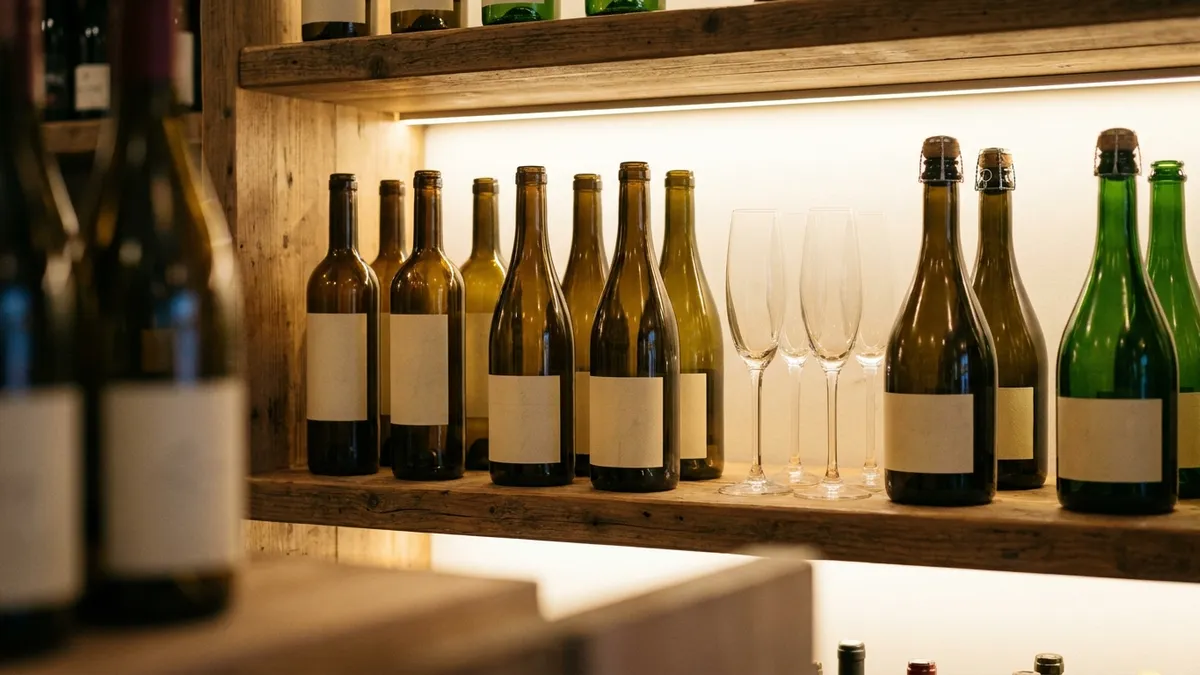
Then confirm on the front and back label. The how to read a wine label guide shows where the grape, region and vintage sit, and the back label guide covers the small print.
Glass colour tells you how well the wine is shielded from light. Clear glass lets through much more of the light that causes lightstruck wine, the cabbage smell that hits pale wines under shop lamps. If a white, rosé or sparkling wine sits in clear glass on a brightly lit shelf, take a bottle from the back of the row.
Weight is the clue to ignore. Still wine holds no pressure, so extra glass on a still red is a packaging choice. If a heavy bottle costs more than its neighbours, compare the region and grape on the label rather than paying for glass; what makes wine expensive lists the costs that do change the wine.
What Is the Punt For?
The punt is the dimple in the base, also called a kick-up, and nobody agrees on a single reason for it. The purpose with firm support is strength: the dome helps a sparkling wine bottle withstand its high pressure, so sparkling bottles carry the deepest punts.
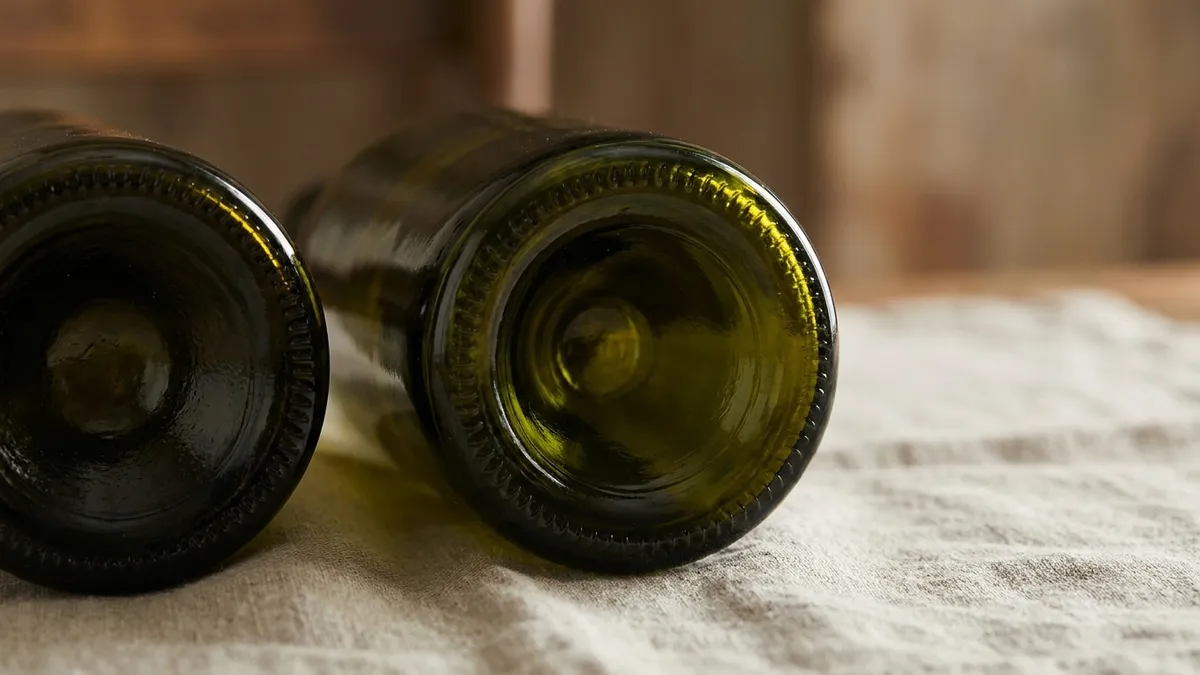
A deep punt shows the bottle was built for pressure or tradition, not that the wine is better. Other explanations are proposed but not settled. They include a leftover from hand glassblowing and a steadier stance on the table. Others are a place for sediment to gather, a grip for turning bottles by hand, and a way to make a bottle look bigger.
Why Are Wine Bottles 750 ml?
Because Europe already used 750 ml, and the United States adopted it in 1979 when it moved wine and spirit bottles to metric sizes. Before that, the US standard was the fifth: one fifth of a US gallon, 25.6 fluid ounces or about 757 ml. The switch barely changed the amount in the glass.
Bigger formats are multiples of that bottle. A magnum holds 1.5 litres, two standard bottles. Champagne in magnum is often thought to be higher quality, a belief rather than a proven rule. Champagne goes further: Jeroboam (3 litres), Methuselah (6), Salmanazar (9) and Balthazar (12).
Most Champagne houses cannot run the second fermentation in anything larger than a magnum, because the big bottles are too heavy to turn by hand. Those giant formats are filled with wine fermented in standard bottles or magnums. If you want sparkling wine that aged in the bottle you are pouring from, a magnum is the largest size that reliably did.
Try the Shoulder Test Tonight
The shoulder test is quickest with two reds from the same price band: one in a high-shouldered bottle and one in a sloping-shouldered bottle. The shape predicts the grape family, and the glass tells you whether the prediction held. More styles and their traditions are mapped in the wine styles hub.
The Sommy app at sommy.wine has bite-sized courses, including Wine 101 and regional courses on France, Italy and Spain, and an AI-guided tasting mode that starts from a photo of the label. Pour a glass tonight and guess its grape from the shoulders first, then photograph the label to check.
Sources
- Wikipedia: Wine bottle (shapes, punt, 750 ml standard, sizes)
- Commission Delegated Regulation (EU) 2019/33, Annex VII: restrictions on the use of specific types of bottle
- Wikipedia: Alsace wine (flûte d'Alsace and the vin du Rhin bottle rule)
- Wikipedia: Bocksbeutel
- Wikipedia: Champagne (bottle pressure and English glassmaking)
Frequently Asked Questions
What do different wine bottle shapes mean?
Each shape follows a regional tradition. High, square shoulders come from Bordeaux and usually hold Cabernet Sauvignon, Merlot or Sauvignon Blanc. Sloping shoulders come from Burgundy and the Rhône, so think Pinot Noir, Chardonnay or Syrah. A tall, slim flute means the Rhine, Mosel or Alsace, often Riesling. A thick bottle with a deep dimple holds sparkling wine under pressure.
Why do Bordeaux bottles have high shoulders?
High shoulders are simply the Bordeaux tradition: straight sides, square shoulders and a pronounced punt in the base. The same shape is used for port and sherry. What the shape reliably tells you is that the winery is signalling a Bordeaux-style wine, so expect Bordeaux grapes or a blend built on them.
Can you tell the grape from the bottle shape?
Often the grape family, never the grape for certain. A sloping-shouldered bottle usually holds Pinot Noir, Chardonnay, Syrah or Grenache, and a high-shouldered one usually holds Bordeaux grapes. Outside the few shapes protected by law, wineries choose freely, so a winery anywhere can put any grape in any bottle. Use the shape as a first guess, then confirm it on the label.
Why are Champagne bottles so thick?
Because the gas inside pushes outward at about six bar, around 90 psi. Champagne bottles are wider than Burgundy bottles, with thick walls and a deeper punt, all of which help the glass hold that pressure. Bottles that strong came first from English glassmakers in the 1600s; French glassworks of the time could not match them.
What is the dent in the bottom of a wine bottle for?
The dent is called a punt or kick-up. The one purpose with firm support is strength: a domed base helps a sparkling wine bottle hold its pressure. Other explanations, such as stability, gathering sediment or a grip for pouring, are proposed but not settled. A deep punt does not mean the wine inside is better.
What is a Bocksbeutel bottle?
A Bocksbeutel is a short-necked bottle with a flattened, round belly, about twice as wide as it is deep. It is the traditional bottle of Franconia in Germany, where Würzburg chose it for the city's best wines in 1728. EU rules reserve it for wines from Franconia, parts of Baden, some Italian and Greek wines, and Portuguese rosé.
Why are wine bottles 750 ml?
Europe already used 750 ml, and the United States adopted it in 1979 when it moved wine and spirit bottles to metric sizes. Before that, the US standard was the fifth, one fifth of a US gallon or about 757 ml. A magnum holds 1.5 litres, which is two standard bottles.
Sommy Team
LinkedInFounder & Wine Educator
The Sommy Team is building the world's most approachable wine education app, helping beginners develop real tasting skills through structured courses and AI-guided practice.