The Bordeaux Blend: Which Grapes and Why They Work Together

By the Sommy Team — AI-assisted, human-edited.
Updated Apr 29, 2026
Contents (10)
- What Is a Bordeaux Blend, in 80 Words
- Why Bordeaux Blends, Not Single-Grape Wines
- The Big Five Bordeaux Blend Grapes
- Left Bank vs. Right Bank: Two Stylistic Camps
- Why the Combination Works
- The Bordeaux Blend in the New World
- How Bordeaux Blends Age
- Food Pairing for Bordeaux Blend Grapes
- Tasting a Bordeaux Blend the Sommy Way
- Where to Take This Next
TL;DR
A bordeaux blend is a red wine built from five traditional grapes — Cabernet Sauvignon, Merlot, Cabernet Franc, Petit Verdot, and Malbec — with Carmenere rarely permitted. Left Bank versions lead with Cabernet Sauvignon for structure. Right Bank versions lead with Merlot for plushness. Each grape covers another's weakness, which is why this formula travels worldwide.
What Is a Bordeaux Blend, in 80 Words
A bordeaux blend is a red wine made from a small group of traditional Bordeaux grapes — most often Cabernet Sauvignon, Merlot, Cabernet Franc, Petit Verdot, and Malbec, with Carmenere rarely permitted. The bordeaux blend grapes are mixed in different proportions depending on where they are grown. On the Left Bank of the Gironde estuary, Cabernet Sauvignon usually leads at 60 to 80 percent. On the Right Bank, Merlot leads at 60 to 90 percent. Each grape covers another's weakness in tannin, aroma, color, and ripening.
Why Bordeaux Blends, Not Single-Grape Wines
Most of the wine world has settled on two big philosophies for red wine. The Burgundian way insists on a single grape — Pinot Noir — and lets the vineyard do the talking. The Bordeaux way takes several grapes and mixes them, letting the winemaker tune the final wine each year.
The Bordeaux approach exists for one main reason: maritime climate. Bordeaux sits a short drive from the Atlantic. Rain at flowering can ruin Merlot. A cool September can leave Cabernet Sauvignon underripe. Hail can wipe out a single block. Planting several varieties that ripen at different moments is insurance.
Blending also lets a winemaker dial in structure — the framework of tannin, acidity, and alcohol that holds a wine together — far more precisely than any single grape allows. If you have not seen the term before, our primer on understanding tannins, acidity, and body covers what each of those components actually does on your palate.
The Big Five Bordeaux Blend Grapes
Five red grapes do almost all of the work. A sixth — Carmenere — is technically permitted under appellation rules but has not been planted at meaningful scale in Bordeaux for over a century.
Cabernet Sauvignon — Structure and Cassis
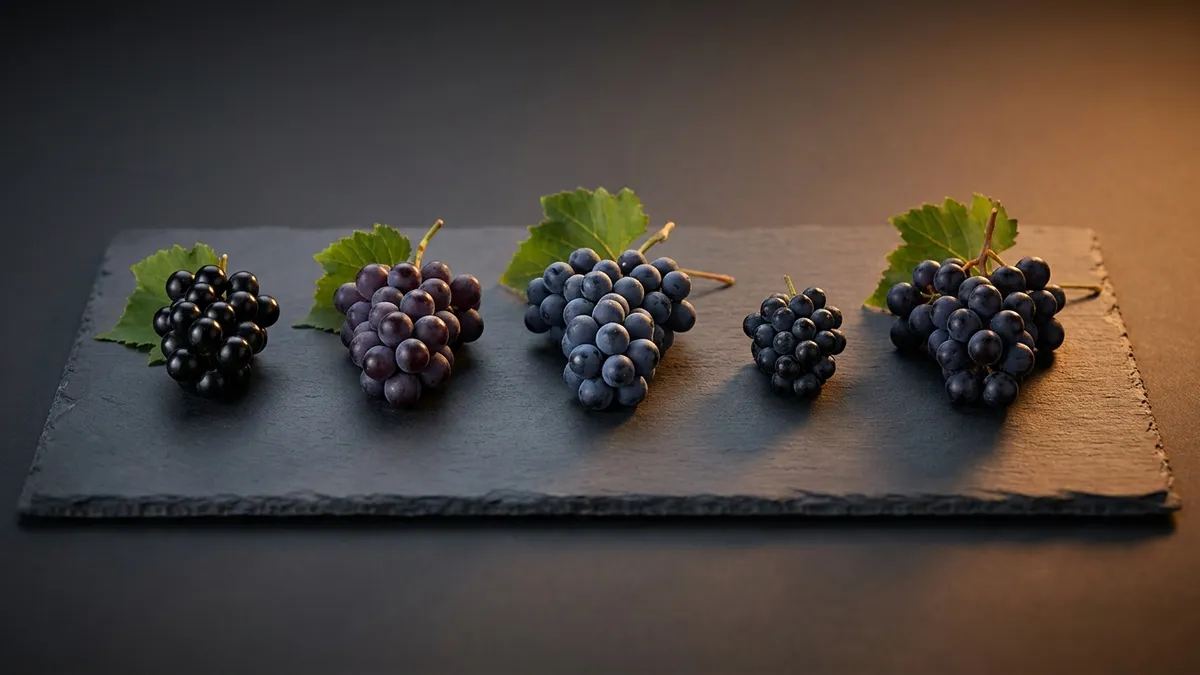
Cabernet Sauvignon is the muscle of the blend. The berries are small, the skins are thick, and the seeds are large, which means a high ratio of solids to juice and therefore high tannin and deep color. It ripens late and needs warm, well-drained soil to finish — exactly what the gravel mounds of the Left Bank provide.
In a blend, Cabernet Sauvignon contributes:
- Aromas of blackcurrant, cedar, graphite, and tobacco
- Firm, grippy tannins that age slowly
- Deep ruby color with a violet edge when young
- Backbone for the cellar — these wines need years to soften
Left Bank wines are Cabernet Sauvignon-led, usually 60 to 80 percent of the blend. The grape is so dominant in global wine culture that even producers outside Bordeaux build their flagship reds around it. For a single-grape deep dive, the Cabernet Sauvignon vs. Merlot comparison breaks down how Cab differs from its partner-in-blend.
Merlot — Plushness and Plum
Merlot is Cabernet Sauvignon's softer, earlier-ripening counterpart. Its berries are larger and thinner-skinned, which produces lower tannin and more juice. It ripens two to three weeks before Cabernet Sauvignon and thrives on the cooler clay soils of the Right Bank, where Cabernet would struggle to finish.
In a blend, Merlot contributes:
- Aromas of plum, black cherry, chocolate, and dried herbs
- Round, generous body with a velvety mouthfeel
- Softer, smoother tannins that drink well earlier
- Approachability — Merlot makes a young wine pleasant rather than punishing
Right Bank wines are Merlot-led, usually 60 to 90 percent of the blend. Even on the Left Bank, where Cabernet is king, Merlot is almost always blended in to round off the edges. By planted hectares, Merlot is actually Bordeaux's most-grown red grape.
Cabernet Franc — Lift and Graphite
Cabernet Franc is the parent grape of Cabernet Sauvignon and the most aromatic of the five. It ripens earlier than Cabernet Sauvignon, with thinner skins and brighter acidity. In Bordeaux it serves as a connective tissue between the heavyweight grapes — adding perfume, freshness, and a savory edge.
In a blend, Cabernet Franc contributes:
- Aromas of red fruit, graphite, pencil shavings, and crushed herbs
- Floral lift at the front of the nose
- Bright acidity that keeps richer Merlot from feeling heavy
- Elegance — a sense of vertical structure as opposed to horizontal weight
Cabernet Franc usually appears at 5 to 30 percent of a Bordeaux blend. Some Right Bank wines push it to 40 percent or more. The grape has its own dedicated profile in our Cabernet Franc wine guide for readers who want to taste it on its own.
Petit Verdot — Color, Tannin, and Violet
Petit Verdot is the late-ripening insurance policy of the Left Bank. Some years it does not finish ripening at all. When it does, it brings deep purple-black color, firm tannins, and a distinctive floral perfume of violets and dried lavender.
In a blend, Petit Verdot contributes:
- Saturated dark color that shores up paler Merlot
- Floral aromas of violet and iris
- Firm acidity and tannin that extend aging potential
- Spice notes — a hint of black pepper and clove
Petit Verdot is usually capped at 1 to 5 percent. A teaspoon is enough — more would dominate. The Petit Verdot wine guide covers how it tastes when bottled on its own, which has become a small but growing category in warmer New World regions.
Malbec — Soft Color, Soft Plum, Softening Role
Malbec is the historical fifth grape. Before phylloxera and frost reshaped Bordeaux, it was widely planted and contributed plenty of color and round dark fruit. After the brutal 1956 frost killed many Malbec vines, growers replanted with hardier Cabernet Sauvignon and Merlot, and Malbec dwindled in Bordeaux.
In a blend, Malbec contributes:
- Inky color and dark plum aromas
- Soft tannins with a velvety mid-palate
- Cocoa and violet undertones
- A rounding effect on otherwise austere blends
Today Malbec rarely exceeds a few percent of any Bordeaux blend, and many estates leave it out entirely. The grape's true second act has been in Argentina, where it became the national variety. Our Malbec wine guide and the broader Argentina wine guide show how a Bordeaux supporting actor became a New World lead.
Carmenere — The Forgotten Sixth
Carmenere is technically still permitted in Bordeaux AOC red wines, though only a few estates grow it. It nearly went extinct in Europe after phylloxera and was rediscovered in Chile in 1994, where vines had been mistakenly labeled as Merlot for over a century. The Carmenere wine guide tells that whole story.
Left Bank vs. Right Bank: Two Stylistic Camps
The same five grapes produce two distinctly different wine styles depending on which side of the Gironde estuary they grow on. The split comes down to soil, climate, and which grape ripens reliably.

Left Bank — Gravel and Cabernet Sauvignon
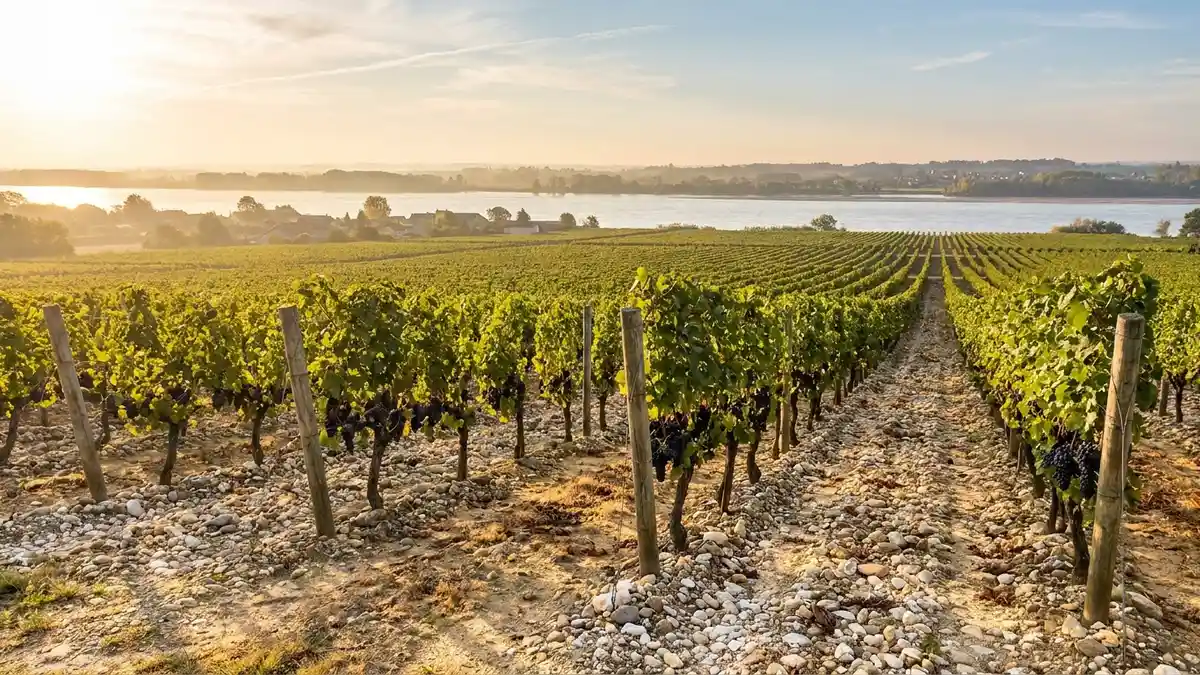
The Left Bank includes Medoc, Haut-Medoc, Pauillac, Saint-Julien, Margaux, and Pessac-Leognan. The soils are deep gravel deposits left behind by ancient river action. Gravel drains quickly, retains heat, and reflects sunlight, all of which help late-ripening Cabernet Sauvignon push to full ripeness in a marginal climate.
A typical Left Bank blend looks something like:
- 60 to 80 percent Cabernet Sauvignon
- 15 to 30 percent Merlot
- 0 to 15 percent Cabernet Franc
- 1 to 5 percent Petit Verdot
- A trace of Malbec, if any
The result is a structured wine with cassis, cedar, tobacco, graphite, and a long finish that softens slowly over fifteen to thirty years.
Right Bank — Clay, Limestone, and Merlot
The Right Bank is anchored by Saint-Emilion and Pomerol. The soils are cooler — clay, limestone, and some sand — which would leave Cabernet Sauvignon green and underripe. Merlot loves this terroir. So does Cabernet Franc.
A typical Right Bank blend looks something like:
- 60 to 90 percent Merlot
- 10 to 40 percent Cabernet Franc
- 0 to 10 percent Cabernet Sauvignon
- A small dose of Malbec or Petit Verdot, occasionally
The result is plusher, rounder, more immediately approachable. Plum, black cherry, cocoa, dried herbs, and softer tannins dominate. The wines still age beautifully — twenty to thirty years for top examples — but they drink earlier than their Left Bank cousins.
For the wider geography, see our French wine regions guide, which sets Bordeaux in context with Burgundy, the Rhone, and the Loire.
Why the Combination Works
The genius of the bordeaux blend grapes is that each variety covers another's weakness.
- Cabernet Sauvignon brings tannin and acid, but on its own it can feel austere.
- Merlot brings flesh and fruit, but on its own it can feel heavy or short.
- Cabernet Franc brings perfume and lift, but on its own it can feel thin.
- Petit Verdot brings color and spine, but on its own it would crush the palate.
- Malbec brings dark fruit and softness, but on its own it lacks structure.
Put them together in the right proportions and you get a wine that is structured and generous, aromatic and age-worthy, deep in color and lifted on the nose. The bordeaux blend is, essentially, a problem-solving formula. That is why it has been copied across nearly every wine-growing country on earth.
If you want to understand the broader logic of mixed-grape reds, the global tour in our piece on the noble grapes lays out why these particular varieties became international.
The Bordeaux Blend in the New World
Outside France, the bordeaux blend grapes travel under several aliases. In California's Napa Valley and Sonoma County, the formal trademark is Meritage — pronounced like "heritage," not the French way. To call a wine Meritage, the producer must be a member of the Meritage Alliance and the wine must be a blend of two or more Bordeaux grapes with no single variety exceeding 90 percent.
You also see the formula in:
- Australia — typically labeled as Cabernet-Merlot or Cabernet-Shiraz when Syrah replaces Merlot
- South Africa — often called Cape Blend or simply "Bordeaux-style red"
- Italy — the Super Tuscan movement that started in the 1970s leaned heavily on Cabernet Sauvignon and Merlot, sometimes with Sangiovese mixed in
- Argentina and Chile — Bordeaux-style blends sit alongside the dominant Malbec and Carmenere bottlings
In warmer climates, the blends taste riper, jammier, and more oak-driven than classic Bordeaux. The Argentina wine guide and the Australian wine guide sketch out how each region adapts the formula.
How Bordeaux Blends Age
Bordeaux blends are some of the most age-worthy red wines in the world, but ageability depends heavily on tier and bank.
Everyday Bordeaux AOC — drink within five to eight years of the vintage. The fruit fades, and the tannins are not built to last decades.
Mid-tier classified estates — fifteen to twenty-five years for good vintages. Tertiary aromas of leather, cedar, dried tobacco, forest floor, and cigar box appear after a decade or so.
Top Left Bank classified estates — fifty years or more for outstanding vintages. The wines start out tannic and reserved, slowly unfurling into complex savory expressions.
Top Right Bank wines — twenty to thirty years for the best, sometimes longer. They peak earlier than Left Bank because Merlot's softer tannins resolve faster.
If you have never compared a young and aged version side by side, the difference is one of the most rewarding lessons in wine. Our guide to tasting young vs. aged wine walks through how the same wine transforms over time.
Food Pairing for Bordeaux Blend Grapes
The high tannin and savory profile of a bordeaux blend asks for protein, fat, and herbal cooking.
Strong matches include:
- Roast lamb with rosemary and garlic — a classic for any Cabernet-led red
- Ribeye or hanger steak — the fat softens the tannin, the char picks up the cedar notes
- Duck breast with cherry sauce — Right Bank Merlot blends shine here
- Braised short ribs — slow cooking matches the wine's long finish
- Aged hard cheeses like Comte and Manchego
- Mushroom risotto or lentil ragu for a vegetarian pairing that picks up the savory tertiary notes
The fundamentals of why these matches work are covered in our pairing red wine with steak guide and the broader wine and food pairing primer.
Tasting a Bordeaux Blend the Sommy Way
The fastest way to learn the bordeaux blend grapes is to taste them side by side. Pour a Cabernet Sauvignon-led Left Bank wine next to a Merlot-led Right Bank wine and a single-grape Cabernet Franc. Take notes on tannin, fruit profile, and finish length. Within an hour of focused tasting, the differences move from theory to memory.
The Sommy app guides this kind of structured comparison through its tasting flow — you log color, aroma, and palate observations, and the app cross-references your notes to help you spot what each grape actually contributes. For deeper sensory training, the framework in our how to describe wine guide gives you the vocabulary to articulate what you are picking up.
A Sommy tip: if you can only buy two bottles to learn the bordeaux blend, get one Pauillac and one Saint-Emilion from the same vintage. The same year, the same region, completely different wines. That contrast teaches more in one evening than any textbook chapter.
Where to Take This Next
The bordeaux blend is the most copied red formula in the world, and learning it unlocks half the global red wine shelf. From here, two natural next stops:
- The Cabernet Sauvignon vs. Merlot deep dive for the head-to-head between the two leads.
- The Cabernet Franc wine guide for the most underrated of the five.
If you want to go region-first instead of grape-first, the French wine regions guide sets Bordeaux next to Burgundy, the Rhone, and the Loire so you can map style onto place. And when you are ready to actually taste through the Big Five, Sommy gives you the structured tasting flow and the prompts to anchor each grape to a specific sensory memory.
Frequently Asked Questions
What grapes are in a Bordeaux blend?
Five red grapes are traditionally permitted: Cabernet Sauvignon, Merlot, Cabernet Franc, Petit Verdot, and Malbec. Carmenere is technically allowed but almost never used in modern Bordeaux. Most blends rely on the first three, with Petit Verdot and Malbec appearing in small percentages for color, perfume, and structural support.
What is the difference between Left Bank and Right Bank Bordeaux?
Left Bank wines are Cabernet Sauvignon-dominant, usually 60 to 80 percent, grown on gravel soils that drain well and ripen Cabernet evenly. Right Bank wines lead with Merlot, often 60 to 90 percent, grown on cooler clay and limestone where Merlot ripens earlier. The result is structured tannic Left Bank reds versus rounder, plusher Right Bank reds.
Why do Bordeaux winemakers blend instead of using one grape?
Each grape ripens at a different time and brings different sensory traits. Blending hedges weather risk in a maritime climate where one variety can fail in a wet year. It also lets the winemaker tune tannin, acidity, color, and aroma. The blend is more consistent and more complex than any single grape could deliver alone.
Is a Meritage the same as a Bordeaux blend?
Meritage is the trademark used in California and other New World regions for wines that follow the Bordeaux blend formula. The grapes and proportions are similar, but Meritage producers can label the variety on the bottle. The style emphasizes ripe fruit and softer tannins than classic Bordeaux because of warmer growing conditions.
What does a Bordeaux blend taste like?
Expect blackcurrant, plum, cedar, graphite, tobacco, and dried herbs, layered over firm tannins and bright acidity. Left Bank examples lean austere and structured, with cassis and pencil shavings. Right Bank examples lean plush and round, with plum, cocoa, and softer tannins. Oak aging adds vanilla, toast, and baking spice across both styles.
How long does a Bordeaux blend age?
Everyday bottlings are best within five to eight years of the vintage. Mid-tier classified wines from good vintages drink well for fifteen to twenty-five years. Top Left Bank Cabernet-led wines from outstanding vintages can age fifty years or more. Right Bank Merlot-led wines generally peak earlier, typically within twenty to thirty years.
What food pairs best with a Bordeaux blend?
Lamb, ribeye, duck breast, hard aged cheeses, and roasted root vegetables. The tannins need protein and fat to soften, while the savory dried-herb side of the blend complements rosemary, thyme, and bay leaf in the cooking. Right Bank Merlot-led blends also work with mushroom dishes and richer poultry preparations.
Sommy Team
LinkedInFounder & Wine Educator
The Sommy Team is building the world's most approachable wine education app, helping beginners develop real tasting skills through structured courses and AI-guided practice.