Sulfur Smell in Wine — Rotten Egg, Match, or Fault?

By the Sommy Team — AI-assisted, human-edited.
Updated Jul 24, 2026
Contents (9)
- Why Your Wine Smells Like Sulfur
- Sulfur Smell in Wine, in About 90 Words
- What Makes Wine Smell of Sulfur
- The Three Sources of a Sulfur Smell in Wine
- How to Tell Which Sulfur Smell You Have
- How to Get Rid of a Sulfur Smell in Wine
- When a Sulfur Smell Is Not Sulfur at All
- Sulfur Dioxide, Sulfites, and the Headache Myth
- Building the Reflex
TL;DR
A sulfur smell in wine comes from three different sources: added sulfur dioxide, the preservative that smells like a just-struck match and blows off in minutes; reductive compounds like hydrogen sulfide that smell of rotten egg and need a decant or copper; and cork taint, which is musty, not sulfur, and never clears with air.
Why Your Wine Smells Like Sulfur
You pull the cork, pour a glass, lean in for the fruit — and instead get a sharp whiff of struck match, rotten egg, or burnt rubber. That sulfur smell in wine is one of the most common things beginners run into, and one of the most misread. Depending on the source, the same broad category of smell can be completely harmless, a deliberate stylistic feature, or a genuine fault that means the bottle is finished.
The confusion comes from lumping every off-putting whiff together. In reality, a sulfur smell in wine has three separate origins, and each one behaves differently in the glass. Learn to tell them apart and a moment of alarm becomes a two-second diagnosis: swirl, sniff, and know exactly whether to keep drinking, wait a few minutes, or open something else.
This guide covers what makes wine smell of sulfur, the three distinct sources, a quick diagnostic you can run at the table, the fixes for each, and how to spot the one "sulfur" smell that is not sulfur at all.
Sulfur Smell in Wine, in About 90 Words
A sulfur smell in wine comes from one of three sources. First, sulfur dioxide (SO2), the added preservative — it smells like a just-struck match, is common on freshly opened whites and sweet wines, and blows off within a minute of swirling. Second, reduction, where sulfur compounds like hydrogen sulfide build up in low-oxygen winemaking and smell of rotten egg, rubber, or cooked cabbage; mild cases clear with fifteen minutes of air or a copper coin. Third, cork taint, which smells musty rather than sulfurous and never clears. The test is always air.
What Makes Wine Smell of Sulfur
Sulfur is woven into winemaking from the vineyard to the bottle, so a faint sulfur note is far more normal than most drinkers realise. The element shows up in two very different roles: as an added preservative that protects the wine, and as a by-product of fermentation that can accumulate when oxygen is scarce.
Sulfur dioxide — the drying, gripping preservative you also meet in dried apricots — is added by almost every winemaker on earth to stop oxidation and unwanted microbes. In small amounts it is odourless. Push the level up, or trap it in a freshly sealed bottle, and it announces itself as a sharp, acrid, matchstick smell the moment you open the wine.
The second family is the reductive sulfur compounds produced by yeast during fermentation: hydrogen sulfide, mercaptans, and dimethyl sulfide. These are the rotten-egg, rubber, and cabbage smells, and they build up when a wine is kept away from oxygen. Both families are sulfur, but they come from opposite ends of the process — one added on purpose, one an accident of chemistry.

The Three Sources of a Sulfur Smell in Wine
Nearly every sulfur smell you meet in a glass traces back to one of three sources. Knowing which one you are dealing with tells you immediately whether to relax, wait, or move on.
Source One — Sulfur Dioxide, the Preservative
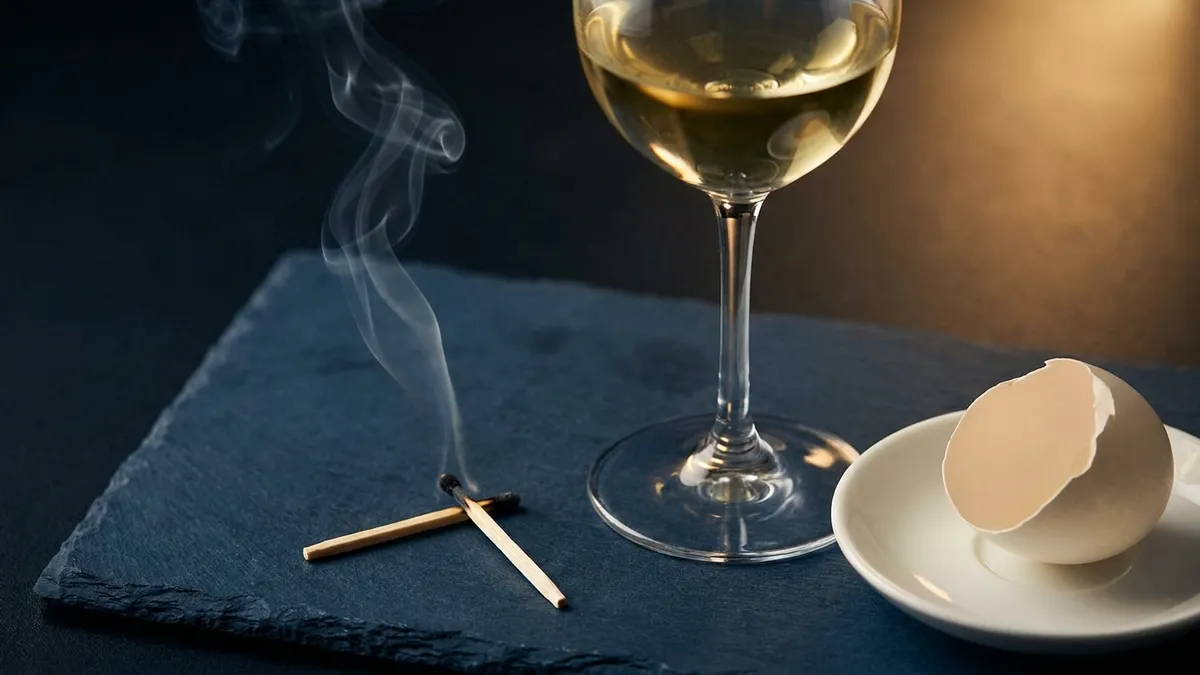
The most common and most harmless cause is added sulfur dioxide (SO2). It smells like the head of a match you have just struck — sharp, mineral, and slightly stinging at the back of the nose. You meet it most on freshly opened inexpensive whites, off-dry and sweet wines, and box wines, because those styles carry more free SO2 to protect freshness and stop residual sugar from refermenting in the bottle.
Regulators treat SO2 as a standard food preservative and cap how much a wine may contain — in the EU, for example, dry red wine is limited to 150 milligrams per litre and dry white to 200, with higher allowances for sweet wines. The key point for a taster is behaviour: free SO2 is a gas dissolved under pressure in a sealed bottle, so it escapes fast. A vigorous swirl and a minute of patience almost always clears it. If your "sulfur" smell vanishes that quickly, it was the preservative, and the wine is fine.
Source Two — Reduction, the Trapped Sulfur Compounds
When the smell is more rotten egg, rubber band, garlic, or cooked cabbage than clean struck match, you are dealing with reduction — sulfur compounds accumulating in a low-oxygen environment. Hydrogen sulfide gives the rotten-egg note, mercaptans the rubber and garlic, and dimethyl sulfide the cabbage and canned-corn end.
These compounds are potent in astonishingly small amounts. Hydrogen sulfide is detectable by the human nose at roughly one to two micrograms per litre, which is why a reductive wine can smell dramatic even when the actual quantity is a rounding error. Modern winemaking — inert-gas blanketing, low SO2, and tight screw-cap seals — protects fruit beautifully but also traps these sulfides more often than older methods did.
Mild reduction is fixable and sometimes even prized; severe reduction is a fault. Because it is a whole subject on its own, we cover the full spectrum, the copper-coin trick, and the feature-versus-fault line in the dedicated guide to reduction in wine.
Source Three — Cork Taint, the Impostor
The third "sulfur" smell is not sulfur at all. Cork taint, caused by a compound called TCA, produces a damp, mouldy smell — wet cardboard, a musty basement, a shut-up attic — that beginners often file under "something chemical is wrong." It is worth separating out because the fix is different: there is no fix. We return to this one below, and go deep in the guide on how to tell if wine is corked.
How to Tell Which Sulfur Smell You Have
The fastest way to sort a sulfur smell is to match the specific note to its likely source and run the air test. Take two short sniffs, name what you smell, then swirl hard and sniff again after a minute.
| What you smell | Likely source | Sulfur? | What to do |
|---|---|---|---|
| Sharp struck match on opening | Added sulfur dioxide (SO2) | Yes — preservative | Swirl hard; gone in about a minute |
| Rotten egg | Hydrogen sulfide (reduction) | Yes — reductive | Decant 15 min or use a copper coin |
| Burnt rubber, garlic, onion | Mercaptans (reduction) | Yes — reductive | Aerate; copper helps; may be a fault |
| Cooked cabbage, canned corn | Dimethyl sulfide (reduction) | Yes — reductive | Aerate; often a fault if strong |
| Wet cardboard, musty basement | Cork taint (TCA) | No — not sulfur | Nothing fixes it; open another bottle |
The pattern to memorise is simple. A clean struck-match smell that vanishes almost immediately is preservative and harmless. A rotten-egg or rubber smell that eases with air is mild reduction. A rotten-egg smell that survives fifteen minutes of aeration is a reductive fault. And a damp, mouldy smell that never moves is cork taint. Building this reflex is exactly what structured aroma practice trains — the Sommy app's fault-recognition drills pair each named smell with a reference so the categories stop blurring together.
How to Get Rid of a Sulfur Smell in Wine
Two of the three sources respond to home fixes. Run them in order, easiest first.
Swirl and wait one minute
Give the glass a hard, aggressive swirl for about thirty seconds and let it sit. Added sulfur dioxide is a gas escaping a sealed bottle — it dissipates almost immediately. If the struck-match smell is gone after a minute, that was the preservative and the wine is ready.
Splash-decant for fifteen minutes
If a rotten-egg or rubber note remains, pour the wine into a decanter with deliberate splashing, swirl the vessel vigorously, and wait fifteen minutes. Mild reduction blows off with this much air. Our guide to how to decant wine covers the technique in detail.
Try the copper coin trick
For a stubborn rotten-egg smell, drop a clean copper coin into the glass, stir for thirty seconds, then pour the wine off, leaving the coin behind. Copper binds hydrogen sulfide and pulls it out of solution. It works on the egg and rubber notes, though not on cooked-cabbage dimethyl sulfide.
Judge what is left
If the smell has cleared, drink and enjoy. If a heavy rotten-egg, rubber, or cabbage smell survives all three steps, the reduction is severe and the wine is faulty. And if the smell is musty rather than sulfurous, no fix applies — it is cork taint.

When a Sulfur Smell Is Not Sulfur at All
The single most useful distinction in this whole subject is between real sulfur smells and cork taint, because they demand opposite responses. Real sulfur smells — preservative and reduction — are volatile and respond to air. Cork taint does not.
Cork taint comes from TCA (2,4,6-trichloroanisole), a compound so potent that the human nose picks it up at a few nanograms per litre — thousandths of the already tiny amount needed to smell hydrogen sulfide. It smells damp and mouldy: wet cardboard, a soggy newspaper, a cellar that has been closed for a decade. It also does something sulfur smells do not — it strips a wine of fruit and leaves it flat and short, rather than adding a sharp off-note on top.
The test, as always, is air. Swirl a suspect wine, walk away for fifteen minutes, and come back. A preservative or reduction smell will have faded. Cork taint will be exactly the same, or worse, because as the faint fruit blows off the musty note stands out more clearly. If you have run the air test and the smell has not moved, stop troubleshooting — the bottle is corked and no amount of decanting will save it.
For the broader picture of how these off-notes sit alongside oxidation, brett, and volatile acidity, the guides on identifying wine faults by smell and the difference between wine flaws and faults map the whole territory.
Sulfur Dioxide, Sulfites, and the Headache Myth
Because "sulfur smell" and "sulfites" sound related, they get tangled together, usually alongside the belief that sulfites cause wine headaches. Worth untangling: the sulfur dioxide you occasionally smell on opening is the same family as the sulfites listed on the label, but the two are not the villains they are made out to be.
Sulfites occur naturally in all fermented wine and are added in small, regulated amounts as a preservative. The smell you notice on a freshly opened bottle is free SO2 escaping, and it dissipates — it is a serving quirk, not a health signal. The evidence linking sulfites to headaches is weak, and the far more likely culprits are alcohol, dehydration, and other compounds entirely. We lay out what the science actually says in the guide to sulfites in wine.
One practical note on closures: screw caps with very low oxygen transmission trap both SO2 and reductive compounds more readily than natural cork, which lets in a trace of oxygen over time. That is why a struck-match or rotten-egg smell on opening is a little more common under screw cap — a trade-off explored in screw cap vs cork. It is a sealing effect, not a quality verdict on either closure.
Building the Reflex
A sulfur smell in wine sits in the same beginner-difficulty bracket as most faults: alarming the first time, obvious once you have met each version twice. Memorise the three sources — preservative that smells of matches and clears in a minute, reduction that smells of egg or rubber and needs air or copper, and cork taint that smells musty and never moves — and you have a diagnosis for almost any off-note you will meet.
The habit worth building is the two-sniff, one-swirl routine: name the smell, swirl hard, sniff again after a minute, and let the wine's response tell you which category you are in. Sharpening that nose is what turns a confusing whiff into information. The how to smell wine framework and the app's guided aroma exercises give you named references to practise against, so struck match, rotten egg, and musty cork stop overlapping. Visit sommy.wine to start working through structured fault-recognition drills and learn to name every off-note in seconds.
Sources
- Sulfur dioxide, reduction, and cork taint entries — The Oxford Companion to Wine, Jancis Robinson & Julia Harding (eds.), Oxford University Press
- Understanding Wine Chemistry — sulfur compounds and sensory thresholds — Waterhouse, Sacks & Jeffery, Wiley
- Hydrogen sulfide and reductive winemaking fact sheets — The Australian Wine Research Institute (AWRI)
- Maximum acceptable sulfur dioxide levels in wine — International Organisation of Vine and Wine (OIV)
Frequently Asked Questions
Why does my wine smell like sulfur?
Most often it is one of three things. A freshly opened wine — especially an inexpensive white or a sweet wine — can smell of struck match because of added sulfur dioxide, the preservative, which fades in minutes. A rotten-egg or rubber smell is reduction, from sulfur compounds trapped by low-oxygen winemaking. A damp, musty smell that never clears is cork taint, which is not sulfur at all.
Is a sulfur smell in wine dangerous to drink?
No. The sulfur compounds behind these smells appear in tiny concentrations — hydrogen sulfide is detectable at around one to two micrograms per litre — far too low to harm you. Sulfur dioxide is a regulated food preservative used across dried fruit and juice. A sulfur smell affects pleasure, not safety. The worst case is a wine that smells and tastes unpleasant, so you pour it out rather than drink it.
How do you get rid of the sulfur smell in wine?
Start with air. Swirl the glass hard for thirty seconds and wait. Added sulfur dioxide dissipates almost immediately, and mild reduction fades within ten to fifteen minutes in a decanter. If a rotten-egg note lingers, drop a clean copper coin into the glass, stir, and pour the wine off — copper binds hydrogen sulfide. If the smell is musty rather than sulfurous, it is cork taint and nothing will fix it.
Does a sulfur smell mean the wine is bad?
Not necessarily. A faint struck-match note on opening is usually harmless preservative or a stylistic feature prized in some white wines, and it clears with a swirl. A persistent rotten-egg, rubber, or cooked-cabbage smell that survives aeration signals a genuine fault. The test is time and air: harmless sulfur smells retreat within minutes, while faults stay put or grow stronger as the fruit fades.
Why does cheap wine smell like sulfur or matches?
Inexpensive wines, box wines, and sweet wines often carry higher levels of free sulfur dioxide because the preservative protects freshness and stops residual sugar from refermenting. On opening, that trapped gas escapes as a sharp, matchstick smell. It is not a fault and it is not dangerous. Pour the wine, give it a vigorous swirl, and the pungency usually vanishes within a minute or two.
What is the difference between a sulfur smell and cork taint?
A sulfur smell is sharp and chemical — struck match, rotten egg, burnt rubber, or cooked cabbage. Cork taint, caused by the compound TCA, is damp and mouldy — wet cardboard, a basement, an old attic. The decisive test is air. Sulfur smells from preservative or mild reduction blow off with swirling and time. Cork taint does not fade at all, and often becomes more obvious as the wine opens.
Sommy Team
LinkedInFounder & Wine Educator
The Sommy Team is building the world's most approachable wine education app, helping beginners develop real tasting skills through structured courses and AI-guided practice.