Wine Rack Guide: Types, Materials and How to Choose

By the Sommy Team — AI-assisted, human-edited.
Updated Sep 25, 2026

Contents (9)
- The Wine Rack Guide, in One Paragraph
- What Types of Wine Racks Are There?
- Which Wine Rack Material Should You Choose?
- Where Should You Put a Wine Rack?
- Does Bottle Orientation Change the Rack You Need?
- How Big a Wine Rack Do You Need?
- Do You Need a Rack If You Own a Wine Fridge?
- How Do You Keep a Wine Rack in Good Shape?
- Set Up Your Rack Tonight
TL;DR
A wine rack holds bottles; the room does the storing. Choose the coolest, darkest, steadiest spot first, ideally near 13°C. Then pick the rack: wood for dry rooms, stainless steel for kitchens, wrought iron for display. Lay cork-sealed bottles flat, let screw caps stand, and measure slots for Champagne bottles.
A wine rack holds bottles, and the room around it does the storing, so choose the spot first and the rack second. Location is the first rule of any wine rack guide. The six rack designs, the right material for each room, sizing and the wine fridge question all follow from it.
The Wine Rack Guide, in One Paragraph
Pick the coolest, darkest, steadiest place in your home, ideally close to 13°C, then buy a rack that fits it. Wood is the most popular material and suits dry rooms; stainless steel resists corrosion in kitchens; plastic stacks cheaply; wrought iron is mostly decorative. Lay cork-sealed bottles on their sides and let screw caps stand. Size the rack to the bottles you keep at once plus a case, and check that wide Champagne bottles fit the slots. For wine you will age a year or more, a wine fridge controls temperature where a rack cannot.
What Types of Wine Racks Are There?
Six designs cover almost every home: countertop racks, stackable cubes, wall-mounted racks, floor-standing racks, big-bottle racks and wine-glass combination racks. They differ in capacity and in where they can stand. None of them controls temperature or light, so pick by bottle count and floor space.
- Countertop racks hold a handful of bottles on a shelf or sideboard. They suit wine you will open within weeks.
- Stackable cubes are modular units (identical boxes you add as you go) that sit side by side or on top of each other.
- Wall-mounted racks fix to a wall and hold bottles in rings or pegs, which saves floor space in a small flat.
- Floor-standing racks use diamond bins, lattices or rows of cradles and hold several cases at once.
- Big-bottle racks are reinforced to carry magnums and other large formats that will not fit a standard slot.
- Glass combination racks hang stemware under a row of bottles, which makes them bar furniture more than storage.
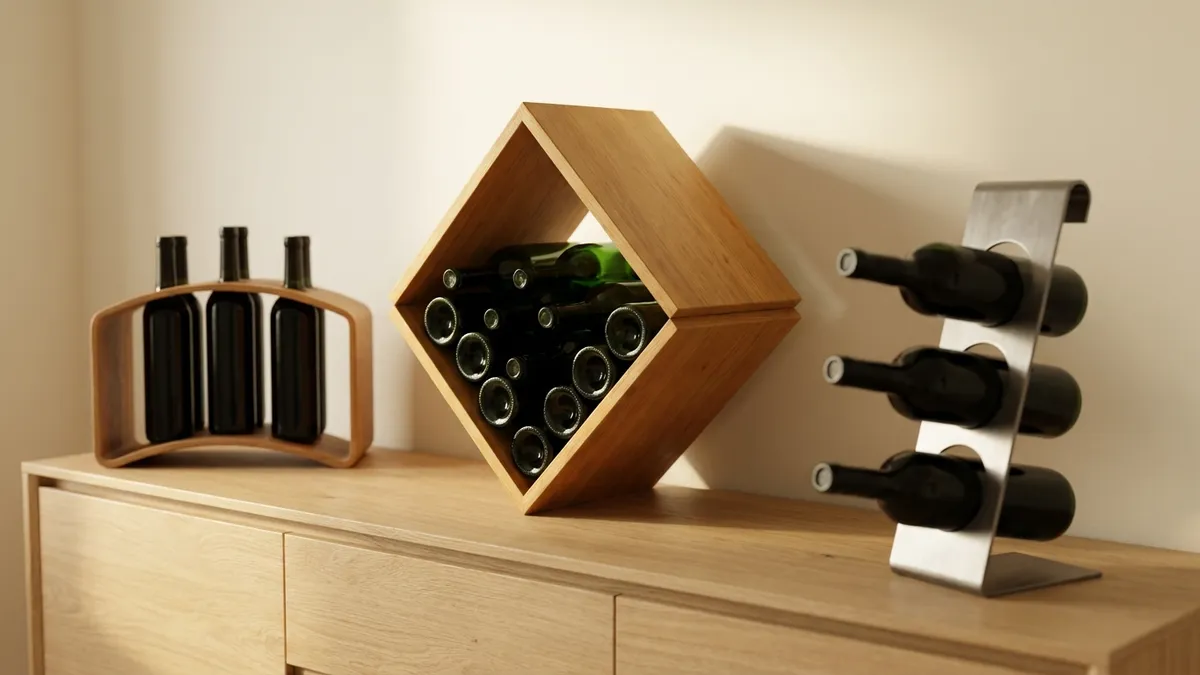
If fewer than a dozen bottles are on hand at a time, a countertop rack is enough. If wine arrives by the case, start with stackable cubes or a floor-standing rack, because both grow without a second purchase in a different style. The guide to building a wine collection estimates how many bottles a small cellar tends to hold.
Which Wine Rack Material Should You Choose?
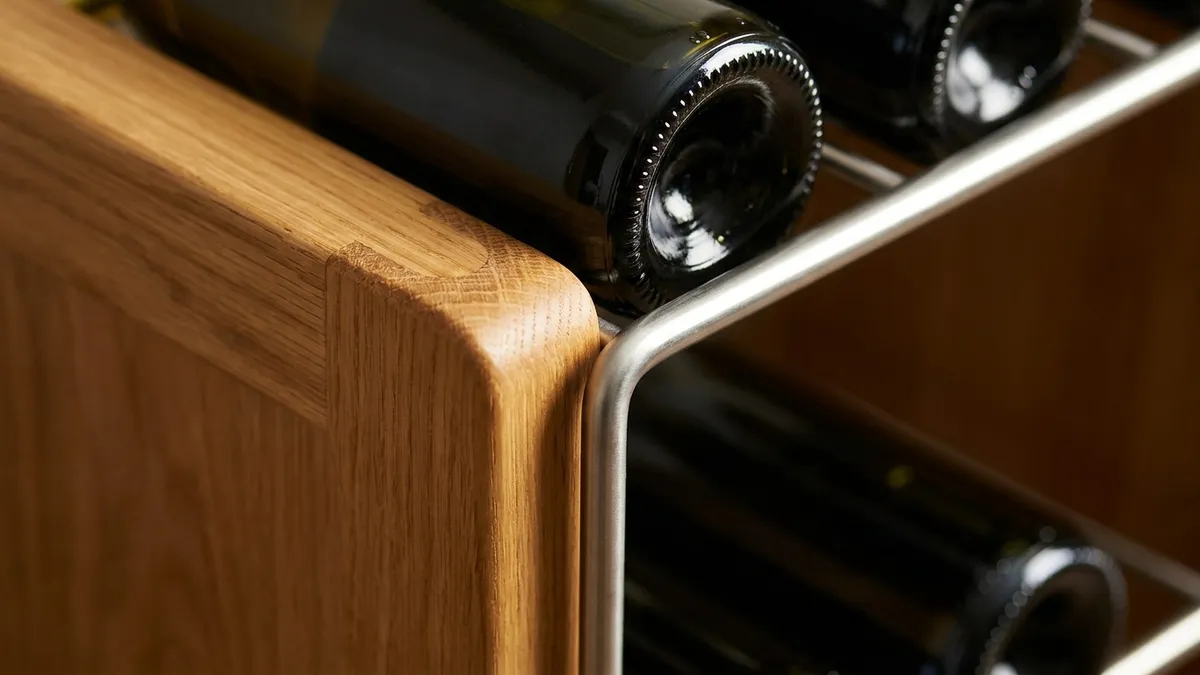
Wood is the most popular rack material and the safest default for a dry, steady room, stainless steel is the better choice in a kitchen, and wrought iron is mostly for display. The deciding factor is the room, because moisture, steam and warmth each punish a different material.
Wood dominates because it is easy to find and easy to work. Racks are commonly built from pine, fir, oak, cedar, redwood and mahogany. Softwoods such as pine keep the price down; denser hardwoods such as oak hold their shape under weight for longer.
Metal allows curves and thin, open shapes that wood cannot manage. Stainless steel adds corrosion resistance, which is why it is a common choice near sinks and steam. Wrought iron racks tend to be decorative pieces that hold a few bottles on show. Plastic racks stack into any shape, cost little and shrug off damp.
| Material | Strength | Weak spot | Choose it if |
|---|---|---|---|
| Wood (pine, oak, cedar, redwood) | Most common, easy to build and extend, cradles bottles gently | Can warp or grow mould in a damp room | Your spot is dry and steady, such as an interior closet |
| Stainless steel | Resists corrosion, slim and open | Costs more; hard edges can scuff labels | The rack goes in a kitchen or near a sink |
| Other metal (powder-coated wire) | Flowing shapes, light, wall-friendly | Coating can chip and rust in damp | You want a wall-mounted rack in a dry room |
| Wrought iron | Decorative, heavy and stable | Mostly built for display, few slots | You want a few bottles on show, not a store |
| Plastic | Cheap, stackable to any shape, ignores damp | Looks utilitarian; can sag under full cases | You need a quick fix in a cellar or cupboard |
If the room is damp, choose metal or plastic; if it is dry and steady, choose wood. Humid basements are where wooden racks warp or grow mould, even though wood is the traditional cellar material.
Where Should You Put a Wine Rack?
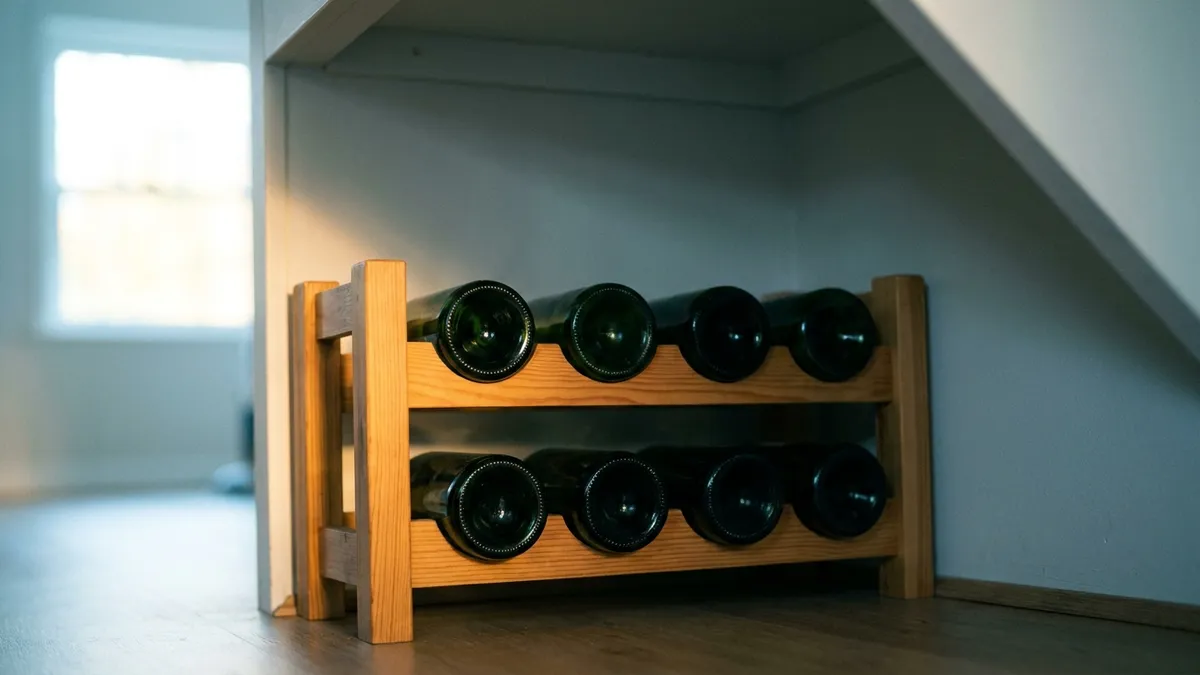
Put the rack in the coolest, darkest and steadiest spot you have, ideally near 13°C, the temperature of the French caves traditionally used to keep wine. The acceptable range is roughly 7 to 18°C, provided the temperature drifts slowly rather than jumping. An interior closet or understairs nook usually beats any spot in the kitchen.
This is where most home setups go wrong. A rack is furniture, not a climate: a beautiful rack in a hot kitchen still cooks the wine. Heat speeds up ageing and can push wine towards the stewed, jammy taste described in cooked wine and heat damage. Sunlight and strong bulbs cause a different fault, the cabbage-like smell covered in lightstruck wine.
Avoid these spots:
- Beside the oven, hob or dishwasher
- On top of the fridge, where warm air vents out
- Next to a radiator or a sunny window
- In a garage or attic that swings with the weather
- Near a washing machine or anything that vibrates
If a spot swings from cool to warm between morning and evening, move the rack, because slow drift is tolerated and fast swings are not. The wine cellar temperature and humidity guide goes deeper on targets, and how to store wine at home ranks common household spots from best to worst.
Does Bottle Orientation Change the Rack You Need?
Yes, but only for bottles sealed with natural cork. A rack that holds bottles on their sides is for corks you plan to keep more than a few weeks. Screw caps and synthetic stoppers have no cork to keep moist, so those bottles can stand upright on a shelf and leave the rack slots free.
Cork suits bottles because it is elastic and nearly impermeable, so it presses tight against the glass neck. The standard advice is to lay cork-sealed bottles flat so the wine keeps the cork moist and stops it shrinking. That advice is widely repeated, but the evidence is mixed. A French study cited in Wine Spectator claimed the air inside a bottle stays at 100% relative humidity whatever the closure or angle. Wine writer Alexis Lichine warned that dry air can still dry corks out from the outside.
Side storage is a rule for corks, not for screw caps. If it has a natural cork and will wait more than a few weeks, lay it down; if it has a screw cap, stand it up and save the slot. That matters more each year: in New Zealand, screw cap adoption went from 1% in 2001 to 70% in 2004. The full comparison of closures lives in screw cap vs cork, and horizontal vs vertical wine storage covers the angles in detail.
How Big a Wine Rack Do You Need?
Count the bottles you usually keep at once, add room for one more case of twelve, and buy that size. Then check two things most buyers skip: whether your widest bottles fit the slots, and whether the wall or shelf can take the weight when every slot is full.
The standard bottle holds 750 mL, and nearly every rack is sized around it. Shape still varies. A Bordeaux bottle is straight-sided with high shoulders and a pronounced punt (the dimple in the base). A Burgundy bottle is taller with sloping shoulders and a smaller punt. A Champagne bottle is wider and thick-walled, with a deeper punt still. A slot cut for Bordeaux can pinch a Champagne bottle or leave a Burgundy sticking out.

Weight adds up faster than people expect. An empty 750 mL bottle averages about 500 g, with a range from 300 g to 900 g depending on the glass. The wine inside adds roughly another three-quarters of a kilo. A full rack of 24 bottles can therefore weigh around 30 kg or more.
If you hang a wall rack, screw it into the studs, the solid timber or metal uprights behind plasterboard. Plasterboard alone will not hold a full rack. If you drink a lot of sparkling wine or Burgundy, measure one bottle before you order, or pick a rack with open bins or a big-bottle row.
Do You Need a Rack If You Own a Wine Fridge?
For wine you will open within a few months, a rack in a cool spot is enough; for wine you will age a year or more, a wine fridge does what a rack cannot. The fridge controls temperature. The rack only holds bottles, so the two do different jobs and many homes use both.
A fridge costs far more per bottle than a rack, so fill it with the bottles that need protection. If a bottle will wait more than a year, it belongs in the fridge or a real cellar. Everyday reds, whites for this month and screw-capped bottles can live in the rack. The wine fridge guide covers how to choose one.
This split also stops the fridge filling with bottles that never needed it. When the fridge is full, move its most recent arrivals to the rack first, since young everyday wine copes best with a few months outside it. Opened bottles need a different plan, set out in how long wine lasts after opening.
How Do You Keep a Wine Rack in Good Shape?
Dust it once a month, check the fixings twice a year, and watch wooden racks for mould or warping in damp rooms. A clean, solid rack protects bottles from knocks, keeps every label easy to read and shows at a glance which bottle to drink next.
If wood shows fuzzy spots or a musty smell, move the rack to a drier room or replace it with metal. Mould on the rack is unlikely to reach the wine in a sealed bottle, but it can stain labels and signals damp that other things in the room will suffer too. Tighten wall screws when you notice any lean.
On metal racks, wipe off any rust spot and touch up chipped coating before it spreads. Keep a gap of a few centimetres behind the rack so air can move and the wall stays dry. The mistakes that do damage most often are listed in wine storage mistakes, and the full set of storage topics sits in our serving and storage hub.
Set Up Your Rack Tonight
Start tonight with what you already own. Walk the house and pick the coolest, darkest, steadiest spot. Sort your bottles: corks flat, screw caps upright, the oldest bottles furthest from the light. Measure your widest bottle, then buy the rack that fits both the spot and the bottle.
Then open the bottle that has waited longest, before it waits too long. Sommy's AI-guided tasting mode takes a photo of the label and walks through look, smell and taste, saving the notes to a tasting journal. Log each bottle as it leaves the rack, and the journal shows which ones were worth keeping. Start at sommy.wine, where the bite-sized Wine 101 course sits alongside the regional courses.
Sources
Frequently Asked Questions
What is the best material for a wine rack?
Wood is the most popular choice and the safest default for a dry, steady room, because it is easy to work and cradles bottles well. Stainless steel suits kitchens, since it resists corrosion near sinks and steam. Plastic stacks into any shape and costs little. Wrought iron racks are mostly decorative, so keep them for a few bottles on show rather than wine you plan to age.
Do wine bottles need to lie on their side in a rack?
Only bottles sealed with natural cork that will wait more than a few weeks. Lying flat keeps the wine against the cork, which is the widely recommended way to stop it drying out, although experts still argue about how much this matters. Screw caps and synthetic stoppers have no cork to keep wet, so those bottles can stand upright or lie down.
Where should you put a wine rack at home?
In the coolest, darkest and steadiest spot you have. An interior closet, an understairs nook or a cool basement corner usually beats the kitchen. Wine keeps best near 13°C, and the acceptable range is roughly 7 to 18°C as long as the temperature changes slowly. Keep the rack away from ovens, radiators, sunny windows and machines that vibrate.
Do you need a wine rack if you have a wine fridge?
Often you need both. A wine fridge controls temperature, which a rack cannot do, so it should hold bottles you plan to age for a year or more. A rack is cheaper per bottle and fine for wine you will open within a few months, provided it sits in a cool, dark spot. Use the fridge for keepers and the rack for everyday bottles.
Can you keep a wine rack in the kitchen or garage?
A kitchen works only for bottles you will drink within weeks, and only away from the oven, the fridge's warm exhaust and sunny windows. Choose stainless steel there, since it resists corrosion. A garage is usually worse, because temperatures swing between day and night and between seasons. Wine tolerates gradual change far better than sudden swings, so pick an interior room instead.
Will Champagne bottles fit in a standard wine rack?
Not always. Most racks are sized around the straight-sided Bordeaux bottle, while Champagne bottles are wider and thick-walled, and Burgundy bottles are taller with sloping shoulders. A wide bottle can jam in a narrow slot or sit proud of the rack. Measure one of your widest bottles before you buy, or choose a rack with a big-bottle row or open bins.
Sommy Team
LinkedInFounder & Wine Educator
The Sommy Team is building the world's most approachable wine education app, helping beginners develop real tasting skills through structured courses and AI-guided practice.