Wine Bottle Sizes: Every Name From Split to Nebuchadnezzar

By the Sommy Team — AI-assisted, human-edited.
Updated Oct 1, 2026
Contents (8)
TL;DR
Wine bottle sizes double up from the 750 ml standard: magnum 1.5 litres, Jeroboam 3, Methuselah 6, Nebuchadnezzar 15. The names shift by region, so a Bordeaux Jeroboam holds 5 litres. Magnums age more slowly because the same cork air meets twice the wine. Buy by headcount and by how long the bottle will wait.
Wine bottle sizes carry names that sound fixed but change with the region. A Jeroboam holds 3 litres of Champagne and 5 litres of Bordeaux, so the litre figure on the label is the only number to trust. Above the 750 ml standard, almost every size is a simple multiple: 2, 4, 8, 12, 16, 20 bottles. The size you pick also changes how a wine ages and how far it goes at the table.
What Are the Wine Bottle Sizes, in Order?
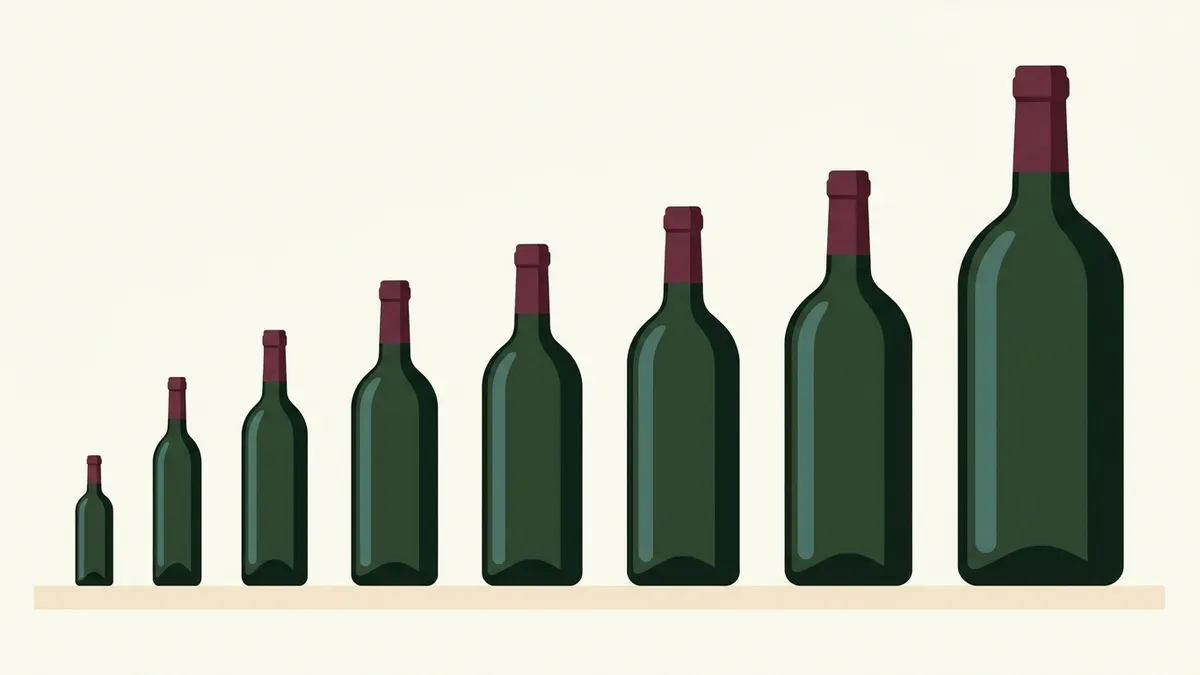
The common wine bottle sizes run from the split (187.5 or 200 ml) through the half (375 ml), standard (750 ml) and magnum (1.5 litres). Then come the Jeroboam (3 litres), Rehoboam (4.5), Methuselah (6), Salmanazar (9), Balthazar (12) and Nebuchadnezzar (15). Anything above the standard bottle is called large format.
The Champagne trade body goes further, up to the 30-litre Melchizedek, also called Midas, which equals 40 standard bottles. Between them sit the 18-litre Salomon, the 26.25-litre Souverain and the 27-litre Primat.
| Name | Volume | Standard bottles | Glasses at 150 ml | Buy it for |
|---|---|---|---|---|
| Split, piccolo or quart | 187.5 ml (20 cl in Champagne) | ¼ | 1 | One glass of sparkling wine, a toast for one |
| Half bottle (demi) | 375 ml | ½ | 2 to 3 | Two people, one glass each; sweet wine after dinner |
| Standard bottle | 750 ml | 1 | 5 | Dinner for two to four |
| Magnum | 1.5 L | 2 | 10 | Six or more people; wine to cellar ten years or longer |
| Jeroboam (Champagne, Burgundy) or double magnum (Bordeaux) | 3 L | 4 | 20 | A party of 15 to 20 |
| Rehoboam | 4.5 L | 6 | 30 | Sparkling wine at a big celebration |
| Jeroboam (Bordeaux) | 5 L | 6⅔ | 33 | Check the label before you order |
| Methuselah or Imperial (Bordeaux) | 6 L | 8 | 40 | Weddings and large dinners |
| Salmanazar | 9 L | 12 | 60 | Events of 50 or more |
| Balthazar | 12 L | 16 | 80 | Show pieces for large events |
| Nebuchadnezzar | 15 L | 20 | 100 | Show pieces for large events |
The glass column uses a 150 ml pour. At smaller pours the counts rise, and the full maths for different glass sizes is in how many glasses are in a bottle.
The word "split" is the loosest name of all. Most of the world means 187.5 ml, a quarter of a standard bottle. In Champagne the quarter is a 20 cl quart, and the German piccolo for sparkling wine is usually 200 ml as well. If a recipe or a gift set says split, check whether it means 187.5 or 200 ml.
Which Bottle Size Should You Buy?
Buy by headcount and by how long the bottle will wait. A standard bottle pours five glasses, so it covers two people with seconds or four people with one glass each. Smaller and larger sizes scale from that same five-glass unit.
- One or two glasses: if you want a single glass each and no leftovers, buy a half bottle. Many sweet wines come in this size, so it suits dessert too. For a solo toast with sparkling wine, a split avoids opening a full bottle that goes flat by tomorrow.
- Six or more at the table: if six or more people will drink, buy magnums. One magnum replaces two bottles, keeps everyone on the same wine and makes fewer trips to the fridge.
- A party: if 15 to 20 people want one toast each, a 3-litre bottle does the job in one pour round. Above that size, bottles get heavy: the wine alone in a Nebuchadnezzar weighs about 15 kg, before the heavy glass is counted, so plan for two people to pour.
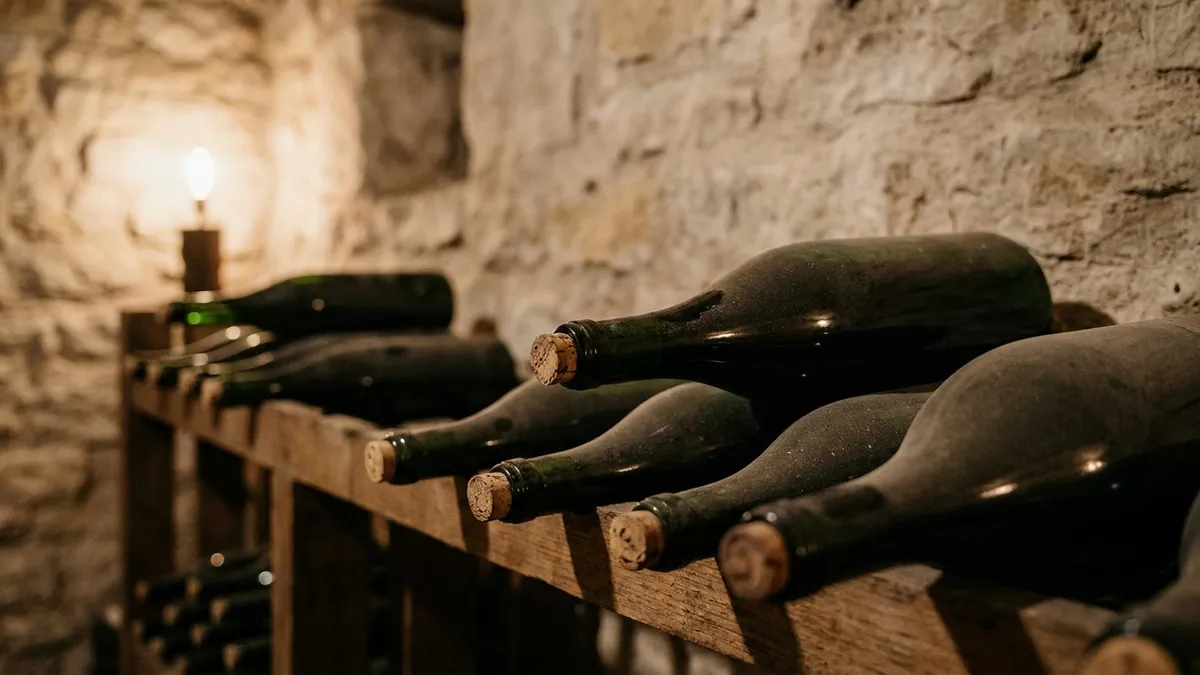
- The cellar: if you plan to keep a wine for ten years or more, buy it in magnum.
Does Wine Really Age Better in a Magnum?
It ages more slowly, which is why collectors keep magnums for long cellaring. The Wine & Spirit Education Trust gives the mechanism: roughly the same amount of air enters a magnum and a standard bottle through the cork, but in the magnum it meets twice as much wine. Less oxygen per drop means slower change.
A bigger bottle also has more thermal mass (the amount of liquid that has to warm up or cool down), so a swing in room temperature takes longer to reach the wine. Slow change keeps the fresh fruit and acidity longer, while the slow developments of age, such as softer tannin and the savoury smells of leather and dried leaves, build at a steadier pace. The full picture of what changes is in our wine aging guide.
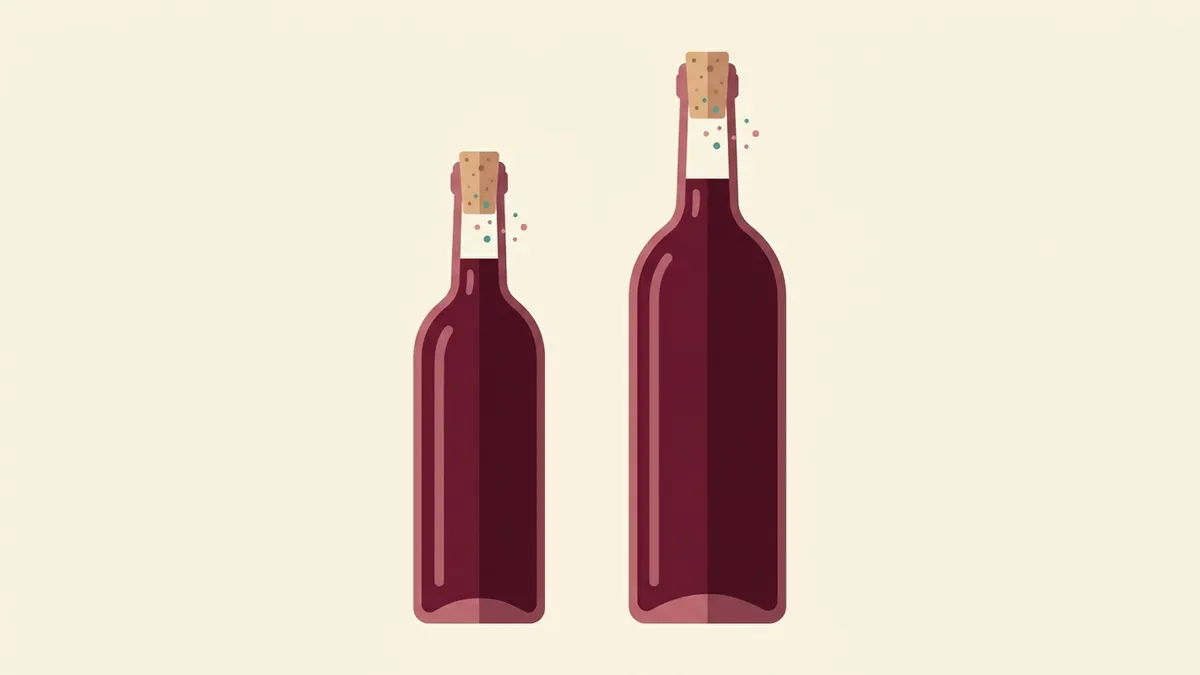
Smaller bottles work the other way. A half bottle or a split puts the same cork over half or a quarter of the wine, so it develops faster. If you are cellaring, keep the halves for the earliest years and open the magnums last. Log each opening in Sommy's tasting journal and the notes show how the same wine changed between sizes.
Size does not rescue bad storage. A magnum kept next to a radiator still cooks, and heat-damaged wine tastes of stewed fruit whatever the bottle. If your storage runs warm, drink the wine young in any size; if it stays cool, steady and dark, a magnum earns its extra years. How to store wine at home gives the targets, and horizontal vs vertical storage covers why cork-sealed bottles lie down.
Is a Jeroboam 3 or 5 Litres?
Both, depending on where the wine comes from. In Champagne and Burgundy a Jeroboam holds 3 litres, four standard bottles. Bordeaux calls its 3-litre bottle a double magnum, and its Jeroboam holds 5 litres. Bordeaux's Jeroboam used to be 4.5 litres, and Champagne and Burgundy call that 4.5-litre size a Rehoboam, six standard bottles.
The 6-litre size has two names too. Champagne and Burgundy call it a Methuselah; Bordeaux calls it an Imperial. Above that the names mostly agree: Salmanazar at 9 litres, Balthazar at 12, Nebuchadnezzar at 15.
A Jeroboam is not always 3 litres, and a wine list rarely says which one it means. If a list or a shop names a large format without a volume, ask for the litres before you order. The volume is printed on the label by law, usually near the alcohol figure, and our guide to reading a wine label shows where. Regional style is covered in the Bordeaux wine guide and the Burgundy wine guide.
How Is a Nebuchadnezzar of Champagne Filled?
Usually by pouring in Champagne that fermented in smaller bottles. The Champagne trade body describes the second fermentation, which makes the bubbles, as taking place in the bottle that will be used from bottling all the way to sale. That works for standard bottles and magnums.
The trouble starts after fermentation. The spent yeast, called lees, has to be worked down into the neck before it is removed, by tilting and turning each bottle a little at a time. That step is riddling. Most Champagne houses cannot carry out the second fermentation in bottles larger than a magnum, because large, heavy bottles are too hard to riddle. So the wine in a Rehoboam, Methuselah or Nebuchadnezzar has normally fermented in smaller bottles and been transferred into the big one.
If you want Champagne that aged on its yeast in the bottle you pour from, buy a magnum or smaller. The méthode champenoise explainer walks through every step from bottling to cork, and the Champagne region guide covers the styles.
Why Is a Standard Bottle 750 ml?
Nobody can prove a single reason. Bordeaux's wine council says 750 ml was only set as the standard measure in 1866. Popular stories credit a glassblower's lung capacity or an old shipping unit, but none has solid evidence behind it.
The rest of the world took longer to agree. Before metric bottles, the US standard was the fifth, one-fifth of a US gallon or 757 ml; the US adopted the 750 ml metric bottle in 1979. If an older American bottle reads "4/5 quart", that is the fifth. Britain had imperial pint bottles of 568 ml, best known for Champagne, until 1973, when it joined the European Common Market.
The rules still shape what you find on the shelf. In the EU, sparkling wine up to 1.5 litres may only be sold in 125, 200, 375 or 750 ml bottles or as a magnum. Since 19 September 2024, the law in Great Britain allows still and sparkling wine in 568 ml pints, sparkling wine in 500 ml bottles and still wine in 200 ml bottles.
Why Are Big Bottles Named After Biblical Kings?
Nobody knows. From 3 litres up, the names mostly come from the Bible, and Decanter calls the reason unclear. Jeroboam, Rehoboam and Solomon were Israelite kings, and Methuselah was a patriarch known for his long life. Nebuchadnezzar was a king of Babylon, and Balthazar is the name tradition gives one of the three wise men.
The names are no help for remembering the volumes. The multiples are: 2, 4, 6, 8, 12, 16, 20 standard bottles from magnum to Nebuchadnezzar. Learn the litres and treat the names as nicknames.
Open the Right Size Tonight
Read the small volume figure near the alcohol percentage on each bottle in your rack. If it says 375 ml, open that half first; if it says 1.5 L, move the magnum to the back for later. More styles worth buying big are in the wine styles hub, from sparkling wine types to reds built for the cellar.
Snap the label of tonight's half bottle in Sommy, let the AI-guided tasting take it through look, smell and taste, then pour the second glass and compare your notes.
Sources
Frequently Asked Questions
What are the wine bottle sizes in order?
From smallest to largest: split or piccolo (187.5 or 200 ml), half bottle (375 ml), standard bottle (750 ml), magnum (1.5 litres), Jeroboam or double magnum (3 litres), Rehoboam (4.5 litres), Methuselah or Imperial (6 litres), Salmanazar (9 litres), Balthazar (12 litres) and Nebuchadnezzar (15 litres). Champagne goes further still, up to the 30-litre Melchizedek, also called Midas.
How many bottles are in a Methuselah?
Eight. A Methuselah holds 6 litres, which is eight standard 750 ml bottles and about 40 glasses at a 150 ml pour. Champagne and Burgundy use the name Methuselah for this size. In Bordeaux the same 6-litre bottle is called an Imperial, which is one reason to check the litres on the label rather than trust the name.
What is the difference between a Jeroboam and a Rehoboam?
In Champagne and Burgundy a Jeroboam holds 3 litres, four standard bottles, and a Rehoboam holds 4.5 litres, six bottles. Bordeaux uses the words differently: its 3-litre bottle is a double magnum, and its Jeroboam holds 5 litres, up from 4.5 litres in the past. The same word can mean two volumes, so ask for the litres.
Does wine age better in a magnum?
It ages more slowly, which is why collectors prize magnums for long cellaring. Roughly the same amount of air enters through the cork of a magnum as through a standard bottle, but it meets twice as much wine. The larger volume also warms and cools more slowly. Poor storage still spoils a magnum, so size only helps a wine kept cool and steady.
What is a split of wine?
A split is a quarter-size bottle, usually 187.5 ml, that pours one generous glass. It is mostly used for sparkling wine, on planes, in hotel minibars and in gift sets. In Champagne the quarter bottle, called a quart, holds 20 cl, and the German piccolo for sparkling wine is usually 200 ml as well.
Is Champagne fermented in a Nebuchadnezzar?
Usually not. Champagne gets its bubbles from a second fermentation in the bottle, and the yeast must then be worked down into the neck and removed. Most houses cannot do that reliably in bottles bigger than a magnum, because the heavy giants are too hard to turn. The wine in a Nebuchadnezzar is normally fermented in smaller bottles and transferred.
Why is a standard wine bottle 750 ml?
No single reason is proven. Bordeaux's wine council says 750 ml was only set as the standard measure in 1866. The US used a 757 ml fifth of a gallon until it adopted metric wine bottles in 1979. Stories about glassblowers' lungs or old shipping units circulate widely, but none has solid evidence behind it.
Sommy Team
LinkedInFounder & Wine Educator
The Sommy Team is building the world's most approachable wine education app, helping beginners develop real tasting skills through structured courses and AI-guided practice.