Champagne Region Guide: Terroir, Grapes, and Styles

By the Sommy Team — AI-assisted, human-edited.
Updated Jun 17, 2026
Contents (11)
- What Is the Champagne Region?
- Where Champagne Is: Climate and Chalk Terroir
- The Three Grapes That Define Champagne
- The Traditional Method: How the Bubbles Get In
- The Sub-Areas of the Champagne Region
- Champagne Classification: The Cru System
- The Styles of Champagne
- Dosage and Sweetness: From Brut Nature to Demi-Sec
- Grower Champagne vs House Champagne
- How a Beginner Should Start Exploring Champagne
- The Reward of Learning Champagne
TL;DR
The Champagne region sits on cool chalk soils northeast of Paris, growing three grapes — Chardonnay, Pinot Noir, and Pinot Meunier — turned into sparkling wine by the traditional method of a second fermentation in bottle. This champagne region guide covers the terroir, sub-areas, styles, and sweetness for beginners.
What Is the Champagne Region?
This champagne region guide starts with geography, because everything that makes Champagne distinctive flows from one cold, chalky place. The Champagne region sits about 90 miles northeast of Paris, near the northern limit of where wine grapes will reliably ripen in France. That cool climate and the famous white chalk beneath the vineyards give the wines their hallmark high acidity and finesse. Three grapes do almost all the work — Chardonnay, Pinot Noir, and Pinot Meunier — and they are turned into sparkling wine by the traditional method, a second fermentation inside the sealed bottle. Learn the terroir, the trio, the method, and the sweetness scale, and any Champagne label becomes readable.
Where Champagne Is: Climate and Chalk Terroir
Champagne is one of the coolest classic wine regions on earth. Its northerly position means grapes here ripen slowly and rarely get fully sweet, holding onto the bracing acidity that makes sparkling wine refreshing rather than flabby. In a still wine that hard, green edge would feel severe. In a sparkling wine it is the backbone.
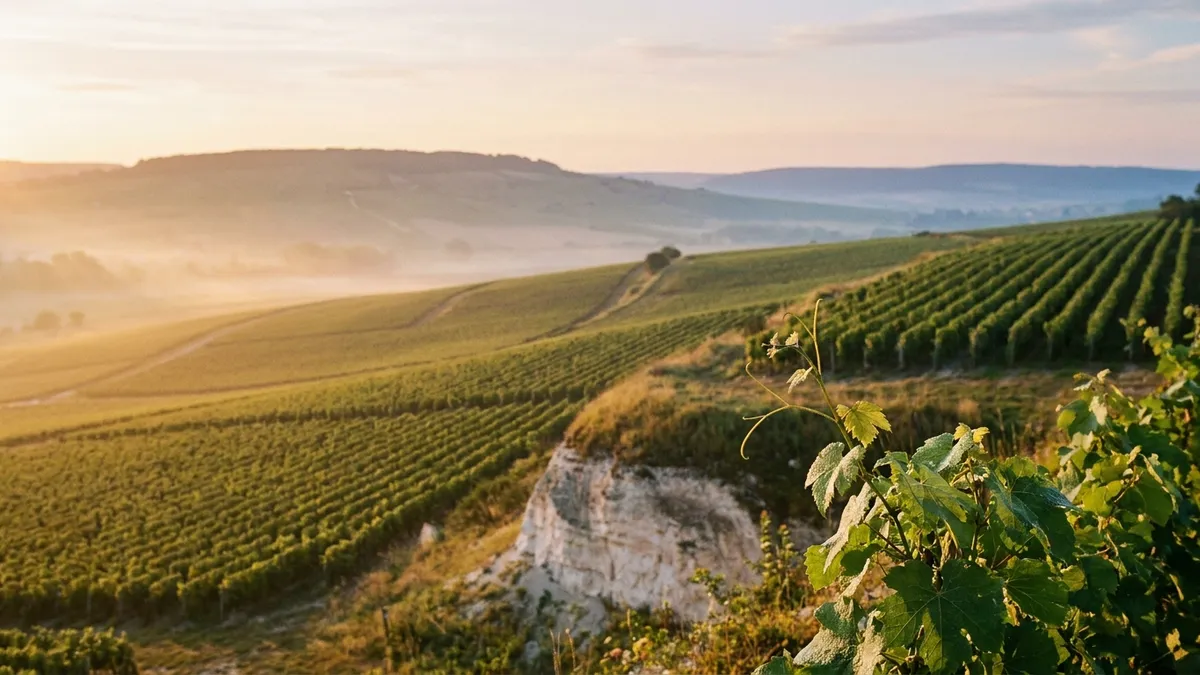
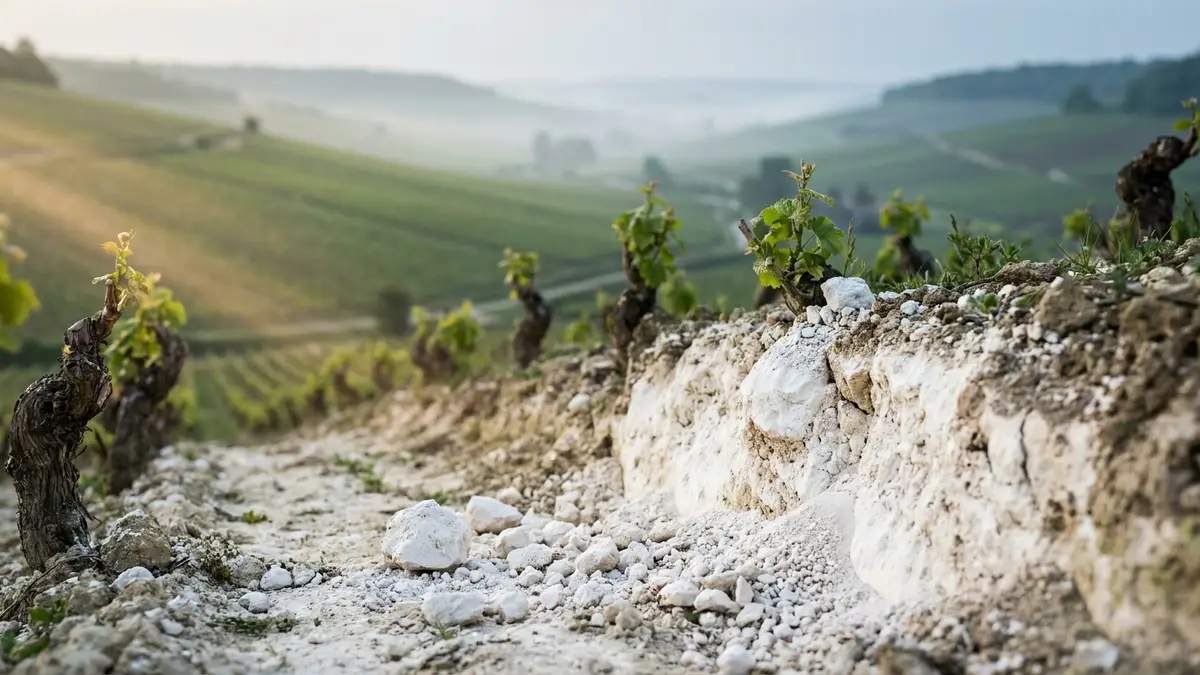
The other half of the story is underground. Much of the region sits on a thick bed of chalk — soft, porous limestone made from ancient sea-shell fossils. Chalk drains well so vine roots never sit in water, holds moisture deep down for dry spells, and lends the wines a flinty, saline mineral tension.
This combination of cold air and bright chalk is the region's terroir — the full set of natural conditions, soil, climate, and slope, that shapes a wine. No other region recreates it exactly, which is a large part of why true Champagne tastes the way it does.
The Three Grapes That Define Champagne
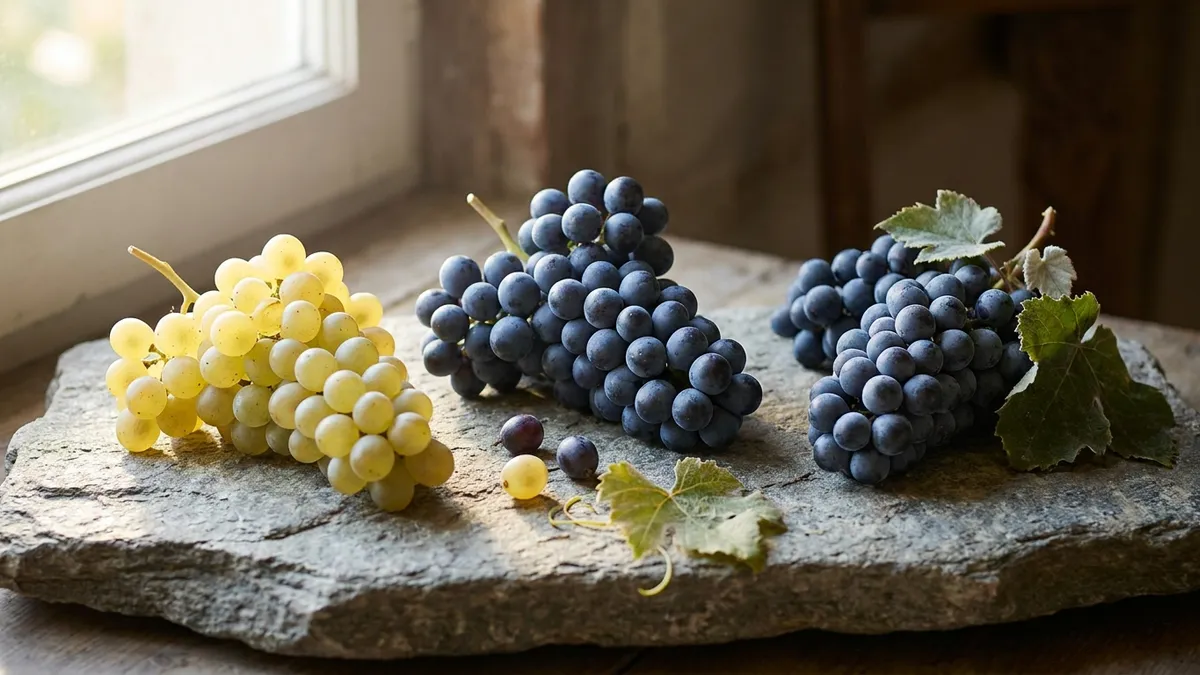
Champagne leans on three grapes, and knowing what each contributes tells you most of what a blend will taste like. Most bottles mix all three, but each plays a clear role.
- Chardonnay: The white grape of the trio. It brings finesse, freshness, citrus, and green-apple lift, plus the structure to age gracefully. Chardonnay-driven wines feel lean, elegant, and mineral. For the grape's wider story beyond bubbles, see our Chardonnay wine guide.
- Pinot Noir: A black grape pressed gently so its clear juice makes white sparkling wine. It adds body, depth, and red-fruit weight, giving a blend power and a firmer core. Pinot Noir's global personality is covered in our Pinot Noir guide.
- Pinot Meunier: The softer, often overlooked black grape. It buds late and ripens early, surviving Champagne's frost-prone springs better than the others, and brings round, easy fruit and approachable charm that makes young Champagne drinkable sooner.
All three are also part of the bigger family of sparkling wine grapes used around the world. Two of them — Chardonnay and Pinot Noir — sit among the noble grapes every learner meets early. The Sommy app's tasting exercises help you isolate what each grape contributes when you taste a blend side by side.
The Traditional Method: How the Bubbles Get In
The single most important technical fact about Champagne is how it gets its fizz. The bubbles come from the traditional method — méthode traditionnelle — a second fermentation that happens inside each sealed bottle rather than in a big tank.
The process runs in clear stages. First, the grapes are pressed and fermented into a still, dry base wine, usually a blend of grapes, villages, and sometimes several years. Next comes the key step: that base wine is bottled with a small dose of yeast and sugar, then sealed. The yeast ferments a second time, and because the bottle is closed, the carbon dioxide has nowhere to go and dissolves into the wine as fine bubbles.
After fermentation, the wine rests on its spent yeast cells — the lees — for months or years. This lees aging is what gives Champagne its signature bready, biscuity, toasty complexity, the savory note that sets it apart from simpler sparkling wines. Finally the yeast is collected in the neck, frozen and shot out under pressure, and a last dose of wine and sugar tops up the bottle before the cork goes in.
The traditional method is slow on purpose. Time on the lees is where a sparkling wine trades crisp simplicity for bready depth.
This is the same method behind several great sparkling wines worldwide, which is exactly why they get compared. Our guide to Champagne vs Prosecco vs Cava lays out how the production differences shape the taste of each.
The Sub-Areas of the Champagne Region
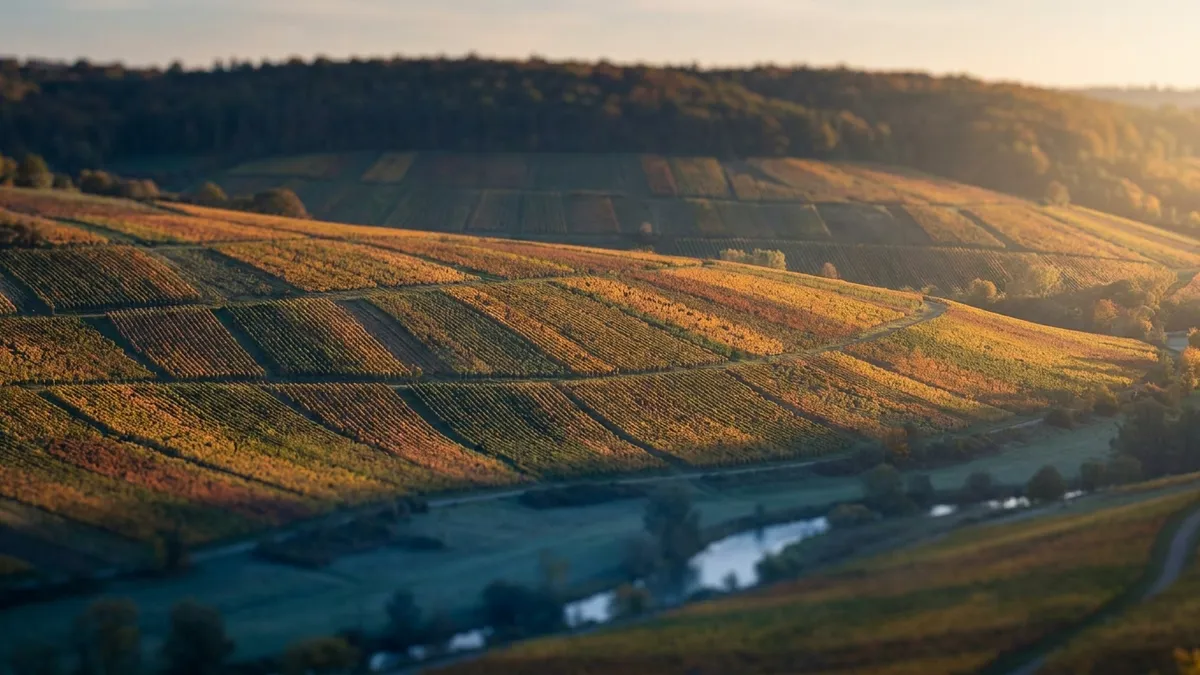
Champagne is not one uniform vineyard. It splits into several growing areas, each leaning toward a different grape and lending its own accent to a blend. Knowing the three core sub-areas turns the map into something you can follow.
- Montagne de Reims: A forested ridge that is the heartland of Pinot Noir. The grapes here ripen with structure and power, so wines drawing on the Montagne tend to feel deeper, firmer, and more age-worthy. Several of the region's top-rated villages sit on its slopes.
- Côte des Blancs: As the name suggests, this is white-grape country, almost entirely Chardonnay planted on especially pure chalk. It is the source of the most prized blanc de blancs wines — lean, citrusy, mineral, and built to age. If a Champagne tastes taut and chalk-driven, the Côte des Blancs is often behind it.
- Vallée de la Marne: The river valley that is the stronghold of Pinot Meunier, the frost-hardy grape that thrives on its cooler, lower sites. Wines leaning on the Marne show rounder, fruitier, more immediately approachable character.
Two smaller areas round out the region: the Côte des Bar in the south, warmer and rich in Pinot Noir, and the Côte de Sézanne, a Chardonnay extension below the Côte des Blancs. Most non-vintage Champagne blends fruit across these areas, balancing power, finesse, and fruit into one consistent style.
Champagne Classification: The Cru System
Champagne ranks its land with a village-based cru system rather than the plot-by-plot ladder of some French regions. Every grape-growing village holds a rating, and that rating historically set the price growers were paid. From top to bottom:
- Grand Cru: The 17 highest-rated villages, considered to grow the finest fruit. A wine labeled Grand Cru uses grapes only from these villages.
- Premier Cru: The next tier, covering 42 villages of strong but slightly lesser standing. Premier Cru bottles offer much of the quality at a friendlier price.
- Other rated villages: The remaining roughly 250 villages, which make up the bulk of the region and supply most everyday Champagne.
The cru rating is about the village, not a single vineyard, so it is a broader signal than Burgundy's plot system. If you want to see how that plot-by-plot logic compares, our Burgundy wine guide walks through the four-tier model, and our overview of French wine regions shows where Champagne fits among them.
The Styles of Champagne
Once you know the grapes and the method, the labels start to make sense. Champagne comes in a handful of styles, defined by which grapes go in and how the wine is built.
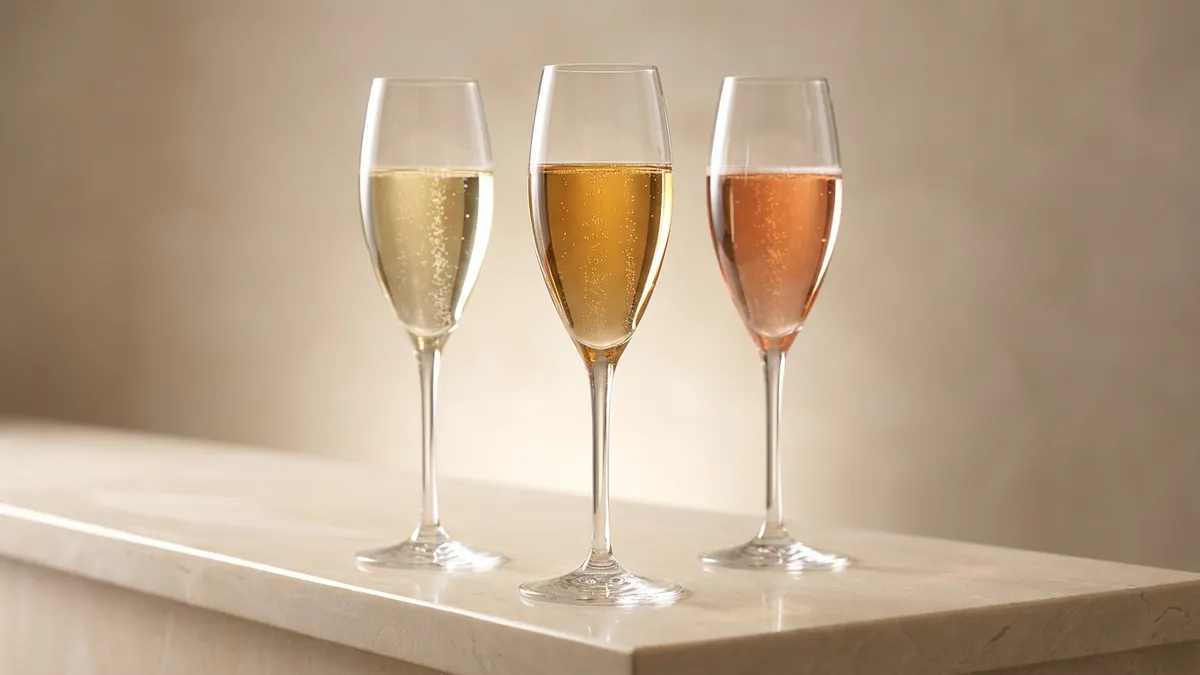
- Non-vintage (NV): The benchmark and the majority of all Champagne. It blends wine from several harvest years to hold a steady house style regardless of the weather in any one season. Reliable, widely available, and the right first bottle for a beginner.
- Vintage: Made only from a single, strong harvest year printed on the label, and aged longer before release. It captures the character of one specific season and is rarer and pricier. Houses declare a vintage only in years they judge good enough.
- Blanc de blancs: White from whites — made only from white grapes, almost always Chardonnay. Lean, citrusy, chalky, and built for aging. The purest expression of the Côte des Blancs.
- Blanc de noirs: White from blacks — a pale wine made only from black grapes, Pinot Noir and Pinot Meunier, pressed so gently the juice stays clear. Fuller, rounder, and more red-fruited than a blanc de blancs.
- Rosé: A pink Champagne, made either by leaving the juice in brief contact with black grape skins or by blending a little still red wine into the base. It carries more obvious red-berry fruit and is just as serious as the white styles.
How a Beginner Should Read These Styles
The fastest way to feel the differences is to taste them against each other: start with a non-vintage brut for the house benchmark, then put a blanc de blancs next to a blanc de noirs to taste how grape choice swings the wine from lean and mineral to round and fruity. The Sommy app turns that side-by-side into a guided exercise, naming the aromas and scoring the structure as you go.
Dosage and Sweetness: From Brut Nature to Demi-Sec
The last decision in making Champagne is how sweet to leave it. Just before the final cork, the producer adds a small top-up of wine and sugar called the dosage. How much sugar goes in sets the sweetness category, which is printed on every label. From driest to sweetest:
- Brut nature: Bone dry, with little or no added sugar. The most austere style, showing the wine's raw acidity and chalk.
- Extra brut: Very dry, a touch more rounded than brut nature.
- Brut: Dry and by far the most common style worldwide. The benchmark balance of fruit and acidity, and where most beginners should start.
- Extra dry (extra sec): Despite the name, slightly off-dry — a little sweeter than brut. The label confuses many people.
- Sec: Noticeably off-dry, with clear sweetness.
- Demi-sec: Sweet, suited to dessert and rich pastries rather than as an aperitif.
The headline trap is extra dry, which is sweeter than plain brut even though the name sounds drier. When in doubt, brut is the safe, dry default. Champagne's high acidity means even a sweeter demi-sec rarely tastes cloying — the acid keeps it lively. Learning to read sweetness off a label, then check it against what you actually taste, is a core skill our how to taste wine guide builds step by step.
Grower Champagne vs House Champagne
Beyond style and sweetness, one more distinction shapes what is in the bottle: who actually made it. The choice is between a grower and a house.
- Grower Champagne: Made by the same estate that farms the grapes, so the wine reflects one set of vineyards and a single grower's hand. These bottles tend to be more site-specific and personal, often showing a clearer sense of place. On the label, the small print code reads RM (récoltant-manipulant). They are usually smaller production and can be harder to find.
- House Champagne: Made by a large producer that buys grapes from many growers across the region and blends them into a big, consistent brand. Houses prize a steady house style that tastes the same year after year, and their wines are the most widely available. The label code reads NM (négociant-manipulant).
Neither is automatically better. A skilled house can outclass a careless grower, and a great grower offers something no large blend can. The distinction simply tells you whether you are tasting one estate's vineyards or a region-wide blend — a useful thing to know before you pour. This grower-versus-blender split echoes the domaine-versus-négociant divide in Burgundy and other classic French regions.
How a Beginner Should Start Exploring Champagne
You do not need a rare vintage or a big budget to understand Champagne. The smartest path is to taste deliberately across the core styles and notice what changes. Here is a practical order:
- Begin with a non-vintage brut. This is the house benchmark and the style most producers stake their reputation on. Taste it slowly and note the three signatures: green apple and citrus fruit, a bready note from lees aging, and bright, mouthwatering acidity.
- Compare a blanc de blancs against a blanc de noirs. Pour them side by side to feel how grape choice swings body and flavor — the all-Chardonnay wine lean and mineral, the all-black-grape wine rounder and fruitier.
- Add a rosé to the lineup. It shows how a touch of black-grape skin or still red wine brings clear berry fruit while keeping the same crisp structure.
- Read the sweetness, then taste it. Pick a brut and an extra dry and notice that the extra dry is the sweeter one, despite its name. Calibrating the label against the glass is the whole game.
- Try one grower bottle. Once the styles are clear, a grower Champagne shows how a single estate's vineyards differ from a big house blend.
Sommy turns these comparisons into guided lessons — naming the aromas, scoring the acidity and body, and building the vocabulary to describe what you sense in a glass of sparkling wine. You can start practicing free at sommy.wine, then bring the method to your next bottle.
It is also worth tasting Champagne against its cousins to understand what the cool climate and traditional method add. A side-by-side with Prosecco's Glera grape makes the contrast obvious: Prosecco is fresh and floral from tank fermentation, while Champagne carries that bready, savory weight only bottle aging brings.
The Reward of Learning Champagne
Champagne packs an unusual amount of information onto a single label: the grapes through styles like blanc de blancs, the harvest logic through vintage or non-vintage, the sweetness through brut or demi-sec, and the maker through grower or house. None of it is decoration. Once you can read it, a Champagne label becomes a precise description of what is in the glass.
Start with a non-vintage brut, taste in pairs, and let the chalk and the bubbles teach you. The Sommy app is built to make that habit stick — turning each bottle into a short, guided lesson so the next Champagne you open is a little clearer than the last.
Sources
Frequently Asked Questions
What grapes are used in Champagne?
Champagne is built on three main grapes. Chardonnay is the white grape, prized for finesse and freshness. Pinot Noir is a black grape that brings body and structure. Pinot Meunier is a softer black grape that adds fruit and approachability. Most non-vintage Champagne blends all three, though some bottles use only one.
What is the traditional method in Champagne?
The traditional method, or méthode traditionnelle, means the bubbles come from a second fermentation that happens inside the sealed bottle. A still base wine is bottled with yeast and sugar, ferments again to trap carbon dioxide, then ages on its spent yeast for months or years. This slow process builds fine bubbles and bready, toasty complexity.
What is the difference between brut and demi-sec Champagne?
Brut and demi-sec describe sweetness, set by the dosage added before final corking. Brut nature is bone dry with almost no added sugar, brut is dry and by far the most common, extra dry is off-dry despite its name, and demi-sec is noticeably sweet. The scale runs from brut nature through extra brut, brut, extra dry, sec, and demi-sec.
What is the difference between vintage and non-vintage Champagne?
Non-vintage Champagne blends wine from several harvests to keep a consistent house style year after year, and it makes up most bottles. Vintage Champagne is made only from a single, strong harvest year, with that year printed on the label, and it is aged longer. Vintage wines are rarer, pricier, and show the character of one specific season.
What does blanc de blancs and blanc de noirs mean?
Blanc de blancs means white from whites — a Champagne made only from white grapes, almost always Chardonnay, giving a lean, citrusy, mineral style. Blanc de noirs means white from blacks — a white Champagne made only from black grapes, Pinot Noir and Pinot Meunier, giving a fuller, rounder, more fruit-driven character despite its pale color.
What is the difference between grower and house Champagne?
A grower Champagne is made by the same estate that farms the grapes, so the wine reflects a single set of vineyards and a personal style. A house Champagne is made by a large producer that buys grapes from many growers and blends them into a large, consistent brand. Grower bottles tend to be more site-specific, houses more uniform and widely available.
Why is Champagne only made in the Champagne region?
Champagne is a protected name, so only sparkling wine from the legally defined Champagne region of northeast France may use it. The same traditional method made elsewhere goes by other names, such as Crémant in other parts of France, Cava in Spain, or Franciacorta in Italy. The region's cool climate and chalk soils give Champagne its signature high acidity and finesse.
How should a beginner start exploring Champagne?
Begin with a non-vintage brut, the benchmark style that most houses build their reputation on. Taste it slowly, noting the green apple and citrus fruit, the bready note from yeast aging, and the high acidity. Then compare a blanc de blancs against a blanc de noirs side by side to feel how grape choice changes body and flavor.
Sommy Team
LinkedInFounder & Wine Educator
The Sommy Team is building the world's most approachable wine education app, helping beginners develop real tasting skills through structured courses and AI-guided practice.