Standard Drink of Wine: Why It's Smaller Than You Think

By the Sommy Team — AI-assisted, human-edited.
Updated Sep 23, 2026
Contents (9)
- What Is a Standard Drink of Wine?
- The Standard Drink, in 100 Words
- How Much Wine Counts as One Standard Drink in the US?
- Does a Standard Drink Change if the Wine Is Stronger?
- How Does a Standard Drink Differ by Country?
- How Many Standard Drinks Are in a Bottle of Wine?
- Why Is a Restaurant Pour Not Always a Standard Drink?
- Is a Glass of Wine Really One Drink?
- How Do You Estimate Standard Drinks From a Wine Label?
TL;DR
A standard drink of wine is defined by grams of pure alcohol, not by the glass. The US uses 14 g (5 oz at 12% ABV), a UK unit is 8 g, Australia 10 g, Canada 13.45 g. Pour size and ABV both change the count: a 250 mL glass of 14% wine is about two US standard drinks.
What Is a Standard Drink of Wine?
Ask ten people what a standard drink of wine looks like and most will point at a glass. The standard drink wine size is not a glass at all. It is a fixed amount of pure alcohol (ethanol, the compound that makes wine alcoholic), and each country's health authority has chosen its own figure. In the United States that amount is 14 grams, which the NIAAA translates to a 5-ounce pour of wine at 12% ABV. Change the pour or the strength and the number of drinks in your glass changes with it.
This is a measurement guide, not a health guide: it explains how the official bodies define a drink so you can read their guidance correctly, and it stays out of the business of telling you how much to drink. The wine health pillar and our responsible wine drinking guide cover the guidelines themselves.
The Standard Drink, in 100 Words
A standard drink is a reference quantity of pure alcohol used by health bodies to count consumption across beer, wine and spirits. The US and CDC figure is 14 grams (0.6 fl oz), equal to 5 oz of wine at 12% ABV. A UK unit is 8 grams (10 mL), so a small 125 mL glass at 12% is 1.5 units. Australia uses 10 grams, Canada 13.45 grams. To count drinks in any glass: multiply millilitres by ABV as a decimal, multiply by 0.789 (ethanol's density in g/mL), then divide by your country's figure. A 250 mL glass of 14% wine is 27.6 grams, or two US drinks.
How Much Wine Counts as One Standard Drink in the US?
One US standard drink is 5 fluid ounces of wine at 12% ABV, according to the NIAAA and the CDC. That pour contains about 14 grams of pure alcohol, the same amount as a 12 oz beer at 5% or a 1.5 oz shot of 40% spirits. The definition is about the alcohol, and the 5 oz figure is simply the volume that happens to carry 14 grams at 12%.
Here is the arithmetic behind that number, and it is the only formula you need for the rest of this article:
Grams of pure alcohol = volume in mL × ABV as a decimal × 0.789
The 0.789 is the density of ethanol: one millilitre of pure alcohol weighs 0.789 grams, so it converts the volume of alcohol into a weight. Run the US example through it. Five ounces is 148 mL. Multiply by 0.12 and you get 17.8 mL of alcohol. Multiply by 0.789 and you land on 14.0 grams. The definition checks out exactly.
The ABV (alcohol by volume, the percentage printed on every label) is where most people's mental model goes wrong. They remember "5 ounces" and forget the "at 12%" that comes with it. Wine is rarely exactly 12%. A dry Riesling might be 11%, a Rioja 13.5%, a Napa Cabernet or Zinfandel 14.5% or more. Our guide to alcohol in wine by type lists where the common styles land, and the numbers below show why that matters.
Does a Standard Drink Change if the Wine Is Stronger?
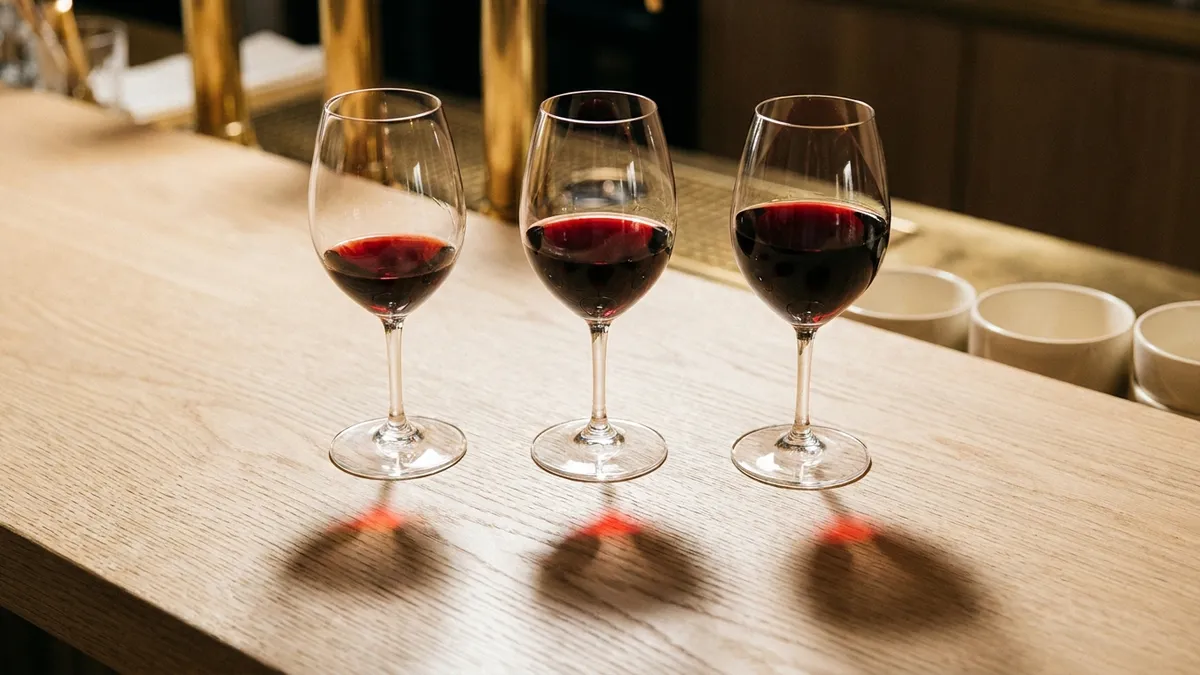
Yes. The gram figure stays fixed, so the volume that delivers it shrinks as ABV rises. One US standard drink is 148 mL of a 12% wine, but only 131 mL at 13.5%, 127 mL at 14% and 118 mL at 15%. A generous-looking pour of a light white and a modest pour of a big red can carry the same alcohol.
Run the formula on a 5 oz pour of a 15% red: 148 mL × 0.15 × 0.789 = 17.5 grams. That is 1.25 US standard drinks in a glass that everyone at the table would call "one." Pour the same 5 oz of an 11% Vinho Verde and you get 12.8 grams, a little under one drink.
The table below does the work for the pours you actually meet. The three metric sizes (125, 175 and 250 mL) are the standard UK glass measures; 150 mL is the US 5 oz pour rounded up by 2 mL. Every cell is US standard drinks, using the 14 g definition.
| Pour | 11.5% ABV | 12% ABV | 13.5% ABV | 14.5% ABV | 15.5% ABV |
|---|---|---|---|---|---|
| 125 mL (UK small) | 0.8 | 0.8 | 1.0 | 1.0 | 1.1 |
| 150 mL (5 oz) | 1.0 | 1.0 | 1.1 | 1.2 | 1.3 |
| 175 mL (UK medium) | 1.1 | 1.2 | 1.3 | 1.4 | 1.5 |
| 250 mL (UK large) | 1.6 | 1.7 | 1.9 | 2.0 | 2.2 |
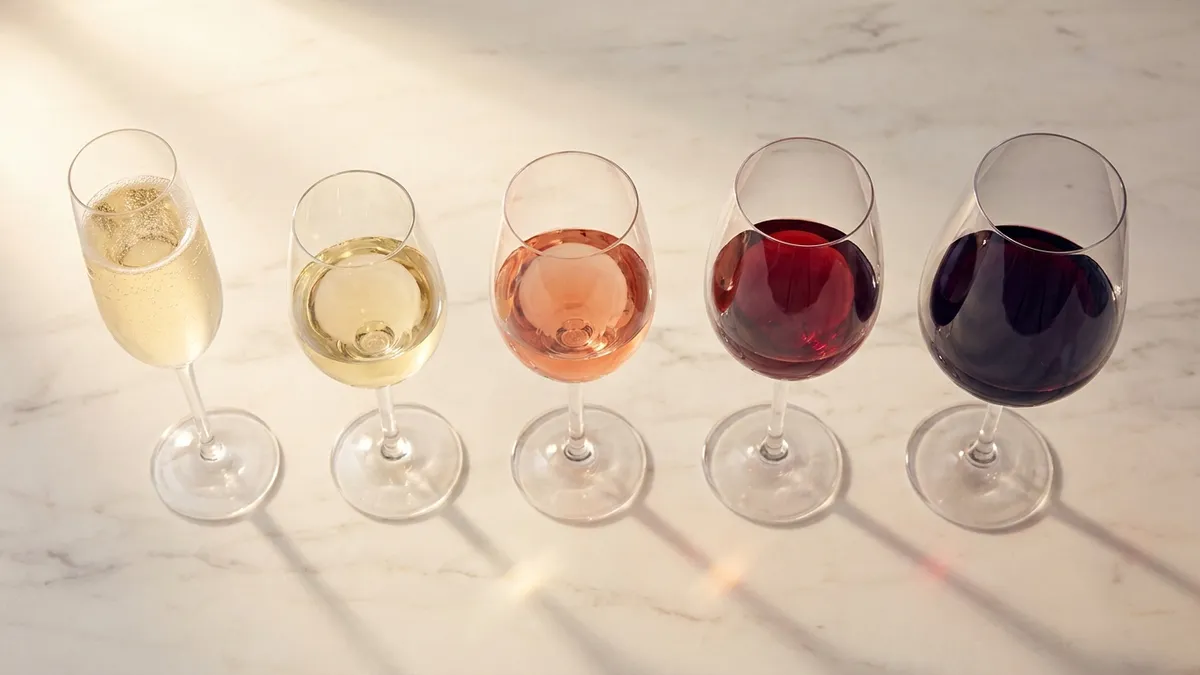
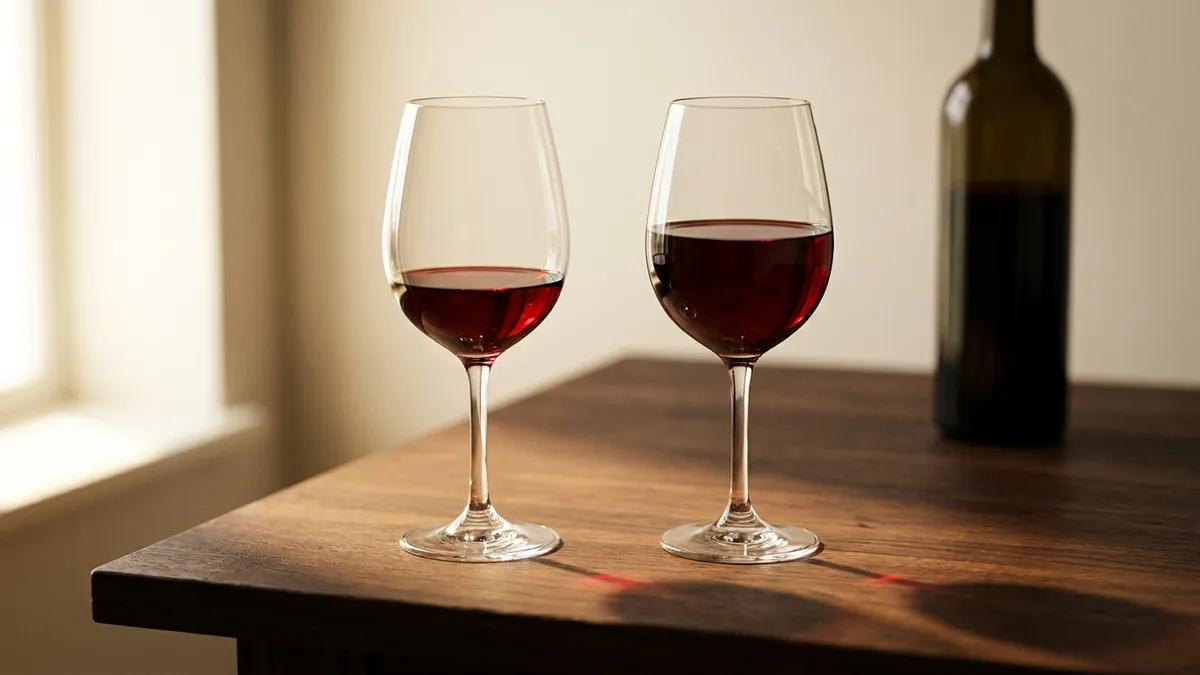
Read it across a row and the ABV effect is gentle but real: a 175 mL glass moves from 1.1 to 1.5 drinks between a light white and a strong red. Read it down a column and the pour effect is bigger: at 13.5%, the difference between a small and a large glass is nearly a full drink. Pour size is the lever most people never touch, and bowl size hides it: our wine glass guide shows how much bigger a modern red-wine bowl is than the pour it usually holds.
How Does a Standard Drink Differ by Country?
There is no international standard drink. Health bodies have picked reference amounts that range from about 8 to 20 grams of pure alcohol, and the four English-speaking countries most likely to be reading this all chose different numbers. The UK unit is 8 g, Australia uses 10 g, Canada 13.45 g and the US 14 g, so one US drink is 1.75 UK units.
| Country | Pure alcohol per standard drink | Wine at 12% ABV that contains it | Official example |
|---|---|---|---|
| United States (NIAAA / CDC) | 14 g (0.6 fl oz) | 148 mL (5 oz) | 5 oz of wine at 12% ABV |
| Canada (Health Canada) | 13.45 g (17.05 mL) | 142 mL (5 oz) | 5 oz / 142 mL of wine at 12% |
| Australia (10 g standard drink) | 10 g (12.7 mL) | 106 mL | 95 mL of red at 13%, 110 mL of white at 11.5% |
| United Kingdom (NHS unit) | 8 g (10 mL) | 83 mL | 125 mL glass at 12% = 1.5 units |
Two things jump out. First, the US and Canadian figures are close enough that both governments use the same 5 oz wine example, and the 4% gap between 14 g and 13.45 g rarely changes a rounded count. Second, the UK unit is nearly half the US drink. A British reader who hears "two drinks" from a US source and pictures two units is picturing 16 grams where the source meant 28, a little over half. The reverse error is just as easy: an American reading a UK figure in units and treating each one as a full drink will overcount by 75%.
Australia's figure, 10 g, deserves a mention because the Australian guidance spells out the consequence plainly: a 150 mL restaurant serve of 13% red is about 1.5 Australian standard drinks, not one. If you are comparing guidance from two countries, convert both to grams first; once everything is in grams, the comparison is a division problem rather than a guess.
How Many Standard Drinks Are in a Bottle of Wine?
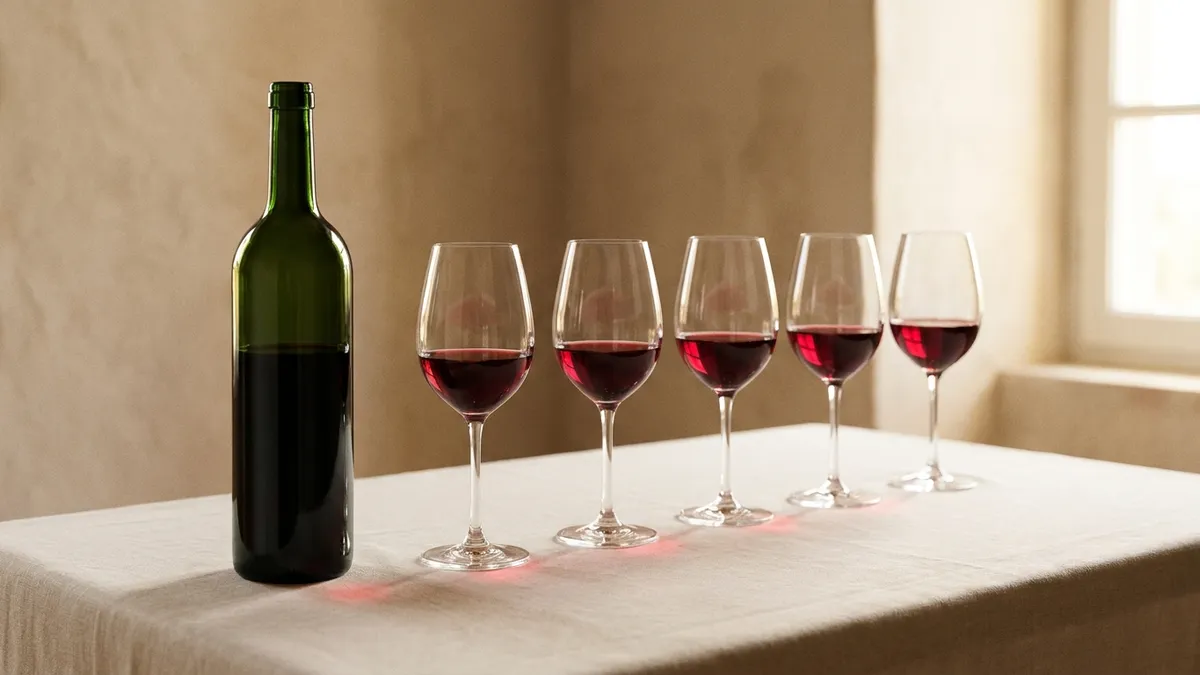
A 750 mL bottle at 12% ABV contains 71 grams of pure alcohol: 5.1 US standard drinks, 9 UK units, 7.1 Australian standard drinks or 5.3 Canadian ones. The bottle holds the same 750 mL whatever the wine, so ABV alone moves the count. At 15%, the same bottle carries 89 grams and 6.3 US drinks.
The full run, using the formula from earlier (750 × ABV × 0.789):
- 11% ABV (a light Riesling or Vinho Verde): 65 g. That is 4.6 US drinks, 8.3 UK units, 6.5 Australian drinks.
- 12% ABV (the textbook number): 71 g. 5.1 US drinks, 9 UK units, 7.1 Australian drinks.
- 13.5% ABV (many European reds and richer whites): 80 g. 5.7 US drinks, 10.1 UK units, 8 Australian drinks. The NHS uses this exact bottle as its example and calls it 10 units.
- 15% ABV (a ripe Zinfandel, Shiraz or Amarone-style red): 89 g. 6.3 US drinks, 11.3 UK units, 8.9 Australian drinks.
So the popular line that "a bottle of wine is five drinks" is right only at 12% with the US definition. It is 5.7 drinks at 13.5% and closer to 6.3 at 15%. For a bottle of 15% red, the count is more than a quarter higher than the rule of thumb. If you like lighter styles, our guide to low-alcohol wines covers the bottom of that list, and calories in wine shows how the same ABV arithmetic drives the calorie count too.
There is a second, sneakier confusion in the "five drinks" line: it mixes up drinks with pours.
Why Is a Restaurant Pour Not Always a Standard Drink?
Because a pour is a serving decision and a standard drink is an alcohol measurement, and the two only line up by coincidence. A US restaurant pour is nominally 5 oz, giving five pours per 750 mL bottle. That equals one standard drink only for a 12% wine. Serve a 14% red in the same glass and each pour is 1.2 drinks.
Wine-service guides describe 5 oz as the standard pour regardless of the wine's color or strength, which is exactly the point: the pour is standardised on volume, not alcohol. Five pours empty the bottle whether the wine is 11% or 15%, so "five glasses per bottle" is a serving fact about volume that tells you nothing about how many standard drinks you are having. The two questions have different answers, and most "how many glasses in a bottle" articles answer only the first one.
The UK makes this visible because pub and restaurant wine is poured in standard measures, most often 125, 175 and 250 mL. Using the NHS formula, at 12% ABV those are 1.5, 2.1 and 3 units. Order the "large" and you have poured yourself three units, or about 1.7 US drinks, before the wine list has even mentioned strength. At 13.5%, the same large glass is 3.4 units.
Home pours drift further than restaurant pours, because nobody at home is measuring, and refills rarely start from empty. Our guide to ordering wine at a restaurant covers the by-the-glass side of the menu; boxes follow the same maths, and the boxed wine guide explains why a 3-litre box is four bottles' worth of pours.
Is a Glass of Wine Really One Drink?
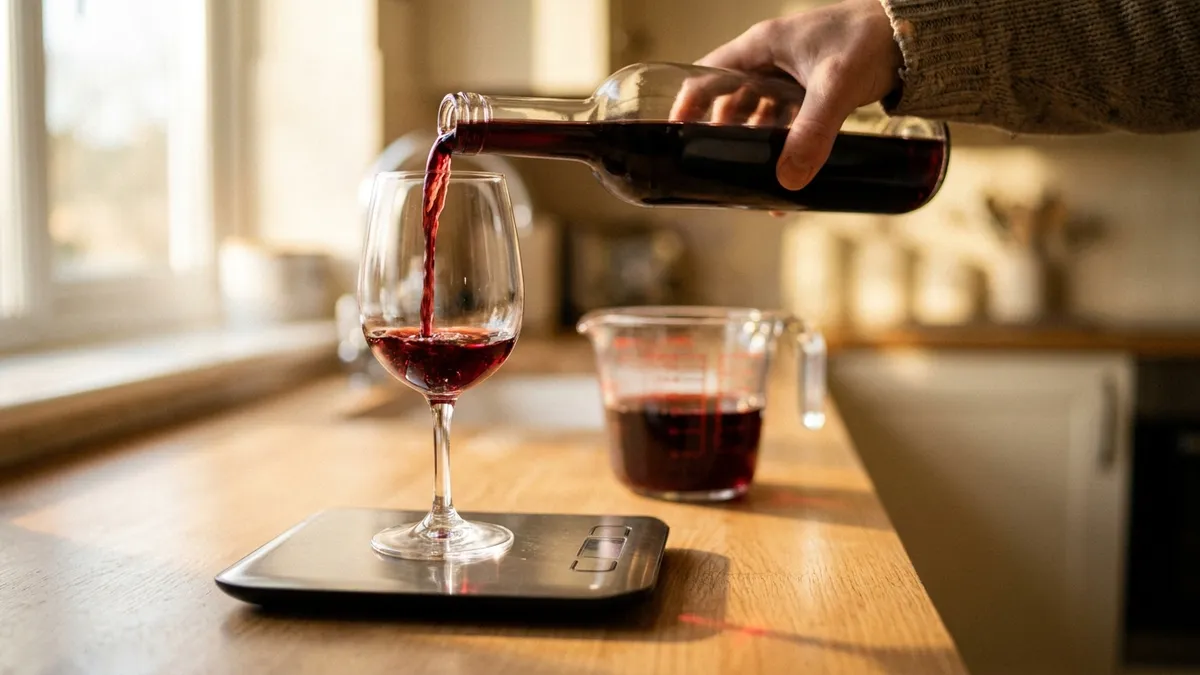
Only when the pour is 5 oz and the wine is 12% ABV, and that combination is rarer than it sounds. A large 250 mL pub glass of a 14% red contains 27.6 grams of pure alcohol, which is 1.97 US standard drinks, 3.5 UK units or 2.8 Australian standard drinks. One glass, two drinks.
Walk that example through the formula step by step, because it is the one worth memorising:
- Volume: 250 mL.
- ABV as a decimal: 14% becomes 0.14. Multiply: 250 × 0.14 = 35 mL of pure alcohol.
- Convert to grams: 35 × 0.789 = 27.6 g.
- Divide by your country's figure: 27.6 ÷ 14 = 1.97 US drinks. Or 27.6 ÷ 8 = 3.5 UK units. Or 27.6 ÷ 10 = 2.8 Australian drinks.
Now the small glass, for contrast. A 125 mL pour of an 11.5% white is 125 × 0.115 × 0.789 = 11.3 g, which is 0.8 of a US drink and 1.4 UK units. Two "glasses" of wine can differ by a factor of two and a half in the alcohol they carry, and nothing about the word "glass" warns you.
How Do You Estimate Standard Drinks From a Wine Label?
The label gives you the ABV and the bottle size, which is everything the formula needs. Multiply the millilitres you pour by the ABV as a decimal, multiply by 0.789, and divide by 14 for US drinks, 8 for UK units or 10 for Australian drinks. A 150 mL pour of a 13.5% wine is 150 × 0.135 × 0.789, about 16 g, or 1.1 US drinks.
A few label habits make this faster:
- Find the ABV first. It is required on the label in most markets, usually in small print near the volume statement. Our guide to how to read a wine label shows where each country tucks it.
- Treat the printed figure as approximate. Labelling rules allow the stated ABV a small tolerance either way, so read 13.5% as "around 13.5%" and round your count up rather than down.
- Remember the volume shortcuts. At 12%, 148 mL is one US drink and 83 mL is one UK unit. At 14%, those fall to 127 mL and 71 mL.
- Use the bottle as a sanity check. A 750 mL bottle divided by the mL-per-drink figure gives drinks per bottle. At 14%, 750 ÷ 127 is 5.9 US drinks.
None of this requires you to change what you drink. It only asks you to count what you already pour in the same units the official guidance uses, so that when you do read a guideline, the numbers on both sides mean the same thing.
If you want the counting to become automatic, practice is the fastest route. Sommy's bite-sized Wine 101 course explains ABV and body in plain language, and the AI-guided tasting mode lets you photograph a label, walk through look, smell and taste, and keep your notes in a tasting journal. You can start at sommy.wine, and the arithmetic in this article will feel like second nature after a few bottles.
Sources
Frequently Asked Questions
How many ounces is a standard drink of wine?
In the United States, a standard drink of wine is 5 fluid ounces (about 148 mL) at 12% alcohol by volume, which delivers roughly 14 grams of pure alcohol. That figure only holds at 12%. At 14% ABV, one US standard drink shrinks to about 4.3 ounces (127 mL), and at 15% it is closer to 4 ounces (118 mL).
How many standard drinks are in a bottle of wine?
A 750 mL bottle at 12% ABV holds about 71 grams of pure alcohol, which is 5.1 US standard drinks, 9 UK units, 7.1 Australian standard drinks or 5.3 Canadian standard drinks. At 15% ABV the same bottle rises to about 89 grams: 6.3 US drinks, 11.3 UK units and 8.9 Australian standard drinks. The bottle does not change; the ABV does the work.
How many units are in a glass of wine in the UK?
The NHS defines one unit as 10 mL or 8 grams of pure alcohol, and gives the formula ABV multiplied by volume in mL, divided by 1,000. At 12% ABV that makes a small 125 mL glass 1.5 units, a medium 175 mL glass 2.1 units and a large 250 mL glass 3 units. A 750 mL bottle at 13.5% ABV contains 10 units.
Is a glass of wine one standard drink?
Only when the pour is 5 oz and the wine is 12% ABV. Most glasses miss on one or both counts. A large 250 mL pub glass of 14% red works out to about 27.6 grams of alcohol, which is nearly two US standard drinks or 3.5 UK units. Treat the glass as a container and count the alcohol inside it instead.
Why does the standard drink size differ between countries?
Each country's health body picked its own reference amount of pure alcohol, and those definitions range from about 8 to 20 grams. The UK unit is 8 g, Australia uses 10 g, Canada 13.45 g and the US 14 g. So a US standard drink contains 75% more alcohol than a UK unit, which matters whenever you read one country's guidance with another country's numbers in mind.
How do you calculate standard drinks from a wine label?
Take the volume you are pouring in millilitres, multiply by the ABV as a decimal, then multiply by 0.789, the density of ethanol in grams per millilitre. That gives grams of pure alcohol. Divide by your country's standard-drink figure: 14 for the US, 8 for a UK unit, 10 for Australia. A 150 mL pour at 13.5% is 150 × 0.135 × 0.789, about 16 g, or 1.1 US drinks.
Does a restaurant pour count as one drink?
Not reliably. A US restaurant pour is nominally 5 oz, and five pours empty a 750 mL bottle, but that equals one standard drink only at 12% ABV. Many reds sit at 13.5% to 15%, so the same pour is 1.1 to 1.25 US drinks. UK measures of 175 mL and 250 mL are larger still: 2.1 and 3 units at 12%, and more at higher strengths.
Sommy Team
LinkedInFounder & Wine Educator
The Sommy Team is building the world's most approachable wine education app, helping beginners develop real tasting skills through structured courses and AI-guided practice.