How to Order Wine at a Restaurant Without the Anxiety

By the Sommy Team — AI-assisted, human-edited.
Updated Apr 29, 2026
Contents (14)
- TLDR
- How to Order Wine at a Restaurant, in 90 Seconds
- The Truth Nobody Tells Beginners
- The Three-Step Script That Always Works
- The Price-Pointing Trick
- Wine List Anatomy
- The Mark-Up Reality
- Pairing Fundamentals (Don't Memorize, Just Know the Rules)
- When to Order by the Glass vs. the Bottle
- The Tasting Ritual, Decoded
- "I'm New" Is a Power Move
- BYOB, Tipping, and Pacing
- The Confidence-Building Habit
- The Bottom Line
TL;DR
Ordering wine at a restaurant is not a memory test. Tell the sommelier your price ceiling, what you are eating, and what you tend to like. They do the rest. The wine list anatomy, the price-pointing trick, and a handful of pairing rules cover ninety percent of dinners. Confidence is procedure, not knowledge.
TLDR
Ordering wine at a restaurant is not a memory test. Tell the sommelier your price ceiling, what you are eating, and what you tend to like. They do the rest. The wine list anatomy, the price-pointing trick, and a handful of pairing rules cover ninety percent of dinners. Confidence is procedure, not knowledge.
How to Order Wine at a Restaurant, in 90 Seconds
Knowing how to order wine at a restaurant comes down to a three-line script the sommelier has heard a thousand times. Tell them your price ceiling — point to a number on the list rather than saying it out loud. Tell them what the table is eating, especially the heaviest dish. Tell them one preference: "crisp whites" or "smooth reds" or "something funky" or simply "not too sweet." A trained sommelier will return with two or three options at your price, and you pick by gut. That is the entire ritual when you order wine at a restaurant. Everything else in this guide is detail for when you want to do it slightly better.
The Truth Nobody Tells Beginners
Nobody knows every wine on every list. Not the regulars at the next table, and not even most sommeliers when they walk into a venue they did not curate themselves. A serious restaurant carries between eighty and four hundred bottles, and even the people who picked the list work by category and region rather than by memory. It helps to remember what a sommelier is: a trained guide whose whole job is narrowing that list for you, not a judge waiting for you to slip up.
The anxiety beginners feel at the table is rational — the wine list looks like a pop quiz nobody studied for. But the people who order wine confidently are not winning at memory. They are winning at procedure.

The Three-Step Script That Always Works
Every confident wine order at a restaurant comes down to three sentences delivered to the sommelier. Memorize the script and the rest is staffwork.
Step 1 — Your price ceiling
The single most useful move is to give the sommelier a number before they bring options. They are happy to recommend at any price; they cannot read your mind. Either say a range — "we are thinking around forty-five to sixty dollars" — or use the price-pointing trick below.
If you skip this step, the sommelier defaults to a mid-list bottle that may or may not match your comfort. Naming the budget removes guesswork on both sides.
Step 2 — What the table is eating
If your group has ordered, tell the sommelier the dishes — especially the heaviest one. A bottle for two diners eating steak and a salmon fillet should match the steak; the salmon will survive a medium red, and the steak will not survive a Sauvignon Blanc.
If the table has not ordered yet, describe the meal briefly: "we are thinking surf-and-turf" or "lots of pasta, mostly tomato-based." That is enough for a useful pairing call.
Step 3 — One preference (or one anti-preference)
Tell the sommelier what you tend to gravitate toward, even loosely. "Crisp whites." "Smooth reds." "Something earthy." Or invert it: "not too sweet" or "not too oaky."
One preference is plenty. The sommelier translates it into specific suggestions on the spot. If you genuinely do not know what you like, say "I am still learning, surprise me within budget" and watch them light up.
The full delivery, in real life, is a single sentence: "We are around fifty dollars, two of us are eating steak, and I tend to like smooth reds — what would you suggest?"
The Price-Pointing Trick
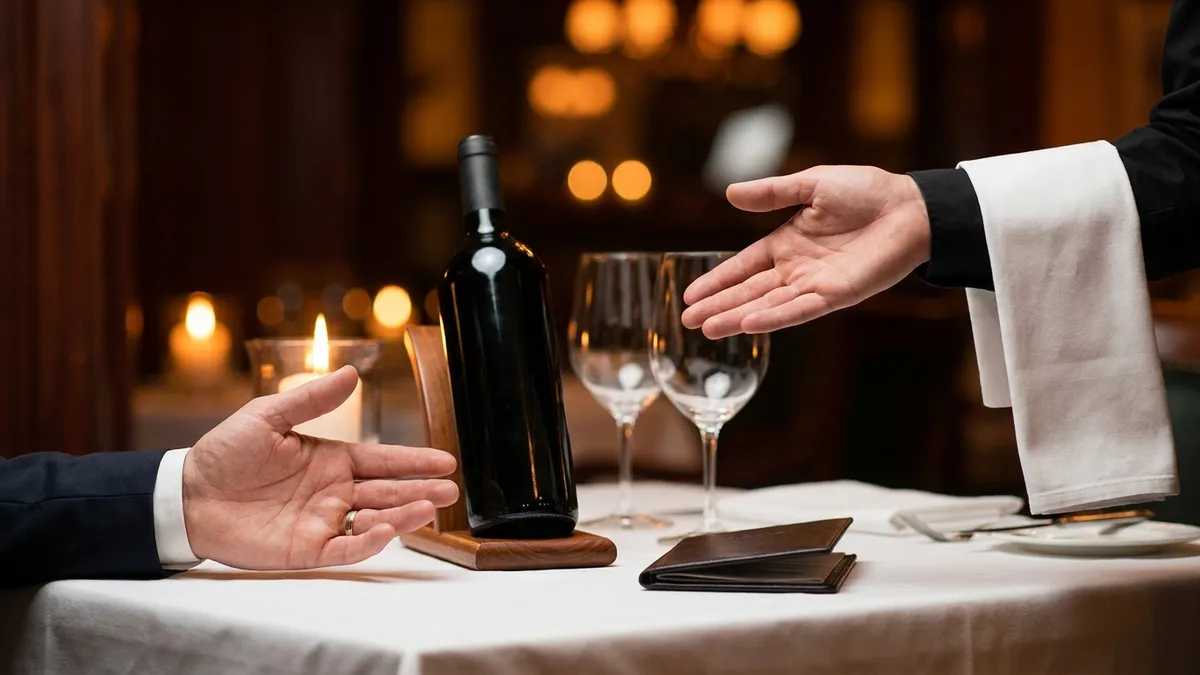
Saying a number out loud at a table can feel awkward — especially with dates, guests, or in-laws across from you. The fix is silent.
When the sommelier hands you the wine list, scan it briefly and tap a bottle priced where you are comfortable. Look up and say "something around here, please." That is it.
The sommelier reads the gesture instantly. They will recommend wines at or below the price you tapped. The table never hears the number, and the sommelier has exactly the data they need. A variation: "a Rioja around this range" works the same way.
Wine List Anatomy
Most restaurant wine lists are organized in one of two ways. Knowing which one you are looking at cuts the time-to-decision in half.
By style or mood
A modern, accessible list is often grouped by mood: "Crisp & Mineral Whites," "Bold Reds," "Skin-Contact and Funky." This style is reader-friendly and rewards quick scanning. You decide what you want and read the small section that matches.
By region or hierarchy
A traditional list is organized by country or region, then by sub-region or producer. France splits into Burgundy, Bordeaux, Rhône, Loire. Italy splits into Piedmont, Tuscany, Veneto. Reading this list requires either knowing the regions or asking for help — which the staff is paid to provide.
A few region-to-grape shortcuts cover most of what you will see:
- Sancerre or Pouilly-Fumé = Sauvignon Blanc
- Chablis = unoaked Chardonnay
- Burgundy red = Pinot Noir
- Beaujolais = Gamay
- Côtes du Rhône = Grenache-Syrah blend
- Rioja = Tempranillo (usually)
- Chianti = Sangiovese
- Barolo or Barbaresco = Nebbiolo
If you know the grape you tend to like, the region tells you what is on offer. Our Cabernet Sauvignon vs Merlot and Chardonnay vs Sauvignon Blanc comparisons are useful when you want to translate a label into a flavor profile in real time.
The four sub-lists you usually see
- By the glass — typically four to ten options, refreshed often, the lower end of the cellar
- By the bottle — the main list, by far the best value per ounce
- Half-bottles — split-the-difference for two diners with different tastes
- Reserve or cellar list — older, premium, higher mark-up, often a separate book
A bottle is roughly five glasses. Two diners drinking through dinner can comfortably split one bottle. A table of four needs two.
The Mark-Up Reality
Restaurants charge between two-and-a-half and three-and-a-half times wholesale on most bottles. A wine that retails at twenty-five dollars in a shop sits at sixty to ninety dollars on a serious list. The cellar, the staff, the glassware, and loss-of-pour on faulty bottles are all built in. Our guide to wine markup at restaurants follows one bottle from the winery to the list and shows how to check a price at the table.
Wine is actually one of the lower-margin categories on most menus — cocktails routinely carry mark-ups of four to six times cost per ounce. The practical takeaway: spend slightly above the cheapest bottle. The cheapest wine carries the highest percentage mark-up because the restaurant has to clear a minimum margin per pour. Moving up ten or fifteen dollars often gets you a meaningfully better bottle for a smaller relative jump in absolute price.
Pairing Fundamentals (Don't Memorize, Just Know the Rules)
The single most useful pairing rule is match the weight of the wine to the weight of the dish. Light food, light wine. Heavy food, heavy wine. The rule is not perfect, but it covers eighty percent of dinner choices and is the only rule worth remembering by heart.
A short cheat sheet for the rest:
- Light fish or seafood — crisp white (Sauvignon Blanc, Albariño, Pinot Grigio)
- Rich fish (salmon, tuna) — white with body or light red (oaked Chardonnay, Pinot Noir)
- Chicken — depends on the prep; roast chicken loves Chardonnay or Pinot Noir, fried chicken loves bubbles
- Pork — medium reds or off-dry whites (Riesling, Pinot Noir, Grenache)
- Beef — bold reds (Cabernet Sauvignon, Syrah, Malbec)
- Lamb — medium-bold reds with a herbal note (Bordeaux, Rhône, Chianti Classico)
- Spicy food — aromatic off-dry whites (Riesling, Gewürztraminer)
- Hard cheese — bold reds; soft cheese — bubbles or sweet whites
- Dessert — sweet wines that match or exceed the dessert's sweetness (Sauternes, Tawny Port, Vin Santo)
Our wine pairing rules guide breaks this down into a longer reference, and the dish-specific guides for wine with steak, wine with chicken, wine with seafood, and wine with spicy food cover the most-asked combinations in detail. The Sommy app's pairing module quizzes you on these combinations until they stop feeling like memorization.

When to Order by the Glass vs. the Bottle
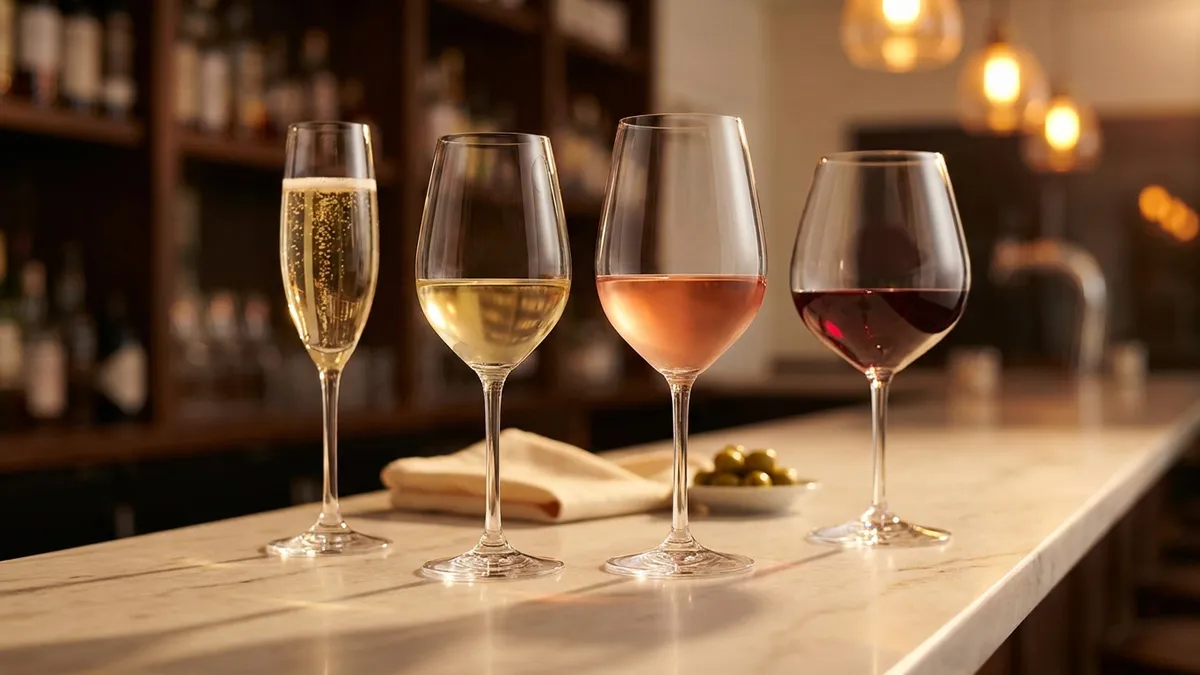
By-the-glass is the right move when the table has ordered widely different proteins, you are dining alone, you want to taste two or three different wines across a meal, or you are unsure what you like and want a low-commitment experiment. Flights and half bottles sit between the two, and wine list types explained shows when each one fits the table.
By-the-bottle is the right move when two or more people will drink the same style, total consumption is likely to exceed three glasses combined (a bottle is cheaper than four glasses almost everywhere), or you want to watch the same wine open across courses.
Half-bottles are a useful middle ground when two diners want different wines without the cost of two full bottles.
The Tasting Ritual, Decoded
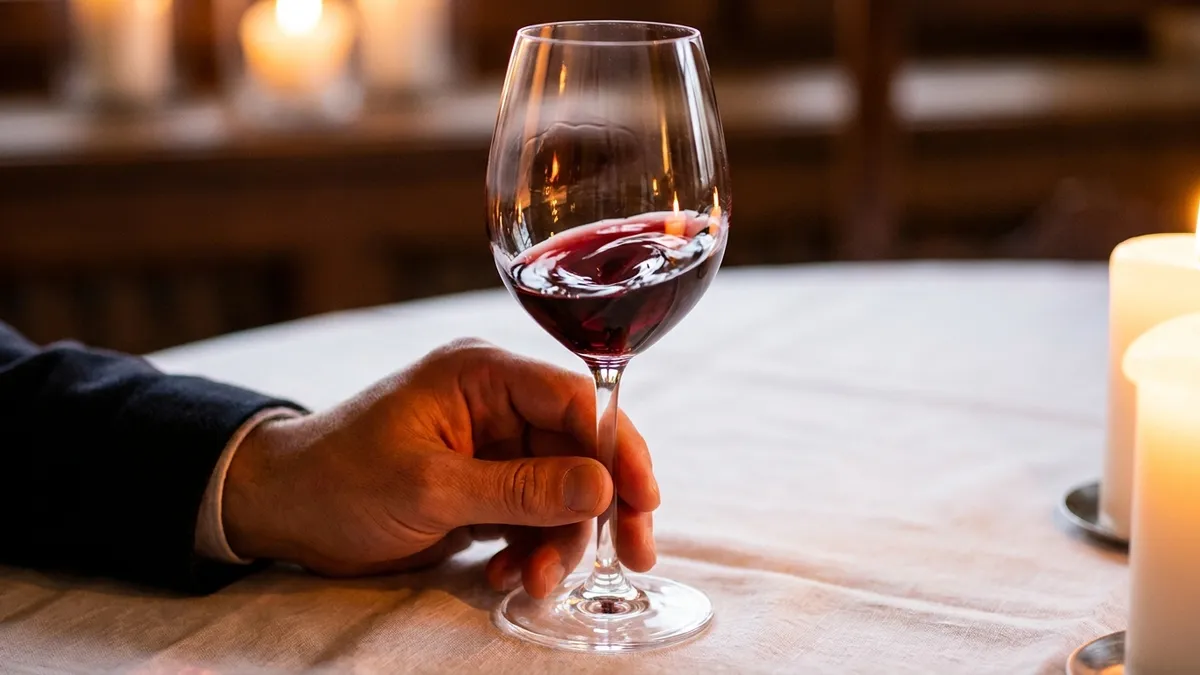
Once the bottle arrives, the sommelier presents the label, opens the wine, and pours a small amount into the host's glass. This is the moment most beginners freeze. The ritual is simpler than it looks.
The taste at the table is for fault detection, not preference confirmation. The question is not "do I like this wine?" — it is "is this wine clean?"
Run the small pour through three quick checks:
- Glance at the label — confirm it is what you ordered (vintage, producer, varietal)
- Smell first for ten seconds — fault-check the wine for cork taint (musty wet cardboard), oxidation (sherry-like, flat), or cooked-wine character (stewed, dull)
- Sip briefly — confirm flavor matches the nose; nothing alarming on the palate
If the wine is clean, nod or say "thank you, that's lovely." If you genuinely cannot tell — and most beginners cannot, fault detection takes practice — a polite "yes, thank you" is the safe default. A flawed wine is usually obvious; a wine you simply do not love is yours to drink.
If the wine is faulty, say so calmly: "I think this might be corked — would you take a look?" The sommelier will smell it, agree or disagree, and either replace the bottle or pour from a fresh one. No drama. Faulty bottles are a normal cost of the wine business and restaurants budget for replacements. Our how to taste wine like a sommelier walk-through covers the full sensory check, and how to describe wine gives you the vocabulary if you want to articulate what you are smelling.
"I'm New" Is a Power Move
The single best opener with a sommelier is honesty. "I am still learning, what would you recommend?" or "I do not know much about wine yet, but I tend to like X — what would pair with this dish?"
Sommeliers love these conversations. Most fell into the profession because someone helped them when they were beginners. They would much rather guide a curious new drinker to a good bottle than watch a guest order badly out of pride. The conversation also shifts the dynamic — you are no longer being tested, you are being taught.
BYOB, Tipping, and Pacing
Corkage — many restaurants allow you to bring your own wine for a corkage fee, typically twenty to forty dollars per bottle at mid-range venues, sometimes higher elsewhere. Always ask in advance. Two etiquette rules: do not bring something the restaurant already sells, and bring something better or more interesting than the equivalent price point on the list.
Tipping — tip on the total bill (including wine) at the standard eighteen to twenty-two percent. The wine mark-up is already factored in, so the percentage handles the math. A separate cash thank-you for an exceptional pairing is appreciated at high-end venues but not expected.
Pacing — a bottle is roughly twenty-five ounces, or five tasting-sized pours. Two diners across a three-course meal finish a bottle comfortably in ninety minutes. Sommeliers pour smaller measures than home pours on purpose — three to four ounces — to keep the wine cool and let it evolve across courses.
The Confidence-Building Habit
The best move as a beginner is to spend two minutes scanning the wine list before guests arrive. Identify three by-the-glass options at a comfortable price. Identify one bottle you would order under any circumstance. That is your safety net.
When the conversation turns to wine, you have already done the work. The two minutes of pre-reading converts what felt like a quiz into something closer to a menu. Over time, the habit compounds — you start recognizing producers, regions, and vintages across cities, and wine lists stop looking like obstacles.
The Sommy app builds the same habit with structured tasting reps. Every wine you log gets categorized by region, grape, and structure, and the app surfaces patterns in your own preferences over time. You arrive at the table with a real read on what you actually like rather than a polite guess.
Our wine glass guide, wine tasting etiquette, and develop your wine palate walk-throughs cover the supporting habits. The wine tasting vocabulary cheat sheet and how to decant wine primers fill in the gaps when you want to talk shop rather than just take a suggestion.
The Bottom Line
Ordering wine at a restaurant is a procedure, not a memory test. Three sentences to the sommelier — your price, your dish, your preference — solve ninety percent of dinners. The price-pointing trick handles the awkwardness of saying a number out loud. The wine list anatomy and a handful of pairing rules handle the rest.
Confidence at the table is not about knowing every bottle on the list. It is about knowing the script, trusting the staff, and letting the sommelier do the job they trained for. Want a structured way to build the underlying palate? The Sommy app and our beginners-buying learning track walk through the foundations — pairing logic, label reading, structure, and the procedural habits that turn restaurant wine lists from puzzles into menus.
Frequently Asked Questions
How do I order wine at a restaurant if I do not know any wines?
Tell the sommelier three things — your price ceiling, what you are eating, and one preference like crisp whites or smooth reds. Most restaurants train staff to handle exactly this conversation. Saying 'I am still learning, what would you recommend' opens the door rather than closing it. Sommeliers prefer beginners who are honest over guests who pretend expertise and order badly.
What is the price-pointing trick for ordering wine?
Tap a price on the wine list rather than saying a number out loud. Point to a bottle priced where you are comfortable spending and say 'something around here, please.' The sommelier reads the gesture instantly and recommends wines at or below that mark. The trick keeps the table from hearing your budget and removes the awkwardness of negotiating value in front of guests.
How much does a restaurant mark up wine?
Most restaurants charge two-and-a-half to three-and-a-half times wholesale. A bottle priced at forty dollars on a list typically costs the restaurant twelve to sixteen dollars. The mark-up is real but not extreme — wine is one of the lower-margin categories on most menus, with cocktails carrying significantly higher mark-ups per ounce. Paying for the cellar, the staff, and the glassware is built into the price.
Should I let the sommelier choose the wine for me?
Often yes. Sommeliers know their list inside out, taste through it weekly, and know which bottles drink above their price. Giving them a budget, a dish, and a preference is faster than guessing from a list you have never seen. The exception is when you already know what you want — in that case, order it and skip the consultation. Sommeliers respect both moves equally.
What if I do not like the wine after I taste it?
If the wine is faulty — corked, oxidized, cooked — send it back and the restaurant replaces it without question. If the wine is sound but not to your taste, the answer depends on the venue. Many high-end restaurants will quietly swap it; most casual places will not. The taste at the table is for fault detection, not preference confirmation. Order conservatively when you are unsure.
Is it acceptable to order wine by the glass at a nice restaurant?
Yes, especially if your group is small or eats different proteins. By-the-glass lists are designed for exactly that flexibility. They cost more per ounce than a bottle but let two diners pair separately. The trade-off is range — by-the-glass lists are typically four to eight wines compared to dozens or hundreds by the bottle. Order by the bottle when the table aligns on a style, by the glass when it does not.
Do I tip the sommelier separately?
Usually no. Standard tipping practice at most restaurants is eighteen to twenty-two percent on the total bill, including wine, and the staff splits according to the house policy. Some high-end venues with a dedicated sommelier appreciate a separate cash thank-you for an exceptional pairing recommendation, but the standard tip already accounts for their work. Tip well on the total and the math takes care of itself.
What is the simplest pairing rule when ordering wine?
Match the weight of the wine to the weight of the dish. Light food calls for light wine, heavy food for heavy wine. A delicate fish wants a crisp white; a steak wants a bold red. The rule is not perfect but it covers most of the table most of the time. Match the heaviest dish at the table when ordering one bottle for several diners.
Sommy Team
LinkedInFounder & Wine Educator
The Sommy Team is building the world's most approachable wine education app, helping beginners develop real tasting skills through structured courses and AI-guided practice.