5 Wine Pairing Rules That Actually Work (and 3 to Ignore)

By the Sommy Team — AI-assisted, human-edited.
Updated Apr 16, 2026
Contents (5)
TL;DR
Five wine pairing rules work reliably: match weight, match sweetness, use acidity to cut richness, pair regional wines with regional food, and match the sauce not the protein. Three rules to ignore: red with meat/white with fish (oversimplified), never mix colors at dinner (unnecessary), and expensive wine pairs better (false).
Wine Pairing Rules: What Works and What Does Not
The internet is full of wine pairing rules. Some are genuinely useful — principles that professional sommeliers rely on every day. Others are outdated oversimplifications that sound authoritative but lead you to worse pairings, not better ones.
The challenge for anyone learning about wine is figuring out which rules deserve your attention and which ones you can safely ignore. This guide separates the signal from the noise: five wine pairing rules that actually work in practice, and three popular rules that you should stop following.
The 5 Wine Pairing Rules That Work
Rule 1: Match the Weight
This is the single most important pairing principle, and it is the one that professional sommeliers check first. Body (or weight) refers to how heavy or light a wine feels in your mouth — think of the difference between skim milk and whole cream.
Match the wine's body to the dish's richness:
- Light dish + light wine — poached fish with Pinot Grigio
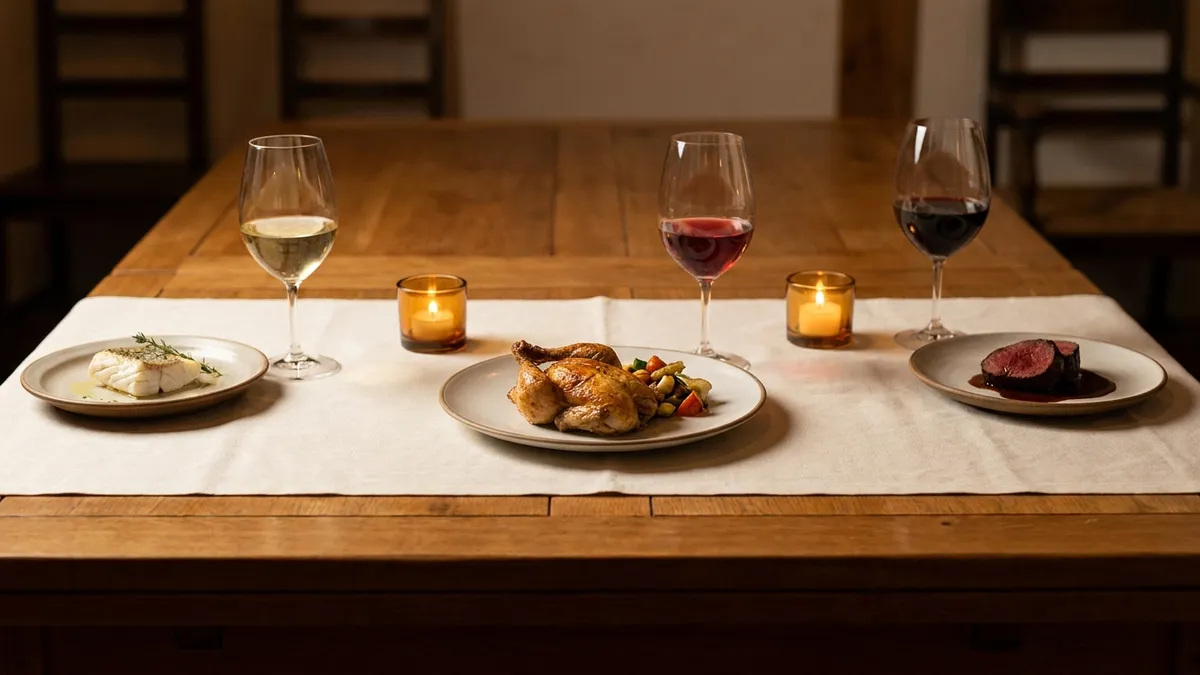
- Medium dish + medium wine — roast chicken with Chardonnay or Pinot Noir
- Rich dish + full wine — braised short ribs with Cabernet Sauvignon
When the weights are mismatched, one overwhelms the other. A delicate Muscadet next to a beef stew disappears entirely — you taste only the food. A massive Barossa Shiraz alongside a light salad overpowers every flavor on the plate.
Body in wine comes from alcohol, tannin, residual sugar, and extract. Body in food comes from fat, protein density, sauce richness, and cooking method. A grilled chicken breast is medium-weight. The same chicken in a cream sauce becomes heavy. Adjust the wine accordingly.
Our wine and food pairing guide covers this principle in depth, including how to gauge body in both wine and food.
Rule 2: The Wine Must Be at Least as Sweet as the Food
This rule protects you from one of the worst pairing experiences: biting into something sweet and then sipping a dry wine. The wine instantly tastes sour, bitter, and stripped of fruit. The sweetness in the food resets your palate, and the dry wine cannot recover.
This matters most with:
- Desserts — always pair with a wine sweeter than the dish (Port with chocolate, Sauternes with fruit tart)
- Dishes with sweet elements — teriyaki, honey glaze, BBQ sauce, sweet-and-sour preparations
- Spicy food — capsaicin amplifies alcohol's burn, so off-dry wines with residual sugar cool the heat
The fix is simple: when the food has significant sweetness or spice, reach for a wine with residual sugar (the natural grape sugar remaining after fermentation). German Riesling, Moscato, Gewurztraminer, and demi-sec Champagne are reliable choices.
Understanding how tannins, acidity, and body interact with different foods is the foundation for applying this rule intuitively.
Rule 3: Use Acidity as a Palate Cleanser
Acidity (the tart, mouth-watering quality in wine) is the most underappreciated tool in pairing. A wine with good acidity acts like a squeeze of lemon on rich food — it cuts through fat, refreshes your palate, and prevents rich dishes from feeling monotonous.
This is why:
- Champagne works with fried food — the bubbles and acid scrub the oil from your palate
- Sauvignon Blanc works with goat cheese — the acid cuts through the richness
- Chianti works with tomato pasta — the wine's acidity matches the tomato's acidity
- Riesling works with pork belly — the acid cuts through the rendered fat
When pairing with rich, fatty, or creamy dishes, prioritize wines with high acidity over wines with high fruit or oak. A lean, acid-driven Chablis handles buttered lobster better than a rich, oaky California Chardonnay — even though both are Chardonnay. The wine with lobster guide applies the same logic to steamed, grilled and butter-poached lobster.
Sommelier tip: If a dish has a squeeze of lemon or a splash of vinegar in its recipe, it almost certainly pairs well with a high-acid wine. The acid in the food bridges to the acid in the wine.
Rule 4: What Grows Together Goes Together
Regional pairing is the oldest and most intuitive wine pairing rule. Wines and foods that evolved in the same region over centuries tend to be natural partners. No one designed these pairings — they emerged organically from local agriculture and culinary tradition.
Classic examples:
- Muscadet (Loire Valley) with Atlantic oysters
- Chianti (Tuscany) with tomato-based pasta
- Albarino (Galicia) with grilled seafood
- Rioja (Spain) with lamb and chorizo
- Gruner Veltliner (Austria) with schnitzel
This rule works because regional cuisines developed around the ingredients and flavors that their local wines complement. The same soil, climate, and culinary culture shaped both what grew in the vineyards and what appeared on the table.
When you are unsure what to pair, start by matching the wine's region to the food's origin. Italian wine with Italian food, French wine with French food, Spanish wine with Spanish food. It is not a universal solution, but it provides a remarkably high success rate as a starting point.
Rule 5: Match the Sauce, Not the Protein
This is the rule that separates beginners from intermediate wine enthusiasts. When a dish has a prominent sauce, the sauce drives the pairing — not the meat, fish, or vegetable beneath it.
Consider chicken prepared three ways:
- Chicken in lemon butter sauce — pair with the lemon butter (Chablis, Sauvignon Blanc)
- Chicken in red wine reduction — pair with the red wine sauce (serve the same grape)
- Chicken in coconut curry — pair with the coconut and spice (off-dry Riesling, Gewurztraminer)
The chicken is the same protein in all three dishes, but the wine should be completely different each time. The sauce is the dominant flavor, and the wine must complement or contrast with the sauce's weight, acidity, and flavor profile.
This rule also explains why grilled foods are so easy to pair — with no sauce, you are matching the protein directly, plus the char and smoke from the grill. The Sommy app includes pairing exercises that train you to identify which element of a dish is driving the flavor — a skill that makes this rule second nature.
The 3 Wine Pairing Rules to Ignore
Bad Rule 1: "Red Wine with Meat, White Wine with Fish"
This is the most famous wine pairing rule, and it is the most misleading. It captures a grain of truth — tannic reds often complement red meat, and crisp whites often complement delicate fish — but it dramatically oversimplifies reality and leads to worse pairings.
Why it fails:
- Salmon pairs beautifully with Pinot Noir (a red), at least when grilled (see wine with salmon)
- Chicken is often better with white wine than red
- Pork pairs with everything from Riesling to Syrah depending on preparation
- Tuna steak (seared rare) handles red wine as well as any beef cut
- Mushroom dishes are natural partners for earthy reds, even when vegetarian (see wine pairing for vegetarian food)
The rule also ignores preparation entirely. A piece of cod in a red wine and shallot reduction needs red wine. A beef carpaccio might pair better with a crisp white or rose than a tannic red.
What to do instead: Match weight and sauce (Rules 1 and 5). A light preparation needs a light wine, regardless of whether the protein is meat or fish. A rich preparation needs a rich wine, regardless of color.
Bad Rule 2: "Never Mix Red and White at a Dinner Party"
This rule suggests that you should serve only one color of wine throughout a multi-course meal. It sounds sophisticated but actually prevents you from creating great pairings.
A well-planned dinner should shift wines course by course:
- Appetizer — Champagne or light white
- Salad course — Sauvignon Blanc or dry rose
- Main course — whatever matches the dish (could be white, red, or rose)
- Cheese — could go red or white depending on the cheese
- Dessert — sweet wine (any color)
Serving only red wine through all these courses means you are badly pairing at least three of them. Sommeliers build wine progressions that move through colors, body levels, and sweetness levels — matching each course individually rather than picking one wine for the whole meal. The wine serving order at dinner lays out that progression course by course.
Bad Rule 3: "Expensive Wine Pairs Better"
Price and pairing suitability have almost no correlation. An eight-dollar Vinho Verde pairs better with grilled sardines than a hundred-dollar Napa Cabernet. A fifteen-dollar German Riesling Kabinett handles Thai green curry better than any Burgundy Grand Cru.
Pairing is about structural compatibility — weight, acidity, sweetness, and tannin — not about quality or price. A well-made, inexpensive wine with the right structure will always outperform an expensive wine with the wrong structure.
In fact, many of the world's best food wines are modestly priced because they come from regions that historically produced wine specifically for the table rather than for cellaring or collection. Muscadet, Vinho Verde, Beaujolais, Cotes du Rhone, and basic Chianti are all under twenty dollars and pair with food better than wines ten times their price.
Putting the Rules Together
The five good rules work together as a decision framework:
- Check weight first — is the dish light, medium, or heavy? Match the wine.
- Check sweetness — is the food sweet or spicy? If yes, choose an off-dry wine.
- Check richness — is the dish fatty or creamy? If yes, prioritize acidity.
- Check origin — is the dish from a specific wine-producing region? Start there.
- Check the sauce — is there a dominant sauce? Match the wine to the sauce, not the protein.
You do not need to run all five checks for every meal. Often, one or two will give you a clear answer. The value is in having a structured approach rather than guessing or falling back on outdated rules.
The Comfort of "Good Enough"
Here is the most liberating truth about wine pairing: most combinations are fine. A truly bad pairing — one where both the wine and the food taste worse — requires a significant structural mismatch. Tannic red with spicy food. Dry wine with sweet dessert. Full-bodied red with delicate raw fish.
Everything else falls on a spectrum from "perfectly fine" to "transcendent." The five rules above help you move from "fine" toward "great," but they should never make you anxious about choosing the wrong wine. If you enjoy the wine and you enjoy the food, you have not made a mistake.
The Sommy app builds pairing confidence by training the underlying skills — identifying acidity, body, tannin, and sweetness in wine — so you can make these assessments instinctively rather than looking up rules every time. Once you can taste the structure of a wine, matching it to food becomes a natural extension of what your palate already knows.
For more detailed guidance on specific pairings, our wine and cheese pairing guide and comprehensive food pairing guide cover dozens of specific combinations with the principles explained here.
Frequently Asked Questions
What is the most important wine pairing rule?
Match the weight of the wine to the weight of the dish. A light wine with light food, a full-bodied wine with rich food. This single principle prevents more pairing mistakes than any other rule and works across every cuisine and occasion.
Is the red wine with meat rule true?
It is a useful starting point but far too rigid. Many meats pair better with white wines — chicken with Chardonnay, pork with Riesling, salmon with Pinot Noir. The rule ignores preparation and sauce, which matter more than the protein itself.
Do you have to match wine to food?
No. Drinking whatever wine you enjoy with whatever food you are eating is perfectly valid. Pairing rules help you find combinations where both the wine and the food taste better together, but they are guidelines for exploration, not laws you must follow.
What is a bridge ingredient in wine pairing?
A bridge ingredient is a component in the dish that shares a flavor characteristic with the wine, creating a connection between the two. Herbs, spices, citrus, or a splash of wine in the sauce can all serve as bridges that make pairings feel more harmonious.
Should you spend more on wine for pairing?
No. Price does not determine pairing success. An eight-dollar off-dry Riesling pairs better with Thai green curry than a hundred-dollar Napa Cabernet. The right structural match always beats price. Many of the best food wines are modestly priced.
Can you pair wine with dessert?
Yes, but the wine must be at least as sweet as the dessert. A dry wine after a sweet bite tastes bitter and thin. Port with chocolate, Sauternes with creme brulee, and Moscato d'Asti with fruit tarts are classic dessert pairings that follow this sweetness-matching rule.
What wine goes with everything?
No single wine pairs with everything, but dry rose, unoaked Chardonnay, and Champagne come closest. Their moderate body, good acidity, and neutral flavor profile allow them to complement a wide range of dishes without clashing. These are the safest choices when you are unsure.
Sommy Team
LinkedInFounder & Wine Educator
The Sommy Team is building the world's most approachable wine education app, helping beginners develop real tasting skills through structured courses and AI-guided practice.