Trockenbeerenauslese: Germany's Rarest Sweet Wine, Compared

By the Sommy Team — AI-assisted, human-edited.
Updated Oct 29, 2026
Contents (9)
- Trockenbeerenauslese, in One Paragraph
- How Does TBA Compare With Other Sweet Wines?
- What Does Trockenbeerenauslese Taste Like?
- How Should You Serve and Pair TBA?
- How Long Does TBA Last?
- How Does Noble Rot Make TBA?
- Why Is Trockenbeerenauslese So Rare and Expensive?
- What Does a TBA Label Tell You?
- Taste TBA's Neighbours Tonight
TL;DR
Trockenbeerenauslese (TBA) is the top level of Germany's Prädikat ladder. Its grapes are shrivelled by noble rot and picked berry by berry, and the juice must reach at least 150° Oechsle. The wine can carry 150 to 300 grams of sugar per litre, yet often only 6 to 8% alcohol.
Trockenbeerenauslese is wine made from grapes that noble rot has shrivelled to raisins on the vine, picked one berry at a time. A litre of its juice weighs at least 1,150 grams, far heavier than water. Yet the finished wine often carries just 6 to 8% alcohol, because the yeast gives up long before the sugar runs out.
Trockenbeerenauslese, in One Paragraph
Trockenbeerenauslese (say TROCK-en-BEER-en-OWS-lay-zuh; TBA for short) is the top level of Germany's Prädikat ladder, the system that grades wine by how ripe the grapes were at harvest. It is made from overripe berries shrivelled by noble rot (a grey mould that dries grapes on the vine), picked individually. The juice must reach at least 150° Oechsle, a little more in some regions. A TBA at the legal minimum holds about 150 grams of sugar per litre, the richest around 300. The legal alcohol floor is only 5.5%, and the best examples often sit at 6 to 8%. Riesling makes the finest; Austria has its own version.
How Does TBA Compare With Other Sweet Wines?
TBA sits at the sweet, botrytised end of a family that shares one idea: concentrate the grape's sugar before fermentation starts. The German levels are graded by must weight, the density of the juice at harvest, measured in degrees Oechsle. France and Hungary use their own rules.
| Wine | How the sugar is concentrated | Must weight (°Oechsle) | Taste | Pick it if |
|---|---|---|---|---|
| Auslese | Selected very ripe bunches, sometimes with noble rot | 83 to 100 | Ripe fruit, sweet but light | You want a sweet Riesling to drink with a meal |
| Beerenauslese (BA) | Overripe berries picked one by one, often with noble rot | 110 to 128 | Very sweet, honeyed | You want the TBA style at a lower price and weight |
| Trockenbeerenauslese (TBA) | Berries shrivelled to raisins by noble rot, picked one by one | 150 to 154 | Syrupy, intense, high acid, 6 to 8% alcohol | One small glass has to be the event |
| Eiswein | Grapes frozen on the vine and pressed frozen; noble rot avoided | 110 to 128 | Very sweet, pure fresh fruit, no honey | You want sweetness with clean, bright fruit |
| Sauternes | Noble rot on Sémillon-led blends in Bordeaux | Not used; French rules | Sweet, rounder, waxier | You want honeyed sweetness with more weight and less acid |
| Tokaji Aszú | Noble-rot aszú berries soaked in wine or juice, mostly Furmint | Not used; Hungarian rules set sugar in the finished wine | Sweet with sharp acidity | You want a sweetness level you can read off the label |
If you want the TBA taste without the TBA price, buy a Beerenauslese from a good vintage: same fungus, less concentration. If honey and dried apricot are not what you want, pick an Eiswein. If you want sweetness with dinner rather than after it, an Auslese has ripe fruit without the raisined weight, and it pours like a normal white. The full German ladder from Kabinett up is laid out in the Prädikat wine classification, and the frozen-grape method in the ice wine guide.

Quick check
One question on what you just read
TBA juice is packed with sugar, yet the wine often has just 6 to 8% alcohol. Why?
Tap an answer to see how you did.
What Does Trockenbeerenauslese Taste Like?
TBA tastes thick and very sweet, with high acidity that keeps it from cloying and alcohol so low it barely warms. The texture comes first: the wine coats the tongue like runny honey. Then acidity (the tartness that makes your mouth water) cuts through, which is why Riesling, a high-acid grape, makes the finest examples.
The sugar level explains the weight. Residual sugar (grape sugar left unfermented) starts around 150 grams per litre in a TBA at the legal minimum and reaches about 300 in the most concentrated. The wine sweetness scale shows how far past ordinary sweet wines that sits.
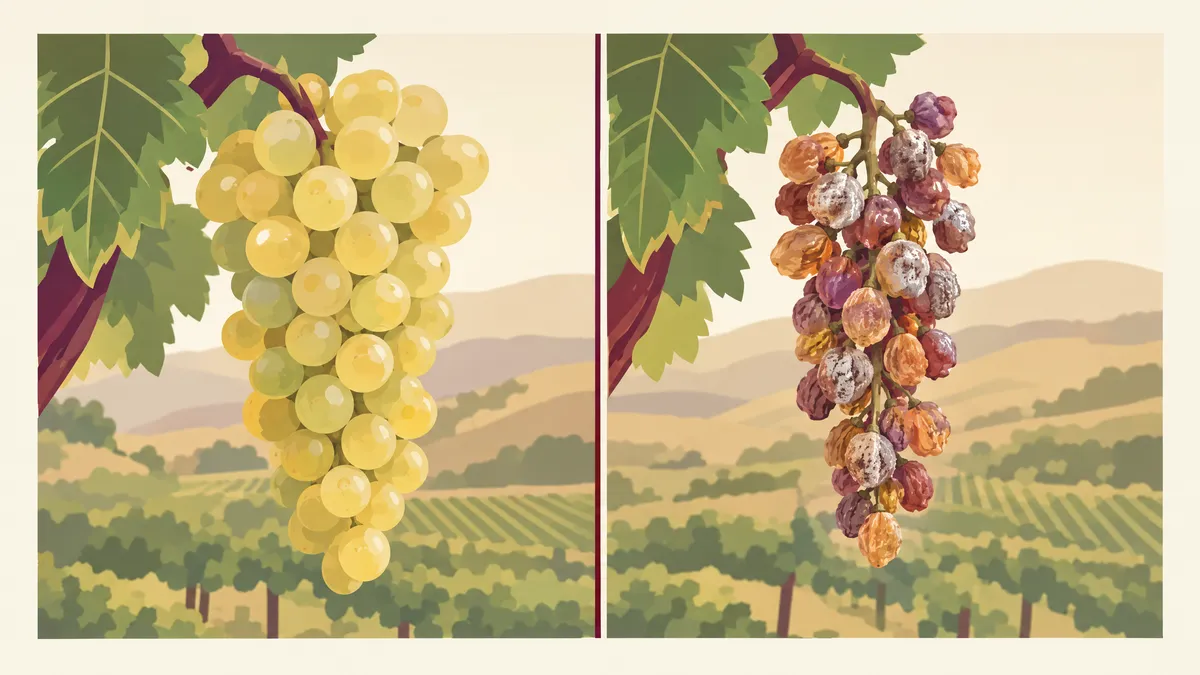
The flavours come from the shrivelled fruit and the mould. Young TBA smells of dried apricot and candied orange peel, because drying concentrates the fruit. It tastes of honey and a faint saffron edge, from the noble rot itself. The colour runs deep gold when young.
How Should You Serve and Pair TBA?
Serve TBA well chilled, in small pours, with food that is less sweet than the wine. Chill it like a white wine; the wine serving temperature chart gives the range for sweet whites. A cold TBA feels fresher, and a warm one turns heavy.
Pour small. A thumb's depth is a full serving of a wine this concentrated, and one bottle stretches across a table of guests. A narrow white-wine glass keeps the aroma gathered.
The pairing rule is the same for every sweet wine. If the dessert is sweeter than the wine, the wine tastes thin and sour. So pick dishes with less sugar than the TBA, or with salt and fat to push against:
- Blue cheese. Salt and sharp mould meet the sugar head-on. The wine with blue cheese guide covers why sweet whites win here.
- Fruit tarts and baked apples. Fruit acidity echoes the wine's acidity, and pastry adds butter without much sugar.
- Rich pâté. Fat coats the mouth and the wine's acidity rinses it off.
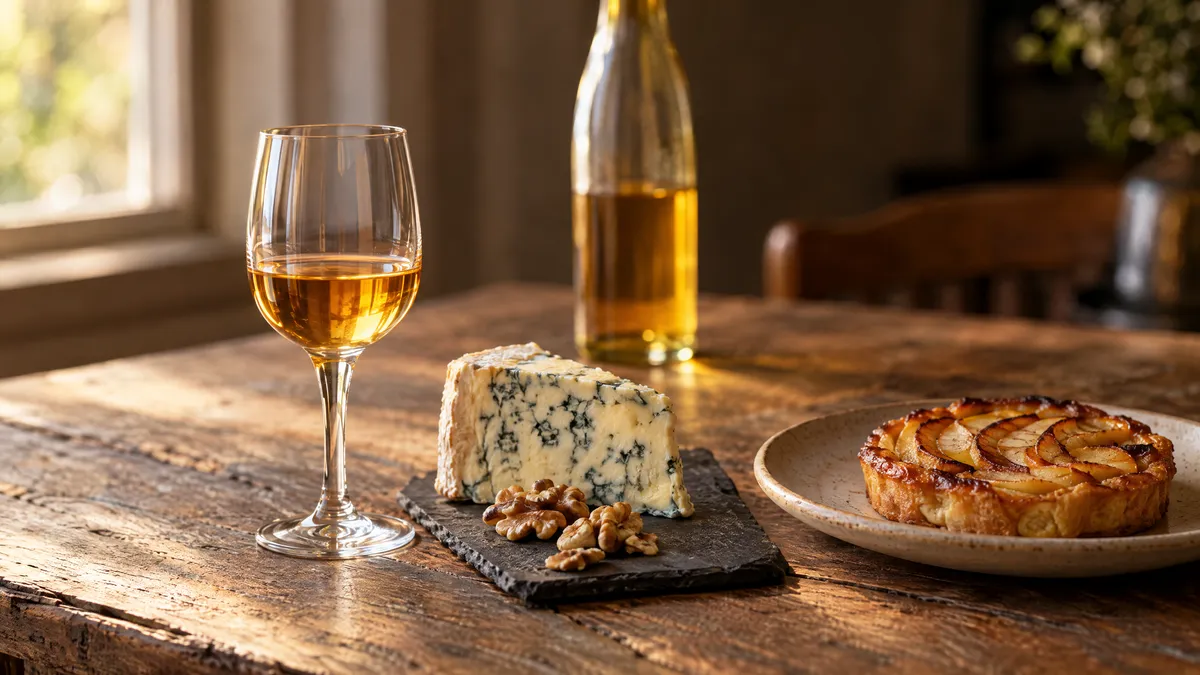
If the dessert is chocolate or a very sugary cake, open something else and save the TBA to drink on its own. The tasting dessert wines properly guide shows how to taste it without food.
How Long Does TBA Last?
For decades. Sugar and acid both protect it, and Wikipedia describes TBA as able to age almost indefinitely. The sugar works as a preservative against spoilage. Riesling's high acidity keeps the wine tasting fresh while the colour and flavours slowly change in the bottle.
Age changes the glass. The colour moves from gold to amber, then towards brown. Fresh apricot fades into caramel, dried fig and marmalade, which are tertiary aromas (flavours that come from age rather than the grape). If you want fresh apricot and honey, open a young bottle. If you want caramel and dried fruit, wait a decade or more, and store it lying down in a cool, dark place, as the wine aging guide explains.
How Does Noble Rot Make TBA?
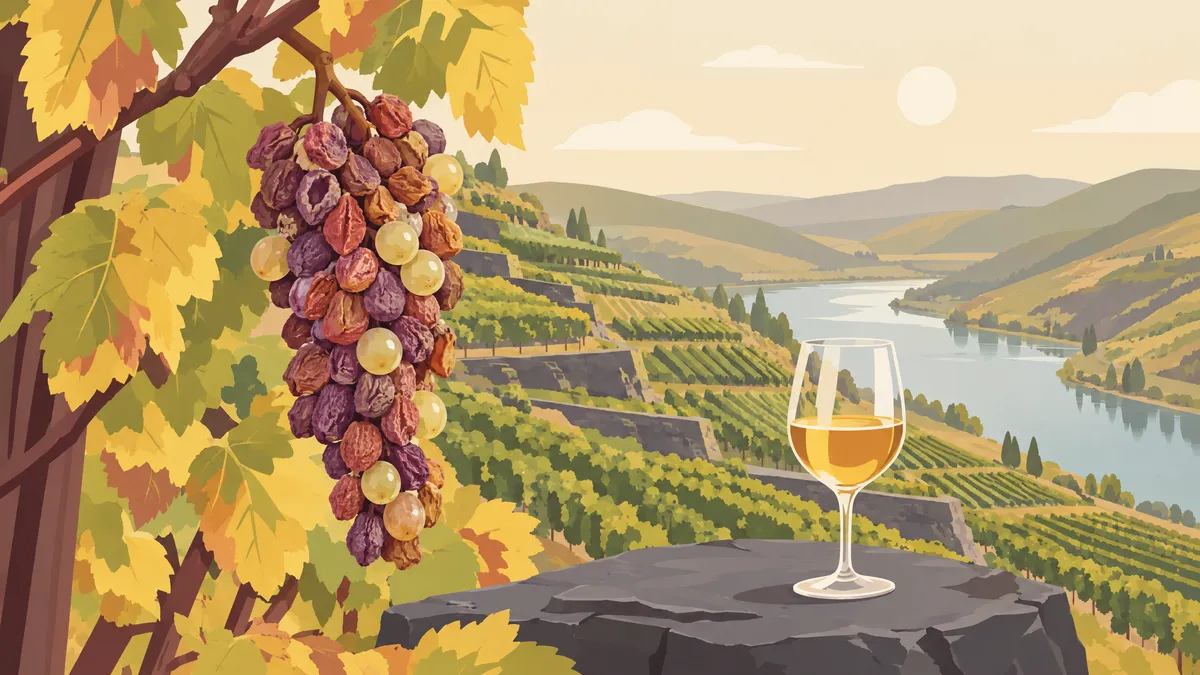
Noble rot is the fungus Botrytis cinerea caught in a humid-then-dry autumn. Infection needs warm, damp conditions, typically around 20 °C and above 80% humidity. Then dry, sunny weather has to follow, so the berries the mould has pierced lose water through their skins and shrivel on the vine.
That sequence is why river valleys like the Mosel matter. Morning mist off the water gives the mould its start. Sunny afternoons dry the berries out. As they dehydrate, the sugar concentration in what is left rises.
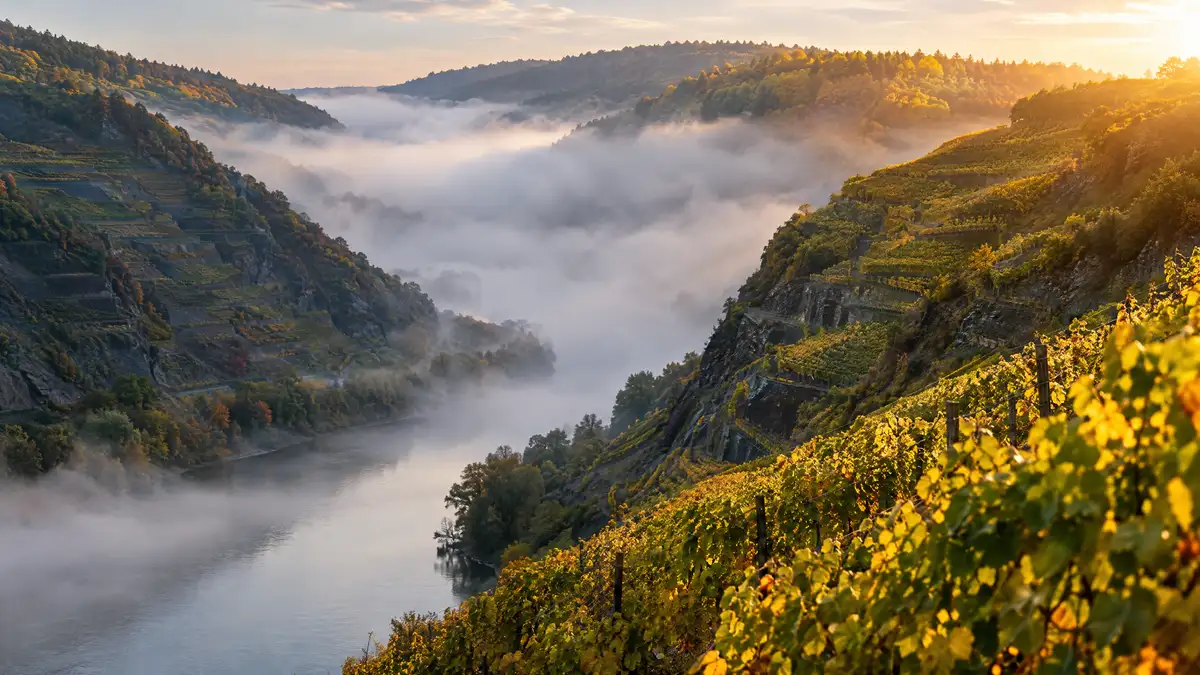
The weather can also go wrong. If rain keeps falling, infected berries stay full of water and their sugar level holds steady or falls, according to Virginia Tech's enology group. The same mould then becomes grey rot (the destructive form that spoils the crop), and no TBA is made that year.
The fungus also changes the juice chemistry. It consumes part of the sugar and can break down 70 to 90% of the tartaric acid. It also leaves gluconic acid behind: 1 to 5 grams per litre in wines from infected fruit. That altered chemistry is part of why a botrytis wine smells of honey rather than fresh grapes. The noble rot guide covers the fungus in more depth.
Why Is Trockenbeerenauslese So Rare and Expensive?
Because the weather has to cooperate and every berry is chosen by hand. The onset of noble rot is unpredictable: it needs the right weather on the right site. In some vintages it never turns noble, and in others it reaches only part of a vineyard.
When it does arrive, it never reaches every berry at once. One bunch can hold plump, half-shrivelled and raisined berries side by side. Pickers walk the same rows several times over weeks, snipping out only the fully dried berries. Berries that are ripe but not yet raisined can go into a lower level, such as Beerenauslese or Auslese, from the same vineyard.
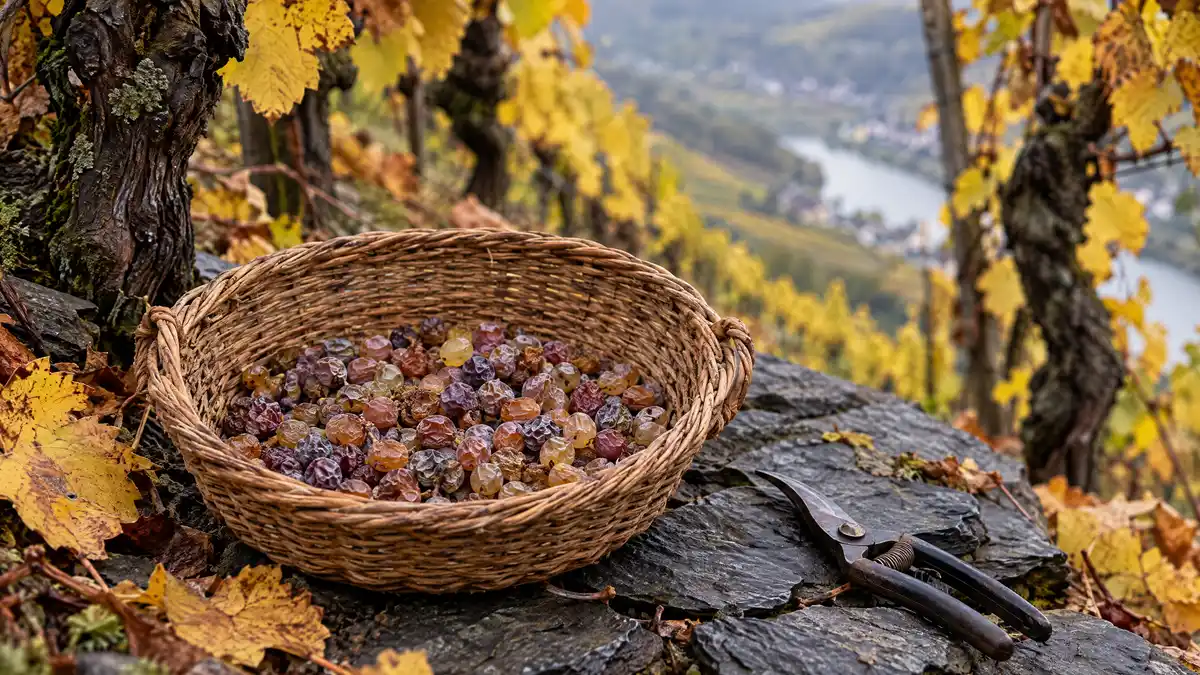
Those berries hold little juice, and the press yields a thick, slow trickle. A morning's careful work may fill only a small basket. Fermentation is slow too, because yeast struggles in juice this sweet.
If a bottle calls itself TBA and sells at the price of an everyday Riesling, read the label again: it may be a Beerenauslese or an Auslese. For the steep-slope Riesling sites behind many famous TBAs, see the Mosel wine guide and the Rheingau wine guide.
What Does a TBA Label Tell You?
The label word guarantees how heavy the juice was at harvest. It sets no number for the sweetness of the finished wine, so two TBAs can taste quite different. The Prädikat levels were first set out in the German Wine Law of 1971.
The name trips up readers. Trocken on a normal German label means a dry wine, but in Trockenbeerenauslese it means the grapes were dried on the vine. The wine is very sweet.
Oechsle measures must weight: each degree is one gram of difference between a litre of juice at 20 °C and a kilogram. Oechsle measures the juice, not the wine: the producer still decides when fermentation stops. A reading of 150° Oechsle means a litre of juice weighs 1,150 grams. The minimum runs from 150 to 154° by grape and region; for Riesling in the Mosel and the Rheingau it is 150.
Austria labels TBA too, with a minimum of 30° KMW (Klosterneuburger Mostwaage, the Austrian must scale, where 1° KMW is about 5° Oechsle). That lands at roughly the same 150° Oechsle. The Austria wine guide covers where it grows.
The alcohol on the label tells the rest of the story. The legal floor is 5.5%, against 7% for Kabinett, Spätlese and Auslese. If the label shows 6 to 8%, plenty of sugar was left in the wine. The Riesling wine guide shows where TBA sits in the grape's range from dry to sweet.
Taste TBA's Neighbours Tonight
More sweet styles, from Sauternes to Port, sit together in the wine styles hub. The Sommy app at sommy.wine has bite-sized courses, including Wine 101, and an AI-guided tasting mode. Chill any sweet white you own tonight, photograph its label, then taste it one sip at a time through the look, smell and taste steps.
Sources
Frequently Asked Questions
What does Trockenbeerenauslese mean?
Trockenbeerenauslese means 'dried berry selection' in German. The word trocken describes the grapes, which have dried on the vine under noble rot until they look like raisins. It does not describe the wine, which is one of the sweetest made anywhere. Pickers choose those dried berries one at a time, which is where the 'selection' part comes from.
How sweet is Trockenbeerenauslese?
Very sweet. A TBA that only just meets the legal minimum can hold about 150 grams of sugar per litre, and the most concentrated examples reach around 300 grams. High acidity, especially from Riesling, keeps it from tasting syrupy-flat. Pour small glasses: a little goes a long way, and its sweetness outlasts most desserts.
What is the difference between Beerenauslese and Trockenbeerenauslese?
Both are made from overripe berries picked individually, often affected by noble rot. Trockenbeerenauslese goes further: the berries must be shrivelled almost to raisins, and the juice must reach at least 150° Oechsle, against 110 to 128° for Beerenauslese. TBA is sweeter, thicker and rarer. Beerenauslese gives a lighter taste of the same honeyed style.
Is Trockenbeerenauslese the same as Eiswein?
No. Trockenbeerenauslese is concentrated by noble rot, a fungus that dries the berries on the vine and adds honey and dried apricot flavours. Eiswein is concentrated by frost: the grapes freeze on the vine and are pressed frozen, and producers avoid noble rot. Eiswein needs the same must weight as Beerenauslese, well below the TBA minimum, and tastes of fresher, purer fruit.
Why is Trockenbeerenauslese so expensive?
Because so little can be made. Noble rot only turns noble in a humid autumn followed by dry, sunny days, and some years never deliver that. When it does, pickers walk the rows several times and choose shrivelled berries one by one. Those raisined berries give very little juice, so it takes a great deal of picking to fill one bottle.
How long can Trockenbeerenauslese age?
For decades. Its high sugar acts as a preservative and Riesling's acidity keeps the wine fresh, so good bottles can age almost indefinitely. Young TBA tastes of fresh apricot and honey. With age the colour turns from gold to amber and brown, and the flavours move towards caramel, dried fig and marmalade.
How do you pronounce Trockenbeerenauslese?
Say it in four parts: TROCK-en, BEER-en, OWS, lay-zuh. The German 'au' sounds like the 'ow' in 'cow', and the final 'e' is a soft 'uh'. Most wine shops and sommeliers simply call it TBA, which is also how many German labels and wine lists shorten it.
Sommy Team
LinkedInFounder & Wine Educator
The Sommy Team is building the world's most approachable wine education app, helping beginners develop real tasting skills through structured courses and AI-guided practice.