Mosel Wine Guide: Steep Slopes and Stunning Riesling

By the Sommy Team — AI-assisted, human-edited.
Updated Jun 17, 2026
Contents (10)
- What Is Mosel Wine?
- Where the Mosel Is and Why the Slopes Matter
- Riesling: The Grape That Defines the Mosel
- Slate Minerality and the Mosel's Terroir
- The Mosel Wine Guide to the Prädikat Ripeness Ladder
- Dry vs Sweet: How to Read a German Label
- The Sub-Regions: Saar, Ruwer, and the Heart of the Mosel
- What Makes the Mosel Distinctive
- How a Beginner Should Start with the Mosel
- The Reward of Learning the Mosel
TL;DR
The Mosel is Germany's most famous wine region, planted on dizzyingly steep blue-slate slopes along a winding river. It makes racy, low-alcohol Riesling ranging from bone-dry to lusciously sweet. This mosel wine guide explains the Prädikat ripeness ladder, how to read a German label, and where a beginner should start.
What Is Mosel Wine?
This mosel wine guide begins with a single grape and a single soil. The Mosel is Germany's most celebrated wine region, a winding river valley in the country's west where vines cling to some of the steepest commercial slopes on earth. Nearly everything serious here is Riesling, grown on blue-grey slate that gives the wine its trademark smoky, wet-stone character. Mosel Riesling is unmistakable: pale, fragrant, low in alcohol, and electric with acidity. It spans the full sweetness range from bone-dry to dessert-rich, organised by the German Prädikat ripeness ladder. Learn the grape, the slate, and how to read the label, and one of wine's most rewarding regions opens right up.
Where the Mosel Is and Why the Slopes Matter
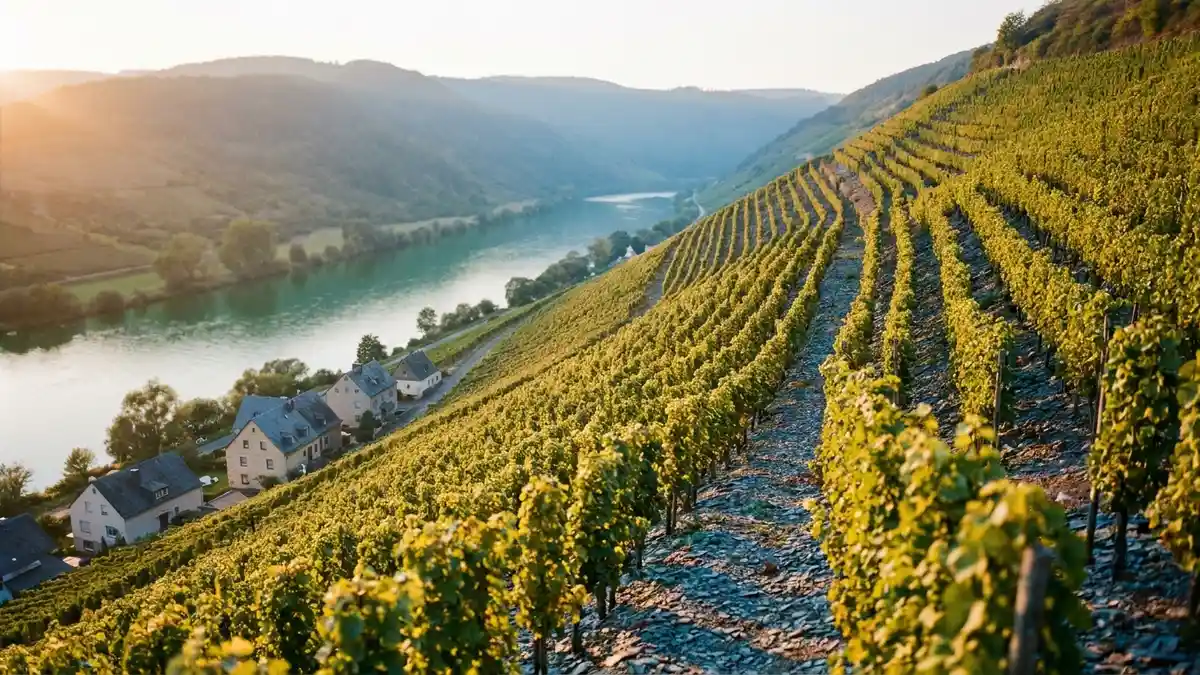
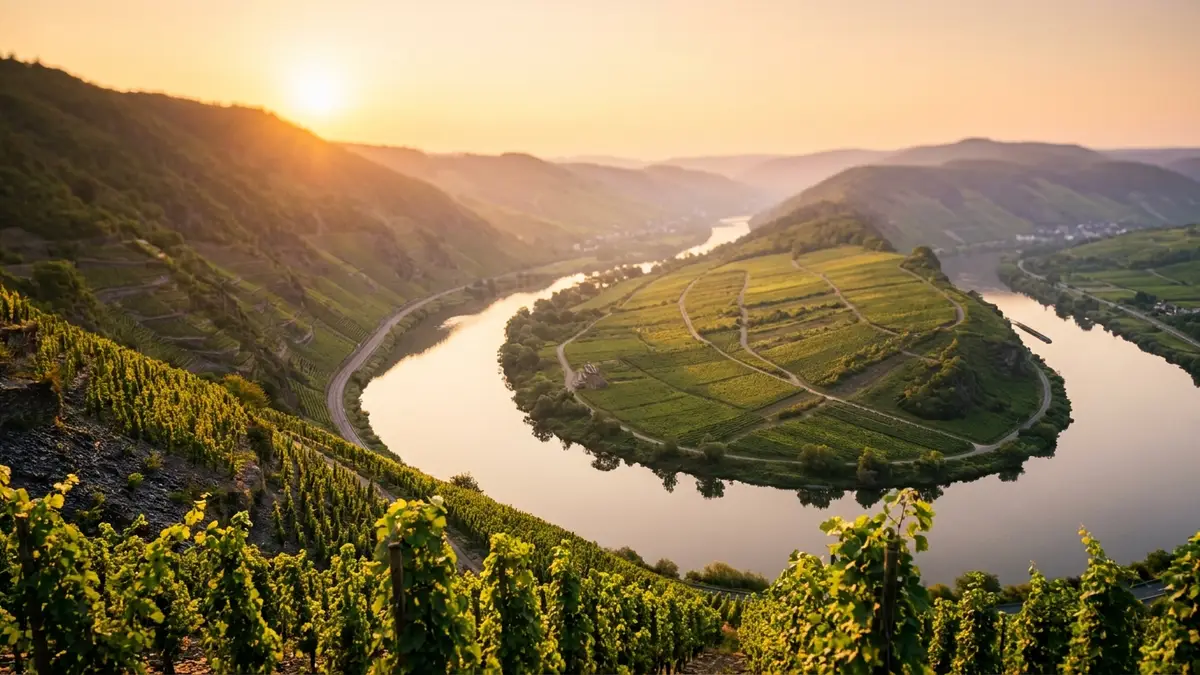
The Mosel river rises in France, threads through Luxembourg, and enters Germany near the ancient city of Trier before looping north to meet the Rhine at Koblenz. The vineyards follow the river's tight bends in a series of dramatic horseshoe curves. To catch enough sun this far north, growers plant on the steep south-facing flanks of the valley — slopes that can exceed a 60-degree gradient and are among the steepest worked vineyards anywhere.
This is cool-climate winegrowing at its extreme. The Mosel sits around the 50th parallel, the same latitude as southern England and Newfoundland, so ripening is slow and never guaranteed. The river itself is part of the solution: water reflects sunlight back up onto the vines and moderates temperature, while the slate soil soaks up daytime heat and releases it overnight.
Those steep sites are not a romantic accident. They are the only way to make great wine at this latitude. The angle tilts each row toward the low northern sun, draining cold air downhill and maximising every available ray during a short growing season.
Riesling: The Grape That Defines the Mosel
If Burgundy is the classroom for Pinot Noir, the Mosel is the world's finest classroom for Riesling — an aromatic white grape prized for its perfume and its ability to carry sweetness without ever turning flabby. Riesling fills around 60 percent of the region's vineyards, and the best slopes are reserved almost entirely for it.
Mosel Riesling is built on a paradox: it can be sweet and yet taste fresh, light and yet intensely flavoured. The engine behind that trick is acidity — the mouth-watering tartness that keeps wine lively. Mosel Riesling has plenty of it, which is why even a sweeter bottle finishes clean and tense rather than syrupy.
Typical aromas: green apple, lime, white peach, pear, and honeysuckle, often with a flinty, smoky, wet-stone note that growers attribute to the slate. Body: light (1-2/5) · Acidity: high to very high (4-5/5) · Alcohol: unusually low (often 8-9 percent in lighter styles). That low alcohol is a regional signature, the natural result of a cool climate where grapes ripen slowly and gently. If you want the grape's full global story beyond this one valley, our Riesling wine guide covers how it behaves from Alsace to Australia, and our overview of the noble grapes places it among the handful of varieties every learner should know first.
Riesling is also a textbook aromatic grape — one that smells strongly of identifiable fruits and flowers, unlike neutral varieties that lean on technique. Our piece on aromatic versus neutral grapes explains why that distinction shapes how a wine smells in the glass.
Slate Minerality and the Mosel's Terroir
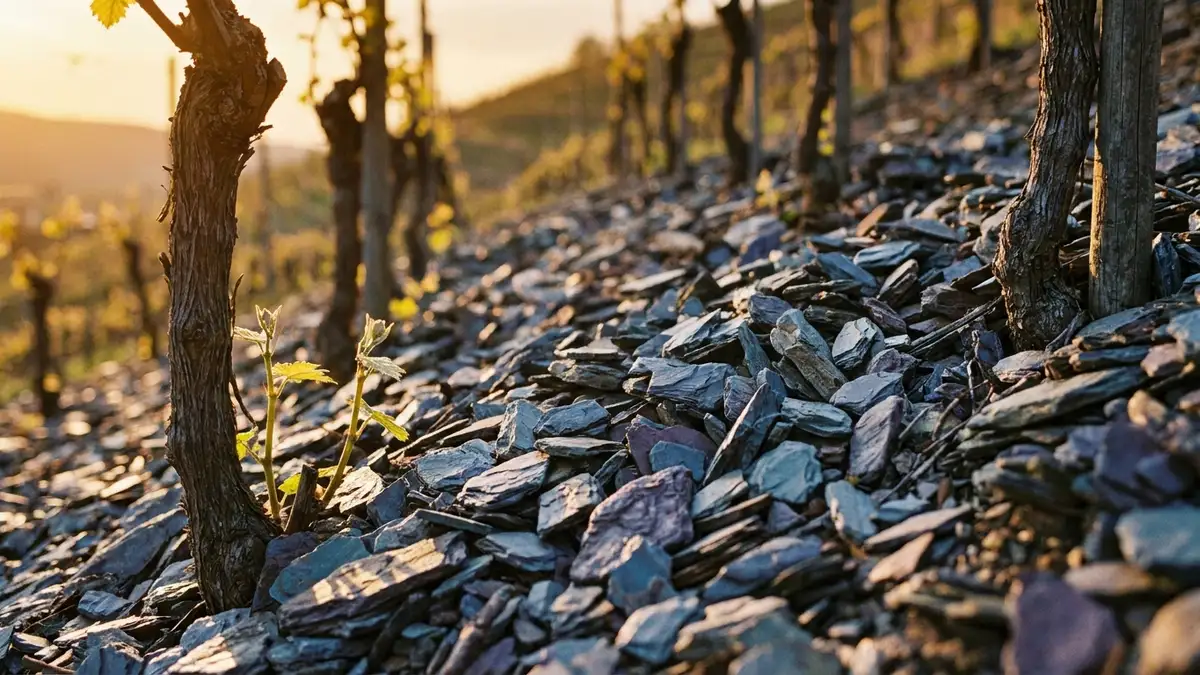
The single most quoted word in any Mosel tasting note is minerality — a smoky, stony, almost saline impression that wine lovers link directly to the region's geology. The Mosel valley is built on layers of Devonian slate, a fine-grained rock that comes in distinct colours, each with its own reputation among growers.
Sorting the slate types is the clearest way to understand why two Mosel Rieslings can taste different:
- Blue slate: The classic Mosel soil, found on many of the most famous slopes. Associated with cool, taut, citrus-driven wines and the sharpest mineral edge.
- Red slate: Iron-rich and warmer, more common in the lower Mosel. Linked to riper, rounder, more spice-toned styles.
- Grey slate: A middle ground in colour and character, balancing fruit and stone.
Slate does more than flavour the wine. The dark rock absorbs heat and warms the roots in a cool region, the loose, broken surface drains water fast so vines dig deep, and the steep angle of the slopes means most of this work is still done by hand. There is little a tractor can do on a 60-degree wall of rock.
Whether minerality is literally the taste of stone is debated among scientists, but the sensory result is real and consistent: Mosel Riesling tastes of more than fruit. It carries a savory, smoky tension that the slate slopes reliably deliver.
The Mosel Wine Guide to the Prädikat Ripeness Ladder
German quality wine is ranked by a system that confuses newcomers and rewards anyone who learns it: Prädikat, a ladder that sorts wine by how ripe the grapes were at harvest, measured as natural sugar in the juice. The riper the fruit, the higher the rung — and usually, though not always, the sweeter the wine. From lightest to richest:
- Kabinett: The base rung. Grapes picked at normal ripeness, making the lightest, most delicate wines — often 8 to 9 percent alcohol, racy, and the easiest everyday Mosel.
- Spätlese: Literally "late harvest." Grapes left longer on the vine for riper, more concentrated fruit. Fuller and more intense than Kabinett, available in both dry and off-dry styles.
- Auslese: "Selected harvest" from especially ripe bunches, sometimes touched by noble rot (a benevolent mould that shrivels grapes and concentrates their sugar). Richer and usually sweeter, with serious ageing potential.
- Beerenauslese (BA): Individually selected, noble-rot-affected berries. A rare, intense, honeyed dessert wine made only in the best years.
- Trockenbeerenauslese (TBA): "Dried-berry selected harvest" — shrivelled, raisined, noble-rot berries picked one by one. The pinnacle of sweetness and concentration, and one of the world's rarest, most expensive wines.
- Eiswein: "Ice wine," pressed from grapes left to freeze solid on the vine, often in December or January. The ice locks out water and leaves a tiny amount of intensely concentrated, sweet-yet-vivid juice.
The pattern to remember: as you climb the ladder, the grapes get riper and the wine gets richer. Kabinett and Spätlese are the everyday rungs a beginner will actually drink; the top three are special-occasion dessert wines. One key point: ripeness is not the same as sweetness — a producer can ferment a ripe Spätlese fully dry, which is exactly why the next section matters.
The Sommy app's tasting exercises walk you through Mosel styles step by step, so you can feel the jump from a delicate Kabinett to a richer Spätlese in your own glass.
Dry vs Sweet: How to Read a German Label
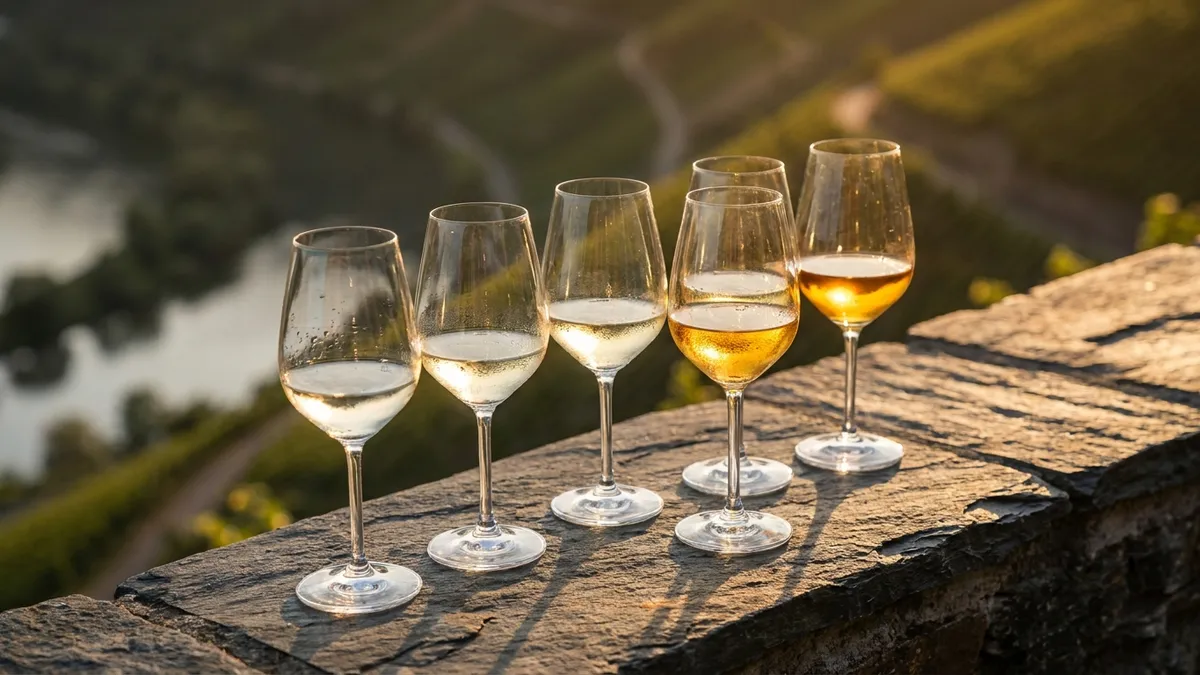
The biggest myth about the Mosel is that all its wine is sweet. The region makes the full spectrum, and the label tells you where a bottle sits — once you know three German words. This is the most practical skill in the whole region, so it is worth memorising.
The dryness terms work like this:
- Trocken: Dry. Little or no perceptible sweetness. Dry Mosel Riesling has surged in popularity and shows the slate minerality in its most direct, food-friendly form.
- Halbtrocken / Feinherb: Off-dry. A touch of sweetness balanced by the wine's high acidity. Halbtrocken is the official term; feinherb is a looser, increasingly common word for the same gently off-dry zone.
- No dryness term: Often gently to noticeably sweet, especially at Kabinett, Spätlese, and Auslese levels. The classic, fruity, low-alcohol Mosel style sits here.
Read a German label from the outside in, and a few clear parts emerge:
- Village and vineyard: Many labels pair a village with its vineyard, joined by the ending "-er." So "Piesporter Goldtröpfchen" means the Goldtröpfchen vineyard in the village of Piesport. The place name tells you where the grapes grew.
- Grape: Usually printed plainly — almost always Riesling on a quality Mosel bottle.
- Prädikat: The ripeness rung (Kabinett, Spätlese, and so on), telling you how ripe the fruit was.
- Dryness: Trocken or halbtrocken if present; assume some sweetness if absent.
Put together, a label like "Riesling Kabinett trocken" reads instantly as a dry, light, normally-ripe Riesling. For the wider question of what "dry" actually means on any wine, our explainer on what dry wine means is a useful companion, and our overview of white grapes shows where Riesling sits among its peers.
The Sub-Regions: Saar, Ruwer, and the Heart of the Mosel
The Mosel is one region but several distinct valleys, and knowing the main divisions turns a confusing map into a story. The official region — formally the Mosel since a 2007 renaming from the older "Mosel-Saar-Ruwer" — gathers the main river and two famous tributaries.
- The Middle Mosel (Mittelmosel): The classic heartland between Trier and Zell, home to the steepest, most renowned slopes and the villages whose names appear on the great bottles. This is where blue slate and Riesling reach their fullest, most balanced expression.
- The Saar: A small, cool tributary valley joining the river just south of Trier. Saar Rieslings are famously precise, taut, and slow to ripen — in great years they are among Germany's most thrilling wines, with razor acidity and deep minerality. Look for "Saar" in the name.
- The Ruwer: An even tinier tributary near Trier, cooler still, producing delicate, filigree Rieslings of remarkable finesse and ageing potential. Tiny in volume but mighty in reputation.
- The Lower Mosel (Terrassenmosel): The steep, terraced stretch toward Koblenz, where red slate plays a bigger role and the wines can show a riper, spicier edge.
- The Upper Mosel (Obermosel): Near the Luxembourg border, planted more to the old Elbling grape and Pinots than to Riesling — a quieter, more rustic corner of the region.
For a beginner, the Middle Mosel is the place to start, with the Saar and Ruwer as the next step once the house style is familiar. To see how the Mosel fits into the country as a whole, our guide to German wine regions maps it alongside the Rheingau, Pfalz, and the rest.
What Makes the Mosel Distinctive
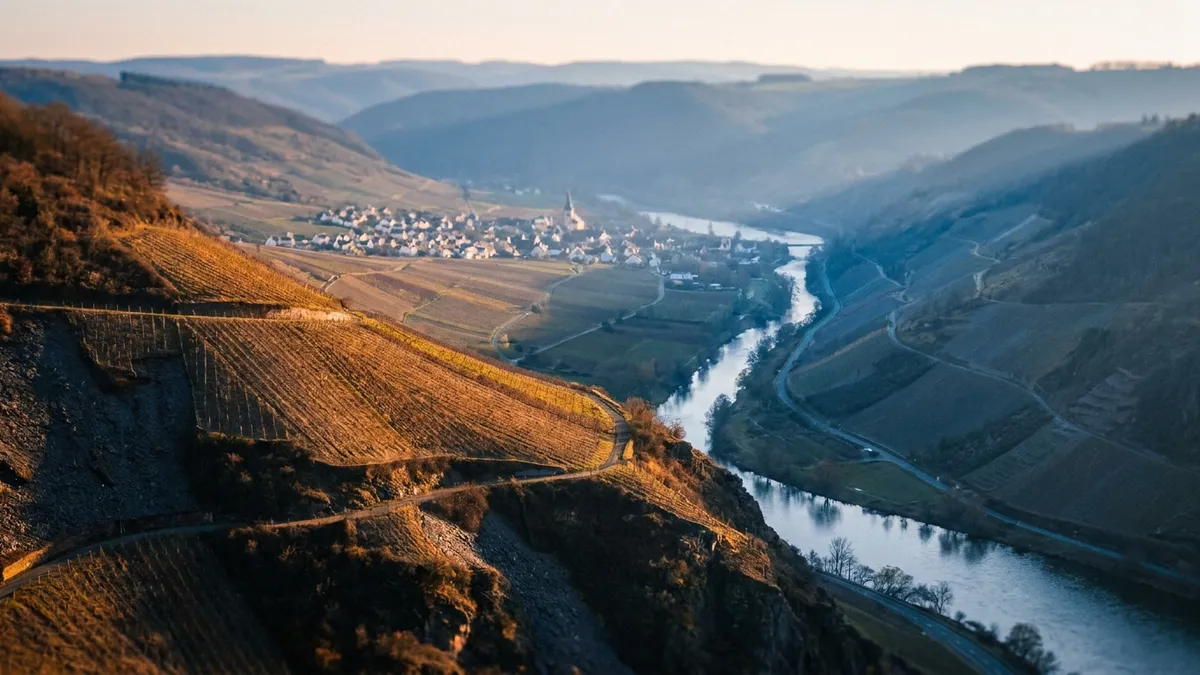
Plenty of regions grow Riesling. What sets the Mosel apart is the combination no one else can copy: extreme steepness, blue slate, a moderating river, and a latitude on the very edge of where grapes ripen at all. The result is a style found nowhere else.
The clearest contrast is with warmer Riesling regions:
- Mosel Riesling: Cool climate · low alcohol (often 8-9 percent) · light body · piercing acidity · slate-driven minerality · frequently off-dry.
- Warm-region Riesling (e.g. parts of Australia or California): Riper · higher alcohol (12 percent or more) · fuller body · softer acidity · more tropical fruit · often fully dry.
That low-alcohol, high-acid profile makes Mosel Riesling one of the most food-friendly wines anywhere. The off-dry styles in particular are a classic match for spicy and aromatic dishes: the touch of sweetness tames chilli heat while the bright acidity cuts through rich, fatty, or salty food. Thai curry, Sichuan dishes, smoked fish, and pork all sing alongside a Mosel Spätlese.
It is also a region built for patience. Mosel Riesling's high acidity preserves it for decades, and a fine Spätlese or Auslese can evolve from primary fruit into honeyed, petrol-tinged complexity over twenty years or more — all while keeping its freshness.
How a Beginner Should Start with the Mosel
You do not need a rare Auslese or a big budget to understand the Mosel. The smartest path is to taste deliberately at the everyday rungs and pay attention to what changes. A practical order:
- Begin with a Kabinett. The lightest, most affordable rung shows the region's signature balance of delicate fruit, gentle sweetness, and racy acidity at low alcohol. It is the truest first impression of the Mosel.
- Compare dry against off-dry. Open a Riesling trocken beside one with no dryness term. Feeling the difference between a bone-dry and a gently sweet version, both lifted by the same sharp acidity, teaches the whole region in two glasses.
- Step up to a Spätlese. Once Kabinett is familiar, a Spätlese shows what extra ripeness brings — more concentration, more weight, the same energy.
- Pour it with spicy food. Match an off-dry Mosel with a spicy Asian dish to see why this style earns its reputation as one of the great food wines.
- Build the tasting habit. Note the pale colour, the low alcohol, the green-apple-and-lime fruit, and that smoky slate edge that sets the Mosel apart. Our guide to how to taste wine gives you the step-by-step method to capture all of it.
Sommy turns these comparisons into guided exercises — naming the aromas, scoring the acidity, and building the vocabulary to describe what you sense. You can start practicing free at sommy.wine, then bring the method to your next bottle of slate-grown Riesling.
The Reward of Learning the Mosel
The Mosel asks a beginner to learn a few German words and one ripeness ladder, and it pays that effort back generously. Few wines deliver so much flavour at so little alcohol, age so gracefully, or pair so happily with difficult food. Once the label clicks, a Mosel bottle stops being a wall of unfamiliar German and becomes a precise description of exactly what waits in the glass — the slope, the ripeness, and the style.
Start with a Kabinett, taste dry against sweet, and let the slate reveal itself one glass at a time. The Sommy app is built to make that habit stick, turning each bottle into a short, guided lesson so the next Mosel Riesling you open is a little clearer than the last.
Sources
Frequently Asked Questions
What kind of wine does the Mosel make?
The Mosel makes overwhelmingly white wine from Riesling, which fills around 60 percent of its vineyards. The style is light, low in alcohol, high in acidity, and ranges from bone-dry to intensely sweet. Smaller plantings of Müller-Thurgau, Elbling, and Pinot grapes exist, but Riesling on steep blue-slate slopes is what made the region famous.
What does Mosel Riesling taste like?
Mosel Riesling tends toward green apple, lime, white peach, and pear, lifted by piercing acidity and a smoky, wet-stone minerality from the slate soils. Alcohol is unusually low, often 8 to 9 percent in lighter styles. Off-dry versions balance sweetness against sharp acid, so the wine tastes fresh and tense rather than sugary.
How does the German Prädikat ripeness ladder work?
Prädikat ranks wine by how ripe the grapes were at harvest, measured as sugar in the juice. From lightest to richest the rungs are Kabinett, Spätlese, Auslese, Beerenauslese, and Trockenbeerenauslese, plus Eiswein from frozen grapes. Higher rungs mean riper fruit and usually more sweetness, though dry versions exist at the lower levels.
Are all Mosel wines sweet?
No. The Mosel makes the full range from bone-dry to lusciously sweet. The German word trocken means dry, halbtrocken or feinherb means off-dry, and a wine with no dryness term is often gently sweet. Even sweeter Mosel wines stay lively because their high acidity balances the sugar, so they rarely feel heavy or cloying.
What are the Saar and Ruwer?
The Saar and Ruwer are two small tributary valleys within the larger Mosel region, each joining the river near the city of Trier. Both are cooler than the main Mosel valley and produce some of its most precise, mineral, and age-worthy Rieslings. Wines from these areas often carry Saar or Ruwer in the name.
Why is Mosel wine so low in alcohol?
The Mosel sits far north in a cool climate, so grapes ripen slowly and accumulate less sugar than in warm regions. Less sugar means less potential alcohol. Many producers also stop fermentation early to leave natural sweetness, which lowers alcohol further. Lighter Mosel Rieslings often land around 8 to 9 percent, well below most table wines.
Where should a beginner start with Mosel wine?
Start with a Kabinett or Spätlese Riesling, which show the region's signature balance of fruit, sweetness, and bright acidity at a fair price. Taste a dry trocken version next to an off-dry one to feel the difference. These off-dry styles also pair beautifully with spicy and Asian food, making them an easy everyday choice.
Sommy Team
LinkedInFounder & Wine Educator
The Sommy Team is building the world's most approachable wine education app, helping beginners develop real tasting skills through structured courses and AI-guided practice.