Climate Change and Wine: How the Wine Map Is Being Redrawn

By the Sommy Team — AI-assisted, human-edited.
Updated Oct 1, 2026
Contents (9)
- How Is Climate Change Affecting Wine, in One Paragraph?
- Why Do Harvests Keep Getting Earlier?
- Why Does Heat Change How Wine Tastes?
- What Has Already Changed, and What Is Only Projected?
- Which Wine Regions Are Under Pressure?
- Which Regions Are Gaining?
- How Are Winemakers Adapting?
- Which Grapes Cope Best With Heat?
- How Can You Taste the Shift Yourself?
TL;DR
Warmer seasons make grapes ripen earlier, with more sugar and less acid, so wines run stronger and softer. French and Swiss harvests have come about 10 days early since 1981. One model sees major regions losing 25 to 73% of suitable land by 2050, while cool places like southern England gain.
Climate change is already in your glass. Warmer summers make grapes pile up sugar faster than they build flavour, while their acid burns away, so wines from classic regions are getting riper, stronger and softer. The places that grow great wine are moving with the heat: uphill, and away from the equator.
How Is Climate Change Affecting Wine, in One Paragraph?
Climate change wine effects already show up in harvest records and in the grapes themselves. In France and Switzerland, a harvest record running back to 1600 shows grapes picked about 10 days earlier since 1981 than the 400-year average. Warmer ripening leaves grapes with more sugar and less acid, which means more alcohol and less freshness in the bottle. One widely cited model projects major wine regions losing 25 to 73% of their suitable land by 2050 under high emissions. Meanwhile southern England, mountain slopes and northern sites are gaining. Growers are fighting back with later-ripening grapes, and Bordeaux has approved new varieties for its basic wines.
Why Do Harvests Keep Getting Earlier?
Because warmer springs and summers push every stage of the vine's year forward, from budburst (the first green shoots in spring) to ripe fruit. A study of harvest records from France and Switzerland, covering 1600 to 2007, found picking about 10 days earlier since 1981 than the long-run average. Only two years since 1981 came in late.
Burgundy shows the same curve over a longer span. Historians led by Thomas Labbé at the University of Leipzig rebuilt Beaune's harvest dates from 1354 to 2018, using church parchments and town records. Grapes there are now picked almost two weeks before their historical norm, and the warming has ratcheted up since the late 1980s.
Champagne, one of the coolest of the great French regions, now sees harvests in summer. The 2018 harvest was the fifth in August in 15 years. One Champagne producer puts it plainly: harvest comes two weeks earlier than it did 20 years ago.
If you compare two vintages of the same wine 20 years apart, expect the younger one to come from grapes picked earlier and riper.
Why Does Heat Change How Wine Tastes?
Heat speeds up sugar faster than it builds flavour, and it burns off acid. Think of a grape running three clocks at once: sugar, acidity (the tartness that makes your mouth water) and flavour in the skins. In cool weather they finish together. In hot weather the sugar clock races ahead.
A 2017 review by Bordeaux researchers Cornelis van Leeuwen and Agnès Destrac-Irvine sums up the trend. Grapes ripened in warmer conditions carry more sugar and less acid, so the juice is less sharp. The authors put the ideal ripening window for the Northern Hemisphere between 10 September and 10 October, when temperatures start to fall. Grapes that ripen earlier, in August heat, give wines high in alcohol that lack freshness and aroma.
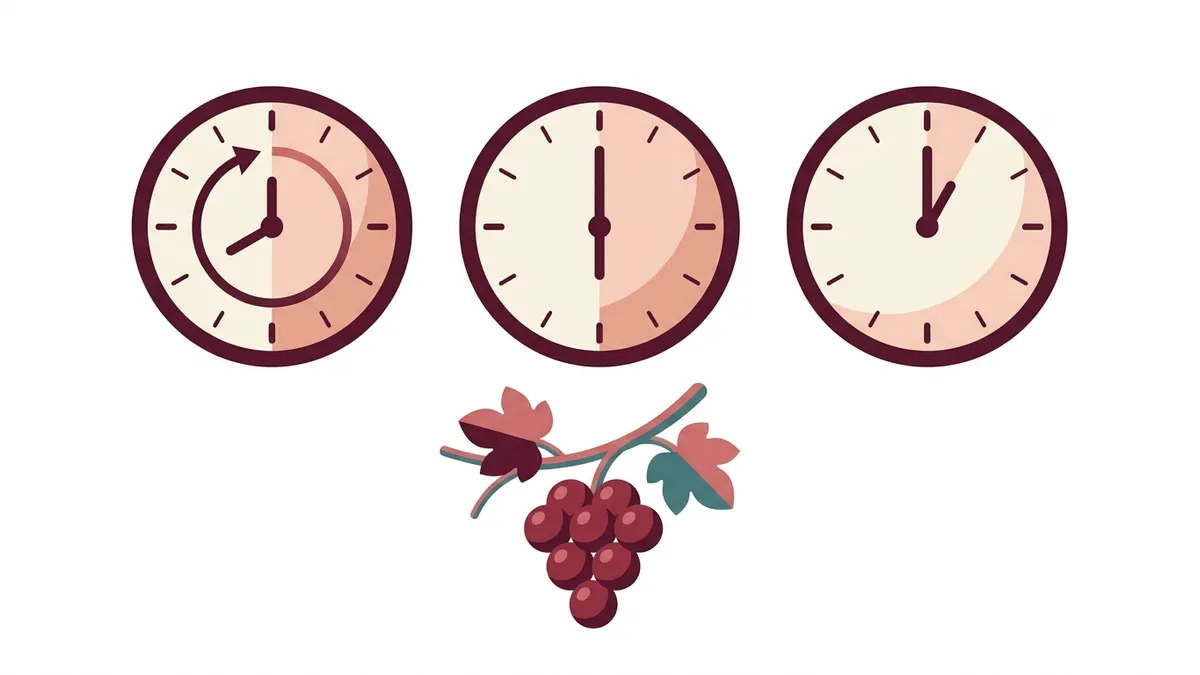
Heat is not the only reason alcohol has crept up. The same review notes that many growers have been picking later on purpose, chasing riper fruit. Both push alcohol higher, which is why a warm climate (long, hot seasons that give riper, stronger wine) and a picking choice can look the same on a label.
This is where the old rule breaks. Traditionally in France, an early harvest meant a hot, dry year and a better wine. An early harvest is no longer a sign of a great vintage: early harvests now come in wet years as well as dry ones, so the shortcut fails. The 2003 heatwave gave the earliest harvest in the 400-year record, about a month ahead of average. How climate shows in a specific grape is covered in climate and wine flavour.
What Has Already Changed, and What Is Only Projected?
Earlier harvests, higher sugar, lower acid and new grape rules are measured facts. The loss of vineyard land by 2050 is a model: high emissions give the bigger loss, lower emissions a smaller one. A model shows what could happen if nothing in the vineyard changes.
| Change | Status | Where it shows | What to check on the label |
|---|---|---|---|
| Harvests about 10 days earlier since 1981 | Measured | France, Switzerland, Burgundy | Vintage year: compare a recent bottle with an older one |
| More sugar, less acid in ripe grapes | Measured | Most wine regions since the 1980s | Alcohol: 14.5% where 12.5% was once normal |
| August harvests in Champagne | Measured | Champagne | Non-vintage blends lean on older reserve wines |
| New heat-tolerant grapes allowed | Measured | Basic Bordeaux and Bordeaux Supérieur | Grape list on the back label |
| Sparkling wine boom on chalk | Measured | Southern England | English origin on traditional-method sparkling |
| 25 to 73% less suitable land by 2050 | Projected (high emissions) | Major regions, worst in Mediterranean climates | Altitude or a northern place name |
If a label names a high vineyard or a northern place, expect more acid and less alcohol than the region's average. If it reads 14.5% or more, expect a riper, softer wine whatever the region's reputation. Our guide to reading a wine label shows where those details sit.
Which Wine Regions Are Under Pressure?
The hot, dry Mediterranean-climate regions face the biggest projected losses. In 2013 a team led by Lee Hannah published a study in the journal PNAS mapping where wine grapes will still grow well in 2050. Under high emissions, suitable land in major wine regions falls 25 to 73%. Under lower emissions the range is 19 to 62%.
Those numbers describe suitability for today's grapes grown today's way. Wine is moving, not vanishing: the same study expects vineyards to climb to higher elevations and spread to higher latitudes, for example in western North America. The authors also warn that this move can clear wild land and compete for scarce water.
Cool classic regions feel a different squeeze. Champagne's style rests on sharp acid, which lets the wine age and keeps it fresh. Warmer seasons give grapes with less acid, which threatens both. The Champagne region guide explains how that acid is built into the house style.
Which Regions Are Gaining?
Cool places that used to fail in bad years, above all southern England. A cool climate (short, mild seasons that give tarter, lighter wine) once meant unripe grapes in a poor summer. Warming has turned that gamble into a fairly reliable crop.
England's advantage is geology as well as heat. The chalk under Sussex, Kent and Hampshire is the same seam that runs under Champagne, and it now ripens grapes for sparkling wine. French Champagne houses have planted vineyards there. The English wine guide covers the grapes and counties.
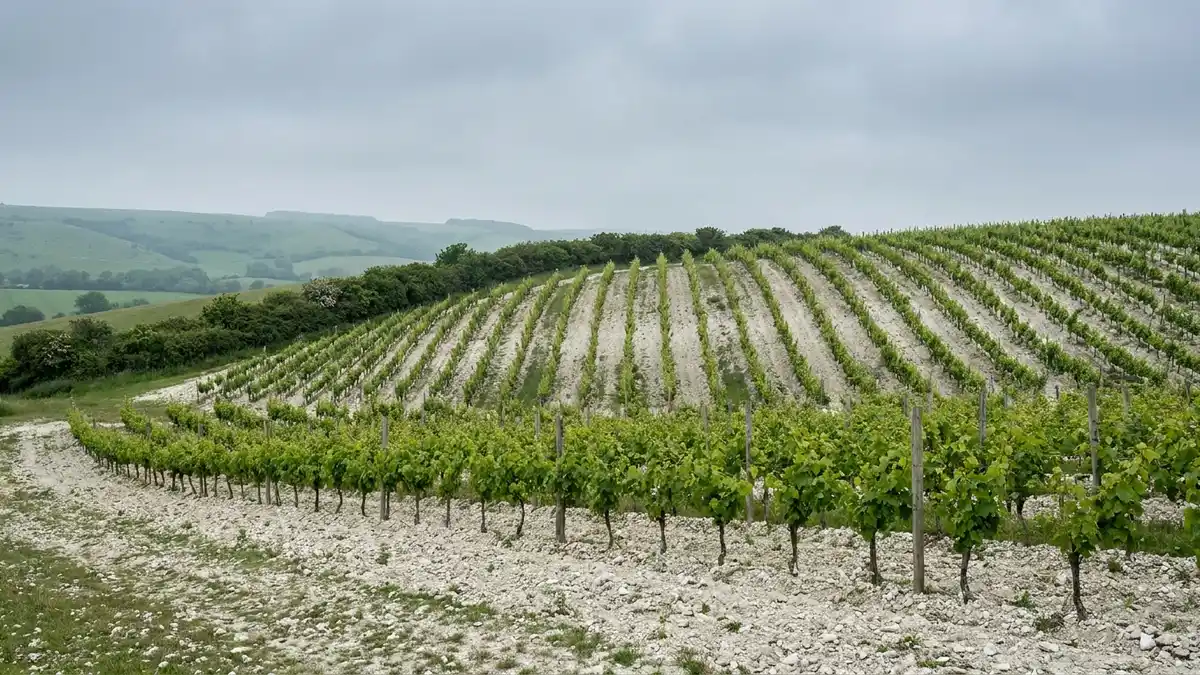
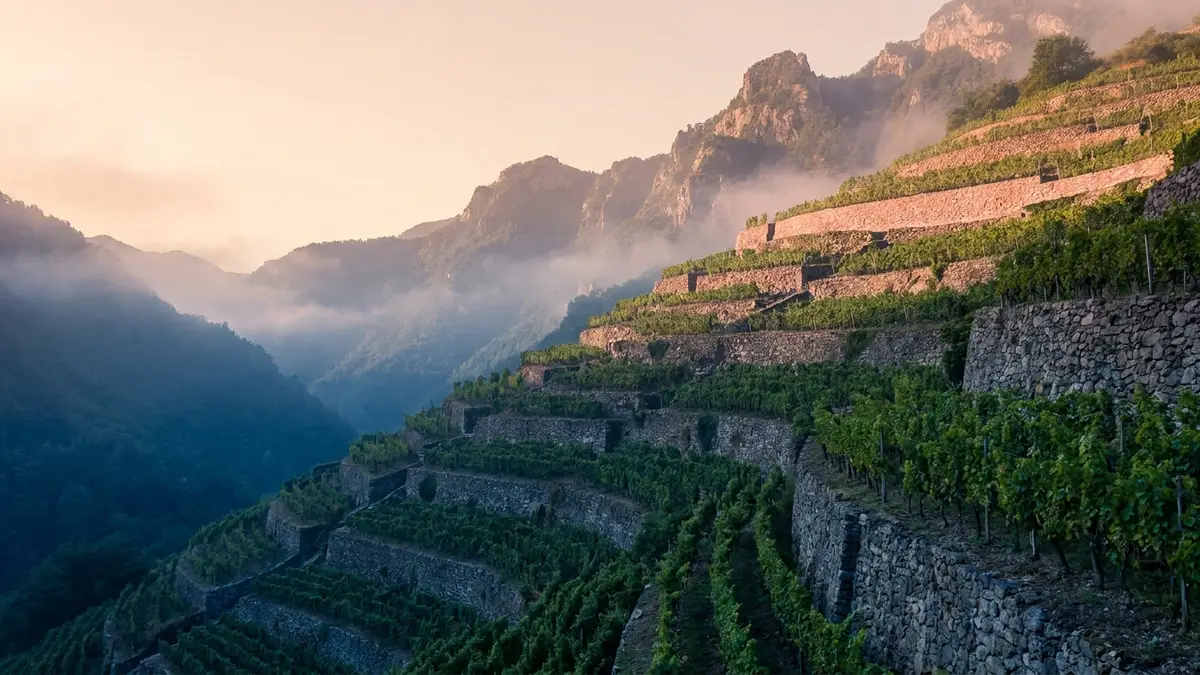
Height and distance from the equator work the same way: every step up a mountain or north on the map buys cooler nights. Tasmania, Poland, Sweden and others are mapped in emerging wine regions of the world.
How Are Winemakers Adapting?
By slowing the vine down. Van Leeuwen and Destrac-Irvine list three kinds of lever: the plant itself, the way it is grown, and where it is planted. Several small changes stacked together can delay ripening by roughly three weeks, which their modelling suggests may be enough until about 2050.
- Later-ripening grapes. In Bordeaux, Cabernet Sauvignon ripens about two weeks after Merlot. When the review was written, Merlot covered 58% of the region's vineyards and Cabernet Sauvignon only 20%, so there is room to swap. The Bordeaux blend grapes guide explains what each brings.
- New varieties. Bordeaux now allows four new red grapes, Marselan, Touriga Nacional, Castets and Arinarnoa, plus white grapes including Alvarinho, but only for wines labelled Bordeaux or Bordeaux Supérieur. In 2017 a trial vineyard in Bordeaux was testing 52 varieties for the future.
- Clones and rootstocks. A clone is a selected strain of one grape variety, and a rootstock is the root the vine is grafted onto. Growers once chose them to ripen early; now researchers urge late ones.
- Taller vines and fewer leaves. Raising the trunk lifts grapes away from the hot ground; trimming leaf area can slow sugar build-up.
- Cooler sites. Higher slopes, north-facing hillsides and soils that hold water.
The cellar adapts too. Champagne makers add more stored reserve wine to restore freshness, and some block malolactic conversion (a step where bacteria turn sharp malic acid into softer lactic acid) to keep acid in. Our guide to malolactic fermentation shows how much it softens a wine.
Which Grapes Cope Best With Heat?
Late-ripening, drought-tolerant grapes from hot Mediterranean regions cope best. Their sugar clock runs slowly enough that acid and flavour keep up, even in a hot summer. Early ripeners such as Merlot and Syrah, and sugar-heavy Grenache, are the grapes researchers suggest replacing.
Mourvèdre is one of the latest-ripening wine grapes there is. In the Languedoc it can replace early-ripening Syrah, or Grenache, which builds very high sugar. Touriga Nacional, Portugal's leading red grape, earned its place in Bordeaux for the same reason. Among Bordeaux's own grapes, Cabernet Sauvignon handles drought better than Merlot. The Mourvèdre and Touriga Nacional guides describe how each tastes.
Old Mediterranean bush vines, grown low without wires, also resist drought well, but they are being abandoned because harvest machines cannot pick them.
If you want a red from a hot place that still tastes fresh, pick one led by Mourvèdre or Touriga Nacional over one led by Grenache. Then check that the alcohol sits below 14.5%.
How Can You Taste the Shift Yourself?
Read the label for cool signals: altitude, a northern place name, a late-ripening grape, and alcohol under 13%. Then taste two wines of the same grape side by side, one with cool signals and one without. The alcohol in wine by type chart shows what is normal for each style.
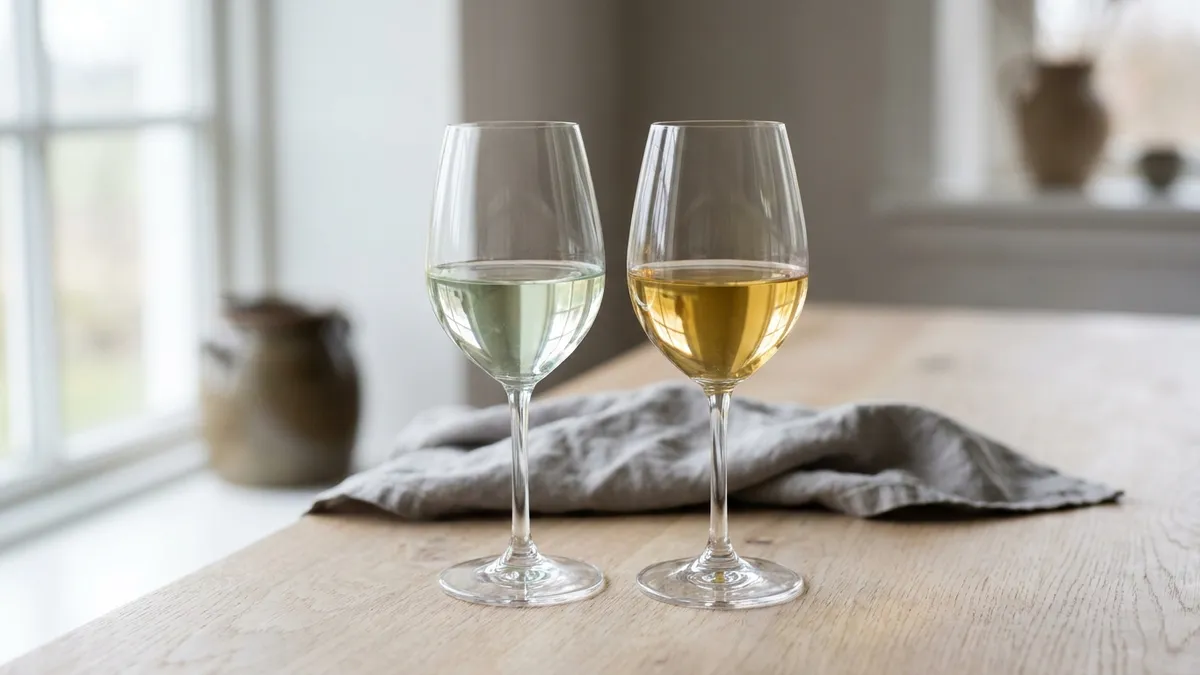
The vintage year matters more than it used to. Hot years now give softer, stronger wine even in cool regions, so the same label can taste different from one year to the next. What a wine vintage means explains how to read the year.
More styles shaped by where and how grapes grow sit in the wine styles hub, and Sommy has bite-sized courses on France, Spain, Italy and California. Tonight, before you pour, read the alcohol and the place on your bottle, guess whether it grew in heat, then taste and see if the acid agrees.
Sources
- The Conversation: Global warming is pushing wine harvests earlier, but not necessarily for the better (Cook and Wolkovich)
- National Geographic: In France, wine takes on the flavor of climate change
- Hannah et al. (2013), Climate change, wine, and conservation, PNAS
- van Leeuwen and Destrac-Irvine (2017), Modified grape composition under climate change conditions requires adaptations in the vineyard, OENO One
- EcoWatch: Climate change threatens Champagne’s unique taste
Frequently Asked Questions
How is climate change affecting wine?
Grapes now ripen earlier and in hotter weather, so they carry more sugar and less acid at harvest. That makes wines higher in alcohol and softer. Harvests in France and Switzerland have moved about 10 days earlier since 1981. Growers are answering with later-ripening grapes, taller vines and cooler hillside sites, and cool regions such as southern England are gaining ground.
Will climate change ruin wine?
No. The evidence points to wine moving and changing style, not disappearing. One 2013 study projects major regions losing 19 to 73% of their suitable land by 2050, depending on how fast emissions grow, while higher and more northern sites become usable. Researchers in Bordeaux argue that small changes in grapes and vine training can hold ripening back by about three weeks.
Why is wine getting more alcoholic?
Warmer ripening makes grapes store more sugar, and yeast turns that sugar into alcohol. Heat is not the only cause: researchers note growers have also been picking later, choosing riper fruit on purpose. Both push alcohol up. A label at 14.5% from a region that once made 12.5% wine tells you which way that producer and that season went.
Which wine regions benefit from climate change?
Cool places that used to struggle to ripen grapes in bad years. Southern England is the clearest case: its chalk soils, the same chalk that runs under Champagne, now ripen grapes for sparkling wine reliably enough that French Champagne houses have planted there. Higher vineyards in mountain regions and sites further from the equator are gaining too.
Does an early harvest mean a better vintage?
Not anymore. In France an early harvest used to signal a hot, dry, high-quality year. Researchers studying 400 years of harvest dates found that link has broken, because early harvests now happen in wet years as well as dry ones. The 2003 heatwave gave the earliest harvest in the whole record, about a month early.
Which grapes handle heat best?
Late-ripening, drought-tolerant grapes from hot Mediterranean regions. Mourvèdre is one of the latest-ripening wine grapes and could replace early Syrah and sugar-heavy Grenache in the Languedoc. Touriga Nacional from Portugal is now allowed in basic Bordeaux. Cabernet Sauvignon ripens about two weeks after Merlot, so Bordeaux growers can plant more of it.
Sommy Team
LinkedInFounder & Wine Educator
The Sommy Team is building the world's most approachable wine education app, helping beginners develop real tasting skills through structured courses and AI-guided practice.