What Is Malolactic Fermentation? The Buttery Chardonnay Secret

By the Sommy Team — AI-assisted, human-edited.
Updated Apr 29, 2026
Contents (12)
- The Hidden Step That Decides How Your Wine Feels
- Malolactic Fermentation, in 90 Seconds
- What Actually Happens Inside the Tank
- Why Lactic Acid Feels Softer Than Malic Acid
- The Butter Aroma Mystery, Solved
- Reds: Almost Always Yes
- Whites: A Style Decision
- A Brief History of the Buttery Backlash
- How to Taste It in the Glass
- What About Sparkling Wine?
- Why This Matters for How You Choose Wine
- Build the Skill, One Comparison at a Time
TL;DR
Malolactic fermentation is a secondary fermentation in which lactic acid bacteria convert sharp malic acid (think green apple) into softer lactic acid (think yogurt). The byproduct, diacetyl, is the same compound that gives popcorn its butter aroma. It is almost universal in red wines and stylistic in whites — fully on for buttery Chardonnay, blocked for crisp Chablis.
The Hidden Step That Decides How Your Wine Feels
Most beginners learn that wine is grape juice plus yeast (the full sequence is in how wine is made). Sugar goes in, alcohol comes out, and the result is wine. That is the headline version, and it covers maybe 80 percent of what happens in the cellar. The other 20 percent is where style is born — and at the centre of that 20 percent sits a quiet, second fermentation called malolactic fermentation wine geeks just shorten to "MLF" or "malo."
MLF is the reason a buttery Napa Chardonnay and a steely Chablis can be the same grape from the same year and feel like completely different beverages. It is the reason almost every red wine you drink has a smooth, rounded mouthfeel rather than tasting like sharp grape juice. And it is the reason your Sauvignon Blanc keeps that mouth-watering crackle from glass one to glass three.
This guide walks through what malolactic fermentation actually is, what it does to acid and aroma, why winemakers choose it for some wines and block it for others, and how to taste the difference yourself — without needing a chemistry degree or a wine cellar.
Malolactic Fermentation, in 90 Seconds
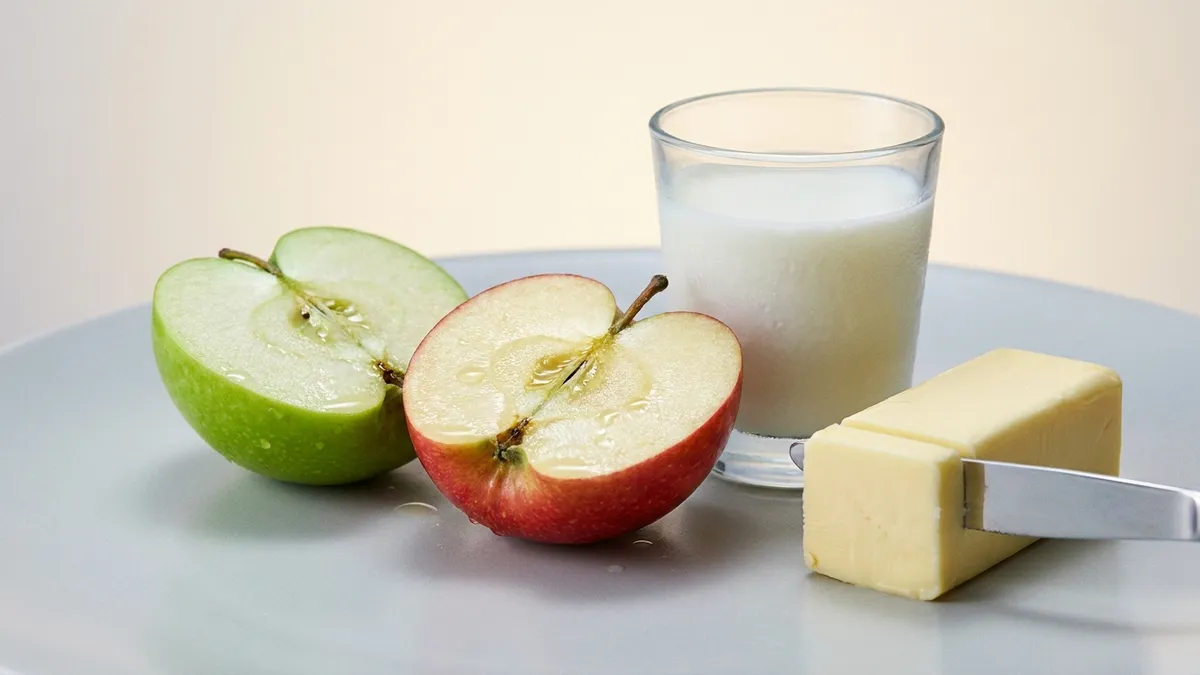
Malolactic fermentation wine chemistry is straightforward. After the primary alcoholic fermentation finishes, lactic acid bacteria — most often a strain called Oenococcus oeni — start eating the harsh malic acid that grapes carry naturally (the same crisp acid in green apples) and converting it into softer lactic acid (the gentle acid in yogurt and milk), releasing a small amount of CO2 along the way. The result is a wine with lower total acidity, a rounder mouthfeel, and often a creamy aroma from a byproduct called diacetyl that most people detect above roughly 4 milligrams per litre. Almost every red wine on earth goes through it. For white wines, it is a deliberate style choice that separates buttery Chardonnay from crisp, citrus-driven styles.
What Actually Happens Inside the Tank
When grapes are crushed, the juice is loaded with malic acid. Apples carry it, rhubarb carries it, and unripe grapes carry a lot of it. It is the acid that makes a Granny Smith apple feel sharp on the cheekbones rather than soft on the tongue.
Yeast finishes the alcoholic fermentation in roughly two to three weeks, and the wine is now technically wine — but it is also young, edgy, and high in malic acid. At this point the winemaker has a decision to make. Letting the bacteria in (or adding cultured strains) starts MLF. The bacteria convert each malic acid molecule into a lactic acid molecule, halving the acid's molecular impact and softening the texture noticeably.
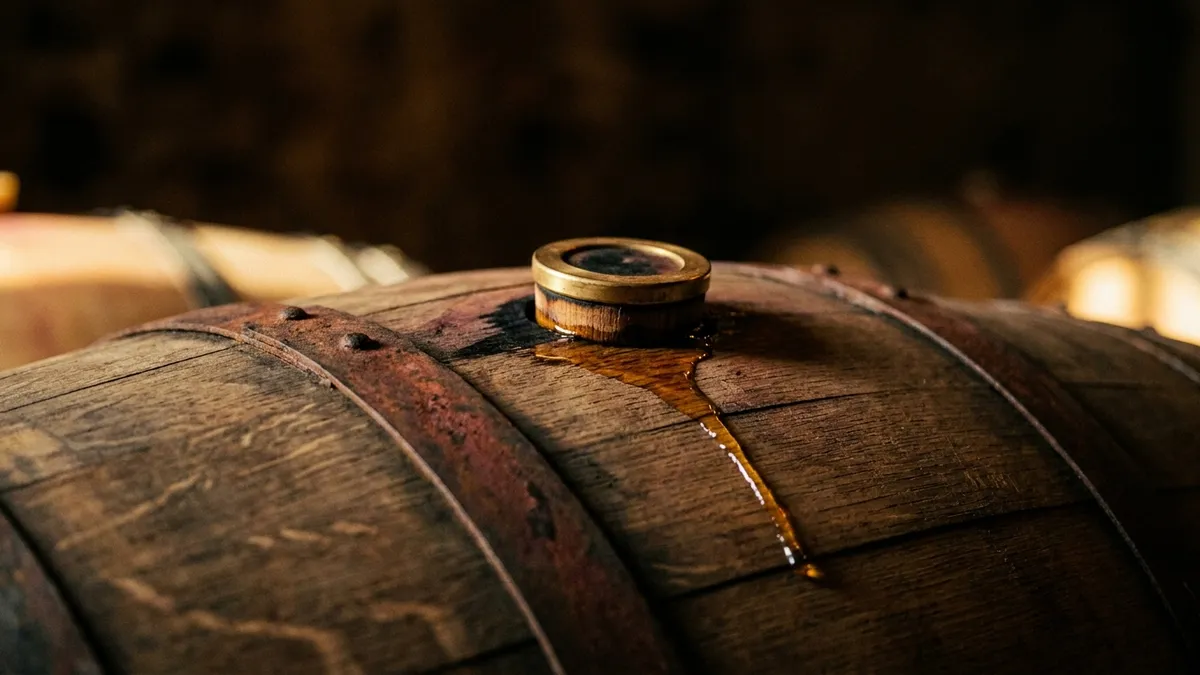
The conversion typically takes two to six weeks. It is slower in cool cellars, faster in warm ones, and often runs while the wine is already in oak barrels. The byproducts are subtle but defining: a small amount of CO2, trace diacetyl, and complex compounds that contribute to creamy, nutty, and slightly toasted notes on the nose. The malic acid disappears entirely if MLF goes to completion.
Why Lactic Acid Feels Softer Than Malic Acid
Acid in wine is not one thing. It is a family of acids — tartaric, malic, citric, lactic, succinic — and each one has a different texture on the palate.
Malic acid is sharp, green, and pointed. It hits the front of the tongue and the cheekbones like a lemon squeeze. Lactic acid is rounder, fuller, and gentler. It sits more on the mid-palate and feels closer to milk than to citrus.
Swapping one for the other does not just lower the numbers on a lab readout. It changes the wine's whole personality. A wine with high malic acid feels alert and electric. The same wine after full MLF feels generous and creamy. The grape variety, the alcohol, and the residual sugar are unchanged — only the acid profile has shifted, and yet the entire mouthfeel reads differently. For a deeper look at how acid interacts with body, our guide to wine mouthfeel covers the full picture.
The Butter Aroma Mystery, Solved
The single most famous side effect of MLF is the buttery aroma in oaked Chardonnay. That smell does not come from oak, even though most heavily oaked Chardonnays also smell like vanilla and toast.
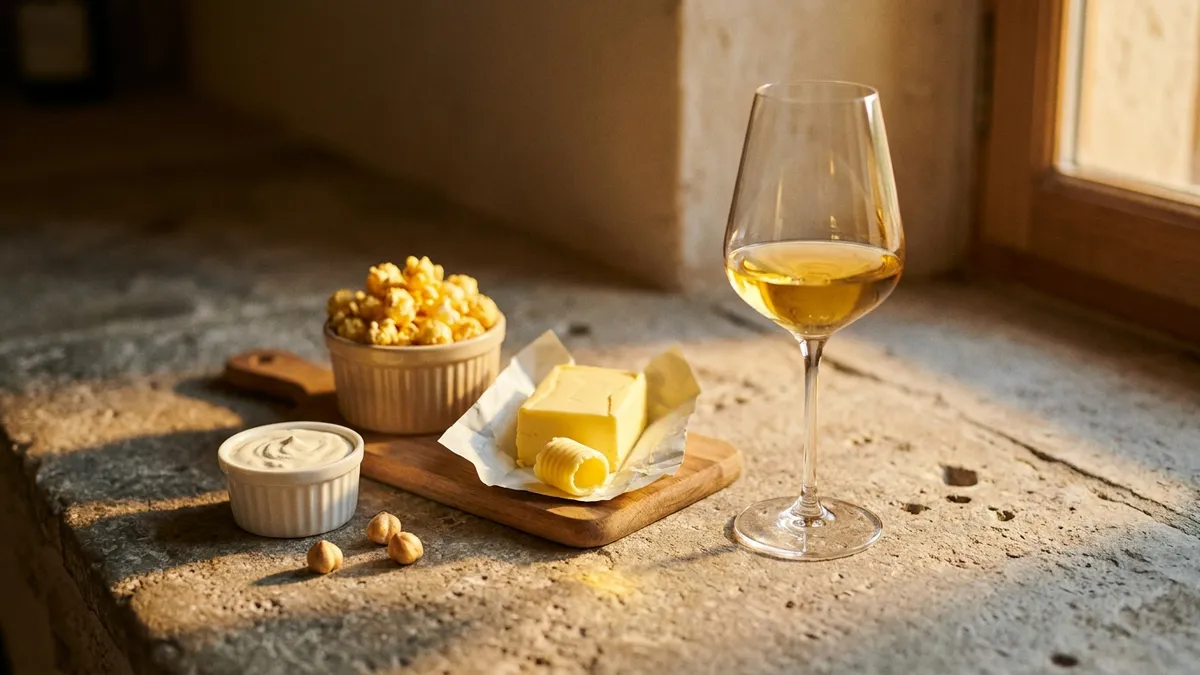
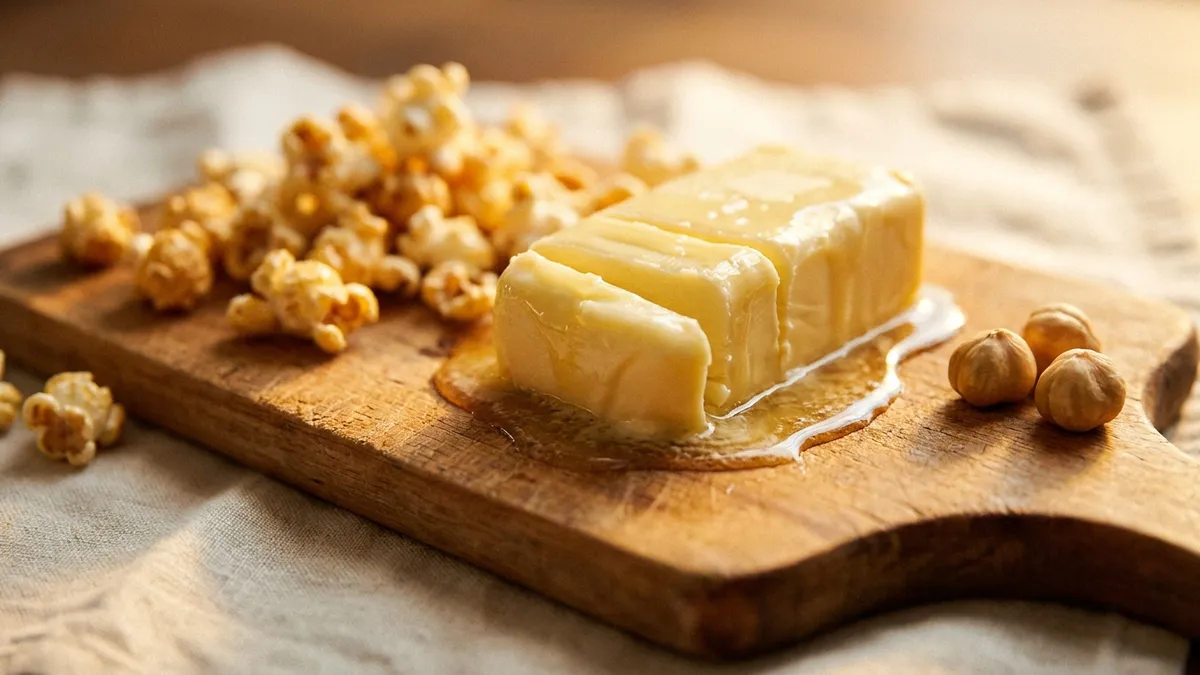
The butter comes from diacetyl, a chemical compound produced by lactic acid bacteria as they metabolise the malic acid. Diacetyl is literally the same molecule food companies use to flavour movie-theatre popcorn. Most human noses can detect it at concentrations above roughly 4 milligrams per litre — below that threshold, the wine just feels rounder; above it, the butter signal is unmistakable.
How much diacetyl ends up in the finished wine depends on a handful of factors: the bacterial strain, the temperature of the cellar, contact time with the lees (the dead yeast cells), and whether the winemaker stirs those lees regularly. Buttery California Chardonnays from the 1990s pushed this to the limit. Many leaned into 100 percent MLF, full new-oak ageing, and weekly bâtonnage (lees stirring) to maximise the creamy, popcorn-butter character that defined the era.
Reds: Almost Always Yes
Red wines almost universally go through malolactic fermentation. The reason is structural rather than aromatic. Reds are made with skin contact, which extracts tannin and pigment, and they often have lower natural acidity than whites because they tend to come from warmer sites or riper grapes.
A red wine that skipped MLF would feel sharp and green against its tannins, and the acidity-tannin contrast would be unbalanced. Worse, malic acid is metabolically attractive to wild bacteria, so an unfinished MLF in bottle can lead to spontaneous fermentation, off-flavours, and excess CO2 — a serious commercial defect, explained from the drinker's side in our guide to refermentation in the bottle.
Pinot Noir, Cabernet Sauvignon, Syrah, Sangiovese, Tempranillo, Nebbiolo — name a red grape, and its commercial wines will have completed MLF before bottling. The texture you associate with red wine — that integrated, smooth, savoury feel — is partly the grape, partly the oak, and partly the lactic acid that replaced the green-apple sharpness early in the wine's life. For more on how this builds the structure of a red, see our guide to Pinot Noir.
Whites: A Style Decision
This is where things get interesting. For white wines, MLF is a deliberate stylistic lever.
Full MLF — The Buttery Style
Full malolactic fermentation is the signature move of buttery, oaked Chardonnay. Combine 100 percent MLF with new oak ageing and weekly bâtonnage (lees stirring), and the wine ends up rich, creamy, and unmistakably buttery on the nose. White Burgundy from the Côte de Beaune — Meursault, Puligny-Montrachet, Chassagne-Montrachet — uses this approach with restraint. Many California Chardonnays use it more aggressively. The same toolkit, dialled differently. For a deeper dive into oak's role, see our oaked vs unoaked Chardonnay guide.
Blocked MLF — The Crisp Style
The opposite approach: deliberately stop MLF before it starts. Crisp white styles depend on bright, mouth-watering acidity, and the malic acid is often the structural anchor that gives them their signature sharpness.
Winemakers block MLF by chilling the wine below the bacteria's working temperature (around 16 °C / 60 °F), filtering the bacteria out, adding a touch of sulphur dioxide, or using lysozyme — an enzyme that disrupts bacterial cell walls. Done correctly, the malic acid stays intact, and the wine keeps the laser-focused acidity that defines the style. Keeping these bacteria out also protects sweetened wines: if they meet the preservative potassium sorbate, they produce the crushed-leaf smell of geranium taint.
This is the default for Riesling, Sauvignon Blanc, Albariño, Grüner Veltliner, and most Chablis-style Chardonnay. The whole point of these wines is the mouth-watering finish, and MLF would soften that finish into something less precise. To understand how this connects to grape varieties, check our Riesling guide and our Chardonnay vs Sauvignon Blanc comparison.
Partial MLF — The Modern Compromise
The newer, more nuanced approach is partial MLF. The winemaker lets a portion of the wine — say 30 to 50 percent — complete malolactic fermentation, then blocks the rest. The two batches are blended back together before bottling.
The result is a wine with some of the round, creamy texture of a malolactic style, but with enough malic acid intact to keep a fresh, lifted finish. This is increasingly the house style across modern California, Oregon, and Australia — a reaction against the heavy, full-MLF Chardonnays of the 1990s.
A Brief History of the Buttery Backlash
The story of malolactic fermentation in white wine is also the story of one of wine's most public style swings.
Through the 1980s and 1990s, California Chardonnay leaned harder and harder into full MLF, full new oak, and lavish lees ageing. The wines were rich, weighty, golden, and intensely buttery. Restaurant pours sometimes felt closer to liquid butterscotch than to grape juice.
By the early 2000s, the backlash had a name: ABC, short for Anything But Chardonnay. Drinkers tired of the heavy oak-and-butter signature started ordering Sauvignon Blanc, Pinot Grigio, and unoaked Chardonnays as a deliberate vote against the prevailing style.
The market responded. By the 2010s, leaner Chardonnays — partial MLF, partial oak, lower alcohol, brighter finish — became the new mainstream. Today, the average premium Chardonnay sits comfortably in the partial-MLF zone, balancing creamy texture with lifted acidity. Full-throttle butter bombs still exist, but they are now a deliberate stylistic choice rather than the default.
How to Taste It in the Glass
Recognising MLF in a wine is one of the most useful tasting skills you can develop, because it appears in nearly every wine you drink and most beginners cannot pinpoint it.
On the Nose
The cleanest tells are dairy and nut-derived aromas:
- Butter — popcorn butter, melted butter on toast
- Cream — fresh cream, crème fraîche
- Yogurt — plain yogurt, slightly tangy
- Hazelnut and almond — toasted, slightly oxidative
- Brioche or biscuit — especially in sparkling wines
If you smell only citrus, green apple, mineral, and floral notes with no creamy or buttery quality, the wine has likely had MLF blocked. For a refresher on identifying these notes systematically, see our how to smell wine guide.
On the Palate
Pay attention to how the finish behaves. A non-MLF white finishes with a sharp, mouth-watering signal that prompts you to take another sip almost immediately. A fully malolactic white finishes softer and rounder — the salivation reflex is calmer, and the wine sits longer on the mid-palate before fading.
Texturally, malolactic wines feel creamier and more viscous. The trade-off: they can sometimes feel slightly flat against rich food, where you would want the cleansing snap of malic acidity. To build vocabulary around these differences, our wine tasting vocabulary cheat sheet covers the language professionals use.
A Side-by-Side That Works
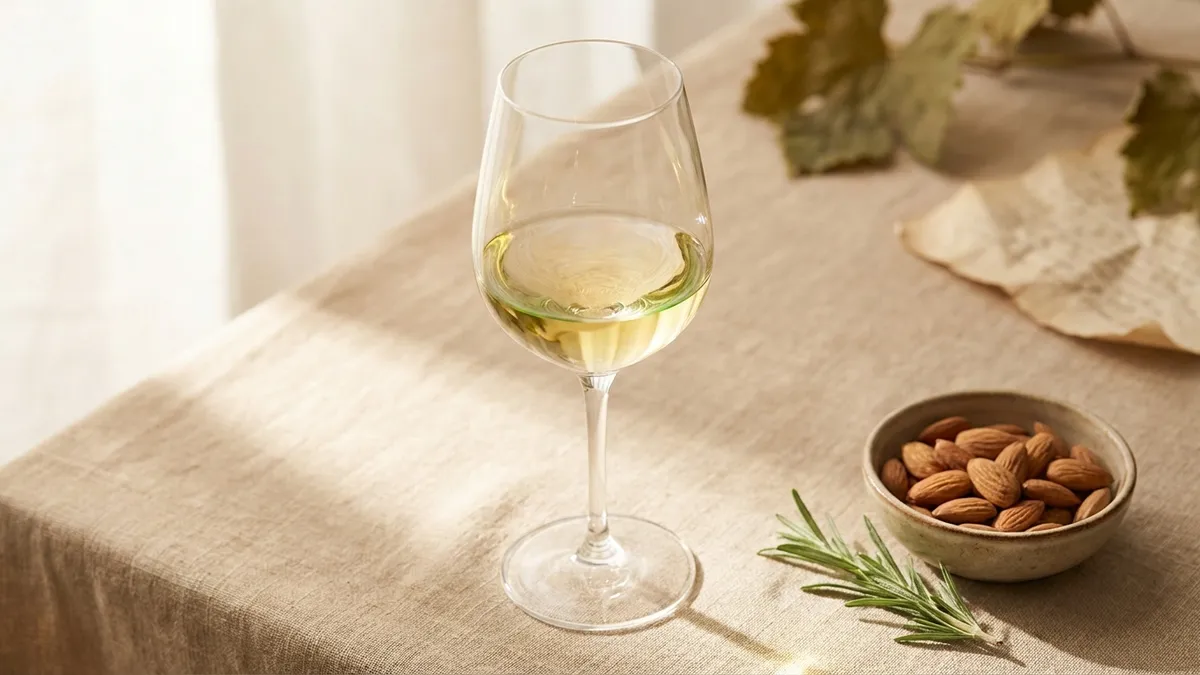
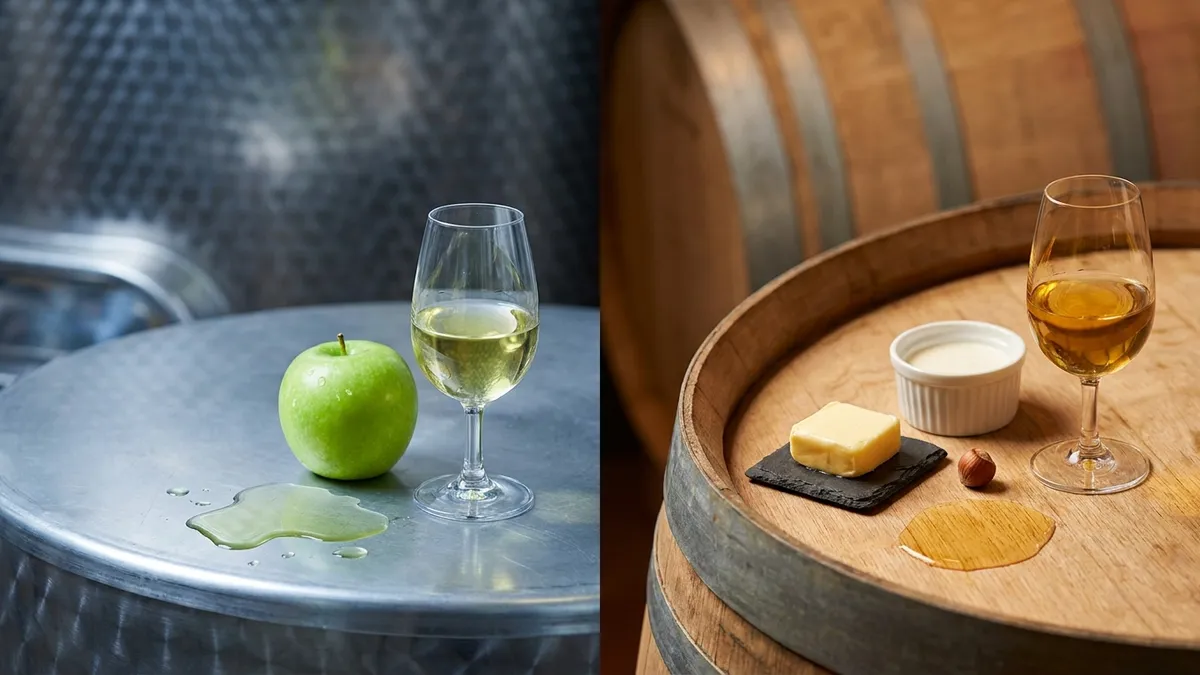
Pour two glasses: an oaked, full-MLF Chardonnay (look for "oaked" or a Côte de Beaune address on the label) and a stainless-steel Chablis or unoaked Chardonnay. Smell both before tasting. The malolactic glass will smell distinctly of butter and cream; the non-malolactic glass will smell of green apple, lemon, and stone. Then taste each — the difference in mid-palate texture and finish is the whole story of MLF in two sips.
What About Sparkling Wine?
Sparkling wine has a complicated relationship with MLF. Most traditional-method base wines — including Champagne — go through malolactic fermentation before the second fermentation in bottle. The reason is similar to red wine: high natural acidity in the cool Champagne climate would feel too aggressive in the finished bubbly without some softening.
But not all sparkling wines play this way. Some Loire-style sparkling producers, several English sparkling houses, and a handful of Champagne producers deliberately block MLF to preserve laser-focused acidity. The result is a tighter, more linear style that ages slowly and rewards patience. For the bigger picture on bubble styles, see our guide to Champagne vs Prosecco vs Cava.
Why This Matters for How You Choose Wine
Malolactic fermentation is one of those invisible variables that decides how a wine feels long before you read the label. Two Chardonnays from the same vineyard, the same year, and the same producer can taste like different beverages depending on this single decision.
Once you can spot it — buttery vs crisp, rounded vs zippy, hazelnut vs lemon — you have a new axis for navigating wine lists and shop shelves. A description like "creamy, rich, full-bodied" is almost always code for full MLF. "Crisp, mineral, mouth-watering" is almost always code for blocked MLF. The vocabulary on the back label suddenly tells you something concrete about how the wine will feel in your mouth.
Our wine glossary covers MLF alongside other essential terms like terroir, lees, and bâtonnage, so the language in tasting notes stops feeling like jargon and starts feeling like a useful map.
Build the Skill, One Comparison at a Time
The fastest way to internalise malolactic fermentation is to taste it deliberately, in pairs, with the variable isolated. One oaked Chardonnay and one Chablis. One Champagne and one non-MLF English sparkling. One Burgundian Pinot Noir and — well, that one is harder, since almost every Pinot Noir has gone through MLF, which is itself the lesson.
Sommy's structured tasting courses are built around exactly this kind of guided comparison. Each session isolates one variable — oak, MLF, body, climate — so the variable becomes a real reference in your palate library rather than an abstract idea on a page. Visit sommy.wine to start working through the building blocks of style, one calibrated comparison at a time. After a handful of side-by-sides, the buttery Chardonnay secret stops being a secret — it becomes a flavour you can name on sight, in any glass, anywhere.
Frequently Asked Questions
What is malolactic fermentation in simple terms?
Malolactic fermentation is a secondary process where lactic acid bacteria — usually a strain called Oenococcus oeni — convert the sharp malic acid in young wine into softer lactic acid, releasing carbon dioxide along the way. The wine ends up with lower acidity, a rounder mouthfeel, and often a buttery aroma from a byproduct called diacetyl.
Is malolactic fermentation the same as alcohol fermentation?
No. Alcoholic fermentation is the primary process where yeast turns grape sugar into alcohol. Malolactic fermentation is a separate, secondary process driven by bacteria, not yeast, and it changes acid rather than sugar. It usually starts after the alcoholic fermentation is finished, though some winemakers run them at the same time.
Which wines go through malolactic fermentation?
Almost all red wines undergo full malolactic fermentation because the softer acidity helps reds feel rounder and more drinkable. For whites, it is a style choice. Buttery Chardonnay, white Burgundy, and most traditional-method sparkling base wines go through it, while crisp styles like Chablis, Riesling, Sauvignon Blanc, and Albariño usually do not.
Why does Chardonnay taste buttery?
The butter aroma in Chardonnay comes from diacetyl, a compound produced by lactic acid bacteria during malolactic fermentation. Diacetyl is the same molecule that gives movie-theater popcorn its buttery smell. Most tasters can detect it above roughly 4 milligrams per liter, which is why fully malolactic Chardonnays smell so distinctly creamy and buttery.
Why do some winemakers skip malolactic fermentation?
When the goal is bright, crisp, mouth-watering acidity, malolactic fermentation works against the style. Riesling, Sauvignon Blanc, Albariño, and Chablis-style Chardonnay rely on sharp natural acidity as their signature, so winemakers either chill the wine, filter the bacteria out, or add lysozyme to block the conversion.
Does malolactic fermentation make wine sweeter?
No, but it can taste that way. Lactic acid is softer and less mouth-puckering than malic acid, so a wine that has gone through full malolactic fermentation often feels rounder and more generous on the palate. Residual sugar levels do not change, but the perception of sweetness can rise because acidity drops.
Can red wine be made without malolactic fermentation?
It is possible but rare. Red wines tend to have lower acidity than whites and benefit from the textural softening that malolactic fermentation brings. A red without it would taste sharp, green, and slightly unstable, with a high risk of spontaneous bacterial activity in bottle. Almost every commercial red has been through it.
How can I taste whether a wine has gone through malolactic fermentation?
Smell for butter, cream, yogurt, or hazelnut, and pay attention to mouthfeel — a malolactic wine feels rounder and less mouth-watering on the finish. A side-by-side of an oaked, fully malolactic Chardonnay and a stainless-steel Chablis is the fastest way to calibrate the difference. Sommy's structured tasting courses include exercises that train this comparison.
Sommy Team
LinkedInFounder & Wine Educator
The Sommy Team is building the world's most approachable wine education app, helping beginners develop real tasting skills through structured courses and AI-guided practice.