How Climate Shapes Wine Flavor: Warm vs Cool Climate Wines

By the Sommy Team — AI-assisted, human-edited.
Updated Apr 29, 2026
Contents (10)
- TLDR
- Warm vs Cool Climate Wine Taste, in 100 Words
- How Climate Classifications Work
- What Climate Does to the Grape
- Same Grape, Different Climate: Four Comparisons
- How Cool Climates Survive Heat: Altitude and Diurnal Shifts
- The Climate Change Question
- Reading Climate from the Glass
- Practice: Train Your Climate Palate
- Putting It All Together
TL;DR
Cool-climate wines (Burgundy, Mosel, Loire, Champagne, Marlborough) show high acid, lower alcohol around 11 to 12.5 percent, pale color, fresh red and citrus fruit, and herbal mineral lift. Warm-climate wines (McLaren Vale, Mendoza, Napa, Languedoc, Stellenbosch) show ripe black fruit, fuller body, softer acid, and 14 to 15.5 percent alcohol. The same grape tastes radically different by latitude and degree-days.
TLDR
Cool-climate wines (Burgundy, Mosel, Loire, Champagne, Marlborough) show high acid, lower alcohol around 11 to 12.5 percent, pale color, fresh red and citrus fruit, and herbal mineral lift. Warm-climate wines (McLaren Vale, Mendoza, Napa, Languedoc, Stellenbosch) show ripe black fruit, fuller body, softer acid, and 14 to 15.5 percent alcohol. The same grape tastes radically different by latitude and degree-days.
Warm vs Cool Climate Wine Taste, in 100 Words
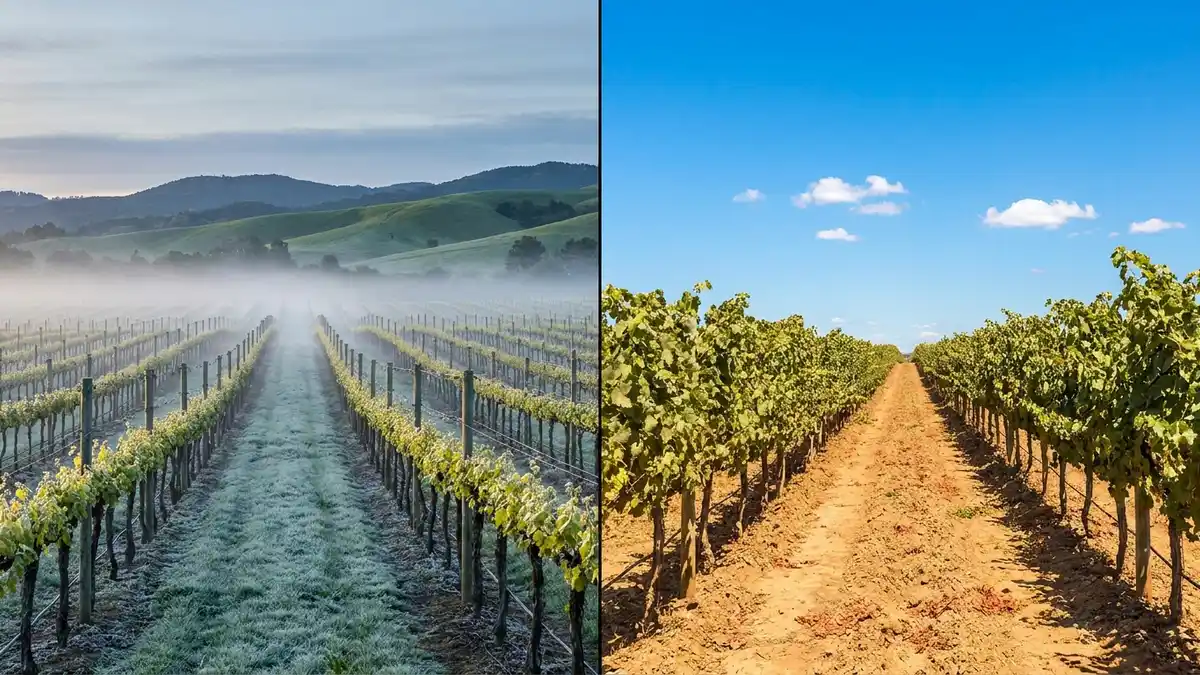
The warm vs cool climate wine taste difference comes down to ripeness physics. Cool sites — Burgundy, the Mosel, Loire, Champagne, Marlborough — give you wines with high acidity, lower alcohol of 11 to 12.5 percent, paler color, lighter body, and fresh primary fruit (red cherry, citrus, green apple, herbal, mineral). Warm sites — McLaren Vale, Mendoza, Stellenbosch, Napa, Languedoc — give you the opposite: softer acid, alcohol of 14 to 15.5 percent, saturated color, full body, ripe or jammy black fruit, and riper tannin. Same grape, different climate, radically different bottle. The defining axis is degree-days, mean July temperature, latitude, and altitude.
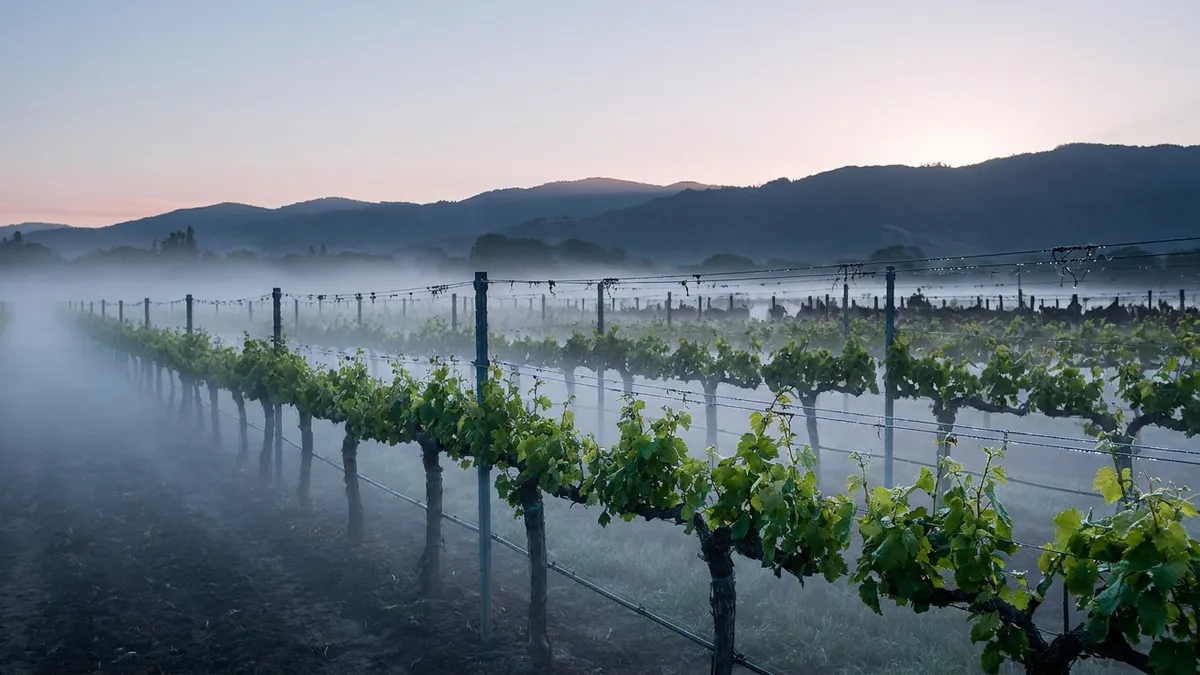
How Climate Classifications Work
Wine science has spent decades trying to put a number on climate. Two systems dominate the conversation: Winkler (developed at UC Davis) and Huglin (developed in Alsace).
Winkler Regions
The Winkler index sums growing degree-days — daily mean temperatures above 50 degrees Fahrenheit, totaled across the April-to-October growing season — and slots regions into five buckets:
- Region I (under 2,500 GDD) — cool. Champagne, the Mosel, Burgundy, Tasmania, Marlborough, Willamette Valley
- Region II (2,500 to 3,000 GDD) — moderate-cool. Bordeaux, the Rhine, parts of Tuscany, Russian River
- Region III (3,000 to 3,500 GDD) — moderate-warm. Northern Rhone, Rioja, Napa Valley, parts of Mendoza
- Region IV (3,500 to 4,000 GDD) — warm. Southern Rhone, Languedoc, McLaren Vale, Stellenbosch
- Region V (over 4,000 GDD) — hot. Central Valley California, La Mancha, parts of Sicily and inland Argentina
Each Winkler band corresponds to a different ripeness window and a different set of grapes that perform well there.
Huglin Index
The Huglin index adjusts Winkler for daylight hours and uses daily maximum temperatures rather than means. It tends to read European cool sites slightly warmer than Winkler does, which fits how those regions actually ripen wine in practice. Both systems agree on the broad ordering — Champagne is cooler than Burgundy, which is cooler than Bordeaux, which is cooler than the Languedoc.
Mean July Temperature and Latitude
Two simpler proxies. Mean July temperature under 64 degrees Fahrenheit usually means cool climate. Sixty-four to 70 degrees is moderate. Above 70 is warm. Latitude matters too — most premium wine regions sit between 30 and 50 degrees north or south, with cooler sites at the high-latitude edges and warmer sites near the equatorial limit. Those edges are moving, which is why emerging wine regions now stretch from southern Sweden to tropical Thailand.
What Climate Does to the Grape
Climate decides four things inside the berry, and each one shows up in the glass.
Sugar Accumulation
Heat drives photosynthesis and sugar storage. Warm-climate grapes accumulate sugar fast — sometimes faster than the rest of the grape can keep up with. Sugar at harvest determines potential alcohol after fermentation, which is why warm-climate wines almost always run higher in alcohol than cool-climate wines from the same variety. Warming is pushing that sugar up even in cool regions, as climate change and wine explains.
Acid Retention
Grapes hold onto malic and tartaric acid through cool nights and a long ripening period. Hot days followed by hot nights burn acid off through respiration. Cool sites keep acid intact even at full ripeness. That is why a Mosel Riesling at 11 percent alcohol can carry razor-sharp acidity, while a McLaren Vale Shiraz at 15 percent often needs added acid to feel balanced.
Phenolic Ripeness
Phenolic ripeness — the maturity of skins, seeds, and stems — runs on a slightly different clock than sugar. In cool climates the grape can hit target sugar before tannins and pigments fully soften, leaving green or harsh tannin. In warm climates phenolic ripeness usually arrives well before the producer wants to pick, giving rounder tannin but risking over-ripe fruit. The best growers chase the moment when sugar, acid, and phenolic ripeness all align.
Aromatic Compounds
Climate also shifts which aroma molecules dominate. Cool sites preserve methoxypyrazines (the green-bell-pepper compounds in Cabernet, Sauvignon Blanc, and Cabernet Franc) and thiols (passionfruit and grapefruit notes in Sauvignon Blanc). Warm sites burn pyrazines off, push fruit into baked and stewed territory, and elevate norisoprenoids (the dried-fruit, tobacco, and leather compounds of mature warm-climate reds).
For a deeper look at how grape ripeness shows up on the palate, see ripe vs green fruit in wine — climate is the single biggest driver of where a wine lands on that ripeness ladder.
Same Grape, Different Climate: Four Comparisons
The cleanest way to feel the warm vs cool climate divide is to taste the same grape from opposite ends of the spectrum.
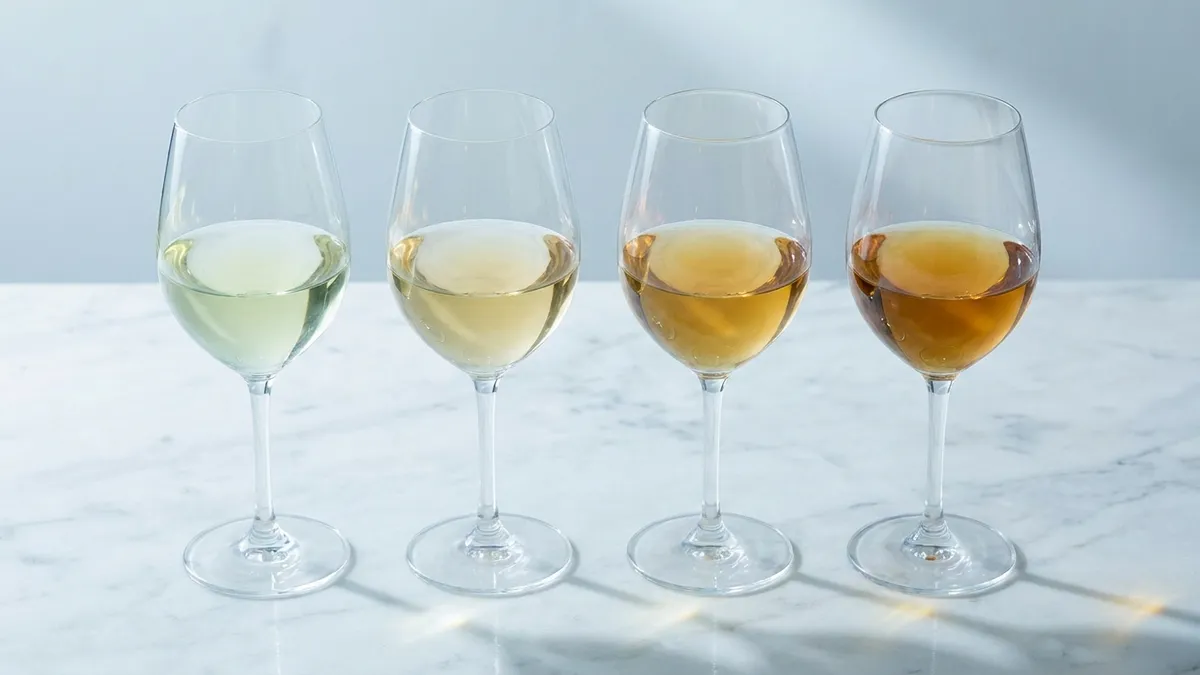
Chardonnay: Chablis vs Napa
| Trait | Chablis (cool) | Napa Valley (warm) |
|---|---|---|
| Alcohol | 12 to 12.5 percent | 14 to 14.5 percent |
| Acid | High, mouthwatering | Soft, ripe |
| Body | Light to medium | Full |
| Fruit | Green apple, lemon, oyster shell | Pineapple, mango, baked apple |
| Other | Flinty, chalky mineral edge | Vanilla and butter from oak, creamy texture |
Same grape. Same winemaking goal of dry white. Different climate, different wine.
Pinot Noir: Burgundy vs Sonoma Coast
| Trait | Burgundy (cool) | Sonoma Coast (warm-leaning) |
|---|---|---|
| Alcohol | 12.5 to 13 percent | 13.5 to 14.5 percent |
| Acid | High | Medium |
| Color | Pale ruby | Deeper ruby |
| Fruit | Red cherry, cranberry, forest floor | Black cherry, plum, cola |
| Tannin | Fine, subtle | Riper, plumper |
The Sonoma Coast is moderated by Pacific fog, which makes it cooler than inland California, but it still reads warmer than Burgundy on every metric.
Cabernet Sauvignon: Bordeaux vs Coonawarra
| Trait | Bordeaux (moderate) | Coonawarra Australia (warm) |
|---|---|---|
| Alcohol | 13 to 13.5 percent | 14 to 14.5 percent |
| Acid | Medium-plus | Medium |
| Fruit | Cassis, cedar, gravel, sometimes a touch of green pepper | Ripe blackberry, mint-eucalyptus, mocha |
| Tannin | Firm, structured | Plumper, softer |
| Aging | Built for 15 plus years | Approachable earlier |
The classic dividing question — does your Cabernet smell of cassis and gravel or of jammy blackberry — is climate, not just style. Our Cabernet Sauvignon vs Merlot guide unpacks the variety side of that question.
Riesling: Mosel vs Clare Valley
| Trait | Mosel (very cool) | Clare Valley Australia (warm-dry) |
|---|---|---|
| Alcohol | 7.5 to 11 percent (off-dry) or 11.5 to 12.5 percent (dry) | 12 to 13 percent |
| Acid | Very high, electric | High but less searing |
| Fruit | Lime, green apple, slate, white peach | Lime, kerosene, orange peel, dried apricot |
| Sweetness | Often off-dry | Almost always bone dry |
Mosel Riesling is the textbook cool-climate white. Clare Valley Riesling shows the same grape under warmer skies — still high-acid, but with dried-fruit ripeness instead of green-apple snap.
For more on what's happening in the Riesling wine guide, the variety adapts to climate without losing its identity, which is why it travels from Germany to Australia and back so successfully.
How Cool Climates Survive Heat: Altitude and Diurnal Shifts
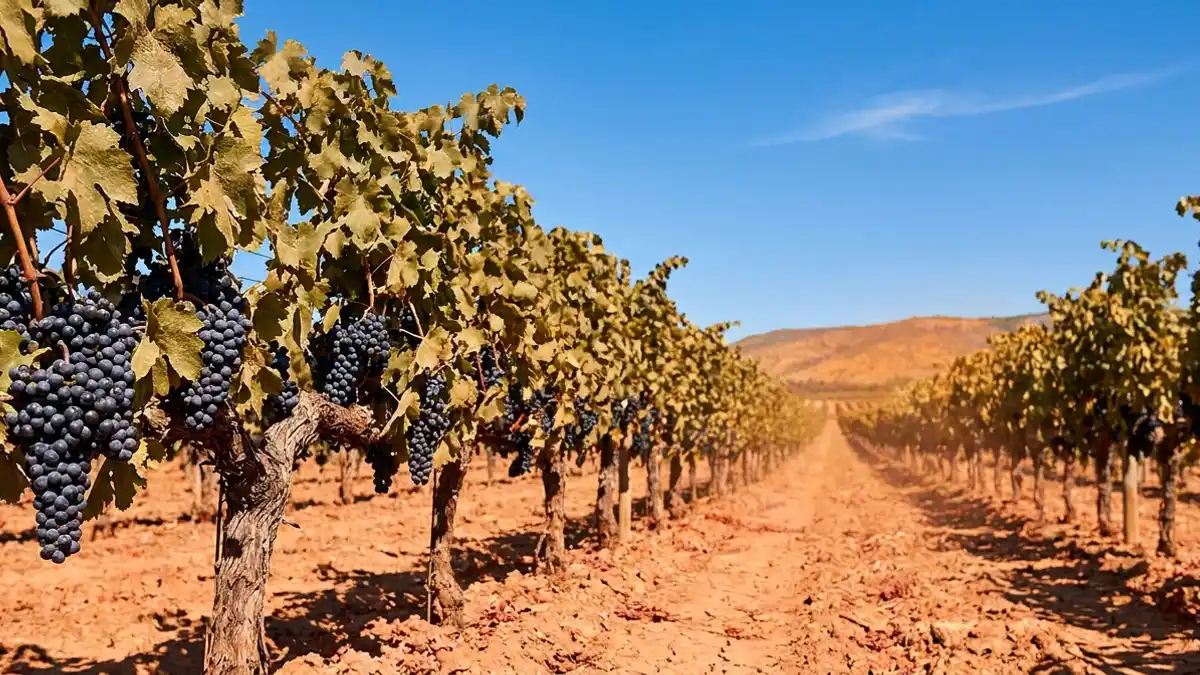
Cool climate is not only about latitude. Altitude acts as a powerful equalizer. Mendoza's most prized Malbec vineyards sit between 3,000 and 5,000 feet, where the temperature drops sharply at night even as daytime sun ripens fruit fully. Why the climb works, and where it does not, is covered in high altitude wine. The same logic applies to Mount Etna in Sicily, the high vineyards of Cafayate in northern Argentina, and parts of Priorat in Spain.
The mechanism is diurnal shift — the gap between daily high and daily low temperature. A wide diurnal shift gives you warm-climate ripening in the day and cool-climate acid retention at night. The result is a hybrid profile: full color, ripe fruit, and bright acid in the same bottle.
Coastal influence works the same way. Marlborough and Sonoma Coast both sit at latitudes that would normally produce warm wines, but ocean fog and breeze pull mean temperatures down by several degrees. Casablanca Valley in Chile, the Limari Valley further north, and the Swartland's coastal subregions in South Africa all use Pacific or Atlantic cooling to produce wines that read cooler than their latitude predicts.
The Climate Change Question
Climate classification used to feel stable. It no longer does. Average growing-season temperatures across most premium wine regions have risen roughly 1 to 2 degrees Celsius over the past 40 years, and the effects are visible in the glass.
- Burgundy harvest dates have moved 2 to 3 weeks earlier since the 1980s. Vintages that would once have been declared too ripe are now considered standard
- Champagne has crossed ripeness thresholds that were almost unattainable in the 1970s. Producers now occasionally need to acidify rather than chaptalize
- Bordeaux is seeing higher alcohols across the board. Some growers are testing later-ripening Mediterranean varieties as future replacements for Cabernet
- Southern England is now producing world-class sparkling wine on chalky soils that used to be too cold for serious viticulture
- Hot regions at the warm edge are pushing into territory that risks losing freshness — McLaren Vale and Languedoc producers are increasingly planting at altitude to preserve elegance
This shifts how to read older guides. A region that was firmly Region II in 1990 may now read as Region III. The cool-warm spectrum is real, but the line is moving.
For more on how regional identity is shifting, see new world vs old world tasting style — a lot of that historic distinction was really a climate distinction in disguise.
Reading Climate from the Glass
Once you know what climate does to a wine, you can reverse-engineer it without looking at the label. Four cues do most of the work.
Acid
Cool climate wines make you salivate. The acid is bright, mouthwatering, and persistent. Warm climate wines feel softer on the palate — you may notice a fuller body but less of that acid lift at the finish. For a deeper dive on this cue, see what is wine acidity.
Alcohol
Under 13 percent on the label almost always means cool climate or early picking. Over 14 percent almost always means warm climate or late picking. Between 13 and 14 percent is the moderate middle, where most balanced wines sit.
Color and Body
Pale color and lighter body track with cool climates. Saturated color and full body track with warm climates. A pale ruby red is cool. A deep, opaque purple is warm.
For more on this side of the picture, what is wine body goes deeper on how climate, alcohol, and extraction combine to give a wine its weight.
Fruit Profile
This is the most specific cue. Cool wines lead with green and red fruit — green apple, lime, gooseberry, red cherry, cranberry, raspberry — plus herbal and mineral notes. Warm wines lead with black and tropical fruit — blackberry, fig, prune, mango, dried apricot — plus baking spice and dried herb.
The Sommy app at https://sommy.wine/ lets you tag fruit profile and structure as you taste, then surfaces the climate signal that's repeating across your bottles. Over time you build a personal map of which climate styles you actually reach for.
Practice: Train Your Climate Palate
Reading about it is one step. Tasting it is the only way to lock the difference into your palate.
A Side-by-Side Flight
The fastest learning loop is two bottles of the same grape from opposite climate poles. Strong pairings to try:
- Chardonnay: Chablis or Macon-Villages next to a Napa or Sonoma Chardonnay
- Pinot Noir: A village-level Burgundy next to a Sonoma Coast or Central Otago Pinot
- Cabernet Sauvignon: A Saint-Julien or Margaux next to a Coonawarra or Napa Cabernet
- Riesling: A Mosel Kabinett next to a Clare Valley or Eden Valley dry Riesling
- Syrah / Shiraz: A northern Rhone Crozes-Hermitage next to a Barossa or McLaren Vale Shiraz — the Syrah vs Shiraz guide covers this exact climate split
Pour both wines, take notes, then compare. The difference in acid, alcohol, color, and fruit will be immediate — and once you've felt it in two grapes, the third and fourth become obvious.
What to Track in Your Notes
For climate practice, focus on four columns in your tasting notebook:
- Acid intensity (1 to 5)
- Alcohol perception (light, medium, hot)
- Fruit ripeness tier (green, fresh, ripe, jammy)
- Body (light, medium, full)
Repeated entries across regions build the pattern. The develop your wine palate guide covers a broader practice plan, and climate recognition slots into it cleanly.
Putting It All Together
Climate is the single biggest variable in wine that does not appear on the front label. Two bottles can carry the same grape, the same vintage, and the same producer's name, and still taste like different wines because they came from different climate zones. Once you can read the cues — acid, alcohol, color, fruit profile — every bottle starts telling you where it came from before you reach the back label.
A glass of pale ruby Pinot at 12.5 percent alcohol with searing acid and red cherry fruit is a Burgundy or a cool-climate New World cousin. A glass of inky purple Shiraz at 15 percent alcohol with stewed blackberry and chocolate is a warm site like Barossa or McLaren Vale. The same axis runs through Chardonnay, Cabernet, Riesling, and every other grape that travels.
The Sommy app guides this kind of practice through structured side-by-side tastings and regional flights, so the warm-cool axis becomes second nature instead of trivia. Pair it with a few real bottles from opposite ends of the spectrum, and the question of climate stops being abstract — it starts being the most useful single signal you can pull from a glass.
Frequently Asked Questions
What is the difference between warm and cool climate wine?
Cool-climate wines come from regions with shorter, cooler growing seasons such as Burgundy, the Mosel, Champagne, the Loire, and Marlborough. They show high acidity, lower alcohol of 11 to 12.5 percent, pale color, lighter body, and fresh red or citrus fruit. Warm-climate wines from McLaren Vale, Mendoza, Napa, Languedoc, and Stellenbosch show riper black fruit, fuller body, softer acid, and 14 to 15.5 percent alcohol.
How does climate affect wine taste?
Climate sets how much sugar, acid, and aromatic compound a grape accumulates. Warmer sites push sugar higher (more alcohol), drop acidity, and shift fruit from green and red toward black and jammy. Cooler sites preserve acid, keep alcohol modest, and hold fruit at the green-and-red end of the spectrum. Color, body, and tannin ripeness all follow the same axis.
What is considered a cool climate wine region?
Wine science uses several thresholds. Winkler Region I (under 2,500 growing degree-days Fahrenheit) and Region II classify as cool to moderate-cool. Mean July temperatures below 64 degrees Fahrenheit also indicate cool climate. Classic examples include Burgundy, Champagne, the Mosel, the Loire Valley, England, Marlborough, Tasmania, and parts of Oregon and Germany.
What grapes grow best in warm climates?
Late-ripening varieties that need long, hot seasons thrive in warm climates: Grenache, Mourvedre, Zinfandel, Malbec, Tempranillo, Nero d'Avola, and Cabernet Sauvignon at moderate-to-warm sites. Cool-loving grapes like Pinot Noir, Riesling, and Chardonnay can also grow in warm regions but produce richer, riper, more alcoholic versions that read very differently from their cool-climate counterparts.
Why does the same grape taste different in different climates?
Sugar accumulates with heat, while acid retention depends on cool nights and a long, even ripening period. A grape grown in a warm region piles up sugar fast and loses acid, producing a rich, high-alcohol wine. The same grape in a cooler region accumulates less sugar, holds more acid, and develops different aromatic compounds, producing a leaner, fresher wine.
Does altitude make a warm climate behave like a cool one?
Partly. Temperature drops about 1 degree Fahrenheit per 300 feet of elevation, and high-altitude vineyards in Mendoza, Etna, or Cafayate get strong diurnal swings — hot days, cold nights — that preserve acid while still allowing full ripening. The result is a hybrid profile: ripe fruit and full body from the heat, plus the bright acid usually associated with cooler sites.
How is climate change affecting cool climate wine regions?
Burgundy, Champagne, and Bordeaux have all moved harvest dates 2 to 3 weeks earlier over the past 40 years. Champagne now regularly hits ripeness levels that were rare in the 1980s. Some producers in classic cool-climate regions are planting later-ripening varieties or moving to higher elevations. Newly viable cool regions, including southern England and parts of Denmark, are now producing serious sparkling wine.
How can I tell if a wine is from a warm or cool climate by tasting it?
Check four cues. High acid that makes you salivate plus alcohol under 13 percent points to cool. Soft, gentle acid plus alcohol over 14 percent points to warm. Pale ruby or pale lemon color points to cool; deep purple or deep gold points to warm. Fresh red cherry, citrus, and herbal notes point to cool; jammy black fruit and dried fig point to warm.
Sommy Team
LinkedInFounder & Wine Educator
The Sommy Team is building the world's most approachable wine education app, helping beginners develop real tasting skills through structured courses and AI-guided practice.