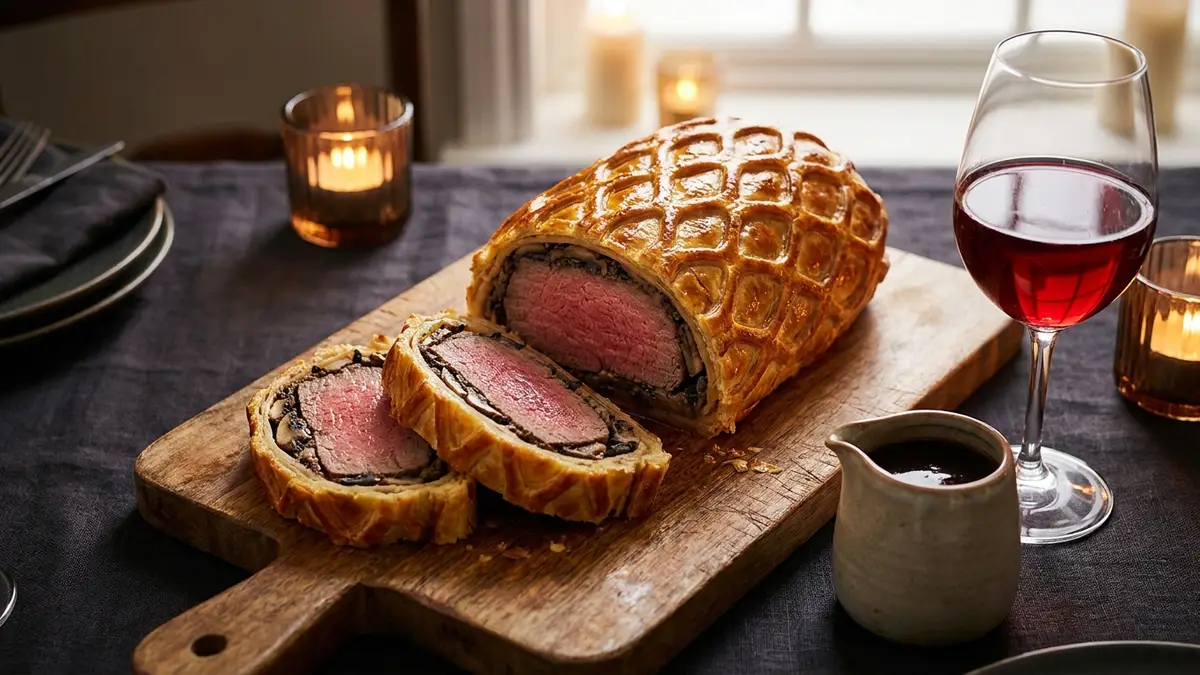
Wine with Beef Wellington: The Showpiece Roast Pairing

By the Sommy Team — AI-assisted, human-edited.
Updated Oct 1, 2026
Contents (9)
- What Wine Goes with Beef Wellington, in One Paragraph?
- Which Wine Should You Pour With Your Wellington?
- Why Is Beef Wellington Hard to Pair?
- Is Pinot Noir the Best Wine for Beef Wellington?
- Which Bordeaux Goes With Beef Wellington?
- How Do the Duxelles, Pâté and Pastry Change the Pick?
- Can You Serve White or Sparkling Wine With Beef Wellington?
- How Should You Serve the Wine on the Night?
- How Do You Test the Pairing Before the Big Night?
TL;DR
Beef Wellington is a lean fillet wrapped in mushroom paste and buttery pastry, so it wants a medium-bodied red with soft tannin and fresh acidity. Pour Pinot Noir with a plain or lightly sauced slice and Merlot-led Right Bank Bordeaux with a red wine sauce. Keep Cabernet for rare, peppered Wellingtons.
Wine with beef Wellington should be a medium-bodied red with soft tannin and fresh acidity, because the dish is a lean fillet wrapped in mushroom paste and buttery pastry. Pinot Noir and Merlot-led Bordeaux fit it. The biggest Cabernet in the shop tends to taste harsh beside it, and a thin, cheap red disappears under the butter.
What Wine Goes with Beef Wellington, in One Paragraph?
The best wine with beef Wellington is Pinot Noir for a plain or lightly sauced slice, and Merlot-led Right Bank Bordeaux when a red wine or Madeira sauce comes with it. Both are medium-bodied, with soft tannin (the drying grip on your gums) and enough acidity (the tartness that makes your mouth water) to cut pastry butter. Save Cabernet-led Left Bank Bordeaux for a rare Wellington with a mustard or pepper layer, and decant it an hour before carving. A full, oaked Chardonnay suits a mushroom-only Wellington, and dry sparkling wine covers the starters.
Which Wine Should You Pour With Your Wellington?
Pick by what sits on the plate beside the slice, because the sauce and the extra layers move the wine more than the beef does. The fillet itself is mild. A jus (a thin sauce made from the roasting juices) changes little; a reduced red wine sauce adds weight the wine must match.
| On the plate | What it asks of the wine | Pour | Skip |
|---|---|---|---|
| Plain slice or a light jus | Soft tannin, fresh acidity, earthy flavour | Pinot Noir, ideally from Burgundy or another cool region | Young Cabernet Sauvignon |
| Red wine or Madeira sauce | More weight and ripe plum fruit, still gentle grip | Right Bank Bordeaux: Saint-Émilion or Pomerol | Light, tart reds the sauce flattens |
| Mustard or black pepper layer, beef served rare | Firmer structure | Left Bank Bordeaux from Pauillac or Margaux, decanted an hour | Very light Pinot Noir |
| Prosciutto or pâté layer | Acidity to cut salt and fat | Cool-climate Pinot Noir | Soft, jammy reds above 14% |
| Mushroom-only Wellington | Low tannin, body to match butter | Pinot Noir or a full, oaked Chardonnay | Tannic young reds |
| Canapés before the roast | Bubbles and acidity | Dry sparkling wine labelled Brut | Sweet sparkling wine |
If you open one bottle for a mixed table, make it Pinot Noir, which covers three of the six rows. If the cook is making a red wine or Madeira sauce, buy a Right Bank Bordeaux instead.
Why Is Beef Wellington Hard to Pair?
Beef Wellington stacks four layers with four different demands. At its simplest it is beef fillet and duxelles (minced mushrooms cooked down in butter to a paste) wrapped in puff pastry. Many cooks add a layer of prosciutto or pâté, a brush of mustard, or a thin crêpe that keeps the pastry dry.
Start with the beef. Tannin binds to proteins, which is why a young red dries your mouth: it grabs the proteins in your saliva. With protein-rich food the tannin binds to the food instead and comes across as softer. That is why big reds work with a fatty ribeye. Fillet is one of the leanest cuts, and a Wellington slice is mostly mushroom and pastry around a modest round of meat.
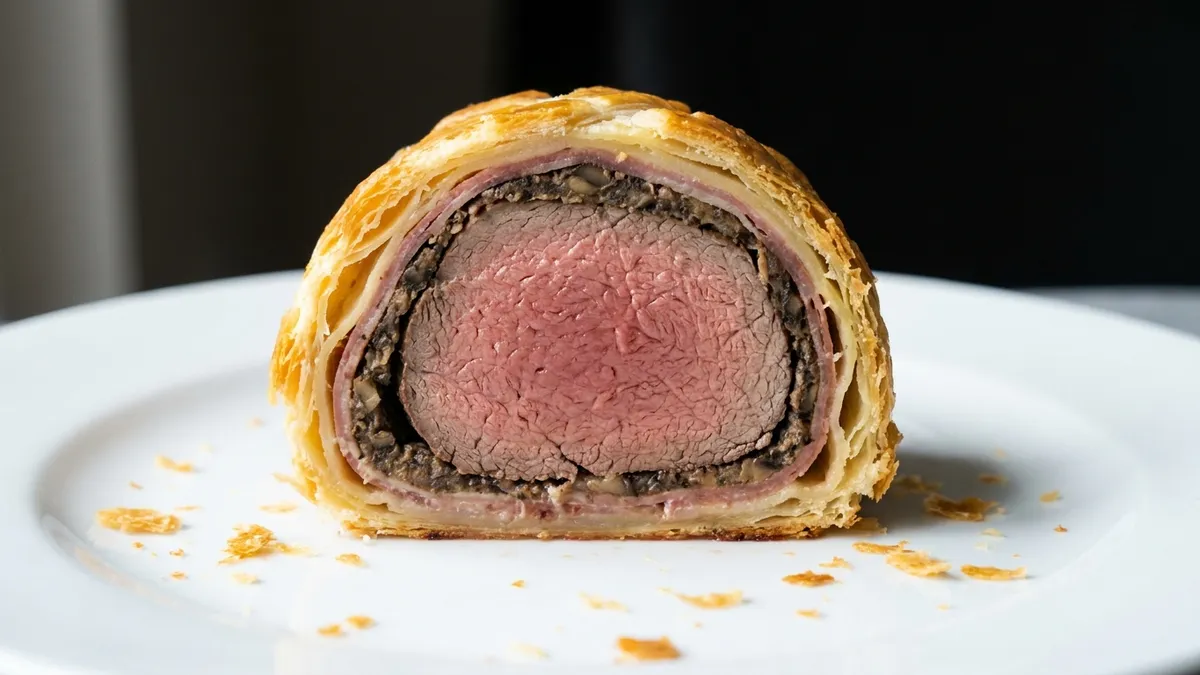
The common rule says beef means Cabernet. Wellington breaks it, because heavy, tannic wines like Cabernet Sauvignon overwhelm delicate dishes, and a tenderloin in pastry is delicate. The crusted, fatty cuts in wine with steak are where Cabernet earns its place. If the only red in the house is a young, tannic Cabernet, save it for the cheese and buy a softer red for the Wellington.
The mushrooms raise the stakes. Umami-rich food tends to make a tannic red taste more bitter, an effect wine with mushrooms traces dish by dish. The pastry adds butter, which only acidity cuts. The target is a medium body (weight in the mouth, like skimmed versus whole milk) with low grip and fresh acidity. What tannins are explains the grip itself.
Is Pinot Noir the Best Wine for Beef Wellington?
For a plain Wellington or one served with a light jus, yes. Pinot Noir has thin skins and low levels of the skin compounds that build tannin, so it makes lightly coloured, medium-bodied, low-tannin wine. That leaves little grip for the mushroom paste to turn bitter.
Young Pinot smells of cherries, raspberries and strawberries. With bottle age it picks up savoury, earthy smells, sometimes called "barnyard", which sit beside the browned mushroom of the duxelles. Earthy Burgundian Pinot with mushroom dishes is a textbook complementary pairing, where wine and food share a flavour.
If the label names Burgundy or another cool climate region (tarter, lighter wine), expect the savoury style that suits a plain slice. If the Pinot comes from a warm region and tastes of cherry ripe to the point of jam, save it for a Wellington with a sweeter, reduced Madeira sauce. The Pinot Noir guide and the Burgundy wine guide map where each style grows.
Which Bordeaux Goes With Beef Wellington?
The Right Bank, in most cases. On the Left Bank, home to Pauillac and Margaux, a typical top-château red blend is about 70% Cabernet Sauvignon, 15% Cabernet Franc and 15% Merlot. On the Right Bank, home to Saint-Émilion and Pomerol, the ratio flips to about 70% Merlot.
That swap changes the texture. Merlot gives softer tannin and plum fruit, so a Right Bank red has the weight to meet a red wine or Madeira sauce without grip that fights the duxelles. Cabernet Sauvignon gives firmer tannin and blackcurrant, which a rare, peppered Wellington can carry and a well-done one cannot.
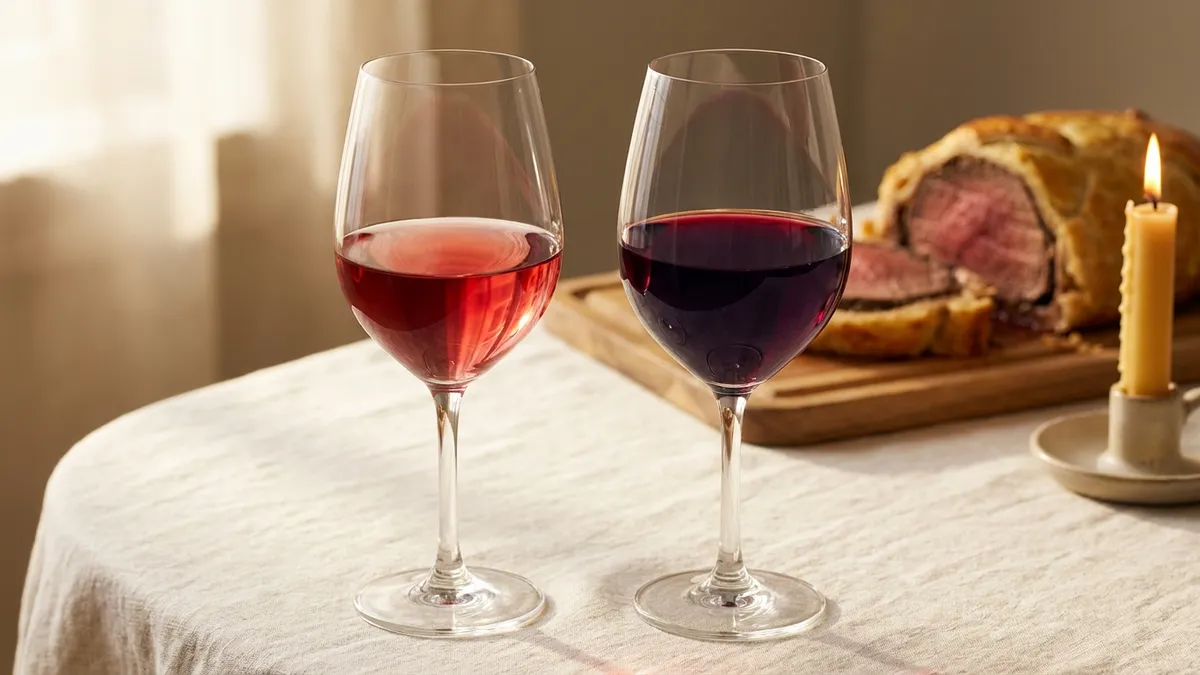
If the label says Saint-Émilion or Pomerol, expect Merlot first and pour it with the sauced Wellington. If it says Pauillac or Margaux, expect Cabernet first, and serve it only with rare beef and a mustard or pepper layer. The Bordeaux wine guide explains how the river splits the two styles.
How Do the Duxelles, Pâté and Pastry Change the Pick?
Each layer pushes the wine one way: mushrooms toward low tannin, ham and pâté toward acidity, pastry toward acidity or bubbles. The mushroom paste matters most, because it wraps the fillet and lands on the fork with every bite of beef.
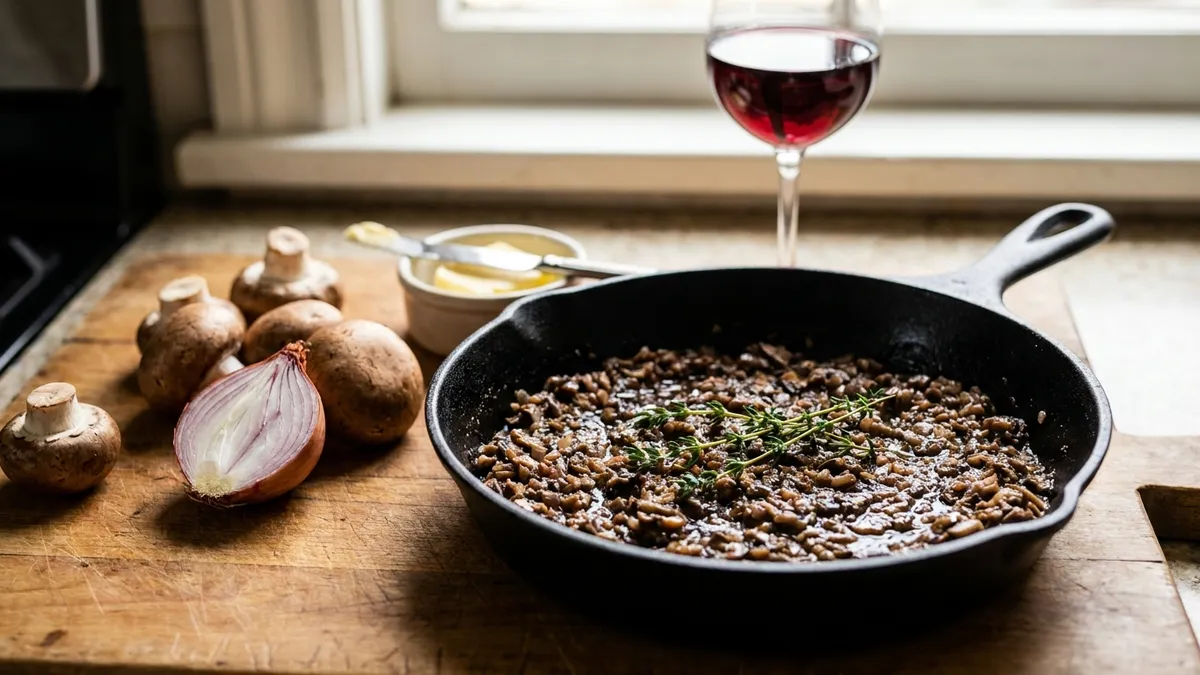
Duxelles is a mince of mushrooms, onions, herbs such as thyme or parsley, and black pepper, sautéed in butter until it reduces to a paste. Mushrooms are a rich natural source of umami (the savoury taste of broth and Parmesan). Some cooks add cream, Madeira or sherry to the pan. If the duxelles carries Madeira, the sauce usually does too, and the Right Bank row of the table applies. The guide to savoury and umami flavours shows where that taste turns up in wine itself.
Prosciutto adds salt; pâté adds fat and more salt. Acidity cuts both, so a Wellington with either layer favours a tart, cool-climate Pinot over a soft, jammy red.
Puff pastry is a laminated dough: solid butter is folded between thin sheets of dough, and steam from the water in that butter lifts the layers in the oven. Every bite of crust is partly butter. A red with fresh acidity clears it from the palate, while a low-acid, high-alcohol red leaves it coating your mouth.
Can You Serve White or Sparkling Wine With Beef Wellington?
Yes, in two places: a full Chardonnay with a mushroom-only Wellington, and dry sparkling wine with the starters. A vegetarian Wellington replaces the fillet with more mushrooms, so there is no meat protein to soften tannin. An oaked Chardonnay has the body to match the butter and pastry; Pinot Noir still works if the table wants red.
Dry sparkling wine labelled Brut (very little sugar) has the acidity and bubbles to cut pastry canapés and salty starters. If the evening runs on bubbles until the roast, switch to red when the Wellington is carved, because the beef and a sauce need more weight than a sparkling wine carries. The sparkling wine types guide sorts the dry styles, and wine for Christmas dinner plans the bottles course by course.
How Should You Serve the Wine on the Night?
Serve the red slightly cool, decant a young Left Bank Bordeaux an hour early, and keep the cooking wine and the drinking wine separate. A red served too warm tastes of alcohol before fruit. A short spell in the fridge brings a warm-room bottle back; the wine serving temperature chart gives the ranges for light and full reds.
The young Left Bank red is the one bottle that gains from air. Pour it into a decanter or a clean jug about an hour before carving, using the steps in how to decant wine. Pinot Noir and Merlot-led reds need no more than pulling the cork when the Wellington goes into the oven.
The wine in the sauce is a cooking ingredient, not the bottle for the glass. Reduction cooks off its fresh fruit, so a sound, inexpensive red of the same style does the job in the pan and the better bottle goes on the table.
How Do You Test the Pairing Before the Big Night?
Rehearse it cheaply. Buy one Pinot Noir and one Right Bank Bordeaux, fry a handful of chopped mushrooms in butter with a pinch of salt, and taste each wine with a forkful. If both stay soft, let the sauce decide using the table above.
The wider rules for roasts and sauces sit in the food pairing hub, and Sommy has a bite-sized France course for the two regions behind these bottles. Tonight, open the app at sommy.wine, photograph each label in the AI-guided tasting mode, and walk through look, smell and taste. Note in your tasting journal which wine stayed soft beside the mushrooms, then buy that style for the Wellington.
Sources
Frequently Asked Questions
What red wine goes best with beef Wellington?
Pinot Noir is the safest single choice, because its low tannin and fresh acidity suit a lean fillet, earthy mushroom paste and buttery pastry at once. If the Wellington comes with a red wine or Madeira sauce, a Merlot-led Right Bank Bordeaux such as Saint-Émilion or Pomerol has more weight to meet it without much extra grip.
Is Cabernet Sauvignon good with beef Wellington?
Only in one case: a rare Wellington with a mustard or black pepper layer and a firm sauce. Fillet is lean and served in modest slices with mushroom and pastry, so it has little fat and protein to soften strong tannin. Choose Left Bank Bordeaux from Pauillac or Margaux for that version, and decant it an hour before carving.
Does Burgundy go with beef Wellington?
Yes. Red Burgundy is Pinot Noir from a cool climate, so it is medium-bodied, tart and low in tannin. With some bottle age it also develops earthy, savoury smells that sit beside the browned mushrooms of the duxelles. It suits a plain Wellington or one served with a light jus better than one drowned in a sweet, reduced sauce.
Can you drink white wine with beef Wellington?
Yes, but it works best with a mushroom-only Wellington. A full, oaked Chardonnay has the body to match butter and pastry, and there is no beef to soften red wine tannin anyway. With a classic beef Wellington, a red covers more of the plate. Dry sparkling wine is the other good white option, poured with the starters before the roast.
What wine goes with a vegetarian mushroom Wellington?
Pinot Noir or a full, oaked Chardonnay. A mushroom Wellington has all the savoury depth and butter of the beef version but no meat protein, so tannic young reds taste harsher with it. Pinot Noir brings earthy flavour with little grip; Chardonnay brings the weight to match the pastry. Avoid young Cabernet Sauvignon and other strongly tannic reds.
Why is it called beef Wellington?
The name is presumed to honour Arthur Wellesley, 1st Duke of Wellington, but the precise origin is unclear. An Austrian cookbook from 1891 already lists a Filet à la Wellington, and the earliest known American reference dates to 1899. The dish itself, beef fillet and mushroom duxelles baked in puff pastry, leans on French technique.
Sommy Team
LinkedInFounder & Wine Educator
The Sommy Team is building the world's most approachable wine education app, helping beginners develop real tasting skills through structured courses and AI-guided practice.