How Wine Color Changes with Age: A Visual Guide

By the Sommy Team — AI-assisted, human-edited.
Updated Apr 29, 2026
Contents (9)
- The Fastest Age Cue in the Glass
- How Wine Color and Age Connect, in 90 Seconds
- The Chemistry Behind the Shift
- What Controls the Speed of the Shift
- The Four-Stage Progression for Each Wine Type
- How to Estimate Age Blind From Rim Color
- Common Confusions
- Designed-Aged Styles, Briefly
- Visit Sommy and Train Your Eye
TL;DR
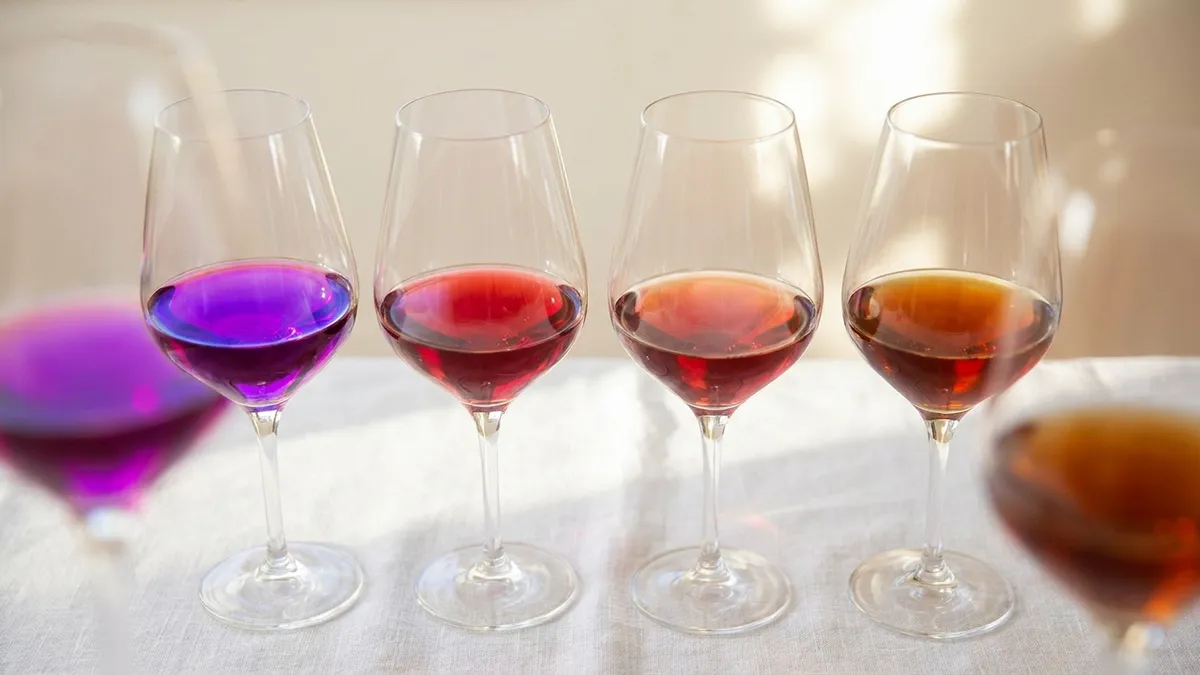
Wine color and age are tightly linked. Reds fade from purple-ruby to garnet to brick to tawny as anthocyanins precipitate. Whites darken from lemon-green to gold to amber as phenolics oxidize. Sparkling deepens from pale lemon to coppery gold. Rosé drifts from bright pink to onion-skin orange. The rim is the fastest age cue you can read in seconds.
The Fastest Age Cue in the Glass
Color is the single fastest age cue you can read on a wine. Before you swirl, before you sniff, before you sip, the wine color and age relationship is already laid out in the glass — written into the rim, the core, and the way light passes through the liquid. A trained eye can date a bottle within two or three years just by tilting the glass over a white napkin. This guide walks through exactly why color changes with age, what the four-stage progression looks like for reds, whites, sparkling, and rosé, and how to use those visual signals to estimate age blind.
The relationship is mechanical. Pigment molecules behave in predictable ways over time. Once you understand the chemistry, every color observation becomes a clock.
How Wine Color and Age Connect, in 90 Seconds
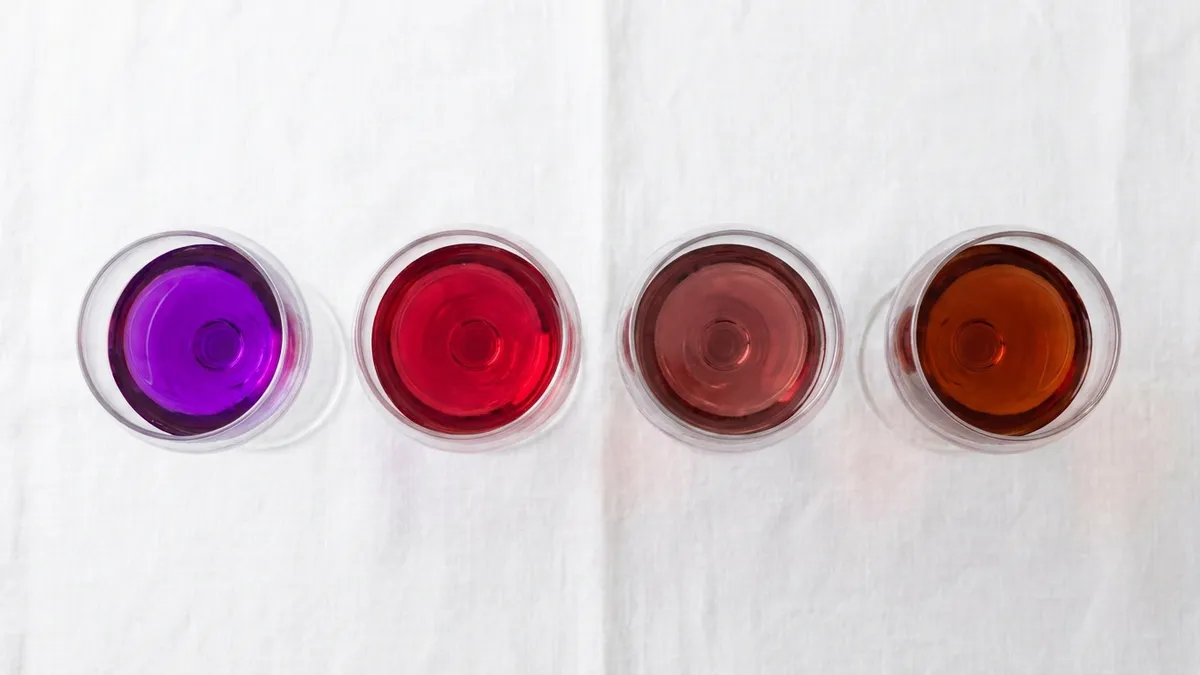
Wine color shifts predictably with age. Reds run a one-way path: purple-rim to ruby to garnet to brick or orange to tawny, driven by anthocyanin (the water-soluble purple pigment in grape skins) precipitation and polymerization with tannin. Whites move the opposite way: pale lemon-green to straw-gold to deep gold to amber to brown, driven by oxidation of phenolic compounds and Maillard-style browning reactions. Sparkling wines deepen from pale lemon through gold to coppery as lees contact and oxidation compound. Rosé drifts from bright pink to salmon to orange and onion-skin. Speed depends on tannin level, acid level, cork oxygen transfer rate, sulfite content, and storage temperature. The rim of the glass shifts first and fastest, which is why it is the single most reliable visual age cue you can read.
The Chemistry Behind the Shift
Color change is not vague. It is the visible result of three measurable processes running on a slow timer inside the bottle.
Anthocyanin precipitation in reds
Young red wine is purple because the grape skins released anthocyanins into the must during fermentation. These pigments are unstable on their own — they want to bind with something. Tannin is what they find. Over years in the bottle, anthocyanins link with tannin molecules into longer polymeric pigments. Once those polymers grow heavy enough, they drop out of solution and settle as fine sediment at the bottom of the bottle.
Two visible effects follow. The wine's overall pigment count drops, so the core lightens. The rim, being the thinnest layer of liquid, lightens first and fastest, taking on a warmer garnet or brick tone where the cooler purple anthocyanins have already departed. By twenty years, most age-worthy reds are translucent tawny at the rim, with a dustier ruby or garnet core.
Oxidation and Maillard reactions in whites
Whites work in reverse. Even with a perfect cork, microscopic amounts of oxygen seep into the bottle each year — a process called oxygen transfer rate (the volume of oxygen passing through a closure annually). That oxygen reacts with phenolic compounds, producing yellow-to-brown aldehydes and melanoidins through Maillard-like browning. The wine darkens steadily as those compounds accumulate.
Add in slow esterification, slight caramelization of residual sugars in off-dry styles, and the breakdown of carotenoids, and the cumulative effect is a wine that walks from pale lemon to deep gold to amber to brown over decades. A young Riesling poured next to a thirty-year-old Riesling looks like two different wines.
Sparkling and rosé follow the same logic
Sparkling wine sits between the two. Long lees contact deepens the wine through autolysis, then bottle age compounds the effect through slow oxidation. A non-vintage Champagne at three years pours pale lemon. The same wine at fifteen years pours coppery gold with softer mousse and a baked-apple nose.
Rosé, with its low pigment load, fades and warms quickly. A bright spring-pink rosé at one year drifts to salmon at three, then to onion-skin or pale orange by five to seven. Rosé is not built to age, and the color tells you when its window has closed.
What Controls the Speed of the Shift
Two bottles of the same vintage can age at very different rates. Four variables determine the pace.
- Tannin content. More tannin slows the color fade in reds because tannin acts as an antioxidant scaffold and as a binding partner that keeps anthocyanin polymers in solution longer. A high-tannin Nebbiolo or Cabernet ages slower in color than a low-tannin Pinot Noir.
- Acid level. Higher acid wines hold color longer in both reds and whites. Acid stabilizes pigment and slows browning chemistry. This is one of the structural prerequisites for any age-worthy bottle. For a deeper map of the structural categories that govern aging, see understanding tannins, acidity, and body.
- Cork oxygen transfer rate. Natural cork allows roughly one milligram of oxygen per year. Synthetic closures and screwcaps allow less, sometimes much less. A wine sealed under screwcap will brown more slowly than the same wine under cork.
- Sulfite content and storage temperature. Sulfites slow oxidation. Heat speeds every reaction in the bottle. Every ten degrees Celsius of warmer storage roughly doubles the rate of color change, which is why hot pantries are the enemy of cellared wine.
Read those four variables and you can predict whether two equally aged bottles will look like siblings or strangers.
The Four-Stage Progression for Each Wine Type
The patterns above turn into concrete colors at concrete ages. Here is what to expect at five, ten, twenty, and thirty years for each of the four major styles.
Red wine, four stages
- Five-year red. Core remains saturated. Rim has just started showing a slightly warmer red, edging from pure purple toward true ruby. Tannin still feels firm. Most age-worthy reds at this point read young.
- Ten-year red. Core has dropped from purple to deep ruby or garnet. Rim shows a clear garnet to brick band against a white background. The pigment count has dropped enough to see through the wine more easily. The classic mid-life look for Bordeaux, Rioja Reserva, and Barolo.
- Twenty-year red. Core is now ruby-garnet. Rim is unmistakably brick orange. The wine reads translucent rather than opaque. This is the visual signature of a fully mature age-worthy red. Sediment is often visible at the bottom of the bottle.
- Thirty-year red. Core has shifted to a dustier garnet-brown. Rim is tawny — a soft warm orange-brown that catches the light. Some wines at this age look almost the color of strong tea. The fruit on the nose is dried or stewed. The wine is at the far end of its arc.
For more on how these visual stages translate to flavor, see our guide to tasting young vs aged wine.
White wine, four stages
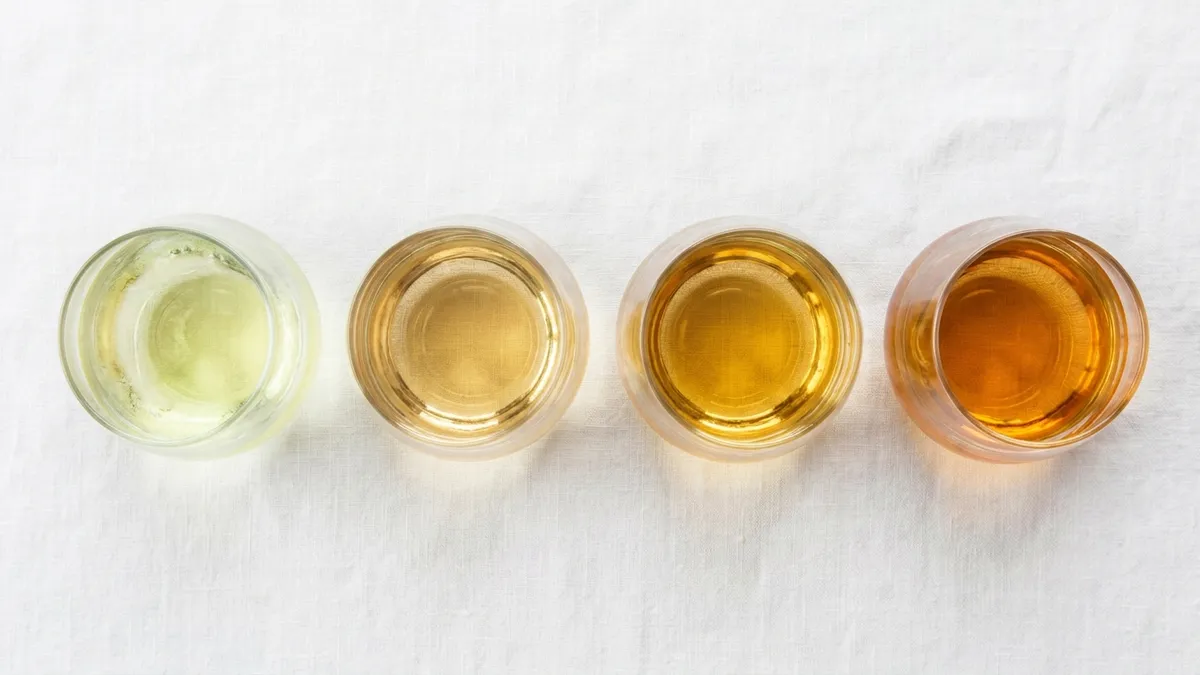
- Five-year white. Pale lemon to straw. A fresh young white at this point should still look bright and clean. Anything noticeably gold at five years is either heavily oaked, off-dry, or has been stored badly.
- Ten-year white. Straw to medium gold. Aged unoaked Riesling, white Burgundy, and aged Chenin sit here. The wine has visibly deepened but is still clearly a white, not yet amber.
- Twenty-year white. Deep gold. Old Sauternes and aged Riesling at this age can look like liquid honey. The shift is striking next to a young version of the same wine.
- Thirty-year white. Amber to light brown. The wine is at the end of its visual arc. Old vintage Sauternes, old Tokaji, and aged sweet Loire wines sit here. Flavors are nutty, raisined, and complex. The color is part of the appeal.
Sparkling wine, four stages
- Three-year sparkling. Pale lemon, sometimes with a green tinge. Bubbles are fine and aggressive. Classic non-vintage Champagne look.
- Ten-year sparkling. Lemon-gold. Bubbles softer, mousse creamier. The wine reads like a lightly aged still white with bubbles attached.
- Twenty-year sparkling. Gold to coppery gold. Bubbles soft and integrated. Aged vintage Champagne and old prestige cuvées sit here.
- Thirty-year sparkling. Deep coppery gold to bronze. Mousse barely visible. The wine reads as a still aged white with a faint sparkle. Rare territory, only the most structured wines reach it intact.
For more on the spectrum across sparkling styles, see sparkling wine types and Champagne vs Prosecco vs Cava.
Rosé, four stages
- One-year rosé. Bright pink, salmon, or coral. The intended drinking window.
- Three-year rosé. Salmon drifting toward orange-pink. Fruit on the nose has started fading.
- Five-year rosé. Orange-pink to onion-skin. Fruit is mostly gone. Most rosé is past its window here.
- Seven-plus-year rosé. Pale orange to amber-pink. Almost all rosé has lost its appeal at this age. Exceptions are structured Tavel and Bandol rosé, which can carry into a second decade.
For the broader context of rosé style, see rosé wine guide and how to taste rosé.
How to Estimate Age Blind From Rim Color
Reading the rim is the highest-yield single skill in visual tasting. The technique is simple and the results are surprisingly accurate.
The procedure
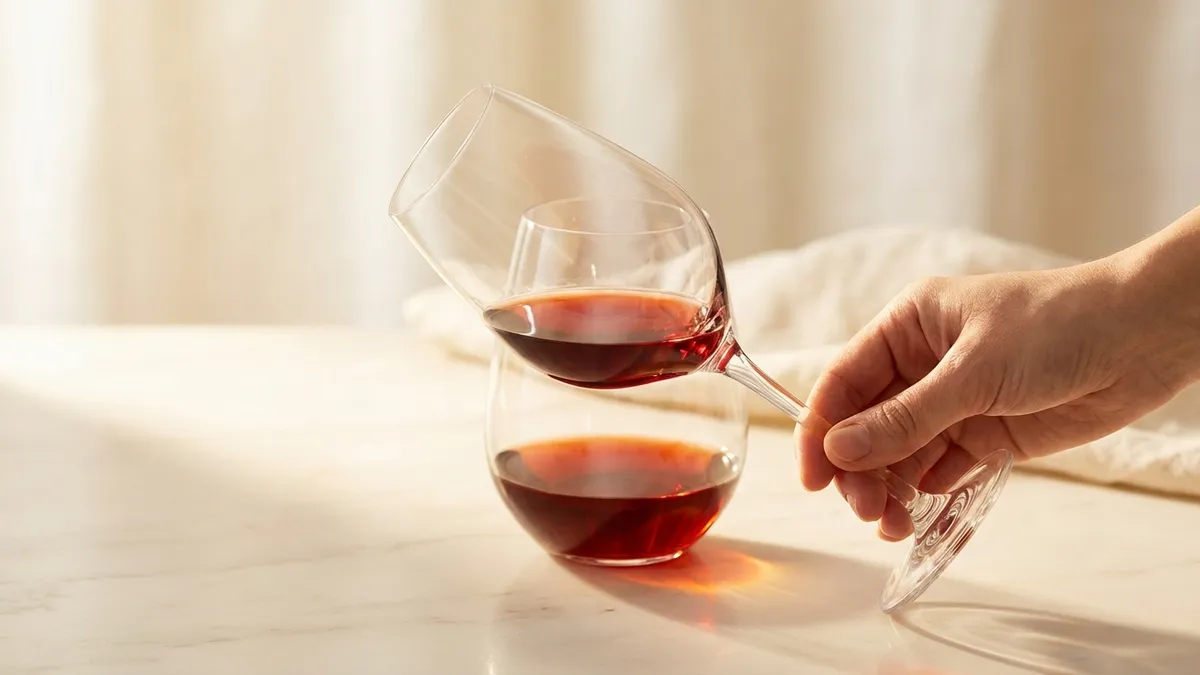
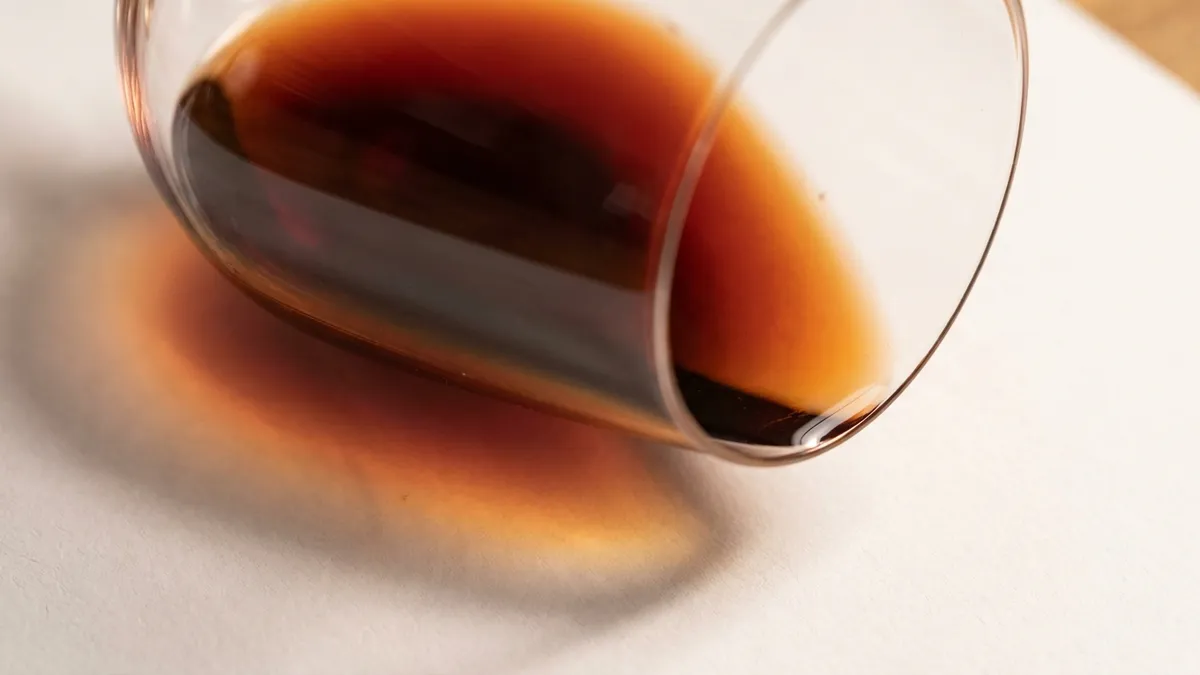
Tilt the glass at forty-five degrees over a white napkin or a blank sheet of paper. Use neutral light — daylight is best, clean white indoor light is acceptable. Hold the glass by the stem and let the wine flow toward one side. The thin upper edge where the wine meets the glass is the rim.
Look at the rim color, then compare it to the core color. A wide variation between core and rim points to age. A tight match points to youth.
Reading the result
For reds, use this rough age table — it works for any age-worthy variety:
- Purple core, purple rim: under three years.
- Ruby core, ruby rim: three to five years.
- Ruby core, garnet rim: five to ten years.
- Garnet core, brick rim: ten to twenty years.
- Garnet-brown core, tawny rim: twenty plus years.
For whites, the same logic in reverse:
- Pale lemon-green: under three years.
- Straw to medium gold: three to ten years.
- Deep gold: ten to twenty years.
- Amber to brown: twenty plus years.
The estimate is not exact. Variety, climate, oak, sulfite level, and storage all bend the curve. But for a structured age-worthy wine in normal storage, the rim will date the bottle within a two- or three-year window. For a fuller framework on visual evaluation, see our wine appearance guide and wine color meaning guide.
The Sommy app's blind tasting flow asks you to log core color, rim color, and intensity at the start of every session, then shows you the actual age of the bottle for comparison. After a few weeks of practice, dating a wine by the rim becomes automatic.
Common Confusions
Color is a strong signal, but a few situations can mislead a beginner.
Heat damage looks like aging
A wine cooked in a hot car or stored above twenty-five degrees Celsius for months can develop a brick rim and oxidative aromas in under a year. The color shift looks like normal aging but the timeline is wrong. The giveaway is the nose. Heat-damaged wine smells stewed, raisined, vinegary, or like wet cardboard. Properly aged wine smells layered — fresh dried fruit, leather, tobacco, forest floor, sometimes truffle. If a young wine looks old, suspect storage before celebrating age. For more on this category, see how to identify wine faults by smell.
Heavy oak makes young whites look older
A heavily oaked young Chardonnay can look gold at two years from new oak compounds and slight oxidative pickup during barrel aging. Cross-check with the nose. If the wine smells of fresh fruit, vanilla, and toast rather than honey, dried fruit, and beeswax, the gold color is from oak, not age. For more on how oak influences a wine, see oak flavors in wine tasting and what does oaked mean.
Dark color does not mean strong wine
Pale ruby is not weak. Some of the world's most structured reds — Pinot Noir, Nebbiolo, Gamay — are genuinely pale even when young. Inky purple does not mean great wine either. Color tells you about pigment, not about quality or power.
Some wines are designed to look aged
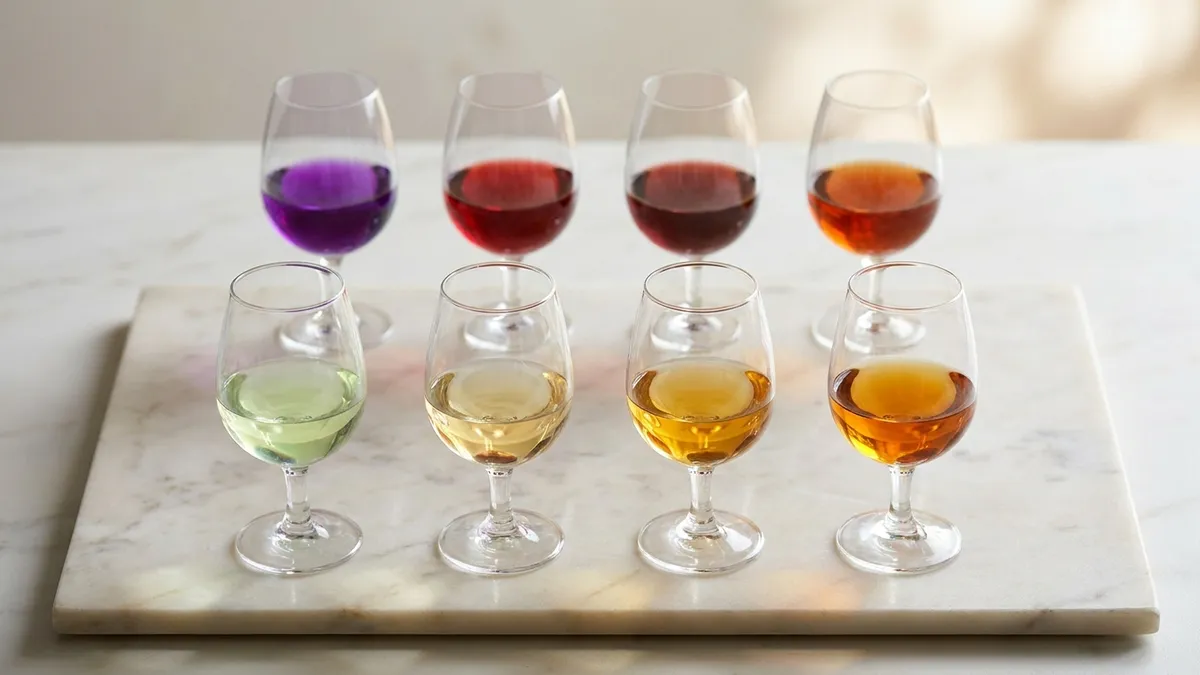
Oxidative styles spend years deliberately exposed to oxygen during winemaking. Sherry, Madeira, vin jaune, Tokaji Szamorodni, and orange wine all emerge gold to amber at release. Their color is by design, not by age. Reading these wines requires knowing the style first. Pour an oloroso Sherry next to a young Sauvignon Blanc and the color difference is dramatic, but neither wine is "older" than the other in any meaningful sense. For a deeper dive, see how to taste fortified wine and orange wine explained.
Designed-Aged Styles, Briefly
A few wines are made to be drunk at the visual signatures of age, by intent.
- Tawny Port. Aged in oak barrel for ten, twenty, or forty years before bottling. The color is true tawny — a soft amber-brown — and the flavors are nutty and caramelized.
- Oloroso Sherry. Aged oxidatively in butt for years to decades. The color is deep amber to mahogany. Flavors are nutty, savory, and intense.
- Madeira. Heated and exposed to oxygen for years. Pre-oxidized by design, which paradoxically makes it nearly indestructible once bottled.
- Vin jaune. Jura whites aged under flor for over six years. Deep gold in color, nutty and savory in flavor.
Color is a signal, not a verdict. Read it in context.
Visit Sommy and Train Your Eye
Visual tasting is the easiest skill to improve because it only needs eyes and reps. Pour a glass, tilt it over white, name the core color, name the rim color, estimate the age. Compare to the label. Adjust. Repeat.
Visit sommy.wine to start practicing inside the structured tasting flow, where every session pairs a wine with a calibrated color reference and asks you to record what you see before the nose biases you. Over a few weeks, your color vocabulary grows from "it's red" to "deep ruby with a clear garnet rim, probably eight to ten years from harvest." That single skill changes how every glass of wine reads. The bottle stops being a static label and becomes a moving target — a snapshot of pigment chemistry caught at one moment of a long, slow journey from purple to brick.
Frequently Asked Questions
How does wine color change with age?
Reds lighten and warm as anthocyanin pigments bind with tannin and precipitate as sediment, moving through purple, ruby, garnet, brick, and tawny. Whites darken as phenolics oxidize and Maillard products accumulate, moving through lemon-green, straw, gold, deep gold, amber, and brown. Sparkling and rosé wines follow similar oxidative curves on a faster clock.
Can you estimate wine age from color alone?
Yes, within a two- to three-year window for age-worthy bottles. Tilt the glass over a white napkin and read the rim. A tight purple rim points to under five years. A garnet rim points to five to ten years. A brick rim points to ten to twenty. A tawny rim points to twenty plus. Whites follow the same logic in reverse — pale to deep.
Why do red wines lose color as they age?
Anthocyanins, the water-soluble purple pigments in grape skins, are unstable on their own. Over years in the bottle they bind with tannin molecules into longer polymeric chains that are too heavy to stay in solution. They drop out as fine sediment, leaving the wine paler and warmer in tone. The rim lightens first because it is the thinnest layer of liquid in the glass.
Why do white wines get darker with age?
Slow controlled oxidation through the cork transfers tiny amounts of oxygen into the bottle each year. That oxygen reacts with phenolic compounds from the grape skins and produces aldehydes, melanoidins, and other browning molecules. The result is a steady deepening of color from pale lemon-green through straw, gold, deep gold, amber, and finally brown in very old or oxidative styles.
What controls how fast wine color changes?
Four factors. Tannin content slows the fade in reds because tannin acts as an antioxidant scaffold. Acid level slows shifts in both colors. Cork oxygen transfer rate sets the pace of oxidation. Sulfite levels add a chemical brake on browning reactions. Storage temperature compounds all four — every ten degrees Celsius warmer roughly doubles the rate of color change.
Can heat damage make a wine look aged?
Yes, and beginners frequently confuse the two. A wine cooked in a hot car or stored above twenty-five degrees Celsius for months can develop a brick rim and oxidative aromas in under a year. The giveaway is the nose — heat-damaged wine smells stewed, raisined, or vinegary rather than showing the layered tertiary character of a properly cellared bottle.
Are some wines designed to look aged when young?
Yes. Oxidative styles like Sherry, Madeira, vin jaune, Tokaji Szamorodni, and orange wine spend years deliberately exposed to oxygen during winemaking. They emerge gold to amber in color even at release, by intent rather than accident. Reading these wines requires knowing the style — color alone will not tell you whether you are looking at a flawed bottle or a designed one.
How does color shift differ across red, white, rosé, and sparkling?
Reds move from saturated purple toward translucent tawny brick. Whites move from pale lemon toward deep amber brown. Rosé moves from bright pink or salmon toward orange and onion-skin. Sparkling moves from pale lemon through straw and gold toward coppery gold as lees autolysis and oxidation compound. All four share the same chemistry — only the starting point and pace differ.
Sommy Team
LinkedInFounder & Wine Educator
The Sommy Team is building the world's most approachable wine education app, helping beginners develop real tasting skills through structured courses and AI-guided practice.