Tokaji Aszú: Puttonyos Chart, Sweetness and Food Pairing

By the Sommy Team — AI-assisted, human-edited.
Updated Oct 29, 2026
Contents (9)
- What Is Tokaji Aszú, in One Paragraph?
- How Do You Read a Tokaji Aszú Label?
- Aszú, Szamorodni or Eszencia: Which Should You Buy?
- How Sweet Does Tokaji Aszú Taste?
- How Should You Serve and Keep Tokaji Aszú?
- What Food Goes With Tokaji Aszú?
- How Is Tokaji Aszú Made?
- Which Grapes Go Into Tokaji?
- Where Is Tokaj, and Why Does Noble Rot Thrive There?
TL;DR
Tokaji Aszú is a sweet white from north-east Hungary, made by soaking noble-rot berries in must or young wine. Since the 2013 harvest every Aszú holds at least 120 g/L of sugar, so only 5 and 6 puttonyos remain. Furmint's high acidity keeps it fresh. Serve it at 7-10°C in 60-90 ml pours.
Tokaji Aszú is a Hungarian sweet white made from grapes shrivelled on the vine by noble rot, then soaked in fermenting juice. Since the 2013 harvest every Aszú must hold at least 120 grams of sugar per litre. A "3 puttonyos" label on a shop shelf today therefore marks an older vintage. Furmint, the main grape, brings the acidity that keeps all that sugar tasting fresh.
What Is Tokaji Aszú, in One Paragraph?
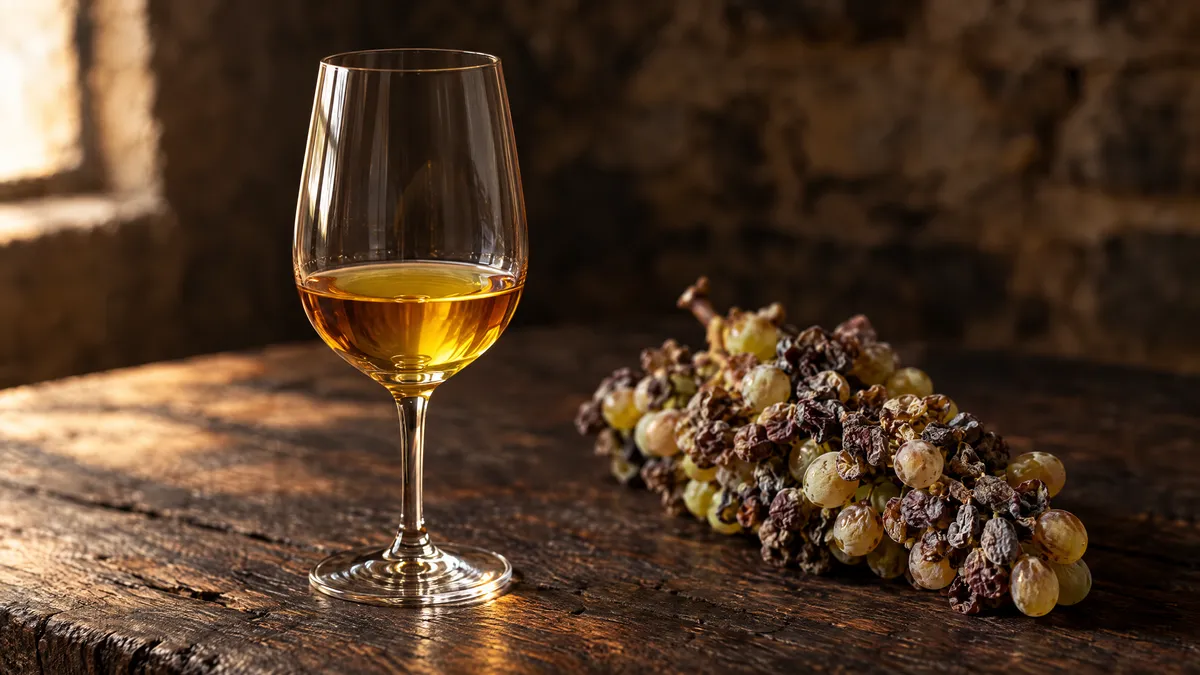
Tokaji Aszú is a sweet white wine from the Tokaj region of north-east Hungary. It is made from aszú berries, grapes shrivelled by noble rot (a fungus that dries ripe grapes on the vine and concentrates their sugar and acid). The berries are picked one by one, mashed into a paste and soaked in must (fresh grape juice) or young wine.
Since 2013 every Aszú needs at least 120 g/L of residual sugar (sugar left after fermentation) and at least 18 months in barrel. Furmint covers about two thirds of the region's vineyards, and its high acidity keeps the wine from tasting syrupy.
How Do You Read a Tokaji Aszú Label?
Read the puttonyos number as a sugar floor: 5 puttonyos means at least 120 g/L and 6 means at least 150 g/L. Puttonyos counts baskets of aszú paste, and for centuries more baskets per cask meant a sweeter wine. The number now stands for sugar measured in the finished wine.
| Label word | Minimum sugar, old rules | From the 2013 harvest | What it means on the shelf today |
|---|---|---|---|
| 3 puttonyos | 60 g/L | Dropped: below the 120 g/L floor | A pre-2013 vintage; lighter and more aged |
| 4 puttonyos | 90 g/L | Dropped: below the 120 g/L floor | A pre-2013 vintage; check the year |
| 5 puttonyos | 120 g/L | Optional, at 120 g/L or more | The modern entry point; good with pâté |
| 6 puttonyos | 150 g/L | Optional, at 150 g/L or more | Sweeter and denser; good with blue cheese |
| Aszú, no number | Not used | At least 120 g/L | A modern Aszú; at least as sweet as 5 puttonyos |
| Aszúeszencia | 180 g/L | Category discontinued | An old bottle above 6 puttonyos |
| Eszencia | 450 g/L | At least 450 g/L | Free-run juice, sold by the spoonful |
If the label shows 3 or 4 puttonyos, the wine was made before the 2013 harvest, so it has less sugar than any modern Aszú and more bottle age. A low number marks an old vintage, not a lighter style made today. If the label shows no number, expect at least 120 g/L. Releases also lag the harvest: an Aszú cannot be sold before 1 January of the third year after picking.

Quick check
One question on what you just read
A Tokaji Aszú in a shop today says 3 puttonyos on the label. What does that low number tell you?
Tap an answer to see how you did.
Aszú, Szamorodni or Eszencia: Which Should You Buy?
Buy Aszú for the classic sweet wine, Szamorodni for a cheaper bottle from the same hills, and Eszencia only as a rare treat. The three differ in how the noble-rot berries are used: sorted and soaked for Aszú, left in whole bunches for Szamorodni, or simply drained for Eszencia.
| Wine | How it is made | Sugar | Pick it if |
|---|---|---|---|
| Dry Szamorodni (száraz) | Whole bunches with some noble-rot berries, fermented dry, 24 months in wood from the 2025 harvest (6 before) | At most 9 g/L | You want a dry aperitif from the same hills |
| Sweet Szamorodni (édes) | Whole bunches with more noble-rot berries, at least 6 months in wood | At least 60 g/L (45 before the 2025 harvest) | You want sweetness at a lower price |
| Tokaji Aszú | Hand-picked aszú berries soaked as a paste in must or wine, 18 months in barrel | At least 120 g/L | You want the classic, for dessert or cheese |
| Eszencia | Juice that runs from piled aszú berries under their own weight | At least 450 g/L, typically 500-700 | You want a rarity to share in small spoons |
Szamorodni goes into the press as whole bunches instead of sorted berries, so it costs less to make than Aszú. Eszencia is so sweet that it ferments for years and usually stops at about 5 to 6% alcohol. Two rarer wines reuse the leftovers: Fordítás pours must over aszú paste that has already been used, and Máslás pours it over the lees (spent yeast) of an Aszú.
If the bottle is for dessert or a cheese course, buy Aszú. If it is for a pre-dinner glass with salted almonds, buy dry Szamorodni.
How Sweet Does Tokaji Aszú Taste?
Very sweet on paper and lively in the mouth. An Aszú holds at least 120 g/L of sugar, well over double the 45 g/L at which EU labels call a wine sweet. It still finishes clean because of its acidity (the tartness that makes your mouth water). The wine sweetness scale puts it beside Sauternes and ice wine.
Sweetness
bone dry → off-dry → medium → sweet → very sweet
Noble rot removes water from the berry, so acid concentrates along with sugar. Furmint starts with high acidity, so the finished wine carries enough tartness to stop the sugar sitting heavy on the tongue. A sweet wine without that acid tastes sticky after two sips.
Three aromas show up most. Dried apricot and orange marmalade come from the shrivelled fruit, its sugar and acid concentrated together. Honey and a faint saffron spice come from the noble rot itself. With years in bottle the colour moves from gold to amber, and the fruit turns toward dried fig and caramel.
How Should You Serve and Keep Tokaji Aszú?
Serve it cold, at 7-10°C, in small pours of 60 to 90 ml. Cold tightens the sugar and lifts the acid, the same range given for Sauternes in the wine serving temperature chart. Take the bottle out of the fridge about 20 minutes before pouring. A white wine glass, or a small tulip glass, keeps the aroma together.
Opened, an Aszú lasts longer than a dry white. Recork it and keep it in the fridge, and it stays good for about 7 to 14 days, as set out in how long wine lasts after opening. If the bottle has been open longer than two weeks, smell it for vinegar or bruised apple before pouring.
Unopened, a good Aszú gains depth over decades, since its sugar and acidity protect it. Store it cool and dark like any wine you plan to keep, following the wine aging guide.
What Food Goes With Tokaji Aszú?
Pair it by salt, fat or a dessert that is less sweet than the wine. The match works when the sugar softens salt and the acidity cuts fat. Blue cheese and pâté are the classic matches, and stone-fruit tarts are the safest dessert.
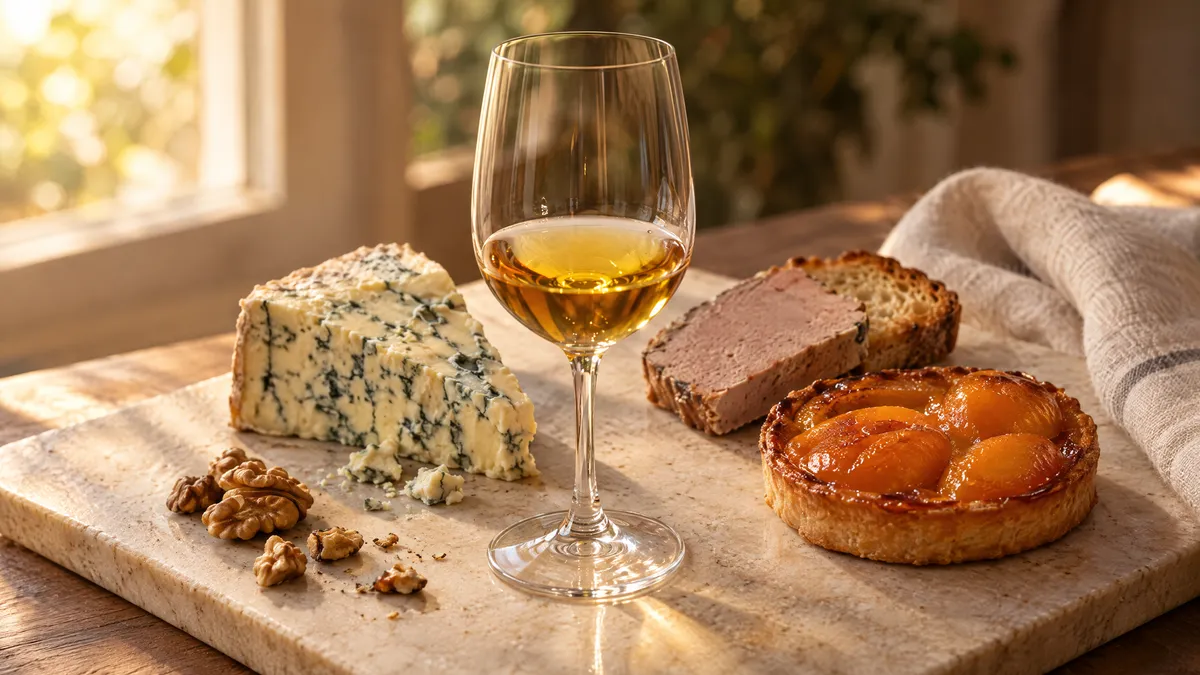
- Blue cheese. Salt and the bitter veins make the wine taste fruitier, and the sugar makes the cheese taste creamier. Use a 6 puttonyos Aszú with strong blues; the cheese board picks are in wine with blue cheese.
- Pâté and foie gras. The fat coats the mouth, and the acidity rinses it away between bites. A 5 puttonyos wine is enough here.
- Apricot or peach tart. Stone fruit repeats the dried-apricot smell in the glass, and the pastry's butter softens the acid.
- Crème brûlée. The burnt sugar top echoes the caramel of an older Aszú, and the custard is milder than the wine.
If the dessert is sweeter than the wine, swap it for cheese, because a sweeter plate makes Aszú taste thin and sour. The sweetness rule behind this sits in the dessert wine guide.
How Is Tokaji Aszú Made?
Noble-rot berries are picked one by one, mashed into a paste and soaked in must or wine before the wine ages at least 18 months in barrel. The grapes are dried by a fungus on the vine, not frozen or sun-dried in a loft, and that fungus adds its own honeyed smell.
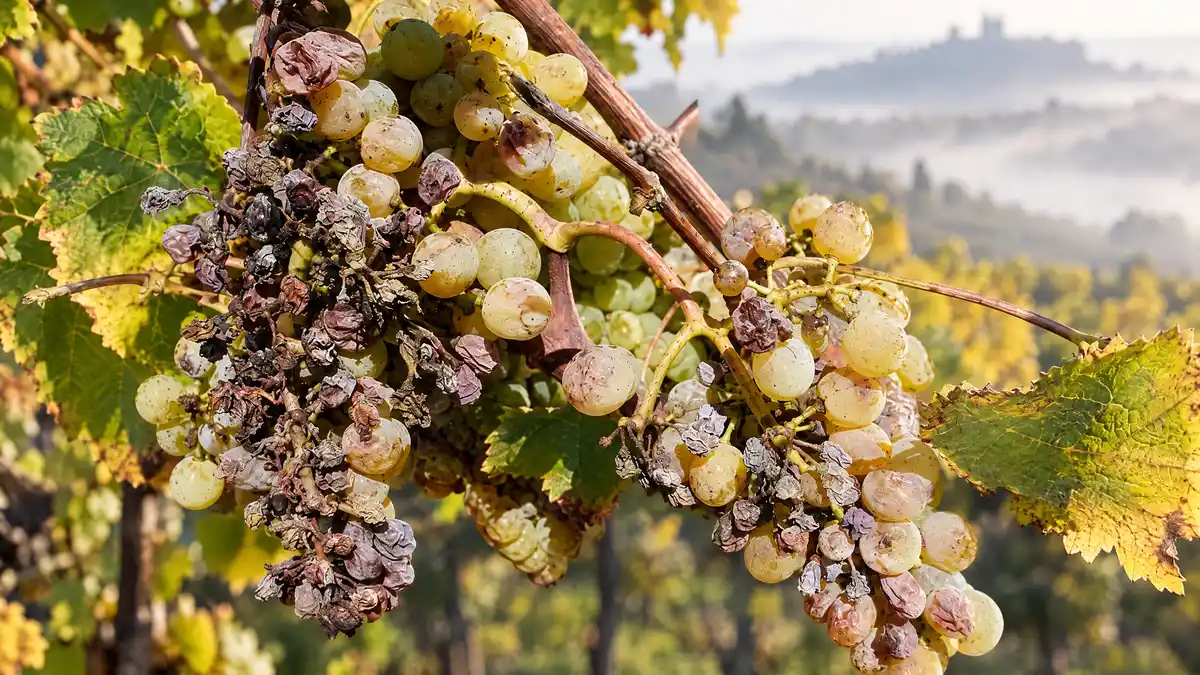
In a humid-then-sunny autumn, the fungus Botrytis cinerea pierces the grape skins. Water escapes through the tiny holes, and the berry shrivels like a raisin while sugar and acid concentrate. The mechanism, and why steady rain turns the same fungus destructive, is explained in noble rot wine.
Pickers take only the shrivelled berries, one at a time. Those aszú berries are trampled into a thick paste. Must or young wine is poured over the paste and left for 24 to 48 hours, with stirring. The liquid is then drawn off into casks, where fermentation finishes and the wine matures in a cool cellar.
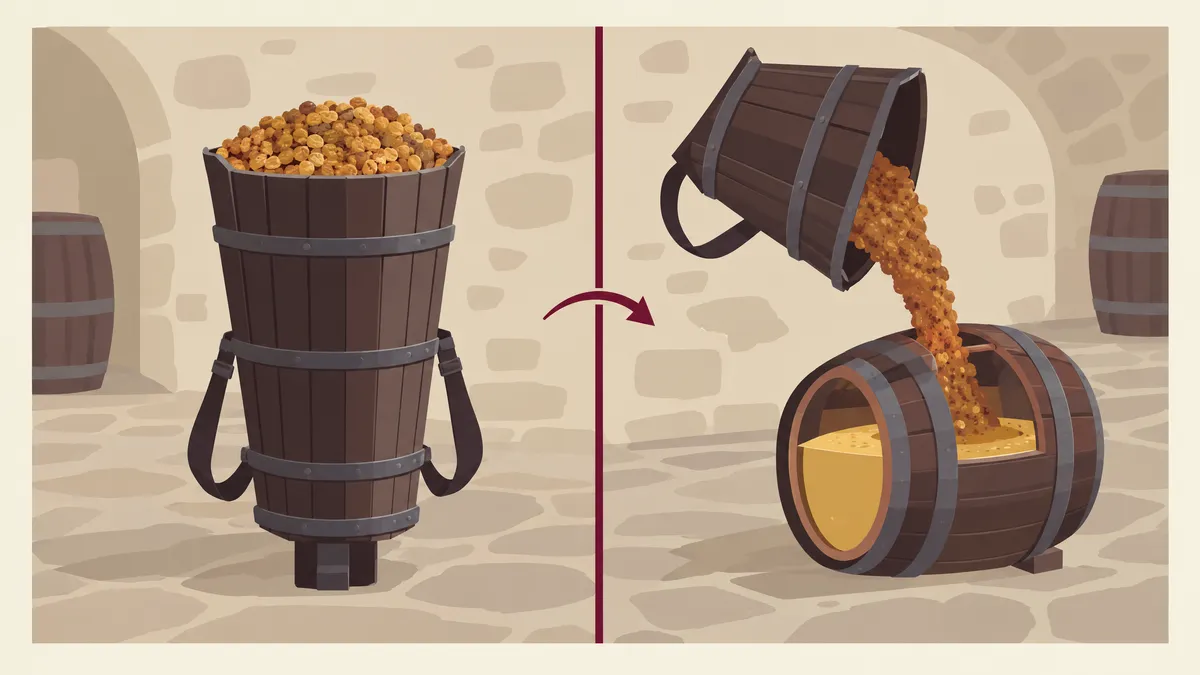
The baskets gave the wine its old scale. A puttony is a wooden hod holding about 25 kg of paste, and the number of hods added to a 136-litre Gönc cask set the puttonyos. More hods per cask made a sweeter wine. The law now measures sugar instead of counting hods.
Which Grapes Go Into Tokaji?
Six white grapes are approved, and Furmint covers about two thirds of the vineyard area. Its thin skin lets noble rot in, and its high acidity balances the sugar. The full grape story, dry Furmint included, is in the Furmint wine guide.
- Furmint: the backbone, tart and long-lived.
- Hárslevelű: the second grape, softer and more floral.
- Sárgamuskotály: yellow Muscat, a small share that adds a grapey, flowery smell.
- Zéta, Kövérszőlő and Kabar: minor grapes used in small amounts.
Where Is Tokaj, and Why Does Noble Rot Thrive There?
Tokaj lies in north-east Hungary, with a small part in Slovakia, where the Bodrog and Tisza rivers keep the autumn air humid enough for noble rot. Sunny south-facing slopes then dry the grapes, so the fungus shrivels them instead of rotting them. The soils are clay or loess over volcanic rock.
The region holds 11,149 hectares of classified vineyard, of which about 5,500 are planted. Seven of its villages, with about 908 hectares, sit across the border in Slovakia. UNESCO listed the Tokaj wine region, its villages and cellars included, as a World Heritage Site in 2002. The region's wider story, from dry Furmint to Bull's Blood, is in the Hungarian wine guide.
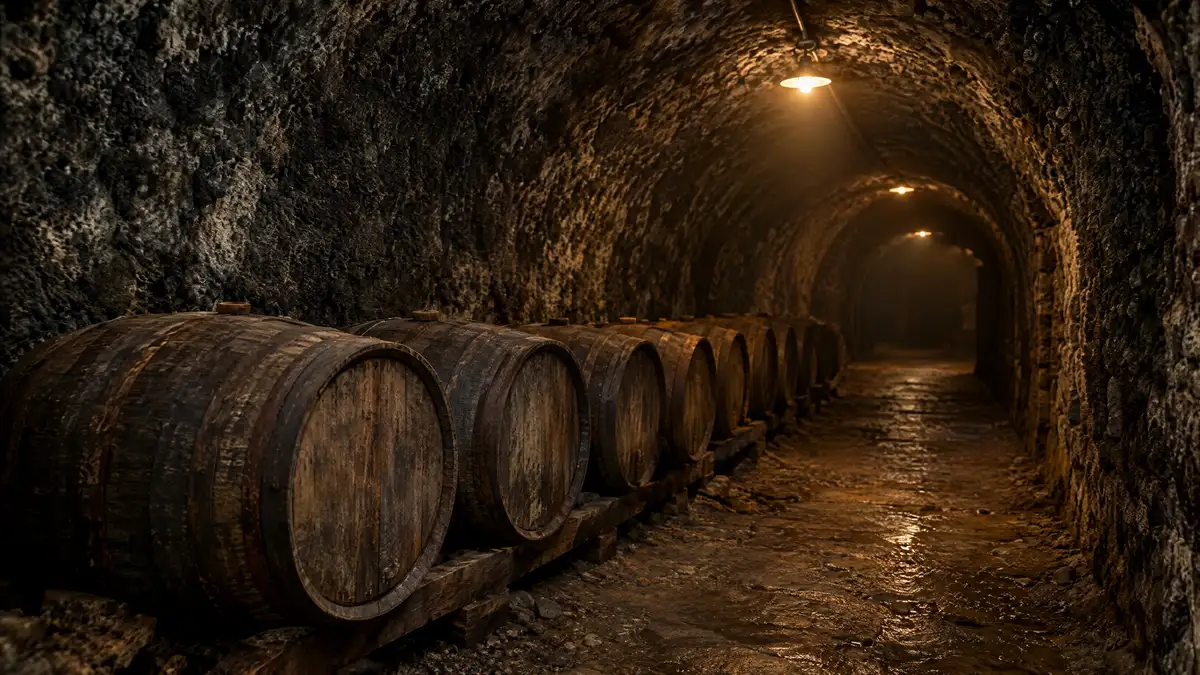
The wine ages in cellars dug into the hills. Their walls carry a dark mould that feeds on alcohol evaporating from the casks and helps hold the air humid.
One name causes confusion. Alsace once sold its Pinot Gris as "Tokay d'Alsace", a different grape and wine. EU rules banned French and Italian producers from using Tokay or Tocai from March 2007, so a modern bottle that says Tokaji comes from Tokaj. The Alsace grape is covered in Pinot Grigio vs Pinot Gris.
Tokaji sits among the noble-rot classics with Sauternes, and the other ways to make a sweet wine are mapped in the wine styles hub. The Sommy app at sommy.wine has bite-sized wine courses and an AI-guided tasting mode. Pour 60 ml of cold Aszú tonight beside a wedge of blue cheese. Photograph the label in Sommy, then taste the cheese first and the wine second.
Sources
- Wikipedia: Puttonyos (old scale and the 2013 Aszú rules)
- Wikipedia: Tokaji (grapes, Szamorodni, Eszencia, how Aszú is made)
- Wikipedia: Tokaj wine region (vineyard area, Slovak part, UNESCO listing)
- Tokaj PDO product specification, version 10 (Hungarian Ministry of Agriculture, in Hungarian)
- Wine with Seth: Tokaj PDO (current label, sugar and ageing rules)
- Wine with Seth: Tokaji Aszú (Gönc casks, food matches)
Frequently Asked Questions
Is Tokaji Aszú still graded 3 to 6 puttonyos?
No. From the 2013 harvest every Tokaji Aszú must hold at least 120 grams of residual sugar per litre, the old 5 puttonyos level. Producers may still print 5 or 6 puttonyos when the wine meets that level's threshold, and 6 needs at least 150 g/L. A bottle labelled 3 or 4 puttonyos comes from a vintage made under the old rules.
How sweet is Tokaji Aszú?
Very sweet by the numbers: at least 120 grams of sugar per litre, and 150 or more for a 6 puttonyos wine. It tastes less heavy than that because Furmint, the main grape, has high acidity, and noble rot concentrates acid along with sugar. Served cold, a good Aszú tastes of dried apricot, orange marmalade and honey, and finishes fresh.
What is the difference between Tokaji Aszú and Eszencia?
Aszú is wine made by soaking noble-rot berries in must or young wine, with at least 120 g/L of sugar. Eszencia is only the juice that runs from the piled berries under their own weight. It holds at least 450 g/L of sugar, typically 500 to 700, ferments for years and usually reaches only about 5 to 6% alcohol.
What grapes are used in Tokaji Aszú?
Six white grapes are approved in Tokaj: Furmint, Hárslevelű, Sárgamuskotály (yellow Muscat), Zéta, Kövérszőlő and Kabar. Furmint covers about two thirds of the vineyard area and leads most Aszú, because its thin skin lets noble rot in and its high acidity balances the sugar. Hárslevelű adds a softer, floral side, and Muscat adds a grapey scent.
How long does Tokaji Aszú last?
Unopened, a good Aszú keeps developing for decades in a cool, dark place, because its sugar and acidity protect it. The law already holds it in barrel for at least 18 months before release. Once opened, recork it and keep it in the fridge, where like other sweet wines it stays good for about 7 to 14 days.
What food goes with Tokaji Aszú?
Salt and fat suit it best. Blue cheese and pâté are the classic matches: the sugar softens the salt, and the acidity cuts the fat. Fruit desserts such as apricot tart or crème brûlée work when they are less sweet than the wine. A very sugary dessert makes the wine taste thin and sour, so serve cheese instead.
Is Tokaji the same as Tokay Pinot Gris?
No. Tokaji is wine from the Tokaj region of Hungary and Slovakia. Producers in Alsace once sold their Pinot Gris as Tokay d'Alsace, a different grape and style. EU rules stopped French and Italian producers from using Tokay or Tocai from March 2007, so a modern bottle called Tokaji always comes from Tokaj.
Sommy Team
LinkedInFounder & Wine Educator
The Sommy Team is building the world's most approachable wine education app, helping beginners develop real tasting skills through structured courses and AI-guided practice.