WSET Level 3: Exam, Pass Marks and Who Should Choose It

By the Sommy Team — AI-assisted, human-edited.
Updated Oct 29, 2026

Contents (8)
- WSET Level 3 in One Paragraph
- What Is on the WSET Level 3 Exam?
- Should You Take Level 3, or Is Level 2 Enough?
- How Does the Blind Tasting Work?
- How Hard Is Level 3, and What Is the Pass Rate?
- How Are Pass, Merit and Distinction Decided?
- How Many Hours Should You Study?
- How Much Does Level 3 Cost, and Can You Resit?
TL;DR
WSET Level 3 Award in Wines ends in a two-hour closed-book theory exam (50 multiple-choice questions, four short written answers) and a 30-minute blind tasting of two still wines. Each written section and the tasting need 55% on their own. WSET sets at least 84 hours of study, and Level 2 is recommended, not required.
WSET Level 3 has three pass marks. The multiple-choice section, the short written answers and a blind tasting of two wines each need 55% on their own. One weak skill fails the exam even when your average looks comfortable.
WSET Level 3 in One Paragraph
The WSET Level 3 Award in Wines is the third of four wine levels from the Wine & Spirit Education Trust, regulated by Ofqual, England's exams regulator. It covers how location, grape growing, winemaking, maturation and bottling shape still, sparkling and fortified wines. Study takes at least 84 hours, 30 of them with a course provider. Unit 1 is a two-hour closed-book paper of 50 multiple-choice questions and four short-answer questions. Unit 2 is a 30-minute blind tasting of two still wines. Each written section needs 55%, and the tasting needs 55% across both wines.
What Is on the WSET Level 3 Exam?
Two units: a two-hour closed-book theory paper and a 30-minute blind tasting (wines served with the labels hidden) of two still wines. The theory paper splits into 50 multiple-choice questions and four short-answer questions worth 25 marks each. Each of the three parts has its own 55% gate.
| Part | Format | Time | Pass mark | How to train for it |
|---|---|---|---|---|
| Unit 1, section 1 | 50 multiple-choice questions, closed book | Shares the 2 hours | 55% of the section | Short daily quizzes on grapes, places and winemaking steps |
| Unit 1, section 2 | 4 short-answer questions, 25 marks each | Shares the 2 hours | 55% of the section | Timed written answers, marked against the course book |
| Unit 2 | Blind tasting of 2 still wines | 30 minutes | 55% across both wines | Full grid notes on unlabelled wines, against the clock |
A candidate with 85% on the multiple choice and 45% on the short answers fails Unit 1. If one part is your weak one, train it first, since it can fail you on its own. WSET School London runs both units on the same day with a short break; other providers set their own timetable.

Quick check
One question on what you just read
On WSET Level 3 you score 85% on the multiple choice but 45% on the short answers. What happens?
Tap an answer to see how you did.
Should You Take Level 3, or Is Level 2 Enough?
Take Level 3 if you want to explain why a wine tastes the way it does and will write answers and taste blind to prove it. Stop at Level 2 if your goal is to shop and order with more confidence. WSET recommends Level 2 or equivalent knowledge before Level 3 but does not require it.
| Option | Pick it if | What it adds |
|---|---|---|
| Self-study with books and an app | You want to buy and order better, with no exam | Grapes and regions at your own pace |
| WSET Level 2 | Tasting terms are still new, or you want a first certificate with a multiple-choice exam | The main grapes and places, and a three-step tasting scale |
| WSET Level 3 | You can already describe acidity, tannin and body and want the reasons behind them | Written answers, a blind tasting, and grape growing and winemaking in depth |
If you can name a wine's acidity, tannin and body without looking at notes, skip Level 2. Hours for the first two levels are in online wine courses, and apps for learning between classes are compared in the best wine education apps.
Level 3 is a study qualification and carries no sommelier title. Restaurant service has its own ladder at the Court of Master Sommeliers, set out in what a sommelier does.
How Does the Blind Tasting Work?
You get two still wines with no labels, 30 minutes and the WSET Level 3 Systematic Approach to Tasting (SAT), the grid listing every line a note must cover. For each wine you describe appearance, nose and palate, then judge quality and readiness to drink. Marks for both wines are combined, and 55% passes.
The Level 3 grid is finer than Level 2's. It adds half steps such as medium(+) on acidity and tannin, a development line on the nose and a readiness call; the WSET grids side by side show every line. There is no line for naming the grape or region. WSET's study advice says the aim is to describe each wine accurately and draw conclusions on quality and readiness.
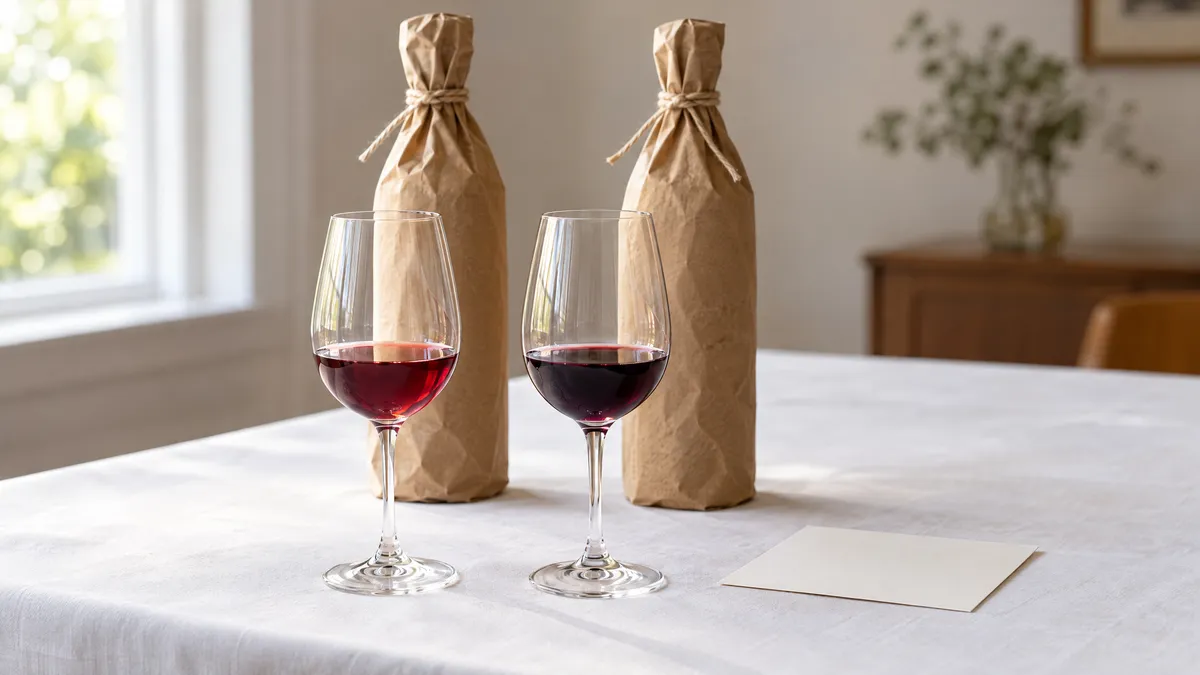
If a wine is pale with high acidity, write that down before forming any idea of what it is. Spit both wines: spitting cleanly keeps 30 minutes of notes sharp. The tasting requires legal drinking age in the country where it is sat, which does not block Unit 1.
Blind wine tasting tips has more set-ups for home practice.
How Hard Is Level 3, and What Is the Pass Rate?
Level 3 is harder than Level 2, but no official number says by how much. WSET releases no pass rates. Rates quoted online come from single schools and cover only their own students, and the "about 50%" figure repeated on question sites has no source we could trace.
The difficulty comes from the formats. Level 2 is multiple choice only, while Level 3 adds written answers and a blind tasting, and each carries its own 55% gate.
For the short answers, WSET advises matching each answer to the command verb (the instruction word, such as "describe" or "explain"). It also says never to leave a question empty, since a partial answer beats a blank one.
How Are Pass, Merit and Distinction Decided?
Grades come from your mean average mark across the papers, once every 55% gate is cleared. A mean of 55 to 64% is a Pass, 65 to 79% a Merit, and 80% or more a Distinction, with no paper below 65%. Even with a mean above 80%, a 60% tasting rules out a Distinction.
How Many Hours Should You Study?
WSET sets a minimum of 84 hours of study, 30 of them with a course provider. Its study advice adds 51.5 hours or more of private study. WSET School London tells online students to plan at least 10 hours a week; at that pace, 84 hours takes a little over eight weeks.

If you can give only five hours a week, choose a long format such as a 16-week evening course over a six-day intensive. Most theory hours go on the winemaking process and how place shapes it, plus how sparkling wines and fortified wines are made. For the tasting hours, a tasting notes template builds the habit of covering every line.
How Much Does Level 3 Cost, and Can You Resit?
Each provider sets its own price; WSET School London charges £995 for its classroom formats and £755 for its online course in 2026. Classroom students taste 81 wines with a tutor; online students must taste at least 21 on their own.
London's formats run one day a week for six weeks, six days in a row, 16 weekly evenings, nine Saturdays or nine weeks online. Results arrive about 10 weeks after the exam. If a quote elsewhere looks cheap, ask whether the exam fee and the class wines are included.
Fail one unit and you resit only that unit. At WSET School London a theory-only or tasting-only resit costs £100, and both together £135. A passed exam cannot be resat to raise its grade.
Other first steps into wine sit in the beginners and buying hub. Sommy at sommy.wine has bite-sized courses, from Wine 101 to France, Italy, Spain and California. Pour one glass tonight, set a 15-minute timer and write a full note before you look at the label.
Sources
Frequently Asked Questions
Is WSET Level 3 hard?
It is clearly harder than Level 2, mainly because of two new skills: writing short answers and tasting blind. WSET publishes no pass rates, so any figure you see online covers only one school's own students. Level 2 is multiple choice only, while Level 3 adds a written paper and a blind tasting, each with its own 55% pass mark.
Do I need WSET Level 2 before Level 3?
No. WSET recommends holding the Level 2 Award in Wines or having equivalent knowledge, but it does not require it. If you can already describe a wine's acidity, tannin and body and know the main grapes and regions, you can start at Level 3. If those words are still new, taking Level 2 first makes the Level 3 workload much lighter.
How many hours of study does WSET Level 3 take?
WSET sets a minimum of 84 hours of study time, including at least 30 hours with a course provider. WSET's own study advice adds at least 51.5 hours of private study on top of classes. At about 10 hours a week, 84 hours takes a little over eight weeks, close to the nine-week online and Saturday formats at WSET School London.
What are the grades for WSET Level 3?
Grades come from your mean average mark across the exam papers. A mean of 55 to 64% is a Pass, 65 to 79% is a Merit, and 80% or more is a Distinction, as long as no single paper scored below 65%. You still need 55% in each written section and across the two tasting wines to pass at all.
How much does WSET Level 3 cost?
Each course provider sets its own price, so it varies by country and format. As one example, WSET School London charges £995 for its classroom formats and £755 for its online course in 2026. Before comparing quotes from other schools, check whether the exam fee and the wines tasted in class are included in the price.
Can you resit WSET Level 3 if you fail?
Yes, and you resit only the unit you failed. At WSET School London a theory-only or tasting-only resit costs £100, and both together cost £135. A passed exam cannot be resat to raise your grade. Other providers set their own resit dates and fees, so ask yours before you book the course.
What is in the WSET Level 3 blind tasting?
Two still wines, served without labels, in 30 minutes. You describe each one with the WSET Level 3 tasting grid: appearance, nose, palate, then conclusions on quality and readiness to drink. The grid has no line for naming the grape or the region. Marks are combined across both wines, and you need 55% to pass.
Sommy Team
LinkedInFounder & Wine Educator
The Sommy Team is building the world's most approachable wine education app, helping beginners develop real tasting skills through structured courses and AI-guided practice.