Wine with Roasted Vegetables: Roots, Squash and Sprouts

By the Sommy Team — AI-assisted, human-edited.
Updated Oct 1, 2026
Contents (9)
- What Wine Goes With Roasted Vegetables, in One Paragraph?
- Which Wine Goes With Which Roasted Vegetable?
- How Does the Roast Level Change the Wine?
- What Wine Goes With Roasted Root Vegetables and Squash?
- What Wine Goes With Roasted Beets and Mushrooms?
- What Wine Goes With Roasted Brussels Sprouts and Broccoli?
- What Wine Goes With Roasted Peppers, Aubergine and Tomatoes?
- Does the Topping Matter More Than the Vegetable?
- Can You Drink Red Wine With Roasted Vegetables?
TL;DR
Match the wine to how dark the roast is. Pale-roasted vegetables want a crisp white; browned, caramelised ones want a riper white, a dry rosé or a soft red like Pinot Noir. Sweet roots take off-dry Riesling or Chenin, bitter sprouts take an unoaked white, and the glaze or cheese on top can override both.
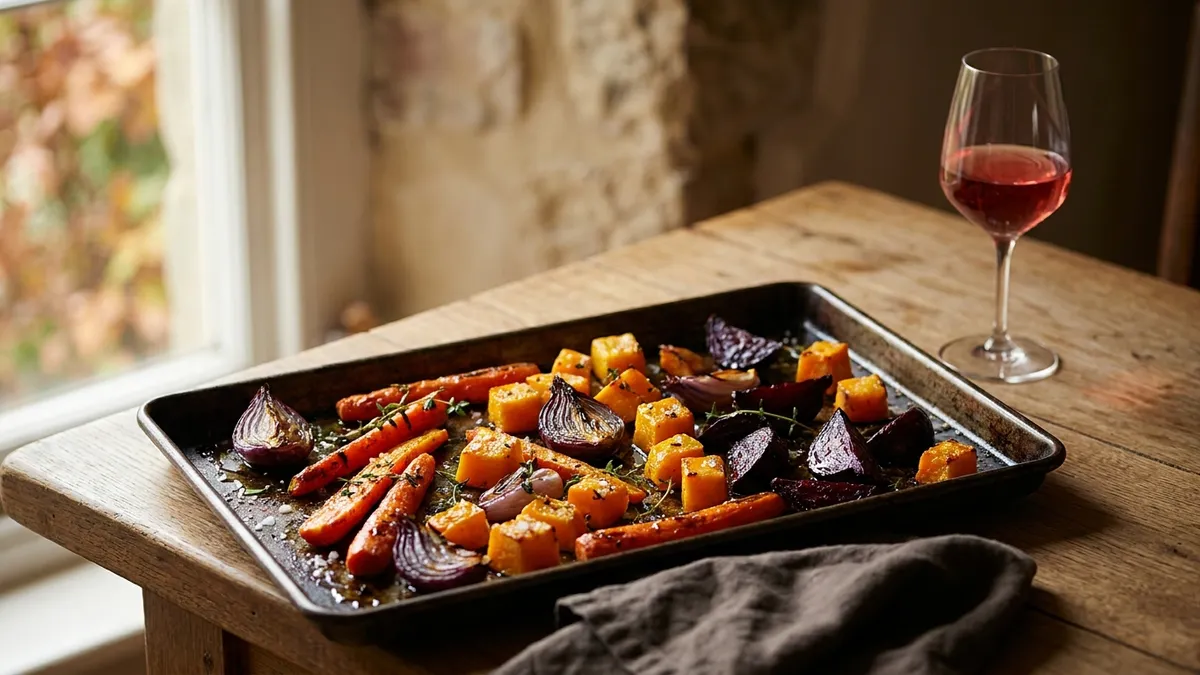
The darker you roast a vegetable, the more wine it can take. A tray of pale, just-tender vegetables wants a crisp white, while wine with roasted vegetables that are browned at the edges can move up to a riper white, a dry rosé or a soft red. Browning adds sweetness and savoury depth, and a wine that ignores those tastes thin.
What Wine Goes With Roasted Vegetables, in One Paragraph?
With a mixed tray of roasted vegetables, pour a dry white with some body (weight in the mouth, like whole milk against skimmed), a dry rosé or a soft red. Pinot Noir, Gamay and Grenache are the safe reds. Sweet roots and squash want a touch of sugar in the wine. Bitter greens like Brussels sprouts want a crisp, unoaked white and no tannin (the drying grip a red leaves on your gums). Earthy beets and mushrooms want Pinot Noir. Vegetables do not need white wine: deep browning gives them enough savoury weight for a light red, as long as oil, cheese or nuts soften its tannin.
Which Wine Goes With Which Roasted Vegetable?
Pick the wine by the vegetable that dominates the tray: sweet roots take off-dry whites, earthy beets and mushrooms take Pinot Noir, bitter greens take crisp whites, and tomatoes take high-acid reds. The last column names the bottle that most often goes wrong with that vegetable.
| Vegetable group | What drives the taste | Pour | Avoid |
|---|---|---|---|
| Carrots, parsnips, sweet potato, squash | Sugar, sharpened by caramelising | Off-dry Riesling or Chenin Blanc; ripe Chardonnay if savoury | Bone-dry, high-acid whites with glazed roots |
| Beets | Earthy smell (geosmin) and sweetness | Pinot Noir; dry rosé with goat cheese | Heavily oaked, tannic reds |
| Mushrooms | Savoury umami | Pinot Noir, Gamay, Grenache | Light, neutral whites that disappear |
| Brussels sprouts, broccoli, cauliflower | Bitterness, more when charred | Sauvignon Blanc, Grüner Veltliner, dry Riesling | Young Cabernet Sauvignon and other firm reds |
| Peppers, aubergine, tomatoes | Acidity and umami from tomato | Barbera, Sangiovese, dry rosé | Low-acid, soft whites |
| Mixed tray with olive oil and herbs | Browning plus fat | Dry rosé, Grenache, unoaked Chardonnay | Sweet wines |
If a tray mixes two rows, follow the vegetable with the strongest taste: bitterness beats sweetness, and a glaze beats both.
How Does the Roast Level Change the Wine?
The darker the roast, the more body and fruit the wine needs. Two browning processes run in a hot oven. The Maillard reaction (sugars reacting with amino acids, the building blocks of protein) runs fast at about 140 to 165°C (280 to 330°F), ordinary roasting heat. Caramelisation is sugar itself breaking down under heat.
Different sugars caramelise at different points, roughly 105°C (221°F) for fructose, 150°C (302°F) for glucose and 170°C (338°F) for sucrose. Sweet roots like carrots and parsnips carry plenty of sugar, so their cut faces go sticky and brown first.
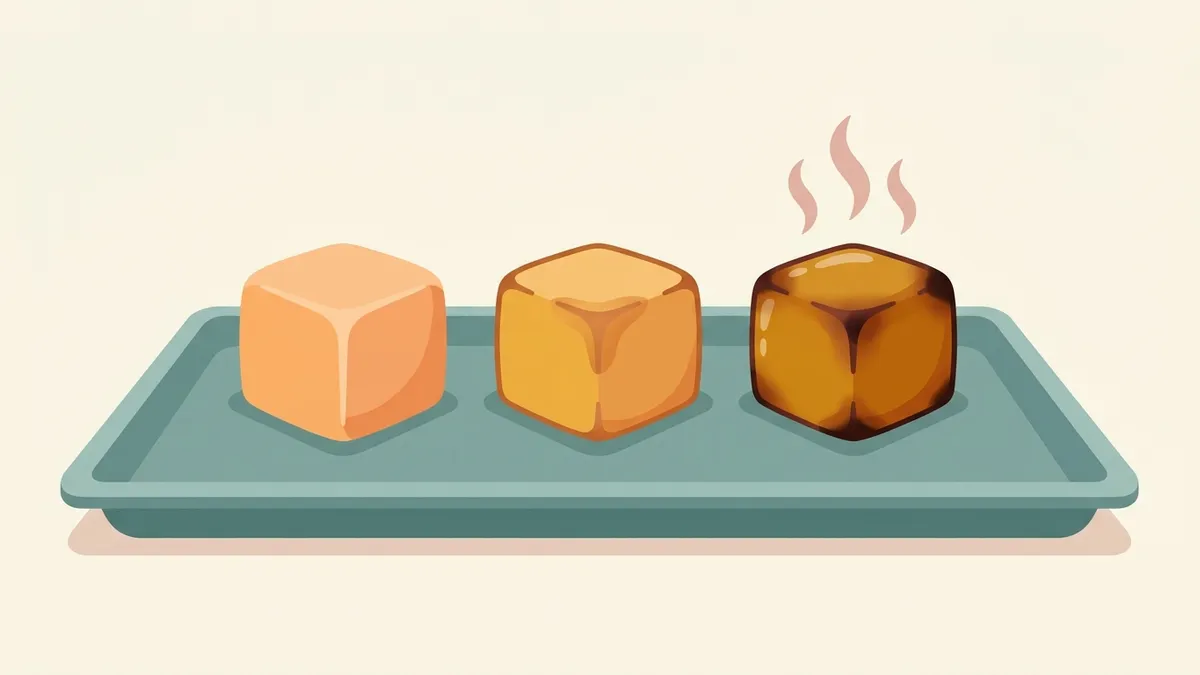
Both processes make new flavour. Browning creates the nutty, toasty aroma compounds found in baked bread and other roasted foods, and it concentrates sweetness as water leaves. Push it further and the dark edges turn slightly bitter and smoky. So one vegetable gives three different plates:
- Pale roast (soft, barely coloured): fresh and sweet, close to steamed. Pour a crisp white such as Sauvignon Blanc or Vermentino.
- Golden roast (brown edges, soft centre): sweeter and nuttier. Pour a riper white such as Chardonnay or Chenin Blanc, or a dry rosé.
- Dark roast (charred corners, sticky surface): sweet, bitter and smoky at once. Pour a soft red such as Pinot Noir or Grenache, or a fuller rosé.
If the edges are dark brown, move one step up in body from what you would pour with the same vegetable steamed.
What Wine Goes With Roasted Root Vegetables and Squash?
Pour an off-dry Riesling or Chenin Blanc, or a ripe Chardonnay, with roasted carrots, parsnips, sweet potato and squash. These are the sweetest vegetables on the tray, and roasting concentrates that sugar, so a bone-dry, sharp white tastes sour beside them.
The rule comes from pairing practice: a sweet wine often needs to be sweeter than the dish it is served with. Off-dry means a wine with a little sugar you can taste, enough to round the edges but far from dessert sweet. Riesling and Chenin Blanc are the easiest places to find it, and both keep enough acidity to stop the sugar feeling heavy. The sweet vs dry wine guide explains how to read sweetness on a label.
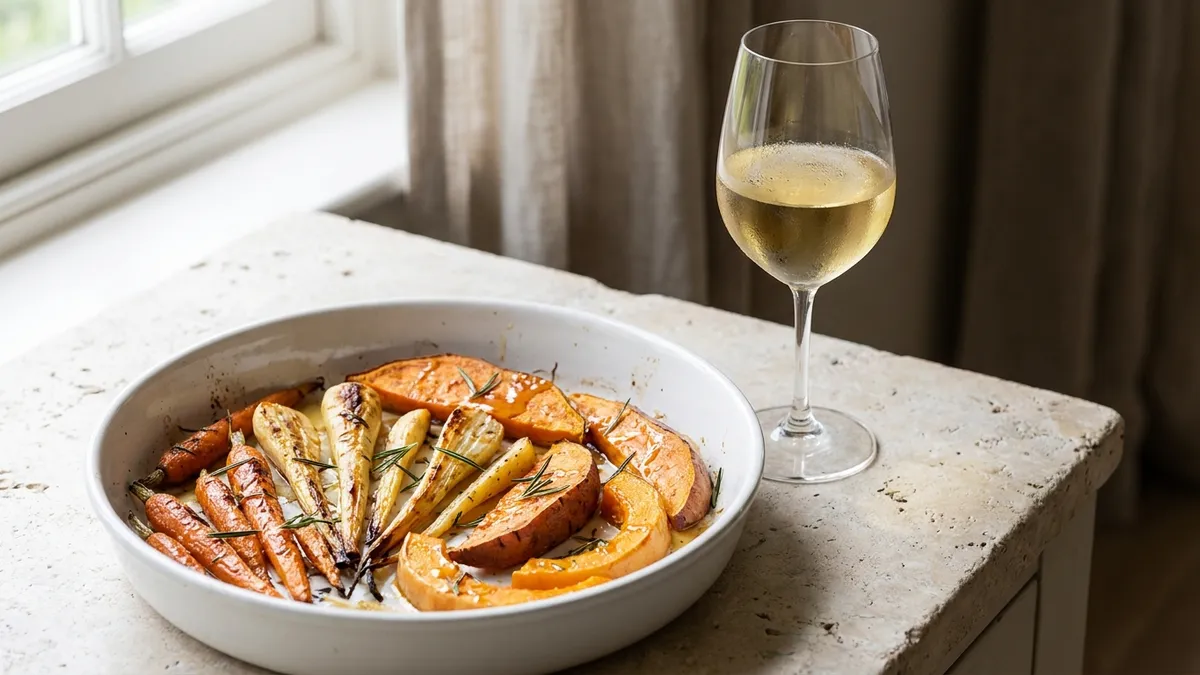
Not every root tray is sweet. Squash roasted with sage, garlic and salt reads savoury, and there a ripe Chardonnay with a little oak works, because barrel ageing adds a toasty edge that echoes the browning. A Sunday tray of roots alongside meat follows the meat first.
If the roots carry a honey or maple glaze, pour off-dry. If they carry only herbs, salt and oil, pour a dry, fuller white.
What Wine Goes With Roasted Beets and Mushrooms?
Pinot Noir is the classic answer for beets and mushrooms, because its earthy smell matches theirs. Pairing guides call this a complementary pairing, where wine and food share a flavour, and earthy Pinot Noir with mushrooms is the textbook example.
Beets get their damp-soil taste from geosmin, a compound people notice at extremely low levels. Mushrooms bring umami (the savoury taste of broth and parmesan). The Japanese chemist Kikunae Ikeda identified it in 1908, tracing the savoury taste of kombu seaweed broth to glutamate. Mushrooms are rich in a second umami compound, guanylate.
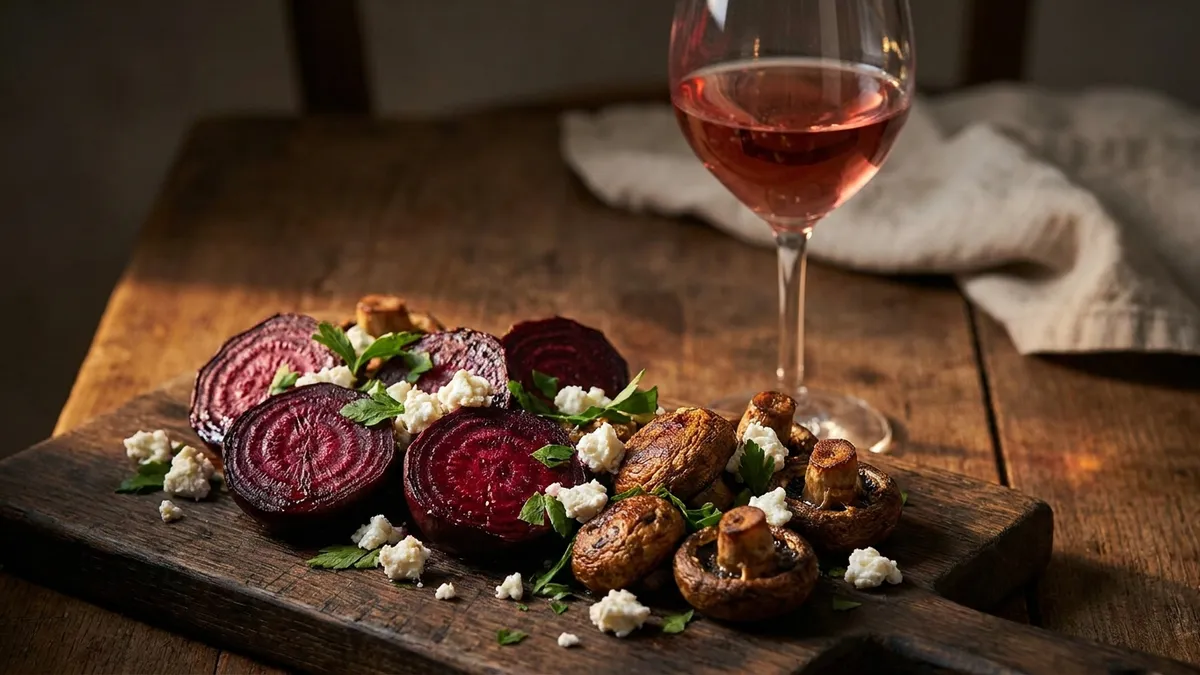
Pinot Noir works because its tannin is light and its smell of cherries and damp leaves sits on the same earthy line. Gamay is often the cheaper option with the same low tannin. The wine with mushrooms guide covers risotto, wild mushrooms and cream sauces.
If the beets come with goat cheese, switch to a dry rosé or Sauvignon Blanc, because the tangy cheese wants acidity more than earthiness. If mushrooms dominate, stay with Pinot Noir.
What Wine Goes With Roasted Brussels Sprouts and Broccoli?
Pour a crisp, unoaked white such as Sauvignon Blanc or Grüner Veltliner with roasted sprouts and broccoli, and keep tannic reds away. Sprouts are bitter by nature, from two compounds called sinigrin and progoitrin. Roasting is a popular way to cook them because browning adds sweetness, but the charred leaves add a bitter edge of their own.
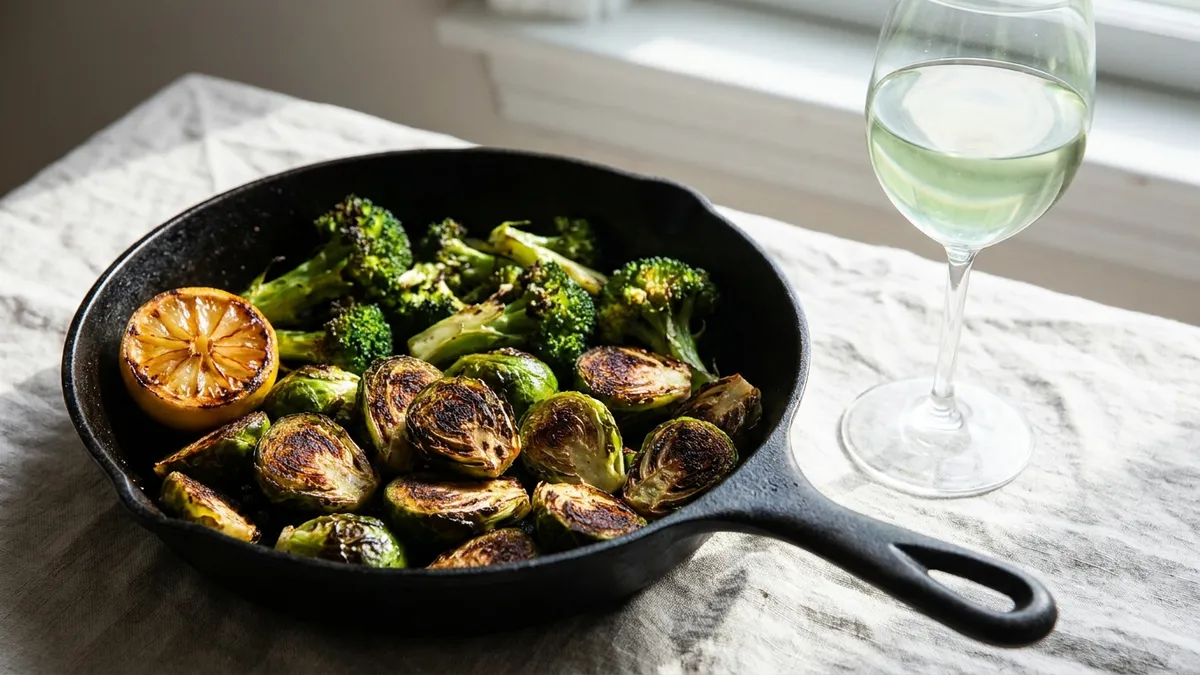
Bitterness and tannin stack. A firm red on top of a charred sprout tastes harsher and drier than either does alone. A crisp white sidesteps the problem, and its acidity does what a squeeze of lemon does to the pan. A dry Riesling works too, and a slightly off-dry one helps if the sprouts carry chilli flakes.
Sprouts rarely arrive plain. Bacon, parmesan or a honey glaze add fat, salt and sugar, and that is enough to let in a light red.
If the sprouts are plain and charred, pour a crisp white. If they come with bacon or parmesan, a chilled Gamay works.
What Wine Goes With Roasted Peppers, Aubergine and Tomatoes?
Pick a wine with at least as much acidity (the tartness that makes your mouth water) as the tomatoes: Barbera, Sangiovese or a dry rosé. Pairing practice is clear on this point: a wine less tart than the dish can taste thin and weak.
Roasted tomatoes are the sharpest thing on a Mediterranean tray, and ripe tomatoes are also rich in glutamate, the source of umami. Peppers and aubergine soak up olive oil and turn soft and sweet. Together they make a dish with acid, savoury depth and fat, which suits a red with high acidity and little tannin.
Barbera has exactly that structure. Sangiovese adds a little more grip, which the oil softens. A dry rosé is the lighter choice for a warm evening or a tray served at room temperature. The wine acidity explained guide shows how to taste acidity in a glass.
If tomatoes dominate the tray, pour a high-acid red. If peppers and aubergine dominate with plenty of oil, a Grenache or a fuller rosé works.
Does the Topping Matter More Than the Vegetable?
Usually, yes: the glaze, cheese, nuts or chilli on top often decides the wine more than the vegetable under it. A tray of carrots with tahini needs a crisp white, while the same carrots with chilli honey need an off-dry one. Read the topping first, then the vegetable.
- Balsamic glaze. Sweet and sharp at once. The acid rule above applies twice over, so pour a high-acid red such as Barbera, or an off-dry Riesling if the glaze is very sweet. Labels differ: Aceto Balsamico di Modena PGI must age at least 60 days, while the traditional PDO version must age at least 12 years and is usually thicker and sweeter.
- Cheese and nuts. Feta, parmesan, goat cheese, toasted walnuts. Fat and protein soften tannin, so a Grenache or Sangiovese now works.
- Chilli. Heat makes alcohol burn harder. Pour an off-dry Riesling or a chilled light red around 12 to 13% alcohol. The wine with spicy food guide covers the reasons.
- Yogurt, tahini or lemon dressing. Tangy and creamy. A crisp white or dry rosé matches the tang.
If you add cheese or nuts, you can move one step fuller. If you add chilli or a sweet glaze, move one step sweeter and lower in alcohol.
Can You Drink Red Wine With Roasted Vegetables?
Yes, if the red is low in tannin or the dish carries fat and protein. Tannin causes astringency (the drying, rough feeling in the mouth) because it binds to the proteins in your saliva. With meat, the tannin binds to the protein in the food instead and feels softer.
A tray of plain vegetables has little protein, so a firm red such as young Cabernet Sauvignon feels harsher than it would with steak. So pick a red with little tannin to begin with: Pinot Noir, Gamay, Grenache or Barbera. Or add the fat and protein yourself with cheese, nuts, a yogurt sauce or a generous pour of olive oil. The what are tannins guide explains how to feel tannin on your gums, and the wine with vegetarian food guide extends the same logic to lentils, cheese bakes and curries.
If the tray is plain vegetables and oil, pour Pinot Noir or Gamay. If it has cheese or nuts, Grenache or Sangiovese is fine.
The wine food pairing guide sets out the general principles, and the food pairing hub links every dish we cover. Sommy has bite-sized courses on tannin, acidity and body, the three things every pairing on this page turns on.
Cook one tray of carrots and red onion tonight until the edges are dark brown. Pour a Pinot Noir or a dry Chenin Blanc beside it. Then photograph the label in Sommy's AI-guided tasting mode and log whether the wine tastes thinner or fuller with each bite.
Sources
Frequently Asked Questions
What wine goes with roasted vegetables?
For a mixed tray, pour a dry white with some body such as Chardonnay or Chenin Blanc, a dry rosé, or a soft, low-tannin red such as Pinot Noir, Gamay or Grenache. Browning adds sweetness and savoury depth, so the darker the roast, the more body and fruit the wine can carry. Pale, lightly roasted vegetables suit a crisp white like Sauvignon Blanc.
Is red or white wine better with roasted vegetables?
Both work, and the roast decides. Lightly roasted, green or bitter vegetables suit a crisp white. Deeply browned roots, beets and mushrooms can take a light red, as long as its tannin is soft. Firm, tannic reds such as young Cabernet Sauvignon taste harsh next to bitter, charred edges unless the dish also has cheese, nuts or plenty of olive oil.
What wine goes with roasted butternut squash?
Roasted butternut squash is sweet and soft, so pour an off-dry Riesling or Chenin Blanc, or a ripe, lightly oaked Chardonnay if the squash is savoury with sage and salt. If the squash has a maple or honey glaze, the wine needs at least as much sweetness as the dish, or it will taste sour and thin beside it.
What wine pairs with roasted beets?
Pinot Noir is the classic choice for roasted beets, because both carry an earthy, damp-soil smell. Beets get that smell from geosmin, a compound people can detect at tiny levels. With goat cheese on top, switch to a dry rosé or a Sauvignon Blanc, whose acidity matches the tangy cheese better than a red does.
What wine goes with roasted Brussels sprouts?
Choose a crisp, unoaked white such as Sauvignon Blanc, Grüner Veltliner or a dry Riesling. Sprouts get their bitterness from compounds called sinigrin and progoitrin, and charring adds more, which makes tannic reds taste harsher and drier. If the sprouts come with bacon, parmesan or a sweet glaze, a light red such as Gamay becomes an option.
What wine goes with vegetables roasted with balsamic glaze?
Balsamic glaze is both sweet and sharp, so the wine needs high acidity and ripe fruit. A Barbera, a Sangiovese or a fruity dry rosé holds up. A low-acid wine will taste flat and thin next to the vinegar. Taste the glaze on its own first; if it is very sweet, an off-dry Riesling is the safer bet.
Sommy Team
LinkedInFounder & Wine Educator
The Sommy Team is building the world's most approachable wine education app, helping beginners develop real tasting skills through structured courses and AI-guided practice.