Wine Auction Guide: How to Bid, Buy and Avoid Bad Lots

By the Sommy Team — AI-assisted, human-edited.
Updated Sep 25, 2026

Contents (8)
- How Does a Wine Auction Work?
- Is Buying Wine at Auction Cheaper Than Retail?
- How Should a Beginner Bid: Online, Absentee or in the Room?
- How Do You Read a Wine Auction Condition Report?
- How Can You Spot a Counterfeit Bottle at Auction?
- What Happens After You Win a Lot?
- Which Wines Are Worth Buying at Auction?
- Is a Wine Auction Worth It for a Casual Drinker?
TL;DR
At a wine auction the hammer price is only the start: major houses add a buyer's premium of a fifth or more, and tax and delivery come on top. Read the fill level and storage history before you bid, set your maximum in advance, and remember that auction wine is sold as-is.
In any wine auction guide, the first number to learn is the fee on top of the winning bid. The major houses add a fifth or more on top of the hammer, and tax, shipping and insurance follow. The second thing that decides a good buy is invisible in the catalogue photo: how the bottle has been stored for the last ten or thirty years. Get those two right and an auction becomes the easiest way to taste a mature wine that no shop still sells.
How Does a Wine Auction Work?
A wine auction is an ascending-price sale: bidders raise each other in set steps until nobody goes higher. The last bid wins the lot (the bottle or group of bottles sold as one unit), and that winning bid is the hammer price. The house then adds its fee, and that total is what you pay.
Each lot carries a printed estimate, a low-to-high guide price, and usually a secret reserve, the minimum the seller will accept. The reserve is normally set between 80 and 100% of the low estimate, and never above it. If bidding stops below the reserve, the lot goes unsold, which the trade calls "bought in".
Is Buying Wine at Auction Cheaper Than Retail?
Sometimes, but rarely by as much as the hammer price suggests. The buyer's premium (the auction house's fee, charged to the winner) was 19.5 to 23.5% of the winning bid at the major houses when Wine Spectator checked in 2017, and rates change, so read each house's terms. Sales tax, shipping and insurance then land on top of that.
Wine Spectator's worked figure puts it plainly: a $500 purchase may cost upwards of $675 once delivered. That is roughly a third more than the number the auctioneer called. A lot that looked like a bargain against a shop's price can land level with it, or above it.
The gap that makes auctions worth the fees is age. A shop sells this year's release; an auction sells the same wine after it has spent 15 years in someone else's cellar. So the fair comparison for an old bottle is the price of finding that wine mature anywhere else.
| Cost layer | What it is | Typical size | What to do |
|---|---|---|---|
| Hammer price | The winning bid | Anywhere above the reserve | Set your ceiling before bidding opens |
| Buyer's premium | The house's fee on the winning bid | A fifth or more at major houses | Add about a quarter to every bid in your head |
| Sales tax | Tax on the purchase, by location | Varies by state or country | Check the house's terms for your address |
| Shipping and insurance | Moving the wine to you, cool and covered | Rises with distance and bottle count | Get a quote before the sale, not after |
| Landed cost | Everything above, combined | A $500 lot can pass $675 | Compare this figure with the retail price |
For the wider question of why some bottles cost what they do, see what makes wine expensive and our look at wine price versus quality.
How Should a Beginner Bid: Online, Absentee or in the Room?
Start with an online or absentee bid, because both force a maximum to be set before the excitement starts. An absentee bid is a written maximum left with the house before the sale; staff then bid one step at a time, up to that limit.
The absentee system has a second safeguard. A winning absentee bid is charged no more than one bid step (the fixed increment between bids) above the next-highest bid, however high the limit was. A $300 ceiling against a rival who stops at $150 costs one step above $150.
Online sales work the same way on screen, and they are not new: online wine auctions have run since the 1990s. In 2018 they took $74.9 million of the $479.1 million spent on collectible wine at auction. Many online lots are single bottles at everyday prices, which makes them the natural place for a first bid.
Bidding in the room is the riskiest option for a beginner. The pace is fast, a rival's paddle feels personal, and two extra steps can erase the saving. If the lot would still feel fair at your maximum after the premium, enter that number as an absentee bid and close the tab.
Our guide to buying wine online covers the delivery and seller checks that apply to any online wine purchase.
How Do You Read a Wine Auction Condition Report?
A condition report shows how the wine has been treated, and the fill level is the first line to read. Fill level, also called ullage, is how far the wine sits below the cork. Wine slowly escapes through even a good cork, so the level drops with age. What matters is whether the drop matches the age on the label.
Fill is described by where the wine sits on the bottle. For a Bordeaux-shaped bottle, the terms run from top to bottom:
- Into neck or base of neck: the level of a young or very well-kept bottle.
- Top shoulder: just where the neck widens, common on older wines.
- Upper shoulder: a little lower, still fine on a wine of several decades.
- Mid shoulder: a real loss of wine, and a sign that air has been getting in.
- Low shoulder: too much air; the wine is likely tired or spoiled.
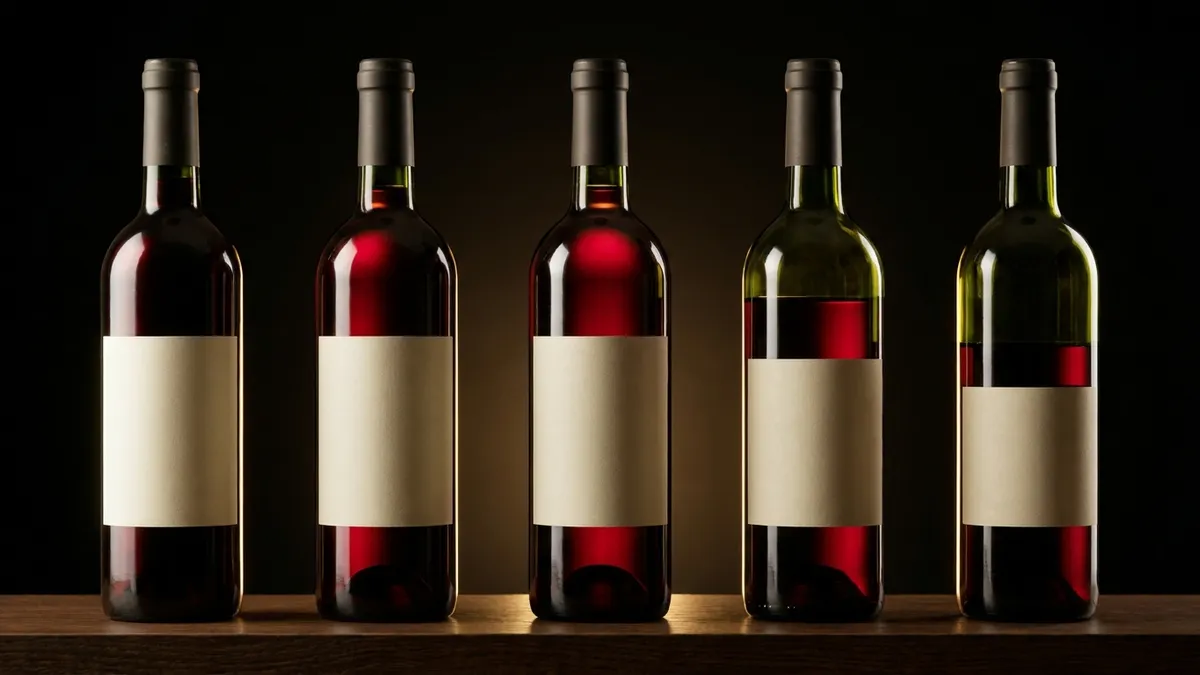
Age decides whether a fill is fine. Top or upper shoulder is common on a wine more than 30 years old. On a bottle only 10 to 20 years old, the same level is a red flag, because a young cork should not have let that much escape. If a 10-to-20-year-old bottle shows top or upper shoulder, skip the lot.
The rest of the report fills in the story. OWC means original wooden case, the box the winery shipped the wine in, which suggests the bottles have stayed together and moved little. Provenance is the record of where the wine has lived since it left the winery.
Storage conditions matter most in that record. Wine Spectator notes that wine kept in temperature- and humidity-controlled storage is preferable to wine from a passive cellar, an unregulated basement or cave that swings with the seasons. Stained or torn labels can point to damp storage, and a sticky or raised capsule can mean heat pushed wine past the cork. A heat-damaged bottle is the classic case; our explainer on cooked wine shows what it tastes like.
How Can You Spot a Counterfeit Bottle at Auction?
Check the story before the bottle: a clear storage history, a vintage the producer actually made, and a label, cork and capsule that fit the age. Fakes are most common among old, famous wines, where buyers have little to compare against and a single bottle can carry a high price.
Rudy Kurniawan, a collector who sold wine through major auctions, bought old but inexpensive Burgundy and relabeled it with prestigious producer names and different vintages. When the FBI searched his California home, agents found cheap Napa wines with notes saying they would be passed off as older Bordeaux, plus corks, stamps and labels. In 2014 he was sentenced to 10 years in federal prison.

One of the red flags that exposed him needed no lab at all. He offered a Burgundy said to come from vintages as far back as 1945, but the estate's head confirmed it had never made that wine before 1982. A vintage the producer never bottled is the cheapest fake to catch, and a quick check against the producer's own history catches it.
The problem has not vanished. As many as 10,000 of his counterfeit bottles may still sit in private collections, and private collections are where auction lots come from. If the seller cannot say where an old bottle has lived, pass on it. The counterfeit wine guide lists the physical checks, from cork branding to glass, in more detail.
What Happens After You Win a Lot?
You pay, arrange delivery, and own whatever arrives, because auction wine is sold as-is. Unlike a restaurant, where a flawed bottle goes back, an auction offers no return if the wine turns out to be corked or tired. The condition report is your protection, which is why it comes before the bid.
The house sends an invoice for the hammer price, the premium and any tax. Then you either collect the wine or pay for shipping. Heat is the main danger in transit: a few days in a hot truck can cook a wine that survived 20 years in a cellar. If delivery would fall in a heat wave, ask the house to hold the wine until the weather cools.
When the wine arrives, stand older bottles upright for a few days before opening. That lets sediment (the solid flakes of pigment and tannin that form as red wine ages) settle to the bottom, where a careful pour leaves it behind. Our guide to wine sediment explains what it is and how to decant off it. Anything you plan to keep belongs somewhere dark and steady; how to store wine at home covers the setup.
Which Wines Are Worth Buying at Auction?
Mature, age-worthy wines that retail shops no longer stock are where auctions earn their fees. A red Bordeaux or Barolo released a decade ago is hard to find anywhere else, and buying it aged saves you years of storage. If a wine is still on shop shelves at its release price, buy it there instead.
The wines that reward this route are the ones built to age: firm tannin (the drying grip on your gums) and high acidity that soften and fade into dried fruit and savoury notes over time. Most wine is made to drink within a year or two, and an old bottle of a wine never built for age is only a faded one. Our wine collection guide lists the styles that reliably improve.
There is a second kind of sale. First-hand auctions are run by wineries or wine bodies selling their own wine, often for promotion or charity. The best-known is the Hospices de Beaune in Burgundy, where wine from vineyards donated to a historic hospital is auctioned by the barrel. Those sales mostly draw trade buyers; the second-hand sales, where private owners sell their bottles through an auction house, are where individual drinkers bid.
If the plan is to resell at a profit rather than drink, the costs change again. The wine investment guide covers bonded storage and seller fees.
Is a Wine Auction Worth It for a Casual Drinker?
Yes, for one or two special bottles a year that no shop can supply. Most drinkers will get more pleasure per euro from a good merchant. The auction is for the exception: a birth-year wine, or a region's classic at 20 years old.
Treat the first purchase as practice in reading a lot. Choose one bottle with a clean fill level for its age and a named storage history. Its landed cost should be a price you would happily pay in a shop. The beginners' buying hub gathers our other buying guides. Sommy's bite-sized courses at sommy.wine build the tasting skills that show whether an old bottle was worth it.
Tonight, open one online auction listing and pick a single lot. Write down its high estimate, add a quarter, then look up the same wine at a shop and buy whichever is cheaper.
Sources
Frequently Asked Questions
Is buying wine at auction cheaper than retail?
Only sometimes. The major houses add a buyer's premium of a fifth or more to the winning bid, and tax, shipping and insurance come after that, so a $500 purchase can cost upwards of $675 delivered. Auctions win on mature wines that shops no longer stock. For young wines still on sale at release price, a shop is usually cheaper.
What is a buyer's premium at a wine auction?
A buyer's premium is a fee the auction house adds to the hammer price, the winning bid. At the major houses it is a fifth or more of that bid. It is not optional and it is not included in the estimate printed in the catalogue, so add roughly a quarter to any bid before deciding whether a lot is good value.
What does fill level or ullage mean on an auction listing?
Fill level, also called ullage, describes how far the wine sits below the cork. Wine slowly evaporates through the cork over decades, so a lower level is normal on very old bottles. A top-shoulder or upper-shoulder level is common on a wine more than 30 years old but is a red flag on a bottle only 10 to 20 years old.
Can a beginner bid at a wine auction?
Yes. Registration is open to anyone of legal drinking age who can pay, and many sales run online with lots at everyday prices. Start with an absentee or online bid on one or two bottles, set your maximum before bidding opens, and choose lots with a clear storage history so the first purchase is a safe one.
How do you know if an auction wine is fake?
Check the story before the bottle. A genuine older wine usually comes with a clear record of where it has been stored, a vintage the producer actually made, and a label, capsule and cork that match that age. Counterfeiters have relabeled cheaper old wine with famous names and invented vintages, so a lot with no storage history deserves a pass.
What happens after you win a wine auction lot?
The house sends an invoice for the hammer price plus the buyer's premium and any tax. You pay, then collect the wine or arrange shipping, which adds cost and should avoid hot weather. Auction wine is sold as-is, so there is no return if a bottle turns out to be flawed. Let older bottles rest upright for a few days before opening.
Sommy Team
LinkedInFounder & Wine Educator
The Sommy Team is building the world's most approachable wine education app, helping beginners develop real tasting skills through structured courses and AI-guided practice.