Types of Corkscrews: Waiter's Friend, Wing, Lever and More

By the Sommy Team — AI-assisted, human-edited.
Updated Sep 25, 2026
Contents (13)
- Types of Corkscrews Start With the Cork
- Types of Corkscrews, in One Paragraph
- What Are the Main Types of Corkscrews?
- What Is a Waiter's Friend Corkscrew?
- How Does a Winged Corkscrew Work, and When Should You Skip It?
- Is a Lever Corkscrew Worth the Price?
- What Is an Ah-So Cork Puller For?
- Do Electric Corkscrews Work Well?
- What Are Self-Pulling and Mounted Corkscrews?
- Which Corkscrew Should You Buy First?
- Do Screw Caps and Sparkling Wine Need a Corkscrew?
- Who Invented the Corkscrew, and What Did Each Idea Fix?
- How Do You Pick the Right Corkscrew Tonight?
TL;DR
Most types of corkscrews pull a cork the same way, with a steel spiral called the worm driven through its centre. The waiter's friend, winged, lever, electric and self-pulling designs differ in how they lift it. The two-pronged Ah-So grips from the outside instead, so it is the tool for old, crumbly corks.
Types of Corkscrews Start With the Cork
The cork decides the corkscrew. Almost all types of corkscrews drive a steel spiral through the centre of the cork and then lift it, which works well on a firm young cork. The one design that grips from the outside, the two-pronged puller, is the tool for an old cork that has dried and turned crumbly.
Types of Corkscrews, in One Paragraph
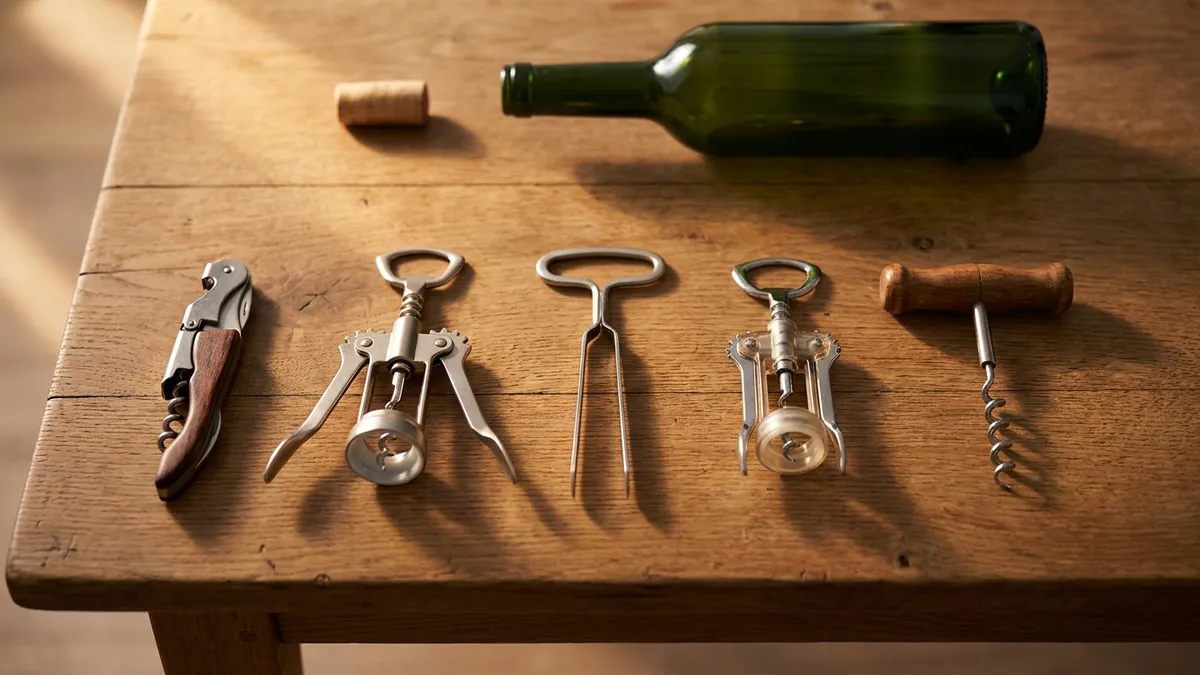
There are seven main types of corkscrews. The waiter's friend folds like a pocket knife and lifts the cork with a hinged lever, often in two steps. The winged corkscrew raises two geared arms as you twist, then lifts the cork as you press them down. The lever or rabbit style clamps the neck and pulls in one down-and-up stroke. The Ah-So slides two flat prongs down the sides of the cork. Electric models turn the spiral with a motor, self-pulling designs keep turning until the cork climbs out, and mounted ones bolt to a counter. Only the Ah-So leaves the cork undrilled.
What Are the Main Types of Corkscrews?
Seven designs cover most corkscrews in a shop, and six grip the cork with the worm (the pointed steel spiral that screws into the cork). They differ only in how they lift it: a lever on the lip, gears, a clamp, a motor, continuous turning or a counter mount. The seventh, the Ah-So, grips with prongs.
That single difference, drilling versus gripping, predicts which tool suits which bottle. A fresh cork is dense and springy, so a worm bites into plenty of material and holds. An old cork can be dry and brittle, so the worm cuts a channel through it and the cork tears around the spiral. If the cork is firm and the wine is young, any worm tool works; if the cork is old, dry or already crumbling, use the prongs.
| Type | How it grips | Lifts by | Watch out for | Reach for it when |
|---|---|---|---|---|
| Waiter's friend | Worm | Hinged lever on the bottle lip, often two steps | Off-centre worm tears the cork | You want one tool that fits a pocket and every cork length |
| Winged | Worm | Two geared arms pressed down | Brute force can punch through a fragile cork | The cork is young and firm and you want no technique |
| Lever (rabbit) | Worm | Clamp on the neck, one down-and-up stroke | Bulky, pricier, hides a cork that is starting to crumble | You open many bottles in one sitting |
| Ah-So (twin prong) | Two prongs outside the cork | Twist and lift | Takes practice on tight corks | The cork is old, dry or already broken |
| Electric | Worm | Battery motor | Needs charge; still tears old corks | Hand or wrist strength is limited |
| Self-pulling | Coated worm | Keep turning one way | Tall frame, awkward on odd necks | You want a cork out whole with no pulling |
| Mounted (bar) | Worm | Lever on a counter-fixed body | Fixed in one place | A bar or restaurant pours all night |
What Is a Waiter's Friend Corkscrew?
A waiter's friend is a folding corkscrew about the size of a pocket knife, with a foil blade, a worm and a hinged lever that rests on the bottle lip. It is also sold as a wine key or sommelier knife, and it is the tool most restaurant servers carry.
The small hinged blade sits in the handle end for cutting the capsule (the foil or plastic sleeve over the cork and neck). Once the worm is in the cork, the lever hooks on the lip and the handle becomes a lever arm, so the lip takes the strain instead of your arm.
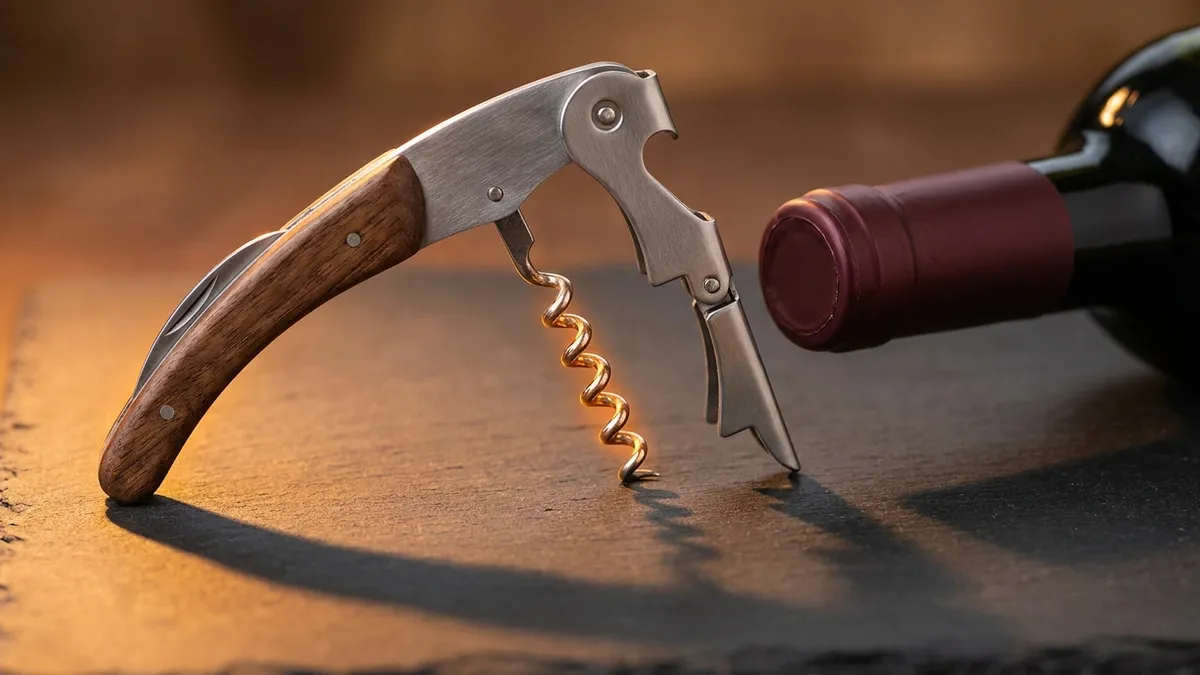
Look for a double-lever model, which has two steps on the lever instead of one. The first step lifts a long cork partway; the second step, resting lower, lifts the rest. Two short lifts put less bend on the cork than one long pull, which matters on a long cork from a wine made for ageing. Many models add a bottle opener on the same arm.
The name has a small story. The design came from Karl Wienke of Germany in 1882, and English speakers who struggled with "Wienke" are said to have turned it into "wine key." For the full foil-to-pour technique, the step-by-step guide on how to open a wine bottle walks through each lift.
How Does a Winged Corkscrew Work, and When Should You Skip It?
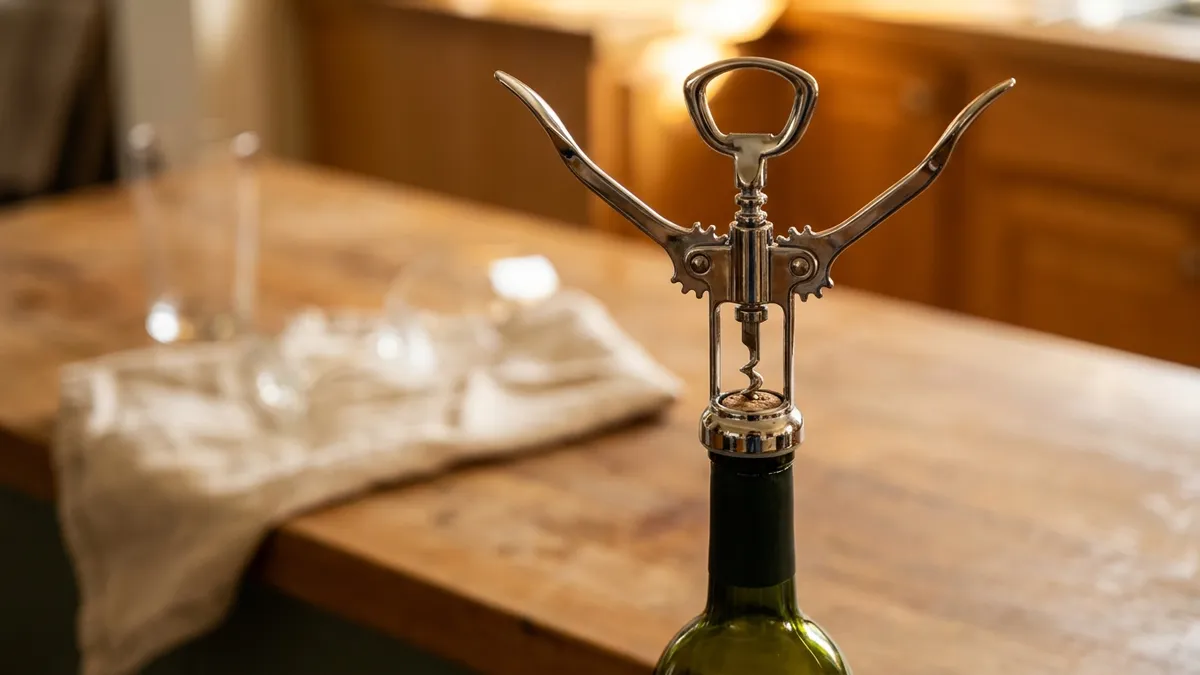
A winged corkscrew uses two geared arms: twisting the top handle drives the worm down and raises the arms, and pressing the arms down lifts the cork. The gears multiply your force, so the pull feels effortless even on a long, tight cork.
That easy feel is the catch. The winged corkscrew is often sold as the gentle beginner tool, yet its gears drive the worm with force you cannot feel. A dry cork gives no warning before the worm punches through or the cork snaps in half. On a firm young cork it does the job well. If the top of the cork looks dry, cracked or shrunken away from the glass, put the winged corkscrew down and use a waiter's friend or an Ah-So.
A dry cork can come from long upright storage in dry air. The guide to storing wine horizontal or vertical explains why cork-sealed bottles belong on their side for longer holds.
Is a Lever Corkscrew Worth the Price?
Yes, if you open many bottles in a row; no, if you open two a week. A lever corkscrew, often called a rabbit, is bulkier and more expensive than other manual styles, but it is much faster, and it asks for almost no technique or grip strength.
Its paired handles clamp around the bottle neck. Pressing the top lever down drives the worm into the cork, and lifting it back up pulls the cork out. Many models then release the cork from the worm with one more stroke, so the tool is ready for the next bottle.
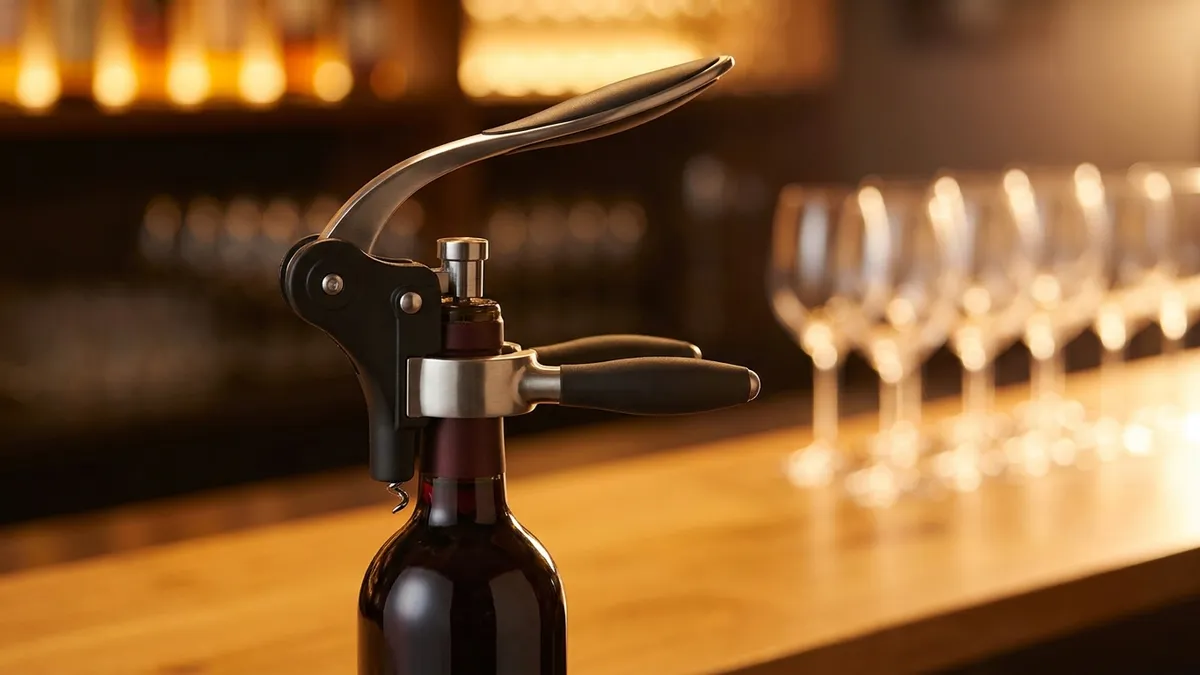
The speed has a cost besides bulk. The stroke meets so little resistance that a cork starting to crumble can tear before anyone notices. If several bottles get opened in one evening, the lever pays back its drawer space. If one bottle lasts from Friday to Sunday, a waiter's friend does the same job for less.
What Is an Ah-So Cork Puller For?
An Ah-So is a two-pronged cork puller for old, dry or crumbling corks, because it grips the cork from the outside instead of drilling through it. It is also called a butler's friend, and the Ah-So name is said to come from the German "ach so!", meaning "now I understand."
The two flat prongs, one usually a little longer than the other, slide down between the cork and the inside of the neck. Rock them in alternately until the handle meets the top of the cork, then twist and lift. The cork comes out whole and unpierced, so it can even be pushed back into the bottle afterwards.
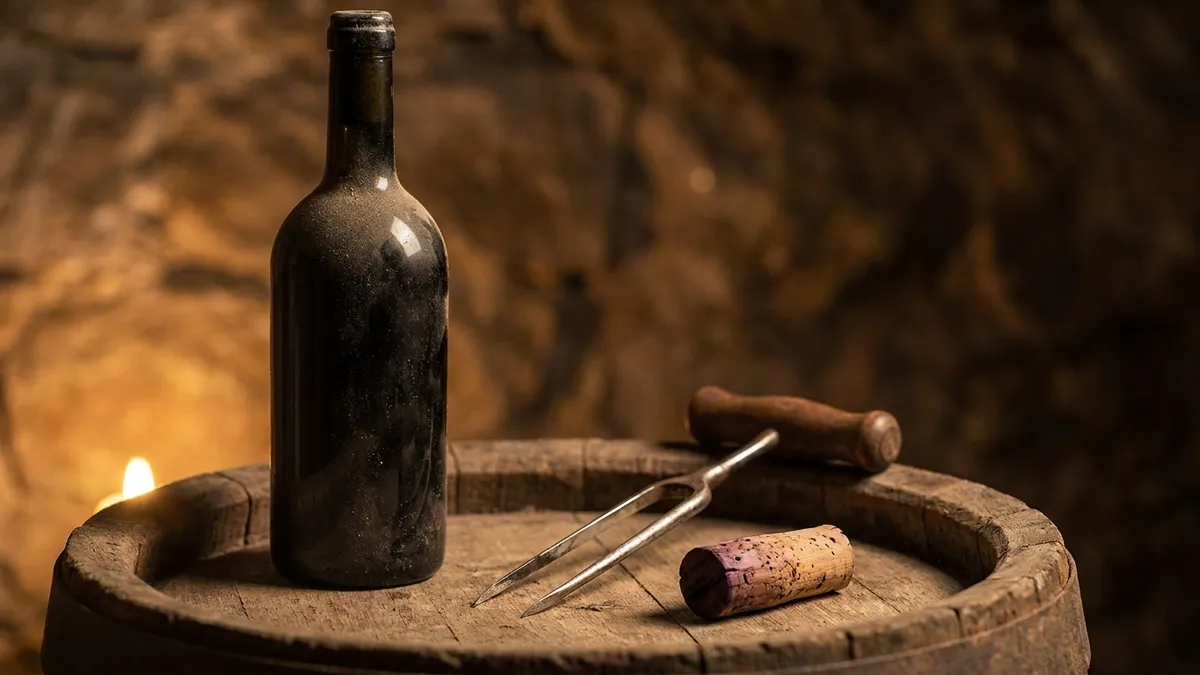
This is where drilling fails. A cork that has aged for many years can lose its spring, and a worm has little sound material left to bite. The prongs avoid the problem: they spread the grip along the cork's sides, where it still touches the glass. The prongs take practice on a very tight young cork, because they have to be forced into a narrow gap. If a cork starts to crumble on a worm halfway out, stop pulling and finish with the prongs.
Old bottles often throw sediment too, so after an Ah-So opening the next step is usually decanting the wine off the sediment.
Do Electric Corkscrews Work Well?
Yes, on a sound natural or synthetic cork, because an electric corkscrew is a worm turned by a battery motor. You set it on the bottle, press a button, the motor drives the worm in and draws the cork up into the body.
That makes it the easiest tool for anyone with sore hands or weak grip strength, and many come with a separate foil cutter. The limits are the limits of any worm. A synthetic cork (a stopper made of plastic rather than cork bark) can be very firm, so let the motor finish rather than forcing the tool. On an old, crumbly cork the motor tears it as readily as a hand-turned spiral, with even less feel for resistance. If the worm lands off centre, stop the motor, reverse it out and start again in the middle.
What Are Self-Pulling and Mounted Corkscrews?
A self-pulling corkscrew keeps turning one way until the cork climbs off the bottle, and a mounted corkscrew is bolted to a counter so a lever pull does the work. Both remove the moment where you yank the cork upward.
The best-known self-puller is the Screwpull, introduced by Herbert Allen in 1979. A frame sits over the neck and centres the worm. The spiral is coated with Teflon, which cuts friction as it twists into the cork, so once the worm is fully in, further turns draw the cork up the spiral and out in one piece. The frame also keeps the worm straight, which prevents the off-centre start behind many torn corks.
Mounted corkscrews date to the late 1800s, built for homes, hotel bars and restaurants at a time when all bottles were sealed with corks. Most early ones were sized for the short corks in beer bottles; modern ones are made for longer wine corks. If you pour by the glass all evening, a mounted unit is quicker than any hand tool.
Which Corkscrew Should You Buy First?
Buy a double-lever waiter's friend first, and add an Ah-So when you start keeping bottles for years. That pair opens almost every cork you will meet, from a firm young synthetic stopper to a dry one in a decades-old bottle. Both fit in one drawer, and the waiter's friend travels in a pocket.
Pick the rest by situation:
- Weak grip or sore wrists: an electric corkscrew or a lever model.
- Parties and tastings: a lever corkscrew, for speed across many bottles.
- Bottles with a decade or more in them: an Ah-So, with a waiter's friend as backup.
- A picnic or travel bag: a waiter's friend, since it folds flat.
- A home bar that pours every night: a mounted corkscrew.
If you own one tool, make it the double-lever waiter's friend. A winged corkscrew already in the drawer is fine for young bottles with firm corks, and the thumb test decides when to leave it there.
Do Screw Caps and Sparkling Wine Need a Corkscrew?
No. Screw caps open by hand, and sparkling wine corks come out with your hand, never a corkscrew. Hold a screw-capped bottle by the body, grip the cap and twist until the seal at the base clicks free, then unscrew the top the rest of the way.
The comparison of screw cap vs cork explains which wines use each closure and why a cap is no sign of a cheap wine.
Sparkling wine is sealed by pressure, and a worm driven into that cork can make it fly. Ease it out with the cage loosened and your hand over the top; the guide to sparkling wine types covers the styles that arrive under those mushroom corks.
Who Invented the Corkscrew, and What Did Each Idea Fix?
The first corkscrew patent went to the Reverend Samuel Henshall in England in 1795, and most later designs fixed one specific problem with pulling a cork by hand. Each fix still shows on tools sold today, from the disc on a T-handle to the gears on a winged corkscrew.
Six Dates, Six Fixes
- 1795, Henshall's button. Henshall fixed a small disc between the worm and the shank. It stops the worm going in too deep, and turning the handle against it twists the cork loose from the glass. The disc on many T-handle corkscrews is that same button.
- 1880, the double lever. William Burton Baker received British Patent No. 2950 for a double-lever corkscrew, the ancestor of the winged design.
- 1882 to 1883, the lever on the lip. Karl Wienke's folding corkscrew used the bottle lip as the fulcrum. His American patent, No. 283,731, was dated 21 August 1883 and titled "Lever-corkscrew." That fulcrum is why a waiter's friend needs so little arm strength.
- 1930, gears in the open. An American patent for the winged corkscrew went to Domenico Rosati, an Italian immigrant bartending in Chicago. His version left its rack and pinion (a toothed bar turned by a toothed wheel) in view, as many winged models still do.
- 1932 and 1936, the owl. The Spanish designer David Olañeta covered the gears with side plates in 1932, and Richard Smythe patented his enclosed "Hootch-Owl" in the US in 1936.
- 1979, the self-puller. Herbert Allen's Screwpull is now part of the Museum of Modern Art's permanent collection.
People who collect these tools have their own name: helixophiles, after the helix of the worm.
How Do You Pick the Right Corkscrew Tonight?
Look at the cork before you choose the tool. Cut the capsule and check that the top is firm and flush in the neck; if it is, a waiter's friend will do. Keep the Ah-So for anything older, drier or already cracked.
A musty smell once the cork is out points to a fault in the wine itself, and the guide on how to tell if wine is corked shows what to check.
For a half-finished bottle, wine preservation tools cover the stoppers and gas sprays that keep it for another night, and the serving and storage hub gathers the rest of the skills from cellar to glass. The Sommy app adds bite-sized courses, including Wine 101.
Press a thumb on the cork of tonight's bottle, pick the tool it calls for, then pour the first glass.
Sources
Frequently Asked Questions
What are the different types of corkscrews?
The main types are the waiter's friend (a folding lever corkscrew with a foil blade), the winged corkscrew with two geared arms, the lever or rabbit style that clamps the neck, the two-pronged Ah-So, electric corkscrews, self-pulling designs such as the Screwpull, and counter-mounted bar corkscrews. All except the Ah-So drive a steel spiral into the cork.
What is the easiest type of corkscrew to use?
A lever corkscrew takes the least skill: clamp it on the neck, press the lever down, lift it up, and the cork comes out. An electric corkscrew is similarly easy. For a tool that also travels and lasts, a double-lever waiter's friend is easy after a few bottles, because the two-step lever lifts a long cork in two short pulls.
Why is a waiter's corkscrew called a wine key?
The waiter's friend was designed by the German Karl Wienke in 1882. English speakers found his surname hard to say, and the tool came to be called a wine key, by most accounts a folk version of Wienke. It is also sold as a sommelier knife, because the folding body with a small blade looks like a pocket knife.
What is the best corkscrew for old or crumbly corks?
Use a two-pronged cork puller, often called an Ah-So or butler's friend. Its two flat prongs slide down between the cork and the glass, so nothing drills through the cork. A dry, fragile cork has little material left to hold a spiral, which is why worm-based corkscrews tend to tear it. Rock the prongs in slowly, then twist and lift.
Do electric corkscrews work on all bottles?
No. An electric corkscrew is a worm turned by a motor, so it needs a cork to drill into. It does nothing for a screw cap and must never be used on sparkling wine, whose cork is held in by pressure. It works well on sound corks, but on an old, crumbly cork it tears just like a manual worm.
Do you need a corkscrew for screw cap wine?
No. A screw cap opens by hand: hold the bottle, grip the cap and twist until the seal at the base clicks free, then unscrew the top. Screw caps are common on fresh whites and young reds meant to be drunk early. A corkscrew is only needed for bottles sealed with a natural, technical or synthetic cork.
Sommy Team
LinkedInFounder & Wine Educator
The Sommy Team is building the world's most approachable wine education app, helping beginners develop real tasting skills through structured courses and AI-guided practice.