How to Remove a Broken Cork: What to Do by What's Left

By the Sommy Team — AI-assisted, human-edited.
Updated Oct 29, 2026
Contents (8)
- How to Remove a Broken Cork, in One Paragraph
- Which Fix for Which Broken Cork?
- Can You Pull Out the Rest with a Corkscrew?
- When Should You Use a Two-Prong Opener?
- Is It Okay to Push the Cork Into the Bottle?
- How Do You Get Cork Bits Out of the Wine?
- Will Cork in the Wine Change the Taste?
- Why Did the Cork Break?
TL;DR
A broken cork rarely harms the wine. If a firm stub is left, drive the corkscrew back in at about 45 degrees and pull slowly. If the cork is old, use a two-prong opener. If it keeps crumbling, push it into the bottle and pour through a coffee filter or cheesecloth.
How to remove a broken cork comes down to one question: what is left in the neck. A firm stub can still be pulled, and a crumbling one gets pushed in and filtered out. Either way the wine inside is almost always fine to drink.
How to Remove a Broken Cork, in One Paragraph
Start with what is left in the neck. If a firm stub sits within reach, drive the corkscrew back into it at about 45 degrees, pressed toward the side of the glass, and pull slowly. If the bottle is old or the cork looks dry, slide a two-prong opener down its sides instead of drilling it again. If the cork keeps crumbling or slips out of reach, push it into the bottle with a wooden spoon handle or a chopstick. Then pour through a paper coffee filter, cheesecloth or a fine sieve to catch the crumbs.
Floating cork does not change the flavour. Sparkling wine is the one exception: never push its cork in.
Which Fix for Which Broken Cork?
If a firm stub is left, pull it; if it crumbles or has slipped out of reach, push it in and filter. An old bottle skips the corkscrew and goes straight to a two-prong opener. Find your bottle in the left column and move down a row only when that fix fails.
| What is left | Do this | Tool | Watch for |
|---|---|---|---|
| A firm stub inside the neck | Screw back in at about 45 degrees against the side of the neck, pull very slowly | Waiter's friend corkscrew | The worm tearing out a second time |
| An old, dry or loose cork | Slide the prongs down both sides, rock in, twist and lift | Two-prong opener (Ah-So) | Forcing the prongs in fast |
| A cork that crumbles on every try, or is out of reach | Push it into the bottle, then filter | Wooden spoon handle or chopstick | Never on sparkling wine |
| Crumbs already floating in the wine | Pour through a filter into a jug or decanter | Paper coffee filter, cheesecloth or fine sieve | Fragments too small to see |
| Crumbs in a decades-old wine | Filter straight into each glass | Paper coffee filter in a small funnel | Extra air on a fragile wine |

Quick check
One question on what you just read
The cork in your bottle of still red keeps crumbling every time you try. What is the best fix?
Tap an answer to see how you did.
Can You Pull Out the Rest with a Corkscrew?
Yes, if the stub is still firm: drive the corkscrew back in at a slant, about 45 degrees, pressed toward the side of the neck, then pull slowly. The slant lets the worm (the steel spiral of the corkscrew) bite into the cork that is left. A straight-down worm can follow its old hole and find nothing to grip.
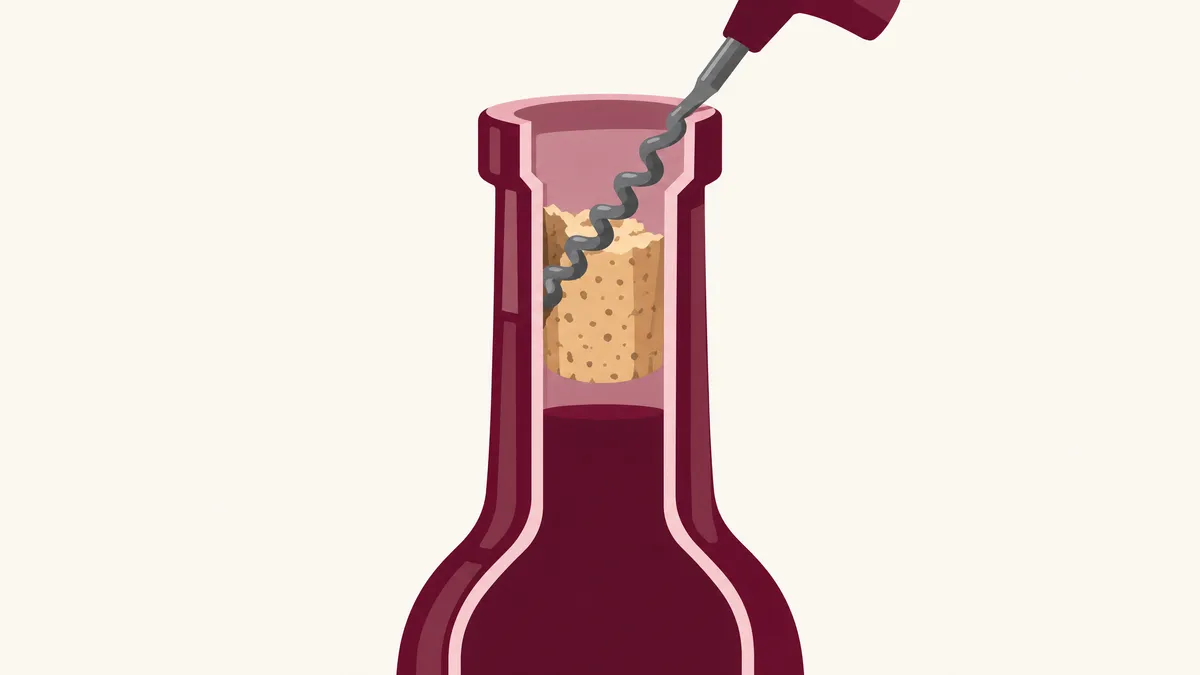
Turn the worm in until it holds, then lift with the lever in small steps. The pull matters as much as the angle. Decanter's advice is to try again very slowly with the corkscrew, pulling very slowly. A fast yank tears a weakened stub in half again.
If the worm tears out a second time, stop pulling. Each attempt sheds more crumbs into the wine and pushes the stub lower. Switch to prongs if you have them, or move straight to pushing the cork in. The full corkscrew technique for a sound cork is in our guide on how to open a wine bottle.
When Should You Use a Two-Prong Opener?
Use a two-prong opener when the cork is old, dry or loose, because it grips the cork from the sides instead of drilling through its middle. Often called an Ah-So, it has two thin flat blades joined by a handle. VinePair calls it the standard tool for fragile old corks.
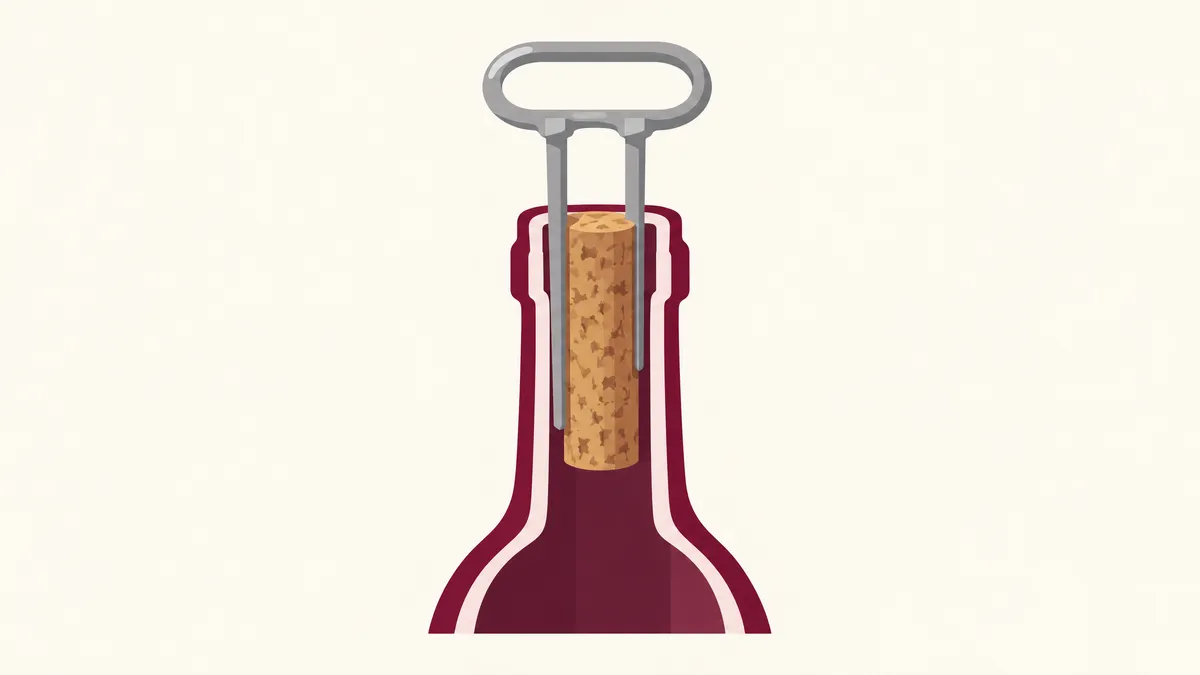
Slide the longer prong a little way down one side of the cork, between cork and glass. Then rock the handle so each prong walks down in turn until the handle meets the top of the cork. Twist and lift as one movement.
Sommelier Julia Sewell told Decanter that anyone who opens older bottles should own one. Clement Robert MS adds that pulling from the sides with prongs is easier than pulling from the middle with a screw. If the bottle has years of cellar age, or the top of the cork looks dry and shrunken from the glass, reach for the prongs before any worm. The other designs, and the cork each suits, are compared in types of corkscrews.
Is It Okay to Push the Cork Into the Bottle?
Yes, for still wine it is the easiest fix, and the wine is fine. Wine Spectator recommends the handle of a spoon, a chopstick or anything else that fits. Stand the bottle on a towel and press steadily down on the centre of the cork until it drops into the wine.
The cork then floats up into the neck as you tilt the bottle, so the pour comes in glugs. Hold the cork back with the same chopstick while you pour, or decant the bottle into a jug in one go. To fish the cork out afterwards, Wine Spectator's trick is kitchen twine with a few knots tied at one end. Slide the knotted end past the cork with a thin knife, then pull the twine slowly. The knots catch the cork and drag it up the neck.
If the bottle is sparkling, never push. The wine is under pressure, and the method for those corks is in how to open sparkling wine. Once the cork is inside, it cannot seal the bottle again, so plan on finishing it or stoppering what is left. How long wine lasts after opening gives the timings by style.
How Do You Get Cork Bits Out of the Wine?
Pour the wine through a paper coffee filter, clean cheesecloth or a fine sieve into a jug or decanter. Julia Sewell calls fine mesh the simplest solution, picked by the size of the pieces. Food Republic notes that some fragments are too small to see, so paper does the cleanest job.
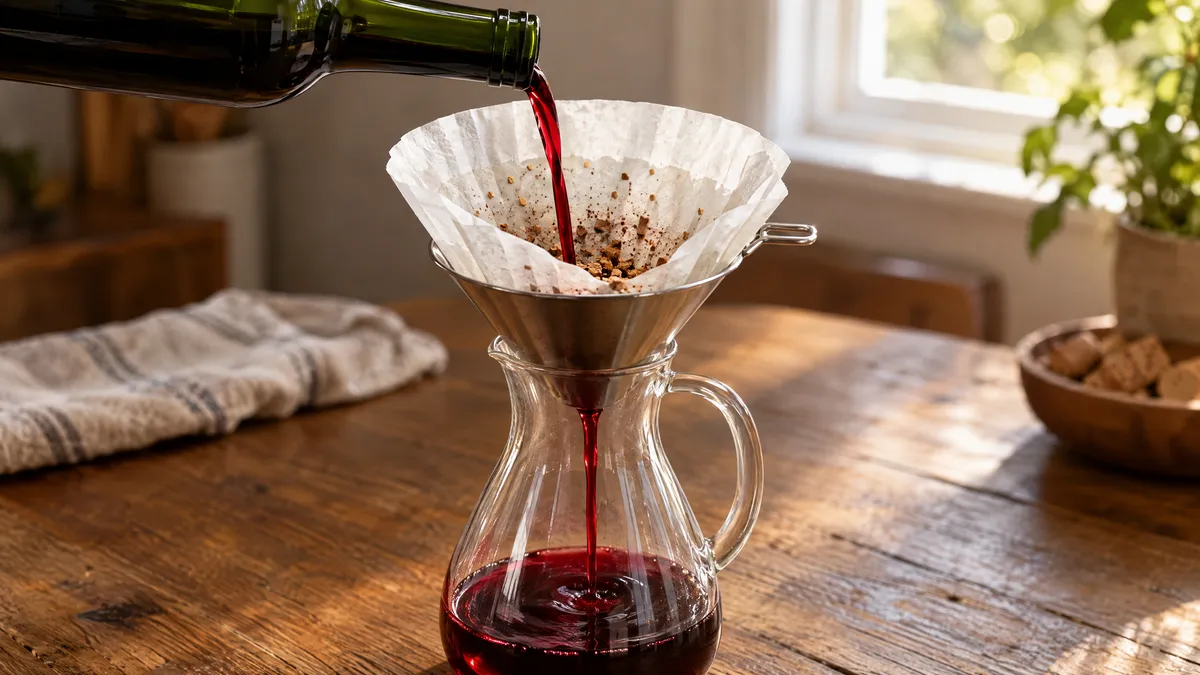
Set the filter in a funnel and pour slowly, so the paper does not overflow or tear. The coffee filter does not change the taste of the wine. A sieve is faster but lets dust through, so use it only when the pieces are large.
Fragile old wine needs a different order. Sewell warns that filtering can speed up oxidation in a very old wine, so it is better to filter it directly into the glass rather than decanting it first. If the wine is decades old, set the filter over each glass as you pour. Pouring off the deposit in an old red is a separate job, covered in how to decant wine and wine sediment explained.
Will Cork in the Wine Change the Taste?
No. The cork sits in the wine for a short time, so it does not change the flavour, as Wine Spectator notes. Floating crumbs are a texture problem, and in most cases the wine is fine to drink, Decanter adds, because the cork kept its seal until you opened it.
A crumbling cork is not a corked wine. Corked wine has a smell fault caused by TCA (a chemical that taints some corks), and it smells of damp cardboard or a musty cellar. Cork condition and cork taint are unrelated: a perfect cork can hide a corked wine, and a crumbled one can sit on a perfect bottle. The smell test in how to tell if wine is corked settles it, and the chemistry is in TCA cork taint, explained.
Why Did the Cork Break?
Most broken corks come from the tool or the cork's age. VinePair's troubleshooting points to four causes: a bent worm, a worm that is off-centre or too shallow, an extra-long cork, or an old, dry cork. Each has its own fix:
- A bent worm. A worm that has started to bend pulls the cork to one side and breaks it in half. Replace the corkscrew.
- An off-centre or shallow worm. VinePair's rule is a worm both centred and deep enough, or the lever lifts only the top. Start at the exact middle and turn until the spiral is buried in the cork.
- An extra-long cork. Some corks, such as those in Barolo and Barbaresco, are longer than a standard cork, so the corkscrew may not pull them out fully. Give the worm another turn instead of forcing the lift.
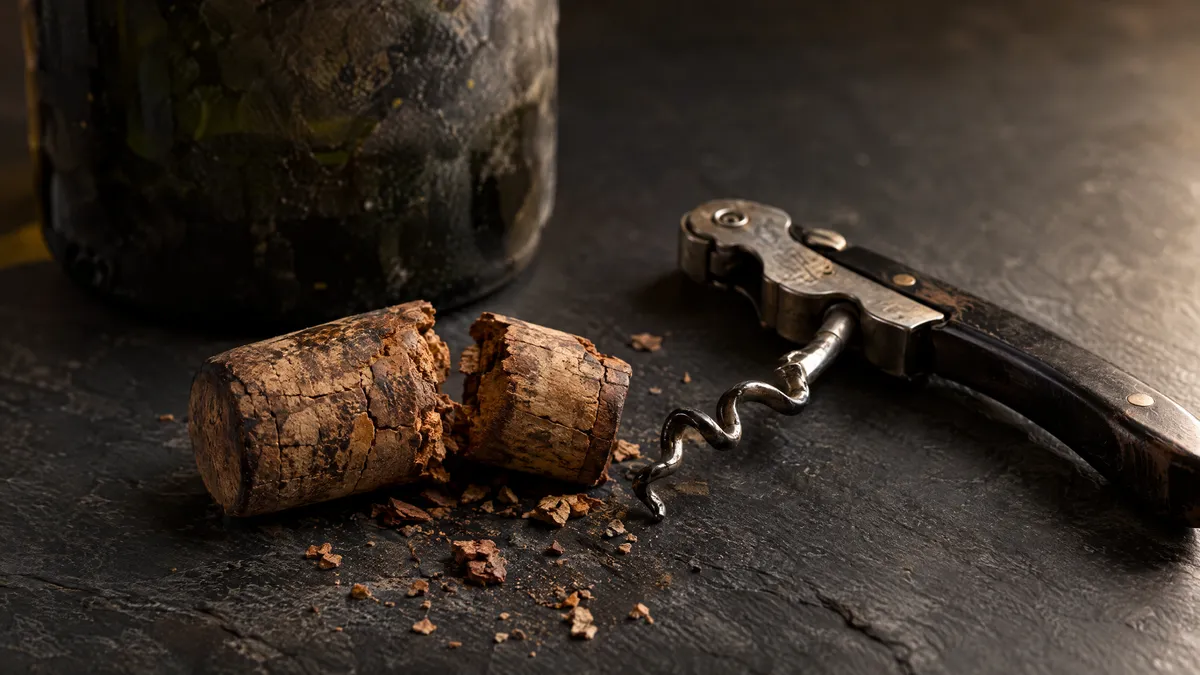
- An old cork. Older bottles have older corks, which can be delicate and crumbly and often fall apart under a standard corkscrew. Use the prongs from the start.
A screw cap removes the problem for bottles meant to be drunk young. The trade-offs are set out in screw cap vs cork.
Serving, storing and opening are gathered in the serving and storage hub, and the Sommy app at sommy.wine has bite-sized wine courses from Wine 101 up. Check your corkscrew tonight: lay its worm against a ruler or a straight table edge. If the spiral leans off its line, buy a new one before you open the next bottle.
Sources
- Wine Spectator: How do I open a wine bottle when the cork is stuck in the neck?
- Decanter China: What to do if your wine cork breaks or crumbles (Ask Decanter)
- Tasting Table: How to remove a broken wine cork
- VinePair: How to stop breaking wine corks
- Food Republic: The coffee filter trick to save wine from floating cork remnants
Frequently Asked Questions
How do you get a broken cork out of a wine bottle?
Drive your corkscrew into the piece left in the neck at about a 45-degree angle, pressed toward the side of the glass, and pull very slowly. If the cork is old or loose, slide a two-prong opener down its sides instead. If it keeps crumbling, push it into the bottle and pour the wine through a coffee filter.
Can you push a cork into the wine bottle?
Yes, with still wine. Wine Spectator calls it the easiest approach. Use the handle of a wooden spoon or a chopstick and press steadily. The pour will be awkward because the cork floats into the neck, so hold it back with the same stick as you pour. Never push the cork of a sparkling wine, which is under pressure.
Is wine safe to drink with cork floating in it?
Yes. Cork crumbs floating in the wine are a texture problem, and the wine was still sealed until you opened it. The cork sits in the wine only briefly, so it does not change the flavour. Pour through a coffee filter, cheesecloth or a fine sieve to catch the pieces, and smell the wine first to check it is not corked.
How do you filter cork out of wine?
Set a paper coffee filter in a funnel over a jug or decanter and pour slowly. Cheesecloth or a fine sieve also works for larger pieces, but paper catches fragments too small to see. The filter does not change the taste. For a very old wine, filter straight into each glass, because extra handling can speed up oxidation.
Why does my wine cork keep crumbling?
Usually the tool or the cork's age. A bent worm pulls the cork to one side and snaps it, and a worm that goes in off-centre or too shallow tears the top away. Older corks turn dry and crumbly and often fall apart under a standard corkscrew. Some long corks, notably in Barolo and Barbaresco, are too long for a standard corkscrew to pull out fully.
Does a crumbled cork mean the wine is corked?
No. Corked wine is a smell fault caused by a chemical called TCA, which gives a damp cardboard or musty cellar smell. A crumbling cork is about the cork's age and condition. A cork can crumble over a perfect wine, and a firm, healthy-looking cork can still hide a corked one. Smell the wine to decide.
Sommy Team
LinkedInFounder & Wine Educator
The Sommy Team is building the world's most approachable wine education app, helping beginners develop real tasting skills through structured courses and AI-guided practice.