TCA and Cork Taint: The Real Science Behind a Corked Wine

By the Sommy Team — AI-assisted, human-edited.
Updated Sep 24, 2026
Contents (10)
- What Is TCA, Exactly? The Basic Science of Cork Taint
- What Causes Cork Taint? How TCA Gets Into a Cork
- How Common Is Cork Taint Today? Reconciling the Conflicting Numbers
- What Does a Corked Wine Actually Smell and Taste Like?
- The Real Chemistry: Why TCA Blocks Smell Instead of Adding One
- Why Can Some People Taste Cork Taint and Others Can't?
- Does a Screw Cap or Synthetic Cork Guarantee No Taint?
- How Is the Cork Industry Fixing This?
- Is Corked Wine Safe to Drink, and What Should You Do About It?
- Cork Taint Is One Fault Among Several, Not a Verdict on the Wine
TL;DR
TCA cork taint science comes down to one molecule, 2,4,6-trichloroanisole, that forms when plant compounds, chlorine and mold interact. It doesn't add a smell so much as block your nose's own signal, which is why light taint just tastes dull. Rates have fallen sharply since 2005 thanks to cork-cleaning technology.
What Is TCA, Exactly? The Basic Science of Cork Taint
TCA cork taint science comes down to one molecule: 2,4,6-trichloroanisole, almost always shortened to TCA. It is a chlorine-based organic compound that forms when natural plant compounds react with chlorine and mold, and it is the most common cause of a "corked" bottle. TCA causes an estimated 80 to 85 percent of all cork taint cases. A handful of close chemical relatives, including TBA (tribromoanisole), TeCA and PCA, produce similar musty defects through the same basic mechanism.
What Causes Cork Taint? How TCA Gets Into a Cork
TCA forms through the interaction of plant phenols, chlorine and mold. Cork bark is naturally full of phenolic compounds. When those compounds meet chlorine, usually from bleaching or sterilizing agents used in wood or cork processing, certain fungi in the environment convert the resulting chlorophenols into chloroanisoles. TCA is the most common member of that family. No legal or regulatory limit exists on how much TCA a bottle of wine can contain, and that missing standard is one reason the fault has persisted so long without an industry-wide fix.
The cork itself is not the only source. TCA can also form on damp surfaces inside a winery, or arrive through chlorine-based cleaning products used on tanks, barrels and floors. From there it can migrate into wine sealed with other closures. That single fact matters more than it looks. It means "cork taint" is shorthand for a supply-chain problem, and the stopper in your hand is not always to blame.
How Common Is Cork Taint Today? Reconciling the Conflicting Numbers
Search for a taint rate and you will find 1 percent, 3 to 5 percent, 7 percent and even "up to 15 percent," often on the same results page. Those numbers do not contradict each other. They measure different things, in different years, with different methods.
| Source | Year | Method | Reported rate |
|---|---|---|---|
| Wine Spectator blind-tasting panel | 2005 | Blind tasting of 2,800 bottles in Napa | 7% tainted |
| Wine Spectator's own tracking | 2007 | Corked bottles in its California wine tastings | 9.5% corked |
| Wine Spectator's own tracking | 2012 | Same tastings, 5 years later | 3.7% corked |
| APCOR (cork industry group) | cited via industry study | Cork-supplier lab testing | 0.7–1.2% tainted |
| Cork industry's general estimate | not stated | Self-reported failure rate | Typically 1–2% |
| Cork Quality Council | 2013 vs. 8 years earlier | Lab TCA measurement of cork batches | 81% drop in TCA levels; 90% of samples below 1.0 ppt |
Two things explain the spread. First, method. A blind-tasting panel counts each bottle a taster flags as off, including mild cases a casual drinker would miss. A cork-supplier lab test measures TCA in parts per trillion on raw cork stock before it ever meets wine. Second, timing: nearly all of these numbers fell between roughly 2005 and 2013, as cork producers rolled out steam extraction and supercritical-CO2 cleaning. If a page quotes a 2005 figure as today's rate, it is out of date.
What Does a Corked Wine Actually Smell and Taste Like?
At high doses TCA smells musty; at low doses it mostly strips flavor. High concentrations smell moldy, like cardboard, damp cement or wet newspaper, and most drinkers recognize that signature once they have met it. At low concentrations TCA usually doesn't smell musty at all. It leaves a normally fruity wine tasting dull, muted or flat.
The low-dose case is the one most drinkers never hear about. A lightly corked bottle rarely announces itself with a basement smell. More often it tastes like a disappointing vintage: fruit that should be bright reads as tired, and a finish that should linger just stops. Plenty of wines dismissed as "not very good" are in fact corked. The 30-second check in how to tell if wine is corked covers both the obvious and the subtle version of the fault.

The Real Chemistry: Why TCA Blocks Smell Instead of Adding One
Sensory scientists studying olfactory cells found that TCA does not work the way a normal smell works. A typical aroma molecule binds to a receptor and triggers a signal the brain reads as a scent. TCA does close to the opposite. It suppresses the channels that carry the nose's own electrical signal, without triggering a normal odor response of its own.
Researchers publishing in the Proceedings of the National Academy of Sciences in 2013 tested isolated olfactory receptor cells. They showed that this suppression happens even at attomolar concentrations, which are extraordinarily low. They proposed that the brain may read that sudden drop in the nose's signal as an odor in itself: a smell made out of absence.
That mechanism is a tidy explanation for something every taster has noticed but few can name: cork taint reads like a wine that has gone quiet. At low levels, TCA appears to interfere with the ability to smell everything else in the glass at the same time.

Why Can Some People Taste Cork Taint and Others Can't?
Detection thresholds for TCA vary enormously between people, and that is the biggest reason cork taint causes arguments at the table. Trained expert tasters can detect TCA at roughly 0.3 to 2 nanograms per liter. Some untrained tasters, by contrast, needed concentrations in the milligram-per-liter range before they noticed anything, roughly a millionfold higher.
Wine style moves the number too. One study put the consumer rejection threshold in white wine at around 3.1 to 3.7 nanograms per liter. One published estimate puts the detection threshold in red wine far higher, around 50 nanograms per liter. The likely reason is that a red's stronger fruit and tannin can mask a moderate amount of taint.
That spread explains a familiar restaurant scene: one guest sends a bottle back, insisting it smells like a basement, while everyone else at the table tastes nothing wrong. Neither person is being difficult. The two sit at different points on a threshold curve that spans several orders of magnitude. Training your palate through repeated, deliberate tasting is the only way to move up it.
Does a Screw Cap or Synthetic Cork Guarantee No Taint?
Mostly, yes, with rare exceptions. Screw caps and synthetic closures contain no natural cork, so the classic taint pathway of cork bark reacting with chlorine and mold is absent. Cork-taint rates on screw-capped wine are close to zero in practice.
That near-zero rate drove the shift toward screw cap in markets like New Zealand and Australia; the screw cap vs cork comparison covers the trade-offs.
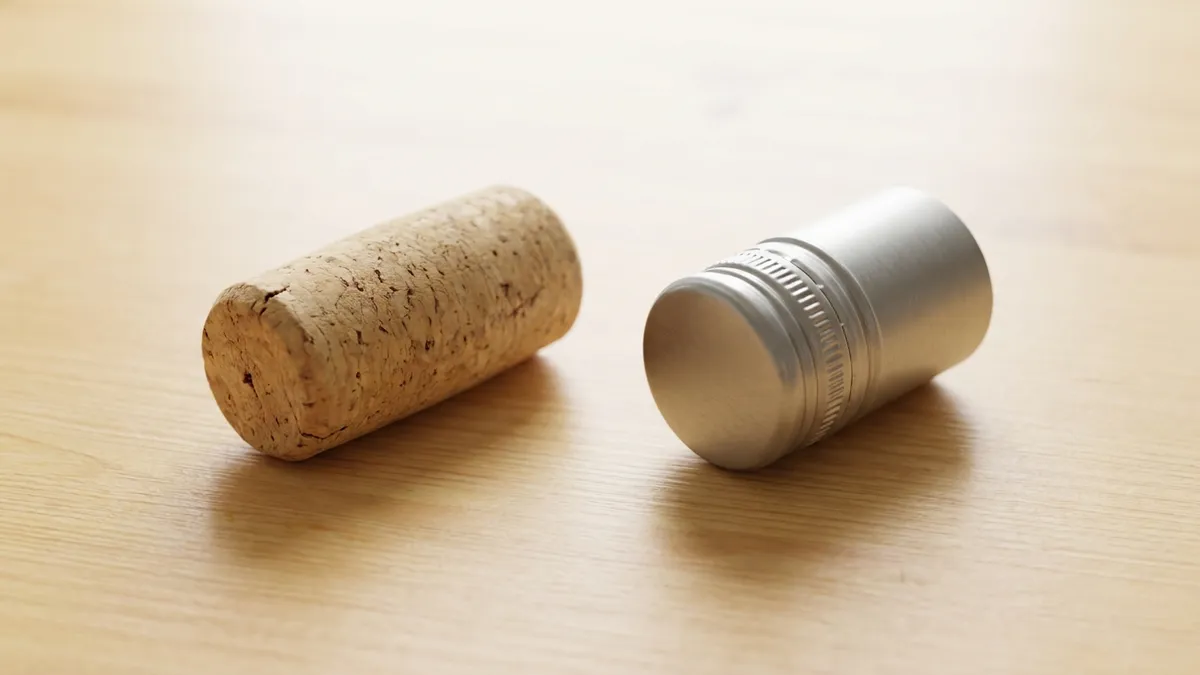
The overstated claim is "screw cap wine can never be corked." TCA and related compounds can originate elsewhere in a winery, in damp surfaces, wooden pallets, barrels or chlorine-based cleaning products. From there they can contaminate wine whatever closure seals the bottle. It is rare, and calling it "impossible" turns a low-probability event into a certainty it is not. The practical advice holds: if you want the lowest odds of a corked bottle, pick a screw cap.
How Is the Cork Industry Fixing This?
After the taint crisis of the 1990s and 2000s, the cork industry made a measurable overhaul of its processes. Producers phased out chlorine-based bleaching in favor of peroxide cleaning, added steam-extraction treatments, and began screening batches with gas chromatography rather than relying on spot checks.
The most advanced fix is a supercritical-CO2 cleaning process, branded by Diam as Diamant. It pushes CO2 through granulated cork under pressure to strip out TCA and related compounds. The resulting closures are guaranteed to test below roughly 0.3 nanograms per liter of releasable TCA.
| Fix | How it works | Result |
|---|---|---|
| Peroxide cleaning | Replaces chlorine-based bleaching agents in cork processing | Removes the chlorine half of the reaction that forms TCA |
| Steam extraction | Draws volatile compounds, including TCA, out of raw cork with steam | Widely used across mid-tier and premium natural cork |
| Gas chromatography screening | Tests individual cork batches for TCA in parts per trillion | Lets producers reject contaminated lots before bottling |
| Supercritical-CO2 (Diamant) | CO2 under pressure strips TCA from granulated cork, which is reformed into closures | Guaranteed releasable TCA below roughly 0.3 ng/L |
The results back up the cork makers' claims. The Cork Quality Council's own testing showed an 81 percent reduction in average TCA levels over an eight-year stretch. By 2013, 90 percent of its samples were below 1.0 part per trillion. The corked-bottle rate in Wine Spectator's California tastings dropped from 9.5 percent in 2007 to 3.7 percent in 2012. None of that makes natural cork taint-free. It does mean a corked bottle is rarer today than it was when your parents started buying wine.
Is Corked Wine Safe to Drink, and What Should You Do About It?
Yes, corked wine is safe. At the concentrations found in tainted wine, TCA is unpleasant and non-toxic, so a small sip to confirm the fault carries no risk. If that sip confirms it, stop drinking and take the bottle back to the shop where you bought it, or ask the restaurant for another.
The only cost of a corked bottle is a ruined bottle and a lost evening, so sending one back is reasonable behavior. Returning it reports a physical defect in the product, the same as returning spoiled milk.
Keep the cork and the receipt from any bottle you suspect, since a reputable shop will want to see both. Note the producer if bad bottles ever repeat. For the full etiquette of the moment, including what to say to a server, see when to send wine back and how to order wine at a restaurant without feeling awkward about it.
Cork Taint Is One Fault Among Several, Not a Verdict on the Wine
Cork taint is separate from the wine's own quality and from faults it gets confused with. A crumbly or floating bit of cork in the glass is a mechanical nuisance, unrelated to TCA. A browned, sherry-like wine is oxidized, a different chemical problem. Telling faults apart, instead of lumping every "something's wrong" bottle into one bucket, is covered in identifying wine faults by smell. The line between a fault and a style choice is in wine flaws vs faults, and the wine faults hub collects the rest.
Cork taint is a specific, learnable signal, and the flatness it causes was never the wine's own fault. The Sommy app builds this kind of tasting vocabulary through short, structured courses and guided practice. If a glass tastes strangely quiet tonight: taste it again, then check the fruit before blaming yourself, the grape or the vintage. Flat, short fruit with no clear musty smell points to light TCA.
Sources
Frequently Asked Questions
What causes cork taint in wine?
Cork taint is caused mainly by a compound called 2,4,6-trichloroanisole, or TCA, which forms through a reaction between plant phenols, chlorine and mold, either inside the cork itself or elsewhere in a winery, such as on damp surfaces or in chlorine-based cleaning products. TCA accounts for an estimated 80 to 85 percent of all cork taint cases; related compounds like TBA cause the rest.
What does TCA smell like?
At high concentrations, TCA smells like mold, wet cardboard, damp cement or wet newspaper. At low concentrations it often doesn't smell musty at all. Instead it mutes the wine's fruit character, so a normally vibrant Sauvignon Blanc or Pinot Noir just tastes dull, flat and short, which is why many lightly corked bottles get blamed on the vintage instead of the cork.
Is corked wine safe to drink?
Yes. TCA is unpleasant, not dangerous. It is not toxic at the concentrations found in wine, so a corked bottle will not make you sick. The fault is purely sensory: it strips the wine of aroma and flavor. There is no reason to worry about drinking a small sip to confirm the fault before pouring the rest out.
Can everyone taste cork taint?
No, detection ability varies enormously. Highly trained tasters can pick up TCA at roughly 0.3 to 2 nanograms per liter, while some untrained tasters need concentrations in the milligram range, a difference of roughly a millionfold, before they notice anything at all. That range is exactly why one guest at a table sends a bottle back while another tastes nothing wrong.
How common is cork taint today?
It depends on which study and which year you cite, which is why the numbers look contradictory. A 2005 blind-tasting study found 7 percent of bottles tainted; the cork industry group APCOR cites 0.7 to 1.2 percent from lab testing; Wine Spectator's own tracking fell from 9.5 percent in 2007 to 3.7 percent in 2012. The cork industry's own estimate today is typically 1 to 2 percent.
Does a screw cap avoid cork taint completely?
Almost always, since there is no natural cork present to react. But TCA and related compounds can occasionally originate elsewhere in a winery, such as in wooden pallets, barrels or chlorine-based cleaning chemicals, and end up in a screw-cap bottle in rare cases. Screw cap dramatically reduces the risk; it does not make it mathematically zero.
How do wineries and cork producers test for TCA?
Cork producers use gas chromatography to measure TCA in parts per trillion on sample batches, and modern cleaning processes such as steam extraction and supercritical CO2 treatment (branded as Diam's Diamant process) strip TCA and related compounds out of raw cork before it ever reaches a winery. The Cork Quality Council has tracked an 81 percent drop in average TCA levels over an eight-year testing period.
Can you fix or remove cork taint from an already-opened bottle?
Only partly. A trick advocated by a UC Davis wine chemist is pouring the wine into a bowl lined with polyethylene plastic wrap, which absorbs TCA within minutes. It can also pull out some of the wine's own aroma, and results vary with how tainted the bottle is. Usually the simplest answer is to return the bottle if you can and open something else.
Sommy Team
LinkedInFounder & Wine Educator
The Sommy Team is building the world's most approachable wine education app, helping beginners develop real tasting skills through structured courses and AI-guided practice.