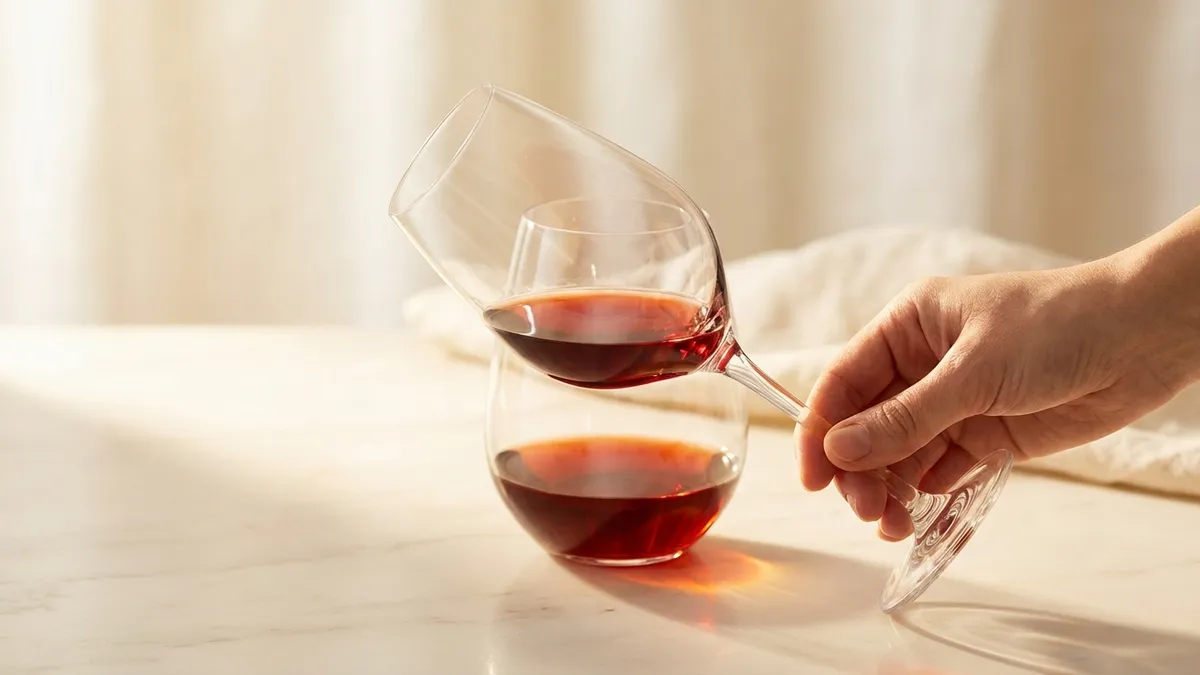
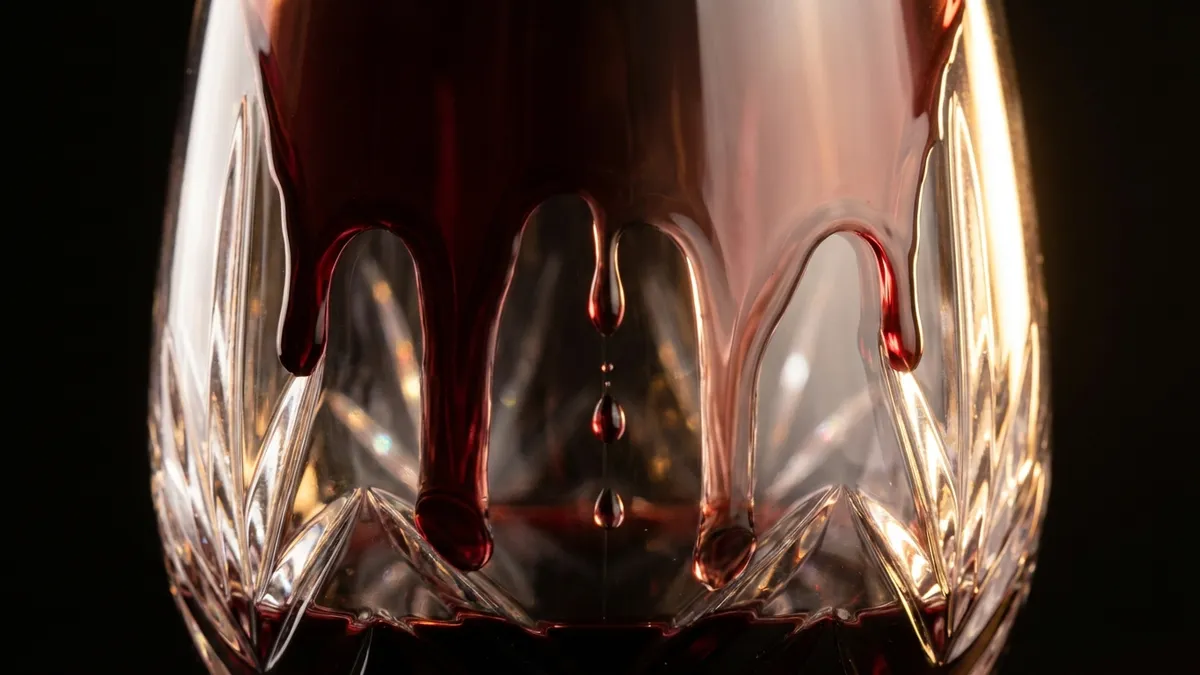
Earthy Flavors in Wine: Mushroom, Forest Floor, and Beyond

By the Sommy Team — AI-assisted, human-edited.
Updated Apr 29, 2026
Contents (8)
- What Earthy Flavors in Wine Actually Mean
- Earthy Notes in Wine, in 100 Words
- Eight Earthy Descriptors and Where They Come From
- Why Earthy Notes Develop: The Four Routes
- Common Confusions: Earthy vs Funky vs Flawed
- How to Train Your Nose for Earthy Notes
- Where Earthy Wines Come From: A Geography
- The Bottom Line
TL;DR
Earthy flavors in wine include forest floor, mushroom, truffle, wet leaves, damp soil, leather, tobacco, and wet stone. They come from bottle age, terroir on limestone and cool sites, low-dose brettanomyces, and whole-cluster fermentation. The clearest examples sit in aged Burgundy, Bordeaux, Barolo, Brunello, and traditional Rioja.
What Earthy Flavors in Wine Actually Mean
Earthy flavors in wine are aromas and palate notes that suggest the ground rather than the fruit on the vine — forest floor, mushroom, truffle, damp soil, wet leaves, leather, tobacco, and wet stone. They are the descriptors that separate a wine that tastes "of fruit" from one that tastes "of place and time."
For decades, beginner wine writing focused almost entirely on fruit. But ask any sommelier what makes mature Burgundy memorable, and the answer points to earth. The fruit is still there — it is just layered under something deeper, something that smells like a damp October forest the morning after rain.
This guide walks through eight specific earthy descriptors, where they come from chemically and geographically, and how to train your nose to find them in any glass.
Earthy Notes in Wine, in 100 Words
Earthy notes in wine include forest floor (sous bois), wet leaves, mushroom, truffle, dried tobacco, damp soil, leather, and wet stone. They come from four main routes: tertiary bottle age, where proteins fragment into savory aldehydes that smell like mushroom and broth; terroir, especially limestone soils and cool climates in Burgundy, Tuscany, and the northern Rhône; low-dose brettanomyces, a yeast that adds controlled leather and barnyard; and whole-cluster fermentation, where grape stems contribute forest floor and herbal earth. The clearest examples sit in aged Burgundy Pinot Noir, Bordeaux, Barolo, Brunello di Montalcino, and traditional Rioja Gran Reserva.
Eight Earthy Descriptors and Where They Come From
Below are the eight earthy descriptors that show up most often in serious tasting notes. Each one has a chemical origin, a regional home, and a way to train your nose for it.
1. Forest floor (sous bois)
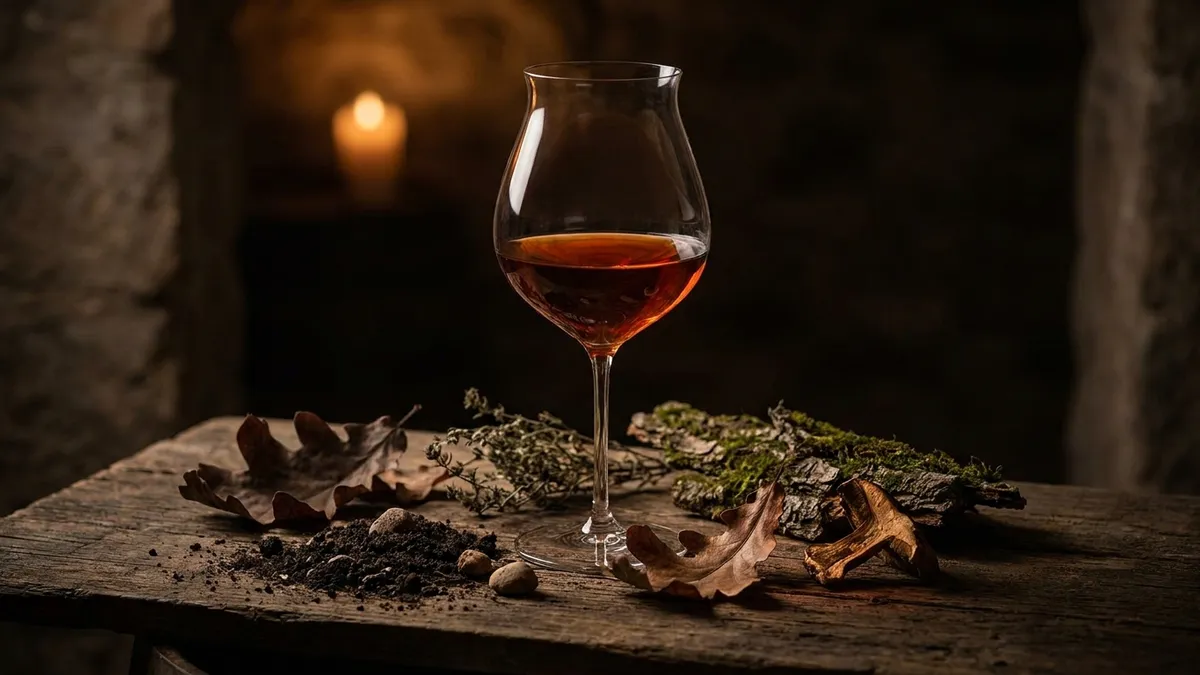
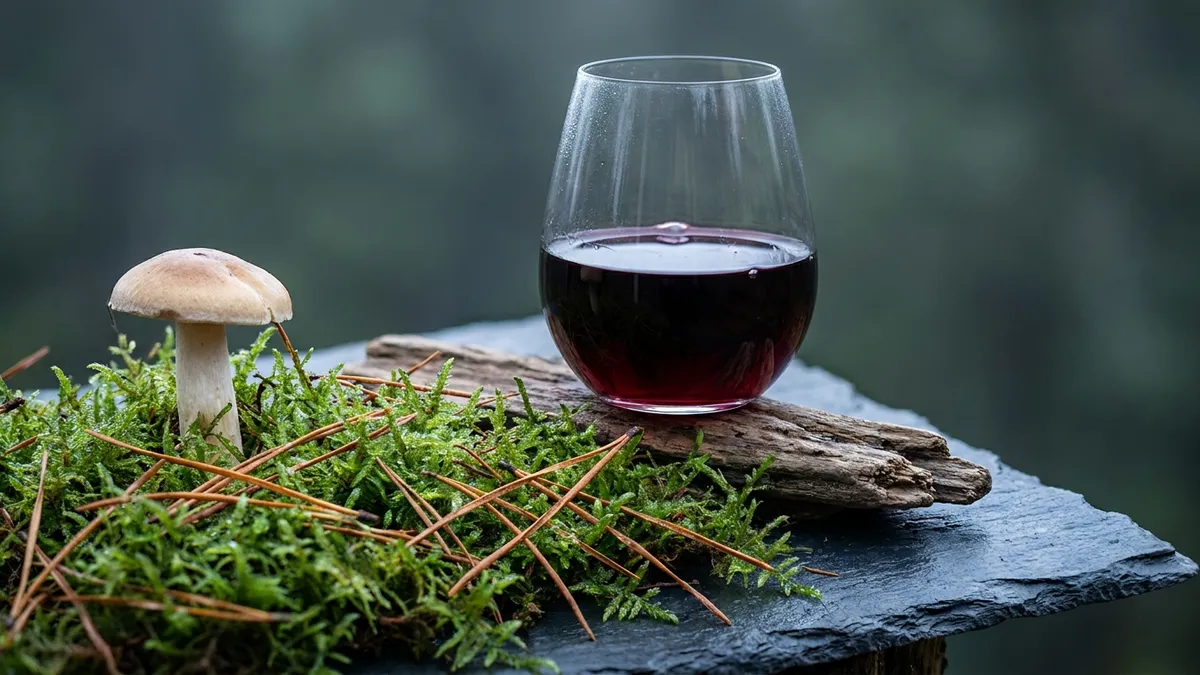
Forest floor — known in French wine writing as sous bois ("under the woods") — is the smell of damp forest at the start of autumn. Decaying leaves, wet bark, moss, and mushroom combine into a single woody, earthy aroma.
The chemical origin is a mix of methoxypyrazines (the herbal-green family), terpenes (the volatile compounds in pine and bay), and tertiary aldehydes that develop as the wine ages in bottle. Whole-cluster fermentation amplifies the effect by leaving stems in the must.
Where to find it: aged red Burgundy from Pinot Noir, mature Barolo from Nebbiolo, and northern Rhône Syrah with stem inclusion are the textbook references.
2. Mushroom (champignon)
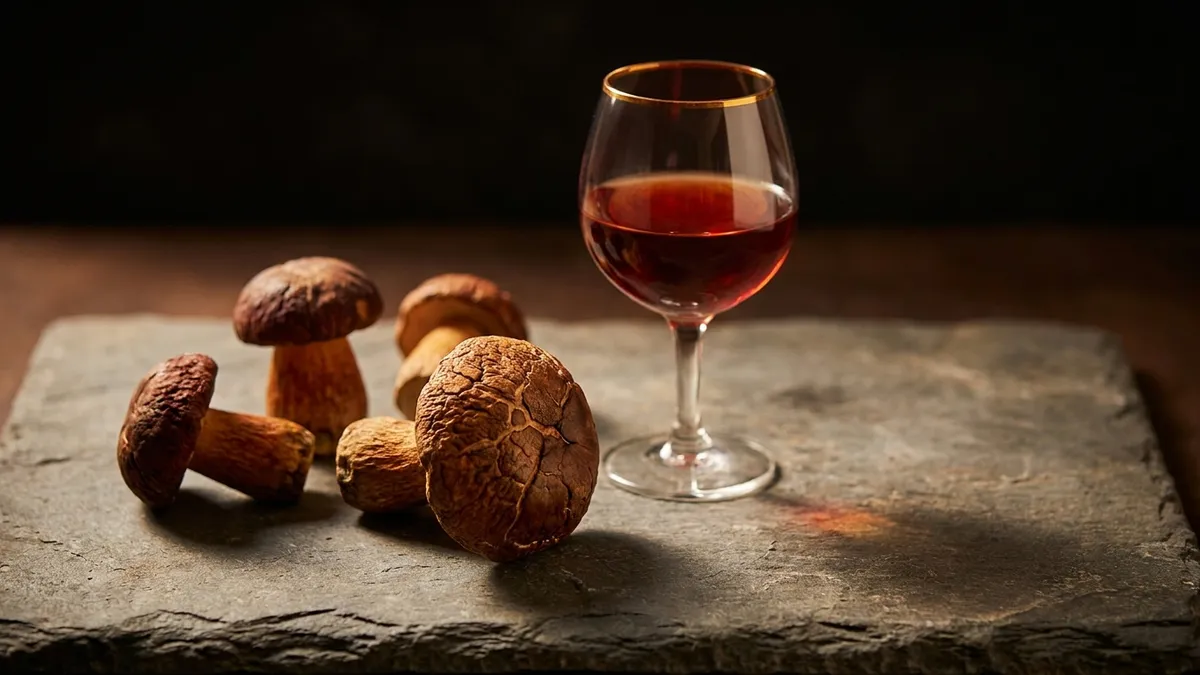
Mushroom in wine is one of the clearest tertiary signals. It develops as wine ages and proteins fragment into amino acid compounds that the human nose reads as porcini, shiitake, or button mushroom.
A clean mushroom note is a sign of complexity. A musty, sweaty mushroom note is a different story — usually brett at high concentration, which crosses from feature to flaw. The distinction matters for anyone learning to evaluate wine.
Where to find it: aged Burgundy at 10+ years, Barolo at 12+ years, and traditional Rioja Gran Reserva.
3. Truffle
Truffle is mushroom turned up to eleven — pungent, slightly sulfurous, deeply earthy. Black truffle in red wine and white truffle in old white Burgundy are real, identifiable aromas, not marketing language.
The compound responsible is dimethyl sulfide at low concentrations, combined with the same tertiary aldehydes that produce mushroom. It is rare in young wine and a hallmark of long bottle age.
Where to find it: very old Nebbiolo from Barolo and Barbaresco, aged red Burgundy at 15+ years, and a small subset of mature Tuscan Sangiovese.
4. Wet leaves and damp soil
Wet leaves and damp soil sit in the same family as forest floor but with less mushroom. They suggest the ground itself rather than what grows in it. The aroma is cool, slightly green, and earthy without being herbal.
This is largely a terroir signal. Limestone soils in Burgundy, the calcareous clay of Tuscany, and the cool slate of the Mosel can all produce this character.
5. Leather
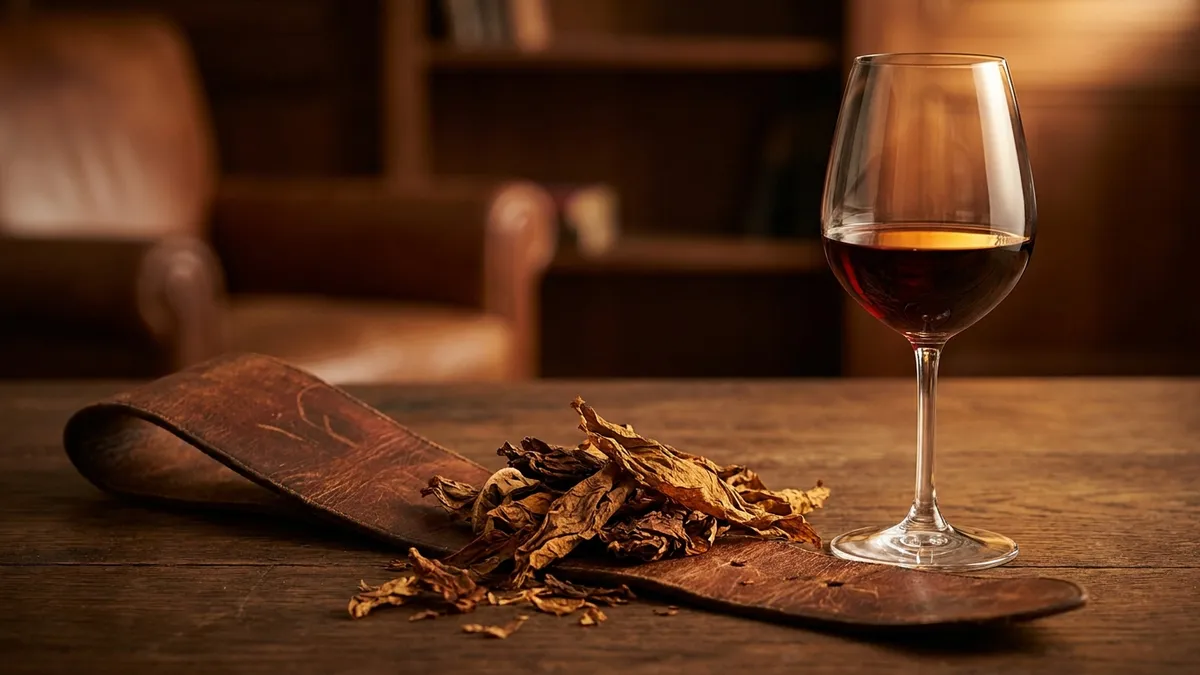
Leather is a savory, animal note that smells like a worn leather chair or saddle. It develops with bottle age, and at low concentrations it sits squarely in the earthy quadrant rather than the faulty one.
The compound is largely 4-ethylphenol, produced in small amounts by brettanomyces yeast. At high levels brett produces band-aid and sweaty horse aromas — those are flaws. At controlled levels, the same compound reads as leather, cigar box, and mature complexity.
Where to find it: aged Bordeaux from Cabernet Sauvignon and Merlot, mature Châteauneuf-du-Pape, and old Spanish Tempranillo.
6. Tobacco and cigar box
Tobacco and cigar box describe the dry, slightly sweet aroma of cured tobacco leaves and the cedar wood used to store them. The cedar component often comes from oak aging; the tobacco itself comes from grape varieties high in methoxypyrazines combined with bottle age.
Where to find it: aged Cabernet Sauvignon and Cabernet Franc, mature Brunello di Montalcino and Chianti Classico Riserva, and aged Bordeaux blends from the Médoc.
7. Wet stone and crushed rock
Wet stone is the smell of a slate roof after rain, or a river pebble pulled from a stream. Unlike the other descriptors here, it leans cool and clean rather than warm and savory. Some tasters call it minerality, though that term remains contested in the scientific literature.
This is the most terroir-driven of the earthy notes. It shows up in young wines from limestone, slate, schist, and volcanic soils. You do not need bottle age to find it.
Where to find it: Chablis Chardonnay, Mosel Riesling, Sancerre Sauvignon Blanc, and dry whites from Etna in Sicily and Santorini in Greece.
8. Damp earth and mineral soil
Damp earth is the catch-all. It describes the smell of garden soil after rain or freshly turned compost. Unlike forest floor it carries no woodland note; unlike wet stone it is warmer and softer.
Damp earth often signals a wine made for terroir expression rather than fruit purity. Cool-climate sites and reductive winemaking — where oxygen is kept low during fermentation — both push wines toward this profile.
Where to find it: cool-climate Pinot Noir from Oregon and Burgundy, German Spätburgunder, and Gamay from Beaujolais crus.
Why Earthy Notes Develop: The Four Routes
Earthy character does not come from one source. It arrives through four mostly independent paths, and great earthy wines often combine two or three.
Tertiary bottle age
Once a wine is bottled, slow chemical reactions continue for years. Proteins fragment into shorter peptides. Volatile compounds rearrange. Tannins polymerize and soften. The cumulative result is tertiary character — dried fruit, leather, truffle, mushroom, and forest floor replacing the bright primary fruit of youth.
A young Burgundy at 3 years old smells of cherry and rose. The same wine at 15 years smells of dried cherry, rose petal, mushroom, and forest floor. The fruit has not vanished — it has been overlaid with earth. Read more in our guide to tasting young versus aged wine and the framework of primary, secondary, and tertiary aromas.
Terroir and soil
Terroir — the environment where grapes grow, including soil, climate, altitude, and exposure — leaves measurable fingerprints in the finished wine. Limestone soils in Burgundy and Tuscany produce wines that taste cool and savory. Slate in the Mosel produces wet-stone Riesling. Volcanic soils on Etna produce smoky, ashen reds.
The science behind terroir is still being mapped, but the empirical pattern is robust enough that experienced tasters can often guess soil type blind. For a deeper read, see our explanation of what terroir means and wine minerality.
Brettanomyces at low doses
Brettanomyces — usually shortened to brett — is a yeast that produces 4-ethylphenol and 4-ethylguaiacol. At high levels these compounds smell like band-aid, sweaty horse, and barnyard, and most modern winemakers consider them flaws. At controlled, low levels they smell like leather, cigar box, and tertiary complexity.
Traditional Old World winemaking often tolerated low-dose brett as part of the regional style. Mature Châteauneuf-du-Pape, aged Bordeaux, and traditional Rioja often carry trace brett character that reads as earthy rather than faulty. Knowing the line between feature and flaw is part of becoming a more confident taster — see how to identify wine faults by smell.
Whole-cluster and stem-inclusion fermentation
Whole-cluster fermentation leaves grape stems in the must during fermentation rather than removing them with a destemmer. The stems contribute herbal, twiggy, forest-floor character that reads as earthy from day one. Some Pinot Noir and Syrah producers in Burgundy, the Loire, and the northern Rhône use 30 to 100 percent whole clusters by tradition.
The technique pushes a wine toward forest floor and stem even when young. Combined with bottle age the effect deepens — twiggy stems become layered sous bois.
Common Confusions: Earthy vs Funky vs Flawed
Earthy descriptors live next door to a few signals that are actually flaws. The distinction takes practice.
Mushroom from age vs mushroom from brett
A clean mushroom note in an aged wine arrives layered under fruit, with savor on the mid-palate and finish. A brett-driven mushroom note feels sharper, more uniform, and often comes with sweaty or band-aid undertones. The brett version dominates the wine; the tertiary version supports it.
Earthy vs corked
Cork taint — caused by the compound TCA (2,4,6-trichloroanisole) — smells like wet cardboard, damp basement, and musty newspaper. It strips fruit out of the wine and leaves it flat and one-note. True earthy character is layered and complex; corked wine is flat and lifeless. If a wine smells musty but also tastes alive and fruited underneath, it is probably earthy. If the fruit has vanished, suspect cork taint. See how to tell if a wine is corked for the full method.
Earthy vs reduction
Reduction — sulfur compounds produced when a wine is bottled with too little oxygen — can smell like struck match, burnt rubber, or rotten egg. Some tasters confuse reductive notes with mineral or earthy character. The fix is simple: decant a reductive wine for 30 minutes and the off-aromas usually blow off, revealing real fruit underneath. Earthy notes from terroir and age do not vanish with air; they integrate. Read more in does decanting change wine flavor.
How to Train Your Nose for Earthy Notes
Recognizing earthy notes in wine is a trainable skill. The references you need are mostly outside the wine bottle.
Build a non-wine reference library
- Smell damp soil after rain in your garden or a park.
- Smell dried mushrooms at a grocery store — porcini, shiitake, chanterelle.
- Smell wet leaves in autumn — really stop and pay attention.
- Smell a leather wallet or belt, an old book, a cigar humidor if you can find one.
- Smell a wet slate roof or a river pebble pulled from a stream.
The Sommy app's olfactory training module walks through this exact reference library with photo prompts, so you can build the mental anchors before you ever try to find them in wine. See our olfactory reference kit for a complete checklist.
Compare young vs aged in the same grape
Pour a young Pinot Noir alongside an aged Burgundy. Pour a young Sangiovese alongside a mature Brunello. The contrast makes the earthy shift unmistakable — bright fruit gives way to mushroom, leather, and forest floor.
This is one of the fastest ways to internalize the difference. Most tasters find that two or three side-by-side comparisons unlock the recognition permanently.
Use retronasal smelling
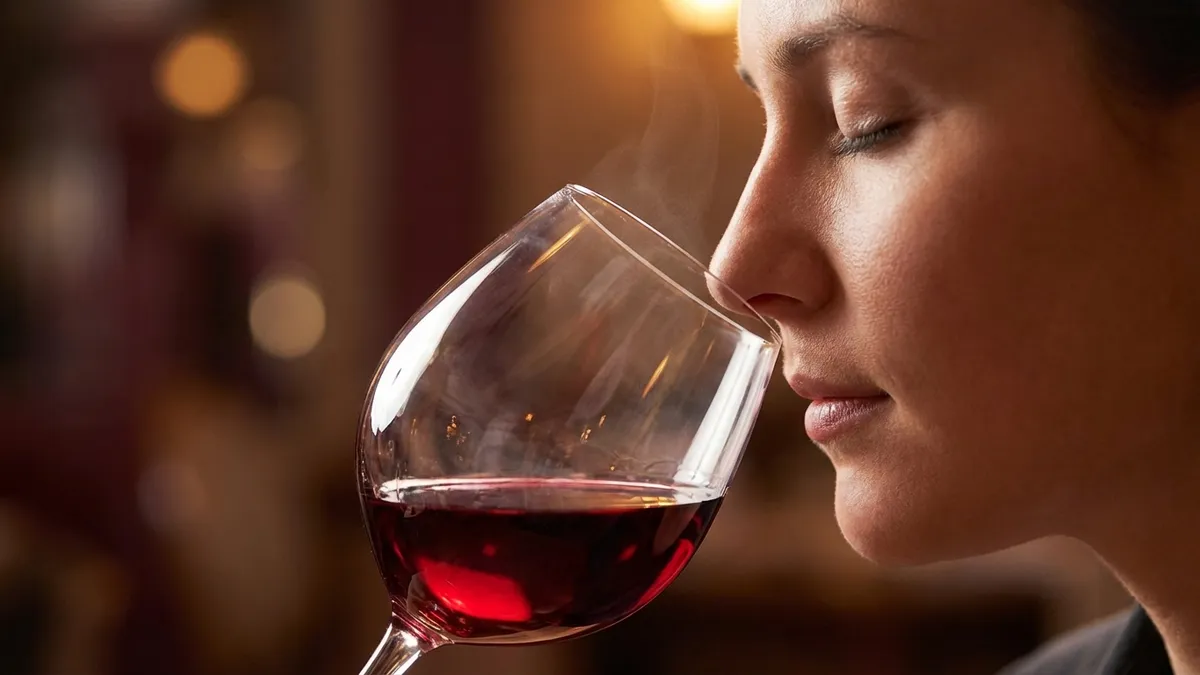
Earthy notes often hide on the finish rather than the attack. Sip the wine, swallow, and exhale slowly through your nose. The aromas that surface in the back of your throat carry the strongest earthy signal. Read the mechanics in our retronasal smelling guide.
Log earthy categories explicitly
Most beginner tasting notes record fruit categories without checking earth, savor, and minerality categories. Force yourself to scan all the categories on every wine — even when fruit hits first, ask whether mushroom, leather, or wet stone hides underneath. The Sommy app prompts this exact scan on every tasting until the habit becomes automatic.
Where Earthy Wines Come From: A Geography
Some regions consistently deliver earthy character. Knowing where to look saves time and bottles.
- Burgundy, France — limestone-rich Côte d'Or sites produce the world's reference earthy Pinot Noir and white Chardonnay.
- Bordeaux, France — Cabernet- and Merlot-led blends from the Médoc and Saint-Émilion show tobacco, cedar, and leather with age.
- Barolo and Barbaresco, Italy — Nebbiolo from limestone-clay soils delivers tar, rose, truffle, and forest floor.
- Brunello di Montalcino and Chianti Classico, Italy — Sangiovese on calcareous clay shows leather, tobacco, and dried herbs.
- Rioja, Spain — traditional Tempranillo aged in American oak develops dried tobacco, leather, and savory earth in Gran Reserva tier.
- Northern Rhône, France — Syrah from steep granite slopes produces black olive, smoke, leather, and forest floor.
- Mosel, Germany — Riesling on slate delivers the cleanest wet-stone minerality in the wine world.
For deeper regional reads, see our guides to French wine regions, Italian wine regions, and Spanish wine regions.
The Bottom Line
Earthy flavors in wine are not a flaw, a fad, or a marketing label. They are the savory, layered, time-driven dimension that separates wines made for now from wines made to age. Forest floor, mushroom, truffle, wet leaves, leather, tobacco, damp earth, and wet stone are the eight descriptors worth learning by name.
They come from four main routes — bottle age, terroir, low-dose brett, and whole-cluster fermentation — and they cluster in a small set of regions: Burgundy, Bordeaux, Barolo, Brunello, Rioja, the northern Rhône, and the Mosel. Once you can name them, your tasting notes get sharper, your pairings get smarter, and aged wines stop seeming weird and start seeming alive.
For a structured route into earthy tasting, pair the Sommy app's guided aroma flow with the savory quadrant of the wine aroma wheel and the broader wine tasting vocabulary — and the earthy quadrant stops hiding.
Frequently Asked Questions
What are earthy flavors in wine?
Earthy flavors in wine are aromas and palate notes that suggest the ground rather than fruit — forest floor, mushroom, truffle, damp soil, wet leaves, leather, tobacco, and wet stone. They appear most often in aged Old World reds and lees-aged whites, and they signal terroir, bottle age, or specific fermentation choices rather than a flaw in the bottle.
Why does my wine taste like dirt or mushroom?
A clean dirt or mushroom note usually points to tertiary aging in a structured red, especially Pinot Noir, Nebbiolo, or aged Bordeaux. Proteins and tannins evolve over years and produce savory, earthy compounds. If the mushroom note is sharp, sweaty, or band-aid-like, the cause is more likely brettanomyces yeast at high levels — that is a flaw, not a feature.
Are earthy flavors in wine a good thing?
Yes, when they are clean, integrated, and arrive on a wine built to age. Earthy notes in mature Burgundy, Barolo, or Brunello are a signature of complexity. They become a problem when they dominate a young wine, smell musty rather than savory, or overlap with cardboard and wet newspaper — those signals point to cork taint or other faults rather than terroir.
Which wines have the strongest earthy character?
Aged red Burgundy from Pinot Noir, Bordeaux from Cabernet Sauvignon and Merlot, Barolo and Barbaresco from Nebbiolo, Brunello di Montalcino from Sangiovese, traditional Rioja from Tempranillo, northern Rhône Syrah, and aged Châteauneuf-du-Pape lead the pack. Cooler climates and limestone-rich soils consistently produce more earthy character than warm, fruit-forward New World sites.
How do I tell earthy notes from a corked wine?
Earthy notes feel layered and savory — mushroom, forest floor, leather under fruit. Cork taint smells like wet cardboard, damp basement, or musty dish towel and strips the fruit out of the wine entirely. If the wine smells flat, lifeless, and one-note musty rather than complex and broth-like, suspect cork taint. See our guide on identifying corked wine for the full distinction.
Where do earthy flavors come from?
Four main sources: tertiary bottle age that fragments proteins into savory compounds, terroir effects from limestone soils and cool climates, low-dose brettanomyces yeast that adds leather and barnyard at controlled levels, and whole-cluster fermentation that brings stem-driven forest floor notes. Most great earthy wines combine two or three of these routes rather than relying on just one.
Can young wines taste earthy?
Yes, though the character is different. Young wines from limestone soils, volcanic terroirs, or whole-cluster fermentation can show wet stone, crushed rock, twig, and herbal earth from day one. What young wines rarely show is the deep mushroom, truffle, and leather of bottle age — those need time. Expect terroir-driven earth in youth and tertiary earth in maturity.
Sommy Team
LinkedInFounder & Wine Educator
The Sommy Team is building the world's most approachable wine education app, helping beginners develop real tasting skills through structured courses and AI-guided practice.