The Wine Aroma Wheel: A Beginner's Guide to Using It

By the Sommy Team — AI-assisted, human-edited.
Updated Sep 10, 2026
Contents (10)
- What the Wine Aroma Wheel Is
- How the Aroma Wheel Is Organized
- Is a Wine Tasting Wheel the Same as an Aroma Wheel?
- Which Aroma Wheels Exist? Red, White, Sparkling, and Beyond
- Why Wine Smells Like Real Things
- How to Use the Aroma Wheel in Practice
- Who Created the Wine Aroma Wheel?
- Common Aromas by Grape Variety
- Training Your Nose
- Tips for Using the Wheel Effectively
TL;DR
The wine aroma wheel is a circular chart, created at UC Davis by Ann C. Noble in 1984, that sorts wine smells into 12 broad categories on the inner ring and increasingly specific descriptors on the outer rings. You use it from the inside out: pick a category, narrow to a subcategory, then name one or two specific aromas.
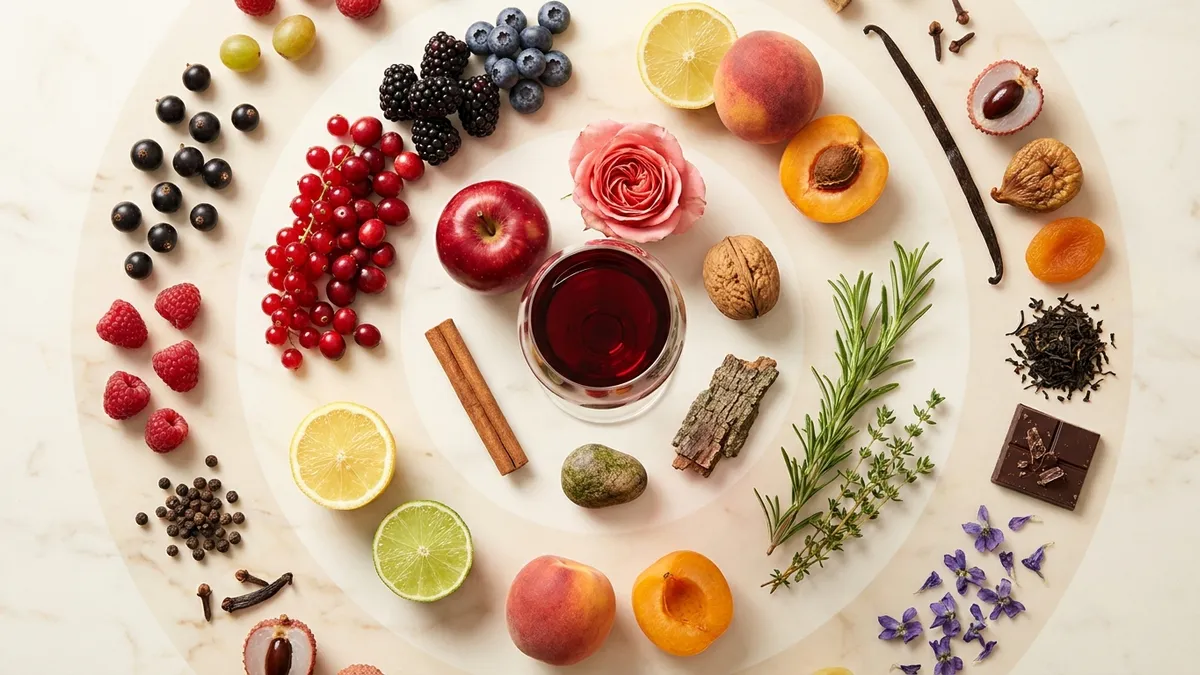
The wine aroma wheel is a circular reference chart that sorts the smells in a glass of wine into three rings. The inner ring holds 12 broad categories, the middle ring holds subcategories, and the outer ring holds specific descriptors. You read it from the inside out, so "smells nice" becomes "ripe blackcurrant, violet, and a touch of clove."
What the Wine Aroma Wheel Is
The wine aroma wheel is a shared vocabulary for smell, built at the University of California, Davis by sensory chemist Ann C. Noble and colleagues. Before it, tasters could detect dozens of aromas in a glass but had no common words for them.
The wheel covers smell only. Taste, texture, and words of praise or criticism are left out on purpose. The authors chose terms that were "analytical and free of hedonic or value-judgment connotations."
How the Aroma Wheel Is Organized
The Inner Ring: Broad Categories
The standard wheel has 12 main categories:
- Fruity: any fruit aroma, from citrus to tropical to dried
- Floral: flowers and blossoms
- Spicy: warm baking spices, pepper, herbs
- Herbaceous / Vegetative: green plants, vegetables, herbs
- Nutty: toasted nuts, almond, hazelnut
- Caramelized: burnt sugar, molasses, honey
- Woody: oak, cedar, resin
- Earthy: mushroom, damp leaves, wet soil
- Chemical: sulfur, petroleum, plastic
- Pungent: alcohol, solvents, acetone
- Oxidized: sherry-like, bruised apple, nutty oxidation
- Microbiological: yeast, dairy, fermentation
The nutty group was added in Noble's 1987 revision.
The Middle Ring: Subcategories
Each category branches into subcategories. "Fruity" breaks into:
- Citrus fruit: lemon, lime, grapefruit, orange
- Berry: strawberry, raspberry, blackberry, blueberry
- Tree fruit: apple, pear, peach, apricot, plum
- Tropical fruit: pineapple, mango, passionfruit, banana
- Dried fruit: raisin, fig, prune, dried apricot
- Artificial fruit: candy, bubblegum (indicates carbonic maceration)
The Outer Ring: Specific Descriptors
The outer ring names the single smell. Within "berry," red berry covers strawberry, raspberry, cranberry, and red cherry; black berry covers blackberry, blueberry, black cherry, and blackcurrant.
Is a Wine Tasting Wheel the Same as an Aroma Wheel?
Not quite. A wine aroma wheel covers only what you smell. A wine tasting wheel or wine flavor wheel adds what you taste and feel in the mouth: sweetness, acidity, bitterness, tannin, body, and finish. Most charts sold as tasting wheels are these broader flavor wheels, built on the same inside-out design.
| Chart | What it covers | Typical layout | Best used for |
|---|---|---|---|
| Wine aroma wheel (UC Davis) | Smell only: 12 categories, subcategories, specific descriptors | Three rings, read from center outward | Naming aromas precisely, calibrating with reference smells |
| Wine flavor wheel | Aromas plus taste and mouthfeel: sweetness, acidity, tannin, body, finish | Usually a wheel, sometimes with a separate structure band | Writing a full tasting note in one pass |
| Wine tasting wheel or chart | Same as a flavor wheel; often a printable poster or PDF | Wheel or grid, frequently simplified to 6 to 8 families | Casual tastings, parties, quick reference |
| Wine tasting notes wheel | Aroma families paired with blanks for structure and a score | Wheel plus a worksheet | Journaling, tracking what you liked |
The tongue detects only a handful of basic tastes. Almost everything called "flavor" is aroma reaching the nose from the back of the mouth; see wine flavor vs aroma. For a full note, use the wheel for the words and a wine tasting notes template for the structure.
Which Aroma Wheels Exist? Red, White, Sparkling, and Beyond
- The original wheel: all 12 categories and the full set of descriptors. If you are still learning, use it, because it teaches the structure.
- Red wine wheel: keeps berry, dried fruit, spice, wood, and earth up front, with leather, tobacco, and game on the outer ring. Pair it with how to taste red wine.
- White wine wheel: leans into citrus, stone fruit, tropical fruit, and flowers, with butter, cream, and toast for oaked styles. See how to taste white wine.
- Sparkling wine wheel: adds a family for autolysis (the bready, biscuity notes from long contact with dead yeast cells) alongside green apple, citrus, and honey. See the sparkling wine tasting guide.
According to the wheel's official site, the standard UC Davis wheel is published in eight languages. The circular idea comes from perfumery: Wikipedia's entry on the fragrance wheel credits Austrian perfumer Paul Jellinek with the first such diagram in 1949, 35 years before Noble's wine version.
Why Wine Smells Like Real Things
Wine contains hundreds of aromatic compounds that share chemistry with the foods and flowers we smell in them.
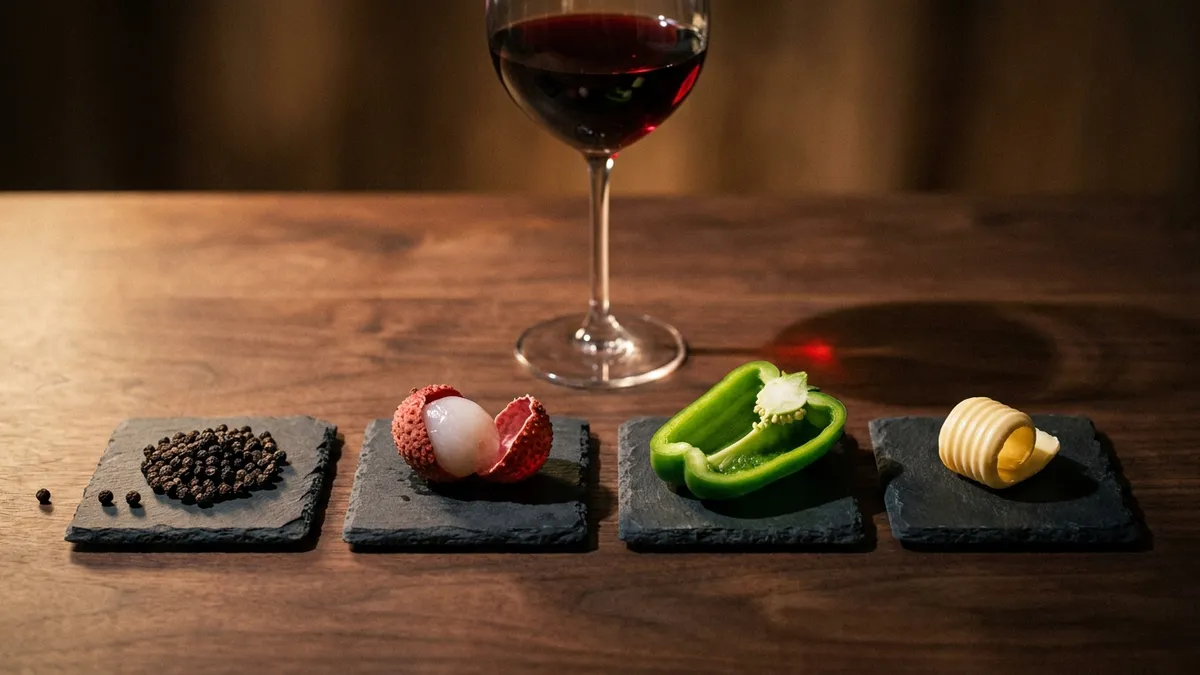
- Rotundone: the black pepper note in Syrah; the same compound is found in black peppercorns
- Cis-rose oxide: the lychee aroma in Gewurztraminer; it is also found in lychees
- Methoxypyrazines: the bell pepper note in Cabernet Sauvignon; the same compounds are found in green bell peppers
- Diacetyl: the butter note in oaked Chardonnay; the same compound flavors microwave popcorn
- Beta-damascenone: stewed apple and rose aromas; the same compound is found in roses
Where Wine Aromas Come From
The wheel does not sort aromas by origin, but the origin tells you the wine's age and how it was made.
| Aroma type | Where it comes from | Typical descriptors | Which wines show it most |
|---|---|---|---|
| Primary | The grape itself and the vineyard | Fresh fruit, flowers, herbs, grass, pepper | Young wines of any color; aromatic grapes like Riesling and Sauvignon Blanc |
| Secondary | Fermentation and winemaking choices | Butter, cream, bread, yeast, vanilla, toast, smoke | Oaked Chardonnay, traditional-method sparkling wine, lees-aged whites |
| Tertiary | Time in bottle or barrel | Dried fruit, leather, tobacco, mushroom, forest floor, nuts, honey | Aged reds, mature Riesling, fortified wines |
More examples by grape are in primary, secondary, and tertiary aromas, and how to smell wine covers the sniffing itself.
How to Use the Aroma Wheel in Practice
Step 1: Smell First, Categorize Second
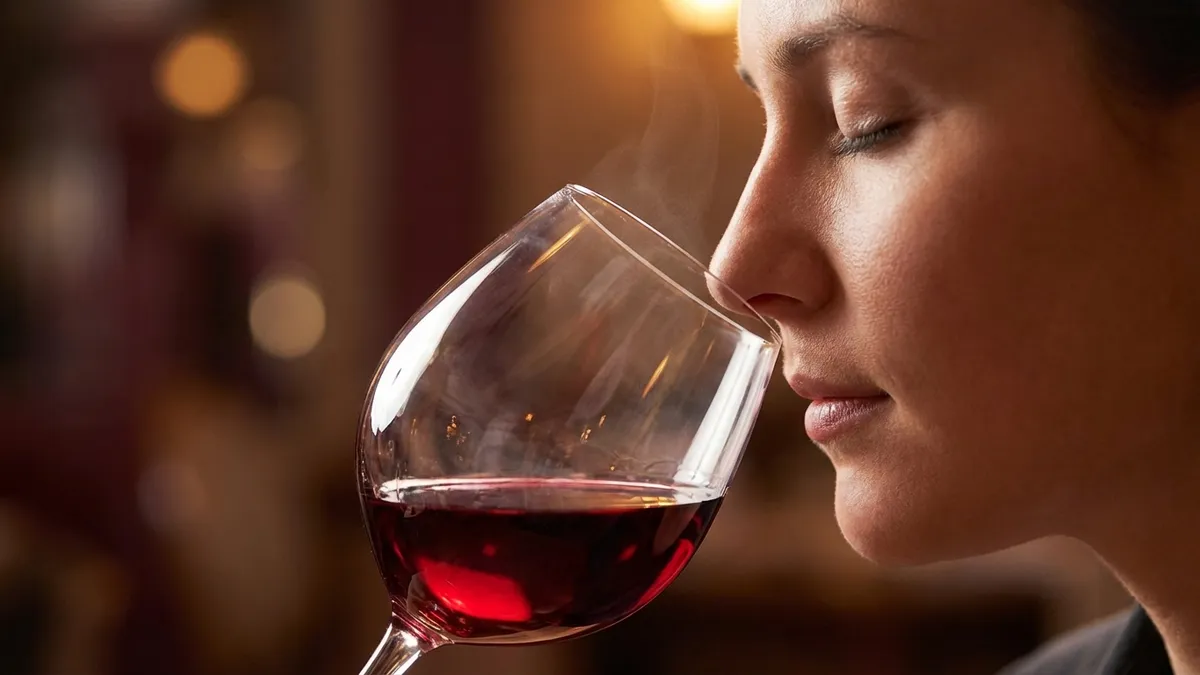
Take a quick sniff and note the first impression: fruity, earthy, floral, or spicy. Pick that one inner-ring category and follow only its branch outward.
Step 2: Zoom In One Level
Name the subcategory. If the wine is fruity, choose between red berry, black berry, citrus, tropical, or dried fruit. If it is spicy, choose between sweet spice (vanilla, cinnamon), warm spice (clove, nutmeg), or peppery spice (black pepper, white pepper).
Step 3: Land on Specifics
Name one or two specific descriptors. This is the hardest step, because it draws on smells you have stored: fruits you have eaten, herbs you have cooked with.
Step 4: Keep Smelling
The aromas change in the glass, so the same wine may show different notes five minutes later. Come back to the wheel every few sips.
Who Created the Wine Aroma Wheel?
Dr. Ann C. Noble, a sensory chemist at UC Davis, created the wheel with a group of co-authors. It appeared in 1984 in the American Journal of Enology and Viticulture as "Progress Towards a Standardized System of Wine Aroma Terminology." A 1987 follow-up paper in the same journal revised it.
According to her own account on the wheel's official site, Noble joined the UC Davis faculty in 1974 as the first female professor hired in the Department of Viticulture and Enology. She retired in 2002. The terms came from years of descriptive analysis (trained panels rating specific attributes of a product), weekly student sensory labs, and feedback from winemakers and flavor chemists. Vague or judgmental terms were culled, leaving words trained tasters could agree on and match to a physical reference standard.
Common Aromas by Grape Variety
These two lists work as the outer rings of a red and a white wine wheel, sorted by grape.
Red Wine Grapes
- Cabernet Sauvignon: blackcurrant, cedar, green bell pepper, graphite, mint
- Merlot: plum, black cherry, chocolate, herbs, tobacco
- Pinot Noir: red cherry, strawberry, mushroom, damp leaves, rose
- Syrah / Shiraz: blackberry, black pepper, smoked meat, violet, licorice
- Sangiovese: sour cherry, dried herbs, leather, tomato leaf, tobacco
- Nebbiolo: tar, rose, dried cherry, truffle, anise
White Wine Grapes
- Chardonnay: apple, lemon, butter (if oaked), vanilla, tropical fruit
- Sauvignon Blanc: grapefruit, passionfruit, gooseberry, grass, bell pepper
- Riesling: green apple, lime, petrol (aged), stone, honeysuckle
- Gewurztraminer: lychee, rose, ginger, orange peel, tropical fruit
- Viognier: peach, apricot, honeysuckle, orange blossom, almond
- Pinot Grigio: pear, lemon, almond, white flowers
For two of these side by side, see Cabernet Sauvignon vs. Merlot.
Training Your Nose
Build Your Aroma Library
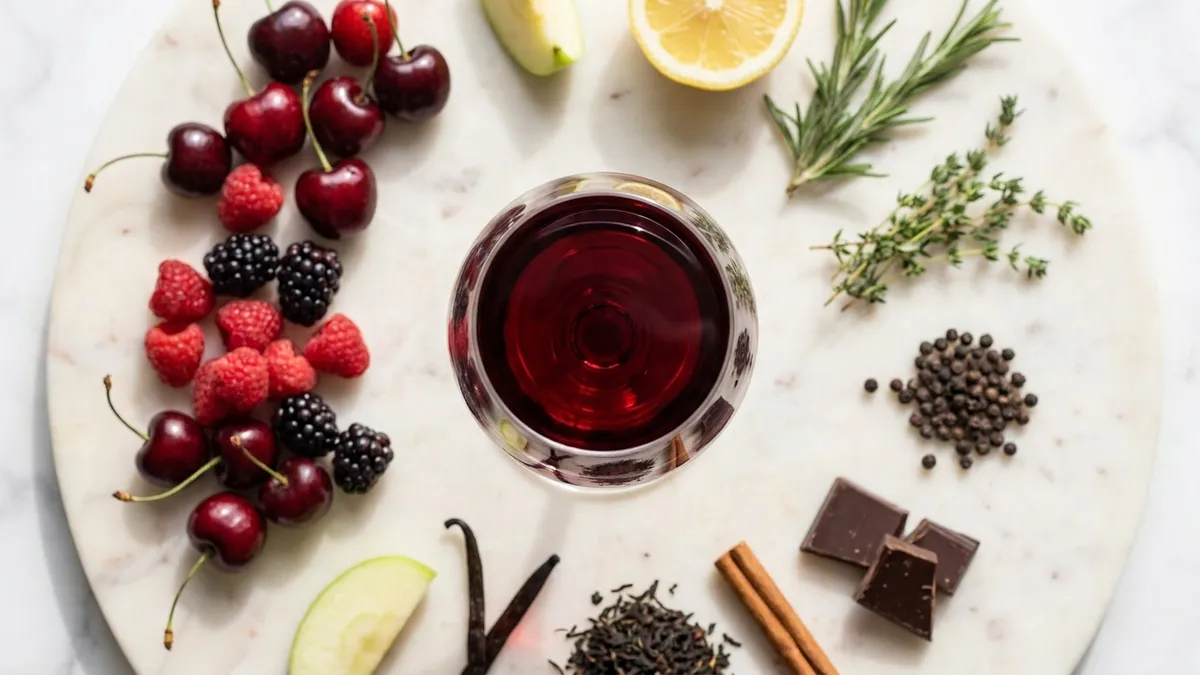
The more real smells your brain has stored, the more your nose can name. Smell everyday items on purpose:
- Fruits: cut them open; notice how raspberry differs from strawberry, and plum from blackberry
- Herbs: rosemary, thyme, basil, mint
- Spices: cinnamon, clove, nutmeg, white pepper, and black pepper
- Flowers: violets, roses, lilies
- Other: leather, tobacco, wet stones, damp leaves, vanilla beans
Can you train your sense of smell covers what the research says and how quickly most people improve.
Calibration Tastings
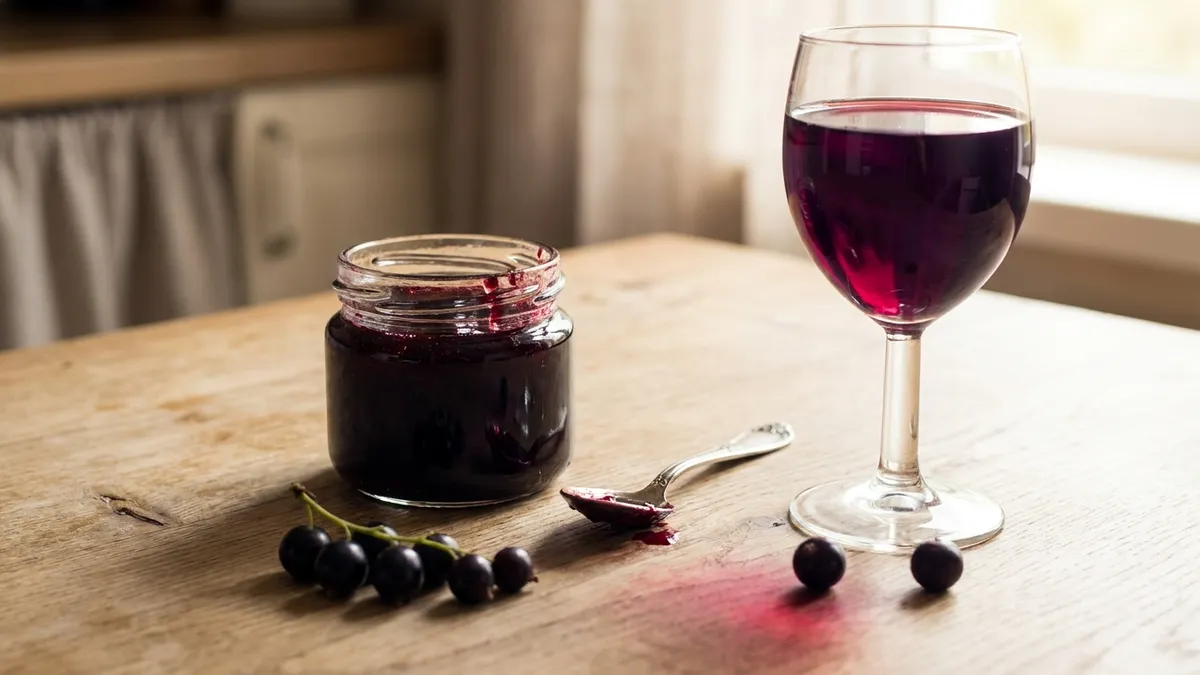
Smell a cup of blackcurrant jam, then smell a Cabernet Sauvignon known for blackcurrant. The direct comparison fixes the link in memory.
Aroma kits: small vials of isolated aroma compounds (vanillin, menthol, cis-rose oxide) that professional tasters use to calibrate. If you are a serious student, a kit speeds up training; if you drink casually, real fruits and spices work just as well. See our review of wine aroma kits.
Aroma is one step in the full routine of how to taste wine.
Tips for Using the Wheel Effectively
- Sniff, then rest: the nose tires quickly, so pause between sniffs
- Smell at different distances: some notes are strongest at the rim, others deeper in the glass
- Compare wines side by side: two wines next to each other are easier to read than one alone
- Write things down: naming aromas in writing fixes them in memory
The words pay off when ordering: "red berry fruit, soft tannin, and no oak" tells a sommelier far more than "something nice." To turn them into full sentences, how to describe wine shows a simple note structure, and the wine tasting vocabulary cheat sheet covers the 50 terms that do most of the work.
Sommy walks you through the inside-out routine in each guided tasting, glass by glass, and checks your answers. Pour one glass tonight and run it once: category, subcategory, then one or two descriptors, written down.
Sources
- Progress Towards a Standardized System of Wine Aroma Terminology — A. C. Noble, R. A. Arnold, B. M. Masuda, S. D. Pecore, J. O. Schmidt, P. M. Stern, American Journal of Enology and Viticulture, vol. 35, no. 2, 1984
- Modification of a Standardized System of Wine Aroma Terminology — A. C. Noble, R. A. Arnold, J. Buechsenstein, E. J. Leach, J. O. Schmidt, P. M. Stern, American Journal of Enology and Viticulture, vol. 38, no. 2, 1987
- About Ann C. Noble and the Wine Aroma Wheel — The Wine Aroma Wheel, official site
- Ann C. Noble — Wikipedia
- Fragrance wheel — Wikipedia
Frequently Asked Questions
What is the wine aroma wheel?
The wine aroma wheel is a circular chart that organizes wine smells into a hierarchy. Twelve broad categories sit on the inner ring (fruity, floral, spicy, earthy, woody), subcategories fill the middle ring, and specific descriptors such as blackcurrant, violet, or clove sit on the outer ring. It gives tasters a shared, standardized vocabulary for what they smell.
Who invented the wine aroma wheel?
Dr. Ann C. Noble, a sensory chemist at the University of California, Davis, created the wine aroma wheel with colleagues. It was published in 1984 in the American Journal of Enology and Viticulture as a standardized system of wine aroma terminology, then revised in 1987. Noble joined the UC Davis faculty in 1974 and retired in 2002.
How do you use the wine aroma wheel?
Work from the inside out, not around the rim. Smell the wine and pick the inner-ring category that dominates: fruity, floral, spicy, earthy. Move one ring outward to narrow it down (fruity becomes berry or citrus or tree fruit), then land on one or two specific descriptors on the outer ring. Repeat after a few minutes as the wine opens.
How many categories are on the wine aroma wheel?
The standard UC Davis wine aroma wheel has 12 categories on its inner ring: fruity, floral, spicy, vegetative (herbaceous), nutty, caramelized, woody, earthy, chemical, pungent, oxidized, and microbiological. Each splits into subcategories on the middle ring and specific descriptors on the outer ring, giving a three-tier system that moves from general to specific.
What is the difference between a wine aroma wheel and a flavor wheel?
An aroma wheel covers only what you smell. A flavor wheel usually adds what you taste and feel in the mouth: sweetness, acidity, bitterness, tannin, body, and texture. Most charts sold as tasting wheels are flavor wheels. The original UC Davis wheel is strictly an aroma tool, which is why it pairs so well with a separate structure checklist.
Is there a different aroma wheel for red wine and white wine?
Yes. The original Noble wheel covers all wines, but red-wine and white-wine versions exist that trim the outer ring to the descriptors each style shows most. A red wine wheel leans into black fruit, pepper, leather, and tobacco; a white wine wheel emphasizes citrus, stone fruit, tropical fruit, and floral notes. Sparkling-wine wheels add yeast, bread, and toast.
Are wine aromas actually in the wine?
Yes. Wine contains hundreds of aromatic compounds that chemically resemble the things we smell in them. The pepper note in Syrah comes from rotundone, the same compound found in black peppercorns. The lychee in Gewurztraminer comes from cis-rose oxide, found in lychees. The associations are chemical reality, not metaphor.
How can I train my nose to identify wine aromas better?
Smell everyday items on purpose: cut fruit, herbs, spices, and flowers. Then taste wines with known profiles and compare your impressions to published descriptions, for example blackcurrant jam beside a Cabernet Sauvignon. The more references your brain has stored, the more your nose can name, so practice often and write down what you find.
Sommy Team
LinkedInFounder & Wine Educator
The Sommy Team is building the world's most approachable wine education app, helping beginners develop real tasting skills through structured courses and AI-guided practice.