Cabernet Sauvignon vs Merlot: What Is the Difference?
Sommy Team
Founder & Wine Educator
April 10, 2026
11 min read
TL;DR
Cabernet Sauvignon vs Merlot comes down to structure. Cabernet has higher tannin, more acidity, darker fruit, and ages longer. Merlot is softer, rounder, more immediately approachable, with plummy fruit and silky texture. Together they make Bordeaux blends; apart they are two of the most planted red grapes on earth.
The Most Common Wine Comparison in the World
Walk into any wine shop, stand in front of the red section, and the first decision most beginners face is this: Cabernet Sauvignon vs Merlot. The two grapes sit next to each other on the shelf, look roughly the same shade of dark red in the glass, and often come from the same regions at similar prices. From the outside, the difference is invisible.
From the inside of the glass, the difference is dramatic. Cabernet Sauvignon is firm, tannic, structured, and built for aging. Merlot is round, supple, fruit-forward, and ready to drink the day you buy it. They share a family tree — Merlot is actually one of Cabernet Sauvignon's parent grapes — but they drink like cousins with opposite temperaments. Understanding that difference is one of the most useful things a beginner can learn, because it teaches you the concept that grape variety determines structure, and structure determines how a wine pairs with food, how long it can age, and how it feels in your mouth.
This guide walks through exactly how these two grapes differ in structure, flavor, aging, food pairing, and winemaking style. It includes a side-by-side comparison you can try at home with any two bottles and a clear framework for deciding which grape to reach for at any given meal.
The Family Tree: How They Are Related
Before the comparison, a piece of genetic trivia that changes how you think about both grapes. DNA testing in the 1990s proved that Cabernet Sauvignon is a natural cross between Cabernet Franc and Sauvignon Blanc — two entirely different grape varieties that hybridized spontaneously in a vineyard somewhere in southwestern France, probably in the 17th century. Merlot, meanwhile, is a parent grape of Cabernet Franc and therefore a grandparent of Cabernet Sauvignon.
The family relationship explains why the two grapes blend so naturally in Bordeaux. They share enough genetic material to be compatible, but they differ enough in structure and flavor to complement each other. The blend is not accidental — it is genetic destiny.
Cabernet Sauvignon vs Merlot: Structure Side by Side
Structure is where the real difference lives. Every other distinction between these two grapes — flavor, aging, food pairing — flows from the structural gap. Here is the comparison in plain terms.
Tannin
Cabernet Sauvignon has thick skins and small berries. More skin means more phenolic extraction during fermentation and more tannin — the drying, gripping compound that makes your gums feel astringent. Young Cabernet can feel almost aggressive on the palate — a firm grip that takes years to soften.
Merlot has thinner skins and larger berries. Less skin per unit of juice means less tannin extraction. The result is a wine that feels softer, smoother, and more immediately comfortable in your mouth. Merlot's tannins are often described as silky rather than grippy.
For a deeper explanation of what tannin is and how it works, see our guide to understanding tannins, acidity, and body. For a broader look at how tannin creates the sensation of wine mouthfeel, that guide breaks down the mechanics.
Acidity
Cabernet Sauvignon typically has higher acidity than Merlot. That acidity gives Cabernet its backbone, its aging potential, and its ability to cut through rich, fatty food. It also makes young Cabernet taste more austere and less fruit-forward than Merlot.
Merlot has moderate acidity — enough to keep the wine fresh but not enough to dominate the palate. This lower acid level is part of why Merlot feels rounder and softer. It is also why Merlot tends to age less gracefully than Cabernet — lower acidity means less structural preservation over time.
Body
Both grapes make medium-to-full-bodied wines, but Cabernet tends to sit heavier in the mouth. A typical Napa Cabernet at 14.5 percent alcohol feels fuller and warmer than a typical Merlot at 13.5 percent. The difference is not enormous, but it is perceptible — and it matters for food pairing.
Alcohol
Cabernet Sauvignon often reaches slightly higher alcohol levels than Merlot because it ripens later in the growing season, giving it more time to accumulate sugar in the berries. More sugar at harvest means more alcohol after fermentation. That said, winemaking style and climate matter more than grape variety for alcohol — a cool-climate Merlot can be lower-alcohol than a warm-climate one.
Cabernet Sauvignon vs Merlot: Flavor Profiles
Once you move past structure, the flavor gap between these two grapes is surprisingly consistent across regions and climates. Each grape has a recognizable "signature" that shows up in almost every version of the wine.
Cabernet Sauvignon Flavor Signature
- Primary fruit: blackcurrant (cassis), black cherry, blackberry, dark plum
- Secondary notes: cedar, tobacco, graphite, green bell pepper (especially in cooler climates), dried herbs
- Oak markers: vanilla, toast, coffee, chocolate, coconut
- Aged notes: leather, cigar box, dried fruit, earth, truffle
The single most diagnostic aroma in Cabernet Sauvignon is blackcurrant (also called cassis). If you pour a red wine and smell blackcurrant before anything else, the odds are very high that you are drinking Cabernet Sauvignon. That note, combined with cedar or tobacco from oak aging, is the universal fingerprint of the grape.
Merlot Flavor Signature
- Primary fruit: plum, black cherry, raspberry, blueberry, red currant
- Secondary notes: chocolate, vanilla, dried herbs, bay leaf, mocha
- Oak markers: vanilla, caramel, toast (similar to Cabernet but softer)
- Aged notes: fig, dried fruit, leather, tobacco (gentler than Cabernet)
Merlot's signature fruit is plum — ripe, juicy, and generous. Where Cabernet's cassis is dark and austere, Merlot's plum is soft and inviting. The difference is immediate in a side-by-side tasting. If you have ever tried a red wine and thought "this tastes friendly and plummy," there is a good chance it was Merlot.
Cabernet says cassis, cedar, and structure. Merlot says plum, chocolate, and ease. Both are right. Neither is better.
For more on how to identify these aroma differences, see our guide to how to smell wine.
Where They Grow: The Global Picture
Both grapes are planted in essentially every wine-producing country on earth, but their global footprints differ in ways that tell you something about each variety's character.
Cabernet Sauvignon is the most widely planted wine grape in the world — roughly 341,000 hectares across six continents. Its heartlands include Bordeaux (Left Bank), Napa Valley, Coonawarra in Australia, Maipo Valley in Chile, Stellenbosch in South Africa, and parts of Tuscany (as Super Tuscan blends). It thrives in warm climates with long growing seasons because it ripens late.
Merlot is the second most planted red grape at roughly 266,000 hectares globally and is actually the most planted grape in France overall. Its heartlands include Bordeaux (Right Bank — Pomerol, Saint-Émilion), northeast Italy, Chile, Washington State, and parts of Languedoc. Merlot ripens earlier than Cabernet and handles cooler, wetter conditions better.
The geographic split in Bordeaux is the clearest illustration of their different temperaments. The Left Bank of the Gironde estuary — Médoc, Pauillac, Margaux — has warmer, gravelly soils that favor Cabernet Sauvignon. The Right Bank — Pomerol, Saint-Émilion — has cooler clay soils that favor Merlot. The same region, two banks, two grapes, two completely different styles of wine.
For a broader look at France's wine geography, see our guide to French wine regions.
The Bordeaux Blend: Why They Work Together
The most famous use of both grapes is the Bordeaux blend, which has been combining Cabernet Sauvignon and Merlot (along with Cabernet Franc, Petit Verdot, and sometimes Malbec) for centuries. The blend works because the two grapes contribute exactly what the other one lacks.
- Cabernet Sauvignon contributes: tannin backbone, acidity, aging structure, dark fruit intensity, cedar complexity
- Merlot contributes: flesh, roundness, approachability, plummy fruit, supple texture
A Left Bank Bordeaux is typically 60 to 70 percent Cabernet Sauvignon, with Merlot as the softening agent. A Right Bank Bordeaux is typically 70 to 90 percent Merlot, with Cabernet Franc or Cabernet Sauvignon as the structural scaffold. Same grape family, opposite proportions, completely different wines.
Understanding this blend logic is one of the most useful pieces of wine knowledge you can carry into a restaurant or a shop. When someone describes a wine as "a Bordeaux blend" or "Meritage" (the New World term), you can immediately predict what it will feel like based on which grape dominates the blend.
Food Pairing: Cabernet Sauvignon vs Merlot at the Table
Food pairing is where the structural difference between these two grapes becomes most practical.
Cabernet Sauvignon Pairs With
- Grilled steak and roast beef — tannin cuts through the fat
- Lamb chops and rack of lamb — the cedar notes echo the herbs used in lamb prep
- Aged hard cheeses (aged cheddar, Manchego, Parmigiano) — tannin and salt work together
- Braised short ribs — the full body matches the heavy richness
- Dark chocolate — tannin on tannin, in a good way
Merlot Pairs With
- Roast chicken and turkey — the softer tannin does not overpower lighter meat
- Pork loin and pork tenderloin — the plummy fruit complements pork's sweetness
- Mushroom risotto and pasta with earthy sauces — the herbal notes match
- Medium cheeses (Gruyère, Gouda, Brie) — the roundness meets the creaminess
- Pizza and charcuterie — friendly, versatile, no-stress pairing
The core rule is simple: match the weight and structure of the wine to the weight and richness of the food. Cabernet is the heavy partner for heavy dishes. Merlot is the medium partner for medium dishes. Neither one works well with delicate fish or raw seafood — both are too heavy. For a more complete guide to matching wine with food, see our wine food pairing guide.
Aging: Which One Lasts Longer?
Cabernet Sauvignon ages longer than Merlot, full stop. The combination of higher tannin, higher acidity, and greater phenolic concentration gives Cabernet the structural support to evolve gracefully over decades. A top Napa Cabernet or a classified Left Bank Bordeaux can improve for 20, 30, even 50 years under proper storage conditions.
Merlot ages well too — especially from the Right Bank of Bordeaux, where the best examples can last 20 to 30 years — but the average Merlot is designed to be drunk within 5 to 10 years of the vintage. Its softer structure means it reaches its peak earlier and fades faster. That is not a flaw — it is a style. Not every wine needs to be a project you store for a decade.
For beginners, this matters mostly for buying decisions. If you are buying wine to drink tonight, Merlot is the safer bet because it is almost always approachable on release. If you are buying wine to store for a special occasion five or ten years from now, Cabernet has better odds of improving in the bottle.
A Side-by-Side Tasting You Can Try Tonight
The single best way to understand this comparison is to taste both grapes back-to-back in the same session. Buy one Cabernet Sauvignon and one Merlot from the same region and roughly the same price point. Pour them into identical glasses and taste them side by side using the framework from how to taste wine.
Focus on three things:
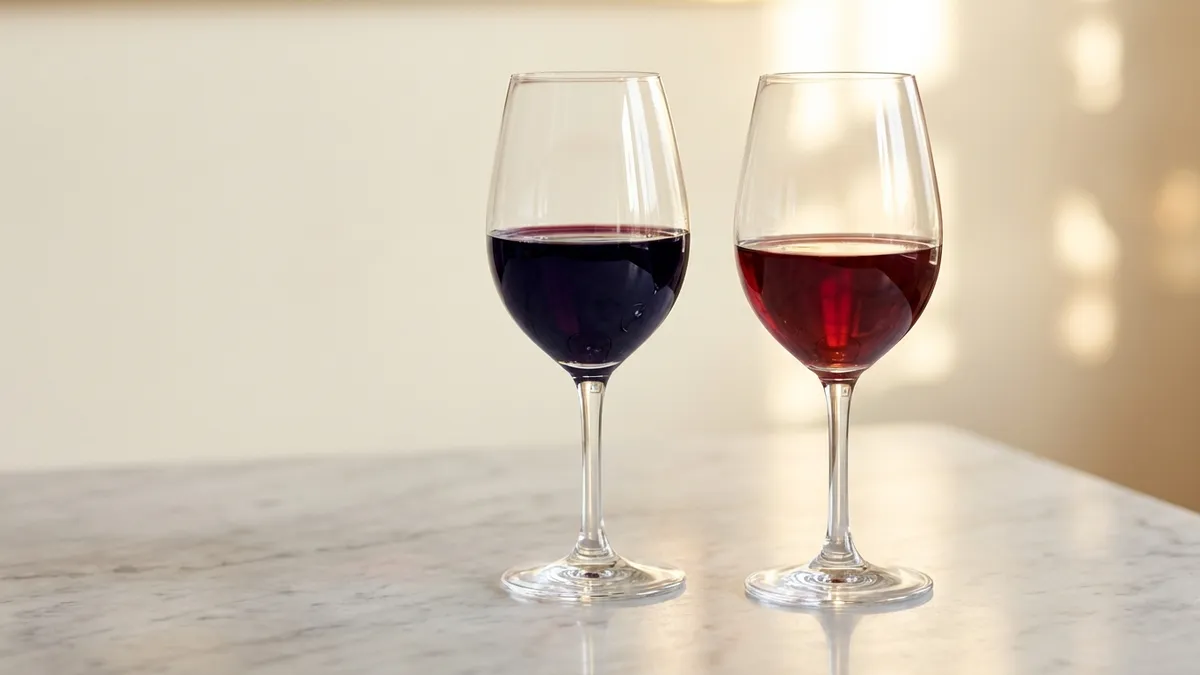
- Color. The Cabernet will usually be deeper and more opaque. The Merlot will be slightly lighter and more translucent at the rim.
- Tannin. After swallowing each wine, pay attention to the drying sensation on your gums. The Cabernet will grip harder. The Merlot will feel softer.
- Fruit character. What fruit do you smell first? Dark cassis in the Cabernet? Ripe plum in the Merlot? Those signatures are remarkably consistent.
After this one comparison, you will never confuse the two grapes again. The Sommy app's guided comparison exercises walk you through exactly this kind of side-by-side with real-time feedback on what to look for at each step.
Build Your Grape Vocabulary One Variety at a Time
Cabernet Sauvignon vs Merlot is the first real grape comparison most beginners encounter. Mastering it gives you a structural framework — high-tannin vs low-tannin, firm vs round, age-worthy vs drink-now — that applies to every other grape pair you will ever meet. Syrah vs Grenache, Riesling vs Chardonnay, Nebbiolo vs Barbera — they all follow the same logic of structural contrast.
The Sommy app builds grape-variety recognition into its structured tasting courses, so you learn each grape's signature through guided tastings with real reference wines. Visit sommy.wine to start working through the varieties one at a time, building a reference library in your palate that makes every future tasting more informed.
Frequently Asked Questions
What is the main difference between Cabernet Sauvignon and Merlot?
Structure. Cabernet Sauvignon has higher tannin, higher acidity, and a firmer backbone that needs time to soften. Merlot has softer tannin, lower acidity, and a rounder, more immediately approachable texture. If Cabernet is the skeleton, Merlot is the flesh.
Which has more tannin — Cabernet Sauvignon or Merlot?
Cabernet Sauvignon, by a wide margin. Cabernet grapes have thicker skins and smaller berries, which means more skin-to-juice contact during fermentation and more tannin extracted. Merlot grapes have thinner skins and larger berries, producing a softer, less astringent wine.
Which is better for beginners — Cabernet or Merlot?
Merlot. Its softer tannins and rounder fruit make it more immediately enjoyable without experience. Cabernet can feel aggressively tannic and austere to a palate that has not learned to enjoy that kind of grip. Start with Merlot, then move to Cabernet once you know you enjoy red wine structure.
What does Cabernet Sauvignon taste like?
Blackcurrant (cassis) is the signature aroma, often joined by black cherry, cedar, tobacco, and graphite. Oaked versions add vanilla and toast. The palate is firm, structured, and tannic, with high acidity and a long finish. Young Cabernet is tight and grippy; aged Cabernet becomes more velvety.
What does Merlot taste like?
Plum and black cherry are the signature aromas, with softer secondary notes of chocolate, vanilla, and dried herbs. The palate is round, supple, and medium-bodied, with moderate tannin and a smooth finish. Merlot is often described as friendly, approachable, and easy to drink young.
Can you blend Cabernet Sauvignon and Merlot together?
Yes, and the blend is one of the most famous in wine. Bordeaux has been doing it for centuries. The combination works because Cabernet provides structure, tannin, and age-worthiness while Merlot adds flesh, fruit, and roundness. Most Bordeaux wines are a blend of both grapes in different proportions.
Which grape is more widely planted?
Cabernet Sauvignon is the most planted wine grape in the world at roughly 341,000 hectares globally. Merlot follows with about 266,000 hectares. Both are grown in virtually every wine-producing country on earth.
What food pairs better with each grape?
Cabernet Sauvignon's high tannin and firm structure pair best with fatty red meats — steak, lamb, and aged hard cheeses. Merlot's softer profile works beautifully with roast chicken, pork, mushroom dishes, and medium-aged cheeses. When in doubt, match the weight of the wine to the weight of the food.
Get the free Wine 101 course
Start learning to taste wine like a pro with structured lessons and AI-guided practice.
Sommy Team
LinkedInFounder & Wine Educator
The Sommy Team is building the world's most approachable wine education app, helping beginners develop real tasting skills through structured courses and AI-guided practice.