Co-Fermentation Wine: Red and White Grapes in One Tank

By the Sommy Team — AI-assisted, human-edited.
Updated Sep 25, 2026
Contents (10)
- What Is Co-Fermentation Wine, in One Paragraph?
- How Is Co-Fermentation Different From a Field Blend or a Blend?
- Why Would a Winemaker Put White Grapes in a Red Wine?
- Does Co-Fermentation Change a Red Wine's Colour?
- Where Can You Buy Co-Fermented Wine Today?
- How Should You Serve and Taste a Co-Fermented Wine?
- Does the Label Say a Wine Was Co-Fermented?
- Why Were Field Blends Normal Before Modern Cellars?
- Why Did Chianti Drop Its White Grapes?
- What Should You Pour Tonight?
TL;DR
Co-fermentation means two or more grape varieties ferment together in one vessel from the start, instead of being made separately and blended later. Côte-Rôtie requires any Viognier, up to 20%, to ferment with its Syrah. Vienna's Gemischter Satz and old California Zinfandel field blends are also made this way.
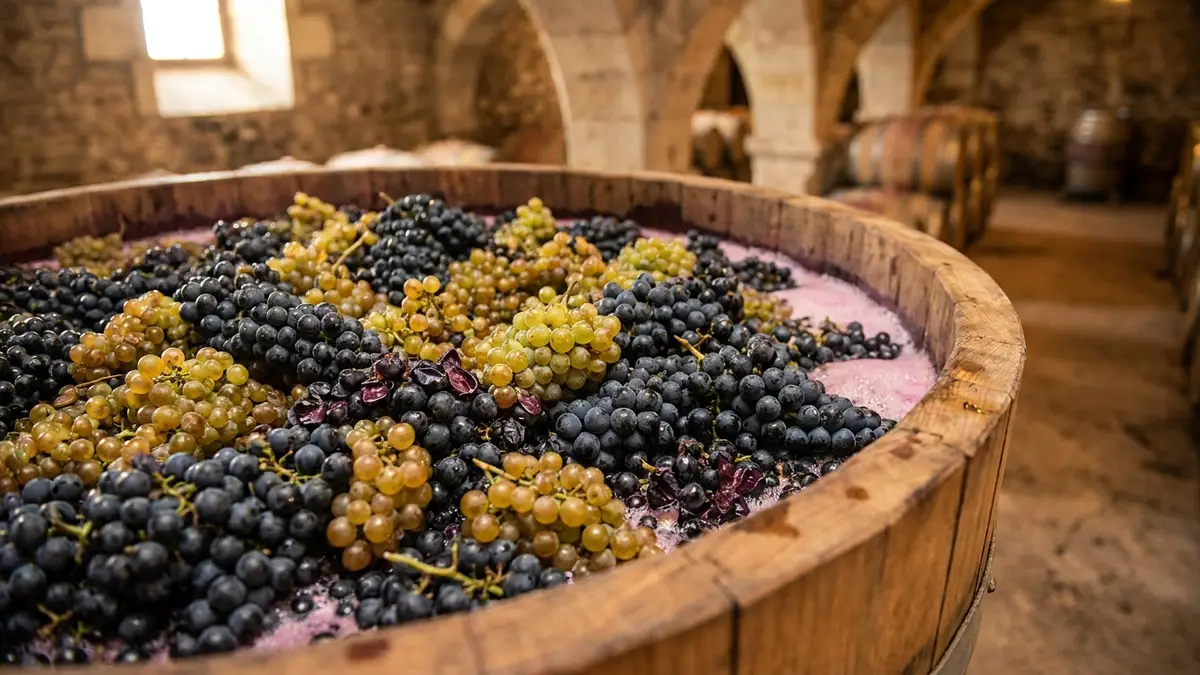
Co-fermentation wine starts with a simple act: two or more grape varieties go into the same vat at the same moment and ferment as one. That timing matters. The grapes' juice and skins react with each other while alcohol is forming, so the result is a different wine from two finished wines poured together afterwards.
What Is Co-Fermentation Wine, in One Paragraph?
Co-fermentation is fermenting two or more grape varieties together in one vessel, starting at the same time. The grapes share one pool of must (crushed grapes with their juice, skins and seeds) and one yeast population. The best-known example is Côte-Rôtie in France's northern Rhône, where up to 20% of the white grape Viognier may join the red grape Syrah, and the rules require both to ferment together. Vienna's Gemischter Satz does the same with white grapes, and the old Zinfandel vineyards of California did it with mostly red grapes. In a normal blend, each grape becomes its own wine first and the winemaker mixes them later.
How Is Co-Fermentation Different From a Field Blend or a Blend?
A field blend is about where grapes grow, blending is about finished wines, and co-fermentation is about the tank. The three terms get swapped online all the time, but each one answers a different question: where the grapes were mixed, and when the decision was made.
A field blend is a wine made from several varieties planted together in the same vineyard, row by row or even vine by vine. The pickers harvest everything at once, so the grapes usually end up co-fermented too. Blending happens after fermentation. Each grape or plot becomes its own wine, and the winemaker tastes the finished lots before deciding the recipe. Rioja is the classic blending region: its reds are assembled from different varieties, and for reds made from destemmed grapes the rules require at least 95% from five red grapes.
| Term | Where the grapes meet | When the choice is made | Clue on the label |
|---|---|---|---|
| Field blend | In the vineyard row | At planting, decades earlier | "Field blend", "Gemischter Satz", or an old mixed-vineyard name |
| Co-fermentation | In the fermentation vessel | At harvest, before any wine exists | Rarely stated; the place name (Côte-Rôtie) tells you |
| Blending | In the cellar, after fermentation | After tasting the finished lots | Grape percentages, or a region known for blends (Rioja, Bordeaux) |
The myth to drop is that a field blend and co-fermentation are the same thing. A winery can pick two grapes from separate vineyards and ferment them in one tank, which is co-fermentation with no field blend. Côte-Rôtie happens to be both: its rules allow Viognier only as vines mixed into Syrah plots, and the grapes must ferment together. For the wider world of mixed wines, the wine blends guide covers every style, and single varietal vs blend explains what a one-grape label promises.
Why Would a Winemaker Put White Grapes in a Red Wine?
For aroma, in the one famous case. In Côte-Rôtie, up to 20% Viognier may go in with Syrah, and the rules say both must ferment at the same time. Côte-Rôtie is an appellation (a protected place name with its own rulebook), and, like nearby Hermitage and Saint-Joseph, it allows some white grapes in its red.
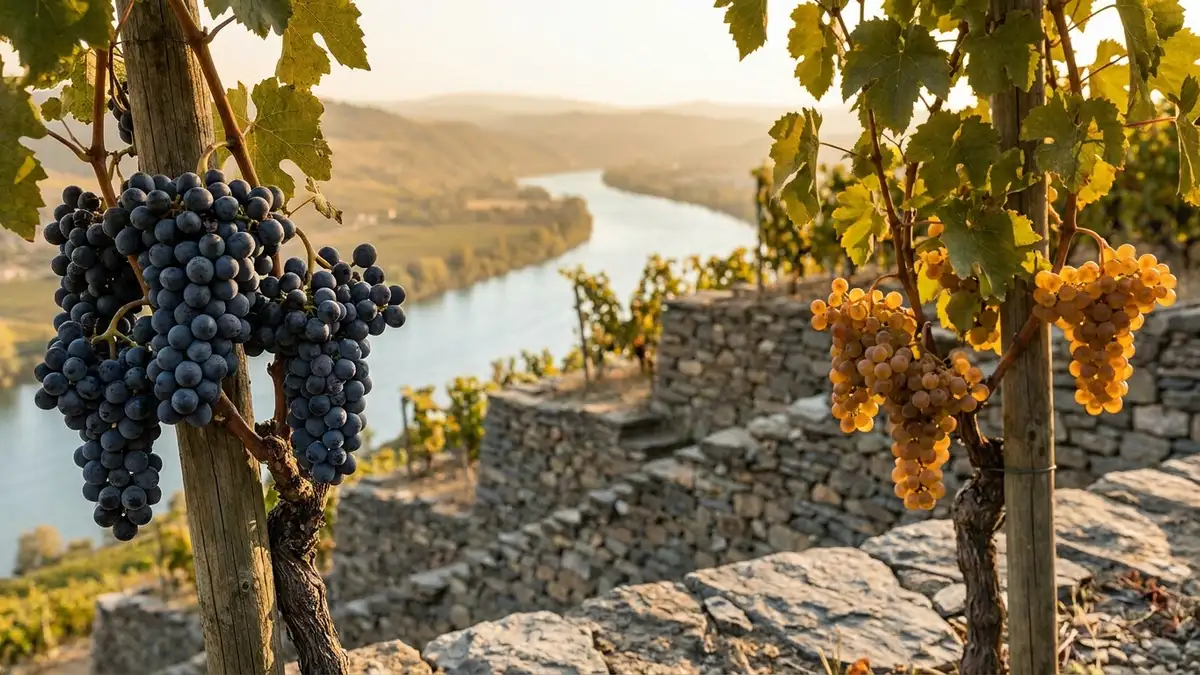
The payoff is a smell that sounds contradictory. Côte-Rôtie is known for meat aromas, bacon included, sitting right beside floral ones. Syrah brings the smoked meat and black pepper. Viognier is a perfumed white grape that smells of apricot and white flowers, and a small share of it lifts the red's nose without turning the wine white in the glass.
Timing is the rule's whole point. Adding 20% Viognier wine to finished Syrah would be ordinary blending elsewhere, but not here. Côte-Rôtie growers must commit before fermentation starts, choosing their Viognier share at harvest with no chance to adjust later. The Rhône Valley guide places Côte-Rôtie among its northern neighbours, and Syrah vs Shiraz explains why the same red grape tastes so different in cooler northern France.
Does Co-Fermentation Change a Red Wine's Colour?
Probably not. The one controlled test of Syrah fermented with Viognier found no colour gain. The popular claim is that the white grape "fixes" or deepens Syrah's colour. The chemistry behind that claim is real. Whether it works in Côte-Rôtie is another matter, and the appellation's own reason for Viognier is aroma.
Red wine gets its colour from anthocyanins (the red and purple pigments in grape skins). Through copigmentation, other colourless flavonoid compounds, called cofactors or copigments, cling loosely to those pigments. The pair reflects more colour than the pigment alone, so part of a young red's colour comes from copigmentation.
The effect is short-lived. Copigmentation matters only in the early stages of a wine's life. As a wine ages, anthocyanins lock onto tannins and other compounds with permanent chemical bonds, and those larger pigments take over. Our guide to wine colour and what it means follows that shift from purple to brick.
A white grape brings cofactors but no pigment. If it ferments with the red from day one, those cofactors are present at the moment the pigments are being pulled from the skins. That is the theory. A 2012 study in the American Journal of Enology and Viticulture fermented Syrah with 5, 10 and 20% Viognier: 5% changed nothing measurable, while 10 and 20% lowered most colour measures and did not make the colour more stable.
Where Can You Buy Co-Fermented Wine Today?
Four places make co-fermented wine easy to find on a shop shelf: Côte-Rôtie, Vienna's Gemischter Satz, old-vine California Zinfandel field blends, and, in rare cases, Beaujolais. Each reaches the same tank by a different route, and each asks for a different bottle.
| Wine | Grapes | What the rules allow | What to buy |
|---|---|---|---|
| Côte-Rôtie (France) | Syrah with Viognier | Up to 20% Viognier, fermented with the Syrah | Any Côte-Rôtie; check the back label for a Viognier share |
| Wiener Gemischter Satz (Austria) | Several white grapes, interplanted | Planted, harvested and made together | A Vienna white labelled Gemischter Satz |
| Old-vine Zinfandel field blend (California) | Zinfandel with Petite Sirah, Carignan, Grenache and others | No rule; comes from old mixed plantings | A Zinfandel labelled "field blend" or old vine |
| Red Beaujolais (France) | Gamay, sometimes with white grapes | Up to 15% white grapes | Any red Beaujolais, though most are 100% Gamay |
Gemischter Satz means "mixed set" in German. Its grapes are planted, harvested and made into wine together. It is a white wine, and the Austria wine guide places it among the country's other styles.
California's old Zinfandel vineyards were historically planted as field blends. Zinfandel vines grew interspersed with Durif (known locally as Petite Sirah), Carignan, Grenache, Mourvèdre, Mission and Muscat. A surviving plot is often picked in one pass and fermented together.
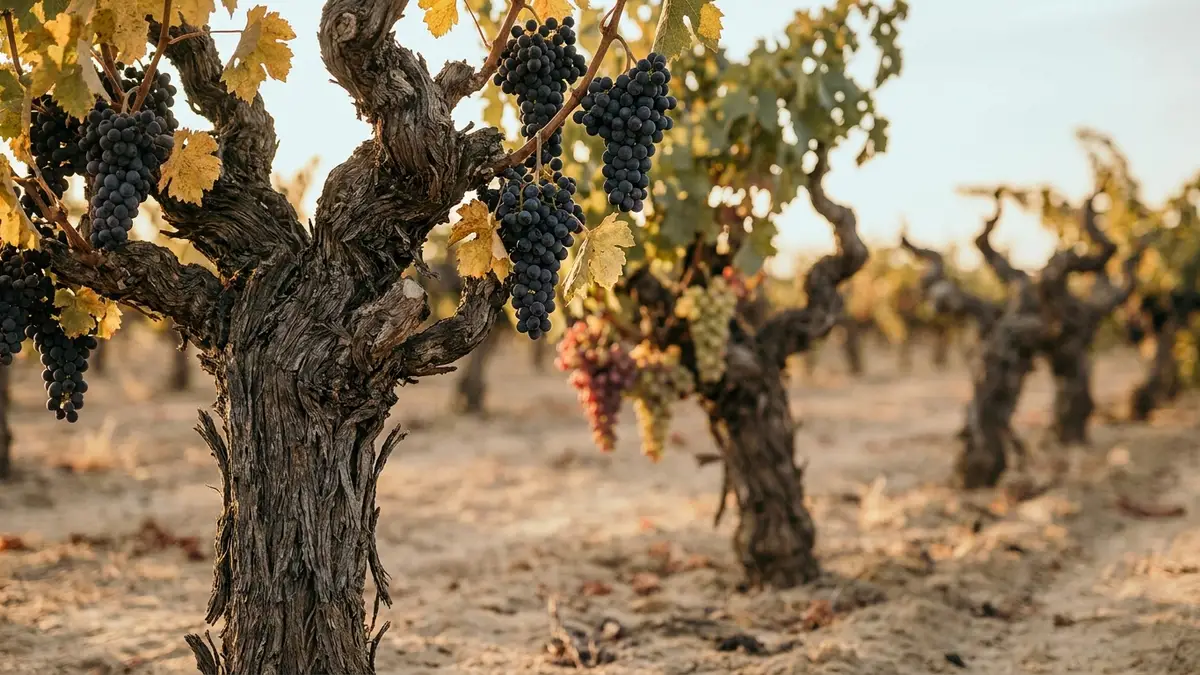
Beaujolais is the fine print. The rules allow up to 15% white grapes in every red Beaujolais, from basic Beaujolais to the top villages, but in practice the wines are almost always 100% Gamay. In top villages such as Morgon, Fleurie and Brouilly, those white grapes are Chardonnay, Aligoté and Melon de Bourgogne, planted among the Gamay vines. See the Beaujolais wine guide for the villages.
If a Côte-Rôtie back label mentions Viognier, that Viognier fermented with the Syrah, because the rules allow no other way. If a red Beaujolais names only Gamay, or no grape at all, assume it is 100% Gamay.
How Should You Serve and Taste a Co-Fermented Wine?
Serve a co-fermented wine the way you would serve its main grape, then taste for the second grape on top. The main grape sets the structure: the tannin (the drying grip on your gums), the acidity and the weight. The minority grape mostly shows up in the smell.
If the main grape is Syrah, as in Côte-Rôtie, treat it as a medium-bodied red with firm tannin. Serve it cool rather than warm and give it food with char and fat, such as grilled lamb or duck, because fat softens tannin and char echoes Syrah's smoked-meat aroma. If the wine is a Gemischter Satz, chill it like any crisp white and pour it with lighter food, such as roast chicken or a vegetable dish. For exact temperatures, use the wine serving temperature chart.
Old-vine Zinfandel field blends taste riper and heavier than either of those. They usually carry more alcohol and softer acidity, so serve them with barbecue, where sweet sauce and smoke need a red with ripe fruit to match.
Does the Label Say a Wine Was Co-Fermented?
Almost never. Co-fermentation is a cellar method, and the rules covered here do not require any label word for it, so the place name does the work. Côte-Rôtie tells you by law. "Gemischter Satz" tells you by definition, because the style is grown and made together.
On New World labels, "field blend" is the closest clue, and it usually means one mixed vineyard picked together. Grape percentages point the other way: a back label that lists exact shares from separate lots more often describes a wine blended after fermentation. If you are unsure what a label word promises, how to read a wine label and what an appellation is cover the basics.
Why Were Field Blends Normal Before Modern Cellars?
Because fermentation tanks were expensive, a grower with a mixed vineyard picked it all at once and filled one vat. Planting was mixed for a practical reason too. New vineyards were often planted from cuttings taken from an older one, copying its mix of grapes, row for row.
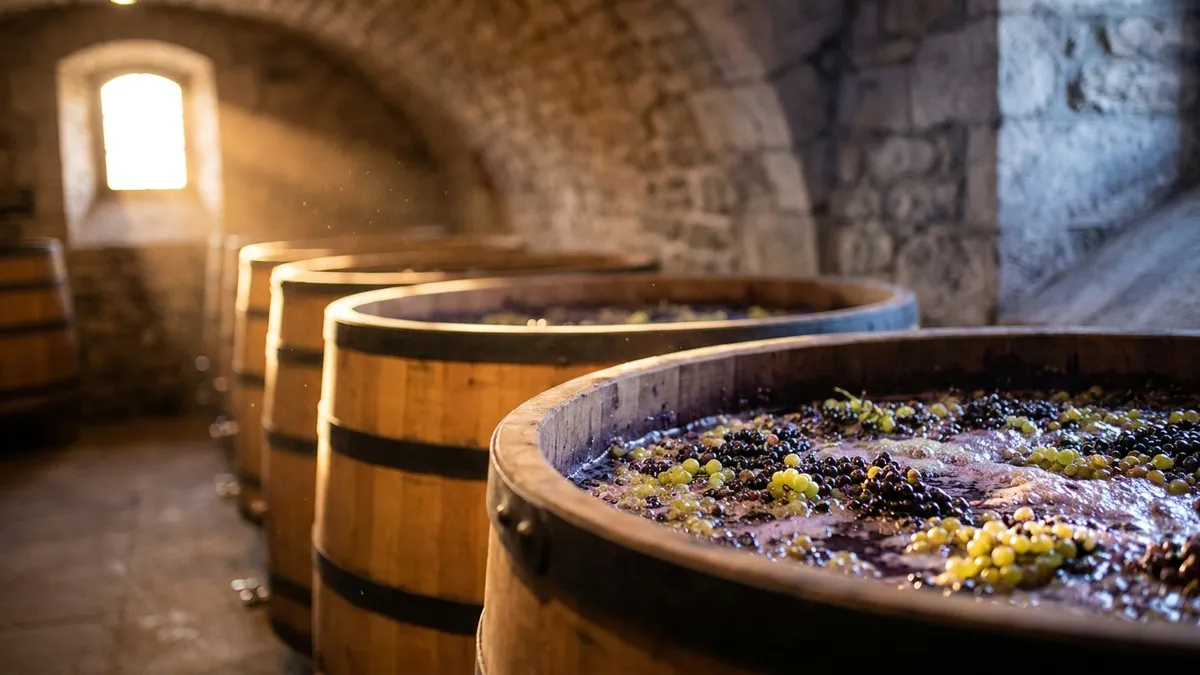
That economy flipped in the twentieth century. Fermentation tanks are now cheap enough that the field blend is an anachronism, and almost all wines are assembled from smaller, individual lots. A winery with dozens of tanks can ferment each grape and plot apart, then decide the recipe later.
Today's field blends and co-fermented wines are survivals from that older economy. Old California Zinfandel plots, Vienna's Gemischter Satz vineyards and Côte-Rôtie's Viognier rule are all older than modern tank rooms. The wine yeast and fermentation guide covers what happens inside the tank itself.
Why Did Chianti Drop Its White Grapes?
Because the white grapes, mostly neutral Trebbiano, thinned the wine, and the law changed in two steps, 1995 and 2006. White grapes in Chianti were written into law. The 1967 DOC rules defined Chianti as a Sangiovese-based blend with 10 to 30% Malvasia and Trebbiano.
By the 1950s, Trebbiano, known for its neutral flavour, made up as much as 30% of many mass-market Chiantis. That share lightened the colour and flattened the taste. Since 1995, producers may make Chianti from 100% Sangiovese, and since 2006 white grapes are banned outright in Chianti Classico, though plain Chianti may still include up to 10%. A Chianti Classico bought today is an all-red wine.
One detail keeps getting repeated wrongly. A famous "recipe" for Chianti, attributed to the nineteenth-century statesman Baron Ricasoli, is widely quoted with exact percentages. A review of his own letters from the time does not back that formula up, so treat the numbers as later folklore.
What Should You Pour Tonight?
Pour a single-grape Syrah beside a Côte-Rôtie and smell them one after the other. The Syrah gives you the red's base: smoked meat, pepper and dark plum. The Côte-Rôtie should add a floral or apricot lift on top, which is the co-fermented Viognier.
If you want a guide while you practise, the Sommy app at sommy.wine runs bite-sized courses, including a Wine 101 course and a France course, and an AI-guided tasting mode that logs each glass. For more styles built from more than one grape, start at the wine styles hub. Then open both bottles tonight and write down which glass smells of flowers first.
Sources
Frequently Asked Questions
What is co-fermentation in winemaking?
Co-fermentation is fermenting two or more grape varieties together in the same vessel, starting at the same time. The grapes' juice, skins and yeast share one fermentation, so they interact while the wine is being made. It differs from blending, where each grape becomes its own finished wine first and the winemaker mixes them afterwards.
Is co-fermentation the same as a field blend?
Not quite. A field blend describes the vineyard: several varieties planted side by side, picked together and usually fermented together. Co-fermentation describes the cellar step, and it can use grapes from separate plots. Côte-Rôtie is both: its rules allow Viognier only as vines mixed into Syrah plots, and the grapes must ferment together.
Why is Viognier added to Syrah in Côte-Rôtie?
For aroma. Côte-Rôtie may include up to 20% Viognier, a white grape, and the rules require it to ferment with the Syrah rather than be added later. The result is known for pairing smoked-meat and bacon aromas with floral ones. A popular theory says the white grape also deepens the colour, but a 2012 study of co-fermented Syrah found no colour gain.
Does adding white grapes make red wine lighter?
In small amounts it barely shows. White grapes have no red pigment, so a large share, like the up to 30% Trebbiano once found in mass-market Chianti, thinned the wine. A 2012 study of Syrah co-fermented with Viognier found that 5% changed nothing measurable, while 10 and 20% lowered most colour measures.
How can you tell if a wine was co-fermented?
The label rarely says so, so read the place name. Côte-Rôtie with Viognier is co-fermented by law, Wiener Gemischter Satz is grown, picked and made together, and a California wine labelled as a field blend usually came from one mixed vineyard. A back label that lists separate lots or percentages more often points to blending after fermentation.
Is Chianti still made with white grapes?
Chianti Classico is not: white grapes such as Malvasia and Trebbiano have been banned there since 2006. Plain Chianti may still include up to 10%, though since 1995 producers can make it from 100% Sangiovese. The 1967 rules had required 10 to 30% white grapes, and mass-market Chianti of the 1950s could hold up to 30% neutral Trebbiano.
Sommy Team
LinkedInFounder & Wine Educator
The Sommy Team is building the world's most approachable wine education app, helping beginners develop real tasting skills through structured courses and AI-guided practice.