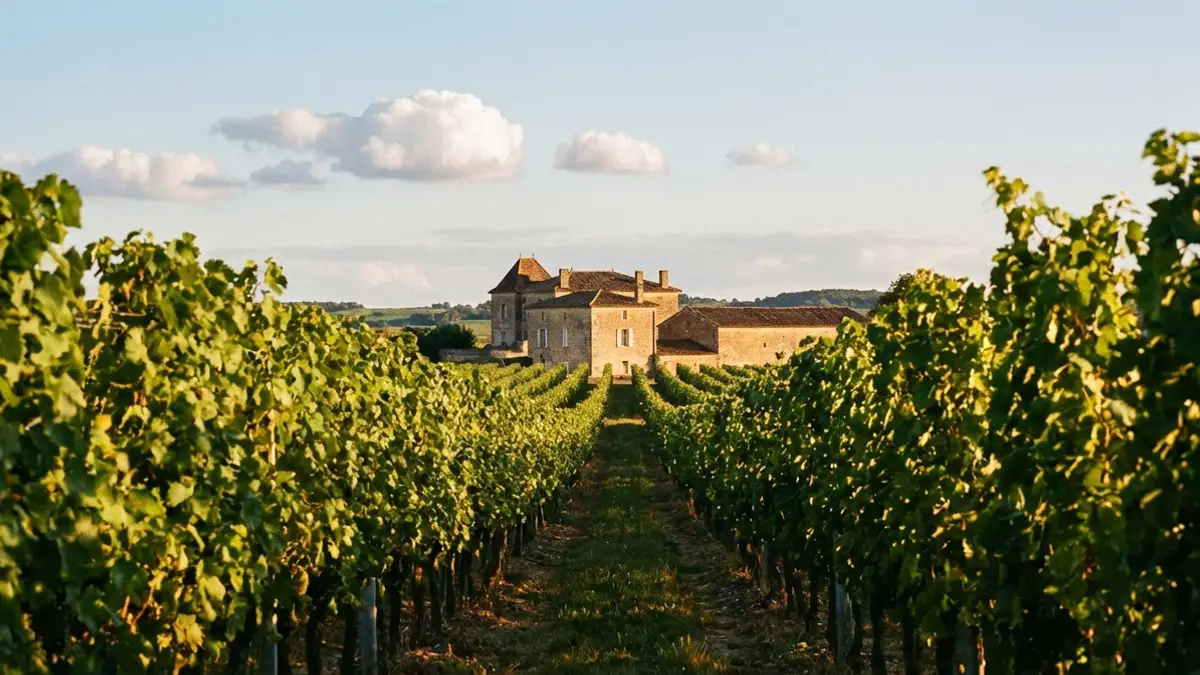
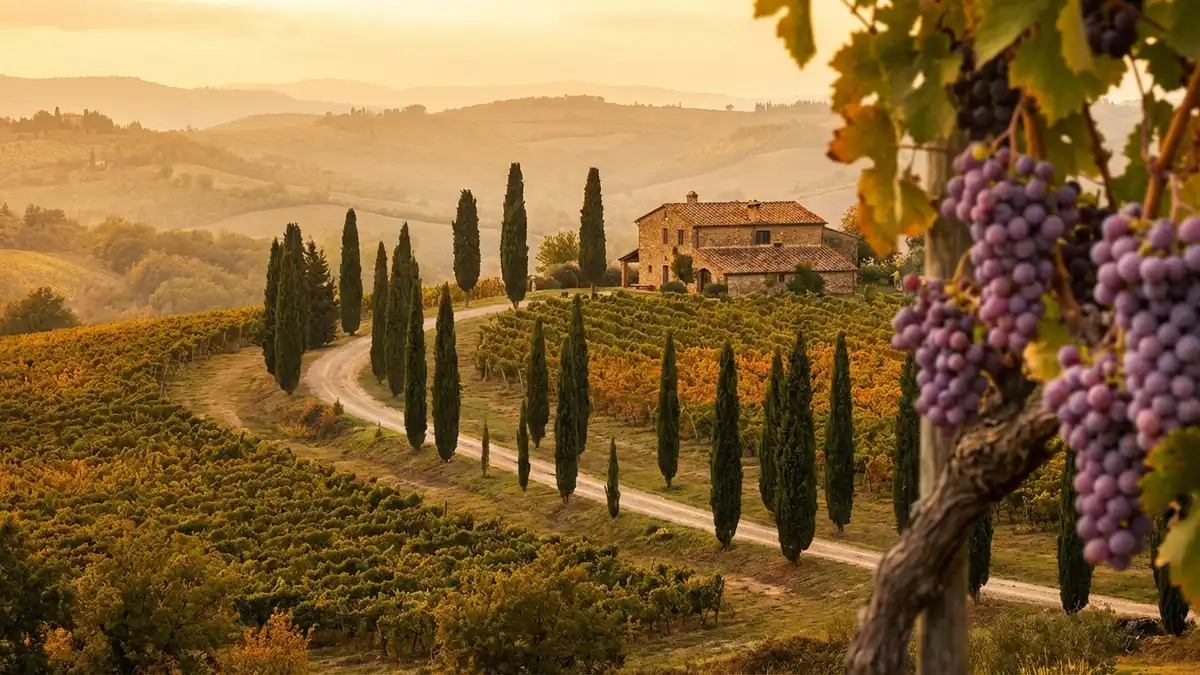
Rhône Valley Wine Guide: Northern vs Southern Rhône

By the Sommy Team — AI-assisted, human-edited.
Updated Jul 21, 2026
Contents (10)
- What Is Rhône Valley Wine?
- Where the Rhône Valley Is and Why Its Two Halves Differ
- The Northern Rhône: Single-Grape Syrah and Aromatic Whites
- The Southern Rhône: GSM Blends and the Power of Many Grapes
- North vs South: The Side-by-Side Contrast
- Prices, Aging, and Reading a Rhône Label
- Food Pairings That Work
- How a Beginner Should Start with the Rhône Valley
- What Makes the Rhône Distinctive
- The Reward of Learning the Rhône
TL;DR
The Rhône Valley is really two regions in one. The steep, granite Northern Rhône makes single-grape Syrah reds and Viognier whites. The warmer, flatter Southern Rhône makes Grenache-led GSM blends, most famously Châteauneuf-du-Pape. This Rhône Valley wine guide shows beginners how to tell them apart and where to begin.
What Is Rhône Valley Wine?
This Rhône Valley wine guide begins with the single most useful idea about the region: it is two different worlds wearing one name. The Rhône Valley follows the Rhône river through southeastern France, and it splits into a Northern Rhône and a Southern Rhône separated by a stretch with almost no vineyards. The North is steep, cool, and granite, making single-grape Syrah reds (Côte-Rôtie, Hermitage, Cornas) and aromatic whites from Viognier. The South is warm, flat, and stony, making GSM blends — Grenache, Syrah, and Mourvèdre — led by famous appellations like Châteauneuf-du-Pape, Gigondas, and Vacqueyras. Learn that North-versus-South divide and the whole region clicks into place.
Where the Rhône Valley Is and Why Its Two Halves Differ
The Rhône Valley sits in southeastern France, running roughly 120 miles south from the city of Vienne toward the Mediterranean near Avignon. The river is the spine, but the climate, soil, and grapes change so completely from top to bottom that the region is best understood as a pair.
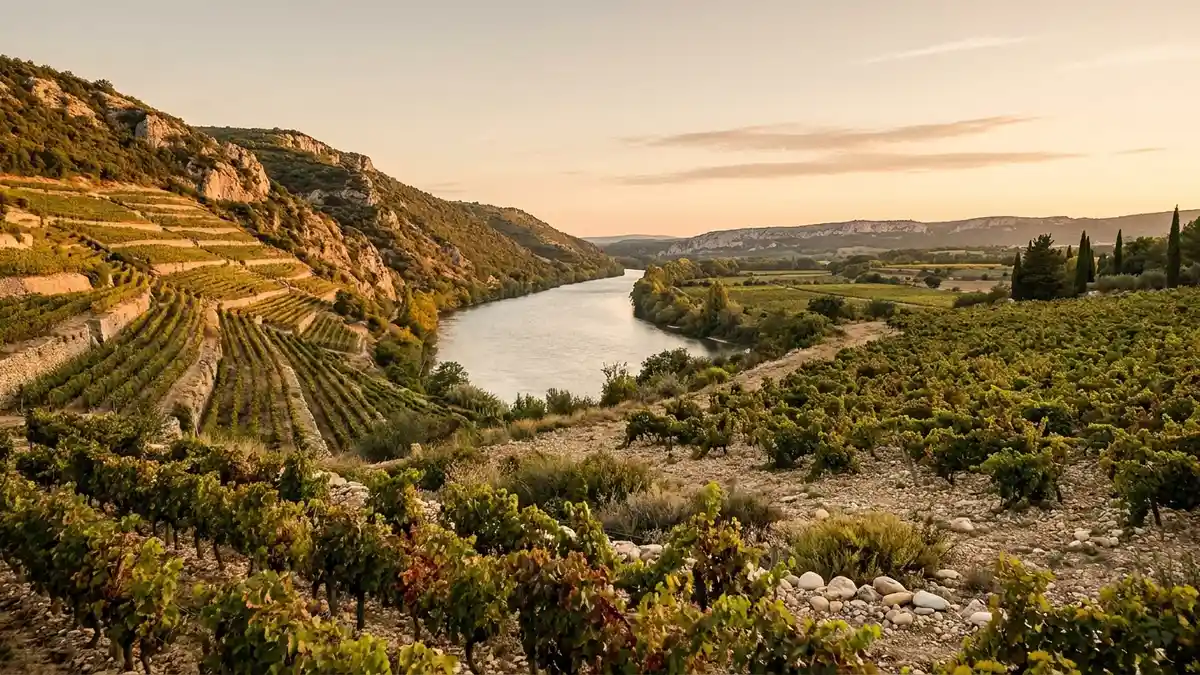
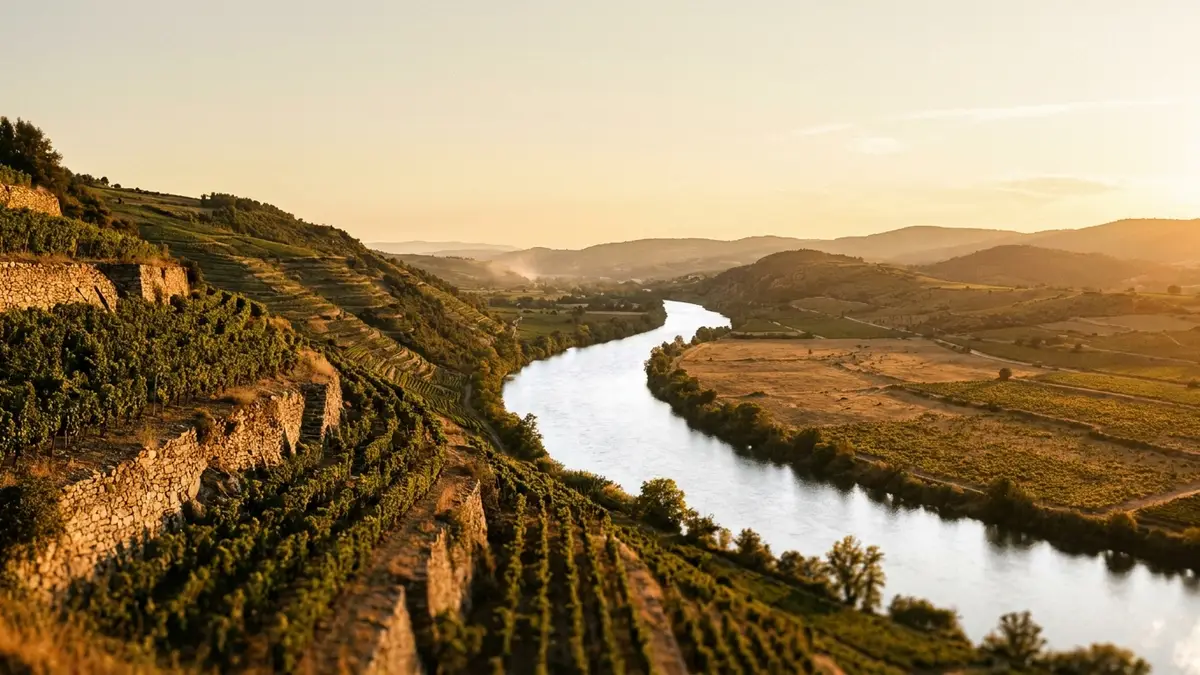
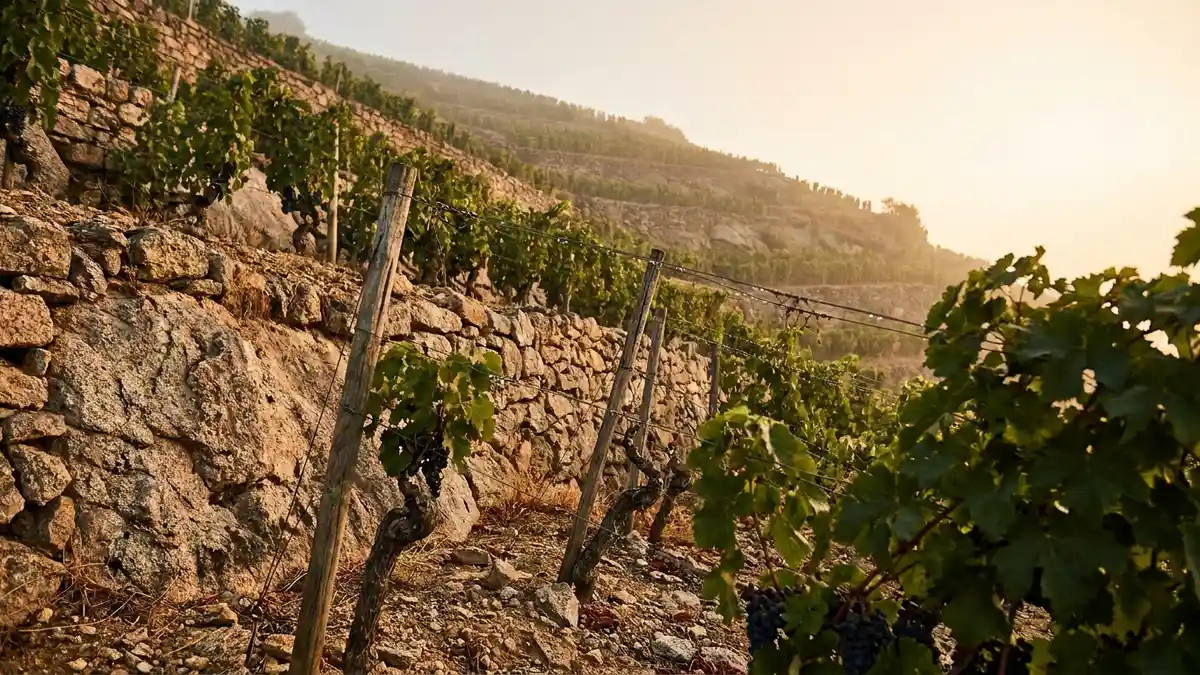
The Northern Rhône is the smaller, cooler half. Vineyards cling to dramatically steep granite slopes above the river, so sheer in places that growers terrace the hillsides and work them by hand. The climate is continental, with warm summers and real seasonal swing. This is Syrah country, and the reds here are made from that one grape alone.
The Southern Rhône is the larger, warmer half and accounts for the great majority of the region's wine. The terrain opens into broad, sun-baked plains and rolling hills under a Mediterranean climate. Here the heat ripens many grapes at once, so the wines are blends rather than single varieties, built around Grenache.
One force ties both halves together: the mistral (a strong, cold, dry wind that funnels down the valley from the north). It dries the vines after rain, keeps disease at bay, and helps grapes ripen cleanly. The mistral is so constant that southern growers train vines low and tuck them into sheltered corners to protect them.
The Northern Rhône: Single-Grape Syrah and Aromatic Whites
If the Southern Rhône is about the blend, the Northern Rhône is about purity. Nearly every red is 100% Syrah, which makes the North the clearest classroom anywhere for learning what this grape tastes like on its own. The whites, though far rarer, are some of France's most distinctive.
Cooler than the South, the North gives Syrah a savory, structured profile rather than a jammy one. Typical aromas: black pepper, blackberry, smoked meat, violet, and olive. The wines are medium to full bodied with firm, fine-grained tannins (the drying, gripping sensation that gives red wine its backbone) and bright acidity that keeps them fresh. If you want to understand that structure before you taste, our guide to understanding tannins, acidity, and body breaks down each element in plain language.
Because the grape never changes, the differences between Northern Rhône reds come down to place. The signature appellations to know:
- Côte-Rôtie: The "roasted slope" at the northern tip, on terraced granite. Perfumed, elegant Syrah, traditionally co-fermented with a small splash of the white grape Viognier to lift the aromatics. Fragrant, floral, and ageworthy.
- Hermitage: A single legendary hill making some of the longest-lived Syrah on earth — deep, powerful, and built to age for decades. Small in size, large in reputation.
- Cornas: Pure, unblended Syrah in its most rugged, dark, and brooding form. No white grape allowed, no softening — just dense, structured red.
- Crozes-Hermitage: The largest and most affordable Northern appellation, surrounding the Hermitage hill on flatter ground. The smartest place for a beginner to meet Northern Syrah without a steep price.
The North's whites deserve a mention because nowhere else makes them quite the same way. Viognier rules the white-only appellation of Condrieu, producing rich, low-acid wine bursting with apricot, peach, and honeysuckle. Further south within the North, Marsanne and Roussanne make fuller, nuttier whites in appellations like Saint-Joseph and Hermitage Blanc — the latter a structured, beeswax-and-toasted-nut white that quietly ranks among the great whites of France. At the North's southern tip, tiny Saint-Péray even makes still and sparkling whites from the same two grapes, an under-the-radar corner worth seeking out.
Syrah is also the grape that travels the world under a second name, and the contrast is one of wine's best lessons in terroir. Our deep dive on Syrah versus Shiraz shows how the same variety becomes a savory, peppery red in the cool Northern Rhône and a bold, fruit-forward one in warm Australia.
The Southern Rhône: GSM Blends and the Power of Many Grapes
Travel south past the vineyard gap and the philosophy flips entirely. The Southern Rhône is warmer, sunnier, and far larger, and its reds are blends that draw strength from combining grapes. The backbone is the GSM trio, and learning what each grape contributes is the key to the whole South.
- Grenache: The leader. It ripens to high sugar in the southern heat, giving ripe strawberry and red-cherry fruit, soft tannins, warmth, and generous alcohol. Most Southern Rhône blends are Grenache-dominant. Our Grenache wine guide covers the grape in full.
- Syrah: The structure. Even in the warm South, Syrah adds color, black-pepper spice, and firmer tannin to stiffen Grenache's softness.
- Mourvèdre: The savory anchor. It brings dark fruit, meaty depth, grip, and the ability to age, balancing Grenache's fruit and sweetness.
Beyond the famous three, the South leans on a wide cast of supporting grapes — Cinsault, Carignan, Counoise, and others — that growers blend in for freshness, perfume, or backbone. Two of these have their own profiles worth knowing: our Carignan wine guide explains the high-acid old-vine workhorse, and the Counoise wine guide covers the peppery minor grape prized for lift.
The Southern reds taste different from the Northern ones in a way you can feel immediately. Typical aromas: ripe red and black fruit, dried herbs, lavender, leather, and garrigue (the scrubby Mediterranean wild herbs — thyme, rosemary, juniper — that perfume the wines). They are full bodied, warming, and rounder than the savory, structured reds of the North.
Châteauneuf-du-Pape and the Thirteen Grapes
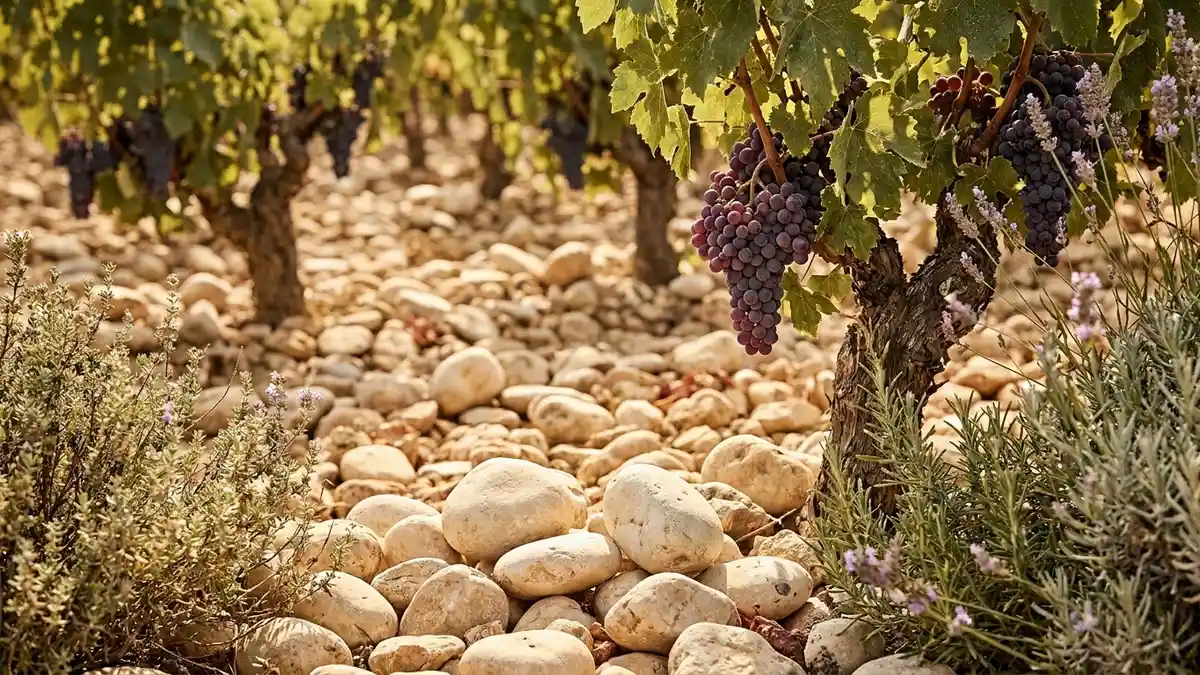
The flagship of the South is Châteauneuf-du-Pape, named for the medieval popes who kept a summer residence nearby. Two things make it famous. First, it permits up to thirteen grape varieties in a single blend — though in practice Grenache leads and most of the thirteen are minor. Second, many of its best vineyards are carpeted in galets (large, smooth, rounded stones polished by an ancient riverbed). The galets soak up the day's heat and radiate it back to the vines overnight, pushing the grapes to full, warming ripeness. The result is rich, spicy, garrigue-scented red built to age.
The Other Southern Appellations Worth Knowing
Châteauneuf gets the headlines, but several neighbors offer the same generous style at friendlier prices:
- Gigondas: Grown in the foothills of the jagged Dentelles de Montmirail. Structured, robust, Grenache-led reds often called the value alternative to Châteauneuf-du-Pape.
- Vacqueyras: A warm, peppery, hearty neighbor of Gigondas. Reliable, full-bodied GSM reds at honest prices.
- Tavel: The South's rosé specialist, and unusual for making only pink wine. Tavel rosés are deep-colored, dry, and full-bodied — serious, food-driven wines rather than light patio sippers, and proof that rosé can have real structure. For more on the grapes behind pink wine, see our rosé grapes guide.
- Lirac: Just across the river from Châteauneuf-du-Pape, making reds, whites, and rosés in a similar generous style at significantly lower prices.
- Beaumes-de-Venise: Known above all for Muscat de Beaumes-de-Venise, a fortified sweet wine of orange blossom, apricot, and honey — the South's dessert-course specialist.
- Côtes du Rhône: The broad, everyday appellation covering most of the South. Affordable, reliable, Grenache-led blends, and the single best entry point to the entire region. One step up, Côtes du Rhône-Villages tightens the rules and lowers yields — and when a village has earned the right to add its name to the label, as in Cairanne or Sablet, expect a meaningful jump in quality for a few dollars more.
North vs South: The Side-by-Side Contrast
The fastest way to lock in this Rhône Valley wine guide is to hold the two halves up against each other. The differences are clean and consistent:
- Northern Rhône — Reds: 100% Syrah · Style: savory, peppery, structured · Terrain: steep granite slopes · Climate: cooler, continental · Whites: Viognier, Marsanne, Roussanne · Signature: Hermitage, Côte-Rôtie, Cornas.
- Southern Rhône — Reds: GSM blends led by Grenache · Style: ripe, warming, herbal · Terrain: flat stony plains and galets · Climate: warmer, Mediterranean · Whites: Grenache Blanc, Clairette, blends · Signature: Châteauneuf-du-Pape, Gigondas, Tavel.
The North-South split tells you almost everything before you open the bottle:
- One grape vs many. A Northern red is a single-variety statement; a Southern red is a team effort. If the label says a Northern appellation, expect pure Syrah; if it says a Southern one, expect a blend.
- Structure vs warmth. Northern Syrah leans cool, firm, and savory. Southern Grenache leans ripe, soft, and warm. Same family, opposite temperaments.
- Cliff vs plain. The North's vines hang on terraced granite; the South's spread across stony flats baked by sun and swept by the mistral.
This single-grape-versus-blend distinction echoes a pattern across France. Burgundy bets everything on one grape per color, while Bordeaux and the Southern Rhône build through blending. Our overview of French wine regions places the Rhône inside that bigger national picture, and our look at the noble grapes explains why Syrah and Grenache earn their place among the varieties every learner should know.
Prices, Aging, and Reading a Rhône Label
The Rhône's label hierarchy is friendlier than Burgundy's, and it maps neatly onto price. Côtes du Rhône sits at the base around $12-20, Côtes du Rhône-Villages at $15-30, cru appellations like Gigondas, Vacqueyras, and Crozes-Hermitage at $25-50, Châteauneuf-du-Pape at $40-150, and Hermitage and Côte-Rôtie from $80 to well past $300 for top single-vineyard cuvées. Two honest buying rules: spend a little extra on a Villages bottling rather than the cheapest Côtes du Rhône, and skip generic Châteauneuf-du-Pape under $40 — at that price the appellation badge usually outpaces the wine in the bottle.
Aging potential follows the same ladder. Côtes du Rhône is built for 3-5 years, Gigondas and Vacqueyras for 8-15, Châteauneuf-du-Pape rewards 8-25 years of cellaring, and Hermitage and Côte-Rôtie from strong vintages can run 15-40. Structured whites — especially Hermitage Blanc — quietly hold 5-15 years, while Condrieu's Viognier is best drunk young and rich.
Food Pairings That Work
The Rhône's two halves pair as differently as they taste. Northern Syrah loves lamb, peppered steak, and grilled meats with rosemary and thyme — the wine's own white-pepper and savory notes double down — plus hard aged cheeses like Comté. Southern Grenache blends handle braised meats and daubes, roast pork, and ratatouille, where the garrigue in the glass meets the garrigue on the plate. Condrieu's rich Viognier shines with roast chicken, lobster, and mild curries. For the underlying logic, our wine and food pairing guide breaks down the principles.
How a Beginner Should Start with the Rhône Valley
You do not need a cult Hermitage or a budget-busting Châteauneuf to understand the Rhône. The smart path is to taste the two halves against each other and pay attention to what changes. A practical order:
- Begin with a Côtes du Rhône red. This affordable Southern blend is the friendliest possible introduction to the warm, peppery, Grenache-led house style. It is widely available and forgiving.
- Add a Northern Syrah. Pick a Crozes-Hermitage or a Saint-Joseph — the accessible end of the North — to meet single-grape Syrah: cooler, firmer, more savory.
- Taste the two side by side. Pour the Côtes du Rhône and the Northern Syrah together. The contrast between ripe blend and structured single grape is the entire region in two glasses.
- Try a serious rosé. Open a Tavel to break the assumption that pink wine must be light. Its depth and grip show how varied the Rhône can be.
- Build the tasting habit. Note the black pepper that runs through Syrah, the warm strawberry of Grenache, and the wild-herb garrigue of the South. Our guide to how to taste wine gives you the step-by-step method to capture all of it.
Sommy turns these comparisons into guided exercises — naming the aromas, scoring the structure, and building the vocabulary to describe what you sense. You can start practicing free at sommy.wine, then bring the method to your next bottle of Côtes du Rhône.
What Makes the Rhône Distinctive
Few regions teach two lessons as cleanly as the Rhône. In the North, you learn what a single grape can do when terroir is the only variable — Syrah from one granite slope tastes different from Syrah a few hills away, with no blending to muddy the comparison. In the South, you learn the opposite art: how combining grapes builds a wine greater than any one of them, where Grenache's fruit, Syrah's spine, and Mourvèdre's depth lock together.
The region also makes wine across nearly every style worth knowing — structured ageworthy reds, generous everyday blends, perfumed Viognier whites, and serious dry rosé. That range, governed by France's AOC appellation rules, makes the Rhône one of the most rewarding regions for a learner who wants variety without leaving a single river valley.
The Rhône asks one question before any other — North or South — and answering it tells you the grape, the structure, and the soul of the wine in your glass.
The Reward of Learning the Rhône
The Rhône gives a beginner an unusually fair deal. Two grapes carry the story — Syrah in the North, Grenache in the South — and once you can place a label on the right side of the river, you can predict the style with real confidence. From there, the appellations fill in the detail: the cliffs of Côte-Rôtie, the legend of Hermitage, the galets of Châteauneuf-du-Pape, the rosé of Tavel.
Start with a side-by-side pour, note what changes, and let the valley reveal itself one glass at a time. The Sommy app is built to make that habit stick — turning each bottle into a short, guided lesson so the next Rhône you open is a little clearer than the last.
Sources
Frequently Asked Questions
What is the difference between Northern and Southern Rhône?
The Northern Rhône is steep, cool, and granite-based, and makes single-grape Syrah reds plus aromatic whites from Viognier, Marsanne, and Roussanne. The Southern Rhône is warmer, flatter, and stonier, and makes blended reds led by Grenache with Syrah and Mourvèdre. North means one grape; South means a blend.
What grapes are used in Rhône wines?
Northern Rhône reds are almost entirely Syrah, with whites from Viognier, Marsanne, and Roussanne. Southern Rhône reds are blends built on Grenache, Syrah, and Mourvèdre, known as the GSM trio. Châteauneuf-du-Pape allows up to thirteen permitted grape varieties in a single wine, though most are minor players.
What is a GSM blend?
GSM stands for Grenache, Syrah, and Mourvèdre, the three grapes that form the backbone of most Southern Rhône reds. Grenache brings ripe red fruit and warmth, Syrah adds color, pepper, and structure, and Mourvèdre lends savory depth and grip. Together they produce rich, generous, food-friendly reds.
What makes Châteauneuf-du-Pape special?
Châteauneuf-du-Pape is the flagship Southern Rhône appellation, permitting up to thirteen grape varieties in one blend. Its vineyards are famous for galets — large, smooth stones that store daytime heat and radiate it back to the vines at night. The result is full-bodied, warming, spice-and-garrigue-scented red wine built to age.
What is the mistral and how does it affect Rhône wine?
The mistral is a strong, cold, dry wind that sweeps down the Rhône Valley from the north. It dries the vines after rain, reducing disease, and helps grapes ripen cleanly under abundant sun. Growers in the South often plant in protected spots or train vines low to shelter them from its force.
Where should a beginner start with Rhône wine?
Start with a Côtes du Rhône red, the region's affordable everyday blend, to meet the warm, peppery Grenache-led style. Then try a Northern Rhône Syrah, such as Crozes-Hermitage, to taste single-grape structure. Tasting one of each side by side makes the North-versus-South contrast immediately clear.
Is Rhône Syrah the same as Australian Shiraz?
They are the same grape, but the styles differ. Northern Rhône Syrah tends to be cooler-climate — peppery, savory, and medium-bodied with firm structure. Australian Shiraz is usually riper, bolder, and more fruit-forward from a warmer climate. Tasting both reveals how dramatically place reshapes a single variety.
What is Tavel and why does it matter?
Tavel is a Southern Rhône appellation that makes only rosé, unusual in a region known for reds. Its rosés are deeply colored, dry, and full-bodied — built for food rather than poolside sipping. Tavel shows that pink wine can be serious and structured, not just light and casual.
Sommy Team
LinkedInFounder & Wine Educator
The Sommy Team is building the world's most approachable wine education app, helping beginners develop real tasting skills through structured courses and AI-guided practice.