Chinese Wine Guide — Ningxia, Marselan, and Buried Vines

By the Sommy Team — AI-assisted, human-edited.
Updated Jul 22, 2026
Contents (9)
- What Is Chinese Wine?
- A Very Old Culture, a Very Young Industry
- Ningxia and the Helan Mountains: China's Fine-Wine Heartland
- The Grapes: Cabernet, Cabernet Gernischt, and Marselan
- Where Chinese Wine Grows: The Regions
- Why Growers Bury Their Vines
- What Chinese Wine Tastes Like
- Chinese Wine Guide: How a Beginner Should Start
- Chinese Wine in the Wider Wine World
TL;DR
China farms one of the world's largest vineyard areas, yet only a fraction becomes wine. Ningxia, below the Helan Mountains, is the fine-wine heartland, built on Bordeaux-style reds and the rising grape Marselan. Winters are so cold that growers bury every vine in soil each autumn. This guide covers the regions, grapes, and where to start.
China grows grapes on a scale that dwarfs France, yet almost no one outside the country has tasted a Chinese wine. This Chinese wine guide maps a young, fast-moving industry built on a hard climate and a lot of ambition: a vast vineyard that is mostly table grapes, a fine-wine heartland in the high desert of Ningxia, and a short list of grapes — led by Cabernet Sauvignon and the rising star Marselan — learning to speak with a local accent. The wines are structured, oak-framed, and improving faster than almost anywhere on earth.
What Is Chinese Wine?
Chinese wine is mostly structured, Bordeaux-style red grown in a handful of northern and western regions, led by Ningxia at the foot of the Helan Mountains. China holds one of the world's largest vineyard areas — roughly 785,000 hectares — but the overwhelming majority is table grapes, not wine. The fine-wine story is small and concentrated: Ningxia alone accounts for close to 40% of the country's wine-grape plantings, around 40,000 hectares, with more than 100 operating wineries. Cabernet Sauvignon dominates the vineyard, Marselan is the grape to watch, and winters are cold enough that growers physically bury their vines every year.
A Very Old Culture, a Very Young Industry
Grapes and grape wine are not new to China — they arrived along the Silk Road more than two thousand years ago, and the country has a long history of eating table grapes. But a modern wine industry aimed at dry, quality wine is barely a lifetime old.
The founding landmark is Changyu, established in 1892 in Yantai on the Shandong coast, which remains the country's oldest and largest wine company. For most of the twentieth century, Chinese wine meant sweet, rustic, high-volume bottlings, and much of the vineyard went to table grapes and grape juice rather than serious wine.
The quality turn is recent and fast. From the 1990s onward, growers began planting international varieties in earnest, importing know-how, and treating wine as a fine-wine project rather than an agricultural commodity. In the space of two decades, China went from a footnote to a country whose best reds compete in international competitions.
Ningxia and the Helan Mountains: China's Fine-Wine Heartland
If you learn one place name from this Chinese wine guide, make it Ningxia — more precisely, the eastern foothills of the Helan Mountains (贺兰山东麓) in the Ningxia Hui Autonomous Region. This is China's answer to a great red-wine address, and it is where the country's reputation was made.
The setting is dramatic. Vineyards sit at around 1,100 metres in a high, dry basin near the Yellow River, sheltered to the west by the Helan Mountains. It is effectively a desert: low rainfall, intense sunshine, and a huge day-to-night temperature swing that lets grapes ripen fully while keeping acidity fresh. That combination — ripeness plus retained acidity — is exactly what structured reds want.
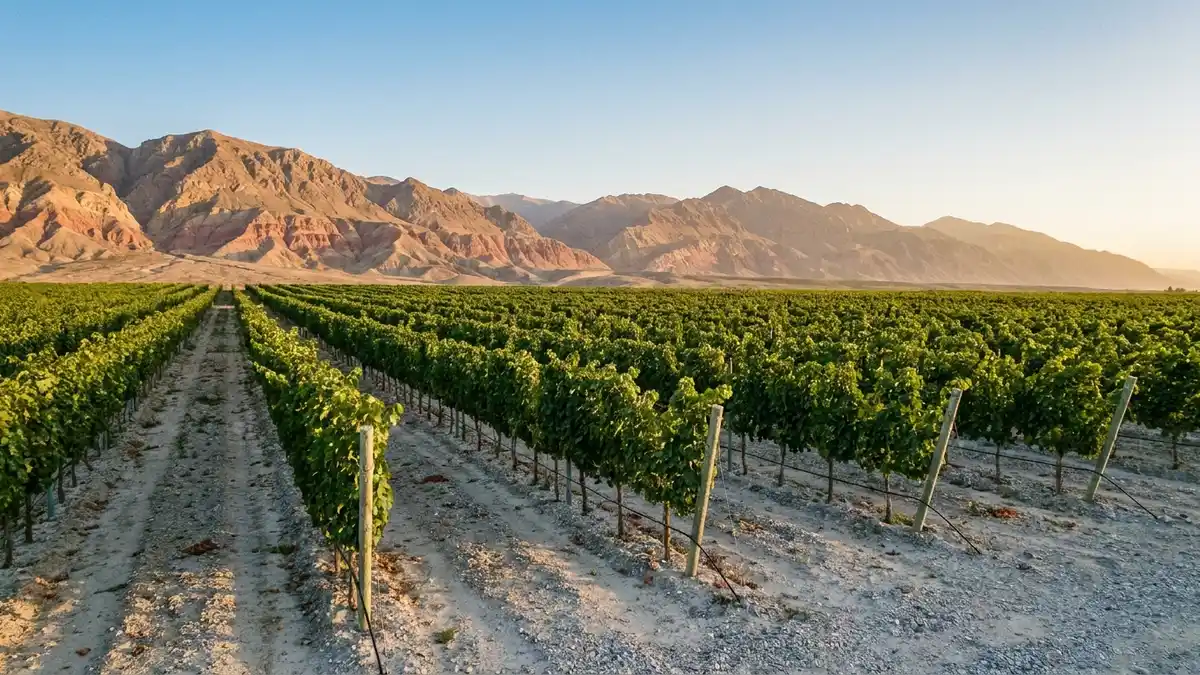
The scale has grown quickly. The Helan Mountain east foothills now hold roughly 40,000 hectares of vineyard — close to 40% of China's total wine-grape area — and more than 100 operating wineries, many of them architecturally ambitious estates built in the last fifteen years. The region also draws millions of wine tourists a year, an economy in its own right.
The moment that changed everything came in 2011. A small Ningxia estate, Helan Qingxue, entered its Grand Reserve Jia Bei Lan 2009, a Cabernet-based Bordeaux blend, into the Decanter World Wine Awards in London and won an international trophy — a first for China against the world's benchmark reds. It was the equivalent of an unknown region walking into the finals and winning, and it reset global expectations for what China could do.
The Grapes: Cabernet, Cabernet Gernischt, and Marselan
China's fine-wine vineyard leans hard on red, and specifically on the Bordeaux family. Understanding four grapes gets you most of the way.
Cabernet Sauvignon
Cabernet Sauvignon is the undisputed king, the most planted quality wine grape in the country and the backbone of nearly every serious red. Chinese Cabernet is typically ripe and full-bodied, with blackcurrant and blackberry fruit, firm tannin (the drying, gripping sensation in red wines), and generous oak. It is often blended with Merlot and Cabernet Franc in a classic Bordeaux blend — if you know Cabernet Sauvignon from Napa or the Médoc, Chinese Cabernet will feel familiar, just with its own desert-grown intensity.
Cabernet Gernischt
Cabernet Gernischt is China's genetic curiosity. Long grown as a local specialty — Changyu has championed it for over a century — it was eventually identified as the same variety as Carménère, the old Bordeaux grape now most associated with Chile. It makes a softer, herb-tinged red with dark fruit and a green-peppercorn edge. If you have tasted Chilean Carménère, you already have a reference point for this quiet Chinese staple.
Marselan
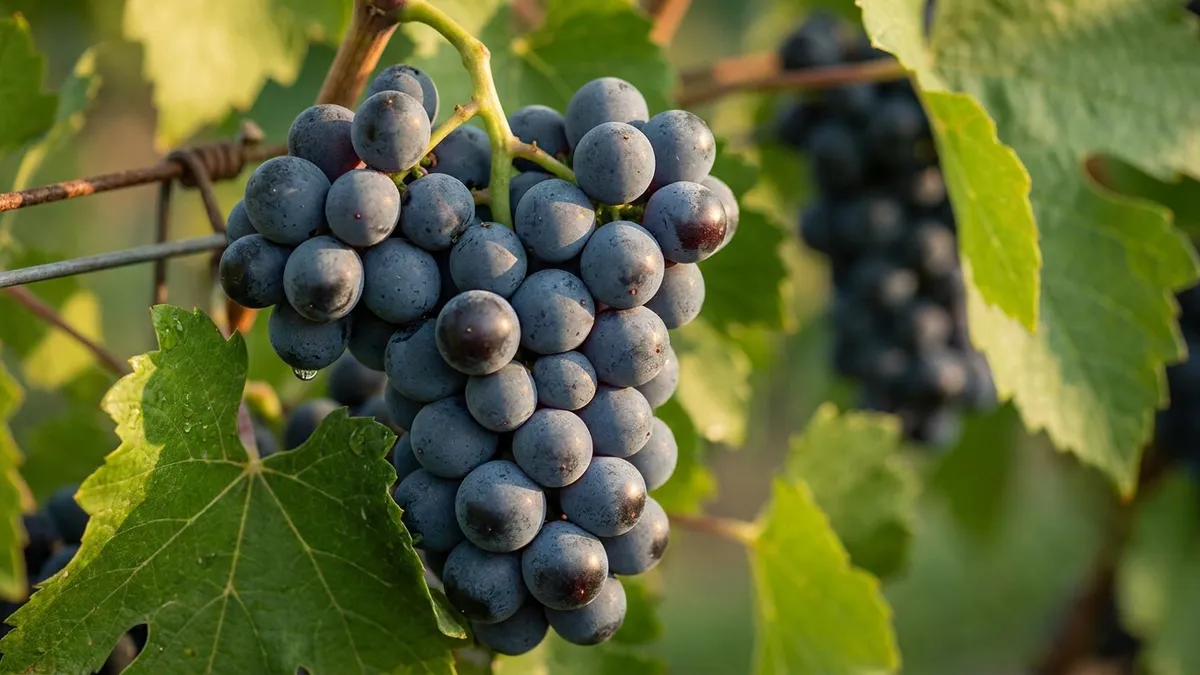
Marselan is the exciting one. It is a cross (a deliberate breeding of two grape species or varieties) of Cabernet Sauvignon and Grenache, created in France in 1961 and first planted in China around 2001. Somewhat by accident, China turned out to be where Marselan makes the world's largest share of high-quality wine, and it is now widely tipped as the country's future signature grape.
Typical Chinese Marselan aromas
Fruit
- Blackberry
- Black Cherry
- Plum
- Cassis
Floral
- Violet
Spice/Herbal
- Licorice
- Black Pepper
Oak/Aged
- Cedar
Marselan gives a deeply colored red with plush texture, ripe blackberry and plum, a floral violet lift, and softer, rounder tannins than straight Cabernet. It is approachable young but has the structure to age, which is why so many estates, from Ningxia to Hebei, are betting on it as the grape that could give Chinese wine an identity of its own.
The Whites and the Rest
White wine is a smaller share of the picture. Chardonnay is the most serious white, made in both crisp and oaked styles, and both Riesling and the widely planted Italian Riesling (Welschriesling) add lighter, aromatic options. The native Longyan ("dragon's eye") grape, an old Chinese variety, still supplies some domestic white. Alongside these, Merlot, Cabernet Franc, Syrah, and Pinot Noir all appear as the industry experiments.
Where Chinese Wine Grows: The Regions
China's wine grows in a broad arc across the cooler, drier north and west — a continental sweep with very different conditions from one end to the other.
| Region | Location and climate | Key grapes | What it does best |
|---|---|---|---|
| Ningxia | High desert at ~1,100 m, Helan Mountains, near Yellow River | Cabernet Sauvignon, Marselan | The heartland — premium Bordeaux-style reds |
| Shandong (Yantai-Penglai) | Eastern coast, humid, maritime | Cabernet Gernischt, Chardonnay | The oldest region — volume and coastal reds |
| Hebei (Huailai) | Near Beijing, continental, dry | Cabernet, Marselan | Reds close to the capital's market |
| Xinjiang | Far northwest, extreme desert continental | Cabernet, red blends | Deeply colored, high-volume reds |
| Shanxi | Loess Plateau, continental | Cabernet, Chardonnay, Aglianico | Boutique, quality-focused estates |
| Yunnan | Southwest Himalayan foothills, 2,000 m-plus | Cabernet, Cabernet Franc | Extreme high-altitude fine reds |
Ningxia, Shandong, and the North
Ningxia is the quality engine, but it is not the only story. Shandong, on the humid eastern coast around Yantai and Penglai, is the historic home of Changyu and still a major producer, though its maritime damp brings disease pressure that the dry inland regions escape. Hebei, near Beijing, and Xinjiang, in the far desert west, add large volumes of ripe red, while Shanxi on the Loess Plateau is home to some of the country's most respected boutique estates.
Yunnan: Wine at the Roof of the World
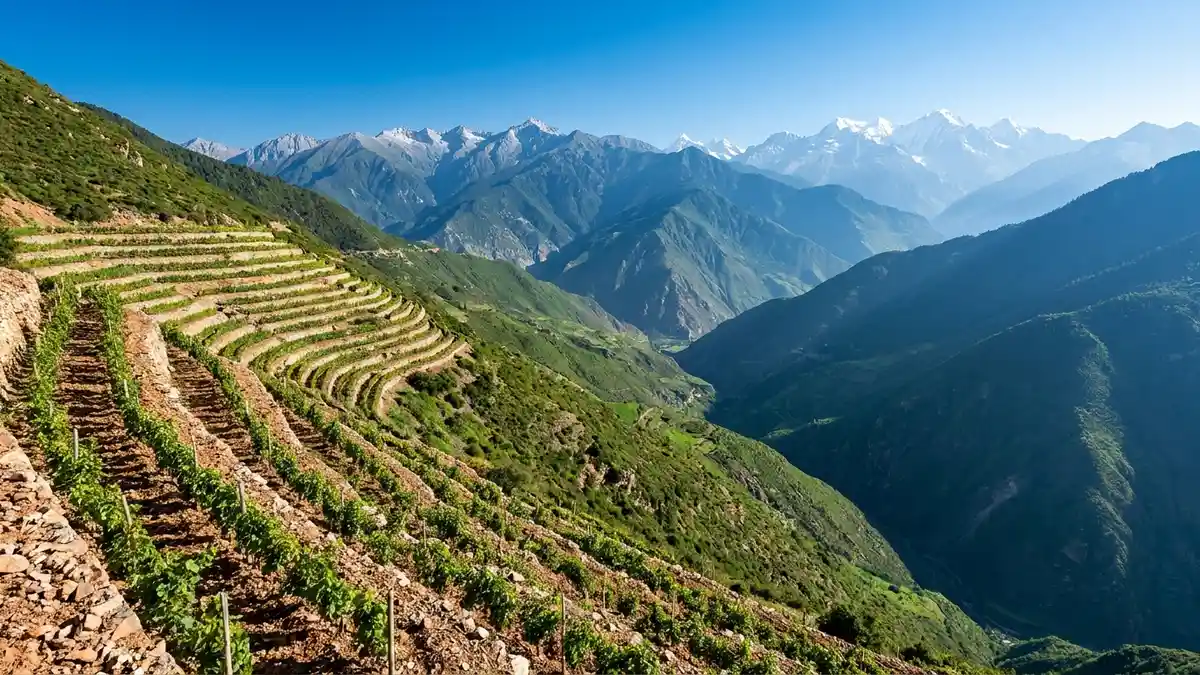
The most extraordinary region is Yunnan, in the southwest, where vineyards climb into the Himalayan foothills near Shangri-La at 2,000 to 2,600 metres — among the highest commercial vineyards on earth. Global attention arrived when a luxury project, Ao Yun, proved that structured, age-worthy Cabernet could be grown at that altitude. The thin air, intense light, and cool temperatures create wines of unusual freshness and lift. It is a vivid demonstration of how much terroir — the full environment where grapes grow — can reshape a familiar grape.
Why Growers Bury Their Vines
Here is the single most distinctive fact in Chinese viticulture, and the one that unlocks the whole industry. Across the cold north — Ningxia, Hebei, Xinjiang, and beyond — winter temperatures drop low enough to kill an unprotected grapevine. The growing season is warm and sunny, but the winter is brutal.
The response is literal. Each autumn after harvest, workers bend the vine canes down to the ground and cover them with a mound of soil, insulating the wood through the freeze. In spring, the vines are dug back out, untied, and lifted onto their trellises for another season. This buried-vine viticulture is repeated every single year across tens of thousands of hectares.
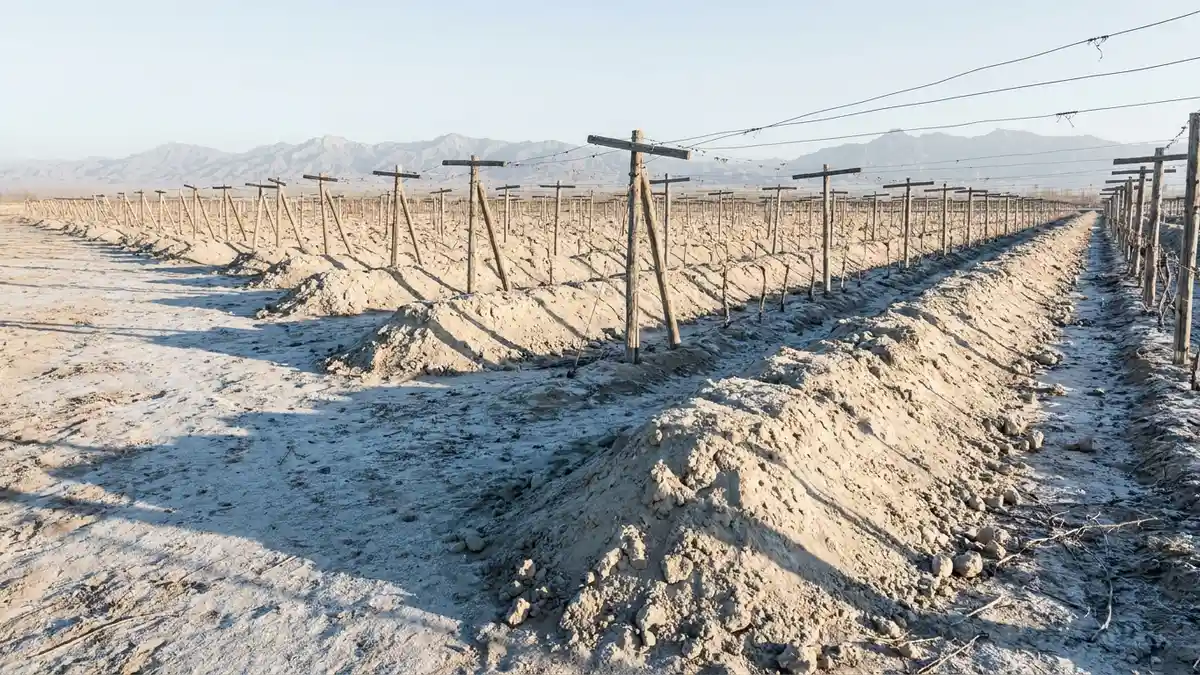
The practice is also a useful lens on climate. Most famous wine regions fight heat or drought; China's north fights a continental winter. That cold is not only a burden — the same big temperature swings that make winters dangerous also give the grapes their fresh acidity, and reading a region's climate is the fastest way to understand its wine, whether you are looking at how climate shapes flavor here or anywhere else.
What Chinese Wine Tastes Like
The house style at the top end is ripe, structured red. Expect deep color, generous blackcurrant, blackberry, and plum fruit, firm tannin, and clear oak influence — cedar, vanilla, sweet spice — from ambitious barrel programs. The best Ningxia examples pair that power with genuine freshness, the payoff of those cold desert nights, so the wine feels lifted rather than heavy.
Marselan softens the picture with its violet perfume and plush, rounded texture, and Cabernet Gernischt adds an herbal, red-fruited counterpoint. Chinese whites are lighter and less common: crisp Chardonnay and aromatic Riesling with citrus, orchard fruit, and brisk acidity.
The through-line is ambition. These are not shy wines — they are built to be taken seriously, often modeled on Bordeaux, and increasingly confident about showing where they come from.
Chinese Wine Guide: How a Beginner Should Start
Work through it in three steps, and taste with a little attention to structure rather than just fruit.
- Start with a Ningxia Cabernet Sauvignon or Bordeaux-style blend, served at 16 to 18°C — check our serving temperature chart if you are unsure. This is the flagship style, and it shows what the high desert does with the world's most famous red grape: ripe fruit, firm tannin, and a fresh edge.
- Try a Marselan next to meet China's rising signature grape. Look for the violet lift, the plush texture, and tannins softer than straight Cabernet, and notice how it feels more approachable young.
- Round out the picture with a contrast — a coastal Shandong red, a Cabernet Gernischt, or a Chinese Chardonnay — to see how varied a country this large really is.
Tasting two wines side by side is the fastest way to build real vocabulary, because the difference does the teaching. The Sommy app walks you through structured comparisons like these step by step, so you learn to name what you are tasting instead of guessing. If you are brand new to the process, start with how to taste wine and come back.
Chinese Wine in the Wider Wine World
China is one of the most instructive countries you can drink right now, because it compresses a whole wine history into a single generation. It has an ancient grape-growing culture and a barely-thirty-year fine-wine industry. It sits firmly in the New World camp of confident, varietal-led, internationally styled wine, yet it is inventing its own defining grape in Marselan and its own defining practice in buried vines.
Its closest cousins are worth tasting alongside it. The story of an ancient culture building a modern quality industry echoes what is happening in Georgia and Greece, while the delicate, food-first Asian counterpoint is Japan, a country that answers the same continent with restraint rather than power. Learning Chinese wine is not just adding a region to your list — it is watching a major wine country decide what it wants to be, in real time. Sommy's regional courses build exactly that comparative instinct, one glass at a time.
Sources
- Asia triumphs as Decanter World Wine Awards 2011 results published — Decanter, 2011
- A Primer to Chinese Wine (Regional Guide with Maps) — Wine Folly
- Marselan: The future 'signature' grape of China — Decanter China
- Winemaking in Cold Regions with Buried Viticulture in China — IntechOpen, 2021
Frequently Asked Questions
What is Chinese wine known for?
China is known for structured, Bordeaux-style red wine, especially deep, tannic Cabernet Sauvignon and blends from Ningxia at the foot of the Helan Mountains. The house style is ripe and full-bodied, often oak-aged. Marselan, a Cabernet-Grenache cross, is emerging as the country's signature grape, and a Ningxia red won a major international trophy in 2011 that put the region on the world map.
What is the main wine region in China?
Ningxia, specifically the eastern foothills of the Helan Mountains, is China's premier fine-wine region. This high-desert area near the Yellow River holds around 40,000 hectares of vines — close to 40% of the country's wine-grape plantings — and more than 100 operating wineries. Its dry, sunny climate and big day-to-night temperature swing suit Cabernet Sauvignon and Marselan, and it draws millions of wine tourists a year.
What grapes are used in Chinese wine?
Cabernet Sauvignon is by far the most planted wine grape, often blended with Merlot and Cabernet Franc in a Bordeaux style. Cabernet Gernischt, genetically the same as Carménère, is a long-standing local specialty. Marselan is the fast-rising signature red. Whites are a smaller share, led by Chardonnay, Riesling, Italian Riesling, and the native Longyan grape.
Why do Chinese growers bury their vines in winter?
In northern regions like Ningxia, Hebei, and Xinjiang, winter temperatures fall low enough to kill unprotected vines. Each autumn after harvest, growers bend the canes to the ground and cover them with a mound of soil to insulate them, then unearth them in spring. This buried-vine viticulture is labor-intensive and shapes how vineyards are trained, pruned, and priced across much of China.
What does Chinese wine taste like?
Premium Chinese reds are ripe, deeply colored, and full-bodied, with blackcurrant, blackberry, and plum fruit, firm tannin, and often noticeable oak — cedar, vanilla, and spice. Marselan adds violet and a softer, plush texture. The best Ningxia wines balance that power with fresh acidity from the region's cold nights. Whites are lighter, with citrus and stone-fruit notes and crisp acidity.
Where should a beginner start with Chinese wine?
Start with a Ningxia Cabernet Sauvignon or a Bordeaux-style blend, served at 16 to 18°C, to meet the country's flagship style. Next try a Marselan to taste China's rising signature grape — plush, violet-scented, and softer than Cabernet. If you can find one, a coastal Shandong red or a Chinese Chardonnay rounds out the picture of a large, varied country.
Sommy Team
LinkedInFounder & Wine Educator
The Sommy Team is building the world's most approachable wine education app, helping beginners develop real tasting skills through structured courses and AI-guided practice.