Wine Ratings Explained: What 90 Points Actually Means

By the Sommy Team — AI-assisted, human-edited.
Updated Apr 29, 2026
Contents (15)
- TLDR
- Wine Ratings Explained, in 90 Seconds
- Where the 100-Point Rating System Came From
- The 100-Point Ladder, Tier by Tier
- The 20-Point System and Other Alternatives
- The Major Publications, Honestly Described
- What 90 Points Actually Means in 2026
- Why Critics Disagree — and Why That Is Healthy
- How Score Chasing Distorts Wine
- Why Retail Shelf-Tags Often Mislead
- The Sweet Spot for Value Buying
- Crowd-Sourced Ratings — Useful, but Different
- A Smarter Way to Use Wine Ratings
- Building Your Own Palate Signature
- The Bottom Line on Wine Ratings
TL;DR
Wine ratings condense a critic's tasting verdict into a single number. The 100-point system, popularized in the late 1970s, dominates English-speaking retail. A 90-point score signals outstanding quality — but inflation, palate bias, and shelf-tag tricks dilute its meaning. Use scores as a filter, not a decision, and learn which critic shares your palate.
TLDR
Wine ratings condense a critic's tasting verdict into a single number. The 100-point system, popularized by The Wine Advocate in the late 1970s, dominates English-speaking retail. A 90-point score signals outstanding quality — but inflation, palate bias, and shelf-tag tricks dilute its meaning. Use scores as a filter, not a decision, and learn which critic shares your palate.
Wine Ratings Explained, in 90 Seconds
Wine ratings explained in plain language — they are a critic's compressed verdict on a single bottle, scored against a structured rubric of color, aroma, palate, and balance. The 100-point system runs the English-speaking world, with 95-100 classic, 90-94 outstanding, 85-89 very good, 80-84 good but unmemorable, and below 80 rarely published. The 20-point system, used by Decanter and Jancis Robinson, is more common in the UK trade. A 90-point score today means clean, well made, and competently expressed — but score inflation has pushed the bar lower than it used to be. Roughly half of all reviewed wines now clear 90, so the number is a quality floor, not a guarantee of greatness. Treat published scores as one filter among several, and let your own palate carry the weight.
Where the 100-Point Rating System Came From
Before the late 1970s, most serious wine criticism used a 20-point scale. The European tradition — Decanter, the Master of Wine community, and most academic wine programs — still leans on it.
Then a new American newsletter called The Wine Advocate launched and started scoring wines on a 100-point system. The format borrowed from the United States academic grading model. Below 50 is failing. 70 is passing. 90 is excellent. 95 and up is exceptional. American readers already understood the ladder, so a 92-point wine instantly read as high quality the way a 92 percent on a school report did.
Within a decade, most major publications writing for English-speaking audiences had converged on the format. The European 20-point world has not disappeared — Jancis Robinson still uses it, and most professional buyers trained through the systematic approach to tasting are comfortable in either. But the 100-point scale dominates retail shelves, restaurant lists, and wine club marketing.
The 100-Point Ladder, Tier by Tier
The numbers translate to a familiar quality ladder. Beginners benefit from memorizing the bands rather than fixating on individual scores.
- 95 to 100 — Classic. World-class example of its style. Roughly 1 to 5 percent of wines in any major publication.
- 90 to 94 — Outstanding. Superior character, strong typicity, no faults. The aspirational tier for most producers.
- 85 to 89 — Very good. A solid everyday wine with no obvious weaknesses.
- 80 to 84 — Good. Acceptable, no faults, but unmemorable. Often the floor for published scores.
- 70 to 79 — Average to below. Rarely published because flawed wines get rejected before print.
- 50 to 69 — Poor. Theoretically possible, almost never seen.
The compression at the bottom is not accidental — producers do not submit wines they expect to fail. The working range of the 100-point scale is more like 80 to 100, and the meaningful differences live in the top 20 points. A 4-point gap is roughly the smallest meaningful difference between competent tasters. A 91 and a 92 are essentially the same wine on different days. A 95 and an 88 are clearly different wines.
The 20-Point System and Other Alternatives
The 100-point format is dominant but it is not alone. Three alternatives matter.
The 20-point system is the European default. Each point covers a wider quality range, which forces the critic to commit to clearer tiers. A 17 out of 20 is roughly equivalent to a 93 on a 100-point scale. Decanter publishes both formats; Jancis Robinson — one of the most respected critics in the world — uses a strict 20-point scale on her own platform.
The 5-star system is the casual reviewer's tool. Wine Folly uses it, as do many smaller blogs and retail apps. It is broad, friendly, and useless for fine wine criticism, but it works for everyday-bottle decisions.
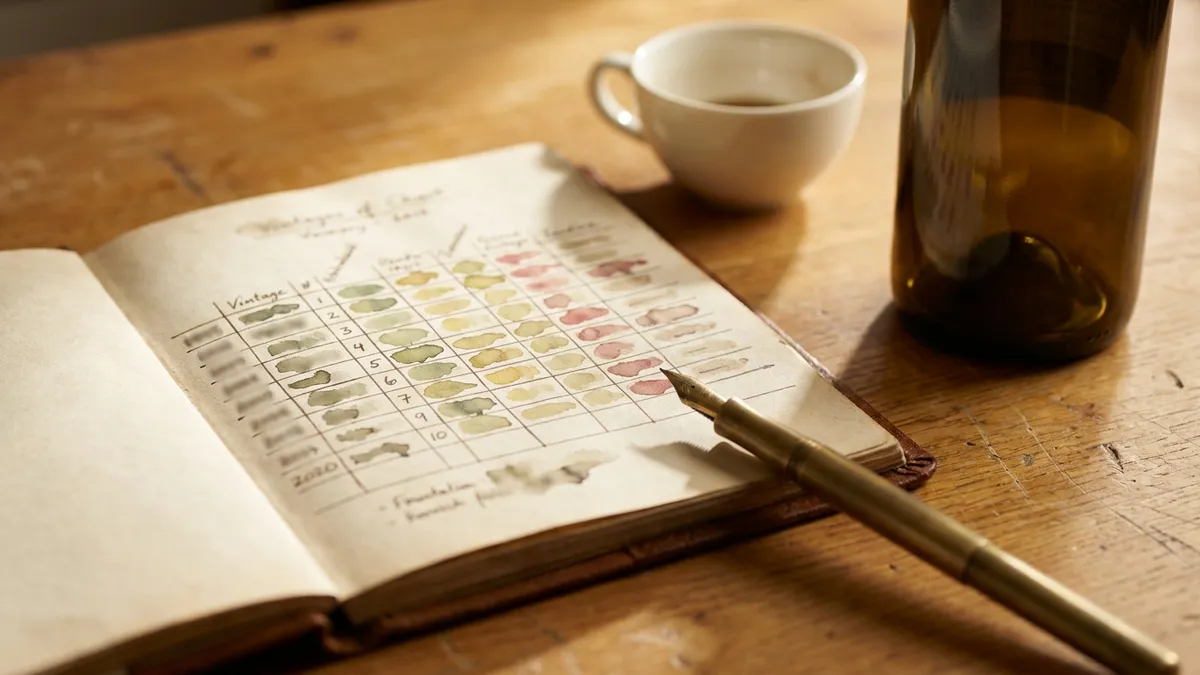
Vintage charts rate something different. They score a year-and-region combination — 2015 Bordeaux, 2010 Barolo, 2018 Mosel Riesling — rather than a specific bottle. A high vintage chart score signals favorable growing conditions across the appellation. That tells you the year is worth shopping. It does not tell you any single bottle from that year will be great. For a deeper look at how vintage shows up in the glass, see our vintage explained piece.

The Major Publications, Honestly Described
A score is only as useful as the critic behind it. The big English-language publications each carry a stylistic signature that beginners should learn to read.
The Wine Advocate built its reputation on long, evocative tasting notes and put the 100-point format on the map. Historically the house style favored ripe, concentrated, oaky reds — a preference that visibly nudged producers worldwide.
Wine Spectator sits closer to mainstream American taste and publishes an annual Top 100 list that drives serious retail traffic. It is generally friendlier to crowd-pleasing styles than to challenging ones.
Decanter is the British counterweight. The panel leans Old World, rewards restraint and structure, and runs a hybrid 20-point and 100-point format. If you taste your way through Bordeaux and find yourself loving the structured red blends, Decanter is probably your home publication.
Vinous descends from the early Wine Advocate aesthetic but with more nuance and a deeper bench of regional specialists. James Suckling runs a fast-turnaround operation with broad coverage and short prose. Wine Enthusiast is the most accessible mainstream option, writing for shoppers who want a number and a sentence.
None of these are wrong. They are tuned to different palates and different audiences. The smart move for a beginner is to find the one whose descriptions match your own experience of wines you already know. That critic is your wayfinder.
What 90 Points Actually Means in 2026
In its original 1980s form, a 90-point score signaled a wine in the top 10 to 15 percent of what a critic tasted that year. It was a real distinction.
Today, score inflation has rewritten the math. Multiple analyses of major-publication archives show that roughly half of all reviewed wines now score 90 or higher. Some publications cluster more than 60 percent of their reviews at or above 90.
Better winemaking is part of it. Modern producers can avoid faults that would have dragged scores down a generation ago. Cleaner cellars, smarter vineyard management, and improved understanding of wine faults all push the floor higher.
But not all the inflation is quality gains. Critic-producer relationships have softened, and publications competing for advertising and access tend toward the generous end. A 90 today is not what a 90 was thirty years ago.
The practical consequence — 90 points is now a quality floor, not a quality signal. It means competent, clean, and typical for category. It does not mean great. The real distinction now sits at 93 and above for most publications, and 96 and above for stricter ones.
Why Critics Disagree — and Why That Is Healthy
Two competent critics tasting the same wine routinely score it 4 or 5 points apart. That is not a flaw — it is the system telling you something true.
A score reflects three things at once — the wine, the critic's palate, and the rubric they apply. A reviewer who grew up on rich, oaky New World reds will score those styles higher than a reviewer who grew up on structured Old World reds. Neither is wrong. They are calibrated to different reference points. Our why experts disagree about wine piece walks through the science and politics behind the disagreement.
The lesson for a shopper — pick a critic whose palate matches yours, then trust their relative scores. A 92 and a 95 from the same critic are comparable. A 92 from one publication and a 95 from another are not.

How Score Chasing Distorts Wine
The influence of high scores on pricing, distribution, and shelf placement is enormous. A 95-point score from a major critic can double the wholesale price of a wine within weeks, which is one reason wine price and quality line up less neatly than shoppers expect. A 99-point score can make a small producer's allocation list ten years long. That economic pressure has real consequences in the cellar.
The phenomenon is sometimes called critic-proofing, and the best-known historical example is Parkerization — the gradual shift toward riper, oakier, more concentrated red wine styles in the 1990s and 2000s, partly because those wines historically scored higher in the most influential American publication. Producers who wanted attention adjusted their winemaking to fit the rubric.
The trend has eased — modern critics are more diverse and consumer taste has shifted toward freshness and lower alcohol — but score-chasing still shapes how producers blend, when they harvest, and how they age their wines.
Why Retail Shelf-Tags Often Mislead
The number you see on a shelf-tag is rarely the full story. A few common tricks to watch for.
Vintage carryover. A 92-point score from the 2017 vintage stays on the shelf-tag when the 2019 lands. The wines are not the same.
Cherry-picked publication. A wine that scored 88 from Decanter, 90 from Wine Spectator, and 93 from a less-known publication will display only the 93. The other two scores exist — just not on the tag.
Old vintage of the same wine. A producer's flagship cuvee scored 96 a decade ago. The current vintage is a different bottle — same label, different wine — and the tag still displays the old score.
Missing context. A score with no critic, no publication, and no vintage is a marketing number, not a verdict. Treat it as decoration. The same test applies to competition stickers, as our guide to what wine medals really mean explains.
A useful shelf-tag includes four pieces — the critic, the publication, the vintage, and the year of the review. Anything less, ask the staff. Our how to read a wine label guide pairs naturally with shelf-tag literacy, and our wine shop guide puts shelf-tag reading into the wider context of shopping a store end to end.
The Sweet Spot for Value Buying
If you treat scores as a filter rather than a decision, a clear value band emerges in the 88-to-92 range. These wines are competently made, often by serious producers, and they have not yet been pulled out of normal pricing by the critic-driven hype cycle. A 95-point wine sets a price ceiling. An 89-point wine often offers 90 percent of the experience at half the cost.
The pattern holds across most categories. An 89-point Cabernet Sauvignon from a respected region can drink alongside a 93-point version from the same producer's prestige tier and offer most of the satisfaction. The difference at the top is often nuance, age potential, and prestige — none of which matter much when you are pairing with Tuesday's pasta.
Crowd-Sourced Ratings — Useful, but Different
Apps like Vivino aggregate scores from regular drinkers. They are useful — but for a different question.
Crowd ratings answer "what do most people enjoy" rather than "what is well made." Those are not the same question. Crowd-rated wines skew toward fruit-forward, ripe, accessible styles because most casual drinkers prefer them. A subtle, structured Old World wine of equal quality often scores lower in the crowd than a simpler ripe red.
Used carefully, crowd scores are a great check for obviously bad bottles. A wine averaging 2.8 out of 5 across thousands of ratings is probably not worth your dinner. Beyond that, the crowd cannot tell you whether the wine matches your palate.
A Smarter Way to Use Wine Ratings
A practical filter for using published scores well, drawn from years of watching beginners over-trust them.
Use them as a category-quality filter. A 92-point Pinot Noir is unlikely to be flawed. That alone is worth something at a crowded shelf.
Stay within a single critic for relative scores. A 91 and a 94 from the same critic are comparable. Cross-publication comparisons are unreliable.
Look at vintage charts before chasing single-bottle scores. A great vintage in Barolo lifts everything; a weak one drags everything. Vintage context beats individual scores when buying current releases.
Distrust the score as a taste recommendation. A high score does not mean you will personally enjoy the wine. The single most useful skill in wine shopping is knowing your own palate, and our develop your wine palate guide covers exactly how to build that.
The Sommy app's tasting flow is designed around this philosophy — every wine you log gets the same structured treatment of appearance, nose, palate, and finish, plus a personal score that calibrates to your palate, not someone else's rubric.
Building Your Own Palate Signature
The best long-term defense against score-driven shopping is a clear sense of what you actually like. That is a structural skill, not a marketing line.
Start by tracking what you drink. Note the grape, the region, the vintage, and a one-line impression in a wine tasting notes template. After twenty bottles, patterns emerge — you score restrained reds higher than rich ones, or your favorite everyday wines all sit between 12 and 13 percent alcohol.
That pattern is your palate signature, and it is more valuable than any 100-point score. It tells you which critics share your taste, which producers consistently land for you, and which styles to seek when shopping abroad. For the language to describe what you taste with precision, our wine tasting vocabulary cheat sheet gives you the working terms — and the Sommy Wine Coach walks you through them in interactive practice sessions tied to your own wines.
Sommelier note: A published score tells you how a wine compares to its category in a critic's mouth. A personal score tells you how it compares to what you actually drink. Only one of those is useful at the wine shop on a Tuesday.
The Bottom Line on Wine Ratings
Wine ratings are a useful invention with real flaws. The 100-point system, born from American consumer culture in the late 1970s, took over English-speaking retail because it compresses a complex evaluation into a single number — genuinely useful for shoppers comparing thousands of bottles. The 20-point system holds its own in Europe, and crowd ratings democratize feedback for casual drinkers.
Subjectivity is unavoidable. Inflation has pushed the meaning of 90 points lower than it used to be. Shelf-tags often mislead. Producers shape their wines toward known critic preferences. None of that makes the system worthless — it just makes it a tool to use deliberately rather than a verdict to obey.
Treat scores as one input among several. Find a critic whose descriptions of wines you know match your experience. Hunt the 88-to-92 value band. And most importantly, build your own palate signature so no single number can override the most authoritative voice in your wine life, which is your own taste. For a structured place to start, browse our pillar of beginner buying guides, where every piece is built around that kind of self-calibration.
Frequently Asked Questions
What does a 90-point wine actually mean?
A 90-point wine sits in the outstanding tier — clean, well made, and showing strong character for its category. It does not mean the wine is universally loved or worth its price. Today, roughly half of all professionally reviewed wines score 90 or higher, so the threshold is more of a quality floor than a stamp of greatness.
Who created the 100-point wine rating scale?
Robert Parker popularized the 100-point system in his newsletter The Wine Advocate in the late 1970s. He modeled it on the United States academic grading scale — 50 is failing, 90 is excellent, 100 is exceptional — to make scores feel familiar to American shoppers. Most English-speaking publications adopted similar variants within a decade.
Is a 95-point wine better than a 90-point wine?
Often yes, but the gap is smaller than the numbers suggest. Below 80 is rarely published, so the working range is compressed into a 20-point band. A 4-point spread is roughly the smallest meaningful difference between competent tasters. A 95 and a 90 are genuinely different tiers, but a 92 and a 90 are essentially the same wine on different days.
Why are 90-point wines everywhere now?
Score inflation. The average published score has crept upward for decades. Wines that would have scored 87 in 1990 routinely score 91 today. Causes include better winemaking, friendlier critic-producer relationships, and commercial pressure on retailers to display only flattering scores. The result — a 90 today is not what a 90 was thirty years ago.
Can I trust the score on a wine shop shelf-tag?
Trust it carefully. Many shelf-tags reuse a score from a previous vintage, leave out the critic and date, or quote a flattering number from one publication while ignoring lower scores elsewhere. Always look for the critic, the publication, the vintage, and the year of the review before letting a tag drive your purchase.
Which wine critics or publications should I follow?
Find the one whose palate matches yours. The Wine Advocate and Vinous lean toward richer, more concentrated styles. Decanter and Jancis Robinson lean Old World and more restrained. Wine Spectator sits in the middle and ranks an annual Top 100. James Suckling moves fast and covers a wide territory. Read three reviews of a wine you already know — the closest description is your critic.
Are crowd-sourced ratings like Vivino reliable?
They are useful as a popularity signal, not a quality signal. Crowd ratings skew toward easy, fruit-forward New World styles because that is what most casual drinkers prefer. A subtle Old World wine with restrained fruit can score lower than a simpler ripe wine of equal quality. Treat crowd scores as a check for obviously bad bottles, not as a benchmark for fine wine.
What is the best way to use wine scores when shopping?
Use scores as a filter, not a decision. The 88-to-92 band is the value sweet spot — high enough to indicate competent winemaking, not so high that the price has been pulled up by hype. Confirm the score is for the current vintage, the critic is one you trust, and the wine matches a style you actually enjoy. Then buy the bottle.
Sommy Team
LinkedInFounder & Wine Educator
The Sommy Team is building the world's most approachable wine education app, helping beginners develop real tasting skills through structured courses and AI-guided practice.