Mousy Wine Taint: The Fault You Taste but Can't Smell

By the Sommy Team — AI-assisted, human-edited.
Updated Sep 23, 2026

Contents (10)
- Mousy Wine Taint in 100 Words
- What Is Mousy Taint, and Why Is It Called That?
- Why Can't You Smell Mousy Wine but You Can Taste It?
- What Causes Mouse Taint in Wine?
- Is Mousy Taint Only a Natural Wine Problem?
- How Do You Test a Wine for Mousiness at Home?
- Why Do Some People Never Notice It While Others Can't Stand It?
- Mouse vs Brett vs Volatile Acidity vs Reduction: How to Tell Them Apart
- Is Mousy Wine Safe to Drink, and Can Anything Be Done About It?
- Tasting Smarter After a Mousy Bottle
TL;DR
Mousy wine taint is a microbial fault that tastes of stale popcorn or a mouse cage but cannot be smelled in the glass. Its compounds only turn volatile at the higher pH of saliva, so it appears on the finish. Low sulfite levels and high pH raise the risk, sensitivity varies enormously, and a palm test can reveal it.
Your nose is usually the best fault detector you own. Cork taint, oxidation, brett, and vinegar all announce themselves on the first sniff. Mousy wine taint is the exception: the glass smells clean, the sip tastes clean, and then a few seconds after you swallow, the back of your mouth fills with stale popcorn, cracker, or something uncomfortably close to a hamster cage. This guide explains what the fault is, why your nose misses it, which wines carry the most risk, and how to test a suspect bottle without drinking it.
Mousy Wine Taint in 100 Words
Mousy wine taint (also called mousiness or mouse) is a microbial fault caused by three nitrogen-containing compounds, mainly 2-acetyltetrahydropyridine (ACTPY), produced by lactic acid bacteria and some Brettanomyces strains. At wine's low pH these compounds are not volatile, so you cannot smell them in the glass. When wine meets saliva, the higher pH releases them inside your mouth and you detect them retronasally, on the finish, where they can linger for more than ten minutes. Risk rises with low or zero sulfur dioxide, high pH, long lees ageing, and oxygen exposure. Sensitivity between people varies a thousandfold, and a simple palm test can reveal it.
What Is Mousy Taint, and Why Is It Called That?
Mousy taint is a wine fault that produces a flavor most tasters compare to a mouse cage, stale popcorn, corn chips, or cracker biscuit. It is one of the recognized faults catalogued by the Australian Wine Research Institute (AWRI), Australia's national wine research body, and it belongs to the same family of problems as brett and volatile acidity: things microbes make in a wine that was not fully protected.
Three compounds are responsible. AWRI names 2-acetyltetrahydropyridine (ACTPY) as the main one, with 2-ethyltetrahydropyridine (ETPY) and 2-acetylpyrroline (ACPY, sometimes written APY) alongside it. You do not need to remember the names. What matters is that they are N-heterocyclic bases, a chemist's way of saying they are nitrogen-containing ring molecules that behave like weak bases. That one property explains almost everything odd about this fault.
The compounds are extremely potent. In water, AWRI reports an odor threshold of just 1.6 micrograms per litre for ACTPY and 0.1 micrograms per litre for ACPY. A microgram is a millionth of a gram, so a few drops' worth in a swimming pool of liquid is detectable. Only ETPY is comparatively mild, with a threshold of 150 micrograms per litre.
Why Can't You Smell Mousy Wine but You Can Taste It?
You cannot smell mousiness because its compounds are not volatile at wine's acidity. Wine typically sits around pH 3 to 4, and at that level the molecules are locked in a charged form that does not evaporate. Nothing rises from the glass, so your nose reports a clean wine. Saliva is far less acidic, and the standard explanation is that once the wine mixes with it, the compounds switch to their neutral form, turn to vapor, and reach your nose from inside your mouth.
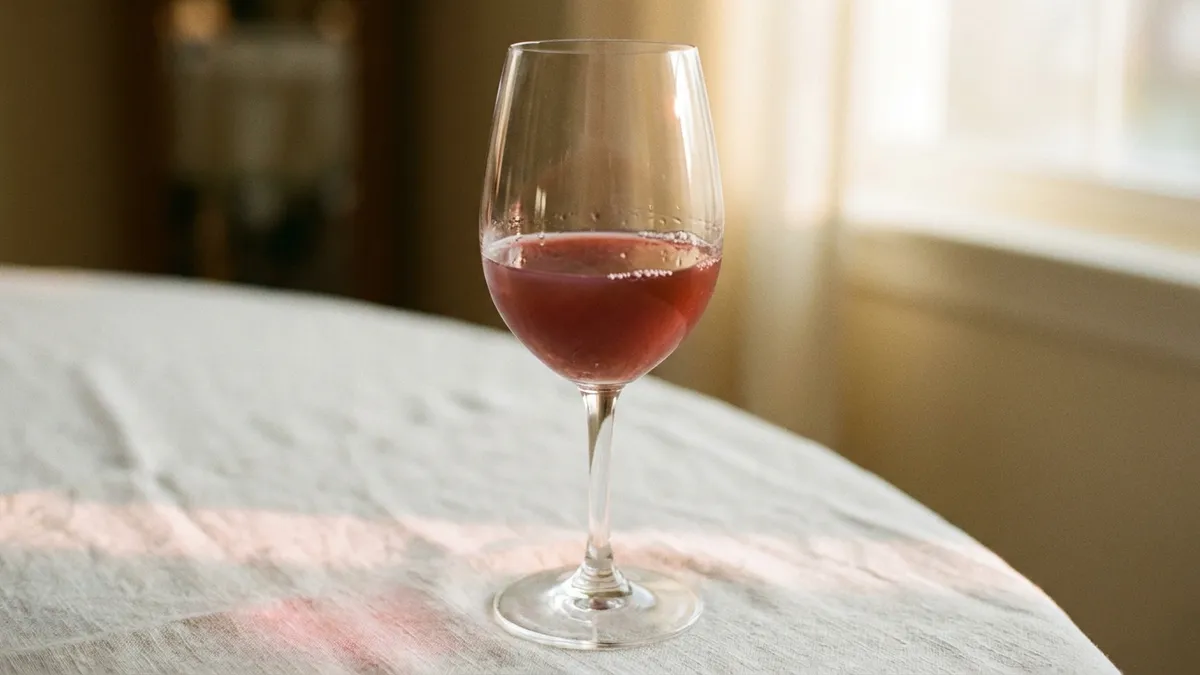
This is why the fault feels like a delayed trap. Wine writer Jamie Goode summarizes the mechanism plainly: at low pH the compounds are not volatile and you cannot smell them, but when saliva mixes with the wine, its higher pH means that "after a while you suddenly detect them retronasally." Retronasal smell is aroma that travels from the back of the mouth up into the nasal cavity, which is how most of what we call "flavor" actually reaches us. If that idea is new, our guide to retronasal smell in wine walks through it with a simple pinched-nose experiment.
The timing follows from the chemistry. The pH shift takes a moment, so the taint shows up seconds after swallowing rather than on the first sip. And because the compounds cling to the mouth, researchers writing in the journal OENO One note the flavor "may persist in the mouth for more than 10 minutes after swallowing or spitting." Spitting does not save you. Rinsing with water does not help much either.
What Causes Mouse Taint in Wine?
Mousiness is made by microbes, mainly lactic acid bacteria (LAB), the same family of bacteria that carry out the softening malolactic fermentation in most red wines. AWRI notes that most LAB strains can produce the taint, particularly the heterofermentative species, which are the ones that produce several by-products rather than just lactic acid. Some strains of the yeast Brettanomyces can make the compounds as well. The bacteria build them from amino acids and small sugars during fermentation and ageing.

The organisms are everywhere in wineries, so the question is not whether they are present but whether the wine gives them room to work. AWRI's risk factors read like a checklist of a wine left unguarded:
- Low sulfur dioxide. SO2 is the winemaker's main tool for keeping bacteria in check. AWRI links higher incidence of mousiness to a lower sulfur dioxide regime, and the researchers Goode interviewed name winemaking without any added sulfites as the single biggest risk factor. Our explainer on sulfites in wine covers what SO2 actually does.
- Low acidity and high pH. Bacteria struggle in very acidic wine. As pH climbs, they thrive, and less of the wine's SO2 is in the active form that stops them.
- Extended lees ageing. Leaving wine on its dead yeast cells for long periods feeds the bacteria with nutrients, and such wines are often left unfiltered.
- Oxygen exposure. AWRI lists oxidative handling as a contributor, and Goode adds that the wine's redox potential (roughly, how oxidized or reduced its chemistry is) matters too. Mousiness can reappear every time the wine meets air, which is why a bottle that seemed fine on opening can turn by the second glass.
Wild fermentations and whole-bunch fermentation are also cited as contributing, though these are correlations rather than proven causes. None of these practices is a fault in itself. Each one simply removes a layer of protection, and mousiness becomes more likely as the layers come off.
Is Mousy Taint Only a Natural Wine Problem?
No. Mousy taint is not exclusive to natural wine, but it is far more common there, and the reason is not ideology but chemistry. The single biggest risk factor is fermenting and bottling without added sulfites, which is close to the definition of the natural wine movement. Add wild yeasts, long lees contact, no filtration, and often higher pH from riper fruit, and most of AWRI's risk list is ticked at once.
That does not make natural wine the villain. Many low-sulfite producers make clean, precise wines by keeping pH low, working fast and cold, and topping barrels obsessively. Mousiness is a sign of a wine that lost protection, not of a philosophy that is wrong.
It also does not make conventional wine immune. Writing in PUNCH, master sommelier Pascaline Lepeltier reports encountering wines that had been dosed with SO2 and still showed mouse. That is a professional's observation rather than a controlled study, but it is a useful corrective. Sulfur dioxide lowers the odds, it does not zero them.
If you drink zero-sulfite wine, learn this fault well, because you will meet it. If you drink conventional wine, you will meet it rarely, but the label does not rule it out. Our guide to wine flaws versus faults helps with the harder question of when a quirk becomes a defect.
How Do You Test a Wine for Mousiness at Home?
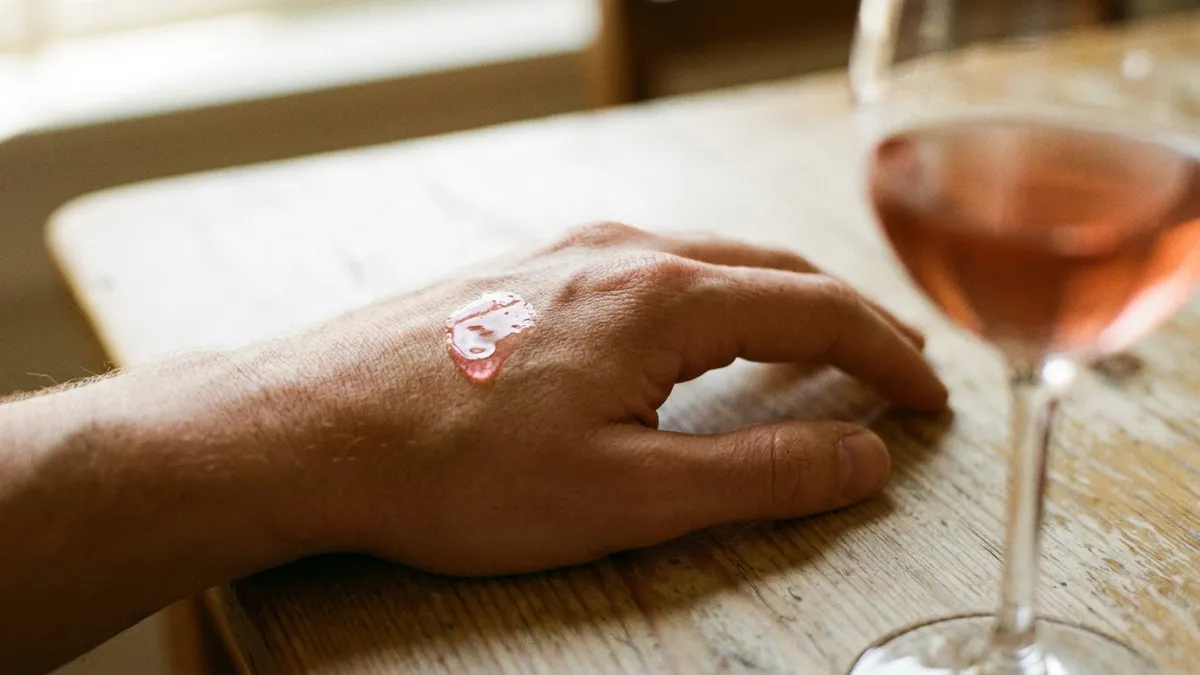
The classic test is the palm-and-sniff. Dip a clean fingertip in the wine, rub it across the back of your hand or the base of your palm, wait five to ten seconds, and smell the skin. Your skin sits at a higher pH than wine, so more of the mousy compounds turn volatile and you can smell them directly, no swallowing required. Goode notes the technique was first proposed in the 1950s, so it has been around far longer than the current natural-wine debate.
A second method uses the same logic with kitchen chemistry. Pour a small measure of wine into a glass with a pinch of bicarbonate of soda (baking soda), swirl, and sniff. Goode cites a dose of around 5 grams per litre, which for a small tasting pour is a pinch on the end of a teaspoon. The baking soda raises the pH, the compounds are released, and a mousy wine suddenly smells mousy in the glass. Do not drink that sample; it is a diagnostic, not a fix.
A third check costs nothing. Sip, swallow (or spit), then close your mouth and breathe out slowly through your nose while counting to ten. Pay attention to the back of the mouth rather than the tongue. A clean wine fades into fruit and acidity. A mousy one grows drier, dustier, and more cereal-like as the seconds pass.
Why Do Some People Never Notice It While Others Can't Stand It?
Sensitivity to mousiness varies enormously between people. A University of Bordeaux team studying the taint found detection thresholds for one key compound that differed a thousandfold between the least and most sensitive tasters. That is not a small spread. It means one person at the table can be revolted by a wine that another person, tasting the same glass, finds perfectly pleasant.
Two things drive the gap. The first is ordinary differences in smell perception, the same reason some people smell asparagus in urine and others never will. The second is specific to this fault: oral pH. Researchers publishing in OENO One observed oral pH ranging from 5.76 to 7.96 across individuals. In theory, someone with more alkaline saliva releases more of the compound with every sip, though wine's own acidity quickly pulls saliva pH down, so the effect is debated. Your mouth is part of the experiment.
Sensitivity is also learnable. Once you have smelled a confirmed mousy wine off the back of your hand, the memory anchors quickly, and you will notice it in the mouth far more often afterward. Recognition is a trained reflex, and the Sommy app's AI-guided tasting mode, which walks you through look, smell, and taste step by step, is built for exactly that kind of repetition.
Mouse vs Brett vs Volatile Acidity vs Reduction: How to Tell Them Apart
Mousiness is easiest to identify by where it shows up, not by what it smells like. Brett, volatile acidity, and reduction all announce themselves on the nose. Mousy taint never does. If a wine smells clean and only turns wrong on the finish, that timing alone points to mouse before you have named a single aroma.

| Fault | Where you detect it | What it smells or tastes like | Main cause | Does air help? |
|---|---|---|---|---|
| Mousy taint | Finish only, seconds after swallowing; nothing on the nose | Stale popcorn, cracker, corn chips, mouse cage | Lactic acid bacteria and some Brett strains; low SO2, high pH | No, it often gets worse with air |
| Brettanomyces | Nose first, then palate | Barnyard, horse blanket, band-aid, clove, smoke | Brett yeast in barrels and cellars; low SO2, residual sugar | No, it stays |
| Volatile acidity | Nose first, sharp and high | Vinegar, nail polish remover, acetone | Acetic acid bacteria plus oxygen and ethanol | No, it stays |
| Reduction | Nose, right on opening | Struck match, rotten egg, burnt rubber, cabbage | Sulfur compounds formed without enough oxygen | Yes, usually blows off with swirling or decanting |
A few quick contrasts that trip beginners up:
- Mouse vs brett. Both thrive in low-sulfite wine and both can come from the same cellars, so they sometimes travel together. Brett is loud on the first sniff. Mouse is silent until the finish. Our brett in wine guide covers the barnyard end in detail.
- Mouse vs volatile acidity. VA is sharp, lifted, and hits the top of the nose like vinegar. Mouse is dull, dusty, and low, at the back of the mouth. They feel like opposites.
- Mouse vs reduction. Reduction smells of sulfur and matches on opening and usually fades with air. Mouse does not smell at all on opening and tends to return every time the wine meets air. If swirling fixes it, it was reduction. See how to smell reduction in wine for the full picture. For the broader method of sorting a suspect bottle, our guide on how to identify wine faults by smell covers the six faults your nose can catch, and the faults hub collects everything in one place.
Is Mousy Wine Safe to Drink, and Can Anything Be Done About It?
Winemakers and researchers treat mousiness as a sensory quality fault, the same category as brett, oxidation, or volatile acidity, not as a food-safety problem. There is no evidence it makes wine harmful, only unpleasant. The compounds involved are produced in tiny amounts, in the microgram range, and the issue is entirely about how the wine tastes.
Can it be fixed? Not by you, and mostly not by the winery either. There is no home remedy: decanting does not help, chilling does not help, and time in the glass tends to make it worse rather than better, because the compounds reappear with each exposure to air. In the winery, the fault is prevented rather than cured, mainly by keeping pH low, adding SO2 at the right moments, and not leaving wine exposed and unprotected on its lees for too long.
So treat a mousy bottle like any faulted wine. In a restaurant, describe what you are tasting plainly ("it tastes like stale popcorn after I swallow") and ask for another bottle. At home, pour it out, or keep a small sample in the fridge: a confirmed mousy wine is one of the most useful training references you can own, because the fault is so hard to learn from description alone.
Tasting Smarter After a Mousy Bottle
Meeting mousiness for the first time teaches a useful lesson: "smell before you sip" has a blind spot, and the finish deserves attention as a separate step. Once you build that habit, you will catch more than mouse, because length, bitterness, and the way acidity fades are all finish-only information.
If you want a structured way to practice, Sommy walks you through look, smell, and taste for every wine you photograph and keeps your notes in a tasting journal, so a mousy finish logged tonight becomes a reference you can compare against next month. The fault will still be unpleasant. It just will not surprise you again.
Sources
- Australian Wine Research Institute — Recognition of wine faults and taints: mousy taint
- Jamie Goode, wineanorak.com — The latest on mouse, the wine taint of our times
- OENO One (Tempère et al., Univ. Bordeaux) — Comparison between standardized sensory methods used to evaluate the mousy off-flavor in red wine
- PUNCH — Mousiness Is Natural Wine's Biggest Flaw
Frequently Asked Questions
What does mousy wine taste like?
Mousy wine tastes fine on the sip and then turns on the finish, a few seconds after you swallow. The flavor is usually described as stale popcorn, cracker, corn chips, or the smell of a hamster cage. It sits at the back of the mouth rather than on the tongue, and research shows it can linger for more than ten minutes after swallowing or spitting.
Why can I taste mousy taint but not smell it?
The compounds behind mousiness are not volatile at wine's low pH, so they cannot rise out of the glass and reach your nose. Once wine mixes with saliva, which has a higher pH, the compounds are released as vapor inside your mouth and travel up to your nose from behind. That is why the fault appears late, on the finish, and never on the first sniff.
What causes mouse taint in wine?
Lactic acid bacteria, especially the heterofermentative species, and some strains of Brettanomyces yeast produce three nitrogen-containing compounds: ACTPY, ETPY, and ACPY. They form more readily when a wine has little or no sulfur dioxide, low acidity and high pH, long ageing on lees, or exposure to oxygen. Winemaking without any added sulfites is the single biggest risk factor researchers name.
Is mousy taint only a natural wine problem?
No, but it is far more common there. Low or zero added sulfites remove the main tool that keeps the responsible bacteria in check, so minimal-intervention wines carry the highest risk. Sommeliers also report the fault in wines that received normal sulfite doses, so a conventional label is not a guarantee. Think of it as risk that rises as protection falls, not a fault owned by one category.
How do I test a wine for mousiness at home?
Dip a clean fingertip in the wine, rub it on the back of your hand, wait a few seconds, and sniff the skin. Skin has a higher pH than wine, which frees the mousy compounds so you can smell them. A second method is to pour a little wine into a glass with a pinch of baking soda and sniff. Either test works without swallowing anything.
Is mousy wine safe to drink?
Mousiness is treated by winemakers and researchers as a sensory quality fault, not a food-safety issue, in the same way brett or volatile acidity are. There is no evidence it makes wine unsafe; the problem is taste. That said, there is no practical way to remove it once it has formed, and it tends to return each time the wine meets air, so a mousy bottle is best sent back or poured out.
Why do some people not notice mousy taint at all?
Sensitivity varies enormously. University of Bordeaux researchers found detection thresholds for one key compound that differed a thousandfold between the least and most sensitive tasters. Oral pH also ranges widely between people, from about 5.8 to 8.0, which may change how much of the compound is released in the mouth. The often-quoted claim that 30 percent of people cannot detect it has no corroboration in the scientific literature.
Sommy Team
LinkedInFounder & Wine Educator
The Sommy Team is building the world's most approachable wine education app, helping beginners develop real tasting skills through structured courses and AI-guided practice.