How to Remember Wine Regions: Blank Map, 3 Facts, 1 Bottle
By the Sommy Team — AI-assisted, human-edited.
Updated Nov 23, 2026
Contents (12)
- How to Remember Wine Regions, in One Paragraph
- What Are the Six Steps?
- Why Start From a Blank Map?
- Which Regions Should You Learn First?
- Which Three Facts Belong on Each Region?
- How Does the Method Work for France?
- How Do You Group Regions by a Shared Cause?
- Why Test Yourself Instead of Rereading?
- How Do You Tie a Region to a Bottle?
- What Does a Weekly Routine Look Like?
- Which Tools Help Between Sessions?
- What to Do Tonight
TL;DR
Lab studies suggest facts stick better when recalled, not only reread, and the same habit suits wine regions. Draw each country from a blank sheet, place five or six anchor regions, and hang three facts on each: where it sits, its main grapes, the style in the glass. Group regions by river or coast, redraw weekly, and taste one bottle.
How to remember wine regions comes down to one habit: pull them out of memory before looking them up. A map drawn from a blank sheet, with three facts beside each region and one bottle tasted, gives each name somewhere to sit.
How to Remember Wine Regions, in One Paragraph
Draw the country from memory on a blank sheet, then correct it against an atlas. Place five or six anchor regions before any small ones. Beside each, write three facts in order: where it sits and its climate, its main grapes, and the style in the glass. Link regions that share a cause, such as one river, a coast or high ground. Redraw from blank a day later and again a week later. Each week, open one bottle from the map and check the three facts against the glass.
What Are the Six Steps?
The method has six steps, and each one ends with a check that shows what is still missing. Steps one to four build the map for a country in a single sitting. Steps five and six repeat every week, and they are the ones meant to make the map last.
| Step | What to do | How to check it |
|---|---|---|
| 1. Draw the outline | Sketch the country from memory: coast, main rivers, mountains | Lay it beside an atlas and correct it in a second colour |
| 2. Place the anchors | Mark the five or six best-known regions | Each one sits in the right corner of the country |
| 3. Hang three facts | Place and climate, main grapes, style in the glass | Say all three aloud with the page covered |
| 4. Group by cause | Link regions that share a river, a coast or high ground | Name the cause for each group in one sentence |
| 5. Test from blank | Redraw after a day, a few days, then a week | Count the misses and start the next session with them |
| 6. Taste it | Open one bottle from a region on the map | The note names the place, the grape and one taste the place explains |
A rough sketch is enough. The outline only has to put the coast, the rivers and the mountains on the correct sides.
Why Start From a Blank Map?
Because one lab study found that trying to recall a map taught more than looking at it again. In a 2007 study by Carpenter and Pashler, 50 people learned one map by ordinary study and another through tests that hid one feature at a time. Their drawings 30 minutes later were better for the tested maps, with equal study time.
Drawing may add its own gain. Across seven experiments published in 2016, Wammes, Meade and Fernandes found that words people drew were recalled better than words they wrote out. Both studies used lab materials and short delays, so they support the habit without proving it for wine.
Put the coastline, the main rivers and the mountain ranges on the sheet before any wine region. Those features shape the climate of several regions in the tables below, and climate is the first fact on every region.
Which Regions Should You Learn First?
Learn the anchors first: the five or six best-known regions per country. For France these are Bordeaux, Burgundy, Champagne, the Loire, the Rhône and Alsace. Smaller regions come later and attach to an anchor nearby.
If a country still feels like one long list, cut it to six names and stop there for a week. The French wine regions page lists all 14 areas on the usual trade list, and the German wine regions page gives all 13 with their sizes. Use pages like those as the atlas for the checking step.
Which Three Facts Belong on Each Region?
Three facts, always in the same order: where the region sits and its climate, its main grapes, and the style in the glass. The order matters because the first fact helps explain the other two, so the three become one short chain that can be rebuilt from its first link.
A cool climate tends to give tarter, lighter wines, and a warm climate riper, stronger ones. How climate shapes wine flavour covers the mechanism.
Write the chain as one sentence per region. "Alsace sits behind the Vosges mountains, so it is dry and sunny, and it grows Riesling." We find a sentence with a "so" in it easier to rebuild than three loose words.
In France and most of Europe, an appellation is a protected place name with rules that include which grapes may be grown there. Leave single appellations for the second pass, when the anchors are solid. What an appellation is covers how the rules work.
How Does the Method Work for France?
France takes six rows, one for each anchor region. Each row runs from place to grape to glass, and the last column is the mark to draw on the map. The place and grape facts come from each region's own wine board, listed under Sources.
| Region | Where it sits, and the climate | Main grapes | In the glass | Draw this |
|---|---|---|---|---|
| Bordeaux | South-west, near the Atlantic, around the Gironde estuary and the two rivers that feed it. Mild | Merlot, Cabernet Sauvignon, Cabernet Franc. Whites: Sauvignon Blanc, Sémillon | Mostly blends of several grapes | An estuary splitting in two, with a C on the left side and an M on the right |
| Burgundy | Inland in the east, from Chablis down to the Mâconnais. Continental influence | Chardonnay, Pinot Noir | White from Chardonnay, red from Pinot Noir | A thin strip running north to south |
| Champagne | North-east, about 90 miles east of Paris. Northerly, with oceanic and continental influence | Pinot Noir, Chardonnay, Meunier | Sparkling wine, usually blended | A circle near the top, with bubbles |
| Loire | Along the Loire river, from the ocean at Nantes inland through Touraine (Sancerre lies further upriver). Oceanic, then more continental | Melon near Nantes. Chenin Blanc in Anjou-Saumur and at Vouvray. Sauvignon Blanc and Cabernet Franc in Touraine | Dry white Muscadet. Chenin Blanc from dry to sweet. Cabernet Franc reds | One long river with four grapes along it |
| Rhône | South-east, along the Rhône from Vienne south to around Avignon. Continental in the north, Mediterranean in the south | North: Syrah. South: Grenache with Syrah and Mourvèdre | Syrah reds in the north, Grenache-led blends in the south | A river with a line across the middle |
| Alsace | East, sheltered from ocean weather by the Vosges mountains. Sunny, warm and dry | Riesling, Gewurztraminer, Pinot Gris among seven main grapes | Mostly white wines, most of them named after their grape | A mountain range with a strip of vines on its dry side |
Three of the rows are split regions, and the split is the thing to remember.
Bordeaux has two sides. The Bordeaux wine board describes most of the Médoc, on the left bank, as Cabernet-driven wines on gravel soils, in its article on blending. On the right bank, around Saint-Émilion, Pomerol and Fronsac, Merlot is dominant. Bordeaux vs Burgundy sets the two red styles side by side.
The Loire changes as the river runs inland. The Loire wine board places Melon near the ocean at Nantes, where winters are mild. Chenin Blanc sits in Anjou-Saumur and reaches Vouvray in Touraine, and Touraine, with more continental influence, has Sauvignon Blanc and Cabernet Franc. Draw the river first and the main grapes fall roughly in order from the coast. The best-known Loire Sauvignon Blanc, Sancerre, lies further upriver.
The Rhône flips halfway down. In the north, Syrah leads the reds. In the south, Grenache is blended with Syrah, Mourvèdre and other grapes. The Rhône wine board calls the climate at Côte-Rôtie, its northernmost appellation, largely continental. It calls the wider Côtes du Rhône climate Mediterranean.
If a French label names a place and no grape, find the place on the map and read off the anchor; the grape usually follows. How to read a wine label covers the rest of the label.
How Do You Group Regions by a Shared Cause?
Group regions that share one physical cause: the same river, the same coast or the same high ground. One cause then explains several regions at once, which leaves fewer separate facts to hold. Spain shows it in four of its regions, each with a different cause.
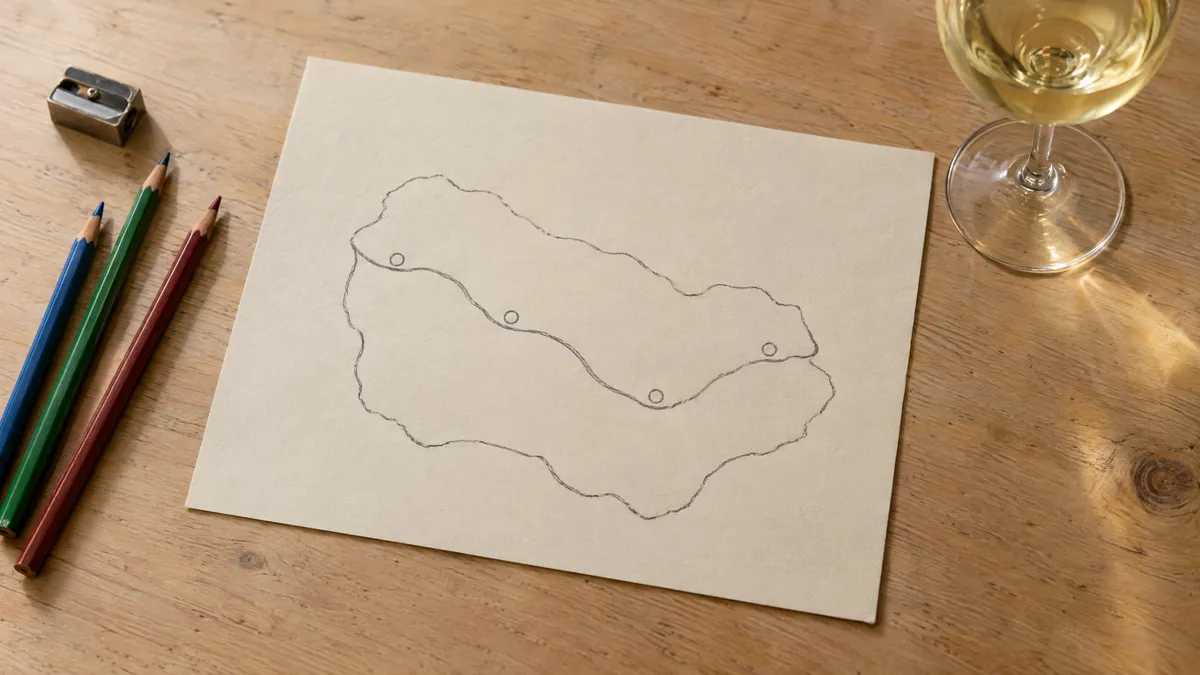
- Atlantic coast: Rías Baixas lies inside Galicia's Atlantic zone, and its regulator calls winter a very rainy season. Albariño is the main grape.
- One river: Rioja lies on both banks of the Ebro in northern Spain, and Tempranillo covers most of its vineyard (about 79% in the regulator's 2023 statistics).
- High ground: Ribera del Duero's vineyards sit between 720 and 1,100 metres (its regulator's 2023 figures), with dry summers and long, harsh winters. Its main grape is Tempranillo again, known locally as Tinto Fino.
- Far south: Jerez is one of the most southerly wine regions in Europe, with a warm climate. Its regulator calls Palomino the undisputable leader among its grapes, and its wine is Sherry.
The pair to keep is Rioja and Ribera del Duero: one grape, two rivers. Rioja's regulator says of its Rioja Alta zone that grapes grown higher up ripen later and keep more acidity, so altitude is a fact worth a mark on any map. The Spanish wine regions guide fills in the regions between the four.
Germany groups the same way. As our German wine regions page shows, most of its regions follow the Rhine and the rivers that feed it, so drawing those rivers places the regions.
Why Test Yourself Instead of Rereading?
Because rereading is the weaker technique. A 2013 review of ten study techniques by Dunlosky and colleagues rated practice testing and distributed practice as high utility. It rated rereading and highlighting as low utility, and suggested practice testing in place of rereading.
Distributed practice means spreading sessions out with gaps between them. Three checks keep a map session a test:
- Blank first. The atlas stays out of sight until the sketch is finished.
- Misses in a second colour. The corrections become the plan for the next session.
- Both directions. Go from region to grape, then from grape to region.
For facts that do not fit on a map, such as grape names and label terms, cards suit them better. Wine flashcards compares the tools, and how to study for WSET turns spaced review into a weekly plan for anyone with an exam date.
How Do You Tie a Region to a Bottle?
Open one bottle a week from a region on the map and check the three facts against the glass. A region tasted has a flavour attached to its name, which a list cannot give. Two bottles from two regions, poured side by side, show a difference that one glass alone hides.
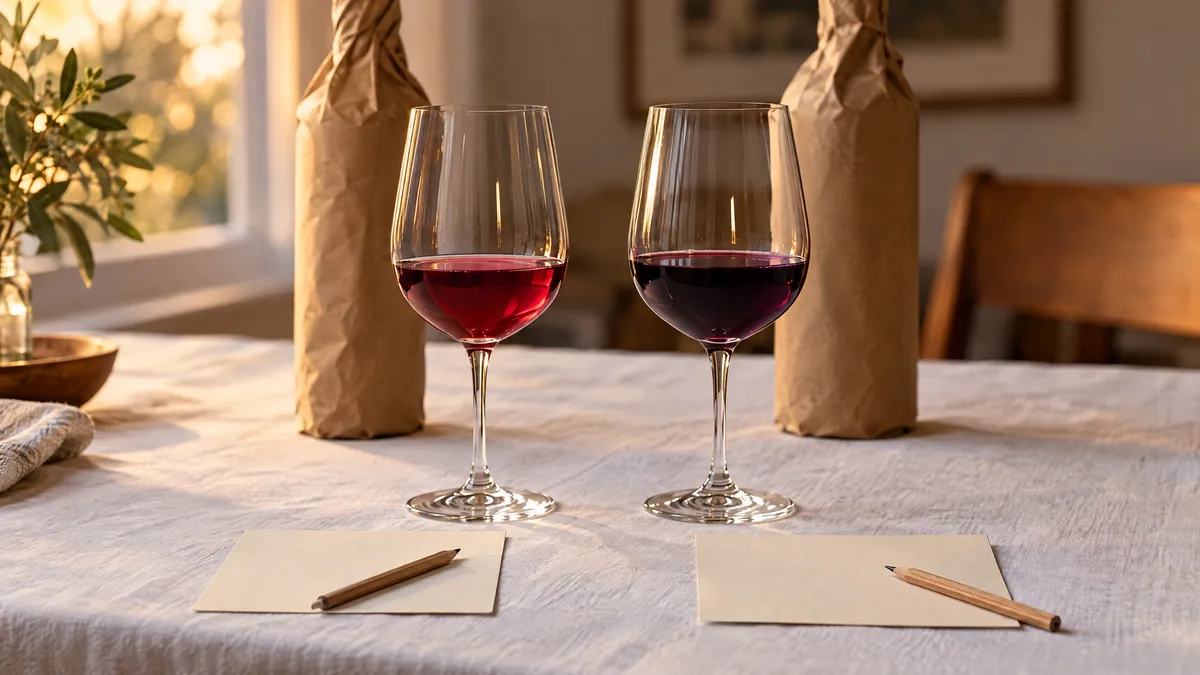
Choose pairs that differ in one cause. Pour a northern Rhône Syrah beside a southern Rhône Grenache blend, or a Rioja beside a Ribera del Duero. Write one line per glass on a tasting notes template: place, grape, and the one taste that the place explains.
Smells and tastes need their own practice, covered in wine memory training.
What Does a Weekly Routine Look Like?
Three short sessions a week are enough to start: one to draw, one to redraw and one to taste. One new country every week or two is fast enough, as long as the older maps keep coming back complete from a blank sheet.
- Session one: draw a new country from blank, correct it, and write three facts on each anchor.
- Session two, a day or two later: redraw it from blank and mark the misses.
- Session three: open one bottle from the map and write the one-line note.
- Once a week, added to any session: redraw one older country, starting with the oldest.
- Once a month: draw every country so far on one sheet.
If an older map comes back complete, double the gap before its next redraw. If it comes back with holes, bring it back the next day. These gaps are a rule of thumb, and no study sets them.
Which Tools Help Between Sessions?
A pencil and a blank sheet do most of the work, and other tools fill the gaps between sessions. An atlas is for checking, cards are for loose facts, and an app is for quick questions away from the desk.
Sommy, the app we build
Sommy is the app we build: a wine learning app for iPhone from the team that writes this blog. Lessons are short and built on picture questions and quizzes, which suits practising grapes and regions between drawing sessions. Its region courses include France, Italy, Spain, California and Germany, and the French course covers the classic regions.
Guided tasting starts from a photo of the label on a real bottle and walks through look, smell and taste. The note is saved to a tasting journal. Free to start on iPhone. Sommy does not draw the map for anyone. People who learn best with a pencil in hand should pick a paper atlas and a pad of blank sheets instead.
Other ways to learn are compared in how to learn about wine.
What to Do Tonight
Draw France from memory on one blank sheet and mark the six anchors. Write the main grapes beside each, then check the sheet against the table above and correct it in a second colour. Tomorrow, draw it again before looking at anything.
Sources
- Carpenter and Pashler (2007), Testing beyond words: using tests to enhance visuospatial map learning — Psychonomic Bulletin and Review
- Wammes, Meade and Fernandes (2016), The drawing effect: Evidence for reliable and robust memory benefits in free recall — Quarterly Journal of Experimental Psychology
- Dunlosky et al. (2013), Improving students' learning with effective learning techniques — Psychological Science in the Public Interest
- Grape varieties — Bordeaux wine board (CIVB)
- The art of the blend in Bordeaux wines — Bordeaux wine board (CIVB)
- Médoc: the appellation guide — Bordeaux wine board (CIVB)
- Pinot Noir and Chardonnay: the Bourgogne region's two noble grape varietals — Bourgogne wine board (BIVB)
- The climate of the Bourgogne winegrowing region — Bourgogne wine board (BIVB)
- Champagne and its grape varieties — Comité Champagne
- Champagne and its climate — Comité Champagne
- The Champagne region — Comité Champagne
- Nantes vineyards — Loire wine board (InterLoire)
- Grape varieties — Loire wine board (InterLoire)
- Soils and climate — Loire wine board (InterLoire)
- Grape varieties — Rhône wine board (Inter Rhône)
- AOC Côtes du Rhône — Rhône wine board (Inter Rhône)
- Côte-Rôtie — Rhône wine board (Inter Rhône)
- The wines of Alsace by grape — Alsace wine board (CIVA)
- Terroir and wine-making in Alsace — Alsace wine board (CIVA)
- Rías Baixas terroir — Rías Baixas regulator (Consejo Regulador)
- Rioja designation specifications — Rioja regulator (Consejo Regulador)
- Rioja statistics 2023 (PDF) — Rioja regulator (Consejo Regulador)
- Rioja Alta — Rioja regulator (Consejo Regulador)
- Ribera del Duero brochure (2023) — Ribera del Duero regulator (Consejo Regulador)
- Viticulture in the Sherry region — Sherry regulator (Consejo Regulador)
Frequently Asked Questions
What is the best way to remember wine regions?
One method in line with lab research on self-testing: draw them from memory. Sketch the country on a blank sheet, mark five or six anchor regions, and write three facts beside each: where it sits, its main grapes and the style in the glass. Check against an atlas only after the pencil is down. Redraw the next day and again a week later, starting with the regions missed last time.
How many wine regions should you learn at once?
Five or six per country is a workable first set. For France that means Bordeaux, Burgundy, Champagne, the Loire, the Rhône and Alsace. Add smaller regions only when the anchors come back from a blank sheet without help. Each new region then has neighbours to attach to, which we find easier than holding a long flat list in order.
Does drawing a map really help memory?
Indirectly. In a 2007 study by Carpenter and Pashler, 50 people learned one map by ordinary study and another through recall tests of single features. Their drawings 30 minutes later were better for the tested maps. A 2016 paper by Wammes and colleagues found drawn words were recalled better than written ones. Neither study tested drawing a map as a study method: the first tested recall and scored it with a drawing, and the second used single words.
What should you memorise about each wine region?
Three facts, in a fixed order. First, where the region sits and what its climate is like. Second, the main grapes. Third, the style in the glass. In that order the first fact helps explain the next two: cooler places tend to give tarter, lighter wines, and warmer places riper, stronger ones.
How do you remember French wine regions and their grapes?
Start with six anchors and one line each. Bordeaux: Merlot and Cabernet Sauvignon blends by the Atlantic. Burgundy: Chardonnay and Pinot Noir inland. Champagne: sparkling wine in the north. Loire: Melon, Chenin Blanc, Sauvignon Blanc and Cabernet Franc along one river. Rhône: Syrah in the north, Grenache blends in the south. Alsace: Riesling behind the Vosges mountains.
Is rereading notes enough to learn wine regions?
Usually not. A 2013 review of ten study techniques by Dunlosky and colleagues rated practice testing and distributed practice as high utility. It rated rereading and highlighting as low utility. For regions, practice testing means redrawing the map or answering cards from memory. Reread only the regions that the test shows are missing.
How often should you review wine regions?
Three short sessions a week are enough to start: one to draw a new country, one to redraw it from blank a day or two later, and one to taste a bottle from the map. Redraw older countries at longer gaps, about once a week and then once a month, as long as they keep coming back complete.
Sommy Team
LinkedInFounder & Wine Educator
The Sommy Team is building the world's most approachable wine education app, helping beginners develop real tasting skills through structured courses and AI-guided practice.