Wine Memory Training: How Sommeliers Remember Hundreds of Wines

By the Sommy Team — AI-assisted, human-edited.
Updated Apr 17, 2026
Contents (16)
- TLDR
- Why Wine Memory Feels So Hard
- What Sommeliers Actually Do
- How to Build a Scent Library
- Spaced Repetition for Wine Facts
- Narrative Association: Turning Facts into Stories
- Drill 1: The Daily 5-Minute Review
- Drill 2: The Two-Wine Comparison
- Drill 3: The Blind Reveal
- Drill 4: The Reverse Prime
- Drill 5: The Teach-a-Friend
- Drill 6: The Monthly Notebook Re-Read
- Mistakes That Slow Wine Memory
- How Long Until It Shows Up
- FAQ
- The Bottom Line
TL;DR
Wine memory is a trained skill built from three tools: sensory anchoring with real-world aroma samples, spaced repetition for grape-region facts, and narrative association for style profiles. Six short drills — daily review, two-wine comparisons, blind reveals, reverse priming, teach-a-friend, and monthly notebook re-reads — produce measurable gains within four to eight weeks of consistent practice.
TLDR
Wine memory is a trained skill, not a gift. The sommeliers who remember hundreds of wines lean on three cognitive tools: sensory anchoring, spaced repetition, and narrative association. You can copy all three without credentials, a cellar, or a classroom. Four to eight weeks of short, consistent drills produce measurable gains.
Why Wine Memory Feels So Hard
Most beginners assume wine professionals are born with better noses. They are not. Studies comparing trained sommeliers to untrained controls consistently show that nasal anatomy and raw sensitivity are roughly the same across both groups. The difference is cognitive: professionals have stored and indexed more olfactory references.
Smell is a strange sense. Unlike vision or hearing, it has almost no default vocabulary. You can recognize a familiar aroma instantly and still be unable to name it. That gap — perception without language — is the memory problem every wine student faces.
Wine memory training is the deliberate effort to close that gap. It is not about drinking more. It is about building a library of aroma-to-word links, reinforcing them on a schedule, and stringing them into patterns that can be recalled under pressure.
The good news: the memory techniques that work for wine are the same ones used by medical students, chess players, and language learners. You can steal all of them.
What Sommeliers Actually Do
When a Master Sommelier tastes a wine blind and calls it within three tries, they are not operating on intuition. They are running a trained procedure that combines three memory tools.
1. Sensory Anchoring
Every professional spends dozens of hours smelling things that are not wine. Jars of black pepper. Crushed fresh thyme. Wet stones. Tobacco leaves. Strawberries at various stages of ripeness. These individual scent anchors are stored with specific words, so that when a wine reveals "black pepper with a hint of violet," the taster can name it because they have smelled real black pepper and real violets enough times to recognize them.
2. Spaced Repetition
Raw exposure is not enough. The library fades if you do not review it. Top candidates for the Master Sommelier and Master of Wine programs use flashcards — physical, digital, or mental — to reinforce country-region-grape-style links on a schedule that matches the forgetting curve.
A simple version: review new material after 1 day, 3 days, 1 week, 2 weeks, 1 month. The repetitions land before the memory fades, which strengthens the recall each time.
3. Narrative Association
Facts stored as isolated points are hard to retrieve. Facts stored inside a story are easier. Sommeliers build mental narratives: "Mosel Riesling — slate soil, cold steep river valley, high acidity, pale lemon-green, low alcohol, petrol note with age." The story becomes a retrieval handle. Pull one thread and the whole bundle comes with it.
How to Build a Scent Library
Start here. Before any wine-specific training, build a library of real-world scents that wines commonly echo.
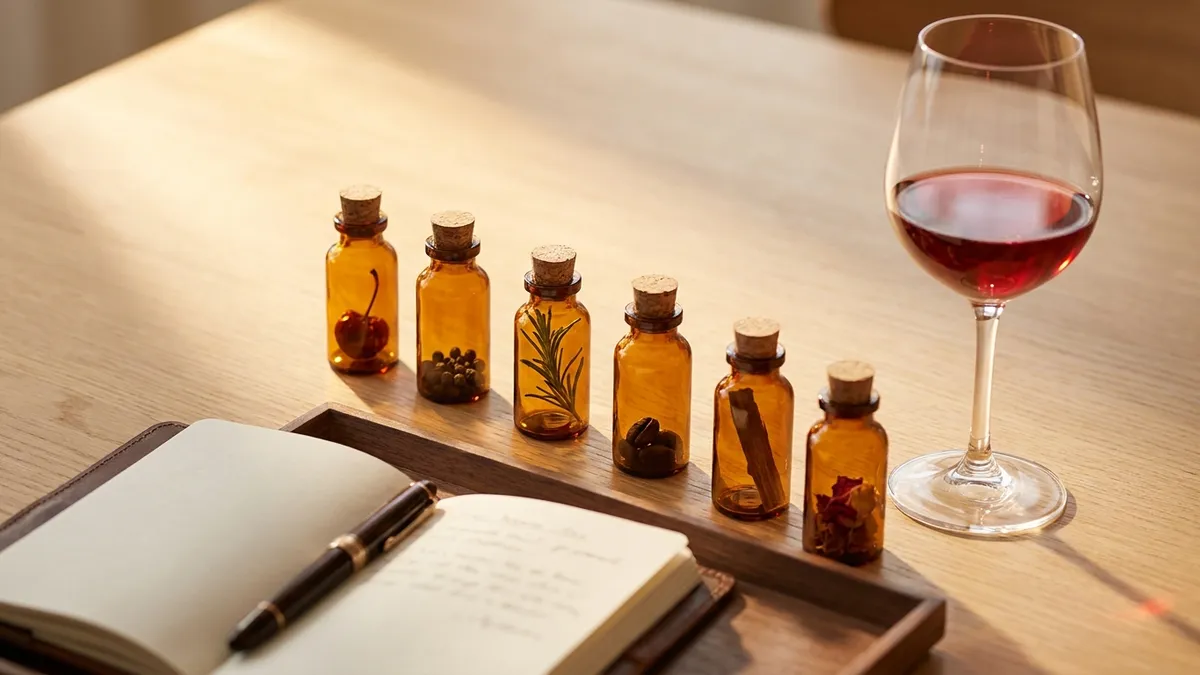
Set out five jars, bowls, or small dishes with:
- A fresh red fruit (strawberry, cherry, raspberry)
- A fresh herb (mint, thyme, rosemary)
- A spice (black pepper, clove, cinnamon)
- A baked or dried aroma (toast, vanilla, tobacco, cedar chips)
- A savory or earthy note (mushroom, wet stone, olive brine)
Smell each one with eyes closed. Say the name aloud. Smell again. Move to the next. Do this three times a week for two weeks — never more than 5 minutes per session, since smell fatigue sets in fast.
Over a month, rotate in new anchors from our wine aroma wheel guide, which lists the aromas that appear most often in wines across styles.
The goal is not to smell a thousand things. It is to build reliable links between a smell and a specific word, so the word is retrievable the instant the smell appears in a glass.
Spaced Repetition for Wine Facts
Wine knowledge has a lot of facts: grape-region pairings, climate patterns, appellation rules, classic styles. Raw memorization is brutal. Spaced repetition cuts the work by more than half.
A working scheme for a beginner:
- Pick 20 grape-region-style links you want to learn. Example: "Sancerre = Sauvignon Blanc from the Loire, high acidity, citrus and gooseberry, no oak."
- Write each on an index card or in a flashcard app (Anki, Quizlet, or any minimalist tool).
- On day 1, drill all 20.
- On day 3, drill only the ones you missed on day 1.
- On day 7, drill them again, adding new cards.
- Continue expanding the deck weekly.
After a month, 100 cards is a realistic target. After three months, 300 cards is achievable with 15 minutes a day. That is enough factual scaffolding to taste blind and start matching aromas to regions you know.
The Sommy app bakes a light version of spaced repetition into its lesson flow — new aromas and grapes reappear across later lessons at intervals timed to the forgetting curve, so you review without having to schedule the review.
Narrative Association: Turning Facts into Stories
Dry lists are hard to remember. Stories stick.
Take Nebbiolo. Dry fact: "Italian red grape from Piemonte, high tannin, high acid, pale color, cherry and tar and rose notes, long aging."
The story version: "Fog-wrapped Piemontese hills in October, light-colored grapes on tall vines, wine so tannic young that it needs a decade to soften, smelling of rose petals and cherries and old tar, grown by small families who have been there five generations."
Both contain the same facts. The second one is easier to recall blind because the smell of rose and tar pulls the whole scene with it.
Build a one-paragraph story for every grape-region pair you study. Include:
- The climate (cold, warm, coastal, continental)
- The soil or terrain (slate, granite, clay, limestone, volcanic)
- Three signature aromas
- One or two structural notes (tannin, acidity, alcohol)
- The age profile (drink young, mid-term, long-age)
After a dozen stories, you will start recognizing the shape of a region blind — the unmistakable slate-Riesling profile, the warm-climate Shiraz profile, the cold-continental Pinot Noir profile. Stories do that work for you.
Drill 1: The Daily 5-Minute Review
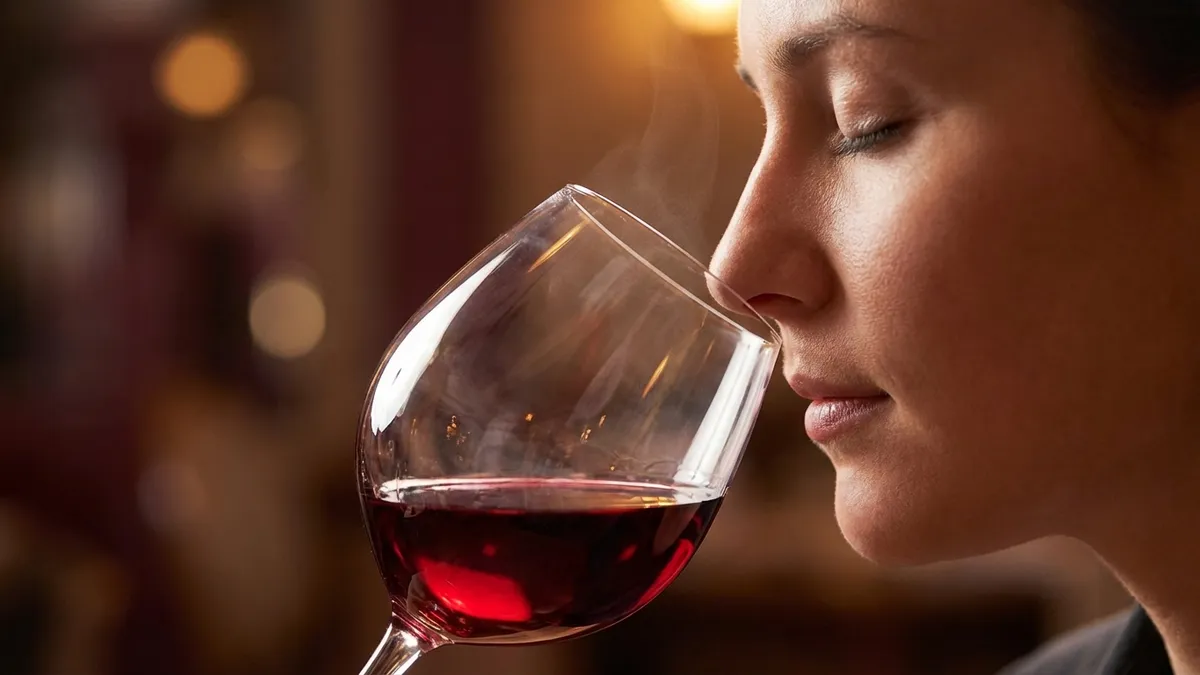
Once a day, for 5 minutes, open a fridge or cellar and pick one wine. Smell it without sipping. Name three aromas. Sip. Name the structure.
If the wine is one you have tasted before, try to remember the previous session's note before re-tasting. This is the key retrieval step — trying and failing to remember is what strengthens recall more than any re-reading.
Short and repeated beats long and occasional. A month of daily drills cements more than a weekend of intensive tasting, because skills consolidate between sessions, not during them.
Drill 2: The Two-Wine Comparison
Pour two wines of the same grape from different regions. Smell, sip, and write down three differences. Thirty seconds, not three minutes.
This drill forces the brain to store wine as a relationship, not an absolute. "Willamette Valley Pinot is brighter and more red-fruited than Russian River Pinot" is easier to remember than either wine on its own.
Our develop your wine palate guide has a month-long calendar that mixes this drill with daily reviews.
Drill 3: The Blind Reveal
Have a friend pour one wine into an opaque glass. Taste it. Guess:
- White or red
- Sweet or dry
- Light, medium, or full body
- Old-world or new-world
- A grape candidate if you dare
Write the guesses before the reveal. Then compare.
Blind tasting activates the retrieval muscle harder than any other drill. Being wrong is how the library gets stronger. Our blind wine tasting tips guide has the full protocol.
Drill 4: The Reverse Prime
Instead of tasting and guessing, start with the answer. Tell yourself: "This is a 2019 Brunello di Montalcino. It should be garnet with an orange tinge, high tannin, black cherry and leather and balsamic, 14.5 percent alcohol, 5-year finish potential."
Then taste. See how close reality gets.
Priming locks the memory in a different way. You are no longer generating a description from scratch — you are verifying one. Every verification strengthens the retrieval pathway for next time you encounter the same style blind.
Drill 5: The Teach-a-Friend
Explain a wine you just tasted to someone who knows nothing about wine. No jargon. Just plain language: "This tastes like strawberry and a little like wet stone."
The moment you reach for a word they will not understand, you realize how vague your own understanding was. Plain language is a brutal filter. It forces precision.
A month of explaining wines in plain words to non-drinkers will sharpen your vocabulary faster than a year of silent tasting.
Drill 6: The Monthly Notebook Re-Read
Once a month, sit down with every tasting note you wrote in the last 30 days. Read them cover to cover. Look for:
- Wines you tasted twice — do the notes agree?
- Patterns in what you like and dislike
- Aromas you used to describe as "fruit" that you now name specifically
- Wines you have forgotten entirely
The forgotten ones are the most valuable. They are the memories that did not stick — which tells you exactly where the library has gaps.
Sommelier note: Treat re-reading as study, not nostalgia. A review that changes your next purchase is a successful review. A review that just makes you smile did not do its job.
Mistakes That Slow Wine Memory
A few common errors stall beginners for months:
- Trying to memorize without anchoring. Reading that Cabernet "tastes like blackcurrant" does nothing if you have never smelled a blackcurrant. Start from real-world smells.
- Cramming before a tasting. Short daily sessions beat long occasional ones. Cramming leaves short-term knowledge that evaporates within a week.
- Relying on passive exposure. Drinking ten bottles a week does not build memory if you never practice recall. Volume without attention is just drinking.
- Skipping review. Notes you never re-read teach you nothing. Schedule a monthly re-read as non-negotiable as the tasting itself.
- Ignoring plain-language vocabulary. If your notes are full of "elegant" and "balanced," they are indistinguishable six months later. Specific nouns and simple adjectives are the memory-friendly format.
How Long Until It Shows Up
Serious students of wine memory typically see the first noticeable gains between weeks 4 and 8 of consistent practice. A typical progression:
- Week 1 to 2: You can name three aromas reliably in a wine you are familiar with.
- Week 3 to 4: You can taste a wine blind and correctly guess old-world vs new-world style.
- Week 6 to 8: You can taste a wine blind and guess the grape within two tries more than half the time.
- Month 3 to 6: You can remember a specific bottle you tasted months ago well enough to compare it to something new.
Professionals go further with years of dedicated work, but those first-month gains are where the confidence builds. Once you can retrieve a wine from memory rather than just recognize it in the moment, the rest is scale.
FAQ
Is wine memory actually trainable as an adult?
Yes. The sense of smell remains trainable for life. Research on perfumery students, sommelier trainees, and flavor scientists consistently shows measurable improvement in recall and identification accuracy with six to twelve weeks of consistent, short sessions, regardless of starting age.
Do I need a cellar or a collection to train?
No. Three to six bottles a month is plenty. Memory training is about repeated attention, not rare wine. Cheaper wines teach the same structural lessons as expensive ones — save the splurge for a monthly reward, not a weekly one.
How long should a training session be?
Five to ten minutes, and no longer. Smell fatigue sets in fast, and attention degrades once you push past 15 minutes of continuous tasting. Short daily sessions consolidate memory between sleep cycles in a way long sessions cannot match.
What is the single highest-impact drill?
The daily 5-minute review. It forces retrieval, anchors new aromas to a real bottle in your hand, and compounds across weeks in a way no single longer exercise can. Start here and add others as the habit stabilizes.
Can flashcards really help with wine?
Yes, for facts: grape-region pairings, style profiles, appellation rules. They do nothing for aroma recall, which has to come from real-world smelling. Use flashcards for the vocabulary scaffold and real wine for the sensory half.
Should I use a spaced-repetition app?
If you enjoy the interface, yes — apps like Anki make the scheduling automatic. If you prefer paper index cards, those work too. The mechanism matters more than the medium: review at increasing intervals, and get the hard ones more often than the easy ones.
Is blind tasting necessary to train memory?
Strongly helpful, not strictly necessary. Blind tasting forces retrieval under pressure, which is the most effective form of memory consolidation. Even a single blind pour per week measurably accelerates recall compared to always-labeled tasting.
The Bottom Line
Wine memory is a stack of trained skills — sensory anchoring, spaced repetition, and narrative association — layered over short daily drills. Professionals did not inherit it. They practiced it, on a schedule, with an honest notebook. A month of 5-minute sessions will move you further than a year of unstructured drinking.
Ready to outsource the scheduling? Sommy's lesson flow builds in spaced repetition automatically — aromas, grapes, and styles reappear at the intervals shown to stick best, so the review happens without you having to remember to do it.
Frequently Asked Questions
Is wine memory actually trainable as an adult?
Yes. The sense of smell remains trainable for life. Research on perfumery students, sommelier trainees, and flavor scientists consistently shows measurable improvement in recall and identification accuracy with six to twelve weeks of consistent, short sessions, regardless of starting age. Nasal anatomy is roughly equal across trained and untrained adults — what differs is the stored library of scent-to-word links.
Do I need a wine cellar to train my memory?
No. Three to six bottles a month is plenty. Memory training is about repeated attention, not rare wine. Cheaper wines teach the same structural lessons as expensive ones. Save the splurge for a monthly reward, not a weekly one. The five-minute daily review compounds across weeks far more than any single premium bottle could.
How long should a single wine memory training session be?
Five to ten minutes, rarely longer. Smell fatigue sets in fast and attention degrades past 15 minutes of continuous tasting. Short daily sessions consolidate memory between sleep cycles in a way long sessions cannot match. A month of five-minute drills cements more than a weekend of intensive tasting because skills consolidate between sessions, not during them.
What is the single highest-impact wine memory drill?
The daily five-minute review. Pick one wine from a fridge or cellar, smell it without sipping, name three aromas, then sip and name the structure. If it is a familiar wine, try to remember the previous note before re-tasting. That trying-and-failing retrieval step strengthens recall more than any re-reading can.
Do flashcards actually help with wine study?
Yes, for facts like grape-region pairings, style profiles, and appellation rules. Flashcards do nothing for aroma recall, which has to come from smelling real things in jars or bowls. Use flashcards for the vocabulary scaffold and real wine for the sensory half. Spaced-repetition apps like Anki automate the scheduling; paper index cards work just as well.
How does spaced repetition apply to learning wine?
Review new material after one day, three days, one week, two weeks, and one month. The repetitions land just before the memory fades, which strengthens recall each time. A working starting deck is twenty grape-region-style links. After three months of fifteen minutes a day, three hundred cards is realistic and gives you enough factual scaffolding to taste blind.
Is blind tasting necessary to train wine memory?
Strongly helpful, not strictly necessary. Blind tasting forces retrieval under pressure, which is the most effective form of memory consolidation. Even a single blind pour per week measurably accelerates recall compared to always-labeled tasting. Being wrong on a blind guess strengthens the library faster than being passively correct with the label visible.
When will I start to see results from wine memory training?
Most consistent students see first gains between weeks four and eight. By week two you can name three aromas reliably in a familiar wine. By week four you can guess old-world versus new-world style blind. By week eight you can guess the grape within two tries more than half the time. Month three onward, specific bottles start sticking in memory.
Sommy Team
LinkedInFounder & Wine Educator
The Sommy Team is building the world's most approachable wine education app, helping beginners develop real tasting skills through structured courses and AI-guided practice.