Wine Flashcards: Which Deck to Pick, Plus a Weekly Plan

By the Sommy Team — AI-assisted, human-edited.
Updated Nov 23, 2026
Contents (10)
- Wine Flashcards, in One Paragraph
- Which Kind of Wine Flashcard Deck Should You Use?
- What Can Wine Flashcards Teach, and What Can They Not?
- Do the Exam Bodies Publish Their Own Flashcards?
- How Do You Judge a Deck Someone Else Made?
- Which Flashcard App Should You Pick?
- How Do You Make Your Own Wine Flashcards?
- What Is a Simple Spaced-Repetition Routine?
- How Does a Week of Cards and Tasting Fit Together?
- What to Do Tonight
TL;DR
Wine flashcards teach facts with one short answer: grape, region, law, label term. They cannot teach tasting. Use the exam body's own cards where it sells them, and write your own from the course book where it does not. Review about 15 minutes a day at growing gaps, and taste two wines a week.
Wine flashcards are a form of self-testing, which a 2013 research review rated above rereading for learning in general. They suit grapes, regions, wine laws and label terms, and they teach nothing about how a wine tastes. The deck matters less than two habits: checking every card against the course book, and reviewing at gaps that grow.
Wine Flashcards, in One Paragraph
Wine flashcards work for facts with one short answer: which grape grows where, what a label term means, which law sets an ageing rule. Four kinds of deck exist: cards from the exam body, decks inside flashcard apps, sets sold by schools and publishers, and cards written by hand. Cards written from the course book are the safest in our view, because several exam bodies say their questions come from that book or study guide. Review them for about 15 minutes a day at gaps that grow, and taste two wines a week beside them.
Which Kind of Wine Flashcard Deck Should You Use?
Use the exam body's own cards where it sells them, and write your own from the course book where it does not. A shared deck in an app saves typing but can carry another learner's mistakes. A bought set sits in between: find the syllabus edition it follows before paying.
| Kind of deck | Who wrote it | Strength | Weak point | Pick it if |
|---|---|---|---|---|
| Exam body's own cards | The body that sets the exam | Built on the study guide the questions come from | Of the four bodies checked, one sells a deck on its own | Your exam body lists one, as the CSW's does |
| App deck by the app's own authors | Educators working with the app | Ready on day one, reviews scheduled for you | Independent of the exam body, edition not named on the two pages checked | You will test it against the book first |
| Shared deck from another learner | A student, often unnamed | Quick to start | Unknown edition, unknown errors | You treat it as a draft and fix cards as you go |
| School or publisher set, printed or digital | A wine school or an author | Written for one course | A printed card cannot be corrected after printing | It names the syllabus edition you are sitting |
| Cards you write yourself | You, from the course book | Writing the card is study, and every card is on your syllabus | Takes time every week | The exam is four weeks or more away |
Facts about exam bodies and apps were checked on their own pages on 23 November 2026. Products and prices change: confirm on the page before paying.
What Can Wine Flashcards Teach, and What Can They Not?
Cards teach facts with one short answer: the grape behind a place name, the country of a region, the meaning of a label term, the rule in a wine law. They cannot teach the feel of a wine in the mouth, and they cannot write a tasting note or a long written answer.
WSET's Level 2 Award in Wines is examined by 50 multiple-choice questions in 60 minutes, and its learning outcomes include the meaning of labelling terms. Most of its assessment criteria ask you to state or identify a fact, which is card work. WSET Level 3 adds a short written answer paper and a blind tasting of two wines, so cards cover only part of it.
The Court of Master Sommeliers, Americas lists map identification, label reading and connecting grape varieties with places among the topics of its Introductory Sommelier exam. Its course guide marks the deductive tasting method "Not tested at this level", though it still lists questions on how the wines tasted in class look, smell and taste.
Acidity (the tartness that makes the mouth water) and tannin (the drying grip on the gums) have to be felt in a glass. Smell and taste need drills of their own, set out in wine memory training.
Do the Exam Bodies Publish Their Own Flashcards?
On the pages checked on 23 November 2026, only the Society of Wine Educators sells a card deck on its own. The Wine Scholar Guild's May 2022 announcement of its French Wine Scholar course lists revised e-flashcards among the materials. The WSET and Court of Master Sommeliers, Americas pages checked list books, workbooks, quizzes or practice exams instead.
- Society of Wine Educators, CSW: nearly 900 digital flashcards based on its CSW Study Guide, at $24.00 for one year of use, as listed on 23 November 2026. The Society calls them the only CSW flashcards it has approved and created. It also lists over 800 map flashcards. The exam is covered in the Certified Specialist of Wine guide.
- WSET, Levels 2 and 3: the qualification pages name no card deck. The Level 2 specification says the recommended study materials, the book Wines: Looking behind the label, contain what the exam questions need. A student account on WSET's site describes revision flashcards inside each module of the Level 1 Online Classroom, so ask your course provider what an online course includes.
- Court of Master Sommeliers, Americas, Introductory: the resources page lists a syllabus, a course guide and a practice exam, and no cards. The course workbook holds maps and end-of-section quizzes.
- Wine Scholar Guild, French Wine Scholar: a 330-page study guide and an online classroom. The Guild's May 2022 announcement of the seventh course version lists revised e-flashcards among the updated materials, and we found no deck sold separately. The Guild's exam FAQ says all questions are taken from the study guide and that practice quizzes sit in the online portal. The course is covered in French Wine Scholar.
How Do You Judge a Deck Someone Else Made?
Check three things before trusting it: the syllabus edition it follows, who wrote it, and how many errors turn up when ten cards are tested against the course book. A deck that fails one check becomes a draft to correct. A deck that fails two gets dropped.
Edition. Exams change when their books change. The Society of Wine Educators runs each CSW exam from one edition of its study guide for a fixed window. The exam based on the 2024 edition is available through 30 December 2026, the 2025 edition through 30 December 2027, and the 2026 edition through 30 December 2028. WSET numbers its specifications, and Level 2 stands at Issue 2.1, dated 2026. A deck that names no edition cannot be matched to any of them.
Author. A named teacher with a stated qualification is easier to trust than a username. Independent work is normal and says nothing bad about a deck. Brainscape's WSET Level 3 page states that Brainscape is not sponsored or endorsed by official publications, tools or services connected to WSET.
Errors. Pull ten cards at random and look each one up in the course book. If two or more are wrong, or are missing from the book, stop using the deck. Anki's manual says shared decks for complex subjects are a supplement to other study material and not a replacement.
Which Flashcard App Should You Pick?
Pick Anki to write and schedule cards of your own, Brainscape for ready decks labelled for WSET levels, and Quizlet to turn typed or pasted notes into a study set. If the exam is less than four weeks away, take a ready deck and test it against the book; with more time, write the cards yourself.
- Anki calls itself a flashcard program. Its site says the free computer version is available for all major platforms and lists Windows, macOS and Linux, with AnkiMobile as the official iOS app and AnkiDroid for Android. Cards take images and audio, and Anki schedules each review for when you are most likely to forget the card.
- Brainscape publishes its own decks labelled for WSET Levels 1 to 3 and for units of the Level 4 Diploma. Its Level 2 page says they were written with a Certified Wine Educator and that the app is free to start, with a paid plan for full access. It runs on the website, iOS and Android. Its Level 2 and Level 3 pages name no textbook edition.
- Quizlet describes itself on its App Store listing as a tool that builds a study set from notes typed, pasted or uploaded. The listing shows a free download with in-app purchases.
Lesson apps are compared in best wine learning apps, and every other kind of wine app in best wine apps.
Sommy, the app we build
Sommy is the app we build: a wine learning app for iPhone from the team that writes this blog. It is not a flashcard app. Lessons are short and built on picture questions and quizzes. You pick a goal, such as ordering with confidence, and Sommy lays its courses out as one path for it.
Guided tasting covers the part cards leave out. Photograph the label of the bottle on the table and Sommy walks through look, smell and taste, then saves the note to a tasting journal. Sommy is independent and not an official prep course. Free to start on iPhone. Anyone who has to drill one syllabus line by line should pick a plain flashcard app and write the cards from the course book.
How Do You Make Your Own Wine Flashcards?
Write one fact per card, straight from the course book, and make each card work in both directions. Turn maps and labels into picture cards. A card that takes longer than five seconds to answer holds too much and gets split in two.
- One fact per card. "Rioja" on the front with grapes, ageing terms and subregions on the back is three cards. Start with "Main grape of red Rioja" and "Tempranillo".
- Both directions. "Trocken" on the front, "dry, on a German label" on the back, then a second card the other way round. Anki has a note type that makes both cards from one entry.
- One right answer. If a card could be answered two ways, add a clue to the front until only one answer fits.
- Maps as pictures. Trace a country outline, number the regions and put the names on the back. In Anki, the Image Occlusion note type hides part of an image and asks for it.
- Page number on the back. Note where in the course book the fact sits. Checking a doubtful card then takes seconds.
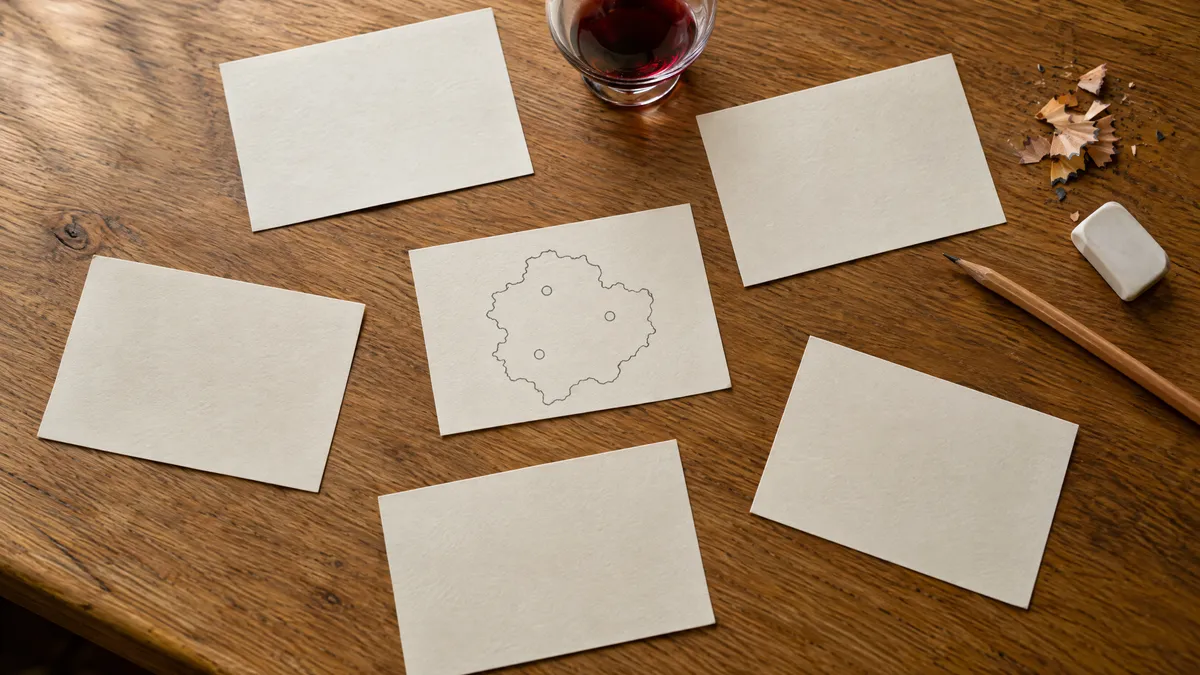
Label terms are the easiest cards to write, because the bottle supplies the question. The words to collect are in how to read a wine label.
What Is a Simple Spaced-Repetition Routine?
Sort cards into three boxes: daily, every third day, weekly. A right answer moves a card up one box, and a wrong answer sends it back to daily. Add no more than ten new cards a day and stop at 15 minutes. A flashcard app does the same sorting without the boxes.
Spaced repetition means reviewing a fact at gaps that grow. A 2013 review by Dunlosky and colleagues rated ten study techniques. Practice testing and distributed practice, which is study spread over time, received the review's high utility rating. Rereading and highlighting were rated low. Flashcards reviewed over weeks combine the two high-rated techniques.
That review covers learning in general, not wine. The three-box timings are a rule of thumb, and no study sets them. Two well-known studies behind the method are summarised in how to study for WSET.
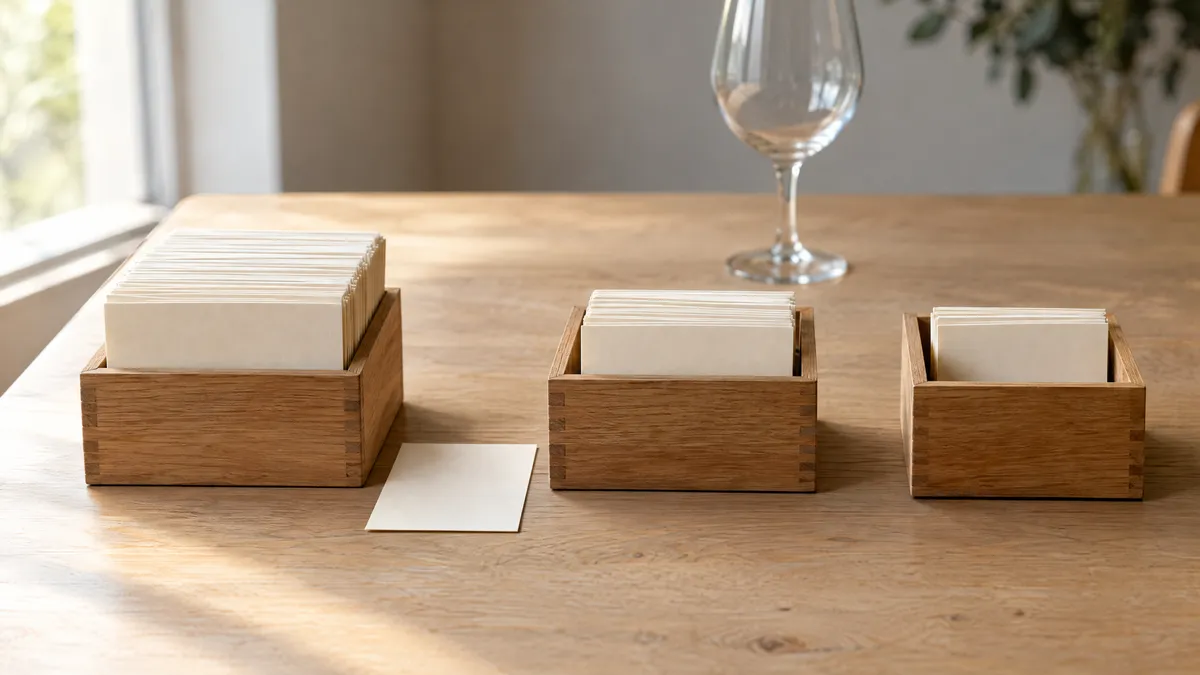
Anki's manual credits Sebastian Leitner with making the paper box method popular, and calls it rough because a box cannot give an exact review date. If the daily box regularly takes more than 15 minutes, move the cards into an app.
How Does a Week of Cards and Tasting Fit Together?
Run five short card sessions, one card-writing session, one map session and one two-wine tasting. The tasting uses grapes from that week's cards, so each fact gains a taste. The card work adds up to about two hours, plus the tasting. WSET sets 11 hours of private study for Level 2, which this routine, tastings included, covers in about four to five weeks.
- Monday to Friday: 15 minutes of cards, daily box first.
- Wednesday: 30 more minutes to write new cards from the week's chapter.
- Saturday: pour two wines from grapes on this week's cards and compare them side by side. A tasting notes template keeps each note in the same order.
- Sunday: 20 minutes filling a blank map from memory, then the weekly box.
If a week has no time for the tasting, cut Wednesday's new cards and keep the two glasses.
How the scores are counted once the exam comes is in WSET pass marks, and more first steps are in the beginners and buying hub.
What to Do Tonight
Open the course book at this week's chapter and write ten cards, one fact each, with the page number on the back. Then pour a glass of one grape from those cards and read its card with the wine in your mouth.
Sources
- Certified Specialist of Wine (study guide editions, digital flashcards, map exercises) — Society of Wine Educators
- Level 2 Award in Wines Specification, Issue 2.1, 2026 (PDF) — WSET
- Level 2 Award in Wines — WSET
- Level 3 Award in Wines — WSET
- Inside story: online vs in-person WSET courses (student account) — WSET
- Resources — Court of Master Sommeliers, Americas
- Introductory Sommelier Course Guide: What to Expect (PDF) — Court of Master Sommeliers, Americas
- French Wine Scholar programme page — Wine Scholar Guild
- Discover the French Wine Scholar newest version — Wine Scholar Guild
- Exams FAQ — Wine Scholar Guild
- Anki: powerful, intelligent flashcards — Anki
- Anki Manual: Getting Started (shared decks, note types) — Anki
- Anki Manual: Background (spaced repetition, the Leitner box) — Anki
- Brainscape Certified flashcards: WSET levels listed — Brainscape
- WSET Level 3 flashcards page (independence statement) — Brainscape
- WSET Level 2 flashcards page (authors, platforms) — Brainscape
- Quizlet: App Store listing — Quizlet Inc
- Dunlosky et al. (2013), Improving Students' Learning With Effective Learning Techniques, Psychological Science in the Public Interest — Psychological Science in the Public Interest
Frequently Asked Questions
Are there official WSET flashcards?
WSET's Level 2 and Level 3 qualification pages named no flashcard deck when checked on 23 November 2026. The Level 2 specification says the recommended study materials, the book Wines: Looking behind the label, contain the information the exam questions need. A student account on WSET's site mentions revision flashcards inside the Level 1 Online Classroom. Decks sold elsewhere are independent unless WSET itself says otherwise.
What is the best app for wine flashcards?
Pick by the job. Anki suits people who write their own cards and want the reviews scheduled, and its computer version is free. Brainscape publishes ready decks labelled for WSET levels, and its Level 2 page says that deck was written with a Certified Wine Educator. Its Level 3 page says it is not sponsored or endorsed by WSET. Quizlet builds a study set from notes typed, pasted or uploaded. Whichever one is used, every card still needs checking against the course book.
Is Anki free?
Anki's own site says the free computer version is available for all major platforms, and its download section lists Windows, macOS and Linux. It describes AnkiDroid for Android as free and developed by contributors, and lists AnkiMobile as the official iOS app, a purchase that helps fund Anki's development. A free AnkiWeb service syncs cards across devices. Check the App Store for the current price of AnkiMobile.
How many wine flashcards should you study a day?
A workable rule of thumb is about 15 minutes a day and no more than ten new cards. Review the daily box first, then the boxes that are due. If the session regularly runs past 15 minutes, stop adding new cards for a few days until the pile shrinks. No study sets these exact numbers; the research supports short, spaced sessions over one long one.
Can flashcards teach wine tasting?
No. A card can state that a grape has high acidity, but only a glass shows what that feels like. Cards hold names, places, rules and label terms. Tasting needs wine in the mouth, a method and a written note. Pair the two: once a week, pour two wines from grapes on that week's cards and compare them side by side.
Should you make your own wine flashcards or use a shared deck?
Make your own when there are four weeks or more before the exam, because writing a card from the course book is study in itself. A shared deck saves typing but can follow an old syllabus or carry another learner's mistakes. Anki's manual says that for complex subjects shared decks should supplement other material, not replace it.
Do flashcards help for the Introductory Sommelier exam?
They fit several of its listed topics. For the Americas exam, the Court of Master Sommeliers, Americas course guide lists map identification, reading a wine label, and connecting grape varieties with places, all of which fit on cards. The same guide marks the deductive tasting method as not tested at this level, though it lists questions on how wines look, smell and taste. The body's resources page lists a practice exam and no card deck.
Sommy Team
LinkedInFounder & Wine Educator
The Sommy Team is building the world's most approachable wine education app, helping beginners develop real tasting skills through structured courses and AI-guided practice.