Certified Specialist of Wine: CSW vs WSET, Which to Pick

By the Sommy Team — AI-assisted, human-edited.
Updated Nov 10, 2026

Contents (7)
TL;DR
The Certified Specialist of Wine (CSW) is a one-hour exam of 100 multiple-choice questions with a 75% pass mark and no tasting. Every question comes from the Society of Wine Educators' study guide. Pick it for self-study; pick WSET Level 3 if you need blind tasting on your record.
The Certified Specialist of Wine (CSW) is a one-hour exam of 100 multiple-choice questions, set by the Society of Wine Educators, with no tasting. Every question comes from one study guide. That makes it the self-study way to prove what you know about wine across the world, with no class and no glass in the exam.
Certified Specialist of Wine, in One Paragraph
The CSW exam has 100 multiple-choice questions and a one-hour limit, and you pass with 75% or better. It runs online or at Pearson VUE test centres around the world. The Society lists no prerequisites, and content is drawn only from its CSW study guide, sold separately. The exam fee is not printed on the Society's CSW page; you see it in the Society's store when you buy. Passing is the entry ticket to the Society's more advanced Certified Wine Educator (CWE). Unlike WSET Level 2 and Level 3, it comes with no class and needs no course provider.
CSW vs WSET Level 2 and Level 3: Which to Pick?
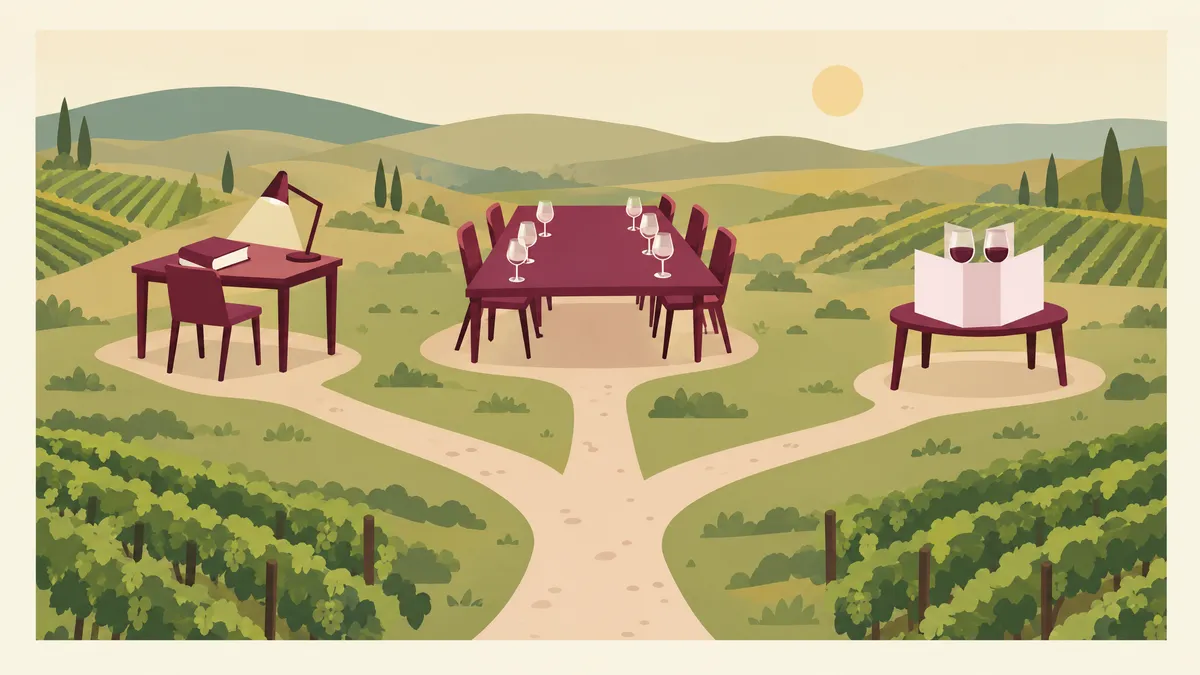
Pick the CSW to study alone with no tasting, WSET Level 2 for a guided first certificate, and WSET Level 3 to put blind tasting (judging wines with the label hidden) on your record. Fees are left out of the table because neither body prints one on these qualification pages.
| Detail | CSW | WSET Level 2 | WSET Level 3 |
|---|---|---|---|
| How you learn | Self-study from one study guide | 16 hours guided by a course provider, plus 11 hours private study | 30 hours guided, plus 54 hours private study |
| Entry | No prerequisites listed | No entry requirements | Level 2 recommended, not required |
| Exam | 100 multiple-choice questions, 1 hour | 50 multiple-choice questions, 1 hour, closed book | 50 multiple-choice questions and a short written paper |
| Tasting in the exam | None | None (the tasting method is taught in class) | Blind tasting of two wines |
| Where you sit it | Online or at a Pearson VUE centre | Set by your course provider | Set by your course provider |
| Pick it if | You study best alone and want proof of wide knowledge | You want a teacher and a first certificate | You want written answers and tasting on your record |
If an employer will want proof of tasting, pick WSET Level 3. A learner who wants a teacher belongs in a WSET course. A confident solo reader who may teach wine later fits the CSW. The full WSET ladder and the Court of Master Sommeliers are compared in wine certifications: WSET vs CMS.
What Does the CSW Exam Look Like?
One hour, 100 multiple-choice questions and a pass mark of 75%, taken online from home or in person at a Pearson VUE centre (an exam company with test rooms worldwide). The exam is multiple choice only. The name on your registration must match your government-issued ID.
A pass lets you write CSW after your name as a post-nominal (letters that signal a qualification). A registration stays good for one full year from the date of purchase, so you can buy it now and book the sitting later.

How Do You Study for the CSW?
From one book: the Society says CSW exam content is drawn exclusively from its study guide. Anything outside the guide will not be asked, so the guide is the syllabus. No course is required, and practice tests and classes are optional.
Pick the right study guide edition
The Society runs three editions at once, each tied to an exam window:
- 2026 edition: exams through December 30, 2028
- 2025 edition: exams through December 30, 2027
- 2024 edition: exams through December 30, 2026
If you plan to sit in 2027, buy the 2025 or 2026 edition; the 2024 window closes this December. The guide is sold as a hard copy on Amazon and as an eBook on Amazon and Apple Books. The Society also sells practice tests and quizzes for $24, with unlimited use for a year.

Taste what you read
The exam never pours a glass, yet tasting the grapes of each chapter makes the facts stick. A place name or an age term from the guide is easier to recall once it has been seen on a bottle. How to read a wine label covers the common ones.
Practice between chapters: Sommy
Sommy is the app we build: a wine learning app for iPhone with short lessons built on picture questions and quizzes. Choose a goal, such as passing a level 1 or level 2 wine exam, and it lays its courses out as one path. More than 20 courses cover the same ground of grapes, regions and tasting: Wine 101, regions from France to Chile and Argentina, styles, blind tasting and how wine is made.
Its guided tasting walks through look, smell and taste after a photo of the label, and saves the note to a tasting journal. Sommy suits practice between chapters. It is independent and not an official prep course, so the guide and the practice tests above remain the source of the exam's wording. Free to start on iPhone.
How Much Does the CSW Cost?
The Society's CSW page gives no exam fee; the price shows in the Society's Catalog+Store at the point of purchase. Figures on prep-school sites differ by membership, sale and year, so treat them as out of date until the store confirms them. Check the store on the day you plan to buy.
Your budget has three parts: the exam, the study guide and any optional practice tests or classes. If a prep school quotes one price, ask which of the three it includes. WSET has no single fee either: each WSET Level 2 course provider sets its own.
Is the CSW Hard?
It tests recall at speed: 100 questions in 60 minutes leaves 36 seconds for each, and passing takes 75 correct answers. Every question comes from the guide, so the work is covering all of it. That leaves room for 25 misses at most.
The Society's CSW page gives no study-hour figure. As a yardstick, WSET sets about 27 hours in total for Level 2 and 84 hours for WSET Level 3. If a timed practice test shows you under 75%, book the sitting only once you clear it with time to spare.
Who Should Take the CSW, and Who Should Skip It?
Take it for proof of wide wine knowledge earned alone, or as the first step to the Certified Wine Educator. Skip it if the goal needs tasting or service skills on the record, or if the only aim is to drink better at home.
- Pick the CSW if you sell or buy wine and want a credential you can earn at home, or if you aim for the Certified Wine Educator, for which the CSW is the prerequisite.
- Pick WSET Level 2 if you are new to wine study and want a teacher, a class and tasting practice in the room. Hours and formats are in online wine courses.
- Pick WSET Level 3 if a future employer will want proof that you can taste blind.
- Pick a service route if you want to work a restaurant floor; what a sommelier does explains that job.
- Skip exams altogether if you only want to choose better bottles; more first steps sit in the beginners and buying hub.
Tonight, decide the month you want to sit the exam, check which study guide edition's window covers it, and order that edition. Then open a wine from its first chapter and taste it before you read a page.
Sources
Frequently Asked Questions
How much does the Certified Specialist of Wine exam cost?
The Society of Wine Educators' CSW page does not state an exam fee. The current price appears in the Society's Catalog+Store when you buy the exam, and figures quoted on prep-school sites are often out of date or tied to membership and sales. Budget separately for the study guide, which is sold through Amazon and Apple Books, and for optional practice tests.
What is the CSW pass mark?
You need a score of 75% or better, which on a 100-question exam means 75 correct answers. That figure comes from the Society of Wine Educators' own CSW page. Passing lets you use the CSW letters after your name, and it is the prerequisite for the Society's more advanced Certified Wine Educator.
Is there a tasting part in the CSW exam?
No. The Society of Wine Educators lists the CSW exam as 100 multiple-choice questions in one hour, with no tasting component. That makes it a test of knowledge only. If you want a qualification that also marks your tasting, WSET Level 3 includes a blind tasting of two wines, and its study time is set at 84 hours.
Can you take the CSW exam online?
Yes. The Society of Wine Educators offers the CSW exam online or in person at Pearson VUE testing centres, and exams are available globally. Your name at registration must match your government-issued ID. A registration stays valid for one full year from the date of purchase, so you can buy it first and book the sitting when you are ready.
Do you need a course before the Certified Specialist of Wine?
No course is required, and the Society lists no prerequisites for the CSW. The route is the study guide plus the exam, since every question is drawn only from that guide. Practice tests and prep classes are optional extras. If you learn better with a teacher and a group, a WSET course with an approved provider suits you more.
Is CSW better than WSET Level 2?
Neither is better; they suit different learners. The CSW is self-study from one book, then 100 questions in an hour. WSET Level 2 is taught by a course provider, with 16 hours of guided learning, 11 hours of private study and a one-hour exam of 50 questions. Pick the CSW to work alone, WSET Level 2 to learn in a class.
Sommy Team
LinkedInFounder & Wine Educator
The Sommy Team is building the world's most approachable wine education app, helping beginners develop real tasting skills through structured courses and AI-guided practice.